
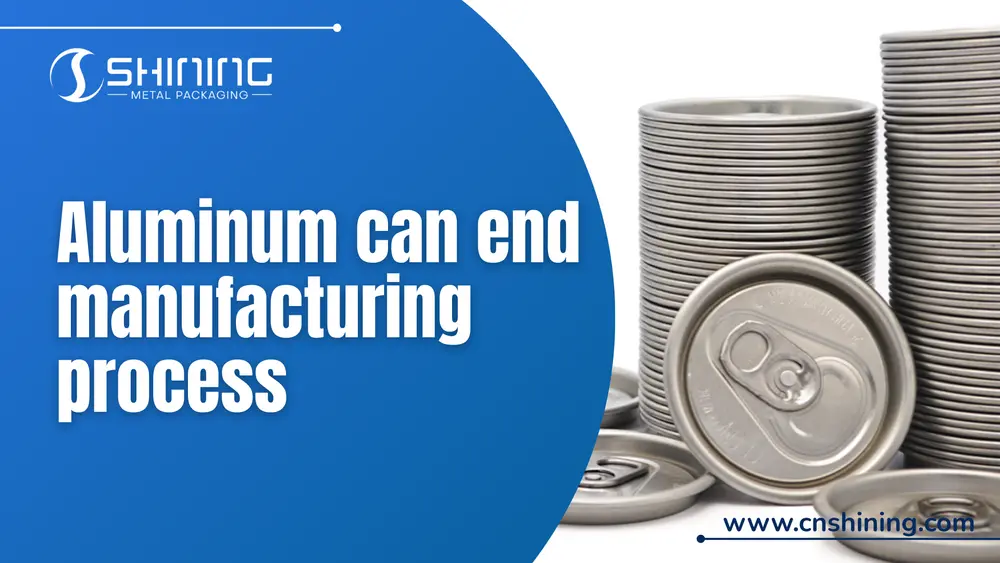
Beverage cans have two main parts: a drawn body and a separate metal end or “lid.” The can end must be strong enough to hold in a pressurized drink yet also easy to open. To achieve this, modern easy-open can ends are stamped from a high-strength aluminum alloy.
Raw Materials
In practice, ends use a 5xxx-series alloy (typically 5182) which contains about 4–5% magnesium. This high-magnesium alloy (in H48 temper) is harder and stronger than the body metal, making the flat lid thicker and more rigid. The manufacturing line turns coils of this alloy into finished can ends at high speed.
(Pull-tabs are made from a narrower aluminum strip—often alloy 5042 in H18 temper—fed separately to the tab-forming stage.) Food-grade lubricants are applied to the aluminum sheet before stamping to allow smooth metal flow and prevent sticking.
| Alloy | Temper | Composition | Mechanical properties | |||||||||
|---|---|---|---|---|---|---|---|---|---|---|---|---|
| Si | Fe | Cu | Mn | Mg | Cr | Rm | Rp0,2 | A | ||||
| % | MPa | % | ||||||||||
| Body | 3004 | H19 | min. | 0,00 | 0,00 | 0,00 | 1,00 | 0,80 | 0,00 | 290 | 270 | 2 |
| max. | 0,30 | 0,70 | 0,25 | 1,50 | 1,30 | 0,05 | 330 | 310 | 2 | |||
| 3104 | H19 | min. | 0,00 | 0,00 | 0,05 | 0,80 | 0,80 | 0,00 | 290 | 270 | 2 | |
| max. | 0,60 | 0,80 | 0,25 | 1,40 | 1,30 | 0,05 | 330 | 310 | 2 | |||
| Lid | 5182 | H48 | min. | 0,00 | 0,00 | 0,00 | 0,20 | 4,00 | 0,00 | 355 | 310 | 5 |
| max. | 0,20 | 0,35 | 0,15 | 0,50 | 5,00 | 0,10 | 400 | 350 | 5 | |||
| Tab | 5042 | H18 | min. | 0,00 | 0,00 | 0,00 | 0,20 | 3,00 | 0,00 | 330 | 300 | 3 |
| max. | 0,20 | 0,35 | 0,15 | 0,50 | 4,00 | 0,10 | 380 | 350 | 3 | |||
Manufacturing Process
1. Coil Uncoiling and Lubrication
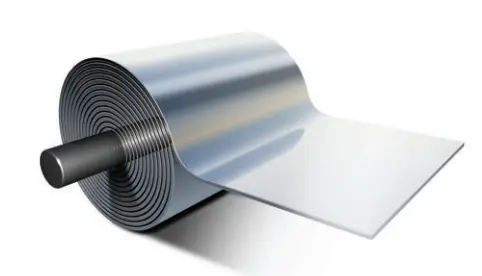
A large aluminum coil is placed on an uncoiler and the sheet is unwound into the production line. A thin film of food-grade oil is applied to the strip to aid forming. This prepares the sheet for the stamping process.
2. Blanking and Curling
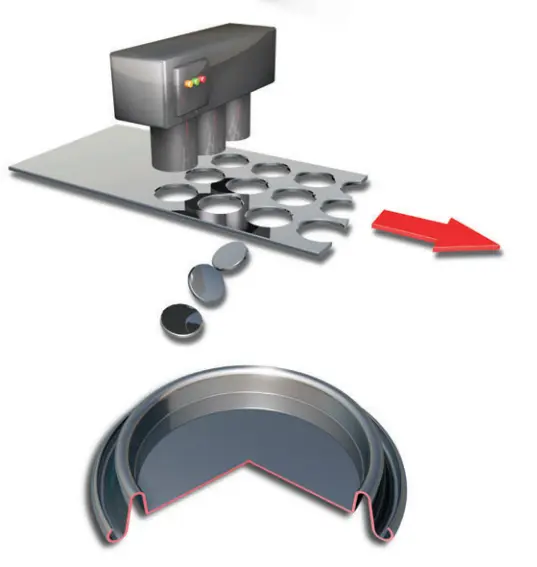
The lubricated strip enters a shell press that blanks and draws can-end shells. In one high-speed stroke, thousands of circular blanks are stamped out of the sheet. At the same time, a curler forms the outer flange: it rolls the edge of each blank into a precise curl. This curled flange will later be used to seam the lid onto the can body.
3. Liner Compound Application
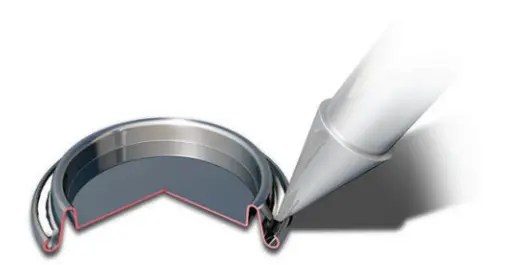
The freshly formed end shells now have a shallow cup shape with a curled rim. They pass through a lining (sealer) machine, which injects a very fine bead of sealing compound into the inside of the curl. This compound (usually a water-based polymer dispersion) will cure into a rubbery gasket.
4. Quality Inspection
After lining, the ends are 100% inspected by automated vision systems. High-speed cameras or light sensors scan each lid to catch any defects (scratches, dents, excess compound, etc.). Imperfect ends are rejected.
5. Scoring and Tab Attachment
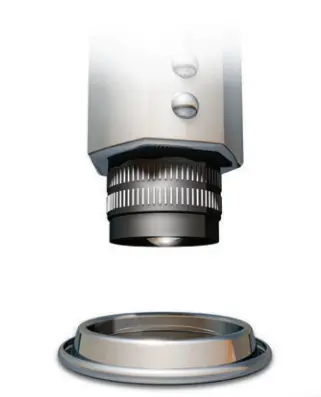
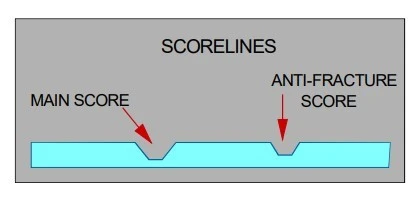
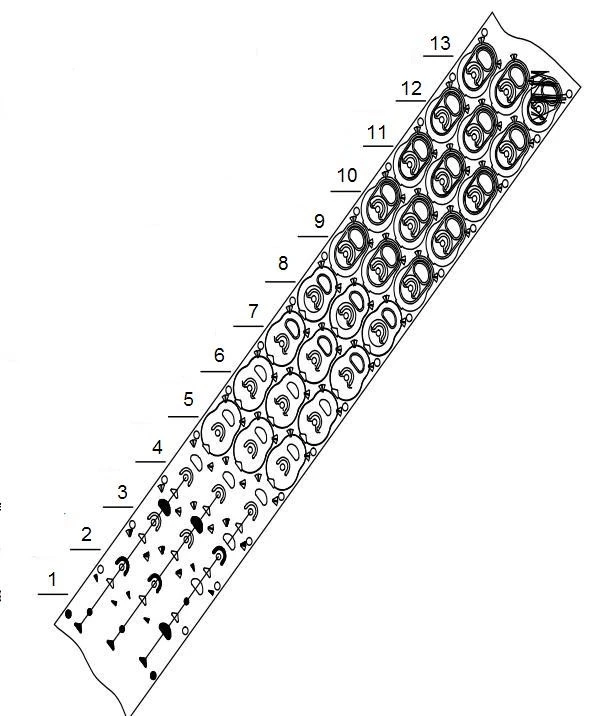
Next is the conversion press, which turns a plain shell into a functional easy-open end. First, the central panel may be embossed with stiffening beads. Then a hardened carbide tool scores the lid in a truncated-V pattern. This score is an extremely precise, shallow groove (residual thickness ~ tens of microns).
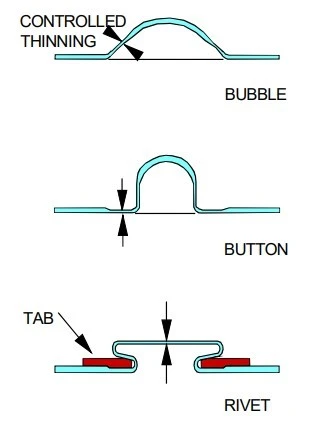
At the same time, the press forms the rivet from the lid itself, and a ready-made pull tab (from 5042 coil) is fed in and staked to create the mechanical hinge – the classic stay-on-tab design.
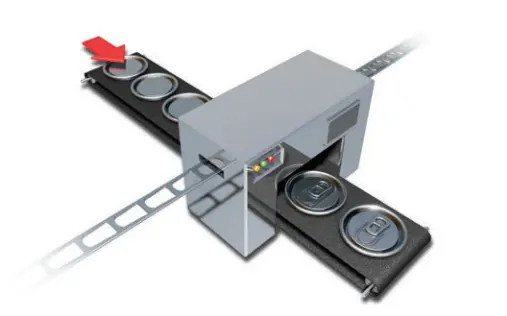
6. Leak Testing
With the tab attached, each end undergoes a leak check. Lids are held under pressure or passed under a fluorescent light in a special inspection unit. Any end with cracks or pinholes is rejected.
7. Final Packaging
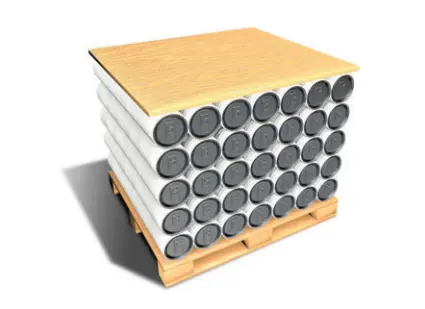
The finished ends are counted and stacked into standard “sticks” (e.g. 250 per stick). These sticks are sleeved and palletized for shipment to canning plants.
Summary
An aluminum can end begins as a coil of specialized 5182 alloy and is progressively transformed through blanking, curling, lining, scoring, tabbing, leak testing, and packaging. The process is highly automated and quality-driven—critical because a single faulty lid can compromise beverage safety and brand integrity.
Frequently Asked Questions
A: Modern stay-on-tab ends target 40–70 microns residual thickness depending on alloy, pressure class and opening force specification. Too thick → hard to open; too thin → risk of premature fracture during seaming or transport.
A: 5182 offers the best balance of formability before scoring and burst strength after conversion. Its higher Mg content provides ~30–40% more strength than 3004/3104 body alloys, allowing thinner yet pressure-resistant ends.
A: The top causes are over-scoring (residual < 35 μm → pop during pasteurization), under-scoring (excessive opening force → consumer complaints), and score tool wear leading to inconsistent depth across a coil.
A: Yes. Stay-on-tab (RRE) ends usually feature a single main score with secondary anti-fracture scores or beads. Full-panel tear-off ends typically have only one continuous score around the entire panel.
A: Extremely critical. Misplacement or insufficient volume in the curl channel causes seaming leaks. Most fillers require 100% vision confirmation of compound bead continuity and position.
A: Substitution is risky. 5042-H18 provides specific strength and bend fatigue resistance needed for reliable tab staking and lifting. Using incorrect temper/alloy can cause tab detachment or rivet pull-out failures.
A: Typical checks include: score residual (micrometer or microscope), pop & tear force (opening tester), compound placement/volume, curl geometry, tab pull-off strength, and visual defects (0–0.5% AQL common).
A: Common causes are damage during transit (dented curls), improper seaming chuck/roll settings, or compound degradation from long storage/high humidity before use.