
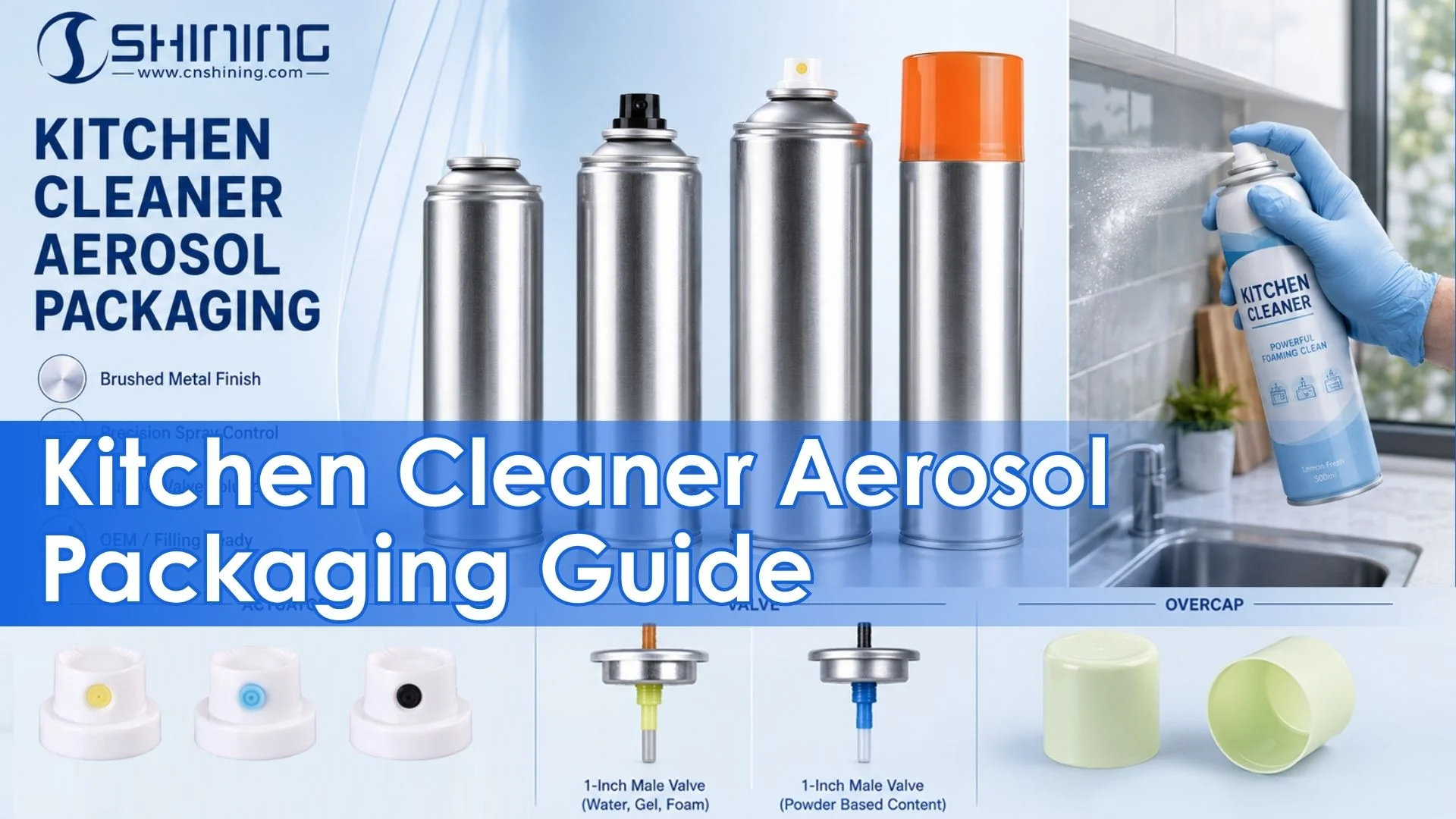
Kitchen cleaner aerosol spray, often sold as oven cleaner aerosol, grill cleaner foam, kitchen degreaser spray, or hard-surface kitchen cleaner, is not just a stronger chemical cleaner in a metal can. Its value comes from controlled spray output, vertical dwell time, corner access, and ready-to-use handling. In heavy-grease applications, the package is part of the cleaning system.
1. Product Definition and Cleaning Mechanism
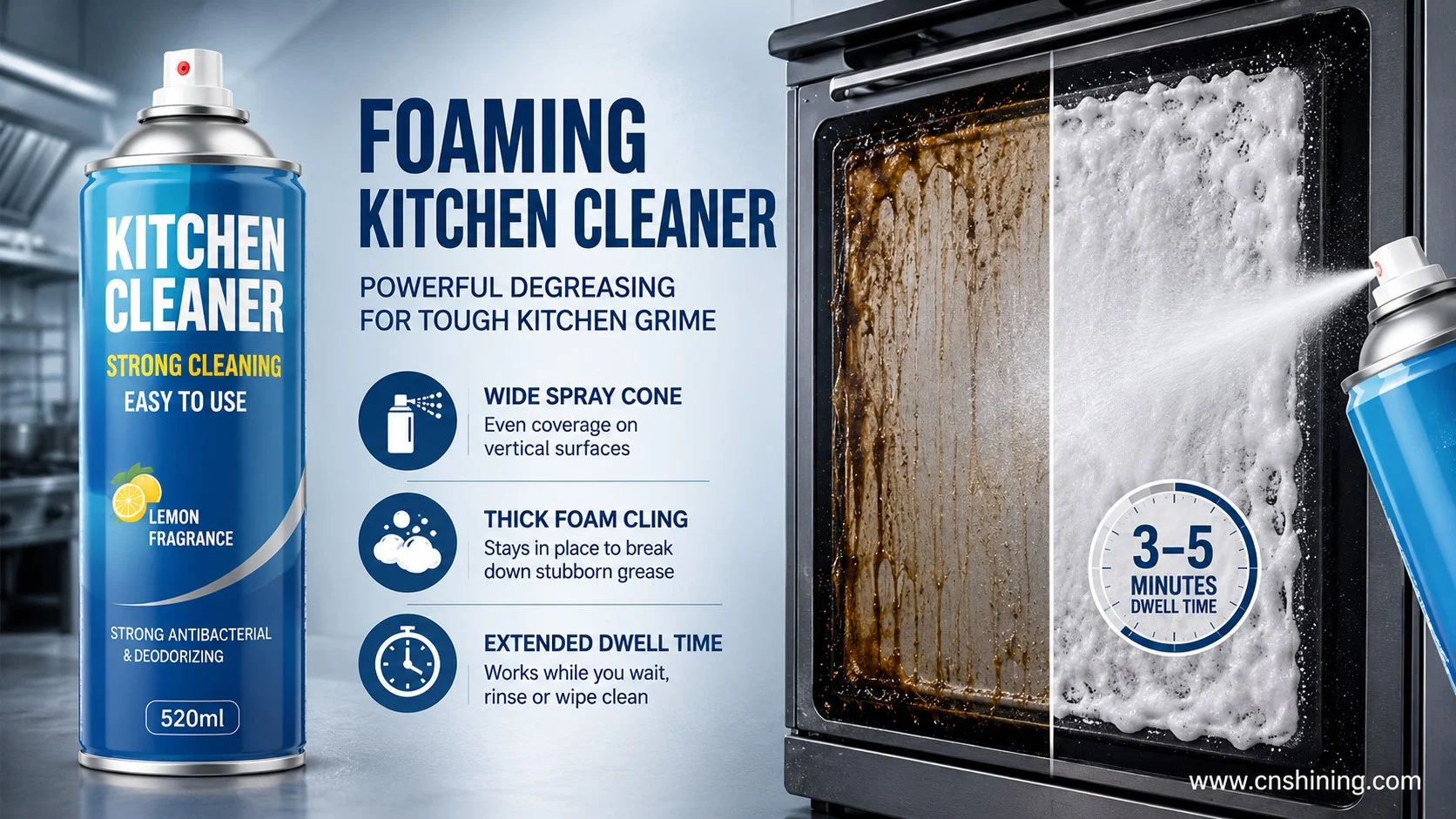
1.1 What is a kitchen cleaner aerosol spray?
In packaging and regulatory terms, an aerosol dispenser is a non-reusable container holding gas under pressure, fitted with a release device that ejects the product as particles, foam, paste, powder, or liquid stream. The EU Aerosol Dispenser Directive gives this technical definition and also describes the main parts: container, actuator, valve, propellant, and active product.
In the kitchen-cleaning category, the practical sub-segments are oven cleaner, grill cleaner, kitchen degreaser, hard-surface kitchen cleaner, appliance cleaner, and stainless-steel surface cleaner. The most typical format is a strong alkaline oven foam, but the category also includes milder low-odor sprays, wall-clinging degreasing foams, commercial kitchen aerosols, and low-VOC BOV or compressed-gas formats.
1.2 Chemical action is not one route
Heavy kitchen soil is usually a mixture of fat, baked oil, polymerized film, carbonized residue, sugar, protein, dust, and mineral contamination. No single mechanism removes all of it. Strong alkaline systems use sodium hydroxide or related alkaline components to saponify fats and loosen baked residues. Recent cleaning research on sodium hydroxide and film-like soils also treats cleaning as a shift between several detachment mechanisms, not as simple dissolution only. See the Springer paper on film-like soil cleaning with sodium hydroxide.
Surfactants reduce interfacial tension, wet the soil, emulsify loosened oil, suspend particles, and help prevent redeposition. The EPA Safer Choice ingredient criteria are useful for understanding how cleaning ingredients are evaluated by functional class.
Solvents such as glycol ethers or benzyl alcohol help soften and swell polymerized oil films. Foam builders, clays, waxes, and polymers help the product remain on vertical surfaces. The actuator, valve, nozzle geometry, gas-liquid ratio, and propellant system then decide whether the output feels like mist, jet, foam, or clinging gel.
1.3 Representative ingredient routes
| Ingredient Route | Representative Ingredients | Main Function | Typical Public Examples |
|---|---|---|---|
| Strong alkali | Sodium hydroxide | Saponifies fats and accelerates baked residue loosening | Heavy-duty oven cleaners, strong grill cleaners |
| Mild alkali / buffered alkali | Potassium carbonate, ethanolamine | Provides alkalinity with lower caustic perception, often used with solvents | Fume-free or lower-caustic oven cleaners |
| Glycol ether / aromatic alcohol solvent | Dipropylene glycol propyl ether, benzyl alcohol, methoxyisopropanol | Penetrates and softens heavy grease film | Degreaser aerosols and professional kitchen cleaners |
| Anionic / nonionic / amphoteric surfactants | Sodium lauroyl sarcosinate, SLES, CAPB, nonionic surfactants | Wetting, emulsification, suspension, soil removal | Daily kitchen spray and lower-alkali degreaser systems |
| Thickening and wall-cling system | Smectite clay, paraffin wax, acrylic copolymer | Improves foam or film hold-up on vertical surfaces | Foaming oven and grill cleaners |
| Propellant system | Butane, isobutane, propane, DME, compressed air, nitrogen | Pushes product out and defines spray texture, VOC load, odor, and pressure behavior | Conventional aerosols, BOV aerosols, compressed-gas aerosols |
Ingredient disclosure varies by country and by SKU. One brand may sell a strong alkaline line, a lower-caustic line, and a professional line with different formulations.
1.4 Why BOV and compressed gas matter
Traditional aerosols commonly use liquefied hydrocarbon propellants or DME. Bag-on-valve and compressed-gas systems separate the product from the propellant or reduce liquefied gas dependence. Shining Packaging describes Bag-on-Valve aerosol technology as a route for product-propellant separation, 360-degree dispensing, high evacuation, and non-VOC propulsion. For kitchen cleaners, that matters when the brief asks for lower odor, lower VOC pressure, and stable foam delivery.
2. Comparison With Non-Aerosol Formats and Formulation Map
2.1 Aerosol is not better in every use case
Aerosol spray has a clear advantage on oven walls, grill grates, hood corners, narrow gaps, and heavy grease where foam dwell matters. It is less attractive for visible remaining volume, refillability, simplified transport, fragrance control, and child access risk. Daily countertop cleaning often works better with trigger spray, foam pump, wet wipes, concentrate, or tablets.
| Dimension | Aerosol Spray | Trigger Spray | Non-Aerosol Foam | Wet Wipes | Concentrate / Tablet |
|---|---|---|---|---|---|
| Heavy grease / baked residue | Strong, especially oven and grill | Medium to strong | Medium to strong | Weak to medium | Depends on dilution |
| Vertical wall cling | Strong, especially foam | Medium | Strong | Not applicable | Weak to medium |
| Corner and gap reach | Strong | Medium | Medium | Weak | Medium |
| Remaining dose visibility | Weak | Strong | Strong | Strong | Strong |
| Ready-to-use convenience | Strong | Strong | Strong | Very strong | Weak; requires water |
| Transport and regulation complexity | High; pressure and possible dangerous goods | Low | Low | Low | Lowest |
| Odor / VOC pressure | Medium to high | Low to medium | Low to medium | Low to medium | Low |
| Typical fit | Oven, grill, hood, heavy grease | Daily stovetop and countertop | Bathroom and kitchen soil needing dwell time | Light daily wiping | Routine multi-surface cleaning |
The conclusion from field experience is direct: aerosol is valuable when the job needs grease attack, wall cling, and directional reach. If the user only needs daily surface wiping, aerosol adds cost and regulatory burden without solving a real problem.
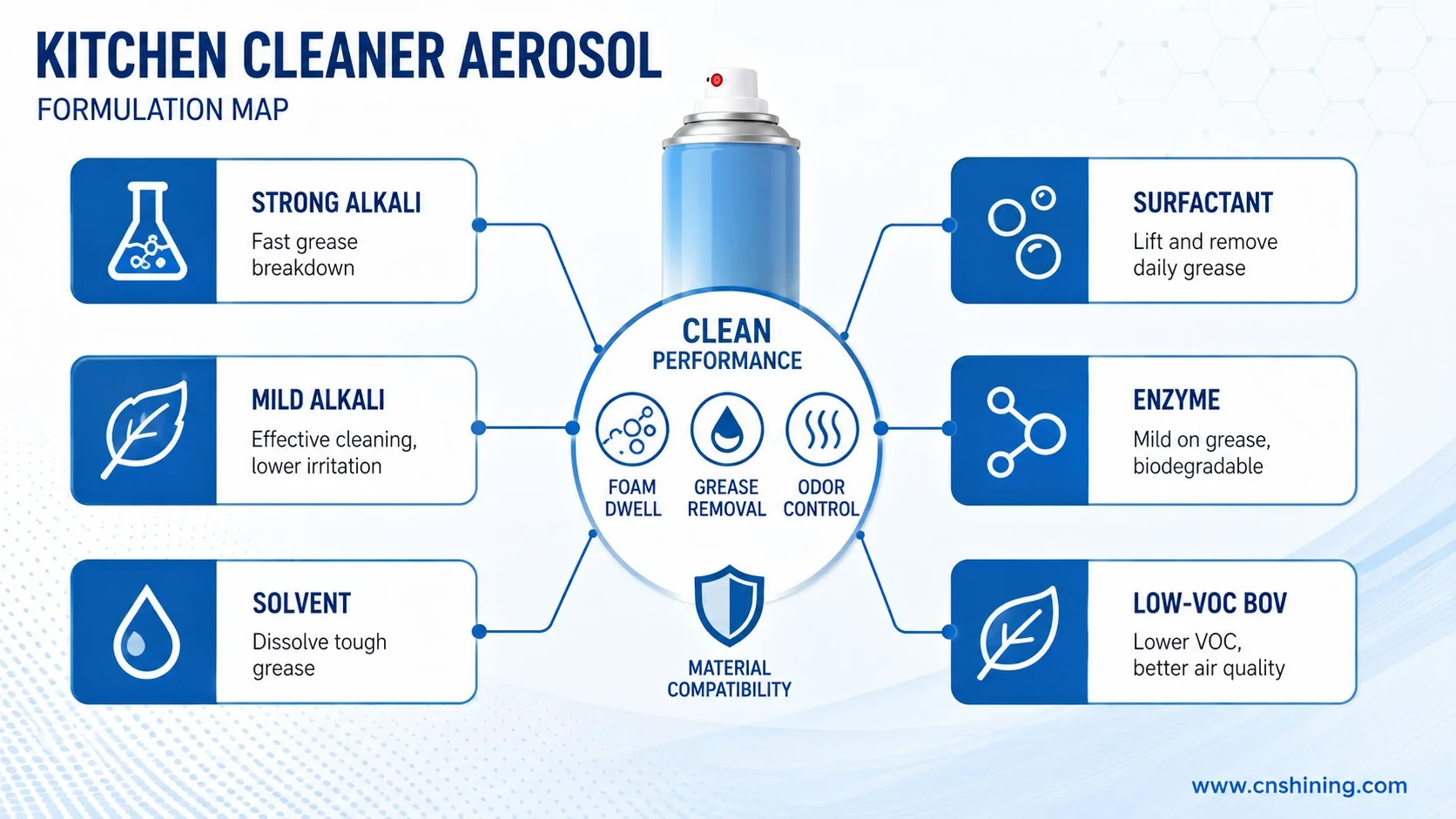
2.2 Typical formulation windows
| Formula Type | Core Function | Typical Engineering Window | Main Risk |
|---|---|---|---|
| Strong alkaline oven foam | Fast breakdown of baked grease | Alkali 1–10%; co-solvent / amine 1–8%; surfactant 0.2–3%; wall-cling system 0.5–5%; propellant 2–15% | Aluminum, coating, hot surface, skin and eye risks |
| Low-caustic alkaline | Balance between cleaning and irritation perception | Carbonate / amine 1–8%; glycol ether / benzyl alcohol 3–15%; surfactant 0.2–3%; propellant 2–12% | Lower odor does not mean no irritation |
| Solvent-reinforced degreaser | Penetrates polymerized oil film | Solvent 5–25%; surfactant 1–5%; weak alkali 0–2%; propellant set by pressure design | VOC and material compatibility constraints |
| Surfactant-led daily kitchen cleaner | Stovetop, countertop, light-to-medium grease | Surfactant 1–10%; chelant 0–3%; low solvent 0–5% | Limited action on black carbonized soil |
| Enzyme / bio-based route | Milder story for biological soil and grease | Enzyme ppm–0.5% range with surfactant, stabilizer and preservative system | Stability, shelf life and cost |
| Acid descaler | Mineral scale, water stains, soap scum | Organic or inorganic acid 1–15% | Not the main route for heavy kitchen grease; metal and stone compatibility risks |
| Low-VOC / BOV / compressed gas | Lower propellant VOC and lower odor perception | High water phase with low or no liquefied propellant; BOV can support high evacuation | Higher cost and filling-line changes |
2.3 Working glossary
| Term | Meaning | Commercial Meaning |
|---|---|---|
| VOC | Volatile organic compound | Affects regulation, odor, indoor air and formula route |
| BOV | Bag-on-Valve system | Supports low-VOC, 360-degree dispensing and high evacuation |
| Propellant | Gas system pushing product out | Controls spray feel, pressure, dangerous-goods status and odor |
| Actuator | Button or spray head | Controls spray pattern, pressing force and clogging probability |
| Valve | Metering and sealing component | Controls flow, sealing, continuous output or metered output |
| Dip tube | Tube drawing product from can bottom | Affects output stability for viscous products |
| Evacuation rate | How much product can be dispensed | Affects user perception of waste |
| Dwell time | Time the cleaner remains on the surface | Directly linked to soil removal and wall cling |
| Saponification | Alkaline reaction with fats | One core mechanism for greasy soil cleaning |
| UN 1950 | Common transport classification for aerosols | Affects air, sea, road transport and warehousing |
3. Regulatory and Compliance Points
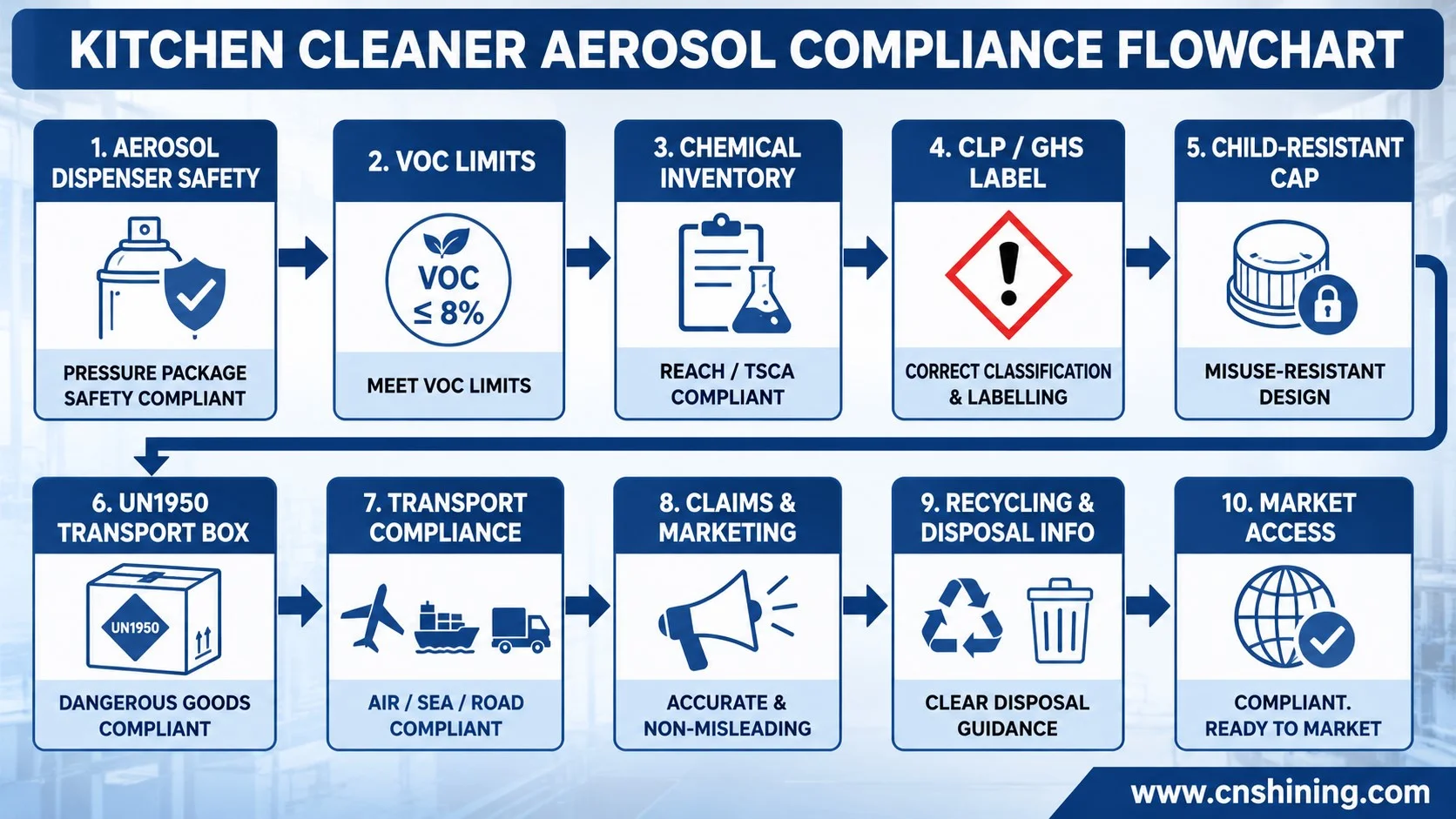
Kitchen cleaner aerosol compliance is not only a formula question. The formula, can, valve, actuator, label, transport route, and marketing claim must fit together. A strong alkaline oven foam may pass cleaning tests but still fail on label claims, VOC limits, corrosion compatibility, dangerous-goods shipping, or child-resistant expectations.
3.1 Europe
The European route commonly touches four layers: aerosol dispenser safety, chemical classification and labelling, REACH substance controls, and detergent content disclosure. ECHA’s CLP overview explains the classification and labelling system, while ECHA’s detergent content labelling page gives context for detergent ingredient disclosure. If a product claims disinfection, a biocidal route may also be triggered.
3.2 United States
At the federal level, ingredient legality starts with the EPA TSCA Chemical Substance Inventory. Being on the inventory is not a safety endorsement. It only answers whether the substance is treated as existing in U.S. commerce under TSCA.
California VOC rules are especially relevant. The CARB standard listed in 17 CCR §94509 includes an 8% VOC standard for aerosol or pump-spray oven or grill cleaner. This strongly influences solvent and propellant choices for U.S. market versions.
For household products with strong alkaline chemistry, child-resistant or misuse-resistant design should be considered early. The CPSC Poison Prevention Packaging Act page is a useful entry point for special packaging obligations.
3.3 Transport and restricted ingredients
Aerosols often fall into dangerous-goods control. Air transport follows the ICAO Technical Instructions framework, with route-specific packaging, documentation and quantity limits. For e-commerce, the practical problem is not only whether the product can ship. It is whether each route is documented and tested.
Some heavy-solvent routes face increasing regulatory and brand risk. EPA’s rulemaking on methylene chloride restrictions is not written only for kitchen cleaners, but it signals why high-toxicity solvent strategies are becoming harder to justify in consumer products.
| Compliance Topic | Question to Ask | Direct Business Impact |
|---|---|---|
| Aerosol container safety | Does the container meet pressure-package requirements? | Market access and transport qualification |
| Chemical legality | Are ingredients allowed under TSCA, REACH and local restrictions? | Formula availability and supplier documentation |
| VOC / GWP | Does the product meet California and other regional limits? | U.S. SKU strategy and propellant choice |
| Label and warnings | Is the mixture classified and labelled correctly? | Retail acceptance and recall risk |
| Detergent disclosure | Are required ingredient ranges disclosed? | EU transparency and customer-service burden |
| Biocidal claim | Does the copy imply disinfection? | Claim boundary and authorization route |
| Child-resistant design | Is misuse protection needed for household use? | Safety, liability and user trust |
| Dangerous-goods shipping | Are air, road, sea and postal routes handled separately? | Cross-border cost and returns handling |
| Recycling and disposal | Can consumers understand empty-can and residue rules? | Sustainability claims and post-use experience |
4. Top Brands and Product Lines
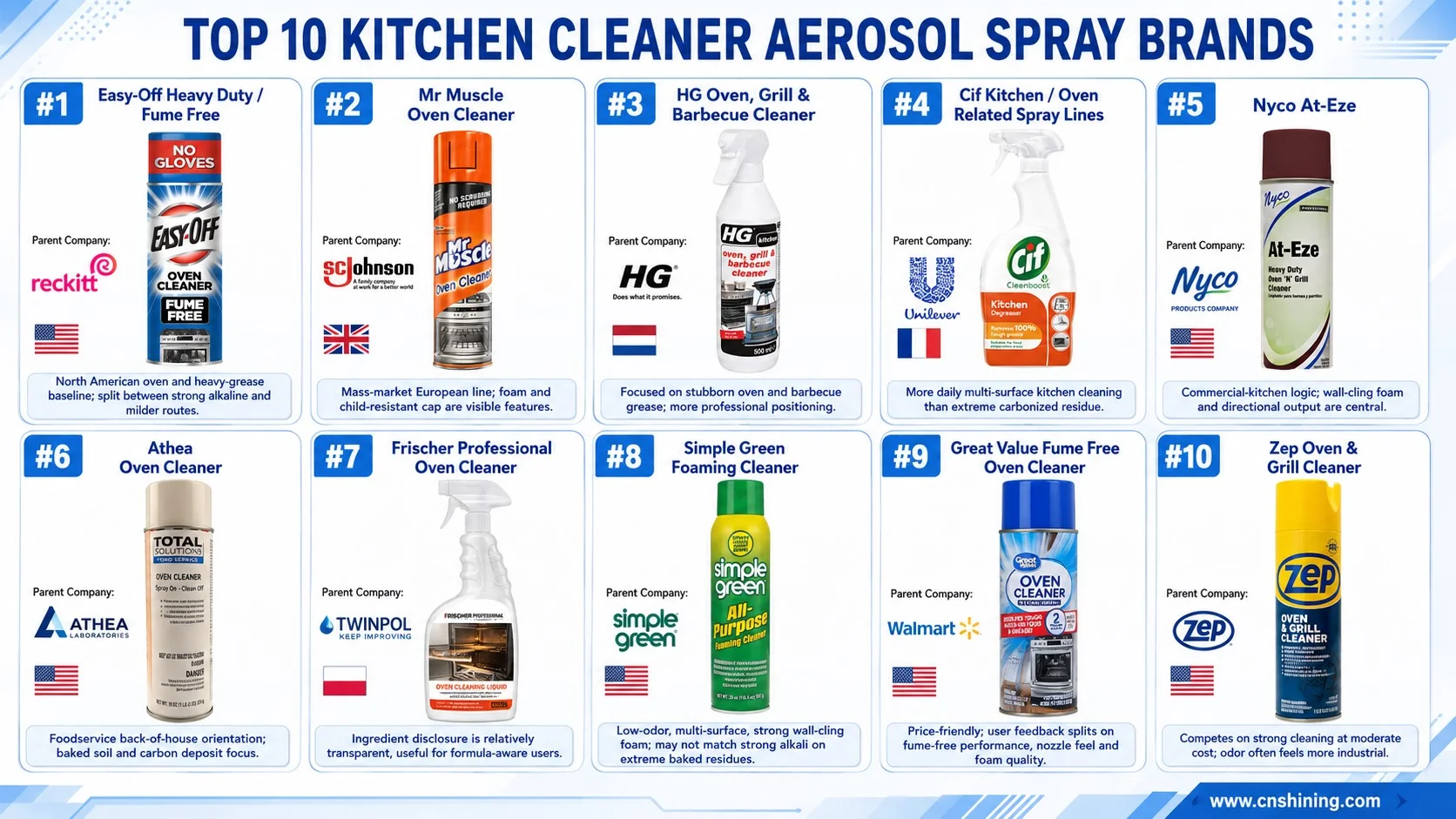
The following table is kept as a separate brand benchmark section. Prices are rough public retail observations from the source report period and vary by region, tax, promotion, platform and pack size. The purpose is technical positioning, not retail quotation.
| Brand / Product Line | Main Market | Owner / Operator | Common Size | Observed Price Band | One-Line Technical Comment |
|---|---|---|---|---|---|
| Easy-Off Heavy Duty / Fume Free | United States | Reckitt | 14.5 oz / 24 oz | about $5-$8 per can, common | North American oven and heavy-grease baseline; split between strong alkaline and milder routes |
| Mr Muscle Oven Cleaner | UK | S.C. Johnson | Often 300–500 mL aerosol cans | about $4-$8, estimated | Mass-market European line; foam and child-resistant cap are visible features |
| HG Oven, Grill & Barbecue Cleaner | Netherlands | HG brand system | 500 mL | about $8-$13, estimated | Focused on stubborn oven and barbecue grease; more professional positioning |
| Cif Kitchen / Oven Related Spray Lines | France | Unilever | Commonly 435–700 mL | about $4-$7, estimated | More daily multi-surface kitchen cleaning than extreme carbonized residue |
| Nyco At-Eze | U.S. commercial | Nyco Products | 18 oz | about $8-$14, estimated | Commercial-kitchen logic; wall-cling foam and directional output are central |
| Athea Oven Cleaner | U.S. commercial | Athea Laboratories | 20oz | about $8-$15, estimated | Foodservice back-of-house orientation; baked soil and carbon deposit focus |
| Frischer Professional Oven Cleaner | Poland | Twinpol | 500 mL | about $6-$11, estimated | Ingredient disclosure is relatively transparent, useful for formula-aware users |
| Simple Green Foaming Cleaner | United States | Simple Green brand system | 20 oz | about $8-$13, estimated | Low-odor, multi-surface, strong wall-cling foam; may not match strong alkali on extreme baked residues |
| Great Value Fume Free Oven Cleaner | United States | Walmart private label | 16 oz | about $3-$5 | Price-friendly; user feedback splits on “fume free,” nozzle feel and foam quality |
| Zep Oven & Grill Cleaner | United States | Zep brand system | About 19 oz, common | about $5-$8, estimated | Competes on strong cleaning at moderate cost; odor often feels more industrial |
5. User Pain Points and Packaging Engineering Response
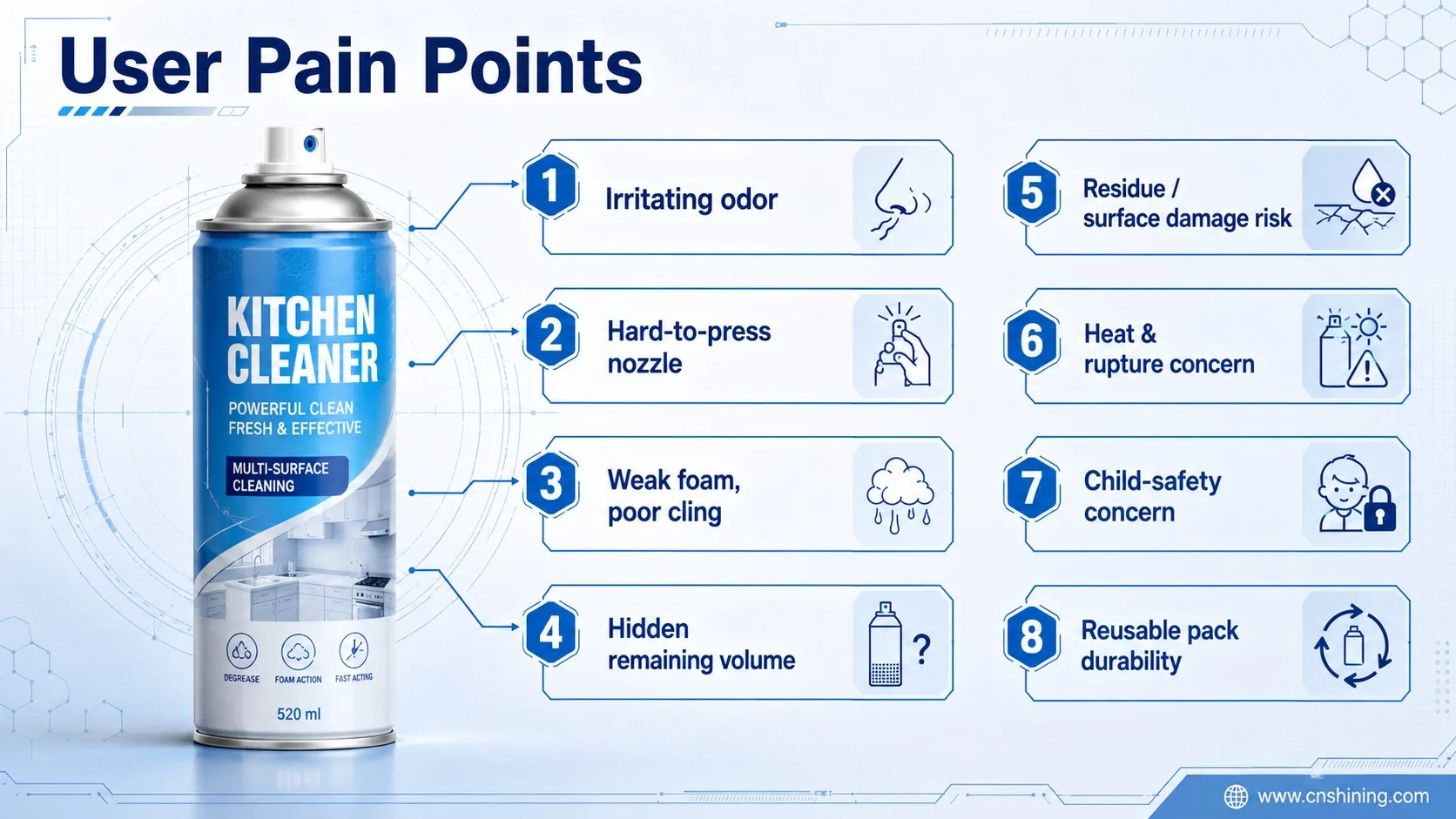
User complaints cluster around odor, actuator force, unstable foam, residue, material compatibility, accidental triggering, heat storage, and child safety. Many of these look like formula issues at first. In practice, the valve-actuator-output interface often decides whether the formula feels controlled or irritating.
| User Pain Point | Evidence Pattern in Source Report | Packaging / Structure Response | Priority |
|---|---|---|---|
| “Fume free” still smells irritating | Public user reviews and discussions report odor and residual smell even in fume-free products | Use BOV or compressed-gas route; reduce propellant odor; tune spray rate; strengthen ventilation and rinse label guidance | High |
| Nozzle is hard to press | Users report difficulty holding the nozzle down during continuous spraying | Lower actuation force; enlarge finger pad; improve thumb or index-finger ergonomics | High |
| Foam does not build or wall-cling | Users report thin output, poor foam and repeated spraying | Match valve, nozzle and gas-liquid ratio; separate spray and foam actuator designs; improve anti-clog features | High |
| Remaining volume cannot be seen | Some users prefer trigger packs because they can see remaining liquid | Use metered valve, smaller multipack sizes, or alternative visible-body structures where feasible | Medium |
| Residue or surface damage concern | Concerns appear after contact with enamel, coating, aluminum or heating elements | Narrow-angle actuator; stronger pictogram warnings for aluminum, coated surfaces and heating elements | High |
| Heat storage and can rupture fear | Complaint communities include kitchen aerosol rupture cases | Clear temperature label; twist lock; e-commerce drop and heat logistics validation | High |
| Child access and accidental triggering | Child-resistant caps are already visible in some oven cleaner designs | Child-resistant overcap, rotating lock actuator, audible click feedback, anti-press transport structure | High |
| Reusable pack or pump durability | Reusable alternatives can fail through cracked bottles or stopped pumps | Validate resin compatibility, pump life, seal aging and spare-part availability | Medium |
Twist-to-lock and capless lock systems are not cosmetic details. Shining Packaging’s twist-to-lock actuator is an example of the design direction: reduce accidental actuation while keeping the user action simple and visible.
6. Packaging Components for Kitchen Cleaner Aerosol Spray: Shining Packaging Fit
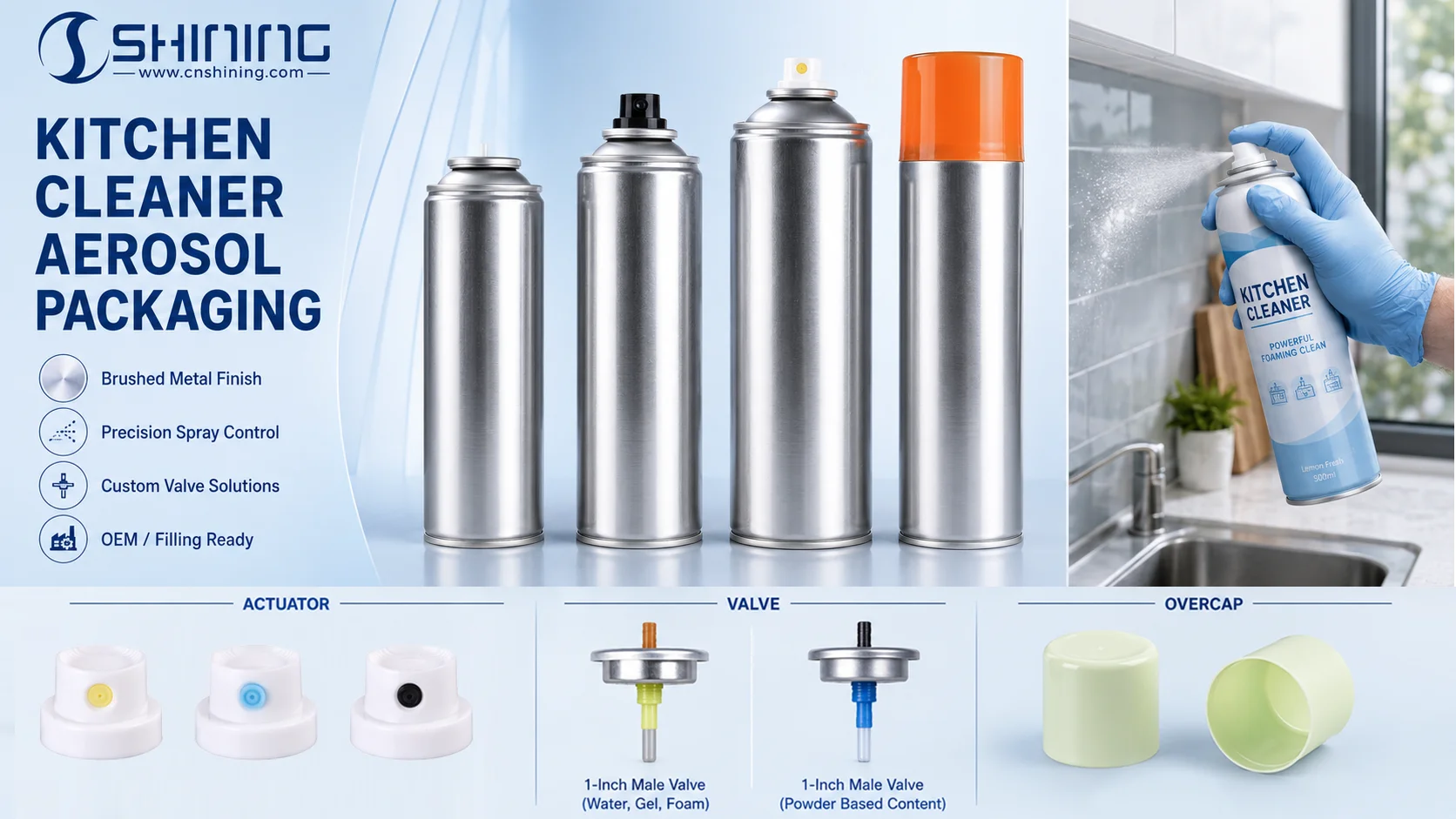
For kitchen cleaner aerosol spray, the package should be selected from the cleaning task backward. A strong oven foam needs stable wall-cling output, corrosion-compatible internal coating, reliable valve sealing and an actuator that users can press without fatigue. A daily kitchen degreaser may need a finer spray and lower flow. A BOV or compressed-gas version may require a different can, valve and filling route.
In this context, Shining Packaging’s relevant work sits around aerosol cans, actuators and valves. The actuator affects spray angle, foam texture, hand force and accidental triggering. The valve controls flow rate, sealing and output stability. The can and internal coating must tolerate alkaline or solvent stress over shelf life. These parts should not be chosen after the formula is finished. They should be tested with the formula from the first pilot batch.
For kitchen cleaner applications, the useful engineering questions are plain: Does the foam stay on the oven wall? Can the user cover a grill grate without finger fatigue? Does the valve remain tight after storage? Does the actuator survive e-commerce compression? Does the internal coating resist high pH or glycol ether exposure? If the answer is not measured, it is not yet a package specification.
7. Conclusion
Kitchen cleaner aerosol spray is a specialized package-format solution for heavy grease, baked residues and vertical surfaces. Its market is not huge, but the use case is stable. The strongest engineering lever is the interface between formula and packaging: actuator force, valve flow, foam quality, can compatibility, VOC route and safety closure. A good product in this category is not only “effective.” It sprays predictably, stays where it is needed, ships safely, and tells the user clearly where not to use it.
8. FAQ: Kitchen Cleaner Aerosol Spray
Kitchen cleaner aerosol spray uses pressure, valve control and actuator geometry to deliver mist, foam or a directed stream. The main difference is not only convenience. Aerosol foam can reach corners and hold on vertical oven or grill surfaces longer than many trigger sprays. That dwell time helps alkaline, solvent and surfactant systems work before wiping starts.
Baked kitchen grease contains fats, oxidized oil films and carbonized residues. Strong alkaline ingredients such as sodium hydroxide can saponify fats and loosen part of the baked organic film. This route is effective, but it raises risks for skin, eyes, aluminum, coated surfaces and hot equipment. Clear material warnings are not optional in practice.
Foam quality controls dwell time, coverage and user dosing. A thin foam runs off oven walls too quickly, wasting cleaner and increasing repeat spraying. Stable foam depends on formula viscosity, surfactant balance, propellant ratio, valve flow and actuator design. Poor foam can come from packaging mismatch even when the chemical cleaner itself is active.
No. “Fume free” usually means the product is designed to reduce harsh fumes compared with stronger caustic or solvent systems. It does not guarantee zero odor, zero vapor or zero irritation. Ventilation, rinsing, waiting before heating and avoiding misuse on unsuitable surfaces still matter, especially with alkaline or solvent-containing kitchen cleaners.
BOV means Bag-on-Valve. The product sits inside a flexible bag, while compressed gas outside the bag pushes it out through the valve. This separates product from propellant, can support 360-degree dispensing and can reduce VOC pressure when air or nitrogen is used. It is useful for low-odor or high-evacuation cleaner formats.
The actuator is the part the user feels directly. If pressing force is high, the finger pad is small, or the spray pattern is unstable, users call the product difficult even when cleaning performance is acceptable. For heavy oven cleaning, continuous spraying can last longer than a quick deodorant spray, so ergonomics matter more.
Many strong alkaline oven cleaners are not suitable for aluminum, some coatings, self-cleaning oven surfaces, heating elements or hot equipment. The risk is surface attack, discoloration, coating damage or residue problems. A technical label should state prohibited materials with pictograms and simple words because many failures come from misapplication, not normal use.
VOC limits influence solvent choice, propellant system and product architecture. In markets such as California, oven or grill cleaner VOC standards can push developers toward lower solvent load, water-based systems, compressed gas, BOV or more efficient foam delivery. The target is not just compliance. Lower VOC can also reduce odor perception indoors.
Test the real formula against can coating, gasket, valve cup, stem, dip tube and actuator resin. High pH, glycol ether solvents, fragrance and surfactants can affect swelling, corrosion, leakage or clogging over time. Storage temperature, inversion use, drop testing and e-commerce compression should be included if the product will ship directly to consumers.
It is better described as a high-scene-value niche. The source estimate places the 2025 global retail market around US$0.45bn, with a reasonable range of US$0.35bn–0.60bn. Growth comes from low-VOC systems, BOV, better actuators, stronger safety design and Asia Pacific demand, not from replacing all kitchen cleaning formats.