
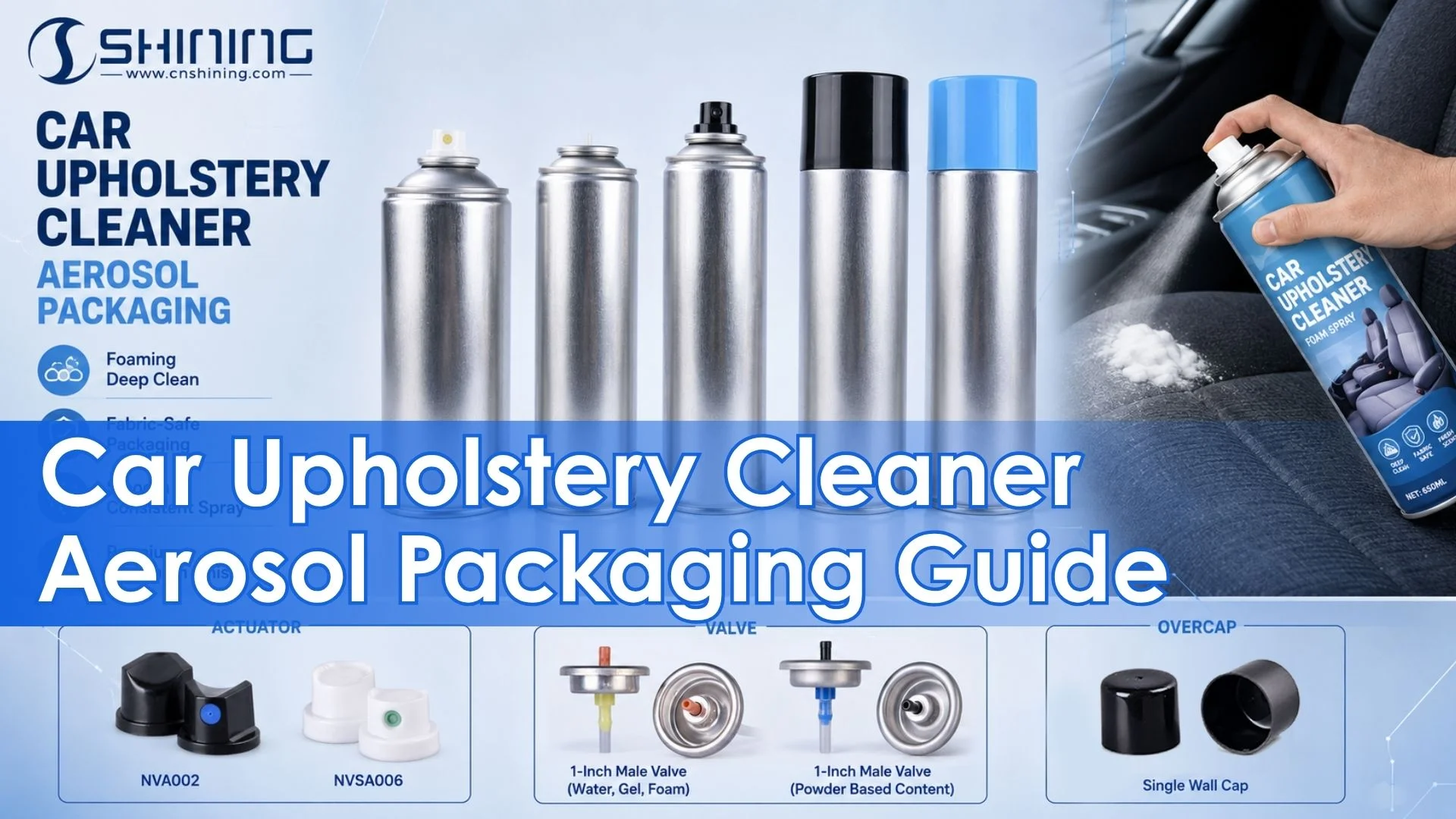
1. Product Boundary and Cleaning Mechanism
A car upholstery aerosol cleaner is not the same product as a leather conditioner or dashboard gloss spray. Its working area is fabric, carpet, headliner, door-panel textile, suede-like microfiber and Alcantara-type surfaces. In the market it may also be called an aerosol foam cleaner, interior fabric cleaner, carpet aerosol cleaner, upholstery spot cleaner or automotive fabric foam spray.
The useful question is simple: does the cleaner remove visible soil without leaving odor, tackiness, white marks or overwetting? For this product class, formulation strength alone does not decide the result. The cleaner depends on a chain: surfactant system, solvent balance, foam stability, propellant or compressed gas, valve output, actuator geometry, can coating and user instructions.
A car upholstery aerosol cleaner is a pressurized product that releases liquid cleaner as foam or spray. The target surfaces are fabric seats, carpet, headliner, textile inserts, door-panel cloth and Alcantara-like surfaces. Products focused only on leather gloss or plastic trim protection sit outside the core sample.
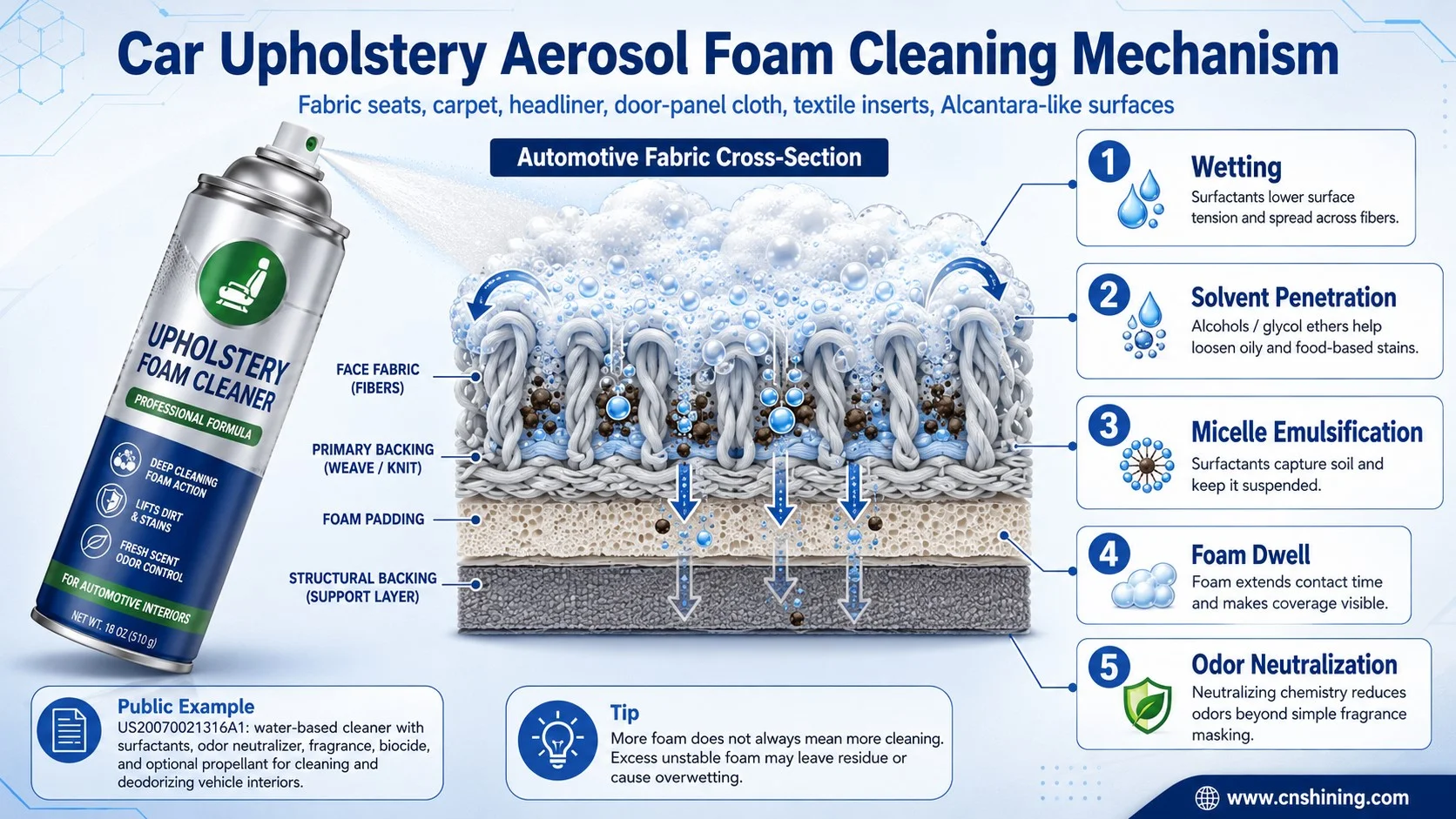
The cleaning mechanism can be broken into five layers. First, surfactants reduce interfacial tension, allowing the liquid phase to wet fibers. Second, small amounts of alcohols, glycol ethers, citrus solvent or hydrocarbons can improve penetration into oil, beverage stains, shoe polish and food soil. Third, nonionic, anionic or amphoteric surfactants emulsify and suspend soil so it does not redeposit. Fourth, foam provides dwell time and visual control. Fifth, odor control may use neutralizing chemistry instead of only fragrance masking.
The patent US20070021316A1 cleaner composition is a useful public example. It describes a water-based cleaner containing surfactants, sodium source, odor neutralizer, fragrance and biocide, with a betaine compound, aminoalcohol, polyol and ionone in the odor-neutralizing system. The document also describes a spray dispenser and optional propellant for cleaning and deodorizing automobile interiors.
Technical Terms
| Term | Plain Meaning | Commercial Relevance |
|---|---|---|
| Surfactant | Lowers surface tension and supports wetting, emulsification and cleaning. | Controls foaming, soil removal, residue and material compatibility. |
| Hydrotrope | Helps surfactants, fragrance and solvent remain dispersed in water. | Affects clarity, low-temperature stability and shelf behavior. |
| APG | Alkyl polyglucoside, a mild nonionic surfactant often described as bio-based. | Supports “mild” or lower-irritation positioning when the whole formula allows it. |
| VOC | Volatile organic compound. | Impacts regulation, odor, flammability, propellant choice and market access. |
| Propellant | Liquefied gas or compressed gas that expels the product. | Controls spray form, pressure, transport class and cost. |
| BOV | Bag-on-valve system separating product from propellant. | Supports low VOC, cleaner dispensing and formula isolation, with higher cost. |
| Re-soiling | Residue attracts dust after cleaning. | A common cause of user complaints and weaker repeat purchase. |
| Internal lacquer | Can internal coating that reduces corrosion and reaction. | Affects leakage, rust, valve blockage and shelf life. |
| UN1950 | Dangerous goods transport classification for aerosols. | Affects air freight, sea freight, warehouse and e-commerce fulfillment. |
2. Formulation Classes and Similar Product Comparison
| Class | Typical Components | Main Mechanism | Advantage | Main Risk |
|---|---|---|---|---|
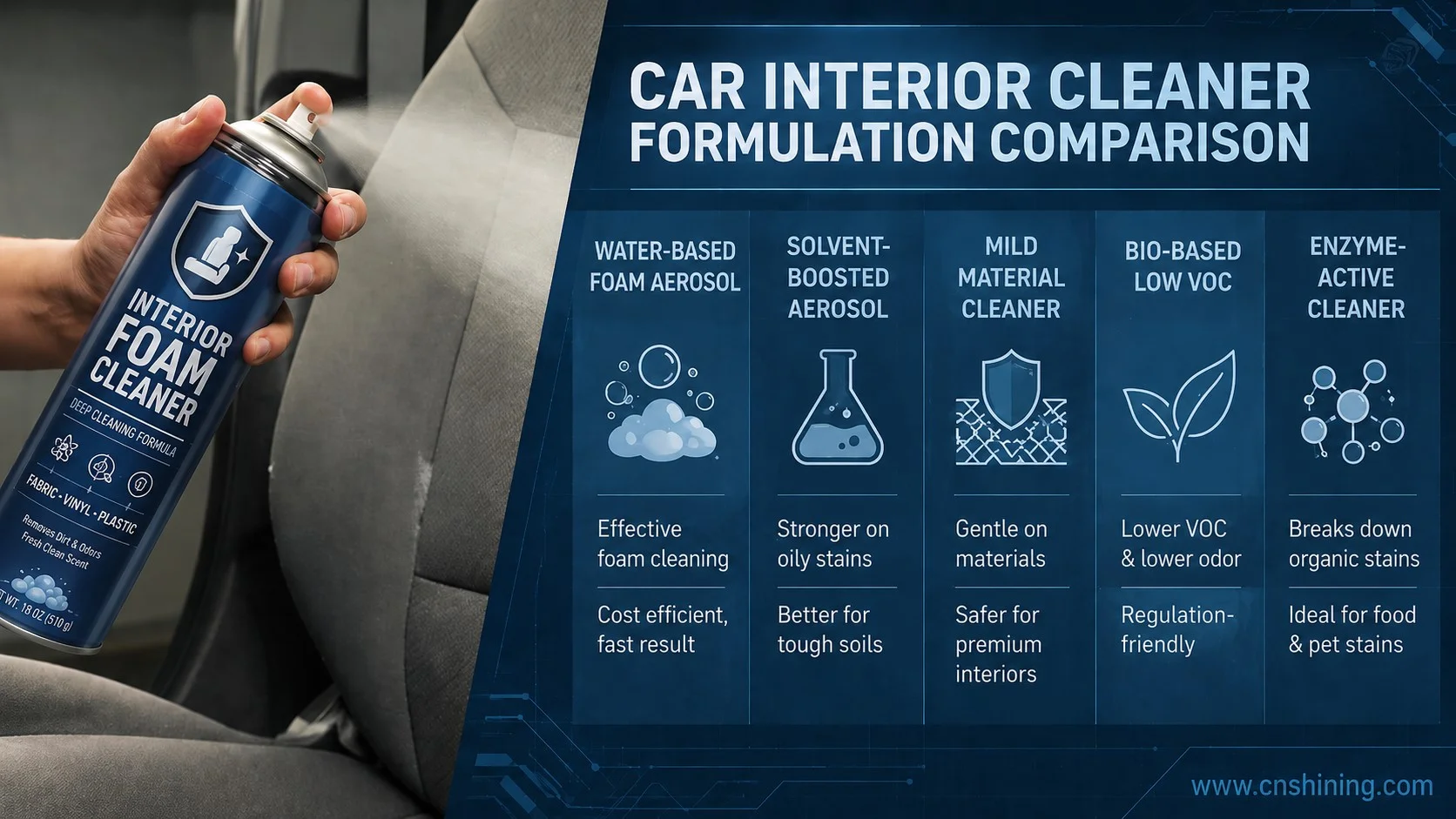
| Traditional water-based foam | Water, nonionic/anionic surfactants, small cosolvent, alkali source, fragrance, propellant. | Wetting, emulsification, foam dwell and wiping removal. | Cost controlled, familiar, fast visual effect. | Flammable propellant, odor and residue complaints. |
| Solvent-boosted cleaner | Water plus alcohol, glycol ether, hydrocarbon or citrus solvent with surfactants. | Improved oil and mixed stain penetration. | Better on oily stains, shoe marks and beverage/food mixtures. | Higher VOC, stronger odor and higher compatibility risk. |
| Mild material-specific cleaner | Milder surfactants, lower solvent load, material-friendly design. | Lower-damage cleaning and texture recovery. | Better fit for Alcantara-like and premium interior materials. | May be weaker on heavy oil soil. |
| Bio-based / low VOC route | Bio-based surfactants, lower-VOC solvents, compressed air or nitrogen. | Lower odor and lower VOC while retaining surface activity. | Regulation-friendly and easier to explain to users. | Higher formula and packaging cost. |
| Enzyme / bioactive route | Protease, amylase or lipase in water-based systems. | Breakdown of protein, starch or fat soil. | Theoretical benefit for food, milk and pet-related stains. | Harder stability in pH, oxygen, water activity, storage and propellant systems. |
Enzyme and bio-based systems are real directions, but they are not yet the typical mass-market hydrocarbon aerosol route. Enzymes are sensitive to pH, temperature, oxygen and package conditions. They are often easier to manage in trigger sprays or isolated systems such as BOV. Public innovation work on bio-based surfactants, such as US20220089983A1 bio-based surfactants, shows the direction, but scale-up still has to pass cost and stability checks.
| Cleaning Scheme | Cleaning Depth | Spot Convenience | Drying Speed | Cost Per Use | Typical Use |
|---|---|---|---|---|---|
| Aerosol foam / spray | Medium to high | Very high | Fast to medium | Low to medium | DIY spot cleaning, odor quick fix, visible stain rescue. |
| Trigger spray | Medium to high | High | Medium | Low | DIY cleaning with easier low-VOC and refill routes. |
| Dry powder / low-water system | Medium | Medium | Fast | Medium | Low-moisture use where overwetting must be avoided. |
| Steam / wet extraction | High | Low | Slow to medium | High equipment cost | Deep cleaning, used car refresh, odor source removal. |
| Professional multi-step detailing | Highest | Lowest | Process-dependent | Highest | Heavy contamination and full interior restoration. |
Aerosol foam is strong when the problem is local and visible. Deep odor reservoirs, soaked cushion layers and old contamination still need extraction, water removal and drying discipline. This is why many brands position aerosol cleaners as spot rescue or first-step treatment rather than a full substitute for professional deep cleaning.
3. Regulations and Testing Control Points
| Market / Topic | Rule or System | Direct Impact |
|---|---|---|
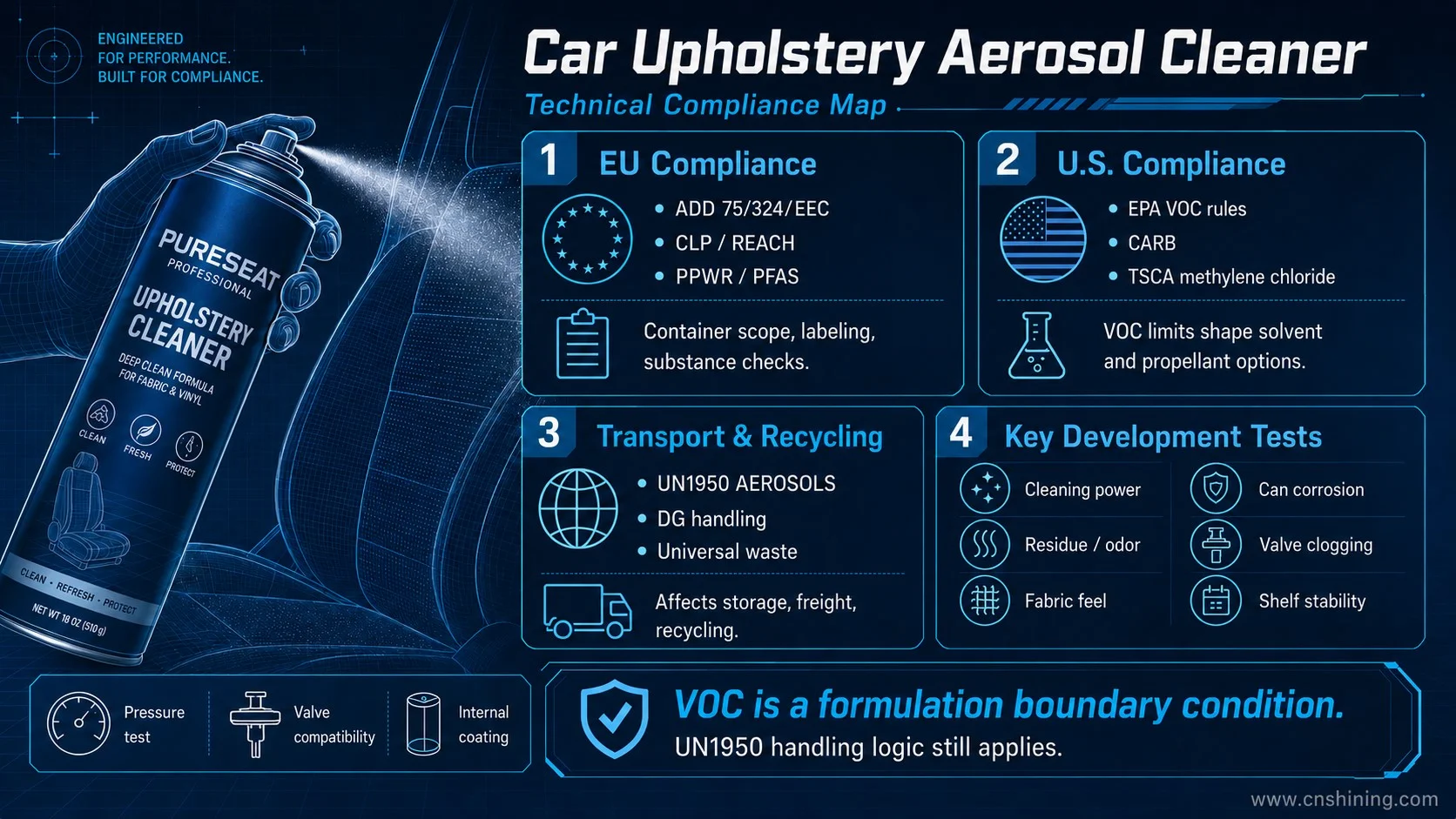
| European Union | Aerosol Dispensers Directive 75/324/EEC | Controls aerosol container scope, pressure framework, testing and labeling basis. |
| European Union | CLP and REACH | Drive hazard classification, labeling, SDS and restricted-substance checks. |
| European Union | PFAS and PPWR pressure | Raises expectations for chemical transparency, recyclability and packaging identification. |
| United States | EPA 40 CFR Part 59 Subpart C and state VOC rules | Limits solvent and propellant choices in consumer product categories. |
| California | CARB Consumer Products Regulations | Often acts as a high-standard VOC reference for U.S. consumer products. |
| United States | TSCA methylene chloride rule | Pushes consumer cleaning products away from methylene chloride risk. |
| Transport | UN1950 AEROSOLS transport framework | Affects storage, ocean freight, air freight and e-commerce fulfillment. |
| Waste / recycling | EPA aerosol cans as universal waste rule | Clarifies hazardous aerosol can collection and recycling pathways. |
VOC is a boundary condition, not a label slogan. It influences whether a formulation can keep certain hydrocarbon, ether or DME/LPG combinations. Dangerous goods status also remains. A cleaner may look like a simple retail product, but a pressurized aerosol generally still enters the UN1950 handling logic.
Testing should cover more than stain removal. A mature development plan checks cleaning power, residue, odor, color change, fabric hand feel, valve clogging, can corrosion, propellant compatibility, internal lacquer compatibility and shelf stability. The test logic may reference pressure methods, carpet cleaning methods and stain-release methods, including ASTM and textile evaluation approaches.
4. Top Brand Samples and User Pain Points
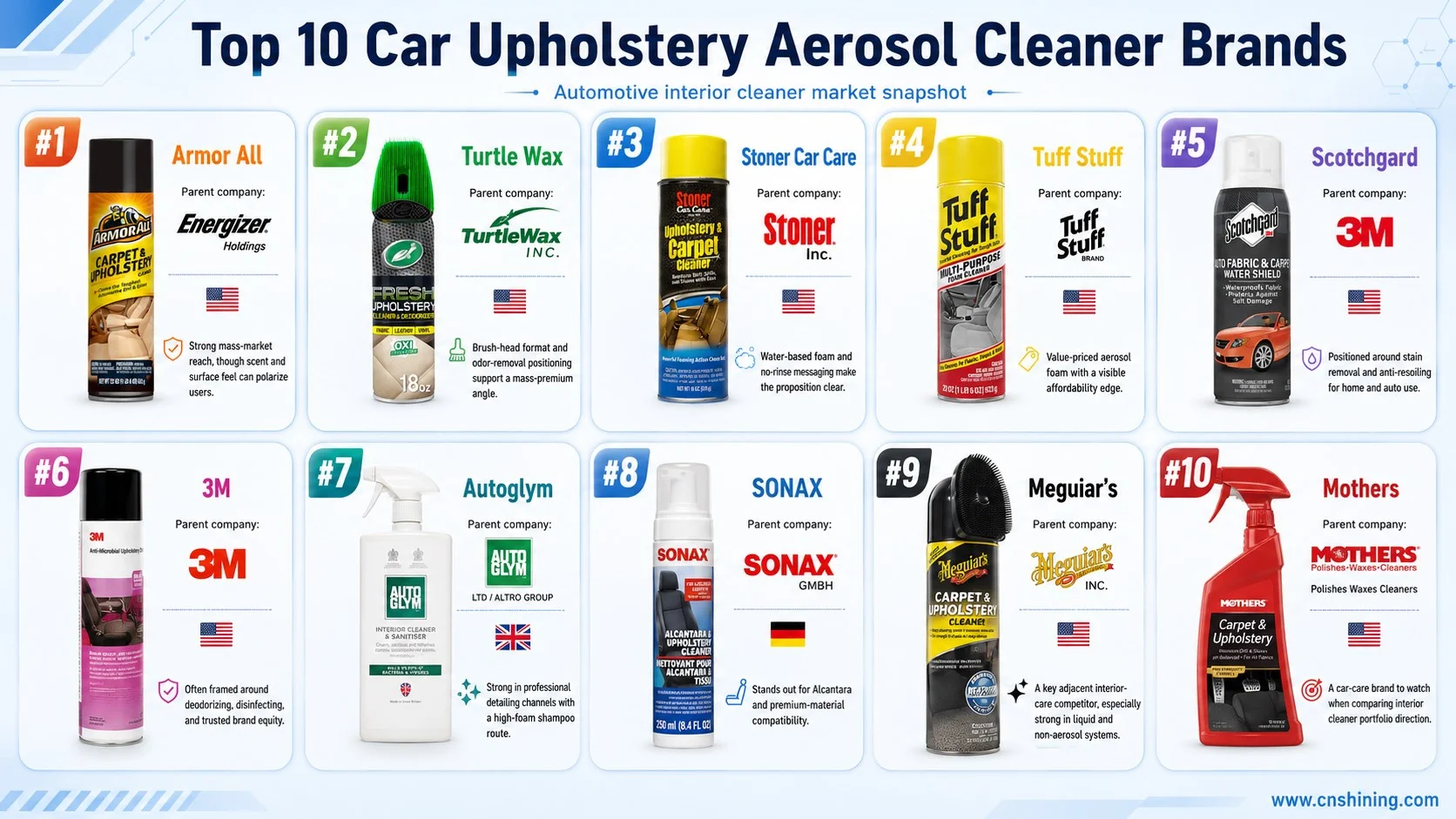
Top Brand Reference Table
| Brand | Country | Operator / Parent | Common Capacity | Typical Price Range | Technical Reading |
|---|---|---|---|---|---|
| Armor All | United States | Energizer Holdings brand | 22 oz | about $8.80 per can by multi-pack allocation | Mass channel strength; odor and surface feel can divide users. |
| Turtle Wax | United States | Turtle Wax, Inc. | 18–22 oz | about $13.99–$16.13 | Brush-head and odor-removal positioning; mass premium direction. |
| Stoner Car Care | United States | Stoner Inc. | 18 oz | about $9.99 | Clear water-based, foam-action and no-rinse narrative. |
| Tuff Stuff | United States | Tuff Stuff brand | 22 oz | about $4.54 | Value-positioned aerosol foam with visible price advantage. |
| Scotchgard | United States | 3M | 14–17 oz | about $5.69–$17.98 | Stain removal plus anti-resoiling position across home and automotive use. |
| 3M | United States | 3M | 420 ml | about $8.98 | Often sold with deodorizing, disinfecting or brand-trust framing. |
| Autoglym | United Kingdom | Autoglym Ltd / Altro Group | 450–500 ml | about $16.10–$18.10 | Professional detailing channel strength and high-foam interior shampoo route. |
| SONAX | Germany | SONAX GmbH | 250 ml / 8.45 oz | about $19.99–$39.48 | Alcantara and premium material compatibility is its clearer differentiation. |
| Meguiar’s | United States | Meguiar’s Inc. | 19 oz | about $6.99 | Important adjacent interior-care competitor, often stronger in liquid and non-aerosol systems. |
| Mothers | United States | Mothers Polishes Waxes Cleaners | 24 fl. oz. / 710 mL | about $11.99 | Adjacent car care brand to watch when comparing interior cleaner portfolio direction. |
User complaints point to a practical truth: buyers are not only buying cleaning power. They are buying predictability. Common problems include heavy chemical smell, strong fragrance residue, tacky or slick feel, weak foam, nozzle or brush trouble, slow drying, damp odor return, headliner marks, fragile material risk and unclear use instructions.
| User Pain Point | Technical Interpretation |
|---|---|
| Chemical or fragrance odor | Odor-removal claims can fail when fragrance or propellant note stays in the closed cabin. |
| Sticky, slick or dusty surface after cleaning | Residue from surfactant, foam stabilizer or overapplication can cause re-soiling. |
| Cleaning effect varies | Soil type, dwell time, brushing energy, fabric construction and wipe-off method all change results. |
| Nozzle or brush trouble | Valve, actuator, foam structure and brush ergonomics are package engineering issues, not only formula issues. |
| Overwetting and damp odor | Excess dose or poor ventilation can leave water in cushion layers or headliner fabric. |
| Headliner and delicate material risk | Adhesive-backed or laminated materials can show marks, sagging or edge damage if over-wetted. |
5. Packaging Improvement and Development Direction
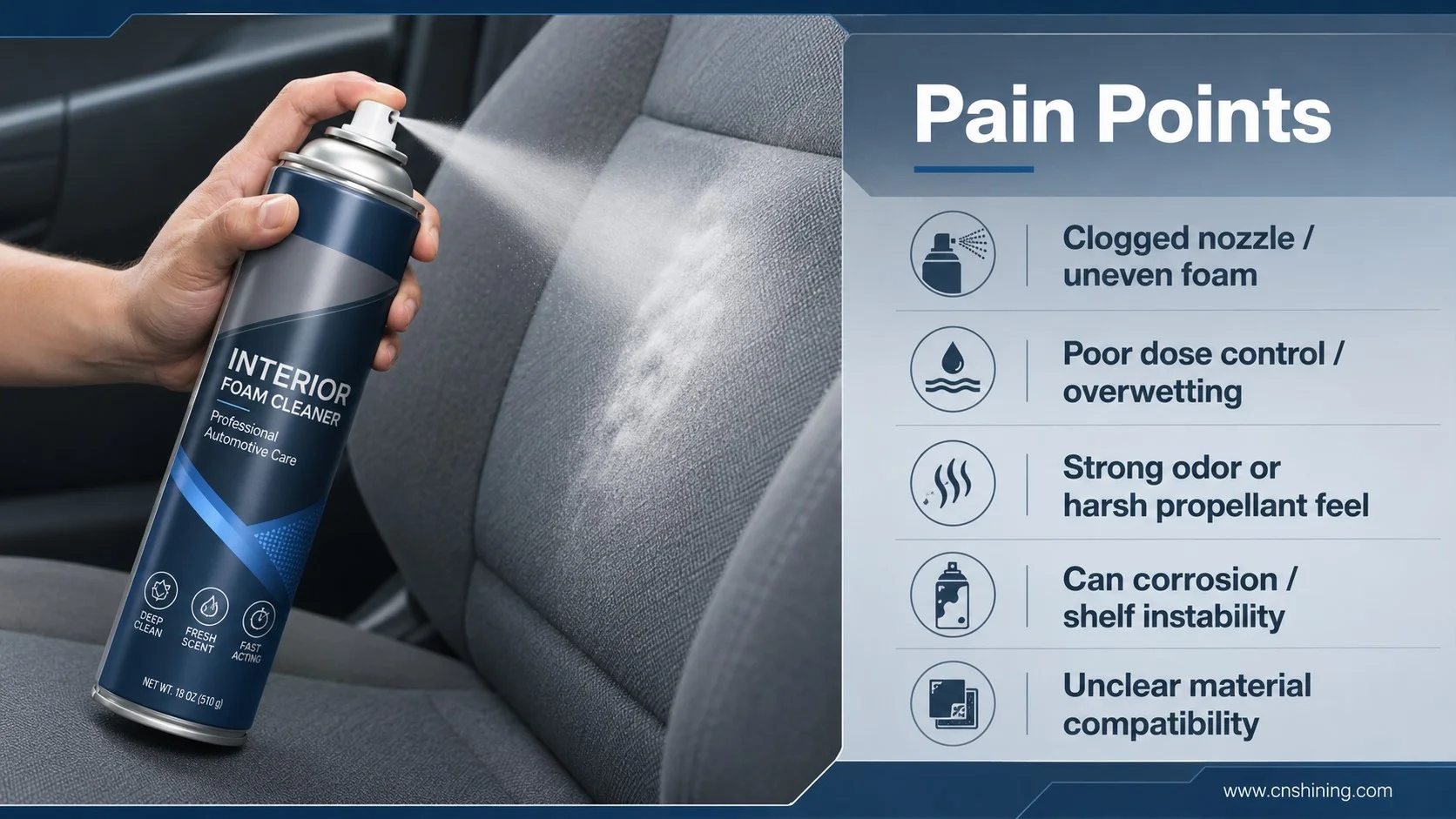
| Pain Point | Packaging Improvement | Expected Gain | Implementation Difficulty |
|---|---|---|---|
| Nozzle clogging or inconsistent foam | Match valve and actuator to foam rheology; add anti-misfire cap. | Lower complaint rate and better first-use success. | Medium; requires compatibility and drop testing. |
| Uncontrolled dose and local overwetting | Use lower-output actuator and narrower spray pattern. | Less residue, faster drying and lower headliner risk. | Medium; needs consumer use testing. |
| Strong propellant feel or odor | Move premium lines toward compressed air, nitrogen or BOV. | Lower VOC direction and cleaner dispensing perception. | Higher cost and filling process change. |
| Can corrosion or shelf instability | Validate formula, propellant, can body, internal lacquer and valve together. | Lower leakage, rust, valve blockage and returns. | Development time increases. |
| Misuse and unclear material scope | Front-label icons for suitable and unsuitable materials, dwell time and drying method. | Fewer user errors and fewer social-media complaints. | Low; mostly label and claims discipline. |
The realistic path is staged. Basic products should first fix actuator, brush, cap and instruction clarity. Mid-level products can reduce output, residue and odor while improving internal coating compatibility. Higher-end products can adopt compressed gas, BOV, stronger material validation and clearer claims for Alcantara, headliner and light-colored fabrics.
6. Product Fit: Shining Packaging Actuators, Cans and Valves
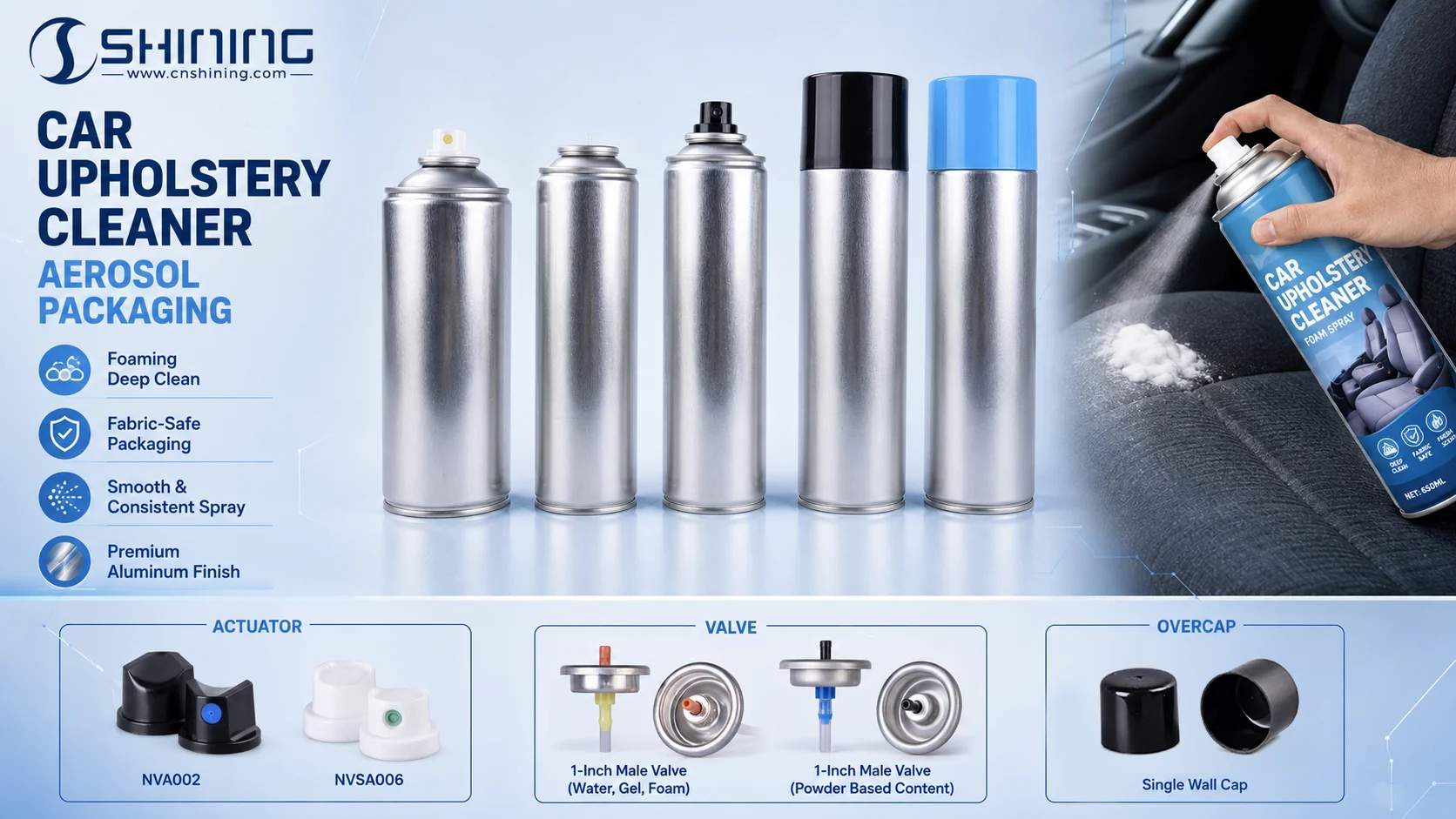
For this application, Shining Packaging’s role is practical packaging hardware: aerosol cans, valves, actuators and compatible caps. The formulation decides wetting, emulsification and odor control. The package decides whether that formulation leaves the can as a controlled foam, a wet spray, a sputtering jet or an over-dose that soaks the fabric.
A car upholstery aerosol cleaner needs stable pressure behavior, clean valve recovery, suitable foam break, controlled output per second and a can coating that tolerates the water-based cleaner, surfactants, fragrance, alkali source and propellant. For headliner or Alcantara-type positioning, a lower-output actuator can be more useful than a high-volume foam plume. Why push more liquid into a delicate fabric than the stain needs?
7. Technical Conclusion
Car upholstery aerosol cleaner is a small but technically dense category. The proxy market is growing, but the harder question is how it grows under VOC limits, transport rules, recycling pressure and higher user expectations. The next improvement is not simply “stronger cleaning.” It is less residue, less odor and less uncertainty.
A better product tells the user where it can be used, how much to spray, how long to wait, when to brush, when to wipe, when to ventilate and when to use extraction instead. On the engineering side, it links formula, valve, actuator, can body and internal coating from the first test batch. That is where this category becomes more predictable.
8. FAQ: Car Upholstery Aerosol Cleaner
A car upholstery aerosol cleaner is designed for fabric, carpet, headliner and textile inserts, not mainly for leather gloss or plastic shine. Its work depends on surfactant wetting, soil emulsification, foam dwell and controlled wipe-off. The aerosol package adds pressure, spray pattern and foam behavior, which directly affect dose, drying and residue.
Foam gives dwell time and visual control. It helps the user see where the cleaner has landed and slows liquid runoff on vertical or textured surfaces. Foam should not be judged only by volume. Dense but controllable foam is usually more useful than large unstable foam, especially on headliners or delicate laminated interior materials.
Residue can come from surfactant level, foam stabilizer, fragrance carrier, overapplication or incomplete wipe-off. When residue remains on fibers, it may attract dust and cause re-soiling. This is why low-residue formulation and dose-controlled actuators matter. User instructions should also state wiping, vacuuming, ventilation and drying time clearly.
No. Solvents can improve removal of oily stains, shoe marks and mixed food soils, but they also increase VOC pressure, odor and material compatibility risk. A stronger solvent system may be wrong for delicate fabrics, Alcantara-like surfaces or headliners. The better choice depends on soil type, material structure and drying limits.
Enzymes can help break down protein, starch or fat stains, but they are sensitive to pH, water activity, oxygen, storage temperature and package chemistry. Traditional hydrocarbon aerosol systems are not always friendly to enzyme stability. This makes enzyme routes more common in trigger sprays or isolated dispensing systems such as bag-on-valve.
Key controls include aerosol container rules, VOC limits, hazard labeling, restricted substances, dangerous goods transport and packaging waste rules. In the EU, aerosol dispenser rules, CLP, REACH and PPWR matter. In the U.S., EPA VOC rules, CARB rules and TSCA restrictions can influence solvent and propellant choices.
A pressurized aerosol product can fall under UN1950 AEROSOLS for transport even when the product is only a consumer cleaner. This affects storage, carton labeling, warehouse handling, air freight, ocean freight and e-commerce fulfillment. Packaging decisions must consider transport classification early, not after the formula has already been approved.
Testing should cover pressure, leakage, valve recovery, actuator output, foam consistency, clogging, internal can corrosion, coating compatibility, drop resistance and long-term storage. It should also include formula performance on real automotive fabrics. A can that sprays well with water may behave differently with surfactant, fragrance, alkali and propellant.
Headliners often use laminated structures and adhesive-backed layers. Too much liquid, aggressive brushing or slow drying can leave marks, weaken bonding or cause sagging. For headliner use, lower dose, controlled spray width, short dwell time and gentle wiping are more important than heavy foam coverage. Clear label limits reduce misuse.
The practical upgrade path starts with fewer errors: better actuator control, clearer material instructions, lower residue and more stable foam. The next step is lower odor, better internal coating compatibility and reduced VOC pressure. Premium products may then move toward compressed gas, nitrogen or bag-on-valve where the cost is justified.