
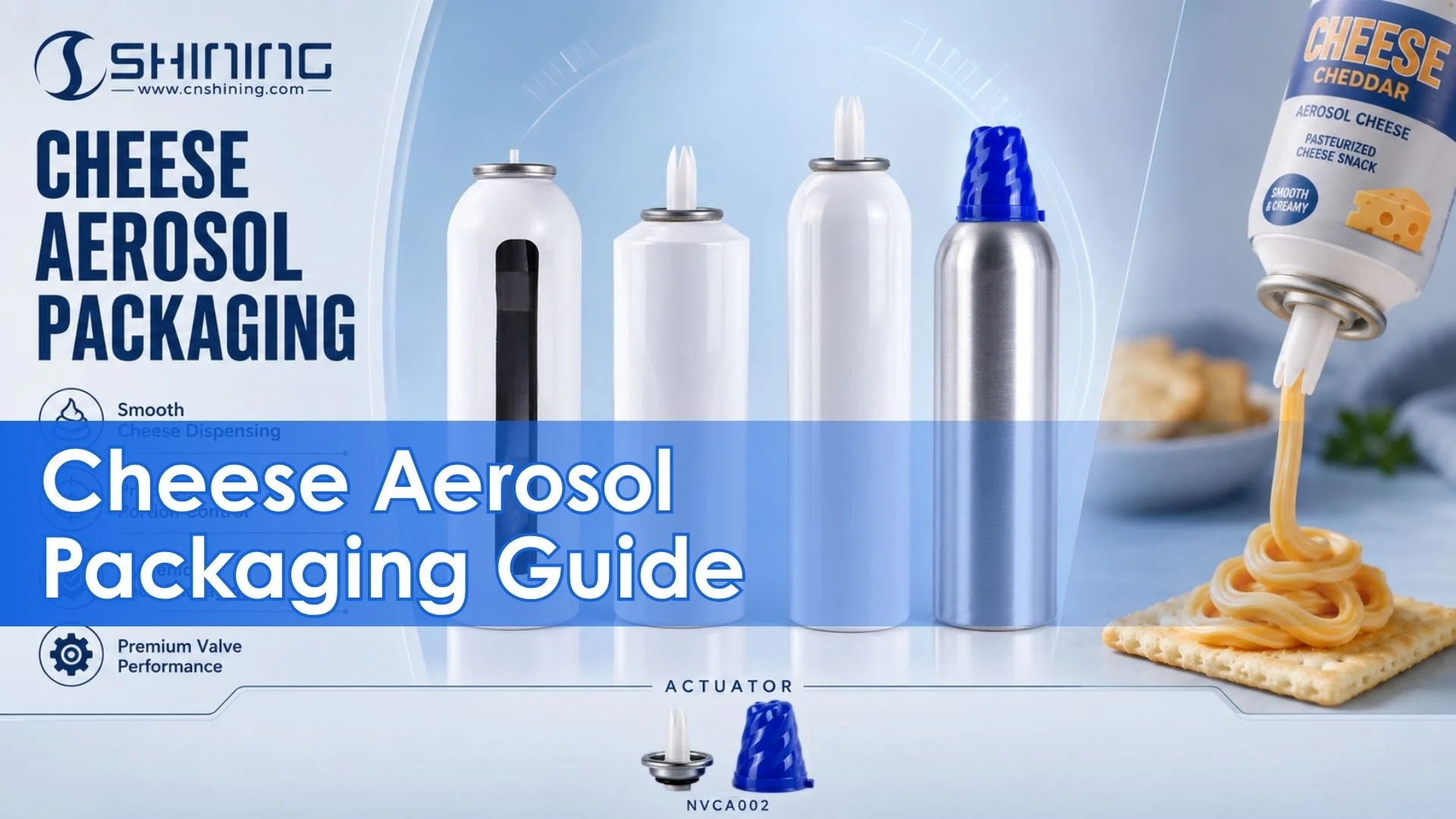
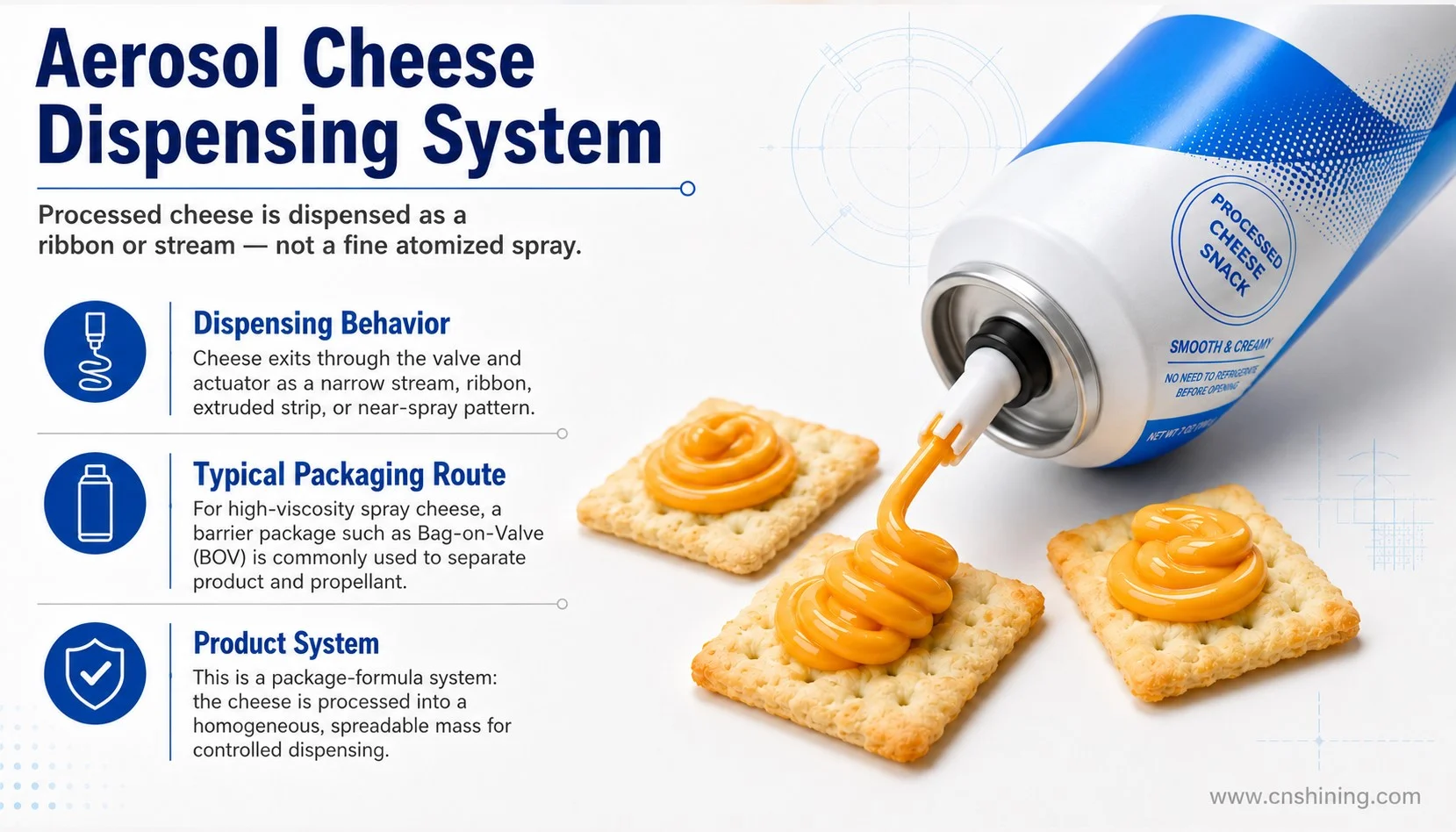
Cheese aerosol spray does not atomize natural cheese. It dispenses a processed, spreadable cheese system from a pressurized metal container through a valve, stem, orifice and actuator. The product may come out as a narrow stream, ribbon, extruded strip or near-spray pattern. That distinction matters. The technical problem is not only food formulation. It is a package-formula system.
For high-viscosity spray cheese, the practical packaging route is usually a barrier package, Bag-on-Valve (BOV) or a similar structure that separates product and propellant. The US regulatory frame often places these products near the logic of pasteurized process cheese spread, where the product is formed by heating, mixing and emulsifying into a homogeneous, spreadable plastic mass at 70°F.
1. What Cheese Aerosol Spray Actually Is
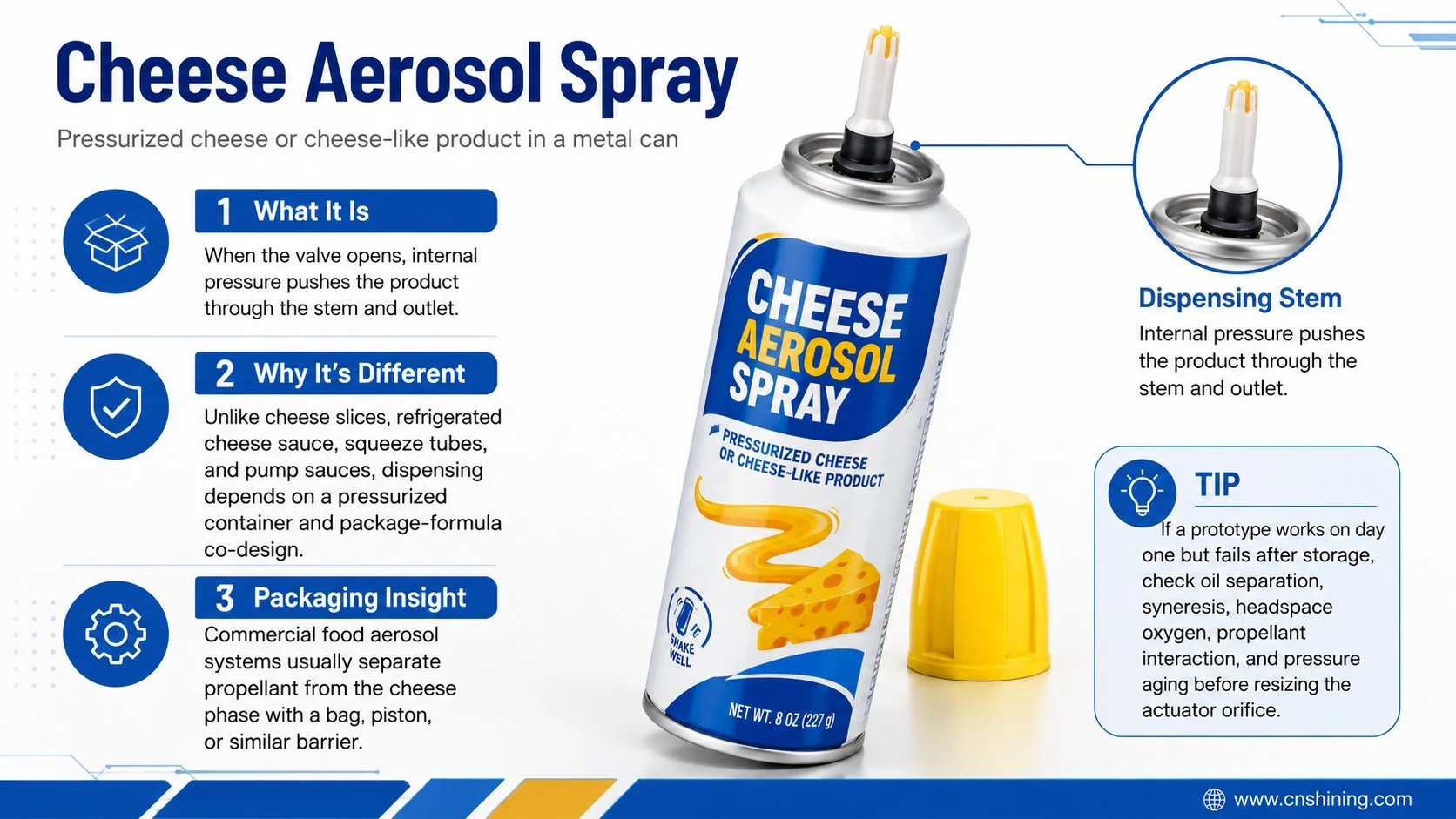
A narrow definition is simple: cheese aerosol spray is a cheese or cheese-like product packed in a pressurized metal can. When the valve opens, internal pressure pushes the product through the stem and outlet. It differs from cheese slices, refrigerated cheese sauce, squeeze tubes and pump sauces because release is driven by a pressurized container and by packaging-formula co-design.
The US eCFR definition of pasteurized process cheese spread is useful here. It describes a heat-treated, mixed product made with cheese ingredients, optional dairy ingredients and emulsifying agents, with spreadability at 70°F. That framework fits many commercial spray cheese systems better than the idea of “natural cheese in a can.”
From a packaging engineer’s view, the defining point is separation. Clayton’s food aerosol packaging paper lists aerosol cheese as a case where propellant and product are separated, so a barrier package for aerosol food is required. The propellant transfers pressure to the cheese phase through a bag, piston or similar barrier, rather than mixing directly into the product.
2. How the Package Dispenses a High-Viscosity Cheese System
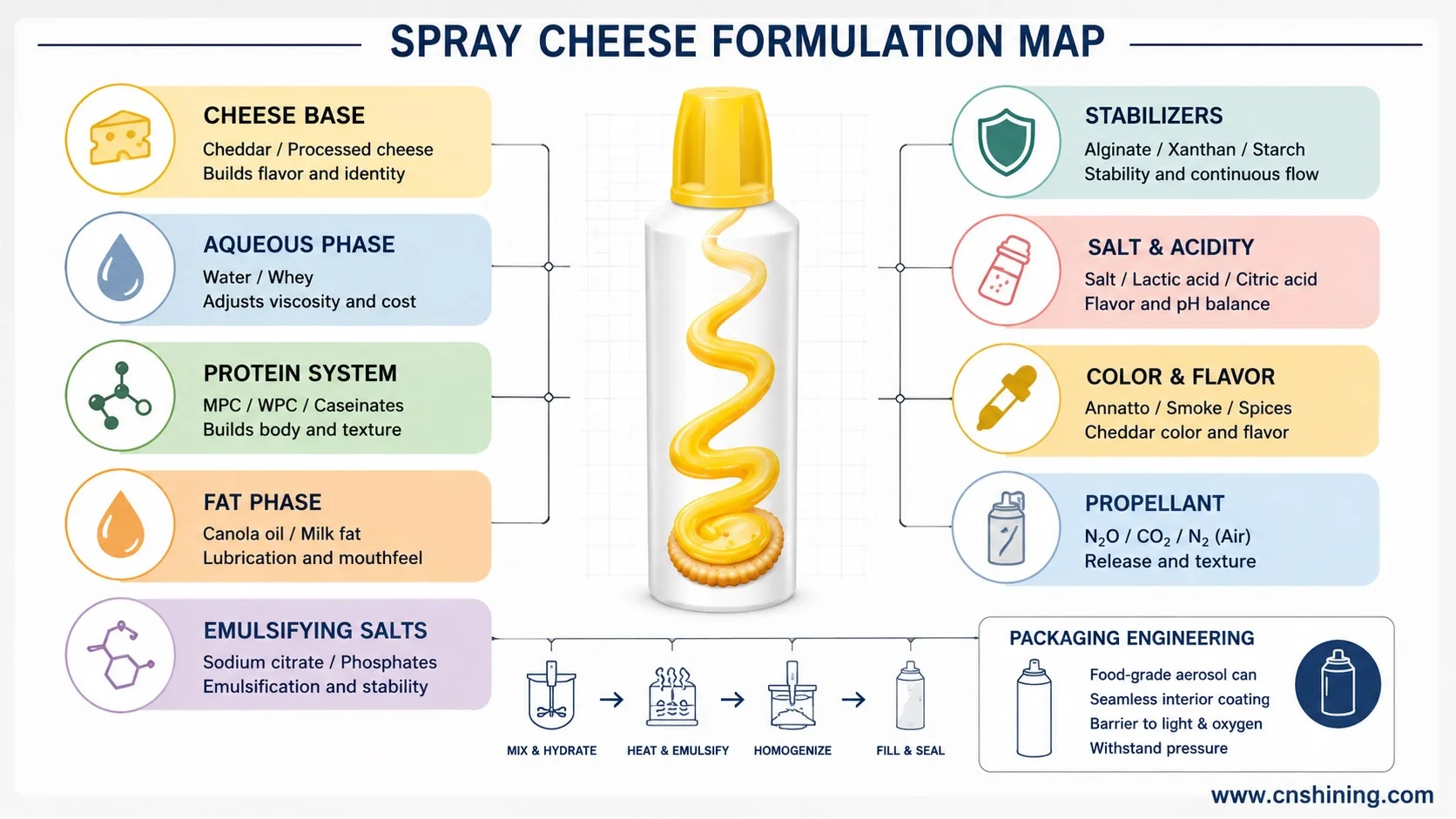
Spray cheese is best understood as a high-solids, controlled-rheology cheese paste. Its discharge does not come from making cheese thin. It comes from setting the paste into a window where it is stable at rest and flows under pressure. Emulsifying salts and proteins hold water and fat together. Stabilizers tune yield stress. The valve, stem, orifice and actuator translate that flow window into a repeatable discharge pattern.
Propellant choice affects taste, emptying rate, foam behavior and compliance. Nitrous oxide under 21 CFR 184.1545 is listed for food use as a propellant and aerating agent. Carbon dioxide under 21 CFR 184.1240 is also listed, but packaging literature warns that CO₂ can add bitterness. In barrier packs, compressed air or nitrogen is attractive because it stays outside the product.
| Component / Concept | Technical Meaning | Commercial Effect |
|---|---|---|
| Barrier package | Product and propellant are kept in separate chambers. | Good fit for high-viscosity cheese; helps flavor retention, hygiene and emptying. |
| BOV | Bag welded to valve; compressed air or nitrogen acts outside the bag. | Supports multi-angle dispensing, lower flammability risk and better emptying perception. |
| Spring valve | Metal spring returns the valve after actuation. | Useful across many liquid and medium/high-viscosity systems. |
| Toggle valve | Rubber recovery valve, often side-actuated. | Intuitive side pressure; can suit some high-viscosity products. |
| Stem / Orifice | Controls flow rate and pressure drop. | Too small may clog; too large may splash or lose ribbon definition. |
| Dip tube | Defines upright or inverted pickup path. | Determines whether the can needs a fixed use posture. |
| Actuator | Finger press, side press, trigger or lever part. | Controls hand feel, discharge form and usability for children or older users. |
| Stream / Spray / Spread tip | Outlet tip geometry creates stream, spray, ribbon or spread pattern. | Directly shapes whether consumers think the product “sprays” or “squeezes.” |
| Overcap | Protective cap over actuator and outlet. | Reduces contamination, dried residue and transport damage. |
| Product emptying | How much product leaves the container before functional failure. | Main KPI behind complaints about half-used cans and trapped cheese. |
A practical flow path is: cheese phase → bag or piston chamber → valve → stem/orifice → actuator/tip → ribbon, strip or near-spray. With compressed gas, the can may discharge faster at the beginning and slower near the end. If that rate shift is unacceptable, the package must be corrected through barrier structure, absorbed gas systems, mixed propellant strategy or orifice redesign.
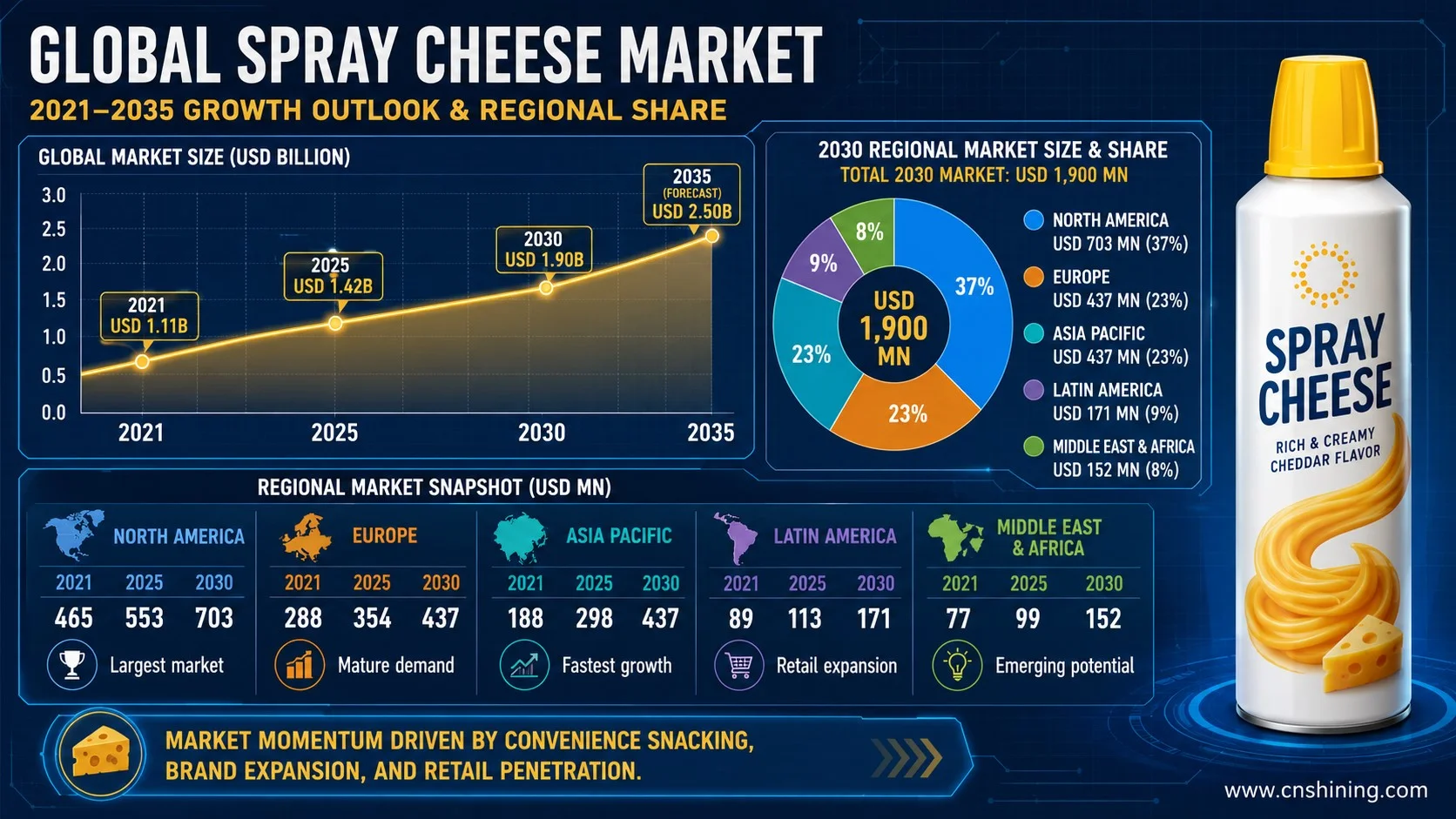
3. Market Size, Regional Structure and Why Forecasts Differ
| Source | Base / Historical Value | Forecast | Working Interpretation |
|---|---|---|---|
| Strategic Market Research | 2024: USD 1.3bn | 2030: USD 1.9bn; CAGR 5.4% | Closer to a core spray cheese view. |
| ReAnIn | 2025: USD 1.48469bn | 2032: USD 1.97635bn; CAGR 4.2% | Near retail spray SKU scope. |
| Cognitive Market Research | 2021: USD 1.1061bn; 2025: USD 1.3496bn | 2033: USD 2.00922bn; CAGR 5.1% | Useful for a longer time sequence. |
| Future Market Insights | 2025: USD 2.1454bn | 2035: USD 2.6563bn; CAGR 5.6% | Broader boundary; useful as a high scenario. |
For product planning, it is safer to maintain two models: a core scenario around USD 1.35–1.50bn for 2024–2025, and a broader high scenario around USD 2.15bn. This is more useful than forcing one exact number into mold investment, valve testing or regional launch planning.
| Region | 2021 Core Estimate | 2025 Core Estimate | 2030 Core Estimate | Structural Reading |
|---|---|---|---|---|
| North America | ~USD 465mn | ~USD 553mn | ~USD 703mn | Largest single region; strong brand and private-label base. |
| Europe | ~USD 288mn | ~USD 354mn | ~USD 437mn | Strong convenience cheese culture; formats are more fragmented. |
| Asia Pacific | ~USD 188mn | ~USD 298mn | ~USD 437mn | Highest elasticity, but category education cost is also higher. |
| Latin America | ~USD 89mn | ~USD 113mn | ~USD 171mn | Driven by imports and modern retail channels. |
| Middle East & Africa | ~USD 77mn | ~USD 99mn | ~USD 152mn | Small base, clear long-term growth direction. |
A 2025 operating view can be simplified as North America 39%, Europe 25%, Asia Pacific 21%, Latin America 8% and Middle East & Africa 7%. The likely shift is not a collapse in North America. It is Asia Pacific gaining share while Europe becomes relatively smaller.
4. Product Formats, Formula Logic and Ingredient Functions
Cheese aerosol spray is not a universal replacement for other convenience cheese products. It wins on speed, controlled placement, shelf-stable snack use and the small ritual of pressing a can. It loses points on package complexity, unit cost, clogging risk, residual product and “too processed” perception.
| Format | Typical Pack | Main Strength | Main Weakness | Formula Difficulty | Packaging Difficulty |
|---|---|---|---|---|---|
| Cheese aerosol spray | Pressurized metal can + valve/actuator | Ready to use; ribbon or strip discharge; strong snack identity. | Loss of pressure, clogging, residue, higher unit cost. | High | Very high |
| Squeeze tube cheese | Laminate or plastic tube | Simple structure; easier to squeeze out. | Less discharge drama; barrier design depends on tube material. | Medium | Medium |
| Pump cheese or sauce | Pump bottle | No compressed gas; reclosable. | Weak for high-viscosity cheese; poor atomization and suck-back. | Medium-high | Medium |
| Pre-packed cheese slices | Film pouch or slice pack | Low cost and broad use. | No instant extrusion or interactive use. | Low | Low |
| Refrigerated cheese sauce | Cup, tub or bottle | Can taste closer to real cheese. | Needs spooning; contamination risk; often cold-chain dependent. | Medium | Low-medium |
| European cheese tube | Soft tube | Flavor variety and lunchbox fit. | Not a shelf-stable aerosol experience. | Medium | Medium |
4.1 Formula Segments
| Type | Representative Style | Formula Feature | Commercial Meaning |
|---|---|---|---|
| Classic spray cheese | Cheddar / American | Cheese + whey or milk protein + fat + emulsifying salts + stabilizer. | Largest base; easiest for market education. |
| Creamier style | American / soft snack profile | More lubricity, fuller fat perception, smoother ribbon. | Fits children and snack dipping use. |
| Seasoned style | Spicy Nacho, garlic, herb, smoky | Base system plus seasoning, spices and flavor materials. | Improves repeat purchase and shortens education. |
| Light or cleaner label style | Lower sodium, fewer additives, natural color | Requires rebuilding flavor, protein structure and stability. | Fits premium or health-aware channels. |
| Plant-based spray cheese | Oat, cashew, nutritional yeast | No dairy base; must rebuild cheese flavor and rheology. | New growth area, but technically harder. |
4.2 Ingredient Functions
| Ingredient Class | Common Materials | Main Function | Development Watchpoint |
|---|---|---|---|
| Cheese base | Cheddar, American, processed cheese base | Builds cheese identity and main flavor. | Higher natural cheese content raises cost and variation. |
| Aqueous dairy balance | Water, whey | Adjusts viscosity, cost and mineral balance. | Too much gives weak flavor and syneresis risk. |
| Protein system | MPC, WPC, caseinates | Builds body, hold and mouthfeel. | Can affect mouth coating and nozzle clogging. |
| Fat phase | Canola oil, milk fat | Provides lubrication and fullness. | Excess oil raises oiling-off and temperature sensitivity. |
| Emulsifying system | Sodium citrate, phosphates, calcium salts | Supports homogeneous plastic mass and fat-water stability. | Affected by sodium pressure and clean-label goals. |
| Stabilizers | Sodium alginate, xanthan gum, starch | Controls yield stress, syneresis and continuous discharge. | Must balance cold use and melt-in-mouth behavior. |
| Salt and acidity | Salt, lactic acid, acetic acid, citric acid | Flavor, pH balance and microbial control. | Excess salt is a repeated consumer complaint. |
| Color and flavor | Annatto, apocarotenal, smoke, spice flavors | Builds cheddar color and stable sensory signal. | Color strength, heat stability and local legality must be checked. |
| Propellant | N₂O, CO₂, compressed air, nitrogen | Drives release or aeration. | Affects flavor, legal review and environmental story. |
5. Regulatory Frame: US, EU
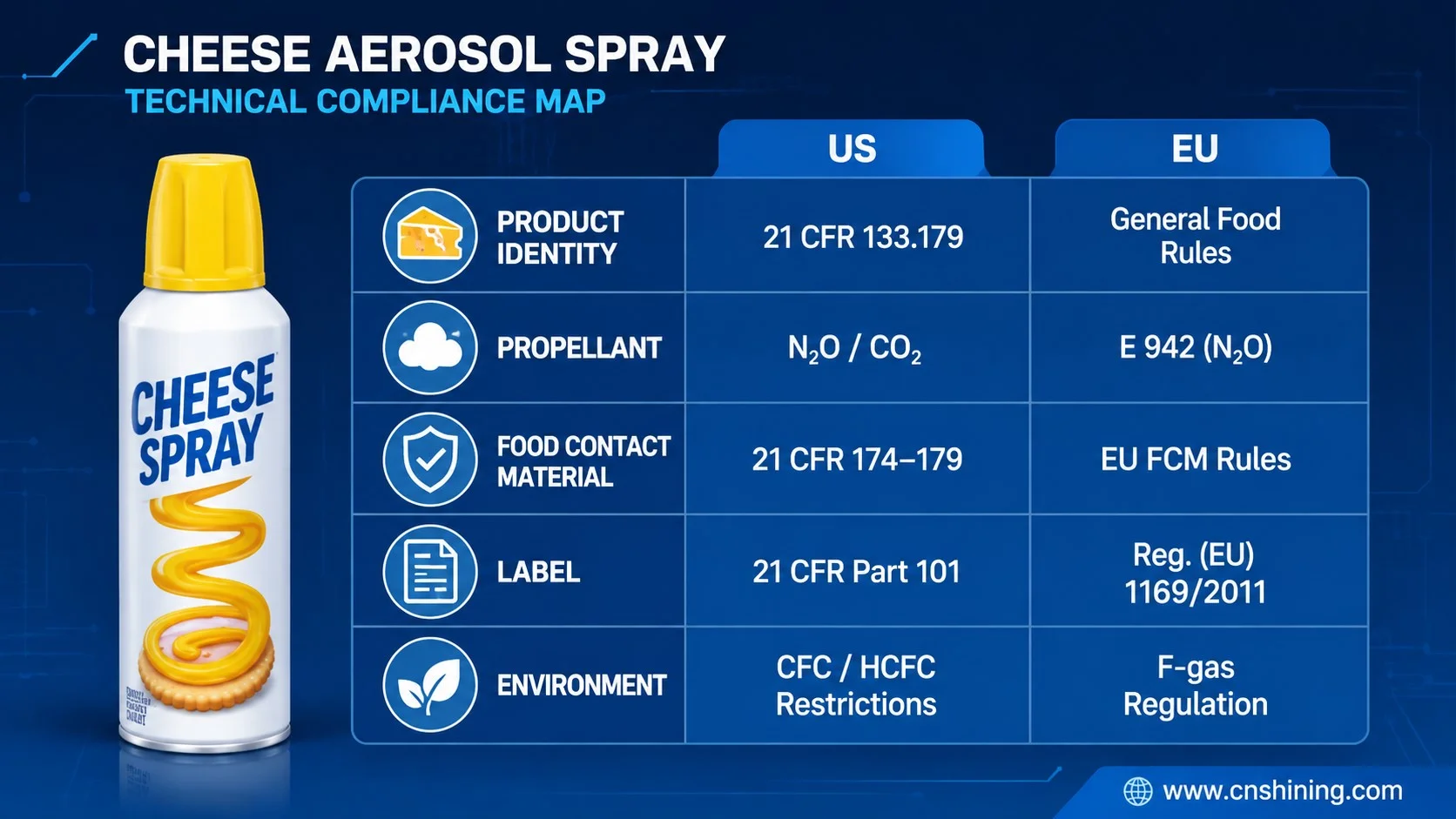
The US framework is built around product identity, permitted ingredients, labeling and food-contact materials. The EU framework runs through additive lists, food information rules, food-contact material requirements and environmental constraints.
| Dimension | United States | European Union |
|---|---|---|
| Product identity | Process cheese spread logic under 21 CFR 133.179 and related standards. | No single “spray cheese” identity rule; general food, additive and label rules apply. |
| Propellant | N₂O and CO₂ are listed for food use; other propellants need case review. | N₂O corresponds to E 942 in the EU food additive database. |
| Food-contact materials | 21 CFR 174–179 logic; coatings and migratable substances must be checked. | EU food-contact material rules plus plastic material controls and BPA developments. |
| Label | 21 CFR Part 101 for ingredient, nutrition and allergen labeling. | Regulation (EU) No 1169/2011 for consumer food information. |
| Environment | CFC and HCFC aerosol restrictions remain a baseline avoid-list. | EU F-gas legislation keeps tightening fluorinated greenhouse gas use. |
The practical rule is: do not start with the marketing name. Start with product identity. If the cheese percentage, additive system and product state point to processed cheese or cheese product, the label should not pretend otherwise. The same thinking applies to coating selection. The US FDA has its position on BPA food-contact applications, while EFSA’s BPA topic page and EU action have pushed can coating decisions in a different direction. A global pack should consider BPA-free or EU-forward coating routes early.
For reference, the US FDA also publishes its consumer-facing position on BPA use in food-contact applications. This does not remove the need for market-by-market review.
6. Technology Movement: Plant-Based, Lower-Impact Propellants and Platform Packaging
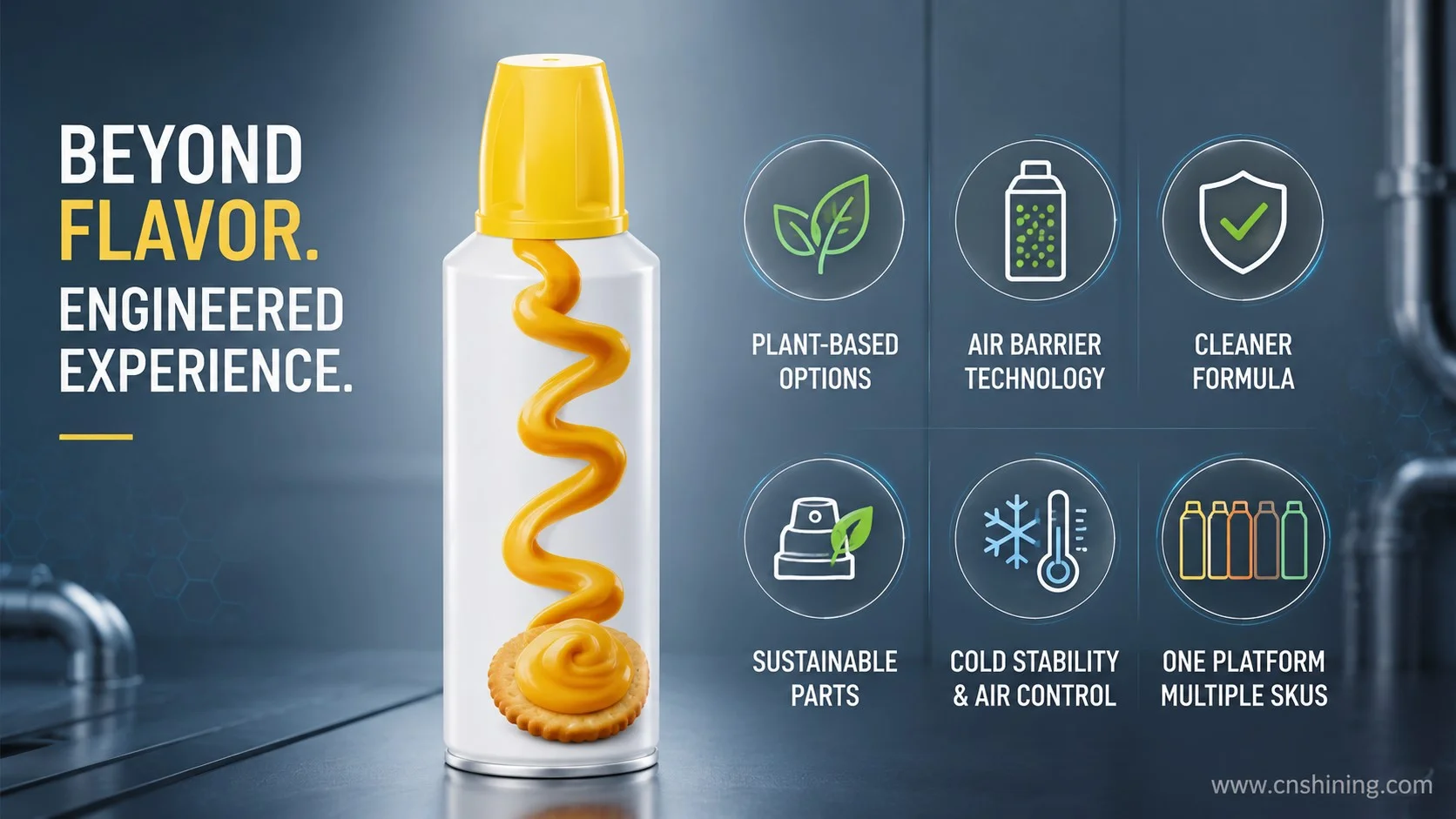
Recent movement is not only about adding flavors. Six technical directions are visible.
- Plant-based spray cheese: oat, cashew and nutritional yeast systems try to reproduce the nostalgic use experience without dairy.
- Compressed air or nitrogen barrier packs: BOV structures separate propellant and food, reduce oxygen exposure and support all-angle discharge.
- Cleaner label and lower sodium: this is not a claim sticker. It changes emulsification, flavor compensation, storage stability and discharge consistency.
- More sustainable dispensing parts: food aerosol actuators increasingly include PCR resin and POM-free options.
- Low-temperature stability and air control: consumers may use the can from room temperature or after refrigeration, so start force and ribbon continuity must stay stable.
- Packaging platform design: one validated valve-can-actuator platform can support Cheddar, American, Nacho, Smoky and plant-based SKUs.
Patent activity supports the same direction. One patent family around powdered cheese methods reflects wider interest in cheese flavor delivery and sodium reduction paths. Another patent application on edible emulsions for air-filled foams shows how air structure and foam behavior are moving into finer food engineering territory.
7. Top 10 Cheese Aerosol Spray Brands
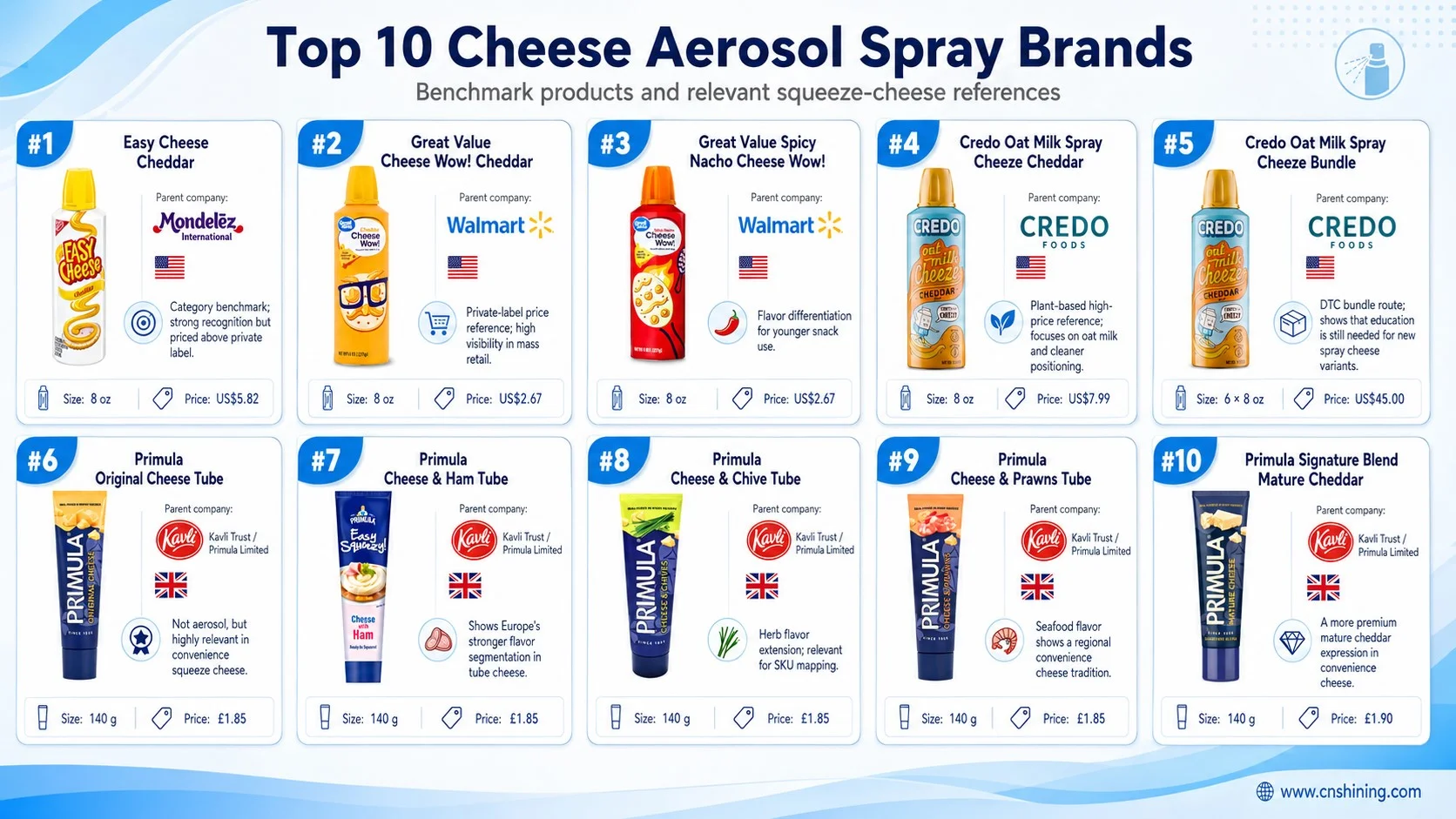
| Brand / Product Line | Country | Company / Operator | Common Size | Public Price | Technical Comment |
|---|---|---|---|---|---|
| Easy Cheese Cheddar | US | Mondelēz International | 8 oz | about 5.82$ | Category benchmark; strong recognition but priced above private label. |
| Great Value Cheese Wow! Cheddar | US | Walmart | 8 oz | about 2.67$ | Private-label price reference; high visibility in mass retail. |
| Great Value Spicy Nacho Cheese Wow! | US | Walmart | 8 oz | about 2.67$ | Flavor differentiation for younger snack use. |
| Credo Oat Milk Spray Cheeze Cheddar | US | Credo Foods | 8 oz | about 7.99$ | Plant-based high-price reference; focuses on oat milk and cleaner positioning. |
| Credo Oat Milk Spray Cheeze Bundle | US | Credo Foods | 6 × 8 oz | about 45.00$ | DTC bundle route; shows that education is still needed for new spray cheese variants. |
| Primula Original Cheese Tube | UK | Kavli Trust / Primula Limited | 140 g | about 2.48$ | Not aerosol, but highly relevant in convenience squeeze cheese. |
| Primula Cheese & Ham Tube | UK | Kavli Trust / Primula Limited | 140 g | about 2.48$ | Shows Europe’s stronger flavor segmentation in tube cheese. |
| Primula Cheese & Chive Tube | UK | Kavli Trust / Primula Limited | 140 g | about 2.48$ | Herb flavor extension; relevant for SKU mapping. |
| Primula Cheese & Prawns Tube | UK | Kavli Trust / Primula Limited | 140 g | about 2.48$ | Seafood flavor shows a regional convenience cheese tradition. |
| Primula Signature Blend Mature Cheddar | UK | Kavli Trust / Primula Limited | 140 g | about 2.55$ | A more premium mature cheddar expression in convenience cheese. |
8. User Pain Points and Packaging Priorities
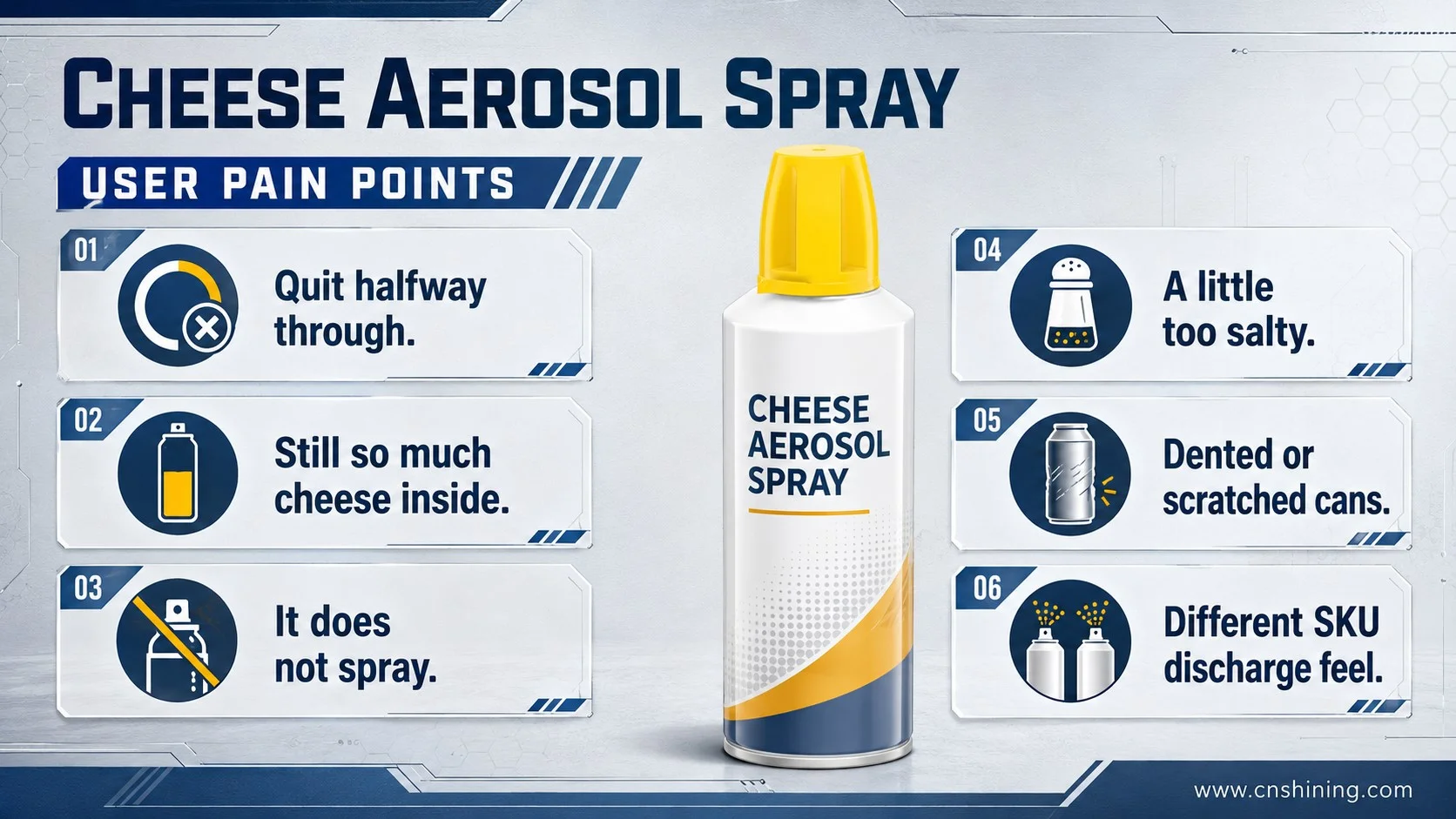
User complaints are not random. They cluster around a few packaging and product-control failures: the can stops halfway, a lot of cheese remains inside, the product does not “spray,” salt impact is too strong, cans arrive dented, and different flavors do not dispense the same way.
| User Signal | Likely Technical Cause | Packaging / Product Direction |
|---|---|---|
| “Quit halfway through.” | Pressure loss, high valve resistance, poor emptying. | Improve BOV/piston emptying, end-of-life flow and pressure margin. |
| “Still so much cheese inside.” | Residual product trapped by structure or viscosity. | Reduce dead zones and validate emptying rate by storage condition. |
| “It does not spray.” | Mismatch between name, visual promise and actual ribbon discharge. | Show real ribbon/spread form on front pack and instructions. |
| “A little too salty.” | High sodium load or too large a single discharge. | Use thinner spread tip or smaller discharge cross-section before full reformulation. |
| Dented or scratched cans. | Transport compression, weak shoulder/dome protection, poor overcap cushioning. | Review can strength, outer case partition and crash-ring cap design. |
| Different SKU discharge feel. | Flavor variants falling outside common rheology window. | Set a shared yield stress, opening force and late-can flow specification. |
| Priority | Problem | Action | Component | Expected Gain |
|---|---|---|---|---|
| P0 | Half-can pressure loss and high residue | Move to higher-emptying BOV or piston design; run DOE on emptying and late-can flow. | Container, bag/piston, propellant system | Directly reduces the most visible failure. |
| P0 | Nozzle clogging and dried residue | Use low-dead-volume path, better overcap sealing and self-cleaning or easy-clean actuator design. | Stem, outlet tip, overcap | Improves repeat-use stability. |
| P0 | “Not really a spray” | Print the real ribbon/spread pattern instead of mist imagery. | Artwork, front panel, use diagram | Reduces expectation gap. |
| P1 | Salt impact | Change outlet geometry to thinner, wider spread; consider metered hand feel. | Orifice, tip, actuator | Reduces perceived salt hit without immediate formula rebuild. |
| P1 | SKU-to-SKU hand feel variation | Unify target yield stress, opening force and flow rate across flavors. | Formula-packaging specification | Makes Cheddar, American and Nacho feel like one platform. |
| P2 | Compliance and sustainability pressure | Select BPA-free or EU-forward coatings; raise PCR content where technically safe. | Can coating, actuator, overcap | Supports broader market access and material story. |
9. Where Shining Packaging Fits in the Spray Cheese Pack
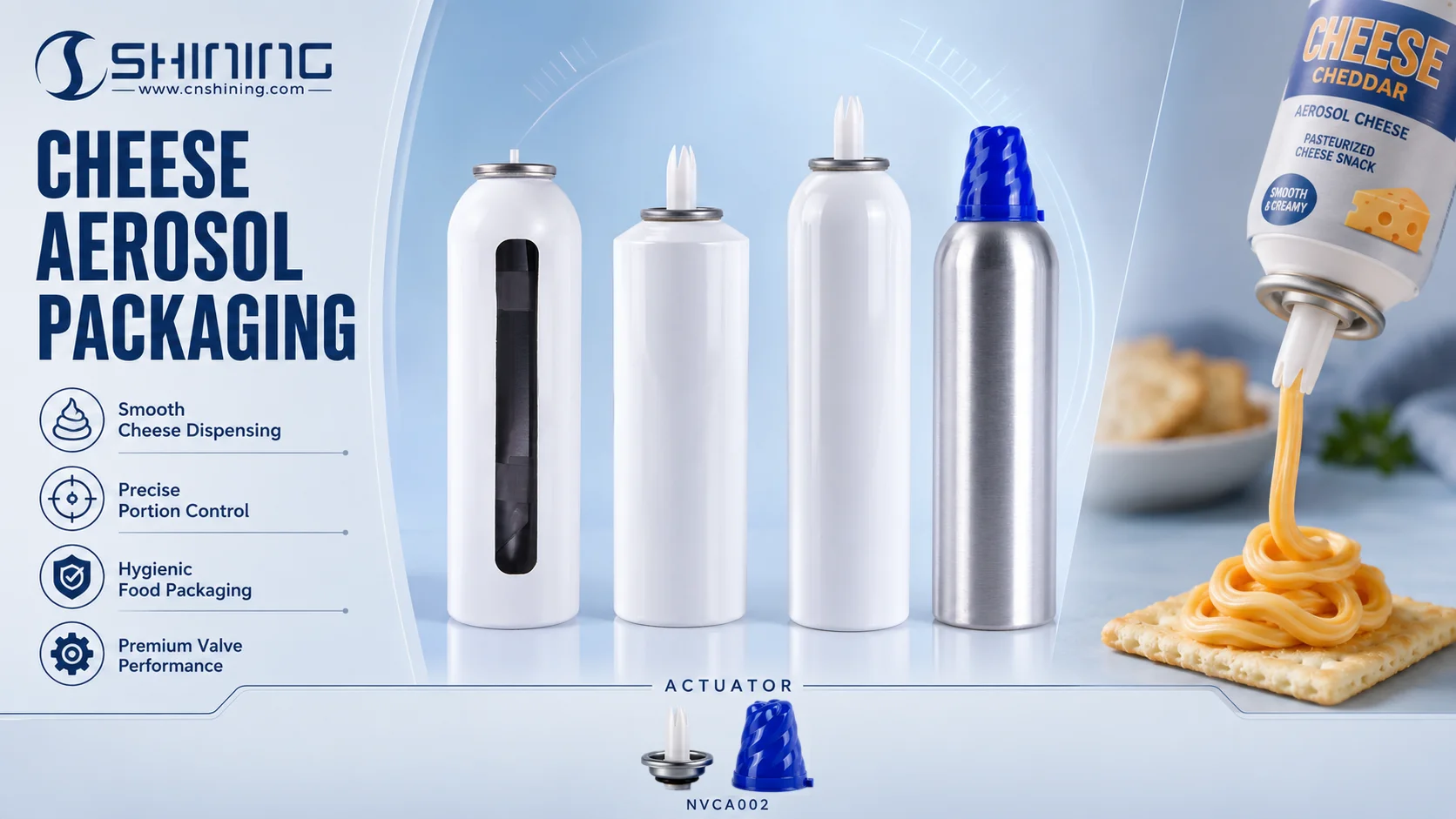
For cheese aerosol spray, Shining Packaging’s relevant work is at the component and compatibility level: actuators, aerosol cans and valves. A high-viscosity cheese system asks more from these parts than a low-viscosity spray oil. The actuator must give enough finger control without creating a large dead zone. The valve and stem need a flow path that does not shear the product into separation or trap paste after use. The can and internal coating must be selected against food-contact, acidity, fat phase and storage conditions.
The useful development route is not to pick a generic actuator and hope the formula follows. Start with target discharge form: narrow ribbon, spread strip or decorative line. Then size the orifice, stem and actuator outlet around the cheese rheology. After that, validate can pressure, coating compatibility, emptying rate and transport resistance. This keeps the package close to the real failure points found in consumer feedback.
For brands working on spray cheese, plant-based spray cheeze or high-viscosity snack sauces, Shining Packaging can naturally sit in the packaging validation discussion: can format, valve choice, actuator feel, overcap protection and visual use instruction. The goal is simple: make the product leave the can consistently, not just look good on the shelf.
10. Practical Closing Notes
Cheese aerosol spray is a small category with a large engineering load. The formula must be smooth, salty enough, stable and spreadable. The package must keep pressure, avoid clogging, reduce residue, protect flavor and survive transport. The user does not separate these problems. If the can stops halfway, the product has failed.
The most useful development sequence is direct: define product identity, set the rheology window, select the barrier structure, tune valve and actuator geometry, test emptying rate, then lock label and coating compliance. This is where spray cheese moves from an interesting snack idea to a controlled aerosol food product.
11. FAQ: Cheese Aerosol Spray
It depends on the formula and legal identity in the target market. Most products are closer to processed cheese spread or cheese product systems than natural cheese. They usually contain cheese, whey or water, milk protein, fat, emulsifying salts and stabilizers. The package then dispenses this controlled paste through a valve and actuator.
High-viscosity cheese paste often should not mix directly with propellant. A barrier package, piston or BOV system keeps the food phase and pressure medium separate. This can protect flavor, reduce gas interaction, support hygiene and improve emptying. It also allows compressed air or nitrogen to drive discharge without entering the product.
This usually points to pressure loss, poor emptying geometry, high product resistance or valve clogging. The remaining cheese may be trapped by dead volume, bag collapse behavior or a rheology window that becomes too stiff near the end of use. Emptying rate and late-can flow need direct testing, not only visual inspection.
The discharge form is controlled by viscosity, yield stress, internal pressure, stem design, orifice size and actuator outlet geometry. High-viscosity cheese normally forms a ribbon, strip or spread pattern rather than a fine mist. Calling it “spray” can create wrong expectations unless the package shows the real discharge shape.
Common food aerosol options include nitrous oxide, carbon dioxide, compressed air and nitrogen, subject to local regulations and product design. CO₂ can create bitterness in some systems. For barrier packs, compressed air or nitrogen is often attractive because the gas stays outside the cheese phase and lowers direct flavor interaction.
Spray cheese is much thicker than many aerosol foods. A small orifice may clog, while a large one may discharge too fast or lose shape. The actuator also affects hand force, dead residue and outlet cleaning. A good design must match the product’s rheology, target ribbon shape and repeated-use behavior.
The main risks are oil separation, syneresis, excessive salt perception, unstable viscosity, poor cold-start flow and clogging after storage. Emulsifying salts, milk proteins, fat phase and stabilizers must be balanced together. A formula that tastes acceptable in a cup may still fail when forced through a small valve and actuator.
Plant-based spray cheese removes the dairy protein and cheese matrix that normally help structure and flavor. Developers must rebuild cheese-like taste, color, yield stress and mouthfeel using plant bases, oils, nutritional yeast and stabilizers. The packaging task remains similar, but the formula window may be narrower and less forgiving.
Test pressure aging, oil separation, syneresis, opening force, flow rate, late-can discharge, emptying percentage, nozzle clogging, storage temperature range and transport dent resistance. For global packs, coating migration, propellant legality and label identity should be reviewed early. Waiting until launch artwork is finished makes corrections expensive.
The category boundary changes by report. A narrow view may count canned spray cheese only. A wider view may include squeeze cheese, plant-based spray cheese, private label, foodservice or adjacent processed cheese products. For planning, it is better to keep a core scenario and a high scenario instead of trusting one number.