
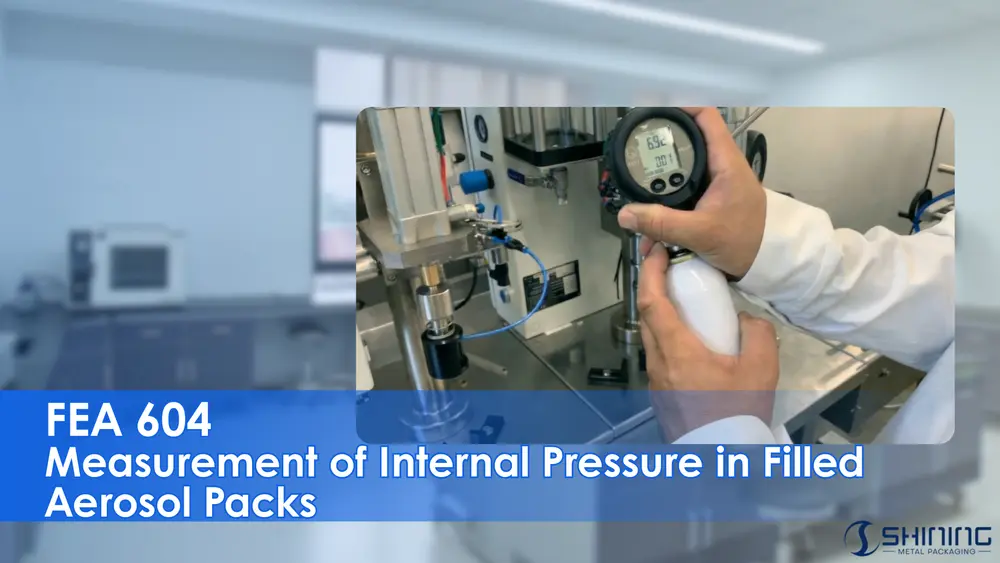
Standard Overview
FEA 604 is an industry standard issued by the European Aerosol Federation (FEA) that defines methods for measuring the true internal pressure of finished aerosol packs.
The objective is to verify that the actual pressure inside a filled aerosol pack is compatible with:
- the mechanical limits of the container
- the valve system
- the pressure limits imposed by applicable legislation
What Is “True Internal Pressure”?
In the context of FEA 604, true internal pressure is defined as:
The relative (gauge) pressure measured by a precision manometer at a specified, controlled temperature.
Although pressure is defined in SI units (Pascal), industry practice allows results to be expressed in bar or Pa.
Why Pressure Measurement Is Necessary
Pressure measurement is required to ensure that:
- the aerosol pack complies with legal pressure limits,
- the container is not overstressed,
- filling consistency is maintained across production,
- abnormal filling or propellant dosing is detected early.
FEA 604 provides practical methods suitable for both 100% in-line control and spot or laboratory testing.
Part 1 – In-Line Pressure Measurement During Production
Objective
The objective of Part 1 is to describe methods that allow pressure measurement during filling:
- with minimal disturbance of the true internal pressure,
- without contaminating the measuring instrument with product.
Apparatus
- A reference gas source (typically nitrogen) with adjustable pressure
- A precision manometer, preferably oil-damped, adapted to connect to the aerosol valve
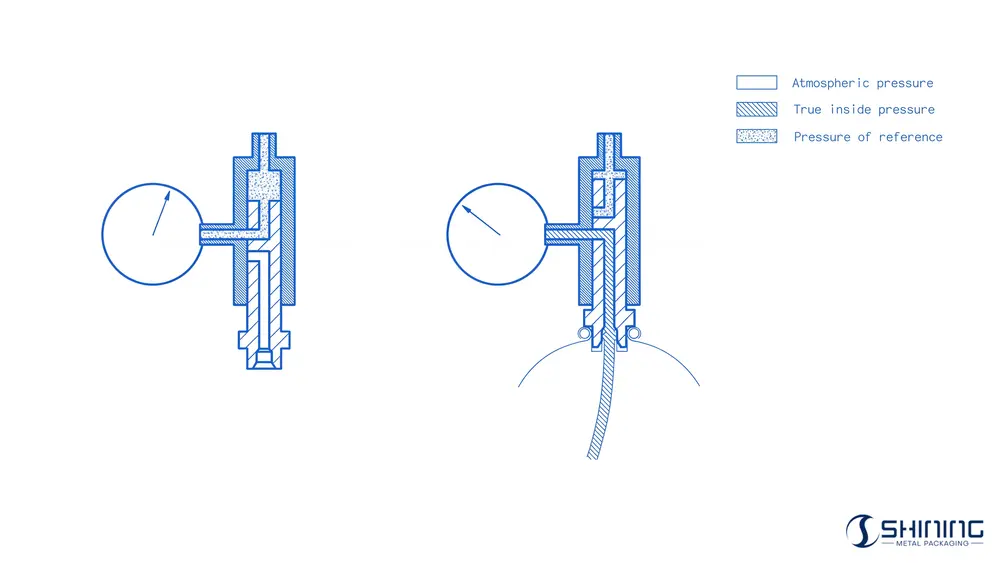
At rest, the manometer is connected to the reference gas, set at a pressure slightly higher than the expected pack pressure. During measurement, the manometer is briefly connected to the pack interior.
Working Procedure (Simplified)
- Immerse the finished aerosol pack completely (including valve) in a thermostatic bath.
- Maintain the pack at the chosen temperature for at least 30 minutes.
- Ensure temperature stability within −0 °C to +1 °C.
- Adjust the reference gas pressure slightly above the expected internal pressure.
- Apply the measuring device to the valve and open it gently.
- Once the needle stabilises, read the true internal pressure.
Measurement Precision
Measurement accuracy improves when:
- the aerosol pack volume is larger,
- the reference gas pressure closely matches the true internal pressure,
- the dead volume of the manometer is kept below 2 ml.
Figure – Principle of In-Line Measurement Apparatusvv
Part 2 – Spot and Laboratory Pressure Measurements
Scope
Part 2 applies to random or regular pressure checks performed either:
- during production
- in laboratory testing
Apparatus
Commercially available devices are used, typically consisting of:
- a pressure transducer
- a digital pressure indicator
- a suitable adaptor for the valve stem
Although these devices have a dead volume, it is generally small enough to be neglected.
Test Method (Simplified)
- Shake the aerosol pack thoroughly.
- Actuate briefly to clear liquid propellant from the dip tube.
- Remove actuator or accessory.
- Stabilise the pack at the chosen temperature in a water bath.
- Remove the pack, minimise heat loss, and apply the pressure probe.
- Once the reading stabilises, record the true internal pressure.
Test Report Requirements
The test report shall include:
- measured pressure values,
- test temperature,
- test method (Part 1 or Part 2),
- equipment used,
- any deviations or incidents affecting results.
Frequent calibration of the manometer is strongly recommended, for example using a manometric balance.
Relationship with Other Aerosol Standards
- FEA 602 – rapid tightness test of filled aerosol packs
- FEA 603 – long-term tightness testing
- FEA 422 – standard fill levels
- EN 15010 – clinch-related tolerances
Download the Standard PDF
This document provides FEA 604, defining methods for measuring the true internal pressure of filled aerosol packs. It covers in-line production control and laboratory spot checks using calibrated manometers to ensure compliance with safety and regulatory pressure limits.
FAQ – Engineering, QA & Compliance
No. It provides a measured pressure value. Acceptance criteria depend on applicable regulations and container specifications.
Because pressure is temperature-dependent. The bath ensures thermal equilibrium and repeatable measurements.
Yes. It applies to any finished aerosol pack, regardless of propellant type.
To minimise pressure loss during connection and improve measurement accuracy.
Part 1 is preferred for continuous in-line production control. Part 2 is better suited for audits, investigations, and laboratory testing.