Standard Overview
FEA 643 is an industry standard issued by the European Aerosol Federation (FEA) that defines a reproducible test method for measuring the discharge rate of filled aerosol packs.
The discharge rate is expressed in grams per second (g/s) and represents the quantity of product expelled through the valve during a defined discharge time under controlled conditions.
Scope and Limitations
This method is applicable to the majority of aerosols currently on the market, including cosmetic, household, and technical products.
However, the standard explicitly excludes:
- Metered-dose valves
- Inverted use of vapour phase tap valves
Test Principle
The discharge rate is determined by:
- Weighing the aerosol pack before discharge
- Operating the valve for a defined time interval
- Weighing the pack again
The mass difference divided by the discharge time gives the discharge rate in grams per second.
Required Apparatus
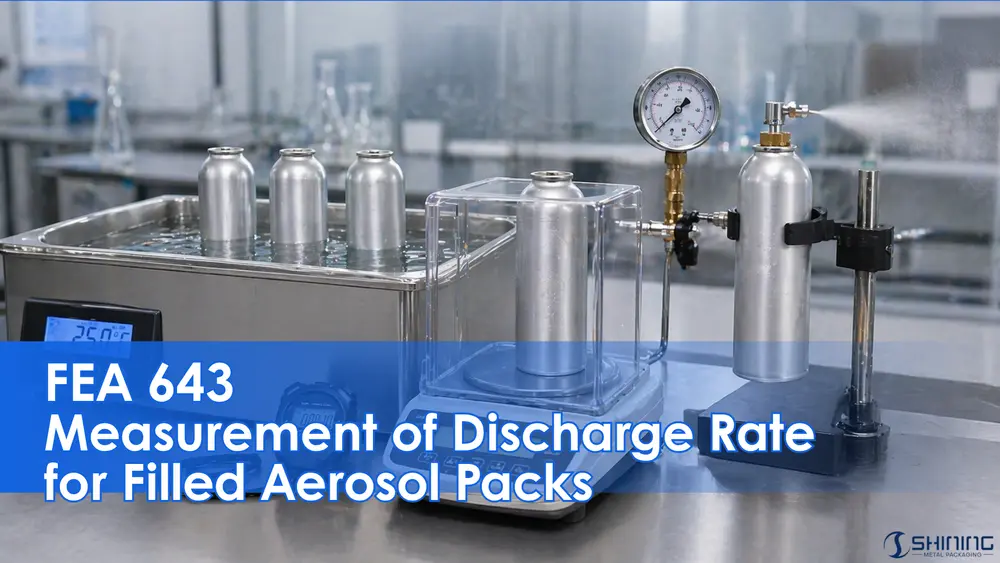
- Water bath maintained at 25 ± 0.5 °C
- Stopwatch accurate to 0.2 s
- Balance readable to 0.1 g
- Pressure gauge accurate to 0.5 bar
Test Sample Preparation
Aerosol samples may be:
- Randomly selected from production after hot water bath testing
- Carefully prepared experimental batches
All defective samples must be rejected, including:
- Leaking packs
- Misaligned valves
- Blocked or malfunctioning valves
Conditioning and Pre-Spray
Before measurement:
- The aerosol is operated for 5 seconds to clear the dip tube
- The pack is conditioned in a water bath at 25 °C for at least 30 minutes
This ensures temperature equilibrium and homogeneous product composition.
Discharge Test Procedure
- Remove the pack from the water bath and wipe dry
- Operate the valve for 1 second to remove residual water
- Measure internal pressure
- Weigh the pack (±0.1 g)
- Shake the pack for 3 seconds
- Discharge continuously for 10 seconds
- Reweigh the pack
The procedure is repeated three times unless otherwise justified.
Calculation Method
Discharge rate is calculated as:
Discharge rate (g/s) = (Mass before − Mass after) ÷ Discharge time
Individual results should not differ by more than 0.1 g from the mean of the determinations.
Alternative Life-Cycle Measurement
For systems where discharge behaviour changes during emptying, measurements may be performed at different fill levels:
- 90%
- 70%
- 50%
- 30%
- 10%
Results may then be plotted to visualise discharge evolution over pack life.
Reporting Requirements
Test reports shall include:
- Measured discharge rate (g/s)
- Mean internal pressure
- Discharge method used (e.g. 3 × 10 s)
- Container specification
- Valve and orifice details
- Initial fill level
Engineering Significance
FEA 643 is essential for:
- Spray performance comparison
- Valve and actuator optimisation
- Stability testing and ageing studies
It is commonly used together with:
- FEA 606 – hot water bath testing
- FEA 621 – container pressure resistance
- FEA 623 – filled pack mechanical resistance
Download the Standard PDF
FEA 643 standard describing a method for measuring the discharge rate of filled aerosol packs. It outlines procedures for determining the quantity of product released over a controlled time under defined temperature conditions to evaluate spray performance and consistency.
FAQ – Engineering & QA
Temperature strongly affects vapour pressure and viscosity. Fixing it ensures meaningful comparison between samples.
Residual product in the dip tube may not represent bulk composition and can distort the first measurement.
No. Metered valves require different test principles and instrumentation.
Solvents can soften gaskets over time, changing flow resistance and discharge rate.
Yes. Discharge rate values are only meaningful when linked to internal pressure.