
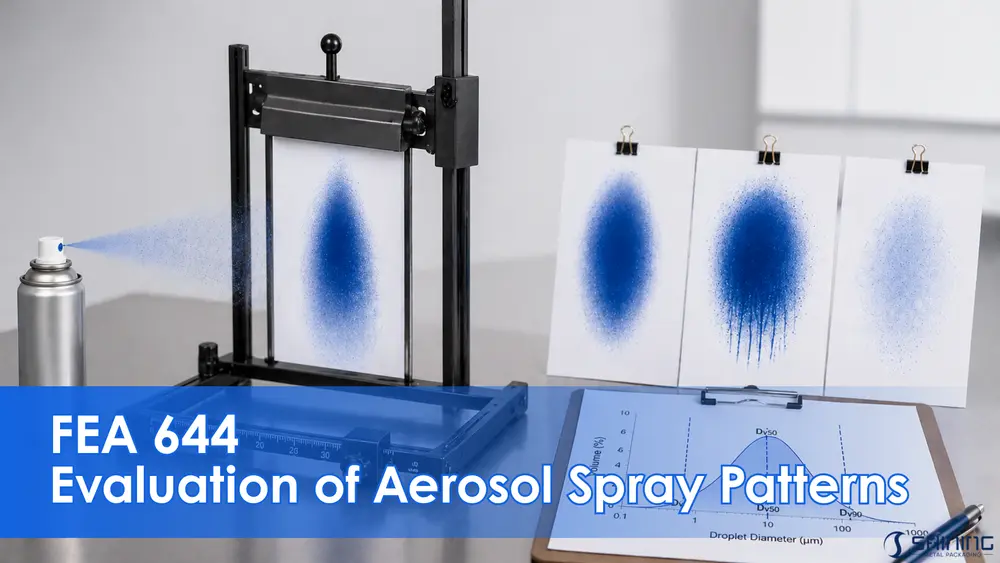
Standard Overview
FEA 644 is an industry standard issued by the European Aerosol Federation (FEA) that defines a practical method for evaluating aerosol spray patterns.
The method focuses on the size, shape and symmetry of the spray under stable full-spray conditions, providing a rapid and reproducible way to compare spray performance.
Scope and Limitations
This method is suitable for:
- Routine quality control
- Comparison between production batches
- Benchmarking against approved reference sprays
The method does not aim to:
- Determine exact particle size distributions
- Analyse transient spray behaviour at start or end of life
Principle of the Vertical Spray Pattern Method
The test records a spray imprint on a vertical screen using a gravity-driven shutter that exposes the recording surface for a very short, controlled time.
Only the spray pattern produced under stable discharge conditions is captured, eliminating start-up and tail-off effects.
Test Apparatus
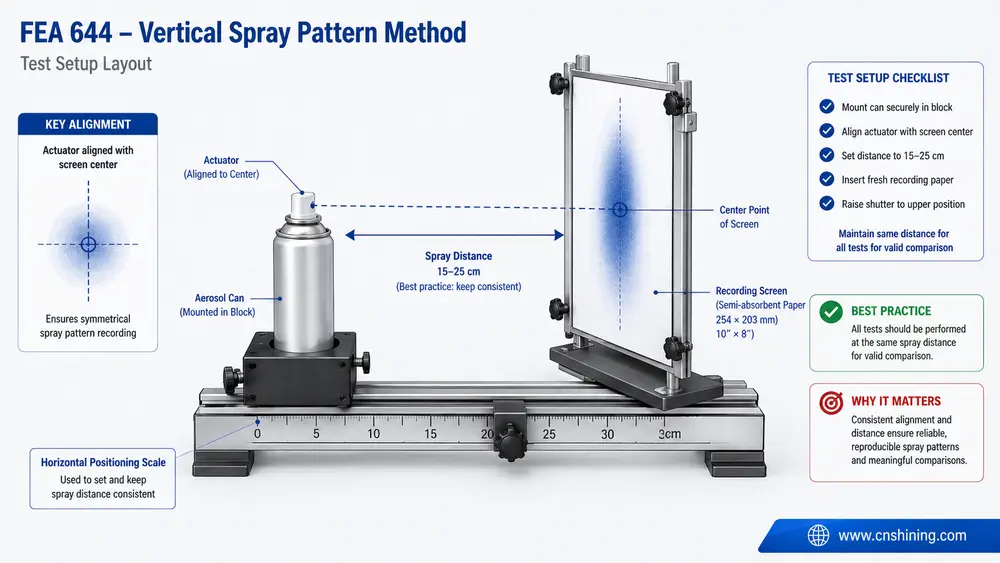
The apparatus consists of:
- A rigid body and vertical frame
- A gravity-operated shutter with adjustable aperture
- A vertical recording screen holder
- A horizontal positioning scale for spray distance
Recording Screen
The recording surface is typically:
- Semi-absorbent paper
- 254 × 203 mm (10″ × 8″)
The paper should be sensitive to one solvent in the formulation (e.g. alcohol) to ensure visible spray imprint without modifying the product.
Test Setup
- Mount the aerosol can in a suitable block
- Adjust so the actuator button aligns with the centre of the screen
- Position the can at a distance of 15–25 cm from the screen
- Insert fresh recording paper
- Raise the shutter to its upper position
Spray Pattern Recording Procedure
- Continuously actuate the aerosol
- Depress the shutter control lever during stable spraying
- Allow the shutter to fall freely and expose the screen
- Remove the screen and examine the spray pattern
If the pattern appears:
- Too dense → Reduce exposure by adjusting aperture
- Too faint → Increase exposure accordingly
Evaluation and Reporting
The obtained spray pattern is compared with:
- A reference aerosol known to give acceptable spray quality
- Other samples from the same production series
If the patterns are similar, the spray quality is considered satisfactory.
Special Case: Spray Distance Measurement
The vertical method does not record spray reach. When spray length is critical:
- Place sensitive paper horizontally on a bench
- Spray from a fixed height and distance
- Compare settling droplet distribution with a reference
Relationship with Other FEA Standards
- FEA 643 – Discharge rate measurement (g/s)
- FEA 606 – Hot water bath safety test
- FEA 621 – Internal pressure resistance
Download the Standard PDF
FEA 644 standard describing a method for evaluating aerosol spray patterns. It outlines procedures using a vertical analyser and recording screen to assess the size, shape, and distribution of sprays, helping compare spray quality and ensure consistent aerosol performance.
FAQ – Engineering, QA & Purchasing
No. It provides a visual and comparative assessment, not numerical droplet size distribution.
Gravity ensures repeatable exposure time without relying on operator reaction speed.
Yes. For water-based systems, very low dye concentrations may be added to make the pattern visible.
Spray behaviour changes during these phases. The test focuses only on normal consumer use conditions.
Yes. It is widely used as a rapid screening tool for valve–actuator–formula combinations.