
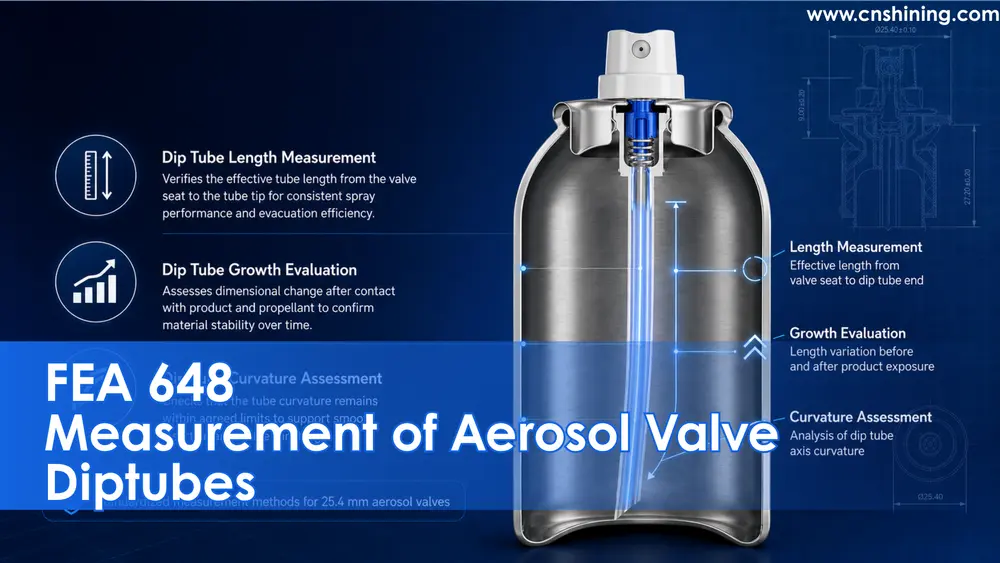
Standard Overview
FEA 648 is an industry standard issued by the European Aerosol Federation (FEA) that defines unified methods for:
- Measuring aerosol valve diptube length
- Evaluating diptube growth after contact with product and propellant
- Assessing acceptable diptube curvature
Although the diptube is a simple component, its length and shape have a direct impact on spray performance, evacuation efficiency, valve insertion, and clinching stability.
Scope and Applicability
FEA 648 applies to aerosol valves with 25.4 mm mounting cups and is independent of diptube material (PE, PP, PA, etc.).
The standard does not define an “ideal” diptube length or curvature value; instead, it provides repeatable measurement methods so that customer and supplier can agree on specifications.
A. Measurement of Diptube Length
Common Industry Length Definitions
The standard recognises four commonly used reference definitions. It is essential that specifications always state which definition is used.
| Designation | Description | Typical Use |
|---|---|---|
| Visible / Exposed | Length of tube visible below valve housing | Assembly checks |
| FBOC | From Base Of Cup | Most common engineering reference |
| FSMS / FBOG | From sealing medium (gasket) surface | Sealing analysis |
| FTMC / CSMA | From top of mounting cup | Tooling & cap clearance |
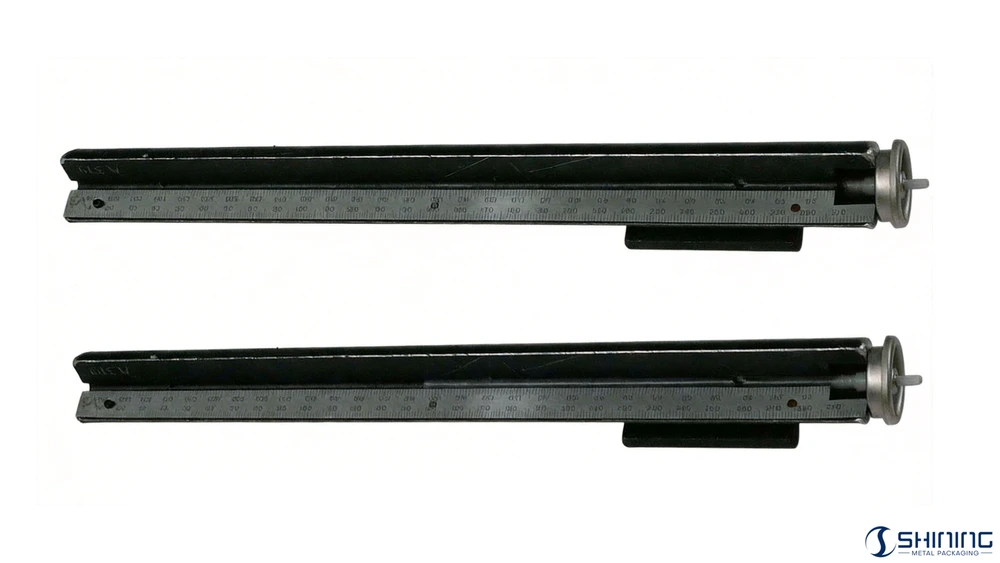
Measurement Gauge – FBOC
The FBOC gauge ensures the diptube is held straight during measurement, which is critical for repeatability and accuracy.
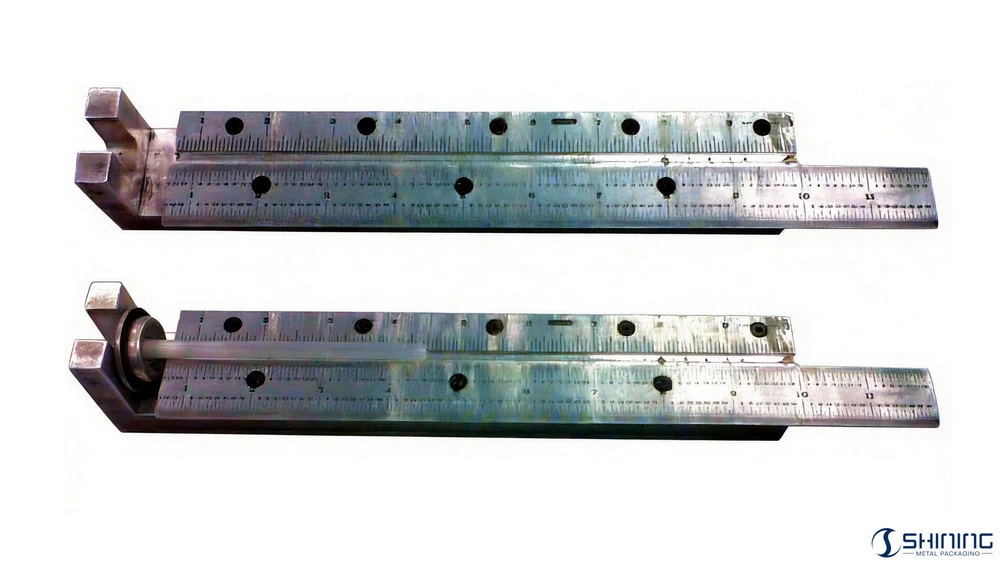
Measurement Gauge – FTMC
FTMC lengths cannot be measured using the same gauge as FBOC. A separate rule-type gauge is used, with the zero reference at the top of the mounting cup.
Reporting
Diptube length shall be reported in millimetres and always accompanied by the reference definition (FBOC, FSMS/FBOG, FTMC, or Visible).
B. Measurement of Diptube Length Growth
Certain formulations and propellants can cause diptube materials to expand or shrink after filling. This effect usually stabilises within the first 24 hours.
Test Procedure Summary
- Cut three diptubes to the intended nominal length
- Measure and record initial length (L1)
- Fill aerosol with final formulation and propellant ratio
- Condition at 50 °C ± 1 °C for 3 minutes
- Store at ambient temperature for 48 hours
- Depressurise safely and re-measure (L2)
Growth (or shrinkage) is calculated as:
Growth = (L2 − L1) / L1 × 100
C. Measurement of Diptube Curvature
A perfectly straight diptube is undesirable. If completely straight, it can rest on the container dome and hold the valve too high, causing clinching problems.
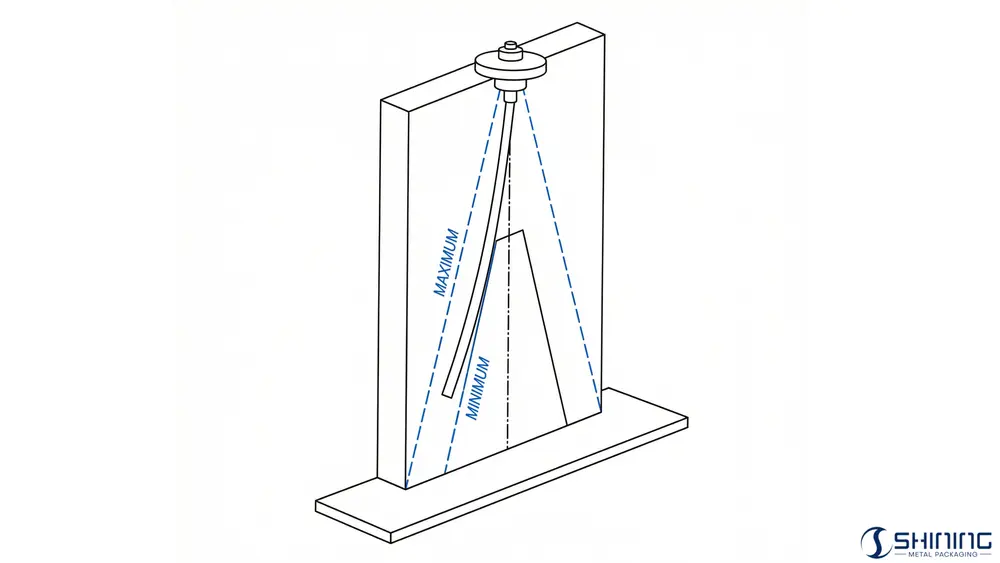
Curvature Measurement Jig
Procedure
The valve is placed in the centre of the jig and rotated. The diptube curvature is acceptable if it rests between the minimum and maximum reference cones.
FEA 648 does not specify numerical curvature limits. These must be agreed between customer and supplier, including sampling plans and AQLs.
Download the Standard PDF
FEA 648 standard describing methods for measuring aerosol valve diptube length, evaluating diptube growth caused by product formulations, and assessing diptube curvature. It defines procedures to ensure correct valve function, proper container evacuation, and reliable aerosol manufacturing performance.
FAQ – Engineering & QA
No. It defines how to measure length accurately so that specifications can be agreed and verified consistently.
Not always, but certain solvent or propellant systems can produce measurable growth that must be compensated during design.
Yes. A small, controlled curvature is necessary to prevent the diptube from supporting the valve during clinching.
Yes, but only by separate agreement. FEA 648 provides a comparative jig method rather than fixed values.
No. FEA 648 is defined for valves with 25.4 mm mounting cups.