
A tomato sauce and a cheese sauce may use the same can size, but they do not create the same packaging conditions.
Internal coating performance depends on the actual food formulation: pH, acidity, salt, fat, protein, solids, additives, and thermal process. These factors can affect corrosion, coating adhesion, migration, staining, blistering, and long-term barrier performance.
The product name alone is not enough. Under FDA definitions, foods with a finished equilibrium pH above 4.6 and water activity above 0.85 are generally considered low-acid foods, while acidified foods have an equilibrium pH of 4.6 or below and water activity above 0.85. Pizza sauce, chili, or curry sauce cannot be classified reliably from the label alone.
For can selection, the better question is: What formulation and process will the package actually face?
1. Common Products Packed in Sauce & Dairy Cans
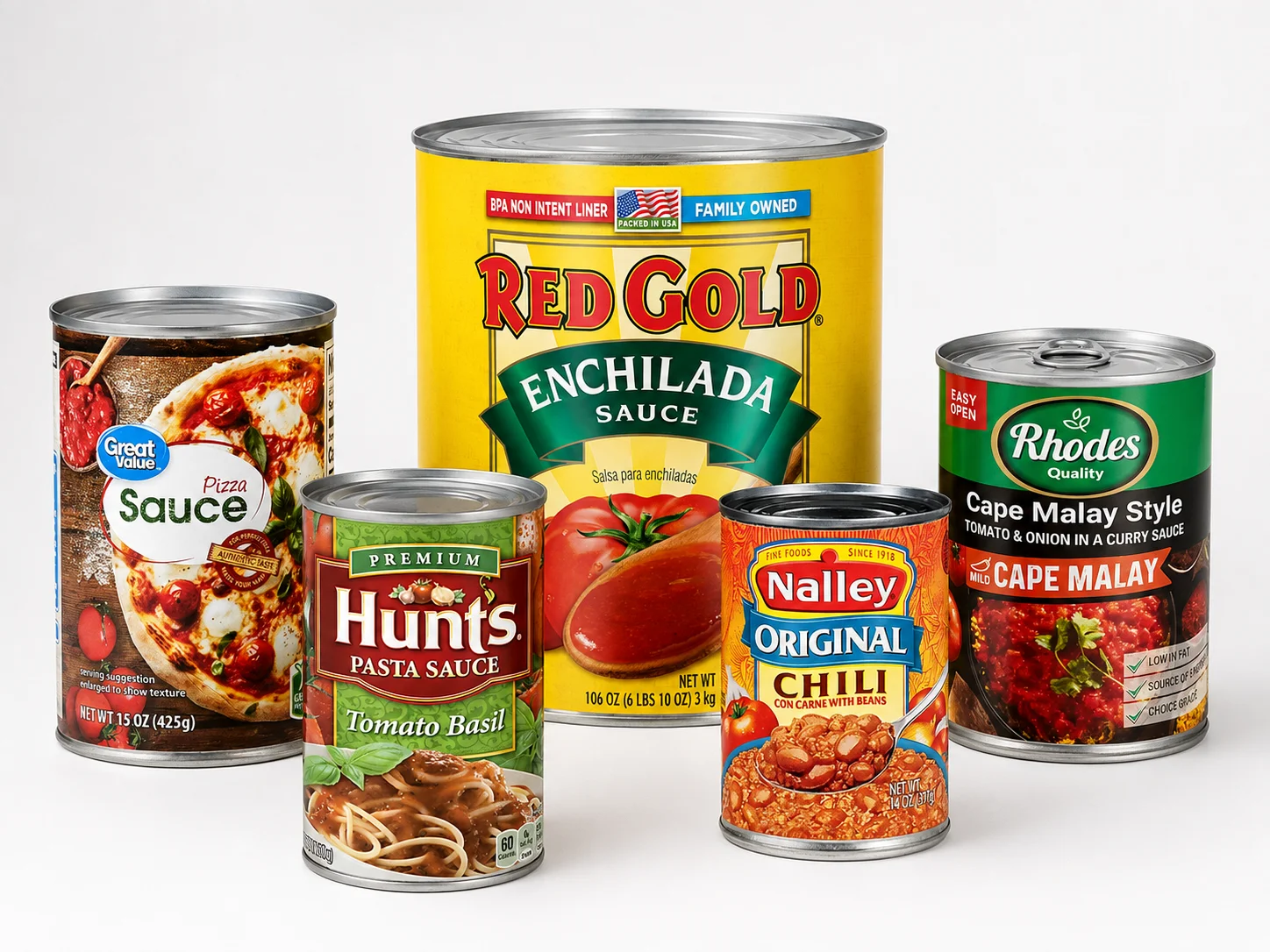
Sauce and dairy products can be divided into several practical groups:
- Acid and tomato-based sauces: pizza sauce, pasta sauce, enchilada sauce, some chili and curry sauces
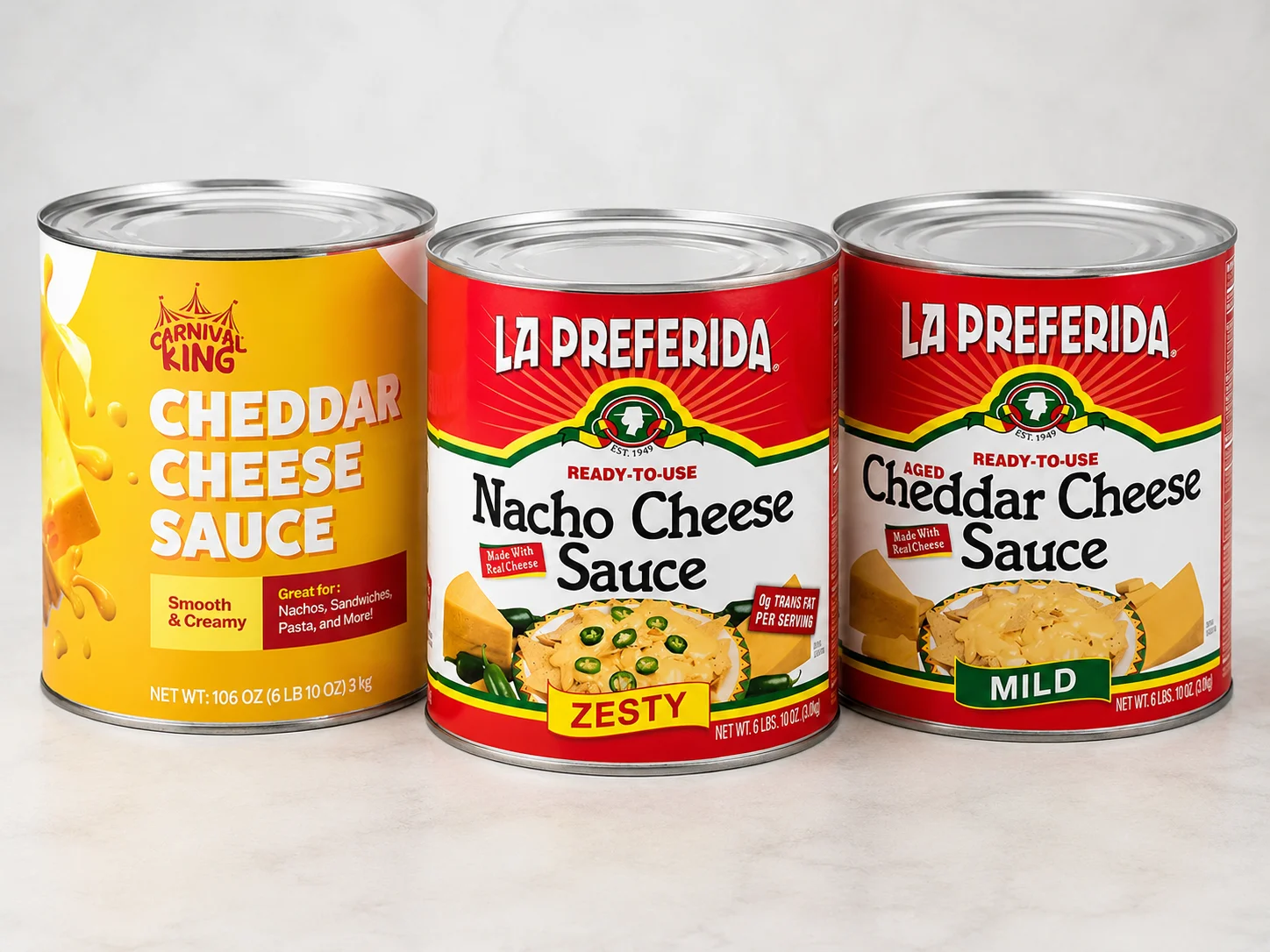
- Cheese and dairy sauces: cheese sauce, nacho cheese sauce, cheddar cheese sauce
- Meat-based products: beef gravy, chicken gravy, meat chili, meat curry
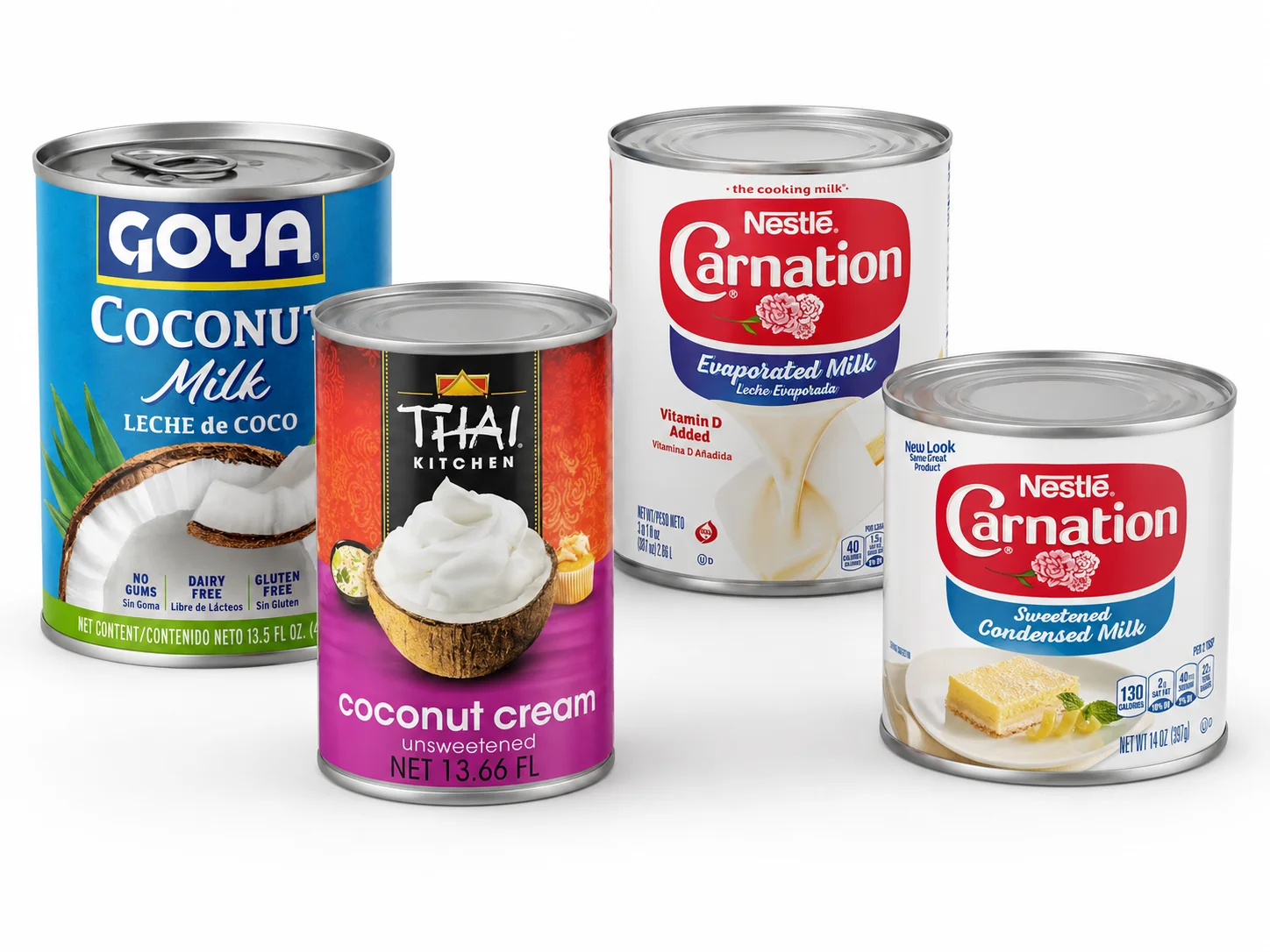
- Coconut products: coconut milk and coconut cream
- Concentrated dairy products: evaporated milk and sweetened condensed milk
Each group creates a different chemical environment inside the can.
1.1 Acidity, Salt, and Coating Resistance
For tomato-based sauces, finished pH matters, but it should not be used alone.
Titratable acidity, acid type, chloride concentration, and thermal process also affect the food–coating system. FDA food-contact guidance notes that acidic conditions may require evaluation using media such as water and 3% acetic acid when acidity can materially affect migration or material performance. (source)
Salt deserves the same attention.
A study from Ohio State University on BPA-NI coated tinplate found that, under its test conditions, 3.5 wt% NaCl was one of the most damaging environments tested. Low pH and nitrate also increased coating degradation. (source)
This does not mean every coating will fail at 3.5% salt. It does show why chloride concentration should be included when qualifying cans for sauces, gravy, chili, and cheese products.
Two sauces with the same pH but salt levels of 0.5% and 3% should not automatically receive the same packaging specification.
Coating color is also a poor basis for selection. Gold, white, or clear mainly describes appearance. Actual resistance depends on resin chemistry, cure, film weight, coating continuity, substrate, and pack performance.
1.2 Fat, Dairy Ingredients, and Food-Contact Compatibility
High-fat foods should not simply be treated as “more corrosive.”
Fat changes the food-contact environment and can affect migration and coating compatibility. FDA guidance for food-contact materials uses edible oils as demanding simulants for fatty-food applications and requires test conditions to reflect the intended temperature and contact time.
This is relevant to coconut milk, coconut cream, cheese sauce, nacho cheese sauce, and evaporated milk.
The useful requirement is not “use a thicker lacquer.” The coating needs to be validated for fatty-food contact, the intended thermal process, and the required shelf life.
Coconut milk shows why fat percentage alone is not enough.
Under Codex CXS 240-2003:
- light coconut milk has a minimum fat content of 5%;
- coconut milk, 10%;
- coconut cream, 20%;
- coconut cream concentrate, 29%.
The standard also specifies a minimum pH of 5.9 and describes coconut milk as an emulsion that requires suitable heat treatment before or after sealing to prevent spoilage. (source)
From a packaging perspective, coconut milk is therefore a low-acid, high-fat, aqueous emulsion exposed to thermal processing.
Additives can change the picture again.
A 2021 Journal of Food Engineering study on epoxy-phenolic coated tinplate cans for coconut milk examined guar gum, CMC, polysorbate 60, citric acid, and sodium metabisulfite. Sterilization reduced coating performance, and under the tested conditions sodium metabisulfite and CMC showed the most aggressive effects, including blister formation. The study linked blister development to penetration of Na⁺, water, and oxygen through the coating. (source)
So for coconut milk cans, stabilizers, thickeners, emulsifiers, and preservatives should be included in pack-compatibility evaluation.
Evaporated milk creates a different combination.
Codex specifications for standard evaporated milk require at least 7.5% milk fat and 25% milk solids, while high-fat evaporated milk can contain at least 15% milk fat. Permitted formulation systems may also include citrates, phosphates, chlorides, carrageenan, and lecithin.
The coating therefore faces:
fat + protein + mineral ions + high solids + thermal processing.
Retort resistance, adhesion, migration performance, ionic resistance, flavor neutrality, and long-term barrier integrity all matter.
Sweetened condensed milk should not simply use the same assumptions.
Codex CXS 282-1971 specifies at least 8% milk fat and 28% milk solids for standard sweetened condensed milk, while the high-fat version contains at least 16% milk fat.
High sugar content does not automatically mean higher corrosion. Sugar changes solids content, water activity, viscosity, and the structure of the food matrix. Actual coating behavior still depends on pH, salts, additives, coating chemistry, and processing.
1.3 Cheese Sauce, Gravy, and Other Complex Foods
Cheese sauces combine several variables at once: milk fat, protein, sodium and chloride, phosphates or citrates, emulsifying salts, starches or gums, and sometimes peppers or tomato ingredients.
A specification such as “food-grade gold lacquer” says very little about whether the can will survive the actual pack.
Commercial coating systems have increasingly moved toward non-BPA/BPA-NI technologies. Sherwin-Williams, for example, describes its V30/V60 polyester food-can systems as retort-capable platforms for D&I cans, three-piece food cans, and closures. (source)
That does not mean polyester is automatically the right coating for every cheese sauce. Resin system, coating weight, cure, substrate, formulation, and retort conditions still need pack testing.
Protein-rich products such as beef gravy, chicken gravy, meat chili, and meat curry bring another issue: sulfur-related staining and coating compatibility.
Sulfur resistance remains a specified property in some food-can coating platforms. AkzoNobel, for example, describes food-can internal coating systems with high-barrier and sulfur-resistant properties for three-piece cans. (source)
For protein-rich products, sulfur resistance may therefore be part of the coating-selection criteria, particularly when retort processing is involved.
2. Internal Coating Requirements for Sauce & Dairy Cans
Internal coating selection should begin with the finished formulation, not with coating color.
Useful qualification data include:
- equilibrium pH and titratable acidity;
- salt and chloride concentration;
- fat and protein content;
- sugar, Brix, and total solids;
- starches and gums;
- sulfites and preservatives;
- emulsifiers;
- filling temperature;
- retort temperature and time;
- target shelf life.
These values describe the actual exposure environment.
Salt and acids affect the chemical conditions at the coating surface. Fat changes migration and compatibility requirements. Protein-rich foods may create sulfur-related concerns. Gums and starches affect viscosity, while some additives may interact directly with the coating.
Thermal processing adds another stress.
The coating has to maintain adhesion and barrier performance after exposure to heat, moisture, pressure, and the food formulation at the same time. Blistering, loss of adhesion, staining, or increased permeability may only become visible after retort.
Shelf life also has to be considered. A coating that looks acceptable immediately after processing has not necessarily demonstrated acceptable performance after 12, 24, or 36 months.
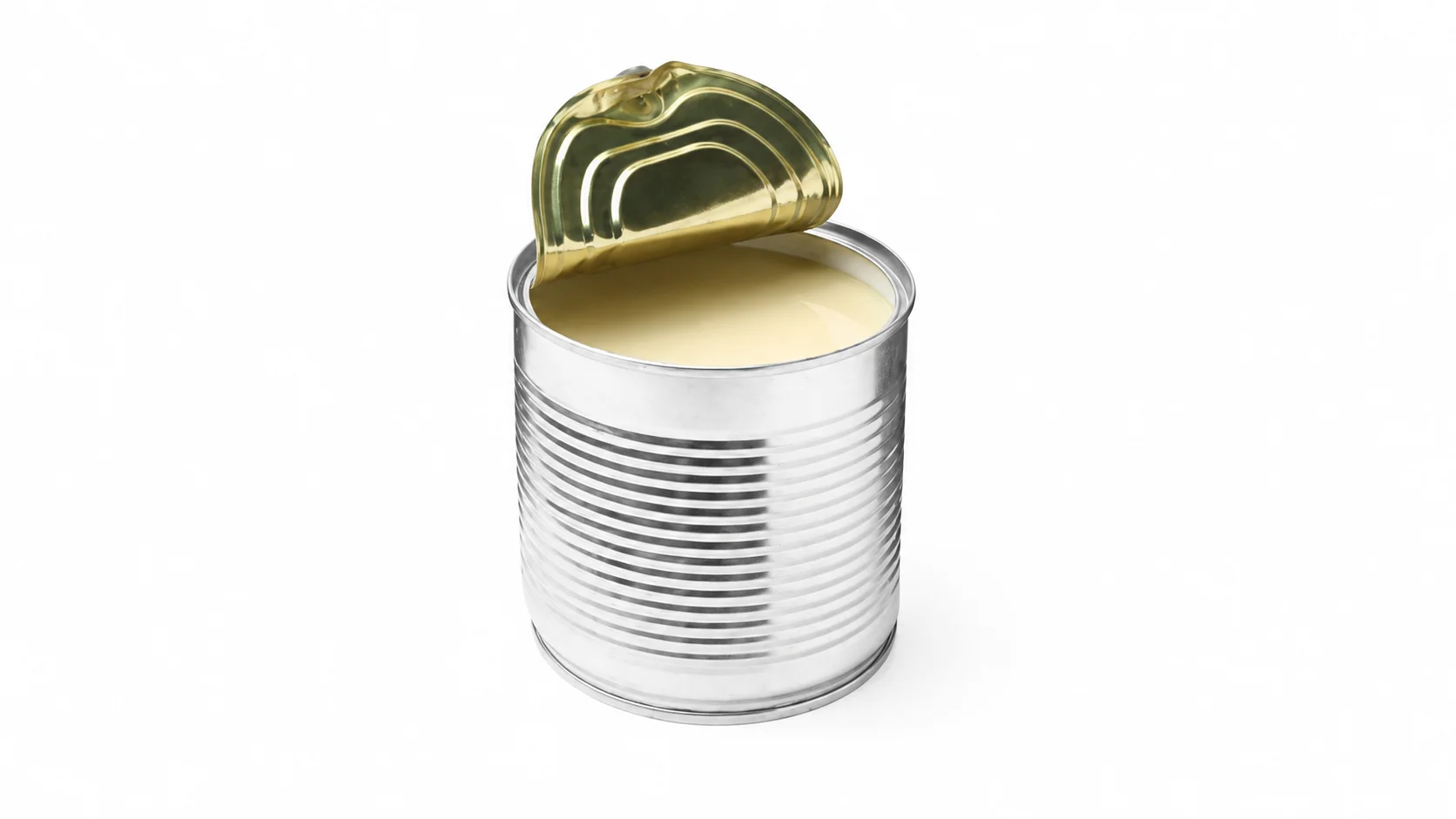
For this reason, a food–coating compatibility matrix combined with actual pack testing is more useful than assigning one generic lacquer to an entire product category.
3. Retort Processing and Heat Resistance
Many sauce and dairy products are thermally processed after closing, so retort resistance is part of the package specification.
Changes in retort temperature, holding time, filling temperature, product solids, container size, or viscosity can change the conditions experienced by both the product and the package.
Viscosity is particularly relevant for cheese sauce, gravy, chili, and thick pasta sauces.
FDA guidance recognizes sauce viscosity as a possible critical factor in a scheduled thermal process. Heating may occur through convection, conduction, or a combination of both, and product consistency affects heat penetration.
A formulation change involving starch, gum, particle size, fill weight, or viscosity therefore should not be treated as a minor packaging detail.
Headspace also matters. FDA guidance notes that insufficient headspace may affect thermal processing and vacuum formation and can contribute to conditions such as flippers or springers. Excessive headspace may leave too much air in the container and accelerate deterioration of the product or package.
The thermal process remains the responsibility of the processor and its process authority. From the can manufacturer’s side, the point is simple: a change in product or container conditions may require the process to be reviewed again.
4. Double Seam and Sealing Requirements
For sauce and dairy cans, a suitable internal coating still depends on a reliable closure system.
The can body, end profile, sealing compound, seamer settings, and process conditions need to work together. For fatty, salty, acidic, or retorted products, sealing compound compatibility should be evaluated against the intended product and process rather than judged only by whether the end can be mechanically closed.
Three-piece cans need additional attention at the welded side seam.
Welding interrupts the original body coating, so a side-seam stripe or repair coating is applied over the weld area. For retorted sauces and dairy products, this stripe is part of the food-contact protection system, not a cosmetic finish.
QC should check stripe continuity, weld coverage, cure, adhesion, and exposed metal.
Double-seam inspection also needs defined controls.
For low-acid canned foods, FDA inspection guidance specifies that visual double-seam examinations should be performed at intervals of no more than 30 minutes of operating time, with additional checks after events such as seamer jams, adjustments, or extended shutdowns.
Teardown examinations by trained closure personnel should be performed at intervals not exceeding 4 hours of operating time, including at least one can from each seaming head.
Typical checks include body hook, cover hook, seam width, thickness, tightness, and overlap.
These inspection frequencies do not create a universal seam specification. Exact seam dimensions and acceptance limits should follow the approved specification for the specific can, end, sealing compound, and seamer, as well as the regulations of the destination market.
5. How to Choose the Right Sauce or Dairy Can
A practical can-selection process starts with four sets of information.
Food formulation: equilibrium pH, titratable acidity, salt or chloride, fat, protein, sugar or Brix, total solids, and relevant additives.
Product structure: viscosity, particle size, starches, gums, emulsifiers, and preservatives.
Process conditions: filling temperature, fill weight, headspace, retort temperature, and process time.
Package requirements: can size, can construction, end system, sealing compound, side-seam protection where applicable, and target shelf life.
From there, the internal coating can be matched to the real chemical and thermal environment and confirmed through pack testing.
For three-piece cans, the body coating, side-seam stripe, end coating, sealing compound, and finished seam should be treated as one packaging system.
6. Conclusion
The right sauce or dairy can is determined by formulation and process conditions, not by lacquer color or the product name.
Tomato sauces bring acidity and chloride into the qualification process. Cheese sauces add fat, protein, salts, emulsifiers, and viscosity. Coconut milk combines high fat, an aqueous emulsion, additives, and retort processing. Meat products may require attention to sulfur resistance.
Before selecting the coating and closure system, obtain the actual formulation, thermal process, and shelf-life requirements.
Those values provide a much better basis for can qualification than simply asking whether the customer needs a “gold lacquer can.”