
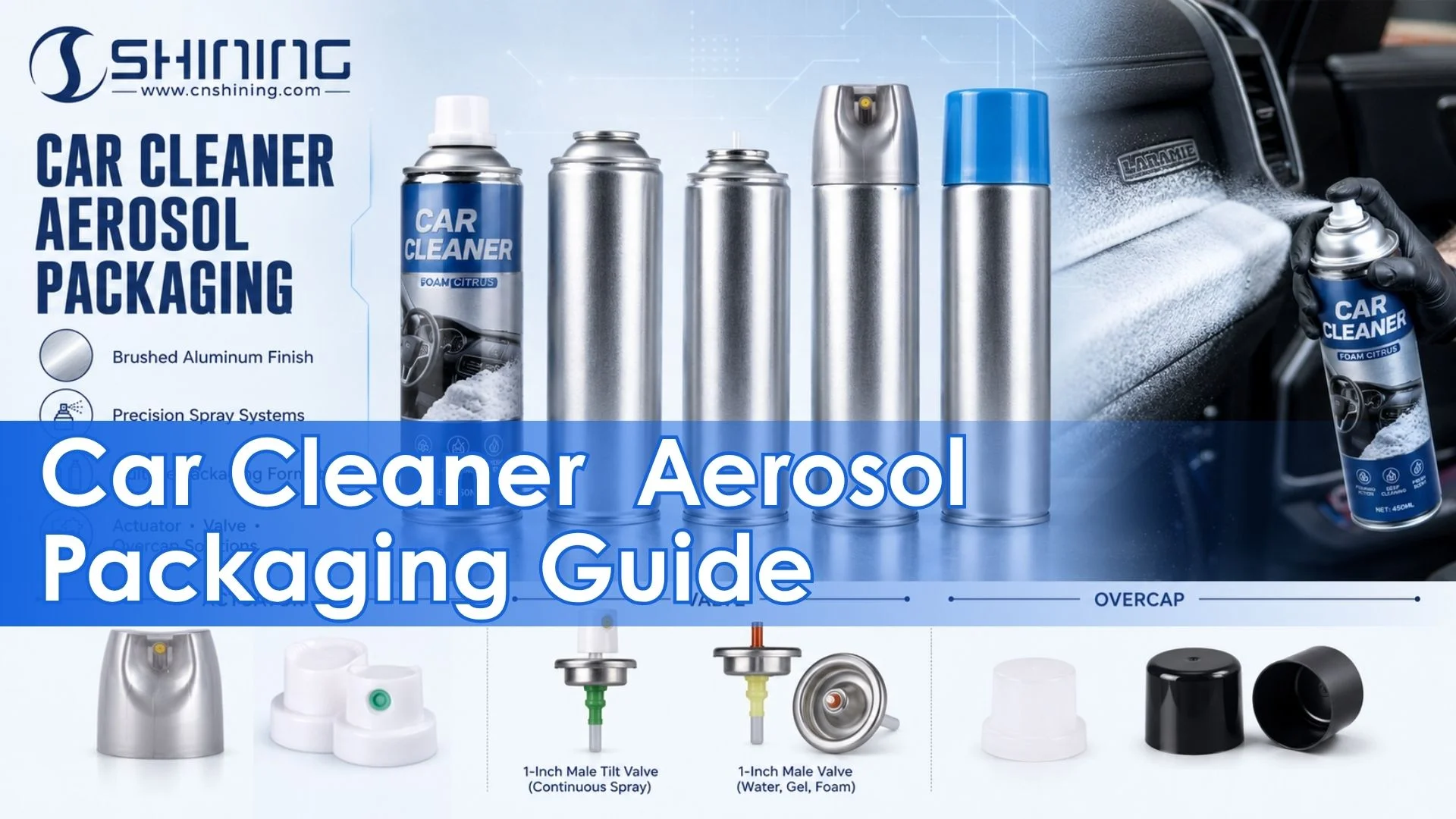
A car cleaner aerosol spray is not just cleaner filled into a metal can. It is a coupled system: cleaning chemistry, propellant, valve, actuator geometry, can material, internal coating, corrosion control, and transport classification all have to work together.
That is why two products with similar ingredients can feel completely different in use. One sprays a controlled fine mist. Another wets the seat, leaves marks on piano-black trim, or smells too sharp in a closed cabin. The difference is often not only the formula. It is the formula-packaging interface.
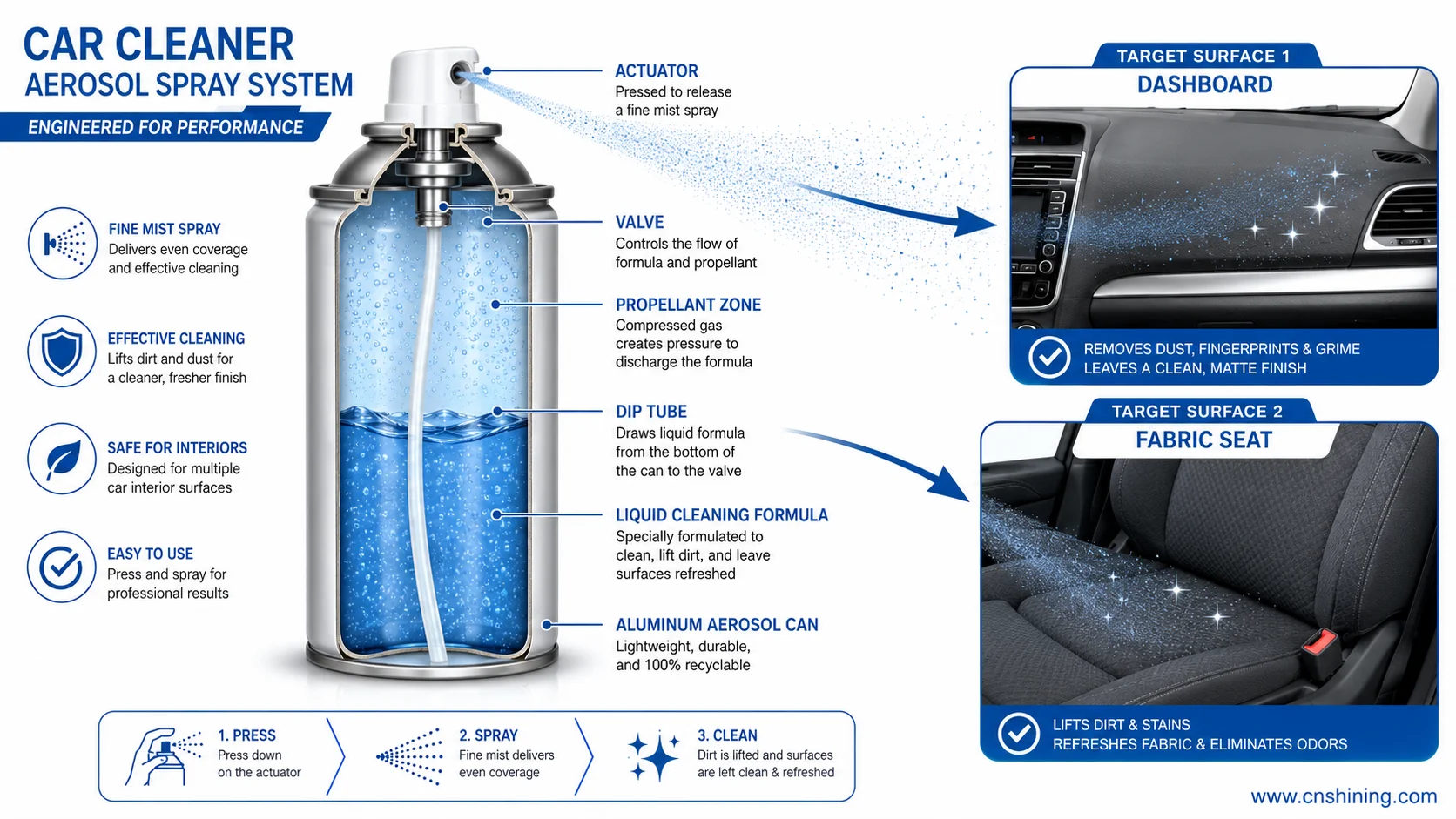
1. What a Car Cleaner Aerosol Spray Really Is
The legal and technical starting point is controlled release. The EU Aerosol Dispensers Directive defines an aerosol dispenser as a non-reusable metal, glass, or plastic container holding compressed, liquefied, or dissolved gas under pressure, with a release device that discharges liquid, foam, paste, powder, or droplets. The Tokyo health authority gives a similar practical definition for aerosol products: propellant gas and liquid are sealed in a valved container, and gas pressure pushes the liquid out through the valve.
For automotive interior cleaner aerosol products, this means the first engineering question is not “how strong is the cleaner?” The first question is: can the system release the cleaner at the right flow rate, droplet size, spray angle, and surface wetting level?
In real use, drivers expect speed, reach, and uniform coverage. Aerosol cleaning spray performs well here because it can reach seams, vents, fabric texture, door panels, and other small gaps faster than a trigger bottle. But the same advantage becomes a problem when the spray is too aggressive.
2. Spray Mechanism and Formula Architecture
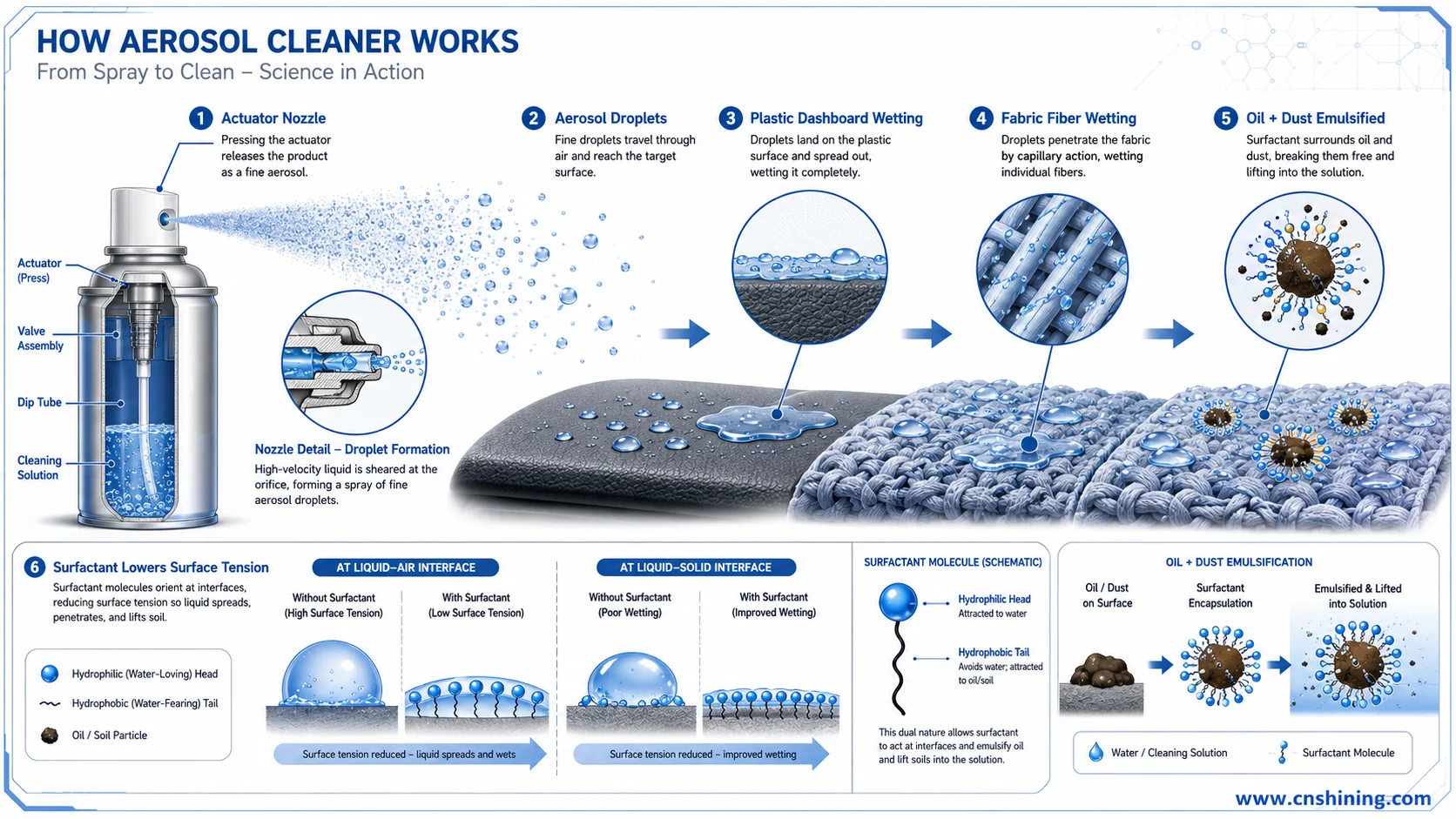
The spray sequence is simple in theory: pressure difference inside the can opens the valve, liquid moves through the dip tube, passes the valve stem and actuator orifice, breaks into droplets, lands on the surface, wets the soil, dissolves or emulsifies it, then carries dirt away during wiping.
The practical behavior is controlled by several variables: liquid viscosity, surface tension, propellant type, valve restriction, actuator swirl design, discharge speed, ambient air, and surface energy. Public patent literature such as US6969698B2 aerosol cleaner shows why modern aerosol cleaners often combine water, surfactants, hydrotropes, alcohols or glycol ethers, corrosion inhibitors, pH control, and propellant in one system.
Typical car soil is mixed. It may include skin oil, dust, road grime, drink residue, sugar, protein stains, smoke odor, plasticizer migration, and light oxidation products. A single ingredient cannot solve all of that. The working formula normally relies on solvent action, surfactant wetting, emulsification, odor masking or neutralization, and controlled drying.
| Component | Main Function | Commercial Meaning |
|---|---|---|
| Water | Main solvent, heat capacity, cost control, lower flammability | Supports low-VOC and lower-odor positioning |
| Alcohols / glycol ethers | Dissolve oily soil, improve drying, support fast cleaning | Better cleaning speed, but higher odor, irritation, VOC, and flammability pressure |
| Anionic / nonionic / amphoteric surfactants | Reduce surface tension, wet, foam, and emulsify soil | Controls spreading, foam quality, residue, and hand feel |
| Hydrotropes | Keep fragrance and hydrophobic actives stable in water phase | Reduces haze, separation, and shelf instability |
| Propellant | Provides discharge pressure and atomization energy | Impacts odor, flammability, VOC profile, and transport class |
| Corrosion inhibitor / chelant / preservative | Protect can and formula from corrosion or microbial failure | Controls shelf life and can compatibility |
| Fragrance / odor-control system | Masks or neutralizes cabin odor | Directly affects reviews, complaints, and repeat purchase |
| pH adjuster | Improves cleaning and reduces material risk | Important for fabric, leather, plastic, and coated trims |
3. Formula Types and Technical Terms
Most car cleaner aerosol spray products fall into five practical groups. The boundaries are not fixed, but this classification is useful for packaging engineers, formulators, and product managers.
| Formula Type | Typical Use | Key Ingredients | Typical Range | Safety Point |
|---|---|---|---|---|
| Water-based fine mist cleaner | Dashboard, door panels, screen area, plastic trim | Water, low-foam surfactant, small amount of alcohol or ether, fragrance, preservative, propellant | Water 40–90%; surfactant 0.1–5%; organic co-solvent 1–10%; propellant 3–20% | Control droplets on screens, coated surfaces, and glossy black trim |
| Foam fabric and seat cleaner | Carpet, fabric seat, headliner | Foaming surfactant, solvent, foam propellant, deodorizer | Surfactant 1–8%; solvent 2–15%; propellant 5–25% | Watch for over-wetting, ring marks, and colorfastness |
| Heavy-duty degreasing aerosol | Engine bay, brake area, metal parts | Strong solvent, solvent-type surfactant, fast-dry system, propellant | Solvent 20–80%; propellant 10–30% | Higher fire, material compatibility, VOC, and shipping risk |
| Low-VOC BOV / compressed gas system | Fine interior care and odor-sensitive use | Water-based formula, compressed air or nitrogen, bag isolation | Formula can be close to non-aerosol liquid; propellant is separated | Higher BOM, but cleaner odor and better formula stability |
| Odor / “new car smell” spray | Cabin air and fabric surface | Fragrance, odor neutralizer, alcohol or water system | Fragrance 0.1–1%; odor-control system 0.1–2% | Common complaints: too sharp, fake smell, short duration, irritation |
| Term | Simple Explanation | Why It Matters |
|---|---|---|
| Aerosol dispenser | Pressurized disposable container with a valve-based release system | Determines aerosol regulation and dangerous goods handling |
| Propellant | Gas that provides discharge pressure | Affects VOC, flammability, odor, and transport |
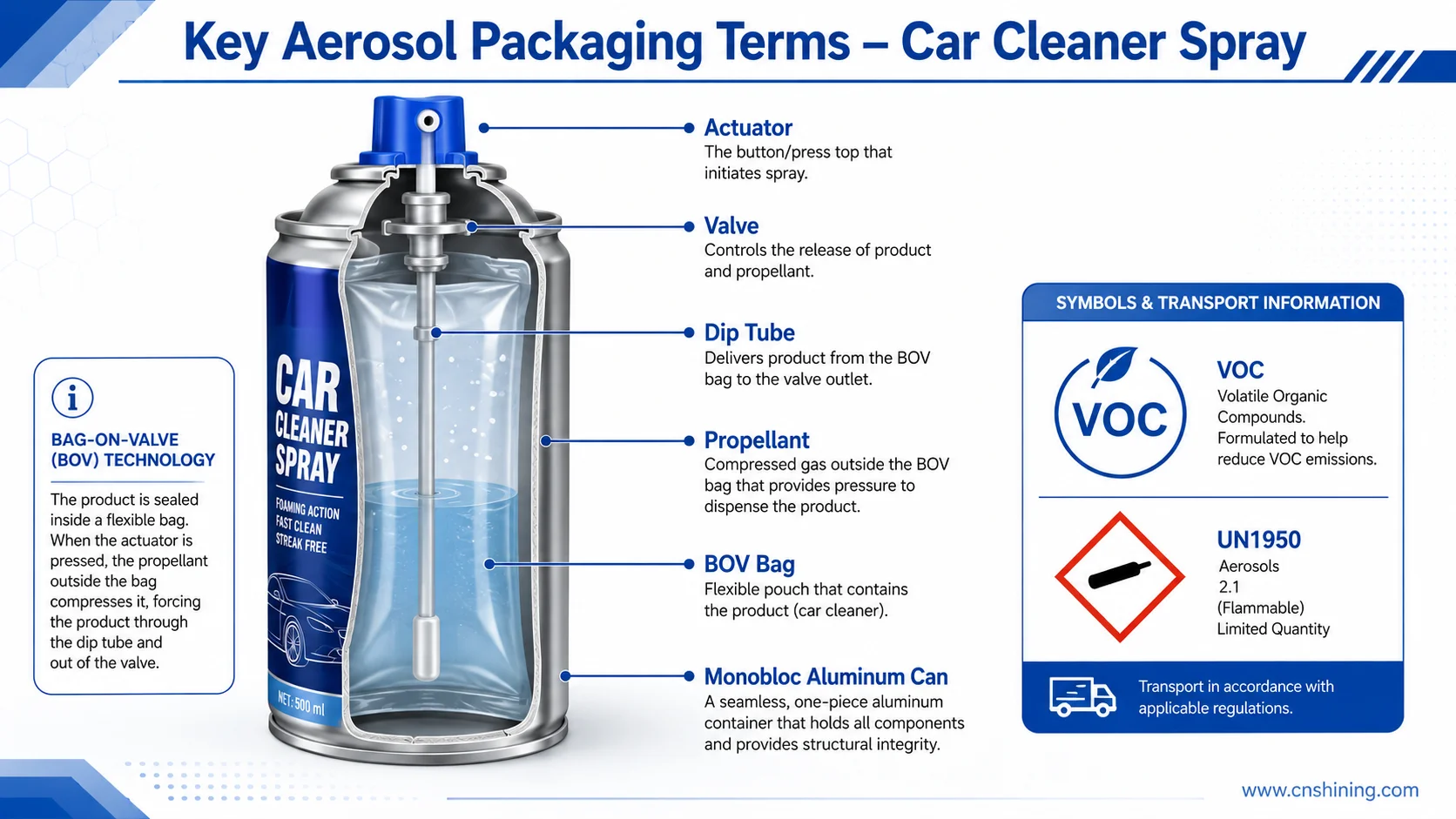
| BOV | Bag-on-Valve system that separates product from propellant | Supports low odor, nearly full evacuation, and 360° use |
| LPG | Liquefied petroleum gas propellant | Low cost and mature, but flammable and may leave odor traces |
| DME | Dimethyl ether | Good solvency and atomization, but flammable and compatibility-sensitive |
| VOC | Volatile organic compound | Controls regulatory status and environmental claims |
| Actuator | Button or spray head that controls discharge pattern | Directly affects overspray, wetting, control, and user rating |
| Metered valve | Valve that releases a fixed dose per actuation | Useful for odor or functional sprays |
| Continuous valve | Valve that sprays while pressed | Common for cleaning and larger-area coverage |
| Monobloc can | One-piece extruded aluminum aerosol can | Good pressure performance, print quality, and premium appearance |
4. Competitive Formats
Traditional aerosol fine mist still has a strong reason to exist. It gives fast coverage, gap reach, and a clear “it works now” feeling. The weakness is the same user experience can become uncontrolled: strong odor, high discharge, leakage, overspray, flammability labeling, or shipping restriction.
| Format | Strengths | Weaknesses | Best Use | Business Judgment |
|---|---|---|---|---|
| Traditional aerosol fine mist | Fast coverage, good gap reach, easy use, strong instant feel | VOC, flammability, transport pressure, possible propellant odor, leakage, overspray | Dashboard, large seat area, fast refresh | Still strong for experience-led products |
| Foam aerosol | Better dwell time, lower running, useful for fabric and headliner | Can create wet marks, dry boundary marks, and brushing workload | Carpet, fabric seat, headliner | Better as a problem-solving SKU than an all-surface product |
| Trigger spray | Better dose control, easier transport, lower odor, easier regulatory path | Less fine spray feel, weaker gap reach and uniformity | Daily maintenance and low-VOC positioning | The most realistic substitute for traditional aerosol |
| BOV / compressed gas aerosol | Product isolated from propellant, near full evacuation, 360° use, cleaner odor | Higher cost; some users do not see why it costs more | Mid-to-high-end interior spray and sensitive-user products | Strong route for compliance and premium control |
| Pre-wet wipes | Low leakage, low shipping risk, fixed dose | Higher unit cost, weaker heavy-soil cleaning, more waste | Fleet, convenience, emergency cleaning | Good companion SKU, not the main cleaning hero |
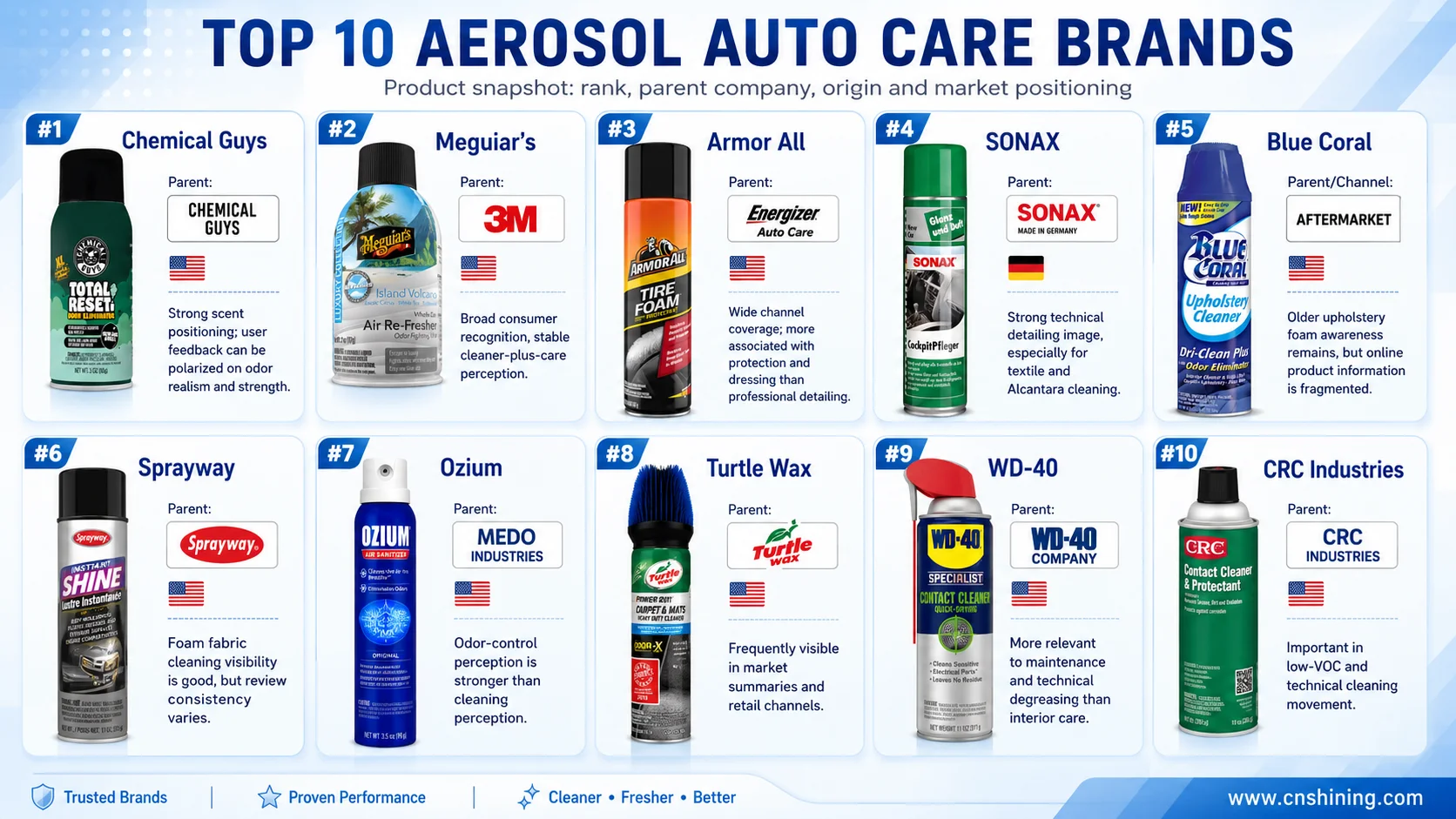
5. Top 10 Automotive Cleaner Aerosol Brands
| Brand | Country | Parent Company | Common Size | Public Retail | Technical Comment |
|---|---|---|---|---|---|
| Chemical Guys | United States | Chemical Guys | 16 fl oz | about 9.87$ | Strong scent positioning; user feedback can be polarized on odor realism and strength. |
| Meguiar’s | United States | 3M | 19 oz / 15.2 oz | about 6.57$ | Broad consumer recognition, stable cleaner-plus-care perception. |
| Armor All | United States | Energizer Auto Care | 19 oz / 8 oz | about 3.35$ | Wide channel coverage; more associated with protection and dressing than professional detailing. |
| SONAX | Germany | SONAX GmbH | 400 ml | about 16.12$ | Strong technical detailing image, especially for textile and Alcantara cleaning. |
| Blue Coral | United States | Aftermarket channel visibility | About 18–20 oz / 2-pack | about 8.72$ | Older upholstery foam awareness remains, but online product information is fragmented. |
| Sprayway | United States | Sprayway Inc. | 19–20 oz | about 3.24$ | Foam fabric cleaning visibility is good, but review consistency varies. |
| Ozium | United States | Medo Industries | 3.5 oz | about 5.99$ | Odor-control perception is stronger than cleaning perception. |
| Turtle Wax | United States | Turtle Wax | 18 oz | about 13.99$ | Frequently visible in market summaries and retail channels. |
| WD-40 | United States | WD-40 Company | 16oz | about 15.39$ | More relevant to maintenance and technical degreasing than interior care. |
| CRC Industries | United States | CRC Industries | 16oz | about 14.53$ | Important in low-VOC and technical cleaning movement. |
6. User Pain Points and Packaging Design Choices
User complaints are concentrated. The repeated issues are not abstract: odor too strong, odor not close to “new car,” short fragrance life, nozzle or bottle leakage, overspray, watermarks, wet seats, delivery damage, price sensitivity, and poor fit for chemically sensitive users.
These issues are packaging problems as much as formula problems. If the valve output is too high, even a mild water-based cleaner can wet a seat. If the actuator has poor breakup, droplets become coarse and leave visible residue. If the locking design is weak, e-commerce leakage becomes a review problem.
| Design Choice | Pain Point Solved | Technical Method | Benefit | Trade-off |
|---|---|---|---|---|
| BOV + compressed air or nitrogen | Propellant odor, flammability concern, poor evacuation, inverted-use limitation | Use bag-on-valve; separate formula from propellant | Cleaner odor, 360° use, better low-VOC story | Higher cost and more complex filling |
| Low-flow fine mist actuator | Overspray, watermarks, wet spots | Reduce output and refine orifice / swirl geometry | Better for dashboard, screen area, and glossy trim | May reduce heavy-soil cleaning speed |
| Dual-spray actuator | One spray pattern cannot handle all cabin areas | Fine mist for broad surfaces, narrow or fan spray for seams and spot soil | More controlled use from one SKU | Higher mold and BOM cost |
| Twist-to-lock or lockable actuator | Transport leakage and accidental discharge | Mechanical lock or dual-trigger protection | Lower logistics loss and fewer leakage complaints | User education may be needed |
| Water-based low-VOC compatible lining | Can corrosion, odor deterioration, shelf-life failure | Match internal coating with water, alcohol, surfactant, and corrosion inhibitor package | Allows greener formula to survive storage | Compatibility testing takes time |
| High-information label design | Misuse, overuse, wrong material application | Use spray-pattern icons, material map, warning symbols, QR batch traceability | Reduces misuse and supports technical trust | Layout becomes harder to design cleanly |
7. Shining Packaging: Aerosol Cans, Valves, and Actuators for Car Cleaner Aerosol Spray
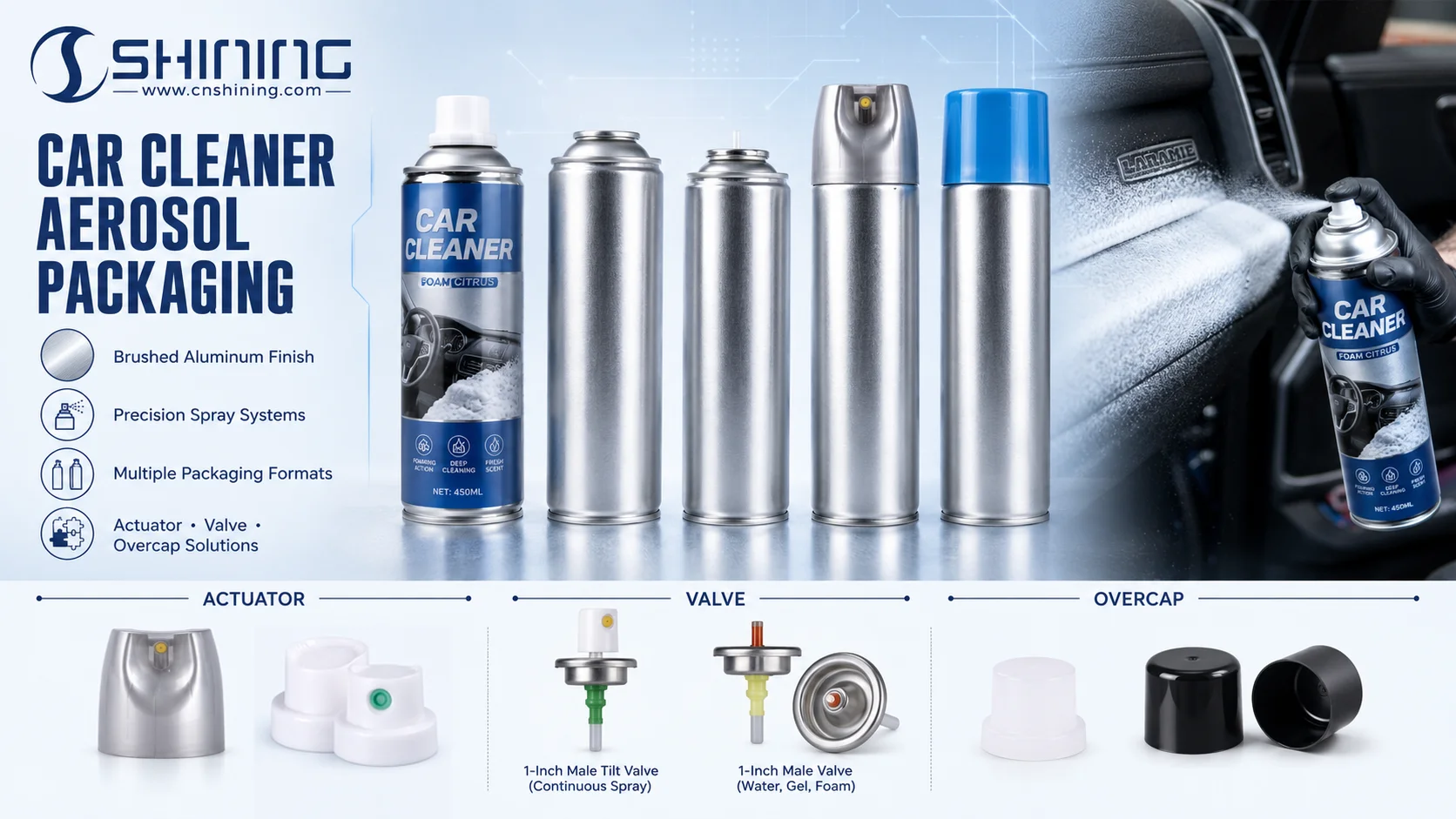
For car cleaner aerosol spray, packaging is part of the cleaning performance. Shining Packaging’s relevant work is mainly around aerosol cans, valves, and actuators. These parts decide how the cleaner leaves the container, how stable the can remains during storage, and how much control the user has during spraying.
For interior cleaner, the more useful direction is usually not a high-output spray head. It is a stable can structure, compatible valve system, and actuator that can deliver a finer, lower-flow mist. For fabric foam cleaner, dwell time and foam texture matter more. For technical degreasing aerosol, pressure performance, solvent compatibility, valve reliability, and clear warning communication become more important.
Shining Packaging can be positioned naturally in this context: not as a formula owner, but as a packaging-side partner for brands and fillers that need cans, valves, and actuators matched to water-based cleaner, foam cleaner, BOV concepts, or traditional solvent aerosol formats. The engineering work should start from the use case: dashboard mist, upholstery foam, odor spray, or parts degreaser. The same actuator cannot be optimal for all four.
8. Regulatory and Dangerous Goods Considerations
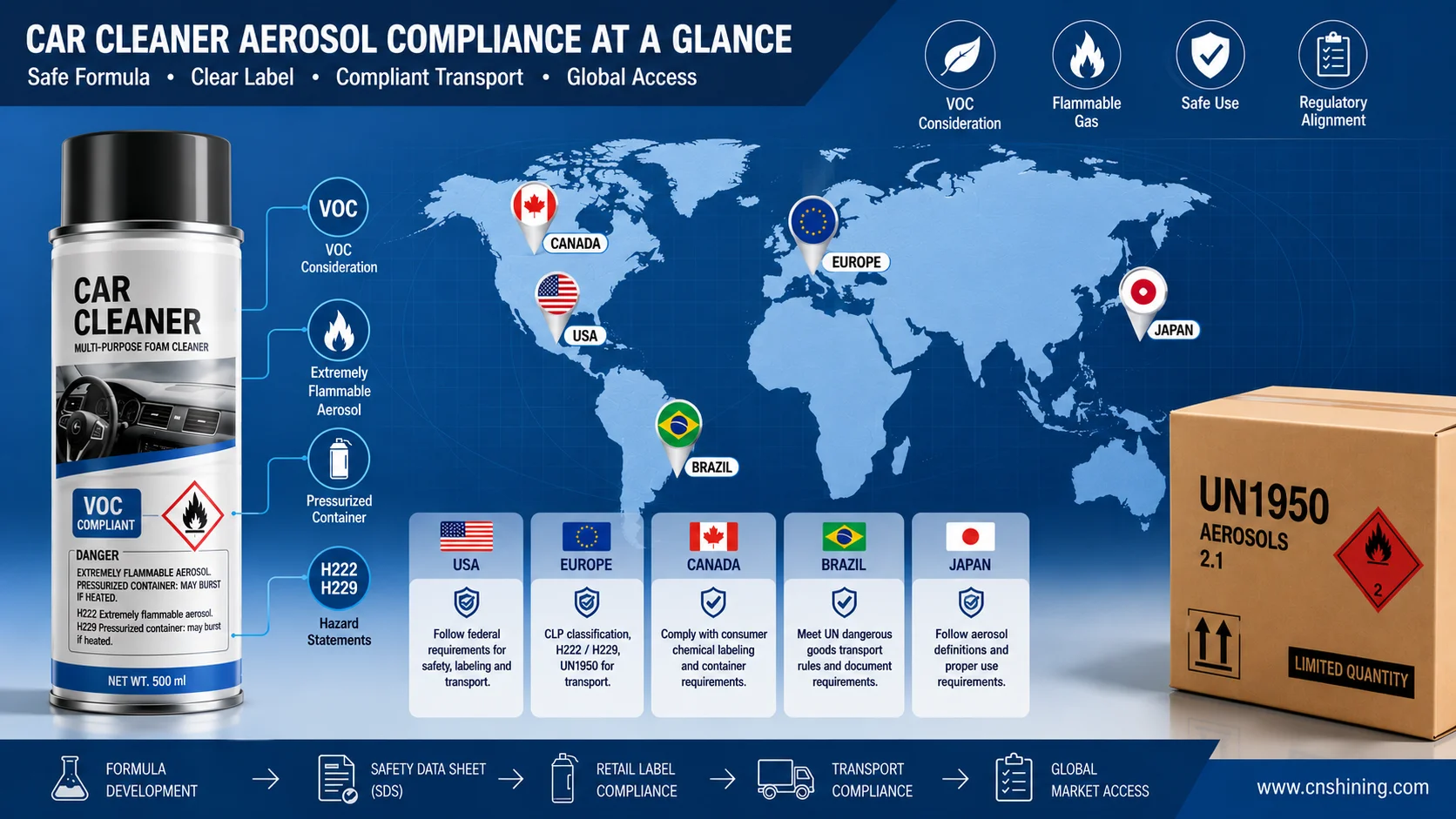
Regulatory design cannot be added after the product is finished. Propellant choice, solvent content, flammability, label space, and shipping mode all affect whether a product can move through retail, e-commerce, and cross-border logistics.
| Market | Main Framework | What to Watch | Packaging Meaning |
|---|---|---|---|
| United States federal | EPA SNAP / AIM, CPSC FHSA, OSHA HazCom, DOT / FAA dangerous goods | Propellant alternatives, hazard warnings, workplace classification, air transport limits | Formula, SDS, retail label, and shipping documents must be aligned |
| California | Consumer Products Regulation | VOC limit, category definition, testing, product dating | Many brands design national formulas by checking California first |
| European Union | Aerosol Dispensers Directive, CLP, F-gas, ADR | Pressure safety, flammable classification, H222 / H229, UN1950 transport | Label design and transport classification become front-end design topics |
| Canada | Consumer Chemicals and Containers Regulations | Consumer chemical hazard symbols and container rules | Important for imported aerosol cleaner products |
| Brazil | ANTT dangerous goods transport system | UN dangerous goods model alignment and transport documents | Hazmat logistics should be checked before launch |
| Japan | Household product aerosol definitions and administrative interpretation | Whether the product is treated as an aerosol and how it is used | Definition is clear; specific automotive VOC limits still need product-level review |
VOC and propellant rules are the main pressure points. The US EPA SNAP aerosol substitutes page shows that aerosol propellants and solvents are part of substitution review. The California Consumer Products Regulation is especially relevant because it defines consumer product categories and VOC standards. For labeling, 16 CFR 1500.121 is a useful reference for hazard label prominence and placement.
Transport is equally direct. Aerosols commonly fall under UN1950, and ADR aerosol classification guidance shows how transport rules can treat a cleaning SKU as a Class 2 dangerous good. For cross-border e-commerce, this often decides what can be shipped at acceptable cost.
9. Conclusion: Where This Format Is Going
Car cleaner aerosol spray is not disappearing. It is becoming more segmented. Traditional aerosol still works for fast, visible cleaning and technical degreasing. Foam aerosol still fits upholstery and headliner cleaning. BOV and compressed gas systems are better suited to low-odor interior care and higher compliance pressure.
The product risk is also clear. If the spray is too strong, too wet, too smelly, or too easy to leak, the user will not separate formula failure from packaging failure. They will simply call the product bad.
The better development route is practical: match formula type, valve output, actuator pattern, can lining, propellant system, and label requirements before the first pilot run. A car cleaner aerosol spray that feels controlled is usually not an accident. It is the result of packaging and chemistry being designed as one system.
10. FAQ: Car Cleaner Aerosol Spray Technical Questions
A car cleaner aerosol spray uses internal pressure, a valve, and an actuator to atomize the cleaner. A trigger spray depends on manual pumping. Aerosol systems usually give faster coverage and better reach into seams, but they also bring propellant, flammability, leakage, VOC, and dangerous goods considerations.
Wet spots usually come from high valve output, coarse droplets, poor actuator breakup, or spraying too close to fabric. The formula may be mild, but the spray system can still over-apply liquid. Low-flow fine mist actuators and clearer use instructions reduce this risk.
BOV is useful when odor control, formula isolation, low VOC positioning, and 360° use matter. The product stays inside a bag while compressed air or nitrogen provides pressure. Cost is higher, but the system can reduce propellant odor and improve controlled dispensing.
The actuator defines spray angle, droplet size, output rate, and user control. For dashboards and screens, a fine low-flow pattern is safer than a heavy wet spray. For fabric foam, the actuator must support foam texture and dwell time without flooding the material.
Common components include water, low-foam surfactants, small amounts of alcohol or glycol ether, hydrotropes, fragrance, preservative, corrosion inhibitor, pH adjuster, and propellant. The exact balance depends on target surfaces, odor limits, drying speed, and can compatibility.
“New car smell” is subjective and chemically sensitive. Some users expect leather, others expect plastic, vinyl, or a clean cabin scent. If the top note is too strong, too artificial, or too short-lived, users quickly judge it as fake or irritating.
The main issues are VOC content, propellant choice, flammability classification, label language, and transport rules. In many markets, the product is not treated only as a cleaner. It may also be treated as a pressurized and potentially flammable dangerous good.
Technically it is difficult. Dashboard cleaning needs controlled fine mist and low residue. Fabric cleaning often needs foam and dwell time. Engine or metal degreasing may need stronger solvents and different warnings. One formula and actuator rarely perform well across all three.
Water-based formulas can increase corrosion risk, especially when surfactants, fragrance, alcohol, and salts are present. The internal coating must match the formula and storage conditions. Without compatibility testing, odor change, rust, pressure loss, or leakage may appear during shelf life.
Test spray pattern, output rate, droplet size, foam quality, material compatibility, odor intensity, residue, can corrosion, leakage after transport simulation, high-temperature storage, valve reliability, and regulatory labeling. The package should be tested with the real formula, not only with water.