
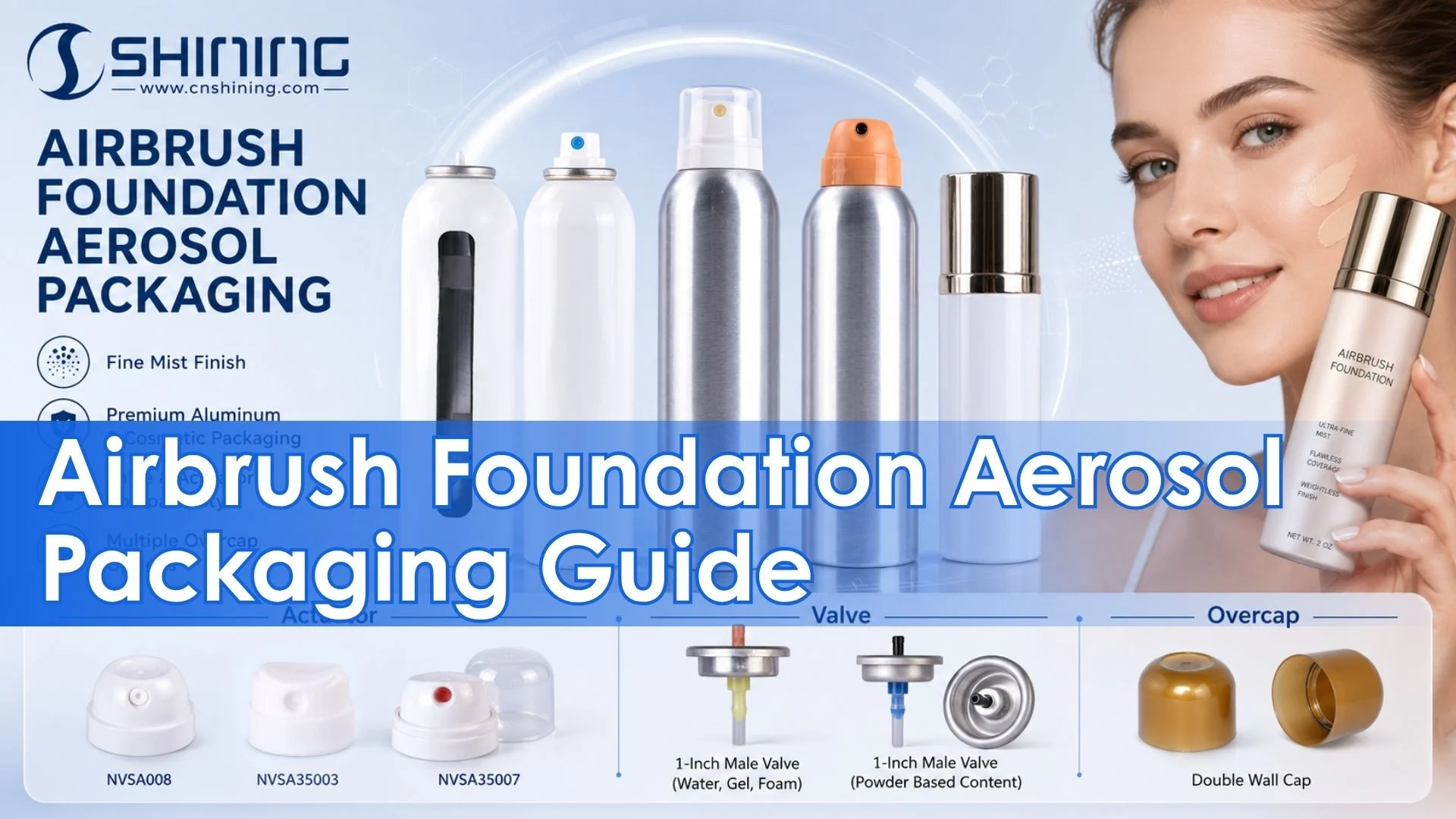
Airbrush aerosol spray foundation is not only a liquid foundation placed in a pressurized can. The product works only when the formulation, valve, actuator, nozzle, propellant system, can coating, and user instructions behave as one system. That is the main engineering point.
In practical terms, this format puts foundation into a self-pressurized container or related spray system. When the user presses the actuator, the valve and nozzle break the product into a fine mist and deposit it on the skin. The target finish is clear: even spray, fast film formation, light skin feel, and fast application.
Compared with a compressor-based airbrush system, aerosol foundation builds the atomization function into the package. Compared with ordinary pump spray, aerosol formats usually produce smaller droplets, higher spray speed, and more uniform coverage. That gain comes with technical cost: inhalation exposure, flammability, warning labels, valve matching, internal coating compatibility, and transport rules all become part of development.
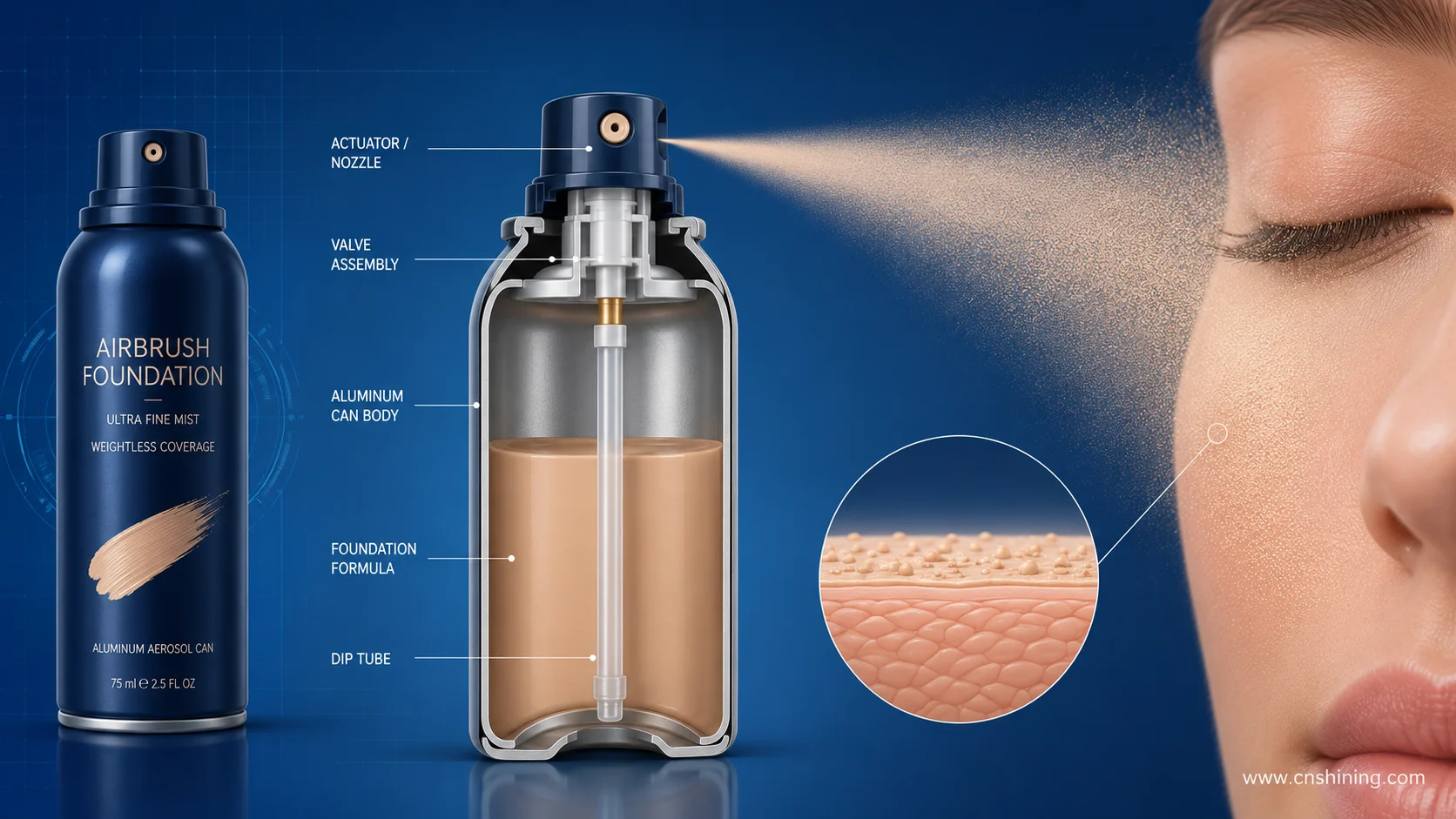
1. Definition and Working Principle
Airbrush aerosol spray foundation sits at the junction of three areas: cosmetic base formulation, spray dispersion and film formation science, and aerosol packaging engineering. The basic task is to spray a liquid system containing pigment, film former, volatile carrier, and skin-feel components into a continuous, thin, uniform coverage film.
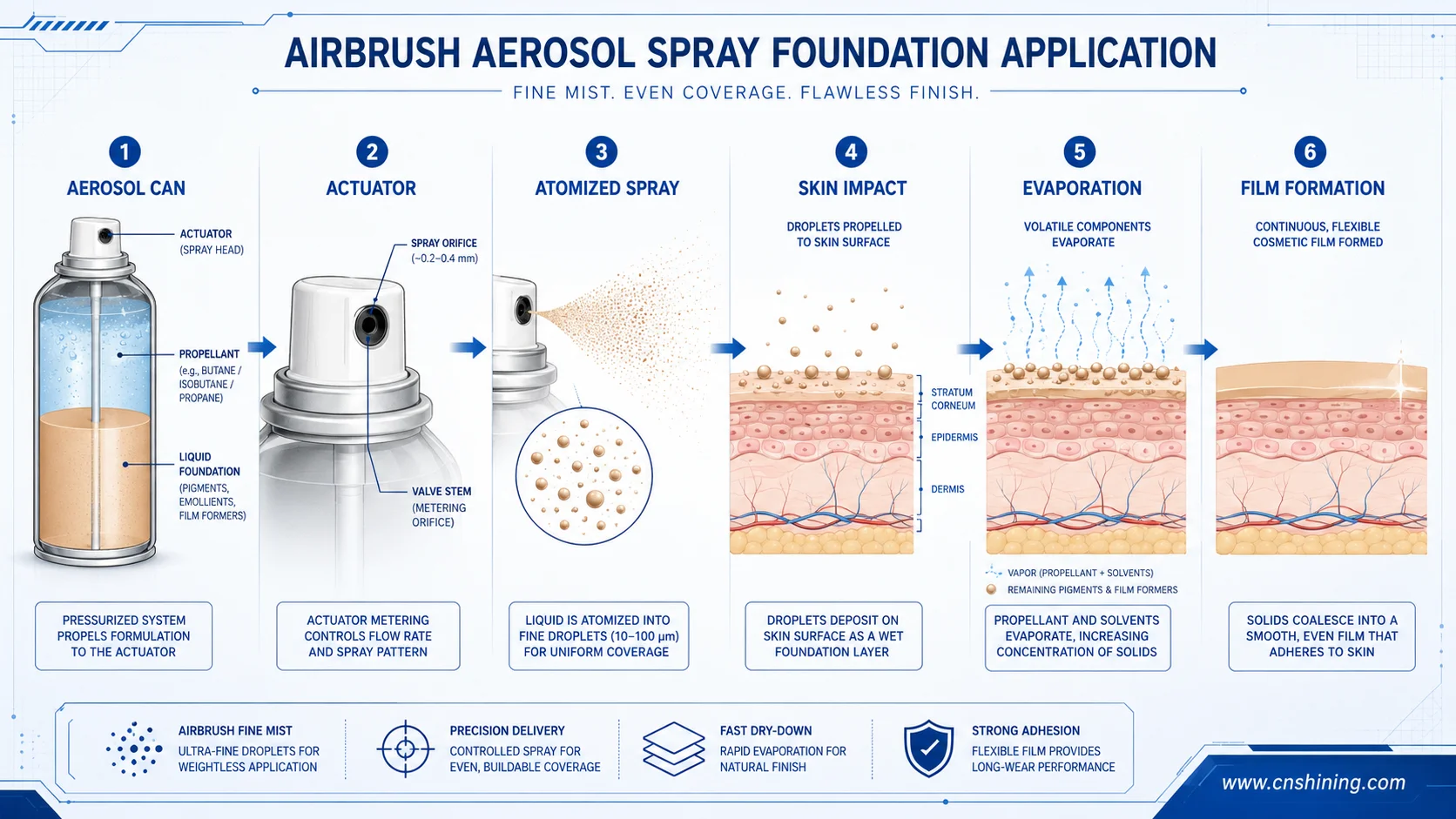
The finish depends on three groups of variables: droplet size distribution, spray velocity and spray pattern, and spreading and evaporation behavior on skin. Literature on cosmetic sprays shows that respiratory deposition is strongly influenced by aerodynamic particle size. Spray container pressure, valve and actuator dimensions, nozzle geometry, and formulation properties all affect droplet size and distribution. Cosmetic spray inhalation exposure review
Aerosol systems often create smaller droplets than pump or trigger sprays. That helps the “airbrush makeup” effect, but it also increases the fraction that may be inhaled. This is why the same feature that makes the finish look refined also makes eye, mouth, nose, ventilation, and use-distance instructions more than legal decoration.
Process Flow
Formulation filled into container → valve sealing and pressure storage → actuator press → stem and tailpiece throttling → nozzle atomization → droplet impact and spreading on skin → solvent evaporation → film formation and pigment deposition.
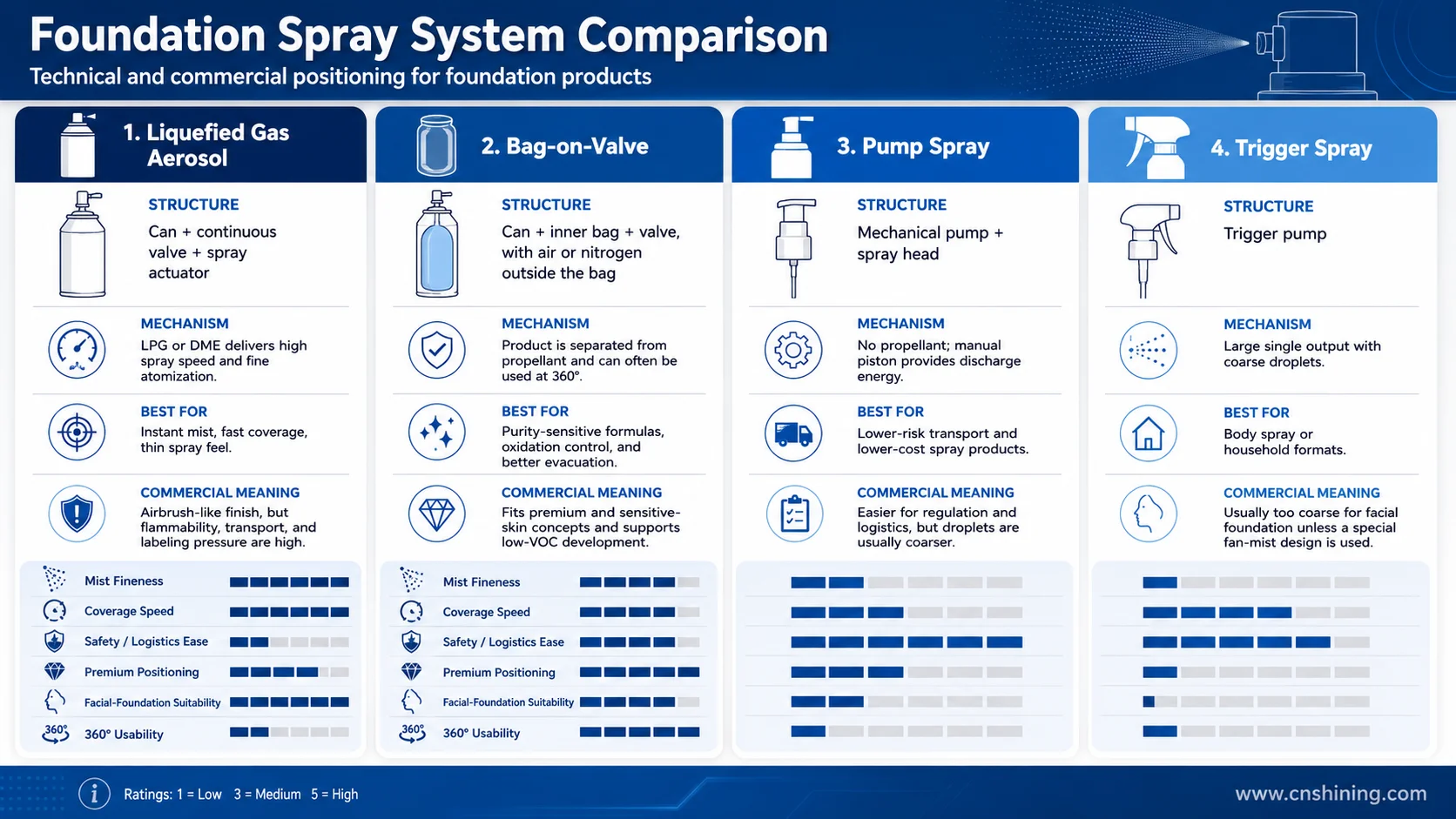
2. Spray System Types and Commercial Meaning
| System Type | Typical Structure | Core Mechanism | Suitable Foundation or Spray Product | Commercial Meaning |
|---|---|---|---|---|
| Liquefied gas aerosol | Can + continuous valve + spray actuator | LPG or DME provides high spray speed and fine atomization during pressure release. | Products seeking instant mist, fast coverage, and thin spray feel. | Closest to an airbrush finish, but flammability, transport, and labeling pressure are high. |
| Bag-on-valve | Can + inner bag + valve, with air or nitrogen outside the bag | Product is separated from propellant and can often be used at 360 degrees. | Formulas requiring purity, oxidation control, or better evacuation. | Fits premium and sensitive-skin concepts, and supports low-VOC development. |
| Pump spray | Mechanical pump + spray head | No propellant; manual piston provides discharge energy. | Lower-risk transport and lower-cost spray products. | Regulatory and logistics pressure is lower, but droplets are usually coarser. |
| Trigger spray | Trigger pump | Large single output, usually coarser droplets. | Body spray or household formats. | Usually too coarse for facial foundation unless a special fan-mist design is used. |
For facial foundation, system choice should begin with use mode. Direct-to-face spray needs lower impact, better aim, and careful inhalation instructions. Spray-to-brush or spray-to-sponge can tolerate a stronger spray because the applicator becomes a buffer.
3. Product Comparison and Formulation Framework
| Dimension | Aerosol Spray Foundation | Liquid Foundation | Cushion | Foundation Stick | Setting Spray |
|---|---|---|---|---|---|
| Core value | Fast, large-area, even deposition; airbrush-like finish. | Flexible, many shades, mature use habits. | Fast touch-up and portable use. | Precise concealing and local correction. | Locks makeup; does not build main coverage. |
| Atomization / spreading | Highly dependent on valve and nozzle. | Spread by hand, brush, or sponge. | Transferred by sponge. | Direct contact with skin. | Mainly reinforces film. |
| Application speed | Very fast. | Medium. | Fast. | Medium. | Fast. |
| Large-area uniformity | One of its strongest points. | Depends on tool and skill. | Medium. | Weak for large areas. | Not applicable. |
| Local control | Weak unless sprayed to brush or sponge first. | Strong. | Medium. | Strongest. | Weak. |
| Typical weakness | Mis-spray, hot spots, clogging, flammability, user education, inhalation warnings. | Can feel heavy or show brush/sponge marks. | Puff hygiene and refill cost. | Can crease; slow for large areas. | Can be mistaken for base makeup. |
Spray foundation is a system product. The customer does not only buy pigment plus humectant. The customer buys the moment when the formula leaves the nozzle. That moment is packaging engineering.
| Function | Main Role | Common Route | Design Focus |
|---|---|---|---|
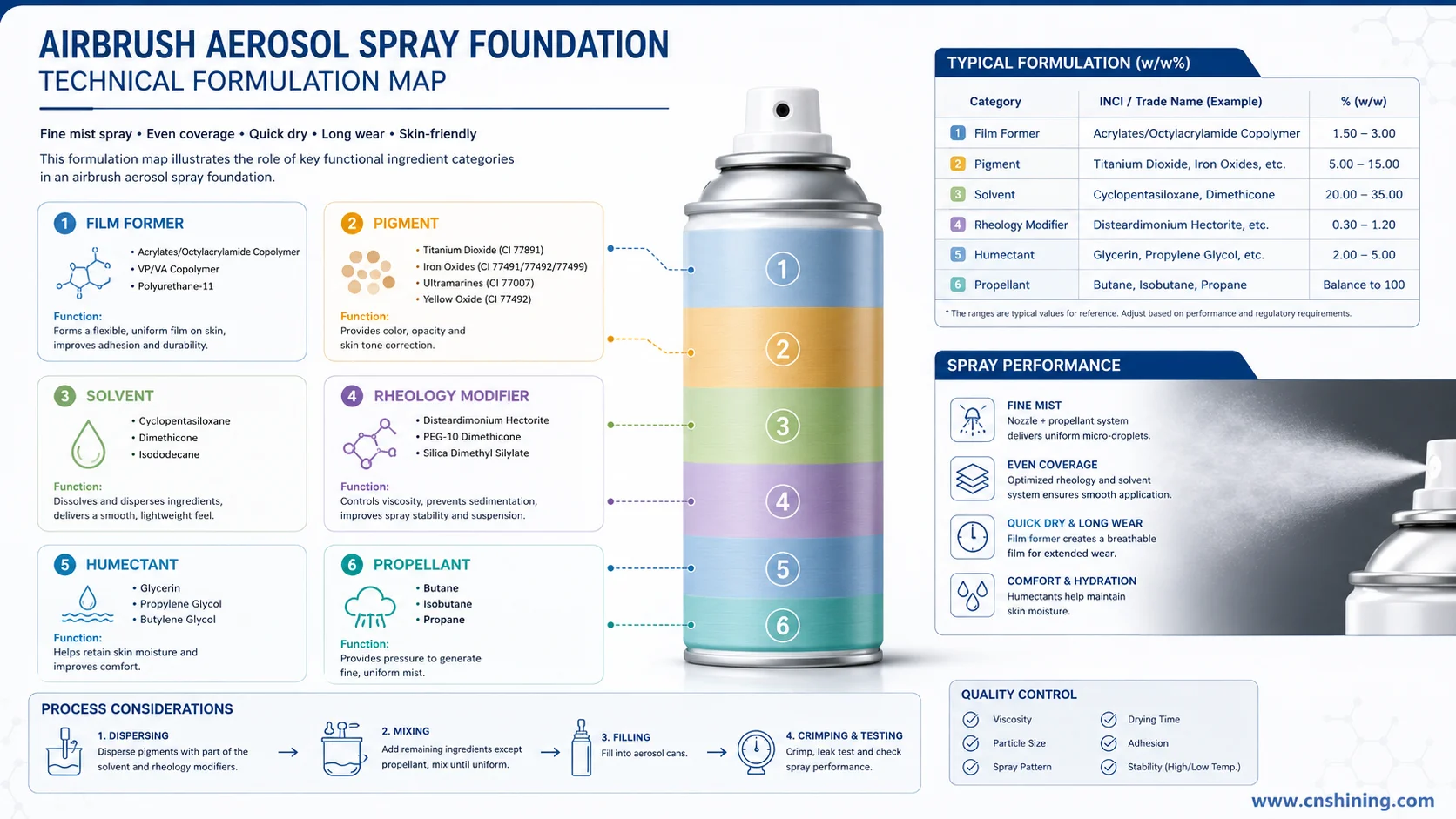
| Film former | Forms a continuous film, improves wear and transfer resistance. | Acrylates/Octylacrylamide Copolymer, VP/VA Copolymer, Trimethylsiloxysilicate. | Strong film can dry fast but may emphasize texture. |
| Pigment | Coverage, color correction, brightness, skin-tone match. | Iron oxides, titanium dioxide, mica, treated pigments. | Coarse particles and agglomerates raise clogging risk. |
| Solvent / carrier | Dissolves resin, controls evaporation, supports spreading. | Water, alcohol denat., isododecane, volatile silicones, light esters. | Too fast causes patchiness; too slow causes wet spray and transfer. |
| Surfactant / emulsifier | Stabilizes oil-water interface and mist spreading. | Silicone surfactants, polysorbates, lecithin. | Too much may foam or weaken film; too little may separate. |
| Rheology / anti-settling | Prevents pigment settling and improves storage stability. | Stearalkonium hectorite, organoclay, fumed silica. | Strong effect on valve clogging and first-spray consistency. |
| Humectant | Reduces tightness caused by quick drying. | Glycerin, butylene glycol, hyaluronic acid, aloe vera. | Too much can reduce transfer control and film strength. |
| Skin-feel / soft-focus agent | Improves slip and reduces powdery feel. | Silicones, spherical powders, elastomers. | Powder loading must be matched with nozzle and valve limits. |
| Propellant | Provides discharge energy and atomization. | Propane, butane, isobutane, DME, nitrogen, compressed air. | Changes flammability, VOC profile, spray quality, evacuation, and regulation. |
| Contact materials | Prevents corrosion, extraction, odor, leakage, and instability. | Epoxy or BPA-NI coating, Micoflex, butyl/nitrile/EPDM gasket, multilayer bag. | Compatibility must be tested by SKU, not assumed from one formula. |
A stable liquid in a beaker is not yet a stable aerosol foundation. A film that looks good on skin is not enough if the same liquid cannot pass hundreds or thousands of actuations without clogging.
4. Common Technical Terms
| Term | Plain Explanation | Why It Matters Commercially |
|---|---|---|
| Actuator | The button pressed by the user. | Controls hand feel, spray pattern, mis-spray risk, and visual identity. |
| Valve | The valve assembly inside the aerosol package. | Core factor for spray stability, yield, and complaint rate. |
| Metered valve | A valve that releases a fixed amount per actuation. | Useful for high-value, small-dose, high-education products. |
| Bag-on-valve | Product is isolated inside a bag while propellant stays outside. | Supports purity, low-VOC direction, and sensitive formula stories. |
| Stem orifice | The hole size in the valve stem. | Directly affects spray rate, velocity, and droplet size. |
| RTP / tailpiece orifice | Restriction point in the valve tailpiece. | Used with nozzle geometry to tune flow and spray shape. |
| MMAD | Mass median aerodynamic diameter. | Connected to inhalation exposure and aerosol fineness. |
| Respirable fraction | Small particles that may reach deep lung regions. | Impacts safety assessment, warning language, and testing plan. |
| VOC | Volatile organic compound. | Related to regulation, odor, sustainability, and claims. |
| ISTA-6 | E-commerce transport testing framework. | Important for aerosol products sold through online channels. |
| UN1950 | Transport UN number commonly used for aerosols. | Affects air, sea, road, warehousing, and limited quantity strategy. |
| Inverted epsilon | EU aerosol dispenser compliance mark. | One visible sign of aerosol container compliance for EU routes. |
5. Regulatory and Transport Compliance
5.1 United States
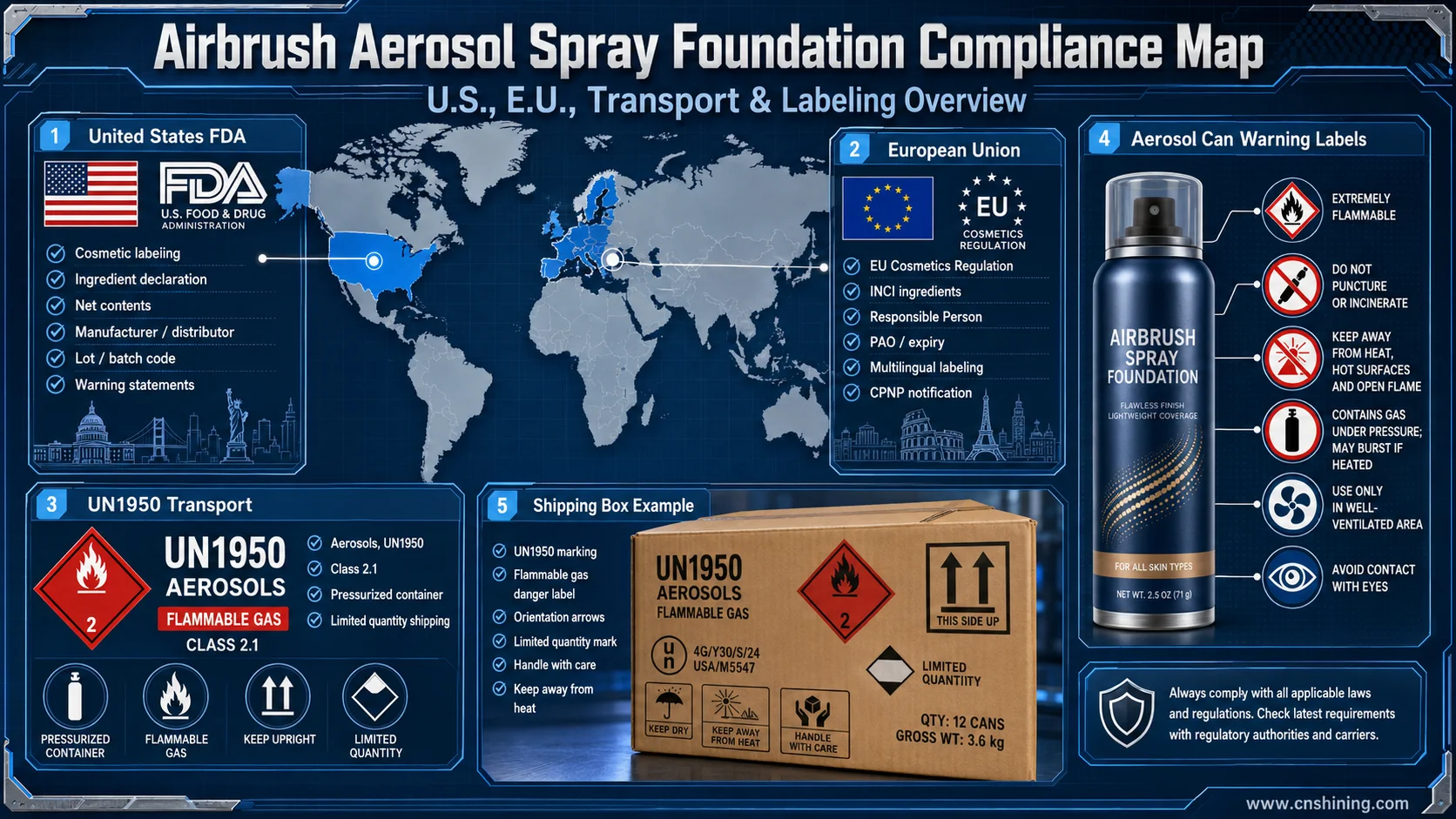
In the United States, ordinary spray foundation is generally regulated as a cosmetic. FDA states that makeup products such as foundation are regulated as cosmetics under the Federal Food, Drug, and Cosmetic Act. If the product carries SPF or sunscreen claims, it may become both a cosmetic and a drug. FDA makeup product regulation
Self-pressurized cosmetic containers need specific warning language under 21 CFR 740.11. Flammability and hazard labeling can also involve CPSC/FHSA and related 16 CFR 1500 logic. 21 CFR 740.11 self-pressurized cosmetic containers
5.2 European Union
In the European Union, the base framework is Cosmetic Products Regulation 1223/2009. Aerosol dispensers are also subject to the Aerosol Dispensers Directive 75/324/EEC. For spray foundation, the difficult work is usually not the headline rule. It is the combined file: PIF, CPSR, ingredient legality, package warning language, propellant selection, and volatile chemistry. EU Cosmetic Products Regulation 1223/2009
5.3 Transport
Aerosols are commonly handled under UN1950 Aerosols. In the U.S., limited quantity and compressed gas packaging provisions can be checked under 49 CFR 173.306. Air, sea, and road transport rules differ. This is why cross-border e-commerce planning should start during formula and package selection, not after launch. 49 CFR 173.306 limited quantities of compressed gases
| Market | Do Not Ignore | Direct Impact |
|---|---|---|
| United States | SPF classification, self-pressurized container warnings, banned propellants or restricted ingredients, flammability testing. | Product classification, label text, listing path, and warehousing feasibility. |
| European Union | CPR 1223/2009, REACH, Aerosol Dispensers Directive, SCCS safety logic. | Ingredient legality, CPSR/PIF, package warnings, and propellant compliance. |
| International transport | UN1950, limited quantity, air/sea/road marking and declaration differences. | Fulfillment cost, warehouse acceptance, and refusal risk. |
6. User Pain Points and Packaging Improvements
The user complaints are consistent. They rarely say only “wrong shade.” They say the first spray is too strong, one area becomes thick, hot spots appear, the valve clogs, the can mis-sprays in transport, the formula transfers to clothes, or the user simply does not know how to apply it.
| Pain Point | Evidence Pattern | Packaging or Instruction Fix |
|---|---|---|
| Beginners spray too much or create hot spots | Airbrush users report cakey results, uneven areas, and a learning curve. | Use more forgiving fan-mist actuators, reduce first-spray impact, consider metered or flow-limited valves, and print distance diagrams. |
| Transfer and humidity concerns | Retail claims often emphasize sweat-proof or humidity-resistant performance. | Improve film formation, lower wet load per area, and clearly state wait time before clothing contact. |
| First spray is confusing | Some brands need to explain seal-breaking or first use behavior. | Add “test spray on tissue 2–3 times” and use lower actuation force where possible. |
| Transport or handbag mis-spray | Lockable actuators target accidental actuation and e-commerce reliability. | Use hoodless lockable actuator, overcap plus lock, audible lock/unlock feedback, or ISTA-6-tested structures. |
| Users do not know whether to spray face, brush, or sponge | Many kits include brushes, showing that application education is part of the product. | Print direct spray, spray-to-brush, and spray-to-sponge methods with preferred order. |
First, valve and actuator selection should begin before formula lock. If direct facial spray is expected, the spray plume must be soft, predictable, and easy to aim. Stem orifice, tailpiece restriction, vapor phase orifice, and nozzle geometry must be tuned together.
Second, BOV or compressed-air routes should be considered for premium or sensitive-positioned SKUs, not automatically forced across the entire line. BOV can support product purity, 360-degree use, oxidation control, and low-VOC direction. It also adds cost and structure complexity.
Third, the can shape and actuator interface should support grip and aiming. A clearer shade strip, lock mark, arrow direction, tactile finger pad, and stable overcap may reduce more complaints than a brighter metallic finish.
Fourth, internal coating, gasket, valve, and bag materials need compatibility matrices by formula type. Spray foundation can contain volatile solvents, silicones, resins, pigments, and rheology systems. Compatibility failure can show as odor, leakage, corrosion, valve swelling, extraction, or spray drift.
Fifth, the label should behave like a short training script. It should state spray distance, shaking instruction, first-spray handling, whether brush application is preferred, eye/mouth/nose avoidance, ventilation, wait time before fabric contact, flammable storage warning, and high-temperature storage warning.
7. Shining Packaging Components for This Product Type
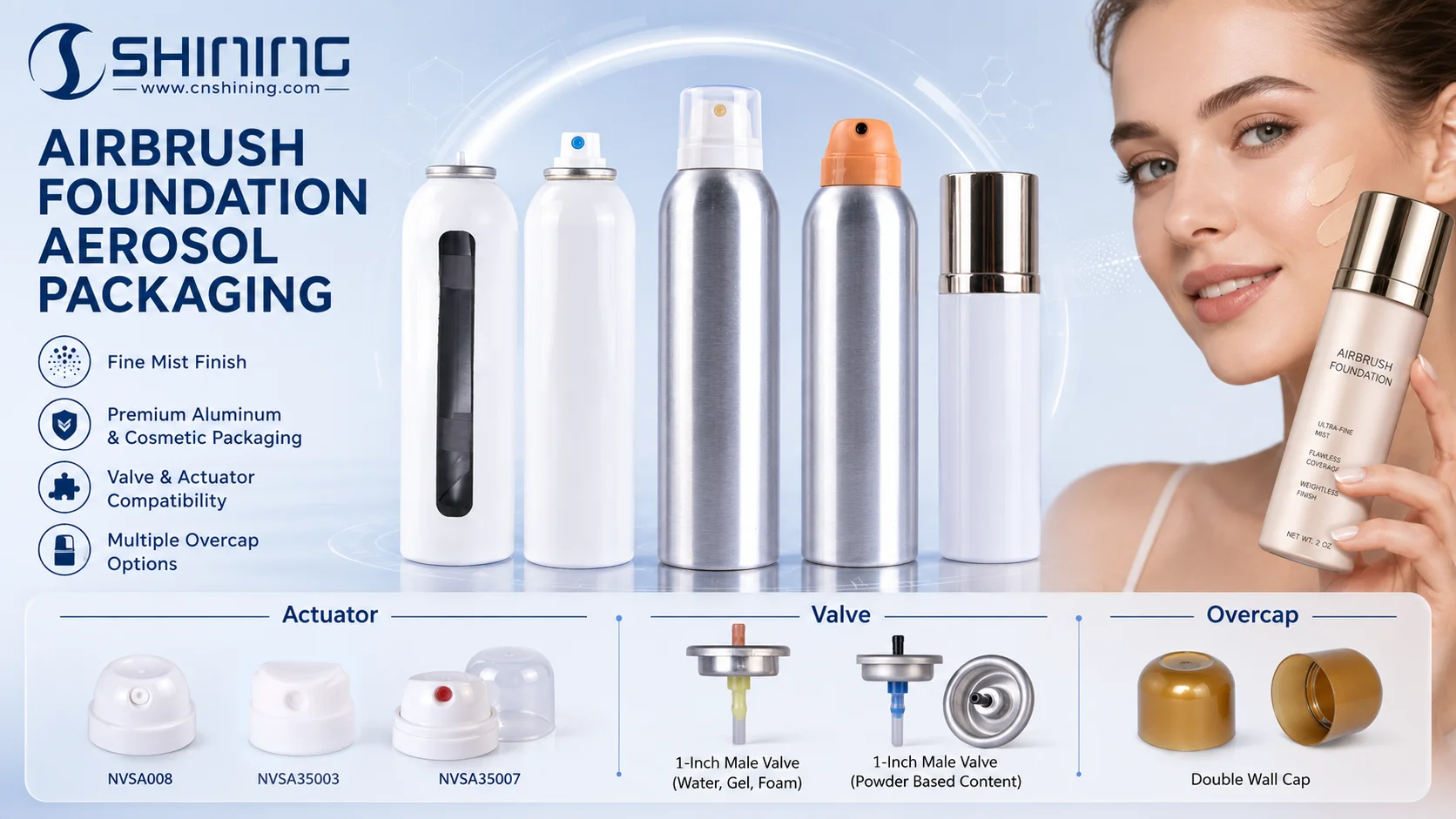
For airbrush aerosol spray foundation, Shining Packaging’s relevant work is mainly around aerosol cans, actuators, and valves. These parts are not decorative add-ons. They decide spray pattern, actuation force, leakage control, transport safety, and whether the formula can remain stable during storage and use.
The aerosol can needs the right diameter, pressure rating, internal coating, decoration process, and crimping compatibility. The valve must match formula viscosity, pigment dispersion, propellant route, and required spray rate. The actuator must help the user aim. A foundation spray that looks good in the lab but mis-sprays in a handbag is not ready for market.
In this category, the practical engineering question is: can the package repeatedly produce a soft, even mist without clogging, leakage, or accidental actuation? Shining Packaging’s role should be framed around that question. Product photography can be placed here to show the applicable actuator, aerosol can, and valve set for foundation spray, body makeup spray, setting spray, and other color cosmetic aerosol formats.
8. Conclusion
Airbrush aerosol spray foundation succeeds only when spray quality and user handling are engineered together. Fine mist is valuable, but it raises inhalation, eye-area, flammability, label, and transport questions. A good formula cannot rescue a poor valve. A good actuator cannot rescue unstable pigment dispersion. A beautiful can cannot rescue confusing use instructions.
The practical route is clear: define the use mode first, select the aerosol system second, tune the valve and actuator with the formula third, and write the label as if the user has never touched spray foundation before. That is how this category becomes reliable instead of just visually interesting.
9. FAQ: Airbrush Aerosol Spray Foundation
It is a foundation format filled into a self-pressurized spray container or related aerosol system. The valve, actuator, and nozzle atomize the formula into fine droplets that deposit on the skin. Its purpose is fast, even, lightweight coverage with a finish similar to airbrush makeup, without requiring an external compressor.
Compressor airbrush systems use external equipment to generate airflow and atomization. Aerosol spray foundation builds the spray energy into the package through propellant, valve, and actuator design. This makes use simpler, but it also shifts more technical responsibility onto the packaging, including pressure control, spray pattern, transport safety, and warning language.
Aerosol systems usually deliver higher spray energy and can generate smaller droplets than many manual pump systems. Smaller droplets help produce a smoother, more uniform film. The same feature may increase inhalable fraction, so use-distance instructions, ventilation, and avoiding eyes, nose, and mouth should be treated as part of product design.
Hot spots usually come from excessive local wet load, narrow spray pattern, high first-spray impact, poor distance control, or uneven user movement. Formula viscosity and pigment dispersion also matter. Packaging fixes may include fan-mist actuators, lower spray rate, metered valves, clearer distance graphics, and spray-to-brush instructions.
Bag-on-valve can be suitable when product purity, low-VOC direction, oxidation control, or 360-degree use is valued. It separates the formula from the propellant, which can help sensitive systems. The trade-off is higher structure complexity and cost, so it fits premium or technically demanding SKUs better than every mass-market version.
The main factors are pigment particle control, film former selection, solvent evaporation rate, rheology, anti-settling behavior, humectant level, and propellant compatibility. A formula that looks stable in a bottle may still fail in an aerosol valve. Sprayability, clogging risk, film formation, and transfer resistance must be tested together.
The actuator controls how the user presses, aims, and feels the spray. It influences spray pattern, finger comfort, mis-spray risk, and accidental actuation during transport. For facial foundation, a softer and more forgiving spray is usually safer than an aggressive high-output spray, especially for first-time users.
Key issues include cosmetic classification, SPF-related drug status in some markets, self-pressurized container warnings, flammability, propellant restrictions, ingredient legality, aerosol dispenser rules, and transport under UN1950. The exact route depends on region. Labeling and logistics should be planned before the package and formula are finalized.
Clogging can come from pigment agglomeration, unsuitable rheology modifiers, resin build-up, poor shaking behavior, valve material swelling, or a nozzle path that is too narrow for the formula. The fix is rarely one ingredient change. Developers need particle-size control, compatibility testing, valve selection, and repeated actuation testing.
Minimum testing should include spray rate, spray pattern, droplet behavior, first-spray performance, valve clogging, evacuation, leakage, compatibility with coating and gaskets, flammability, transport simulation, and user application SOP. For this format, packaging tests and cosmetic performance tests should run together, not as separate late-stage checks.