
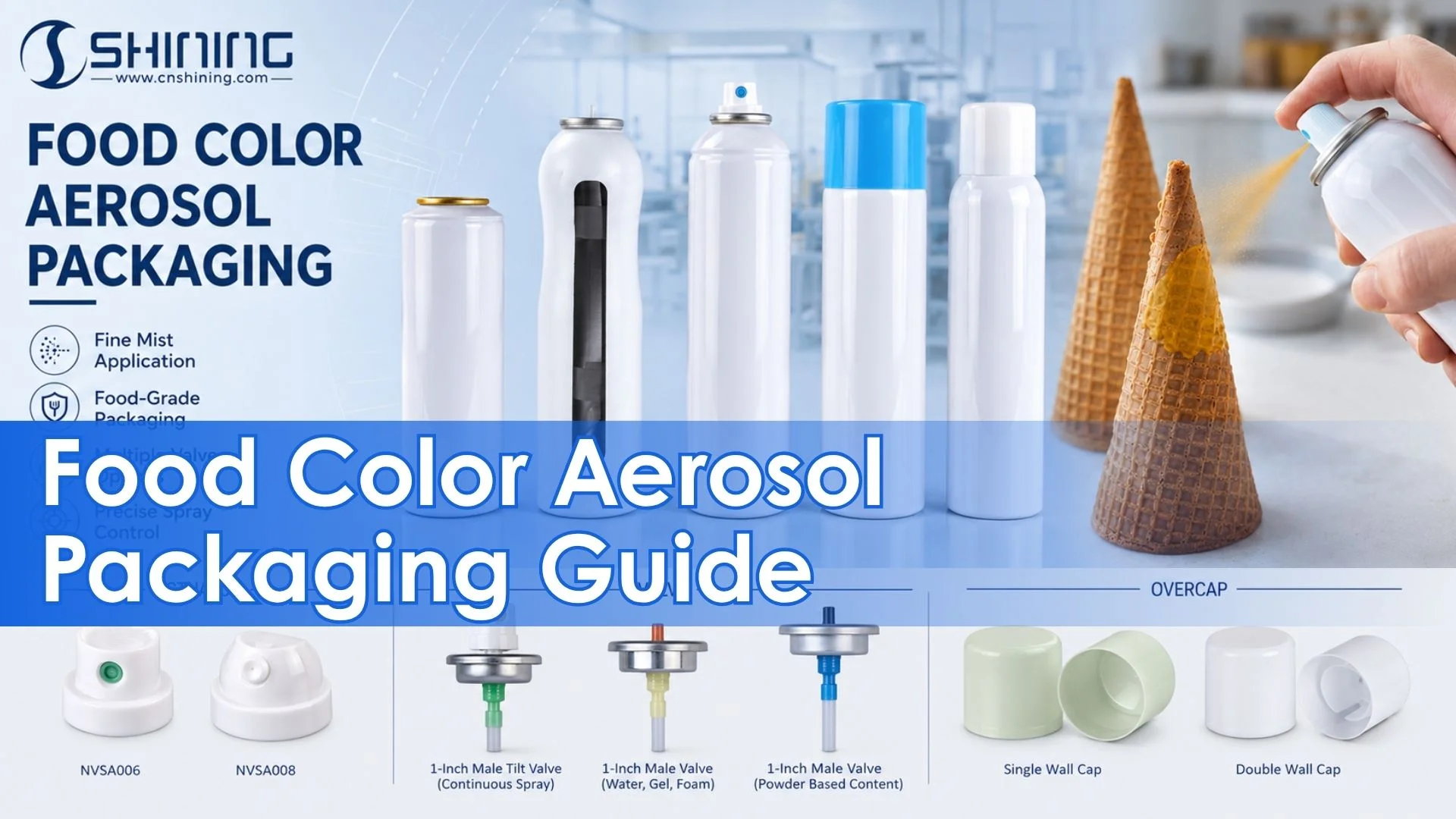
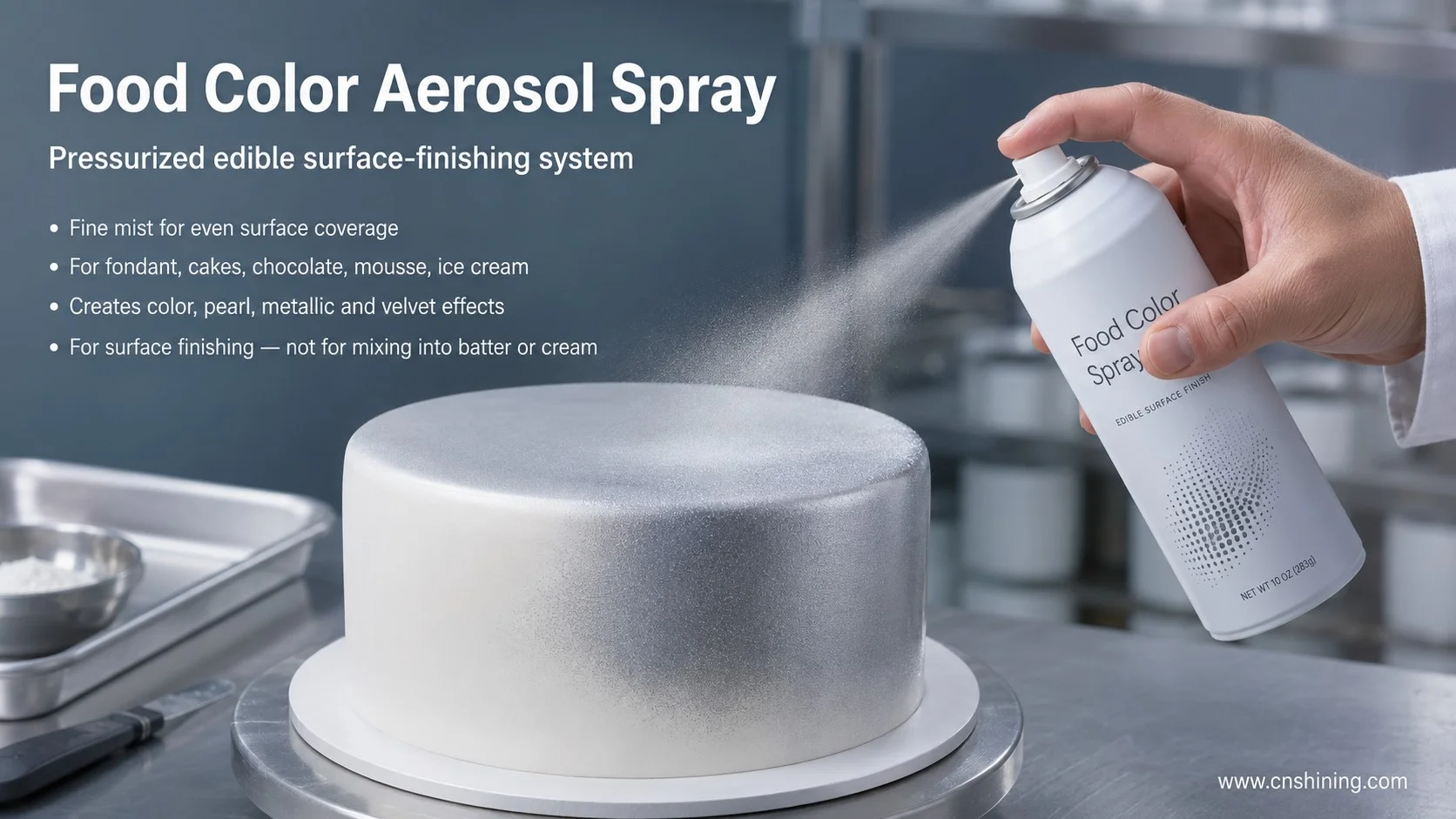
Food color aerosol spray is not one fixed formulation. It is a pressurized delivery system that puts edible colorants, carriers or solvents, and a propellant package into an aerosol can. When the actuator is pressed, the product is released as a fine mist and deposited on the food surface.
Its real use is surface finishing. Typical applications include cakes, fondant, sugar paste, macarons, chocolate, mousse, ice cream and frozen desserts. It is used for surface coloring, pearl effects, metallic finishes and velvet textures. It is not designed for coloring a whole batch of batter, cream or icing from inside.
1. Product Definition and Working Principle
Mechanically, a food color aerosol spray works like a standard aerosol. Pressing the actuator moves the valve stem downward. The gasket seal is opened. The pressurized formulation travels through the dip tube, valve body, stem and actuator orifice. At the actuator exit, the liquid breaks into droplets. Releasing the actuator lets the spring return the stem and closes the flow path.
This explains many field complaints. If the valve, actuator and formulation are not matched, the result is not a minor defect. It becomes intermittent spray, spitting, uneven spray pattern or nozzle clogging. Aerosol valve training material shows why actuator design, gasket selection, dip tube geometry and mechanical breakup inserts all influence spray quality.
The propellant system decides the spray feel and atomization quality. In simple terms, liquefied propellants tend to hold pressure more steadily through the can life and produce finer particles. Compressed gas systems lose pressure as product volume drops, so they are more likely to give wet spray and larger droplets near the end of use.
In public product specifications for food decoration sprays, the common propellant route is butane / isobutane / propane, often declared as E943a / E943b / E944. Metallic sprays often use an alcohol-based carrier. Velvet sprays often use cocoa butter or vegetable fat carriers.
Conventional aerosol cans are not the only technical route. Bag-on-Valve separates the product from the propellant gas. The system can support high emptying rate, lower contamination risk, longer shelf life and all-angle spraying. For food color aerosol spray, BOV is not yet the mainstream retail format, but it is a strong upgrade path for premium lines that need less residue, cleaner sensory performance and better end-of-life spray consistency.
2. Formula Types, Advantages and Competing Options
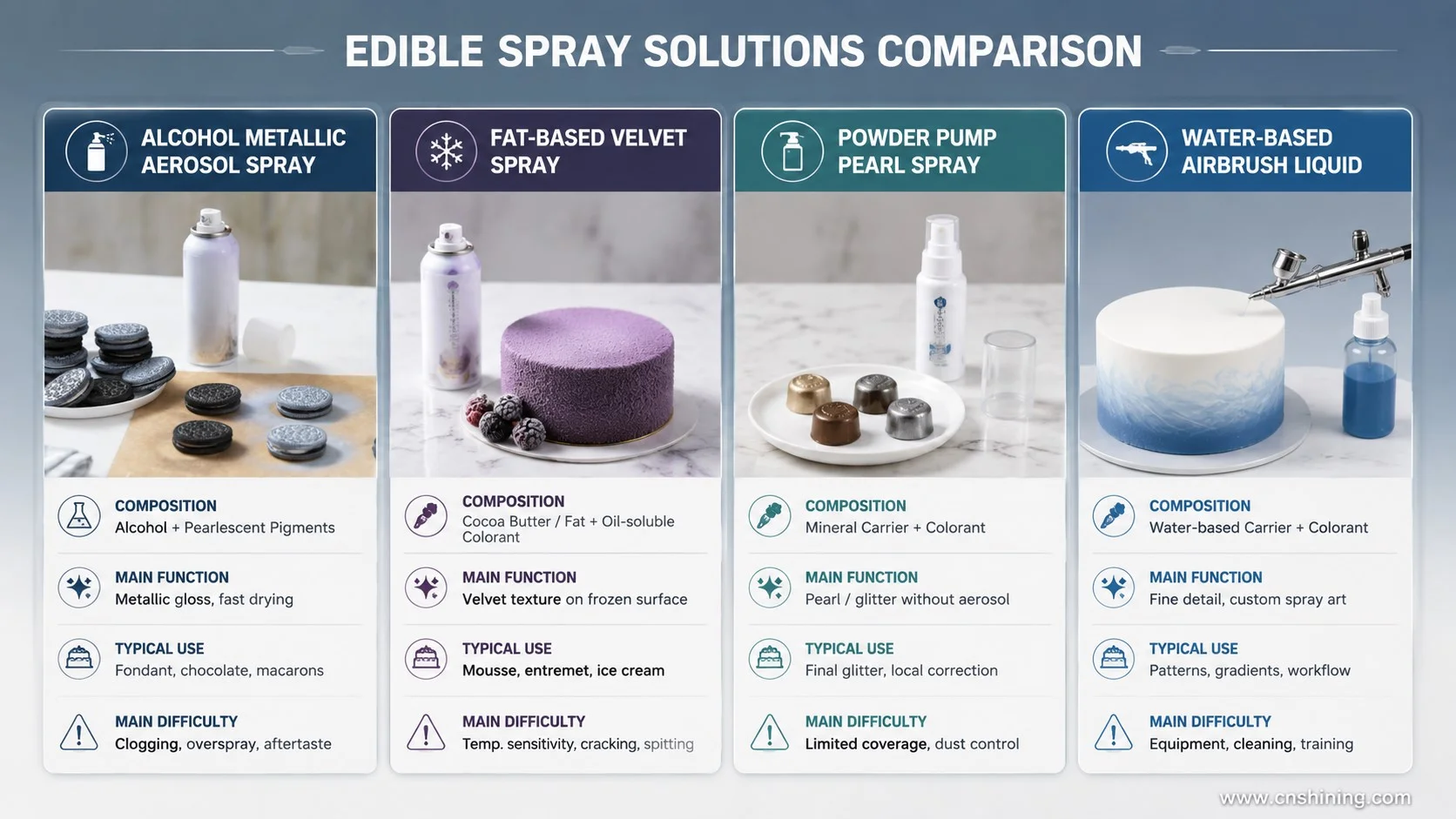
From a formulation and application point of view, food color aerosol spray should be split into at least four groups. “Spray” is the packaging and delivery format. It is not one chemical system.
| Category | Common Composition | Main Function | Typical Use | Main Difficulty |
|---|---|---|---|---|
| Alcohol-based metallic / pearl aerosol spray | Ethanol + colorant / pearlescent component such as E172 + E943a / E943b / E944 | Fast drying, metallic gloss, thin-layer coverage | Fondant, chocolate, macarons, surface highlights | Clogging, aftertaste, overspray, color shift |
| Fat-based velvet aerosol spray | Cocoa butter or vegetable fat + oil-soluble colorant + propellant | Rapid solidification on cold surface, velvet texture | Mousse, entremet, ice cream, frozen desserts | Surface temperature sensitivity, cracking, slipping, spitting |
| Powder pump spray / non-aerosol spray | Mineral carrier such as E555 + colorant + anti-caking agent E551 | Pearl or glitter layer without aerosol can | Final glitter, light pearl finish, local correction | Limited coverage, dust control, brightness depends on base color |
| Water-based airbrush liquid | Water-based carrier + concentrated edible color | Fine detail, gradient and custom spray art | Custom patterns, controlled gradients, commercial workflow | Requires equipment, cleaning time and user training |
The formulation signals are visible in public product specifications. Metallic sprays often show ethanol, E172 and hydrocarbon propellants. Velvet sprays often show cocoa butter plus colorants and propellant. Powder pump sprays use a different logic: dry powder dispersion. So the real technical split is fast-drying film, fat crystallization on a cold surface and dry powder distribution.
Aerosol spray has one clear advantage: speed. It needs no premixing, no external compressor and no brush cleaning. It is good for fast uniform surface finishing. But it is weak in fine detail. It also has more overspray risk than brush or airbrush work, more logistics limitations than pump spray, and less internal coloring strength than gel or paste.
| Option | Strongest Point | Weakest Point | Best Fit |
|---|---|---|---|
| Aerosol spray | Fast, wide coverage, no equipment, instant finish | Overspray, clogging, weak detail, logistics limits | Home baking, event orders, fast finish |
| Pump spray / powder pump spray | Non-aerosol, easier shipping, cleaner sustainability story | Brightness and coverage often weaker than aerosol | Glitter, local pearl finish, light decoration |
| Airbrush | Best control, gradients and detail | Equipment and cleaning cost | Professional studios, custom orders, complex artwork |
| Gel / paste | Strong internal coloring, stable depth, low unit cost | Weak for metallic or velvet finish | Batter, cream, fondant body coloring |
| Powder / brush application | Fine correction, low cost, good for edges | Slow for large area, poor uniformity on wide surfaces | Highlights, edge correction, detail repair |
The practical positioning is clear. Food color aerosol spray is not a universal color product. It is a tool-type SKU for the fastest large-area surface finish. It works well for seasonal baking, live demos, new users and high-turnover stores. For ultra-fine custom spray art, internal coloring or low-risk cross-border shipping, airbrush liquids, pump sprays and gels can replace it.
3. Glossary for Packaging, Product and Compliance Teams
These terms matter because purchasing, product management, packaging engineering, regulatory and marketing teams often discuss the same problem with different words.
| Term | Plain Explanation | Business Meaning |
|---|---|---|
| Aerosol | A pressurized container releases liquid or slurry as droplets. | The SKU is a ready-to-use finish tool, not a normal food dye. |
| Actuator | The button or spray head pressed by the user. | Directly affects spray width, finger feel, overspray and premium perception. |
| Valve | The release-control assembly. | A core part for consistency and complaint reduction. |
| Stem | The valve part that opens the flow path when pressed. | Too small may clog; too large may produce wet spray. |
| Gasket | The sealing component. | Poor compatibility can cause leakage, spray failure or loss of pressure. |
| Dip tube | The tube that draws liquid from the can bottom to the valve. | Affects emptying rate and end-of-can residue. |
| Propellant | The pressure source that pushes product out. | Affects atomization, transport class, flammability label and regulation. |
| Liquefied propellant | Propellant that keeps more stable pressure during use. | Better for fine mist and consistent spray pattern. |
| Compressed gas | Gas pressure that drops as product is used. | May cause wetter spray late in can life. |
| Atomization | Breaking liquid into fine droplets. | Decides whether the surface looks uniform or spotted. |
| Spray pattern | The shape and angle of the spray output. | One of the most visible signs of professional finish. |
| Overspray | Spray landing outside the target area. | Creates waste, cleaning work and negative reviews. |
| Clogging | Nozzle or orifice blockage. | A common problem for metallic powders, cocoa butter and high-solids sprays. |
| BOV | Bag-on-Valve separates product from propellant gas. | Useful for cleaner, higher-emptying and premium product lines. |
| Internal coating | The inside coating of the aerosol can. | Relates to odor, migration, corrosion and food-contact compliance. |
| Migration | Transfer of packaging substances into food. | Important for EU compliance and customer audits. |
| E171-free | Free from titanium dioxide as food additive. | A key claim for white, silver and pearl routes in European markets. |
| Azo-free | Free from azo colorants. | Can reduce regulatory and public-perception risk in some markets. |
| Surface decoration | Use on the outside of food. | Prevents users from treating the spray as a universal coloring paste. |
| Declaration of Compliance | Document showing food-contact conformity. | Often required for bakery chains, distributors and export customers. |
4. Regulatory and Compliance Framework
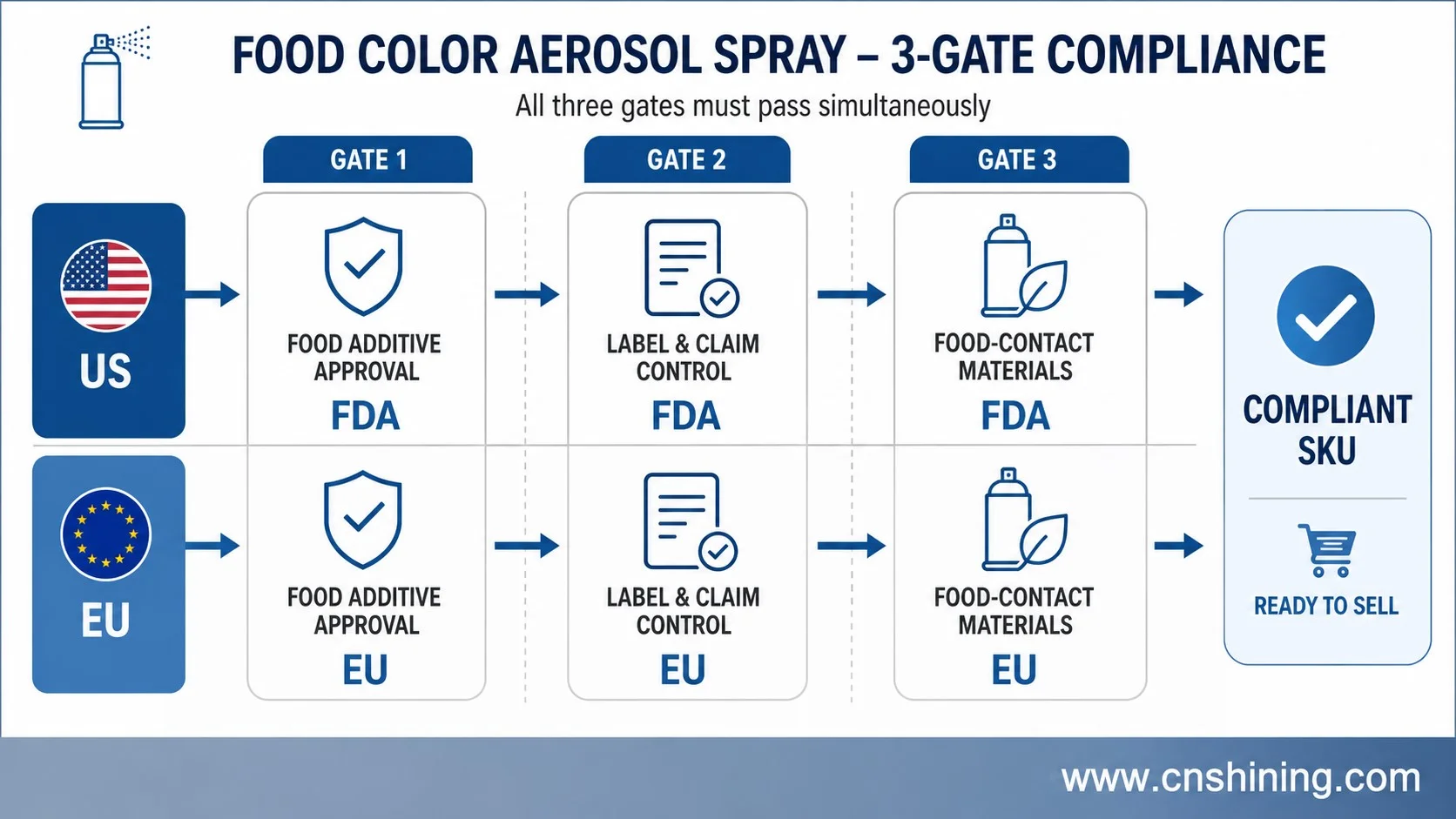
A food color aerosol spray has to pass three gates at the same time: legal use of food additives, legal label and claim language, and legal food-contact packaging materials. The hard part is not making the spray work. The hard part is making one SKU legally sellable across different jurisdictions.
4.1 United States
In the US, color additive approval and labeling claims are central. FDA moved in 2026 to allow “no artificial colors” claims when a product does not contain petroleum-based colors, even when approved natural-source colors are used. That policy shift will push spray decoration lines toward natural-source and plant-derived color systems. The relevant FDA release is available under FDA no artificial colors claims.
For US product management, the practical questions are plain: is the product edible or only for surface decoration? Is it taste-free? Are allergens declared? Is there a maximum suggested use level? High-opacity white, bright silver and strong pearl routes will become harder to share across US and EU SKUs without reformulation.
4.2 European Union
Europe adds a denser regulatory layer. First, E-number declarations such as E943a, E943b and E944 can appear directly in product ingredients. Second, titanium dioxide changed the route for white, silver and pearl effects. Regulation (EU) 2022/63 removed E171 from the authorized food additive list; the legal text can be checked through EU Regulation 2022/63 on titanium dioxide.
Food-contact materials are another pressure point. Regulation (EU) 2024/3190 restricts BPA and other high-risk bisphenols in food-contact materials. This matters for food color aerosol spray because the risk map is not limited to the can coating. Printing inks, valve elastomers, gaskets, adhesives and other contact-related materials also need a controlled file chain. TÜV Rheinland summarizes the scope, detection limit and Declaration of Compliance implications in its bisphenols in food contact materials note.
5. Top 10 Food Color Aerosol Spray Bands
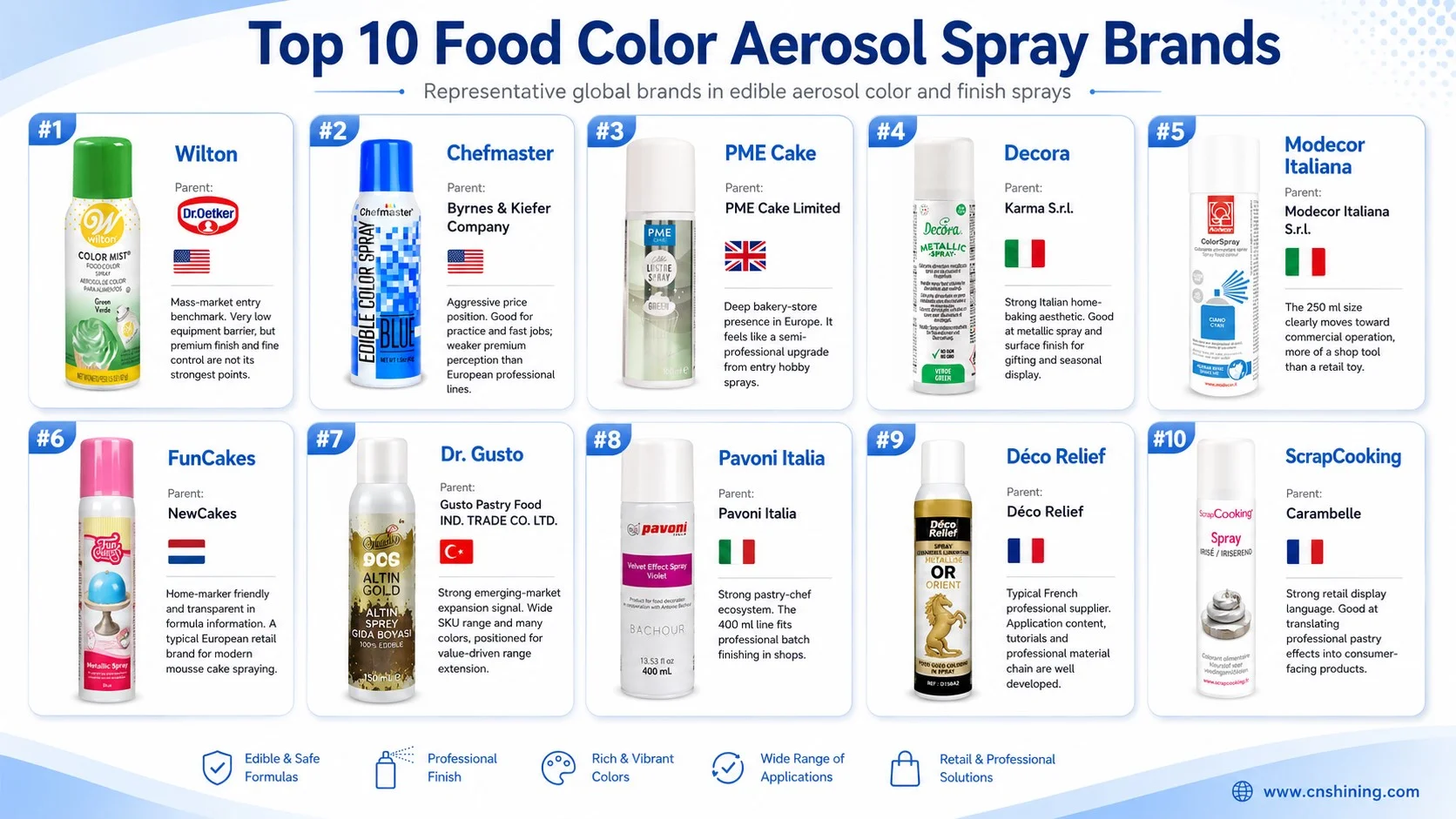
| Brand | Country / Parent or Operator | Representative Aerosol SKU | Reference Price | Direct Comment |
|---|---|---|---|---|
| Wilton | US; parent group Dr. Oetker | Gold Color Mist, 1.5 oz / 42 g | about $12.94–13.87 | Mass-market entry benchmark. Very low equipment barrier, but premium finish and fine control are not its strongest points. |
| Chefmaster | US; Byrnes & Kiefer Company | Edible Spray, 1.5 oz | about $4.98–5.75 | Aggressive price position. Good for practice and fast jobs; weaker premium perception than European professional lines. |
| PME Cake | UK; PME Cake Limited | Edible Lustre Spray Gold, 100 ml | about $10.37–10.95 | Deep bakery-store presence in Europe. It feels like a semi-professional upgrade from entry hobby sprays. |
| Decora | Italy; Karma S.r.l. | Metallic Food Spray Gold, 75 ml | about $16.16–17.31 | Strong Italian home-baking aesthetic. Good at metallic spray and surface finish for gifting and seasonal display. |
| Modecor Italiana | Italy; Modecor Italiana S.r.l. | Spray Colouring Pink, 250 ml | about $33.24 | The 250 ml size clearly moves toward commercial operation, more of a shop tool than a retail toy. |
| FunCakes | Netherlands; NewCakes | Velvet Spray Pink / Metallic Spray Gold, 100 ml | about $11.92–13.27 / $12.40 | Home-baker friendly and transparent in formula information. A typical European retail brand for modern mousse cake spraying. |
| Dr. Gusto | Turkey; Gusto Pastry Food IND. TRADE CO. LTD. | Metallic Gold Spray, 150 ml | about $3.68 / $17.80 | Strong emerging-market expansion signal. Wide SKU range and many colors, positioned for value-driven range extension. |
| Pavoni Italia | Italy; Pavoni Italia | Dolce Velluto Black, 400 ml | about $30.56 | Strong pastry-chef ecosystem. The 400 ml line fits professional batch finishing in shops. |
| Déco Relief | France; same-brand operator | Gold Velvet Spray, 400 ml | about $20.07–24.09 | Typical French professional supplier. Application content, tutorials and professional material chain are well developed. |
| ScrapCooking | France; Carambelle | Yellow Velvet Spray, 400 ml | about $32.26 | Strong retail display language. Good at translating professional pastry effects into consumer-facing products. |
Three facts stand out. First, retail entry lines usually cluster around 1.5 oz / 75–100 ml. Second, professional velvet lines often move directly to 250–400 ml. Third, price does not scale linearly with volume. Finish type, compliance route, brand position and channel structure matter as much as can size.
6. Packaging Components for Food Color Aerosol Spray: Shining Packaging
For this category, packaging is not only a container. It is part of the spray performance. A weak actuator can make a good formula look cheap. A mismatched valve can turn metallic pigment into clogging complaints. A poor internal coating can create odor, migration concerns or compatibility problems.
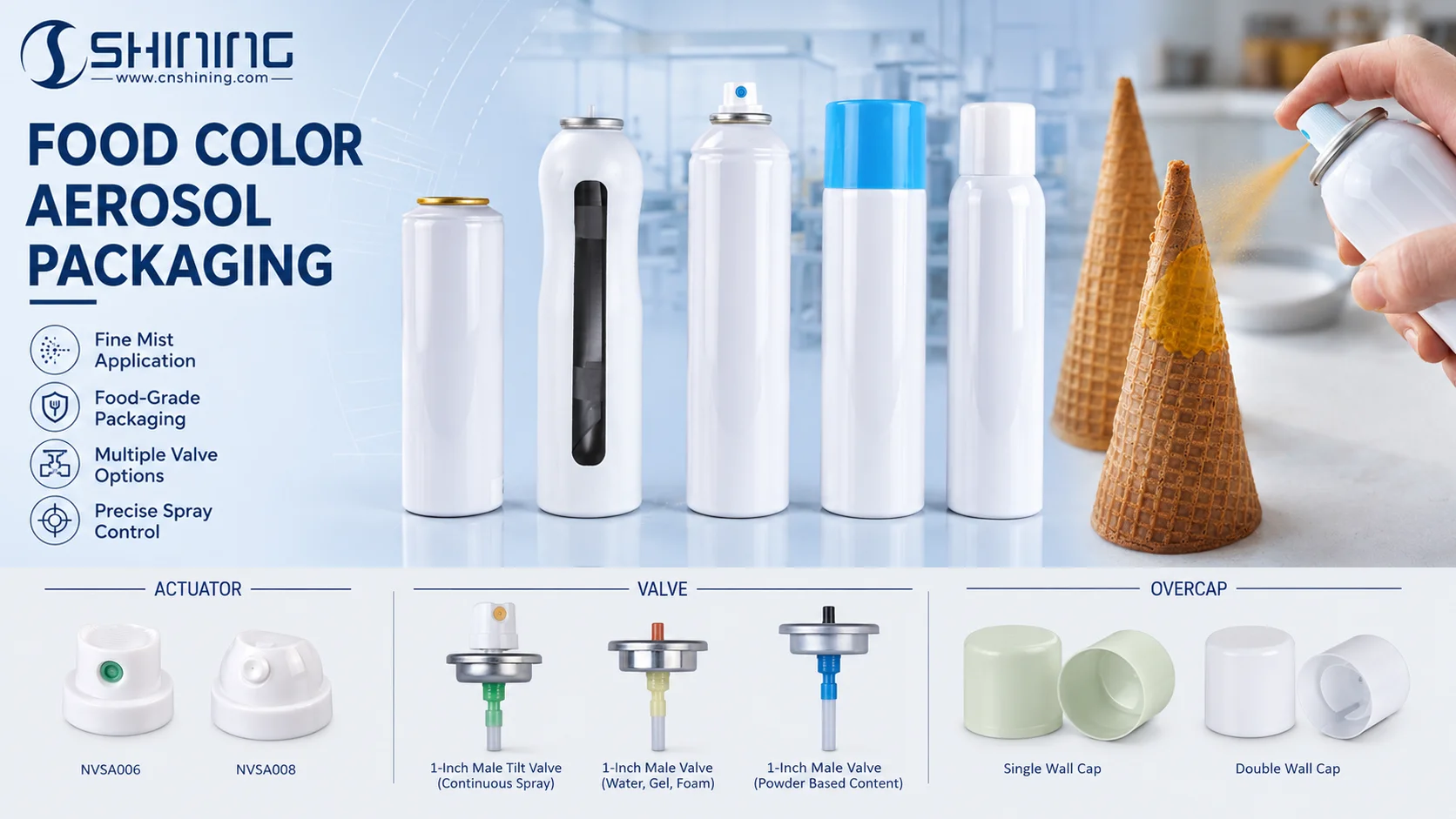
In a food color aerosol spray project, Shining Packaging would normally look at the system from three hardware points: the actuator, the aerosol can and the valve. The actuator controls finger feel, directionality, spray pattern and overspray behavior. The can body affects grip, capacity, printing space, corrosion resistance and logistics fit. The valve decides discharge rate, sealing stability, dip tube behavior and formula compatibility.
For metallic and pearl sprays, the practical target is a fine mist that tolerates suspended particles without easy blockage. For velvet sprays, the target is a stable output rate that can handle fat-based systems and still create an even surface at a practical spraying distance, often around 25–30 cm. These two jobs should not be forced into one universal valve-and-actuator setup.
The better question is not “which can looks nicer?” It is: which can, valve and actuator combination makes the product harder to misuse? That is where packaging engineering reduces complaints before the product reaches the shelf.
7. User Pain Points, Packaging Fixes and Current Trends
7.1 Common user complaints
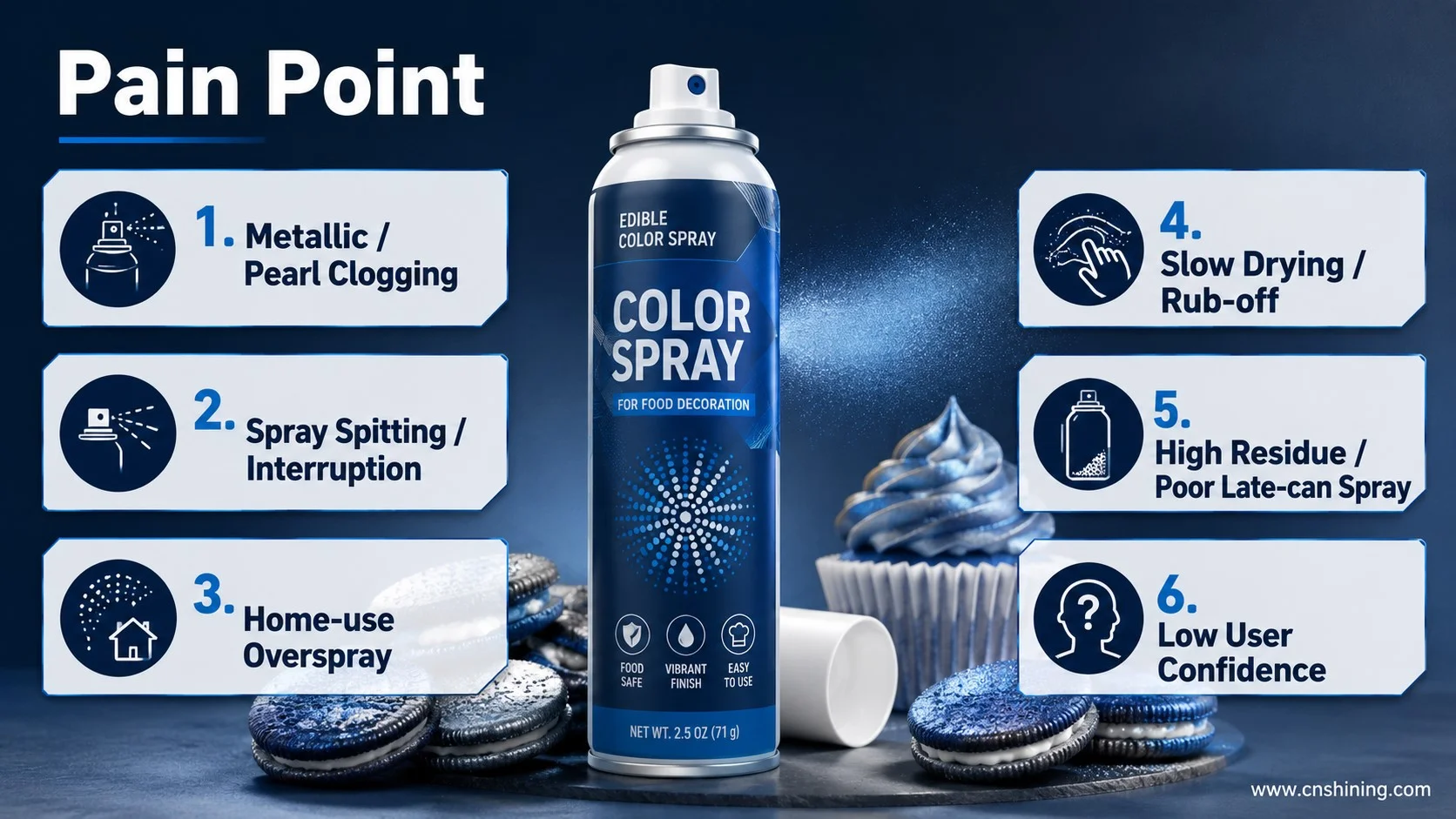
Public feedback from retail platforms, forums and tutorial content points to the same issues again and again: clogging, uneven spray, overspray, unexpected color, slow drying, rubbing off, aftertaste concern, and velvet layer cracking on cold-chain surfaces. This category has demand. The weak point is often the final 20% of user experience.
| Pain Point | Typical Field Signal |
|---|---|
| Clogging / interrupted spray | Users report uneven output and nozzles that need constant cleaning. |
| Uneven spray / spitting | Spray appears spotty instead of forming a controlled mist. |
| Overspray on hands and worktops | Color lands outside the target area even when users try to shield the cake. |
| Color below expectation | Gold may look tan or dull if film thickness, base color or pigment route is wrong. |
| Slow drying / rub-off | Excess output or unsuitable substrate leaves a surface that transfers color. |
| Aftertaste / safety concern | Users notice sensory residue, especially in stronger color systems. |
| Velvet layer cracking or slipping | Surface not cold enough, moisture, frost or unstable fat crystallization can ruin the texture. |
7.2 Packaging translation of those complaints
Users do not complain in engineering terms. They say “the nozzle clogs” or “it sprays everywhere.” Packaging teams should translate that into specific questions: is the valve flow rate right? Is the actuator spray pattern right? Is the instruction panel clear? Is the internal coating compatible with the formula?
| Pain Point | Valve | Actuator | Can Format | Printing / Instructions | Internal Coating |
|---|---|---|---|---|---|
| Metallic / pearl clogging | Increase particle tolerance; avoid overly narrow orifices; check gasket compatibility. | Use wider-path fine-mist insert to reduce pigment build-up. | 75–100 ml retail size can reduce long storage after opening. | Show shake, distance, wipe-after-use and warm-water unclog steps. | Use low-odor, low-migration coating compatible with alcohol systems. |
| Velvet spray spitting / interruption | Tune discharge rate for fat-based systems. | Use fan pattern suitable for 25–30 cm spraying, not uncontrolled wide scatter. | 250–400 ml professional straight-wall cans support steadier grip. | Use large icons for warming, shaking, cold dry surface and distance. | Check cocoa butter or vegetable oil compatibility to reduce odor and separation. |
| Home-use overspray | Lower discharge rate; avoid excessive flow per press. | Directional spray head or guarded actuator reduces side drift. | Slim cans help users keep distance; anti-slip shoulder is better than glossy-only finish. | Draw a masked working area; QR video often works better than text only. | Not the main cause, but good coating reduces odor concern. |
| Slow drying / rub-off | Control single-press output to avoid thick deposits. | Fine spray beats a heavy “big blast” pattern. | Separate fast-dry metallic line and velvet line by can design. | Print substrate, pass count and drying time as a matrix. | Low-odor, low-migration coating reduces chemical perception. |
| High residue / poor late-can spray | Optimize dip tube length and residue control; evaluate BOV for premium lines. | Match actuator for 360° or low-angle spray where needed. | BOV or better emptying structure suits premium SKUs. | State upright or inverted use clearly. | BOV separates product and propellant, supporting a cleaner product story. |
| Low user confidence | Make output controllable and reduce over-application. | Stable button feel reduces accidental spraying. | Small retail sizes feel easier to finish safely. | State edible, surface decoration, allergens, maximum dose and flammability clearly. | BPA-free or BPA-NI documentation matters for B2B buyers. |
This category needs a system that is harder to use incorrectly. That means separate valve and actuator tuning for metallic powder systems and velvet fat systems, narrower and clearer home-use spray control, stronger emptying performance for professional lines, and complete food-contact files for coatings, inks and elastomers.
7.3 Current trends
The strongest trend is the move from synthetic colors toward natural or lower-controversy color systems. In the US, the FDA claim change around petroleum-based colors will affect new product development. In Europe, E171-free and BPA-free pressure changes both the formula route and the packaging documentation route.
Aerosol packaging innovation also matters. AEROBAL’s 2025 award cycle and industry coverage show movement around low-carbon aluminium cans, 360° embossing, weight reduction and differentiated surface treatment. These cases are not all from food decoration, but the message transfers well. Future food color aerosol spray packaging will compete on compliance, controlled function, shelf recognition and carbon story. Public industry coverage of the award is available in World Aerosols’ AEROBAL 2025 award report.
Channel split is also clear. Retail will keep favoring 75–100 ml small cans with low-error actuators. Professional users will keep using 250–400 ml velvet and metallic cans. Cross-border e-commerce may push more brands toward pump spray, powder pump spray or clearer SKU separation because flammable aerosol transport remains inconvenient.
If a brand is planning a new product or packaging upgrade, the better investment is not simply one more color. Split the range into three lines: 75–100 ml fast-drying metallic retail spray, 250–400 ml professional velvet spray, and non-aerosol pump spray or airbrush support line. These lines solve different complaints, face different regulatory pressure and fit different user expectations.
8. Summary
Food color aerosol spray is a surface-finishing tool. Its value comes from speed, wide coverage and low equipment barrier. Its problems also come from the same place: pressurized output gives less detail control and punishes poor valve-actuator-formula matching.
The strongest technical conclusion is simple. Do not design one universal spray pack for every formula. Metallic sprays, velvet sprays, pump powders and airbrush liquids are different systems. For aerosol products, the valve, actuator, can coating, propellant and label instructions must be developed as one package. That is how the product avoids clogging, overspray, rub-off, residue and compliance surprises.
9. FAQ: Food Color Aerosol Spray
It is mainly used for surface decoration on cakes, fondant, chocolate, macarons, mousse, ice cream and frozen desserts. It creates color, metallic shine, pearl effects or velvet texture on the outside surface. It is not meant for mixing color into batter, cream or fondant mass.
Clogging usually comes from poor matching between formulation, valve and actuator. Metallic powders, high-solids color systems and fat-based velvet sprays can deposit inside narrow passages. A better design needs suitable orifice size, gasket compatibility, actuator insert design and clear after-use cleaning instructions.
Metallic spray is often alcohol-based and designed to dry into a thin shiny layer. Velvet spray is normally fat-based, often using cocoa butter or vegetable fat, and forms texture by solidifying on a cold surface. They need different spray rates, actuators and user instructions.
The actuator controls spray direction, pattern, output feel and overspray. A poor actuator can make a good formula look uneven or messy. For food decoration, the actuator should support fine mist, predictable pattern and stable finger control, especially for home users without spray training.
Bag-on-Valve is not the current mainstream retail format, but it is technically useful for premium lines. It separates product from propellant gas, can improve emptying rate, supports all-angle spraying and may reduce contamination risk. It is worth testing for high-value clean-finish products.
Velvet spray depends on quick fat crystallization on a cold, dry surface. If the dessert surface is too warm, wet, icy or uneven, the coating may crack, slip or form spots. Packaging instructions should clearly state surface temperature, shaking, spray distance and preparation steps.
Overspray can be reduced by lowering discharge rate, using a more directional actuator, narrowing spray pattern for home-use cans and printing clear masking instructions. A QR demo can help because many users do not understand spray distance, angle or the need to protect the work area.
The product must be checked through food additive legality, label and claim wording, and food-contact packaging compliance. Colorants, propellants, can coating, inks, valve elastomers and gaskets all matter. In export work, a formula that passes one region may not pass another unchanged.
Retail entry products often use 1.5 oz or 75–100 ml cans because they are easy for home bakers and reduce long storage after opening. Professional velvet and metallic lines often move to 250–400 ml because shops need faster batch finishing and better operating efficiency.
Metallic sprays and velvet sprays fail in different ways. Metallic systems fight pigment settling, nozzle deposits and color uniformity. Velvet systems fight fat flow, temperature sensitivity and surface texture defects. Separate valve, actuator, can-size and instruction strategies reduce complaints more effectively than one shared design.