
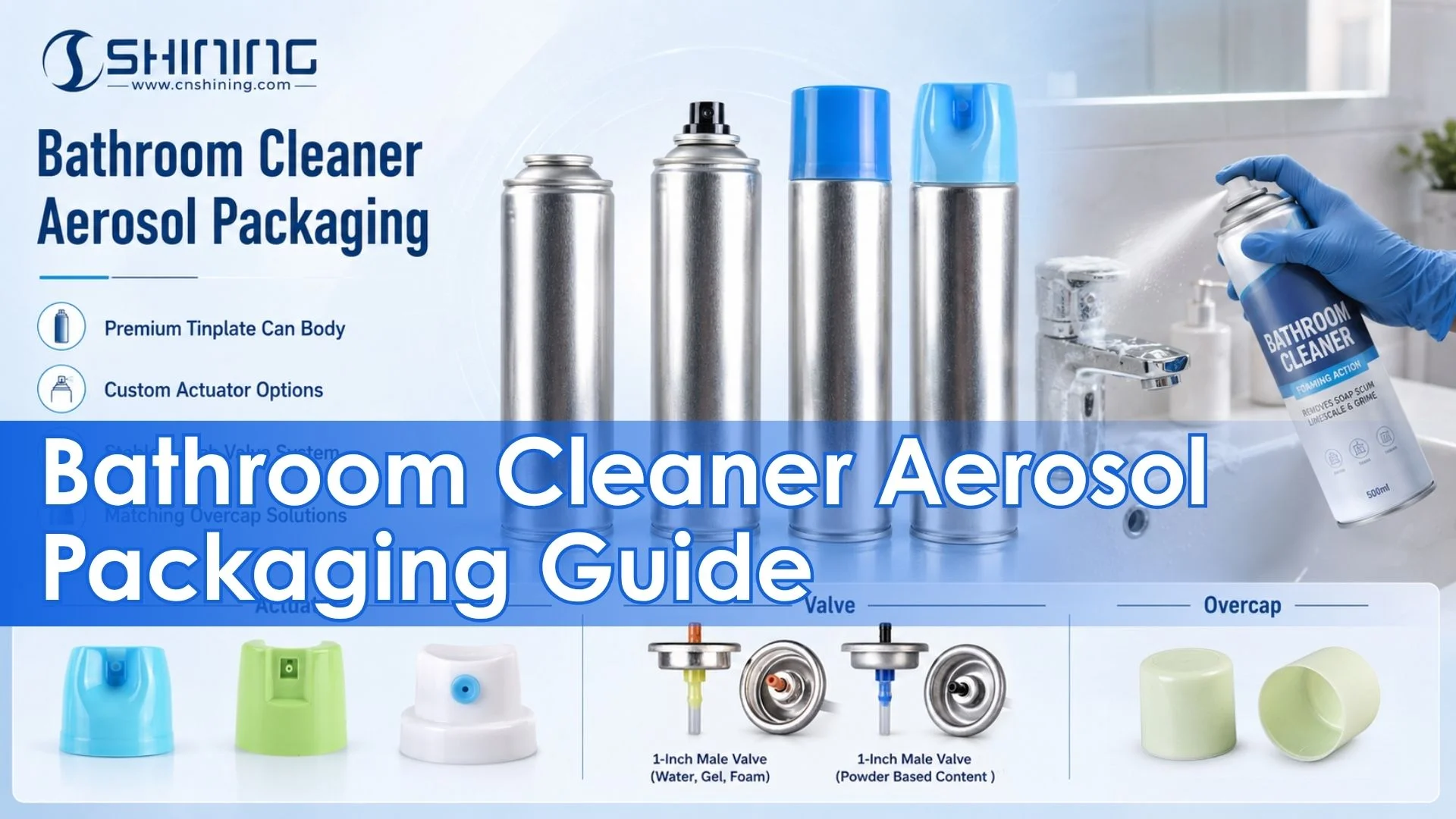
Bathroom cleaner aerosol spray, shower foamer, tub-and-tile aerosol cleaner, bathroom disinfectant foam and hard-surface bathroom spray all describe the same type of system: a cleaning formulation packed in a pressurized container and discharged through a valve and actuator as mist, fan spray or foam.
This product format is not defined by chemistry alone. It is defined by the interaction between formula, propellant, can, internal coating, valve, dip tube, actuator and spray pattern. That is why a bathroom aerosol can work well on vertical tile and glass, yet still fail through corrosion, clogging, harsh odor, unstable foam or poor user control.
From a regulatory point of view, the distinction between aerosol and pump spray matters. The U.S. federal VOC rules define an aerosol product as a pressurized spray system that uses liquefied or compressed gas to dispense contents, while pump spray is not treated as aerosol under that definition. See the relevant 40 CFR Part 59 aerosol and VOC framework.
1. Definition and Working Principle
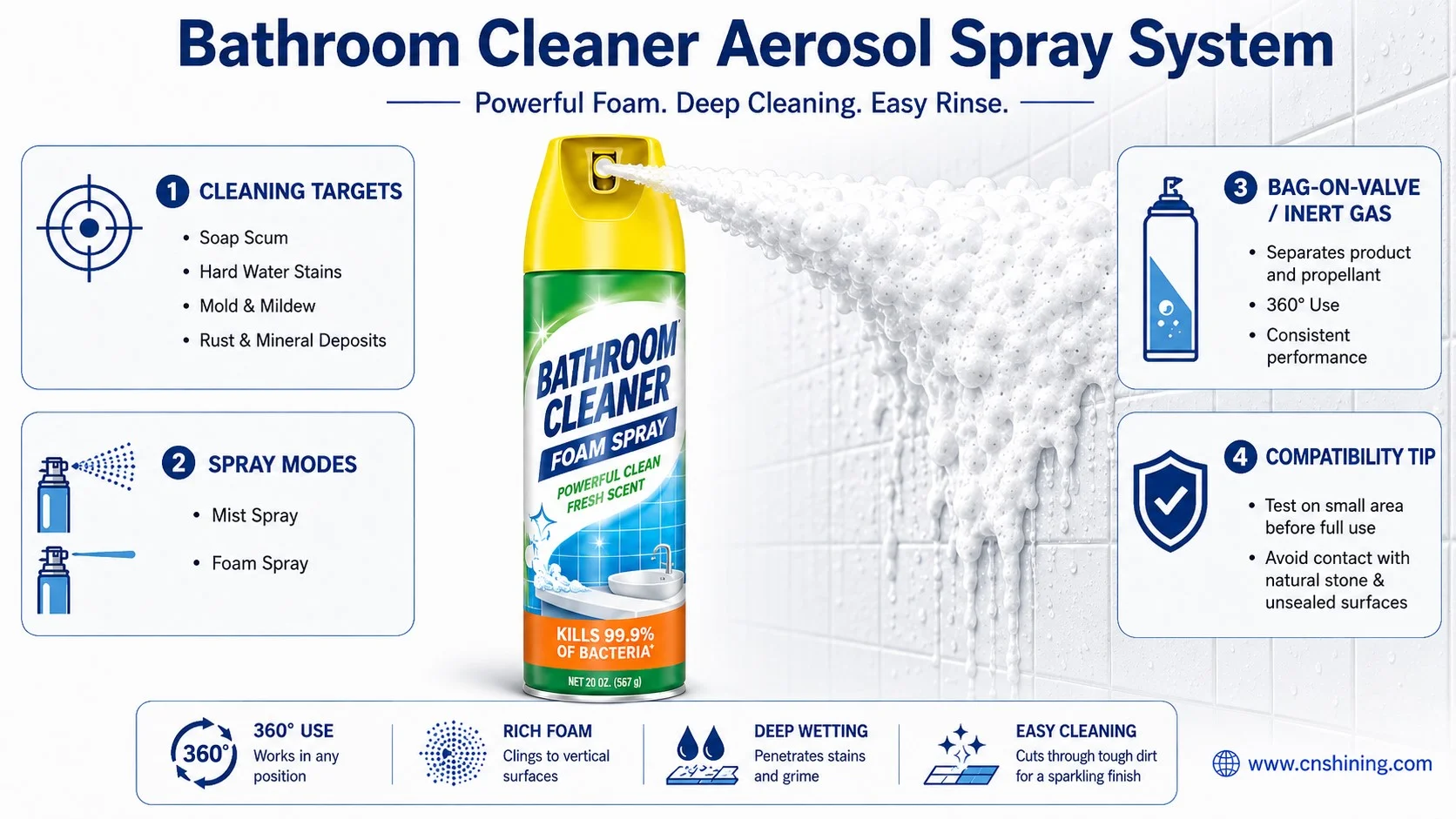
A bathroom cleaner aerosol spray is a packaging-formulation system. The formulation targets soap scum, hard-water scale, mineral deposits, rust stains, mold, mildew, bio-soil, fingerprints and sebum residues. The packaging delivers that liquid as mist, fan spray or foam.
The typical structure includes cleaning liquid, propellant, metal can, internal liner, valve, dip tube and actuator/nozzle. Foam and fan spray are common because bathroom surfaces are rarely flat and horizontal. Shower glass, tile joints, toilet exterior areas and faucet backs need coverage, dwell time and local wetting.
The regulatory boundary changes when a product claims more than cleaning. The EPA separates products that clean, sanitize and disinfect; sanitize and disinfect claims require specific microbial performance and label directions such as wet contact time. The EPA explains this distinction in its page on cleaning, sanitizing and disinfecting surfaces.
Patent literature also shows why propellant is not just a pressure source. In one bathroom aerosol cleaner patent, surfactant, solvent, chelant, water and n-butane are treated as a combined system for bathroom soil removal. The patent record for US8927479B2 aerosol bathroom cleaner is a useful reference for this interaction.
Bag-on-Valve and inert-gas systems deserve separate attention. Bag-on-Valve separates product and propellant, supports 360-degree use and can improve evacuation and formula preservation. Shining Packaging describes Bag-on-Valve aerosol valve technology as a one-way dispensing system using air or nitrogen outside the product bag.
2. Market Size and Development Trend
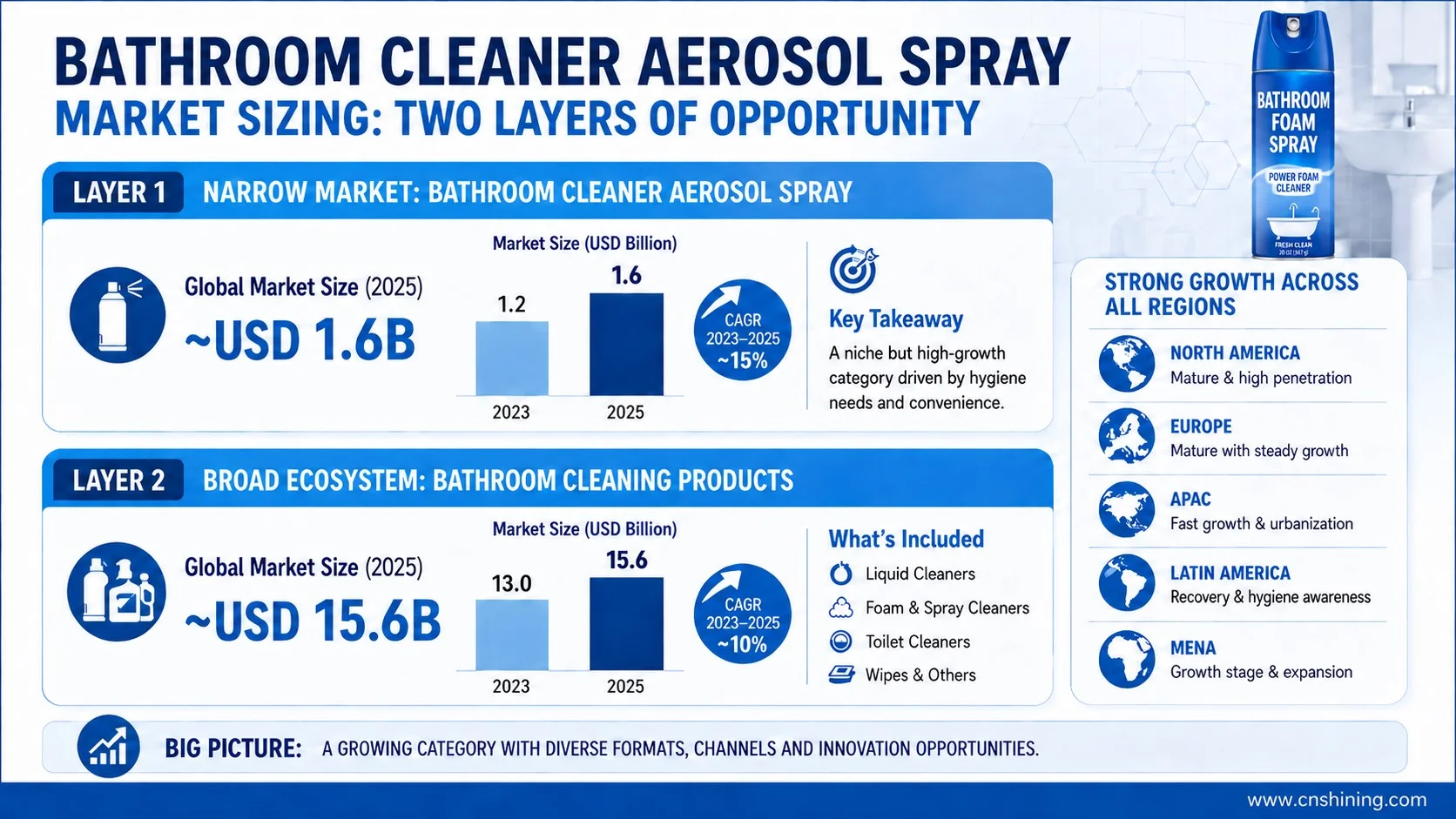
| Region | Closest Public Proxy | Current Judgment | Main Drivers | Main Barriers |
|---|---|---|---|---|
| North America | U.S. home care retail value around US$40.2bn in 2025; e-commerce value share around 31% | Mature, high penetration, concentrated brands | Disinfection claims, repeat purchase, e-commerce, convenience | Price sensitivity, sustainability pressure, VOC and transport costs |
| Europe | Western Europe home care grows slowly; fragrance, sustainability and discount channels matter | Mature but slower growth; highest regulatory threshold | Fragrance experience, eco-formula, private-label upgrade | CLP, BPR, Aerosol Dispensers Directive and detergents compliance complexity |
| APAC | Asia-Pacific and MEA contribute important home care volume growth | One of the key incremental regions | Urbanization, hotel and food service cleaning, modern bathrooms | Fragmented price bands, regulations and channels |
| Latin America | Recovery after pandemic cooling, but inflation pressure remains | Recovering, with obvious price pressure | Hygiene awareness, social media, modern retail | Inflation, downtrading, private label and low-price substitutes |
| MENA | Home care volume growth continued after 2020; household care proxy around US$6.28bn in 2025 in one secondary source | Growth stage, with function and value both relevant | Hygiene needs, retail expansion, hotel and tourism recovery | Economic volatility, value orientation, import cost |
The category is driven by four practical forces: hygiene anxiety, vertical-surface convenience, visible cleaning effects and hard-water or high-humidity conditions. Foam expansion, color change, broad spray and strong scent work well in short-form content, but the real technical reason is simpler: bathroom soils need wetting and dwell time.
The barriers are just as clear. Aerosol products carry VOC, flammability, storage and transport burdens. Refill formats naturally compete with aerosol for sustainability claims. Disinfection claims add registration and evidence cost. Consumer complaints about harsh scent, small capacity, clogged actuators and poor performance on heavy soap scum directly expose the weakness of old aerosol design.
The valuable intersections are not “spray” by itself. They are household foam for soap scum and limescale, low-irritation disinfecting bathroom spray, professional mold or heavy-soil foam, and green chemistry paired with low-VOC or recyclable packaging.
3. Product Comparison and Formulation System
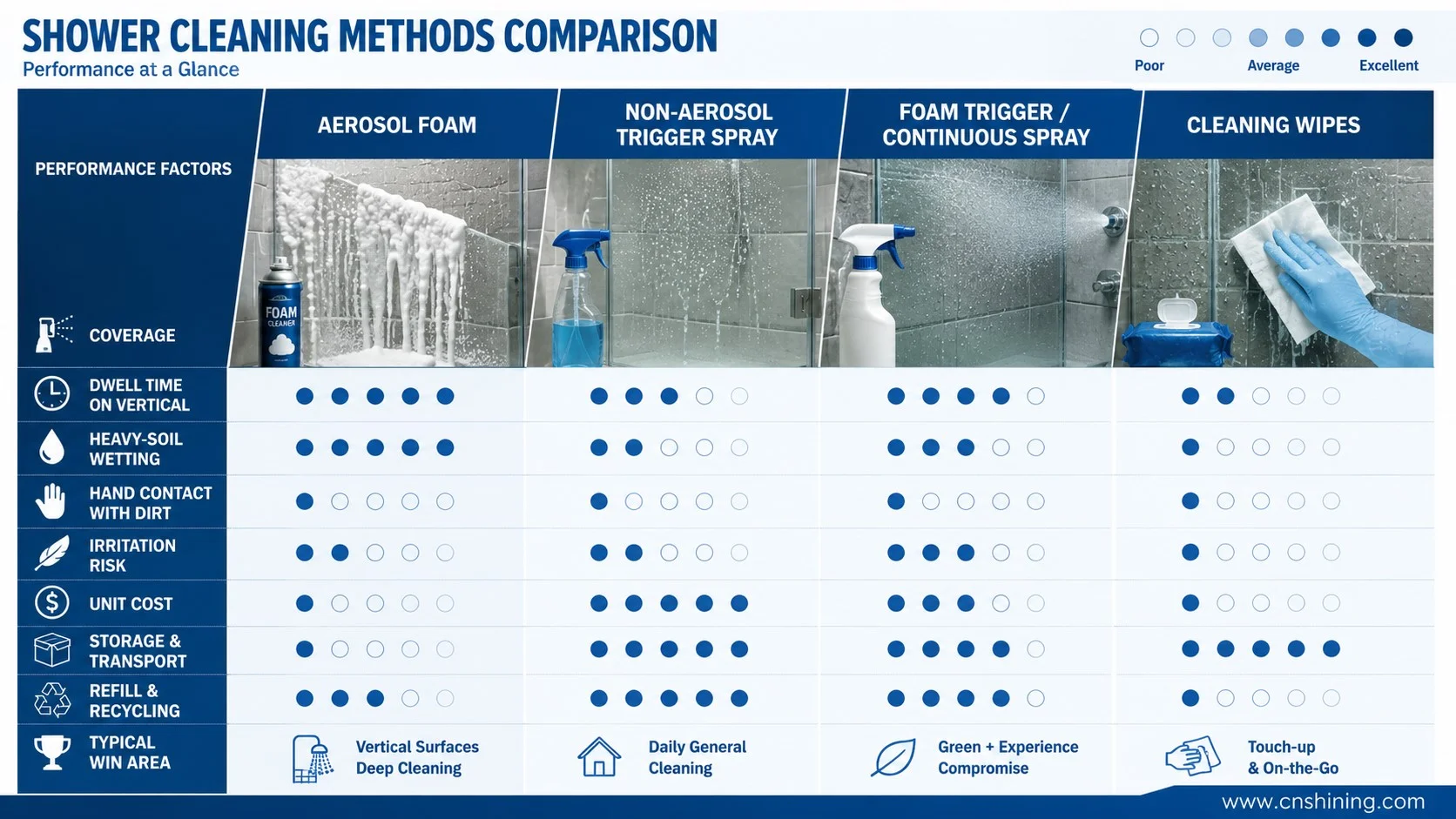
3.1 Aerosol Foam Versus Trigger Spray, Continuous Spray and Wipes
| Dimension | Aerosol Spray / Foam | Non-Aerosol Trigger Liquid | Foam Trigger / Continuous Spray | Wipes |
|---|---|---|---|---|
| Coverage speed | Fast; suitable for large and vertical surfaces | Medium; often spot or fan spray | Medium to fast; continuous spray is user-friendly | Slow; better for small areas |
| Vertical dwell | Strong, especially foam | Average; requires more spraying | Relatively strong | Depends on wipe liquid load; weak for large vertical surfaces |
| Heavy-soil wetting | Strong | Medium | Relatively strong | Weak |
| Hand contact with dirty surface | Low | Low | Low | Higher because wiping is required |
| Irritation in small bathroom | Higher, especially with strong fragrance or propellant odor | Low to medium | Low to medium | Low |
| Unit use cost | Often higher | Usually lowest | Medium | Often higher |
| Storage and transport complexity | Highest: pressurized, VOC and flammability constraints | Lowest | Low to medium | Low |
| Refill and recycling fit | Medium; depends on can and local recycling stream | Best; easy to build refill systems | Good; refill-friendly | Poor; composite materials are common |
| Typical win area | Shower glass, vertical grout, visual no-scrub cleaning | Daily general cleaning | Green + experience compromise | Fast touch-up, travel and detail cleaning |
Consumers still buy aerosol bathroom cleaner because it gives immediate visual feedback. Thick foam, wide spray and color-change effects make the product feel active. The technical basis is more concrete: foam holds liquid on vertical surfaces long enough to dissolve soap scum and limescale.
3.2 Formulation Classes and Stability Problems
The market and patent sources point to four main formulation routes: acidic descaling, soap-scum removal, disinfecting formulations and low-odor or green formulations. The following table keeps the original technical logic, but translates it into a development view.
| Class | Common Actives and Functional Ingredients | Typical Example Structure | Main Target | Safety and Stability Issues |
|---|---|---|---|---|
| Acidic descaling type | Citric acid, lactic acid, sulfamic acid, phosphoric acid, low-foam nonionic surfactant, chelants such as EDTA or GLDA | Water 70–85%; acid 3–10%; surfactant 1–4%; chelant 0.1–2%; fragrance/additives 0.1–1%; propellant 5–12% | Hard-water scale, rust, mineral deposits | Corrosion risk for metal cans, valve springs and liners. Fragrance in acidic systems can become sharper. Early acidic tile cleaner patent work focused on balancing acid cleaning and surface compatibility. |
| Soap-scum / general grime type | Nonionic, amphoteric or alkyl glycoside surfactants; glycol ether solvents; EDTA; mild alkali or buffers | Surfactant + water-soluble or dispersible solvent + chelant + n-butane propellant + water, as seen in aerosol bathroom cleaner patent structures | Soap scum, sebum, general bathroom grime | Solvent and propellant affect VOC, odor, spray pattern and flammability. High surfactant can increase valve residue or surface film. |
| Disinfecting type | Quaternary ammonium compounds such as ADBAC, DDAC and ODDAC; low-foam surfactants; solvent; pH adjuster | Bathroom foamer systems often combine quats with nonionic or controlled anionic cleaning components | Cleaning plus disinfecting or sanitizing claim | Quats may be deactivated by incompatible anionic sulfate or sulfonate surfactants. WIPO-type patent records note this compatibility risk. Disinfecting claims also require contact-time and registration evidence. |
| Low-odor / green type | Citric acid, lactic acid, bio-based surfactants, probiotics, biosurfactants, low-VOC solvents | A Japanese limescale remover application uses lactic acid plus fumaric acid to balance odor and calcium carbonate dissolution; Unilever introduced probiotic home-cleaning concepts in Cif Infinite Clean. | Cleaning with lower odor and greener positioning | Often requires longer contact time, more careful packaging compatibility and tighter claim control. Disinfection claims make the route more difficult. |
| Glycoside / mild surfactant type | APG, nonionic surfactants, small solvent fraction, EDTA, propellant | Older aerosol hard-surface cleaner work notes glycoside surfactant systems with useful tinplate steel can stability; see the aerosol hard surface cleaner patent record. | Milder cleaning and lower irritation story | Foam feel is good, but heavy soil still needs acid or solvent support. The surfactant package must keep the nozzle clean and avoid surface residue. |
The common failure is not weak active ingredient alone. It is system mismatch. Formula developers need to check at least five interfaces: active and surfactant compatibility, acid or alkali versus metal and liner, fragrance drift under solvent and propellant, propellant impact on droplet size and cleaning rate, and valve/nozzle tolerance against surfactant deposit or crystallization.
4. Product Fit: Shining Packaging Actuators, Cans and Valves
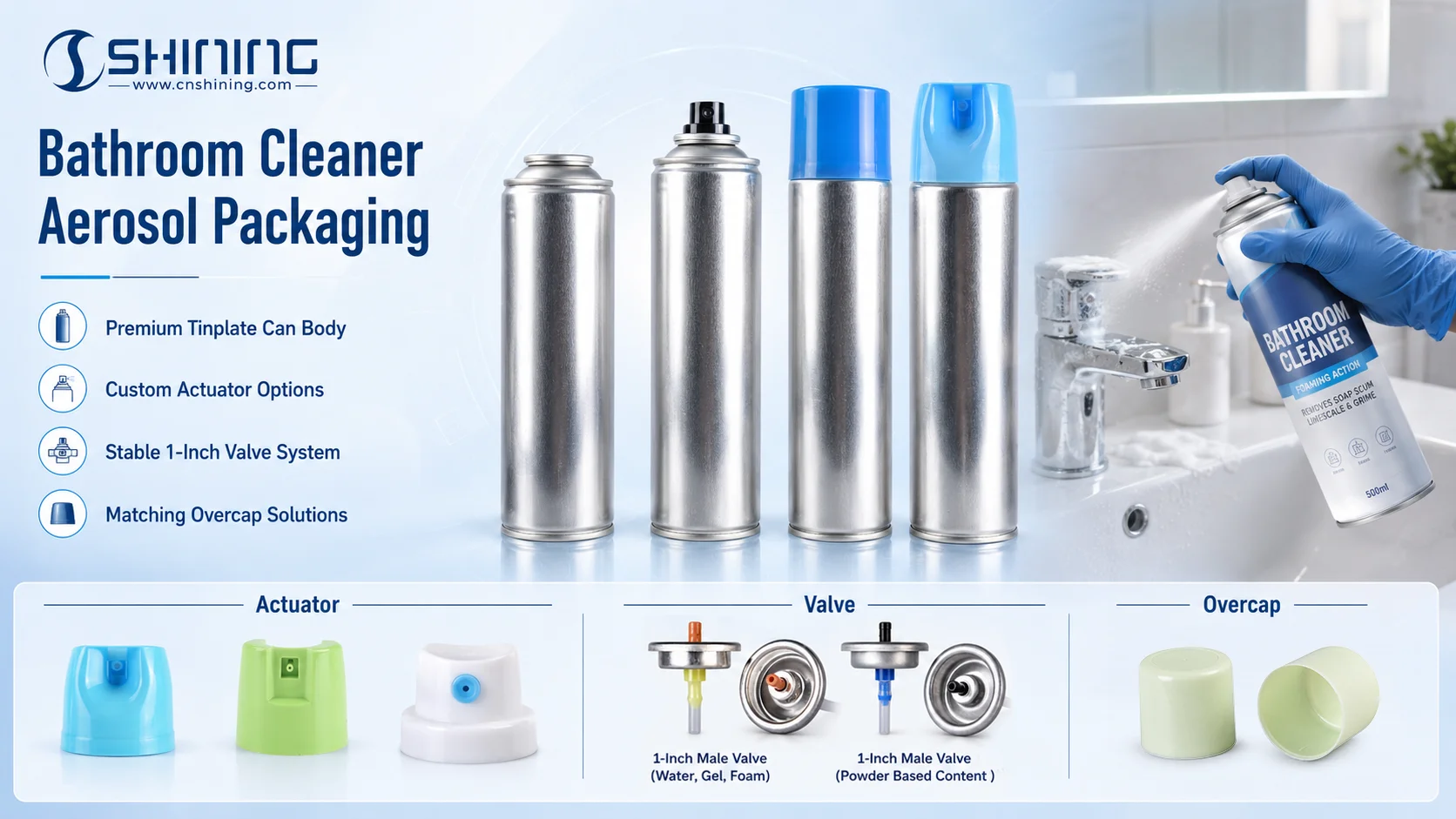
For Shining Packaging, this application is mainly about three hardware decisions: actuator geometry, aerosol can compatibility and valve selection. A bathroom cleaner is often acidic, surfactant-rich, fragranced or disinfectant-loaded. That means the package cannot be selected after the formula is already fixed.
The actuator should match the use case. A wide fan spray helps shower glass and wall tile. A foam actuator improves dwell time on vertical surfaces. A lower-mist or more focused spray can reduce eye and nose irritation in small bathrooms. Opening force and rebound also matter because wet hands and gloves make poor actuator ergonomics more obvious.
The aerosol can must be checked against formula pH, solvent system, fragrance load and corrosion behavior. Acidic descalers and high-fragrance formulas need liner screening, storage tests and valve-elastomer checks. The valve must deliver stable foam or spray until late product life, not only in the first discharge test.
5. Terms, Regulations and Compliance
5.1 Key Terms
| Term | Plain Technical Meaning | Business Meaning |
|---|---|---|
| Aerosol | Pressurized container dispensing liquid as mist or foam; not ordinary pump spray | Pulls the product into VOC, transport, flammability and aerosol labeling systems |
| Propellant | LPG, DME, nitrogen, CO2 or similar pressure source | Controls spray pattern, VOC, flammability, cost and ESG narrative |
| BOV | Bag-on-Valve, separating product and propellant | Good fit for sensitive formulas, 360-degree use and higher-end packaging |
| VOC | Volatile organic compound | Directly linked to formula design, odor, compliance and national or state rules |
| Contact time | Time a treated surface must remain wet for sanitizing or disinfecting | Determines whether the disinfecting claim is technically and legally supportable |
| Quats | Quaternary ammonium disinfectant actives | Effective, but require registration, compatibility control and environmental review |
| Chelant | EDTA, GLDA or similar complexing agent | Very useful against hard water, soap scum and mineral deposits |
| Soap scum | Mixture of soap metal salts, sebum and dirt | Usually needs solvent + surfactant + chelant rather than one active |
| Limescale | Carbonate-based mineral deposit | Normally pushes the formula toward an acidic route |
| Liner | Internal coating of the can | Determines whether acids, solvents and fragrance can coexist with metal |
| Continuous spray | Dispensing structure that allows repeated or steady output | Improves usability but raises valve reliability requirements |
| CRC | Child-resistant closure or packaging | May become a threshold requirement for certain hazardous formulas |
| List N | EPA list for SARS-CoV-2 disinfectants | Highly recognizable in U.S. disinfectant communication |
| CLP | EU classification, labeling and packaging rules | Controls hazard pictograms, signal words and label layout |
| GB 38508 | China VOC limit standard for cleaning agents | Defines China-market VOC boundaries and low-VOC claims |
5.2 United States
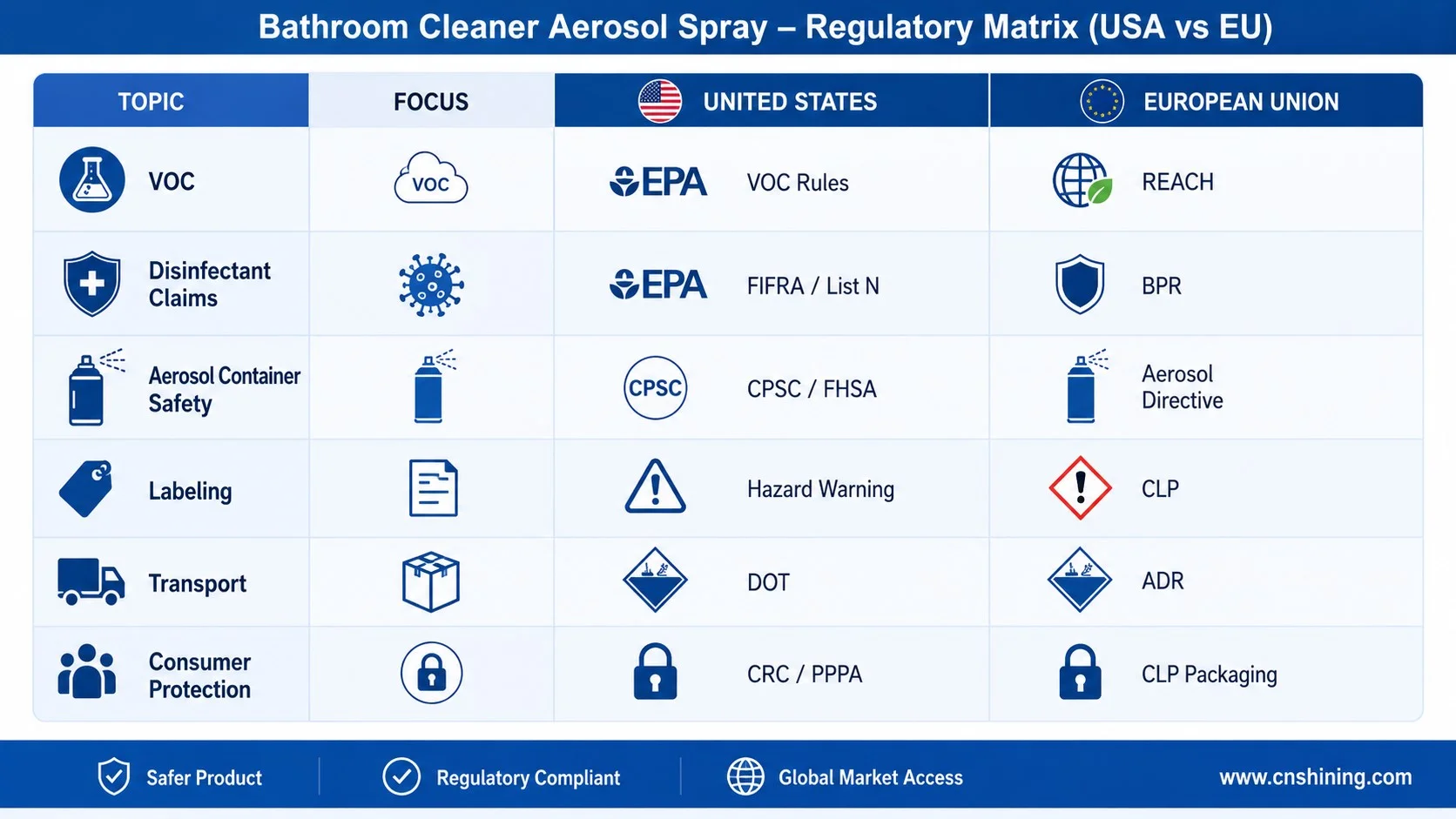
The U.S. split is simple: cleaning-only products sit mainly in hazard labeling, VOC, transport and consumer packaging. Products claiming disinfection, sanitization or virucidal performance normally enter the EPA/FIFRA system. EPA’s List N disinfectant page is often used as a reference point for coronavirus-related disinfectant recognition.
For ordinary household aerosol bathroom cleaner, manufacturers also need to consider EPA consumer product VOC standards, CPSC/FHSA hazard warnings, PPPA child-resistant packaging where relevant, DOT limited quantity rules and state-level VOC categories such as CARB where applicable. The CDC’s regulatory framework for disinfectants and sterilants helps explain the EPA/FDA boundary for disinfectant-type products.
5.3 European Union
The EU is a layered compliance market. REACH and CLP form the base. Detergent products also need detergent-rule review. Biocidal claims move the product into BPR. Pressurized aerosol dispensers add aerosol container safety and labeling requirements. For CLP classification and labeling reference, see ECHA CLP legislation.
6. Top 10 Bathroom Cleaner Aaerosol Spray Brands
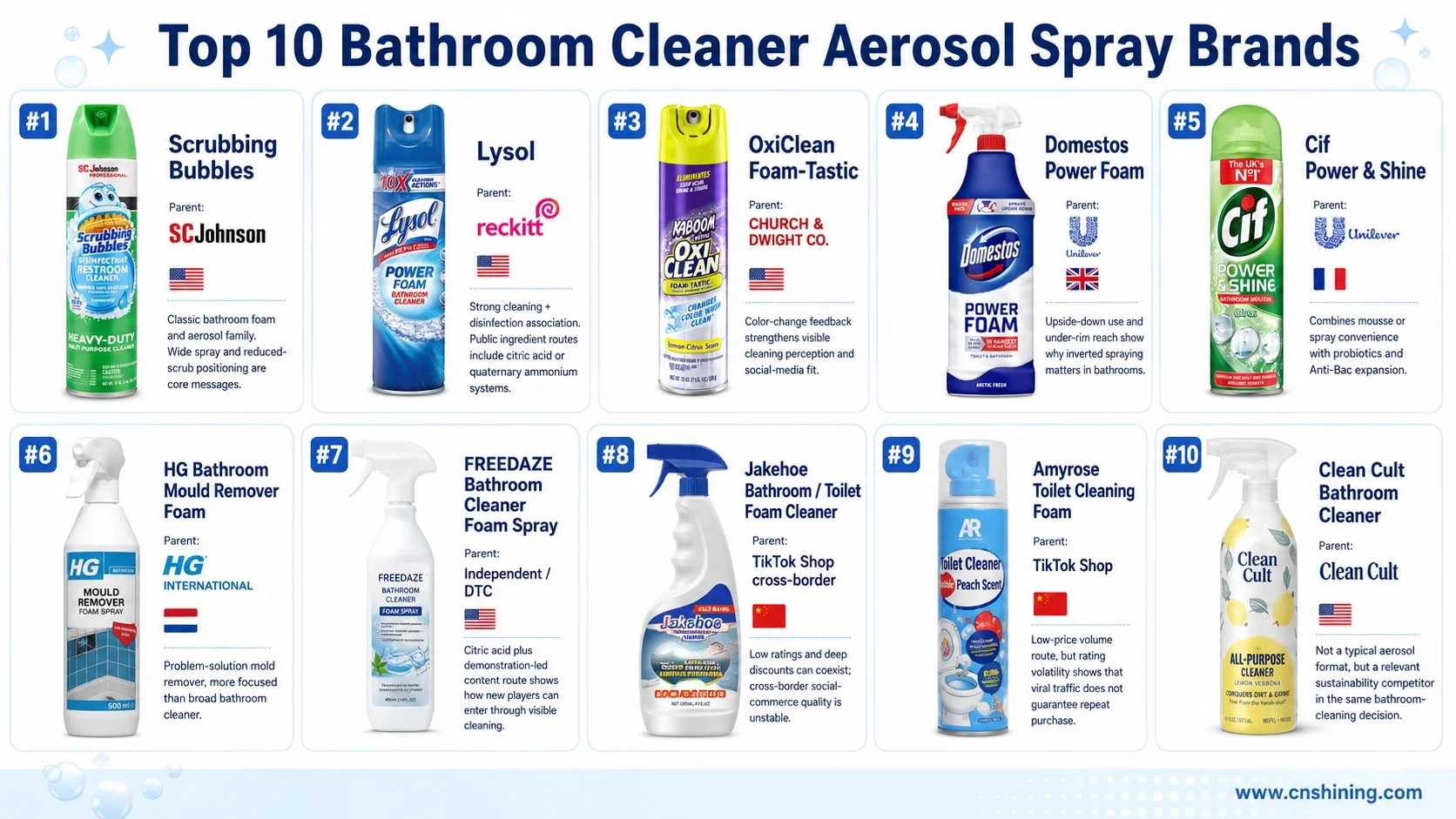
The following table is a representative competitive map, not a global sales ranking. Some brands use metal aerosol cans as a main format. Others use foam trigger, continuous spray or refill systems. They still compete in the same buying decision because users compare them by cleaning effect, convenience, scent, price and packaging reliability.
| Brand | Country | Parent | Common Size | Price Range | Technical Comment |
|---|---|---|---|---|---|
| Scrubbing Bubbles | United States | SC Johnson | 13.58 oz, 20 oz, 32 oz | about 4.49$-8.68$ | Classic bathroom foam and aerosol family. Wide spray and reduced-scrub positioning are core messages. |
| Lysol | United States | Reckitt | 24 oz, 32 oz, 650 mL | about 4.27$-6.00$ | Strong cleaning + disinfection association. Public ingredient routes include citric acid or quaternary ammonium systems. |
| OxiClean Foam-Tastic | United States | Church & Dwight brand family | 19 oz | about 8.85$ per 19 oz can | Color-change feedback strengthens visible cleaning perception and social-media fit. |
| Domestos Power Foam | UK | Unilever | 450 mL | about 2.69$-4.04$ | Upside-down use and under-rim reach show why inverted spraying matters in bathrooms. |
| Cif Power & Shine / Infinite Clean | France | Unilever | 280 mL, 500 mL | about 4.04$-5.39$ | Combines mousse or spray convenience with probiotics and Anti-Bac expansion. |
| HG Bathroom Mould Remover Foam | Netherlands | HG International | 500 mL | about 7.01$-8.76$ | Problem-solution mold remover, more focused than broad bathroom cleaner. |
| FREEDAZE Bathroom Cleaner Foam Spray | United States | Independent / DTC | 400 mL | about 11.95$-18.99$ | Citric acid plus demonstration-led content route. Shows how new players can enter through visible cleaning. |
| Jakehoe Bathroom / Toilet Foam Cleaner | China | TikTok Shop cross-border | Single bottle | about 16.65$-16.99$ | Low ratings and deep discounts can coexist. Cross-border social commerce quality is unstable. |
| Amyrose Toilet Cleaning Foam | China | TikTok Shop | Single bottle | about 3.99$-9.99$ | Low-price volume route, but rating volatility shows that viral traffic does not guarantee repeat purchase. |
| Clean Cult Bathroom Cleaner | United States | Clean Cult | Refill + aluminum bottle system | about 4.98$-8.99$ | Not a typical aerosol format, but a relevant sustainability competitor in the same bathroom-cleaning decision. |
7. User Pain Points and Packaging Improvement
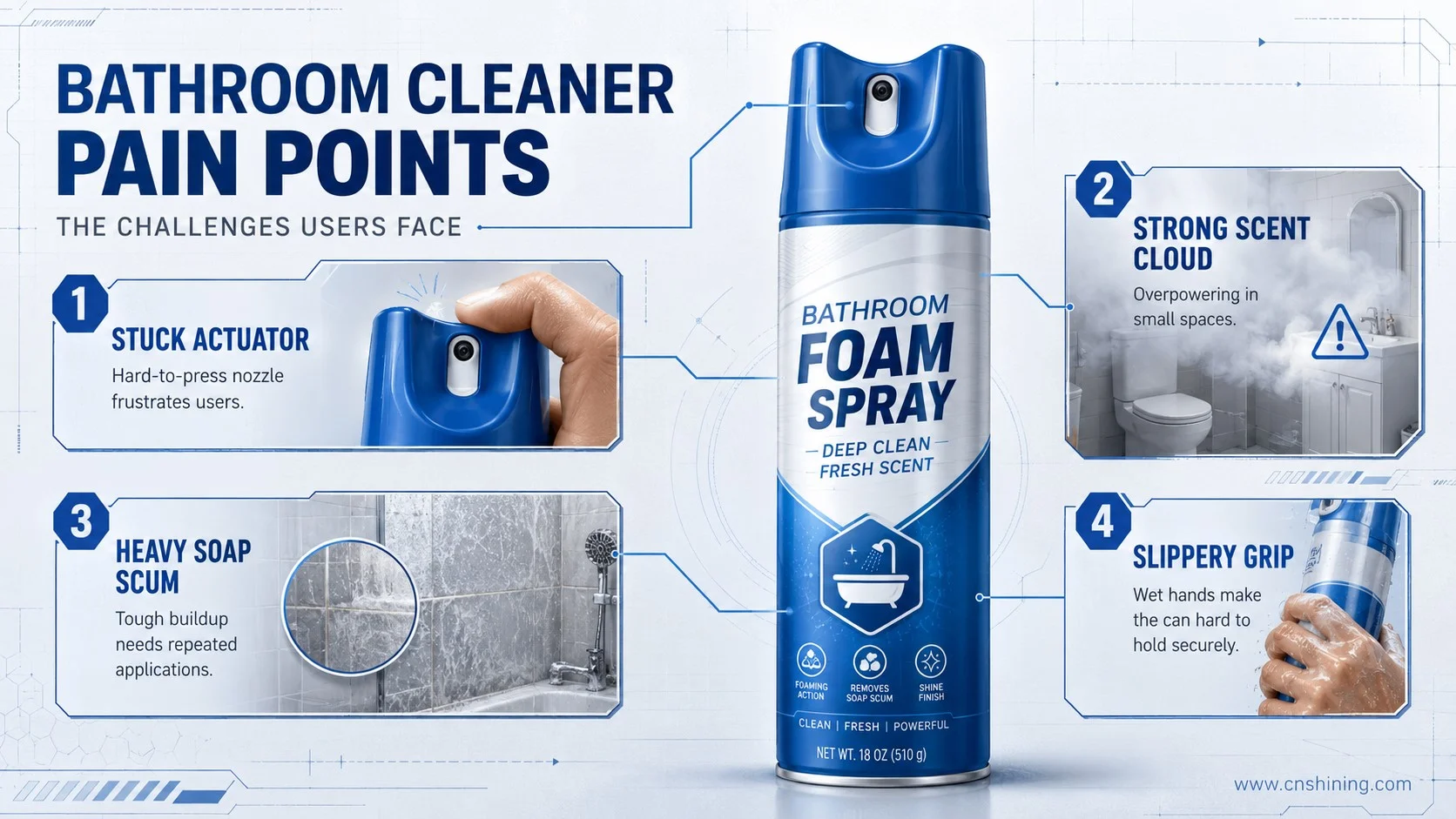
Consumer complaints concentrate around five issues: strong odor, stuck or defective actuator, “no scrub” expectations failing under hard-water or heavy-soil conditions, small capacity versus price, and eye/nose irritation in small bathrooms. These are not only fragrance or formula issues. They are packaging-formulation issues.
| Platform Type | Typical Complaint | Frequency | Example Signal | Sentiment |
|---|---|---|---|---|
| Amazon | Capacity feels small; consumers compare aerosol cost with large trigger bottles | Medium | 20 oz twin aerosol pack around US$8.68 versus 32 oz trigger around US$4.88 in the same product family | Mildly negative |
| Walmart | Scent is unpleasant or too strong in small bathrooms | Medium | “Unpleasant scent” type comments | Negative |
| Walmart | Sprayer sticks or fails; formula may work but package disappoints | Medium to high | “Defective sprayer” and “sprayer sticks every time” signals | Clearly negative |
| Walmart | Heavy soap scum still needs reapplication or brushing | Medium | Heavy soap scum buildup needs repeat application | Neutral to negative |
| TikTok Shop | Rating volatility and over-strong demonstrations | Medium to high | Some cross-border SKUs fluctuate around low-to-mid star ratings | Negative |
| Reddit / social discussion | No-rinse or no-scrub claim fails in hard-water environments | High | Users report soap marks on tile and glass shower doors remain when water is hard | Frustrated |
| Reddit / social discussion | Concern about aerosol on skin and eyes in small bathrooms | Medium | Users ask how to avoid aerosol exposure during use | Concerned |
| Social reviews | Strong smell and slightly high price | Medium | Users like cleaning effect but object to scent strength and cost | Negative |
| Editorial testing | Foam nozzle can be messy or uneven | Medium | No mist option or messy foam discharge | Moderately negative |
Five Packaging Improvements Worth Testing
First, the valve and actuator should move from “can spray” to “controlled spray.” Dual or triple mode actuators are useful: wide fan, focused jet and low-mist foam are more practical than one fixed pattern.
Second, 360-degree use should become a standard target for higher-end bathroom sprays. Toilet outer rims, faucet backs, shower door tracks and corners are exactly where upright-only spraying feels weak.
Third, the can body should be designed for wet hands. Waist shaping, ovalized grip zones, micro-texture and clear tactile nozzle orientation can reduce accidental spraying and grip adjustment.
Fourth, front-of-pack instructions should be more technical. Users need to see surface fit, rinse requirement, hard-water limitations, reapplication guidance, contact time and ventilation advice. “Kills 99.9%” and “no scrub” are not enough.
Fifth, internal liner, valve elastomer and nozzle size should be chosen by formula route. Acid systems, quat systems, high-fragrance systems and low-VOC BOV systems should not share a generic package specification.
8. Business Opportunity, Supply Chain and Cost Drivers
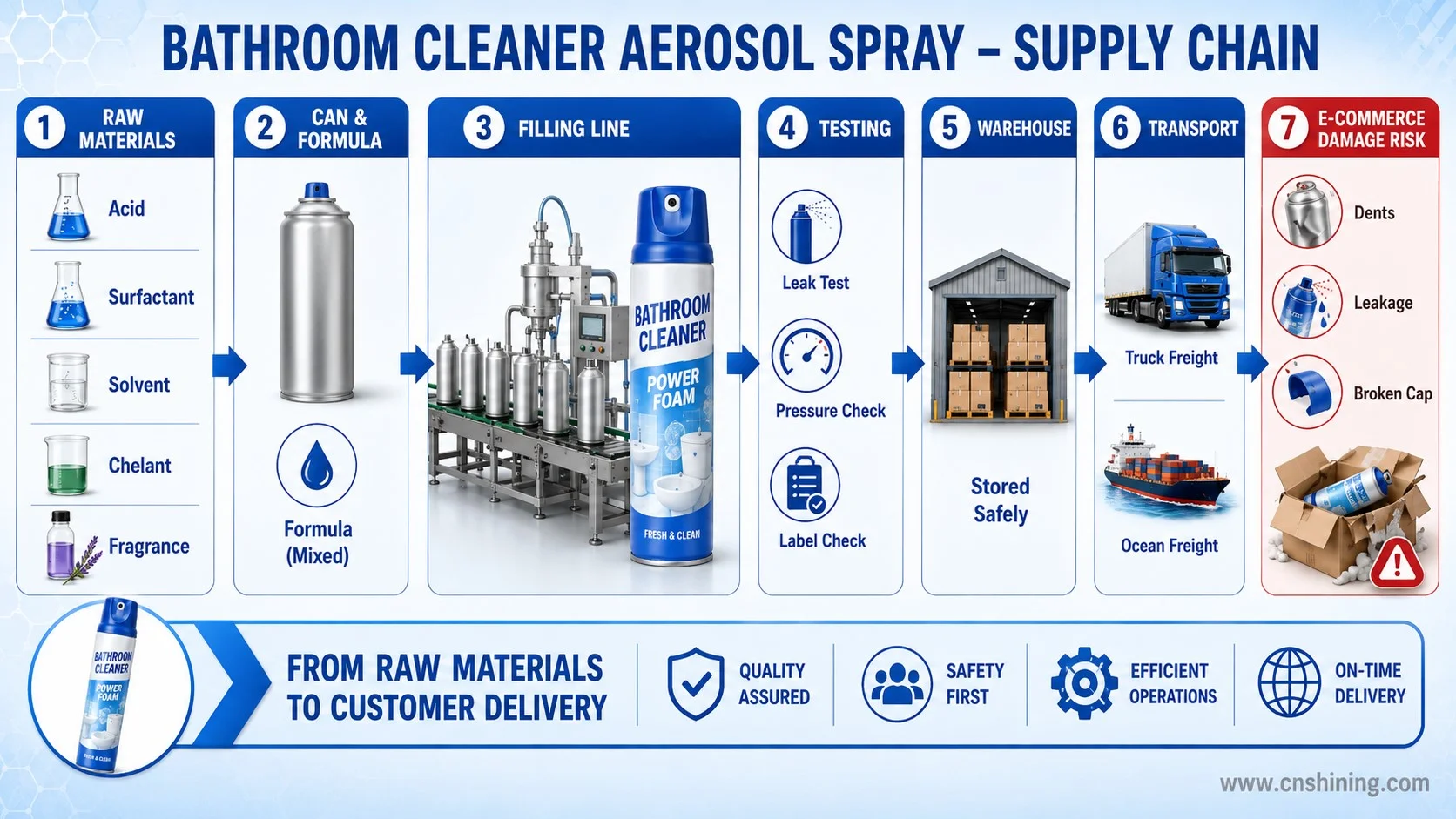
The real opportunity is not another high-odor, generic aerosol can. Four routes look more rational: hard-water regional SKUs, low-VOC or BOV premium lines, careful pairing of green chemistry with defensible claims, and a two-format platform where aerosol handles heavy soil while refill trigger products handle daily maintenance.
The supply chain is formula raw materials, packaging components, filling and pressurization, compliance testing, label control, warehouse, transport and channel. For aerosol, cost often rises through metal can, valve and actuator specification, filling-line efficiency, hazardous transport and damage claims. For green systems, the expensive part is often not the natural acid. It is the upgraded packaging and validation work needed to keep the product stable.
Seven cost drivers should be watched: metal can cost, valve and actuator grade, propellant selection, filling speed, efficacy and regulatory testing, fragrance or odor-control system, and channel losses. If the product enters EPA, BPR or China disinfection systems, registration and testing costs rise. If it shifts to BOV or inert gas, unit packaging cost rises but formula preservation and user experience can improve.
9. Closing Technical View
Bathroom cleaner aerosol spray is not an outdated format. The weak point is the old answer: LPG-heavy aerosol, strong fragrance, single spray pattern and broad claims. The stronger next-generation product will need smarter spray control, lower irritation, clearer compliance boundaries and a more credible metal-packaging sustainability path. The winning design will not come from formula or packaging alone. It will come from treating both as one system.
10. FAQ: Bathroom Cleaner Aerosol Spray
Bathroom cleaner aerosol spray uses a pressurized container and a propellant to discharge the liquid as mist, fan spray or foam. A pump spray relies on manual mechanical pressure and is not treated as aerosol under the U.S. federal aerosol definition. This distinction affects VOC classification, flammability review, transport handling, labeling and package design.
Bathroom soils are often on vertical or irregular surfaces, including shower glass, tile joints, faucet backs and toilet exterior areas. Foam and fan spray improve surface coverage and dwell time. The liquid stays wet longer, giving acids, surfactants, solvents and chelants more time to soften soap scum, limescale and mineral deposits before wiping or rinsing.
Acids such as citric acid, lactic acid, sulfamic acid or phosphoric acid attack carbonate scale, rust stains and mineral deposits. Chelants such as EDTA or GLDA bind metal ions and improve performance in hard water. The challenge is compatibility: acid and chelant systems can increase corrosion risk for metal cans, valve parts and internal coatings.
Clogging usually comes from system mismatch rather than one bad component. High surfactant load, crystallizing actives, incompatible fragrance, corrosion particles or dried residue near the nozzle can restrict flow. Foam actuators are especially sensitive because small geometry changes affect bubble structure and spray uniformity. Storage testing with the final formula is necessary.
A cleaning claim mainly describes soil removal. A disinfecting, sanitizing, virucidal, antibacterial or mold-inhibition claim usually requires proof against defined organisms and strict label directions such as wet contact time. In the U.S., this generally brings the product into EPA/FIFRA review. In the EU, biocidal claims can trigger BPR requirements.
Bag-on-Valve and inert-gas systems can separate product from propellant, reduce LPG dependence and support more stable dispensing at different angles. This is useful for acidic, low-odor, sensitive fragrance or green formulations. The trade-off is higher package cost and the need to validate valve, bag, can and filling compatibility as a complete system.
The full contact system needs testing: metal can, internal liner, valve cup, spring, gasket, dip tube, actuator and nozzle. Acidic descalers, quaternary ammonium disinfectants, glycol ether solvents and high-fragrance formulas can behave differently after heat aging or long storage. A passing water-spray test does not prove the final cleaner will remain stable.
Hard water leaves carbonate scale and soap-metal salt deposits that are more resistant than light daily grime. Foam improves wetting and dwell time, but heavy deposits may still need repeat application, brushing or longer contact. A technically honest label should explain hard-water limits, reapplication needs and whether rinsing or wiping is required.
VOC control starts with solvent and propellant selection, not with labeling at the end. LPG, DME, glycol ethers and fragrance components can all affect VOC profile and odor. Low-VOC design may use compressed gas, BOV, water-based formulations or lower-solvent systems, but spray pattern, foam quality and storage stability still need validation.
Start with use geometry: vertical tile, shower glass, toilet rim, corners and small enclosed bathrooms. Then define spray width, foam density, output rate, actuation force and mist control. The actuator should reduce overspray while giving enough wetting for soil removal. The valve must maintain stable output across storage, temperature variation and can depletion.