
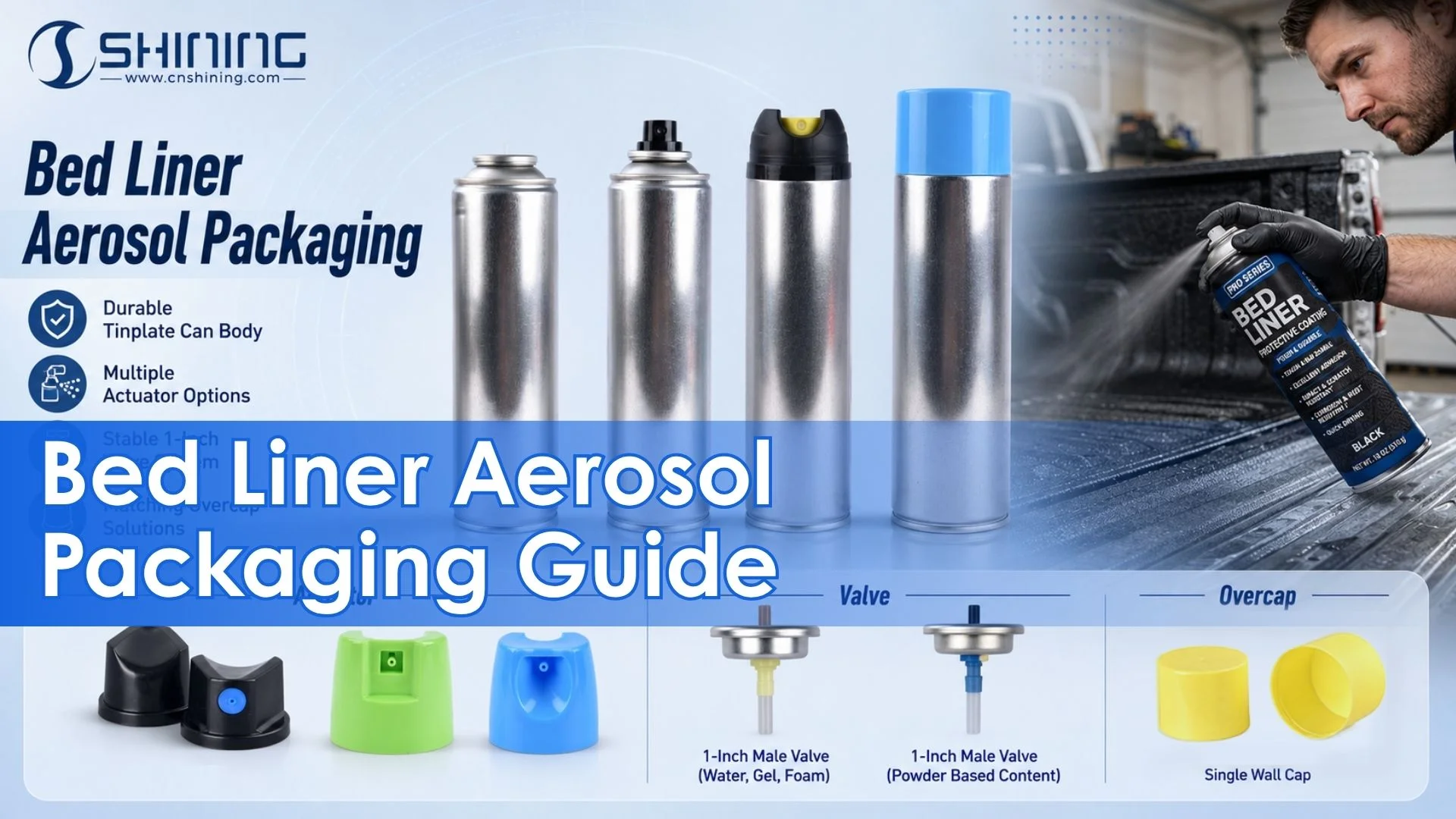
Bed liner aerosol is a structural protective coating packed into a disposable spray can. It is used on pickup truck beds, wheel arches, steps, bumpers, off-road accessories, cut edges and local repair zones. Its purpose is not to replace every professional hot-spray polyurea or polyurethane bedliner system. The useful space is narrower: small areas, complex corners, no spray gun, quick touch-up and retail availability.
The product category now follows four practical routes: 1K solvent-based textured aerosol, 1K waterborne rubberized polyurethane aerosol, 2K can-activated polyurethane or polyurethane-acrylic aerosol, and professional two-component spray systems used as the performance reference. Official technical data for Rust-Oleum Truck Bed Coating Aerosol, Dupli-Color Bed Armor and RAPTOR 2K Bedliner Aerosol shows this spread clearly.
1. Product Definition and Working Mechanism
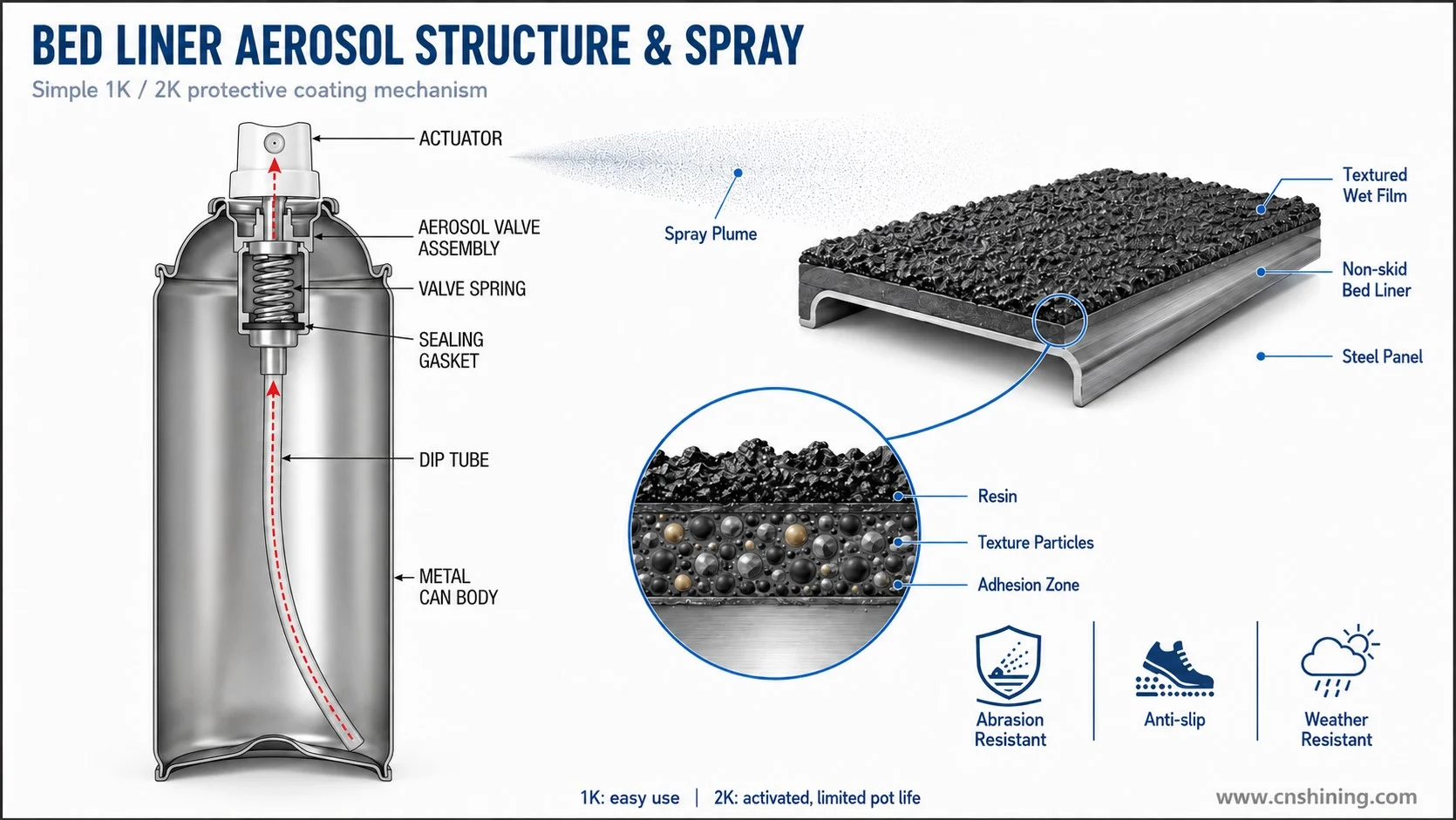
Functionally, a bed liner aerosol forms a textured, abrasion-resistant, non-skid protective film. The deposited layer needs impact resistance, scratch resistance, weathering resistance and some damping effect. In real use, adhesion and texture stability matter more than the label claim.
The working process is simple to describe but difficult to control:
- Package release: pressing the actuator opens the valve, and the coating plus propellant passes through the valve and spray insert.
- Atomization and wet film deposition: resin, pigment, filler, rubber particles or texture particles land on the substrate and create a rough wet film.
- Drying or curing: 1K systems rely on solvent or water evaporation, oxidative drying, moisture response or self-film formation. 2K systems cure by chemical crosslinking after activation.
- Performance build: abrasion resistance, anti-slip texture, adhesion and chemical resistance increase as the film dries and crosslinks.
The RAPTOR 2K technical data sheet gives a useful example: the can is activated before use, and the working time after activation is about 60 minutes. That pot life changes the user experience. A 1K aerosol behaves like a convenience tool. A 2K aerosol behaves more like a portable repair system.
Compared with ordinary black textured spray paint, bed liner aerosol is not only about texture. It is about the combination of texture, toughness, anti-slip behavior, edge coverage and substrate tolerance. Metals, aluminum, fiberglass, wood, plastics and OEM painted surfaces may all appear in product claims, but the field result depends on cleaning, sanding, primer choice, film thickness and spray pattern stability.
2. Market Size, Regional Trends and Growth Drivers
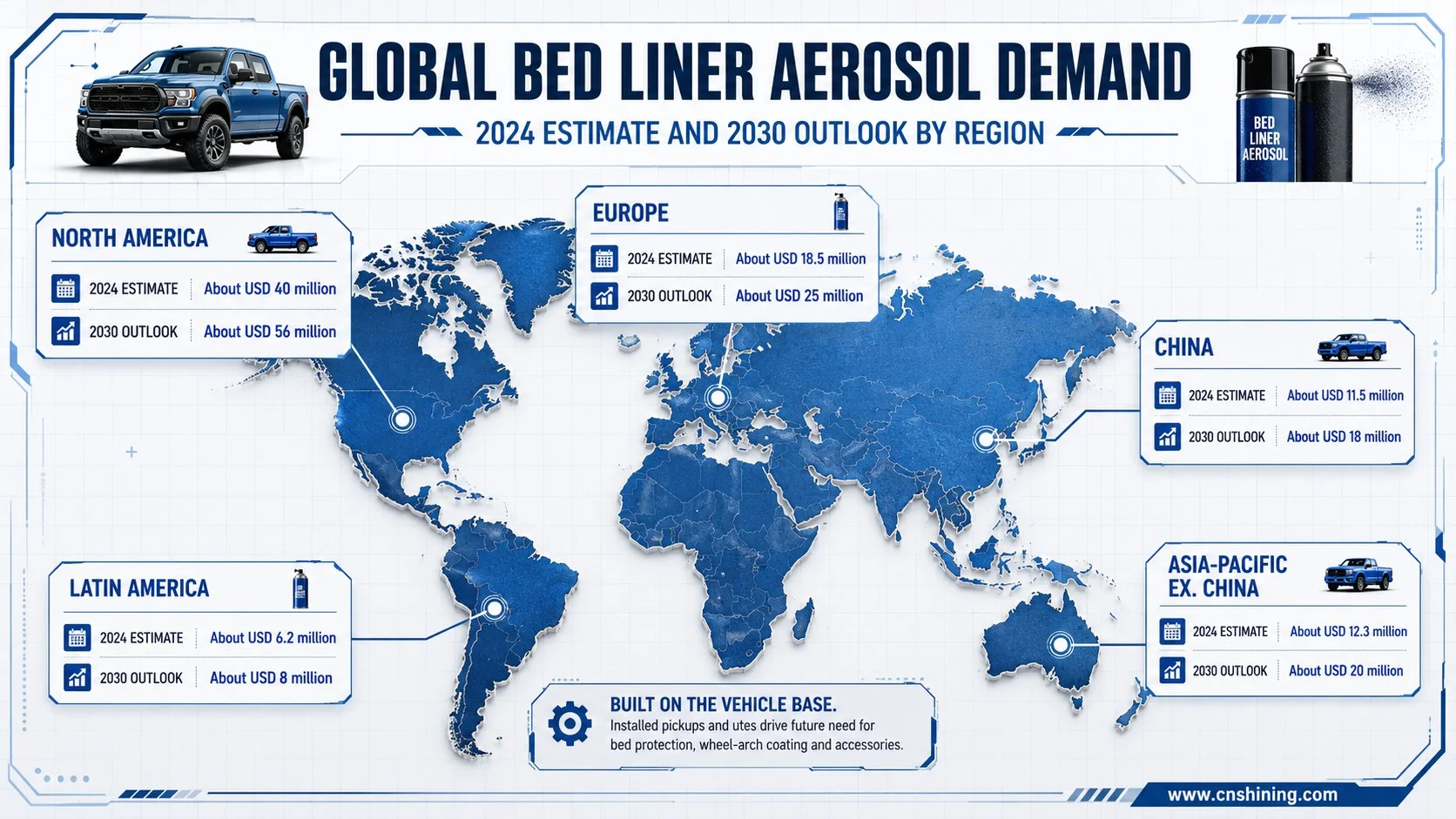
The broader bedliner market still centers on North America and Europe, while China and other Asia-Pacific markets are faster from a smaller base. The Cognitive Market Research global truck bedliner report places the 2024 global market at about USD 559.6 million under its scope, with region-level splits supporting the same direction.
| Region | 2024 aerosol center estimate | 2030 judgment | Main driver |
|---|---|---|---|
| North America | About USD 40 million | About USD 56 million | Pickup ownership, DIY culture, e-commerce and repair habits. |
| Europe | About USD 18.5 million | About USD 25 million | Mature 2K aerosol refinish channels and higher-value repair systems. |
| China | About USD 11.5 million | About USD 18 million | Pickup sales growth, off-road accessories, camping and protective repair. |
| Latin America | About USD 6.2 million | About USD 8 million | Agriculture, logistics and price-sensitive DIY repair. |
| Asia-Pacific excluding China | About USD 12.3 million | About USD 20 million | Australia and Thailand pickup culture, plus India growth. |
Demand starts with the vehicle base. A Cox Automotive December 2025 pickup market report shows the revenue weight of full-size pickups in the United States. Australia remains ute-heavy according to FCAI vehicle market reporting. Brazil’s 2025 vehicle registration growth is visible in the ANFAVEA January 2026 release. These are not aerosol numbers, but they describe the installed base that can later need bed protection, wheel-arch coating or accessory touch-up.
3. Product Comparison, Formula Systems and Terms
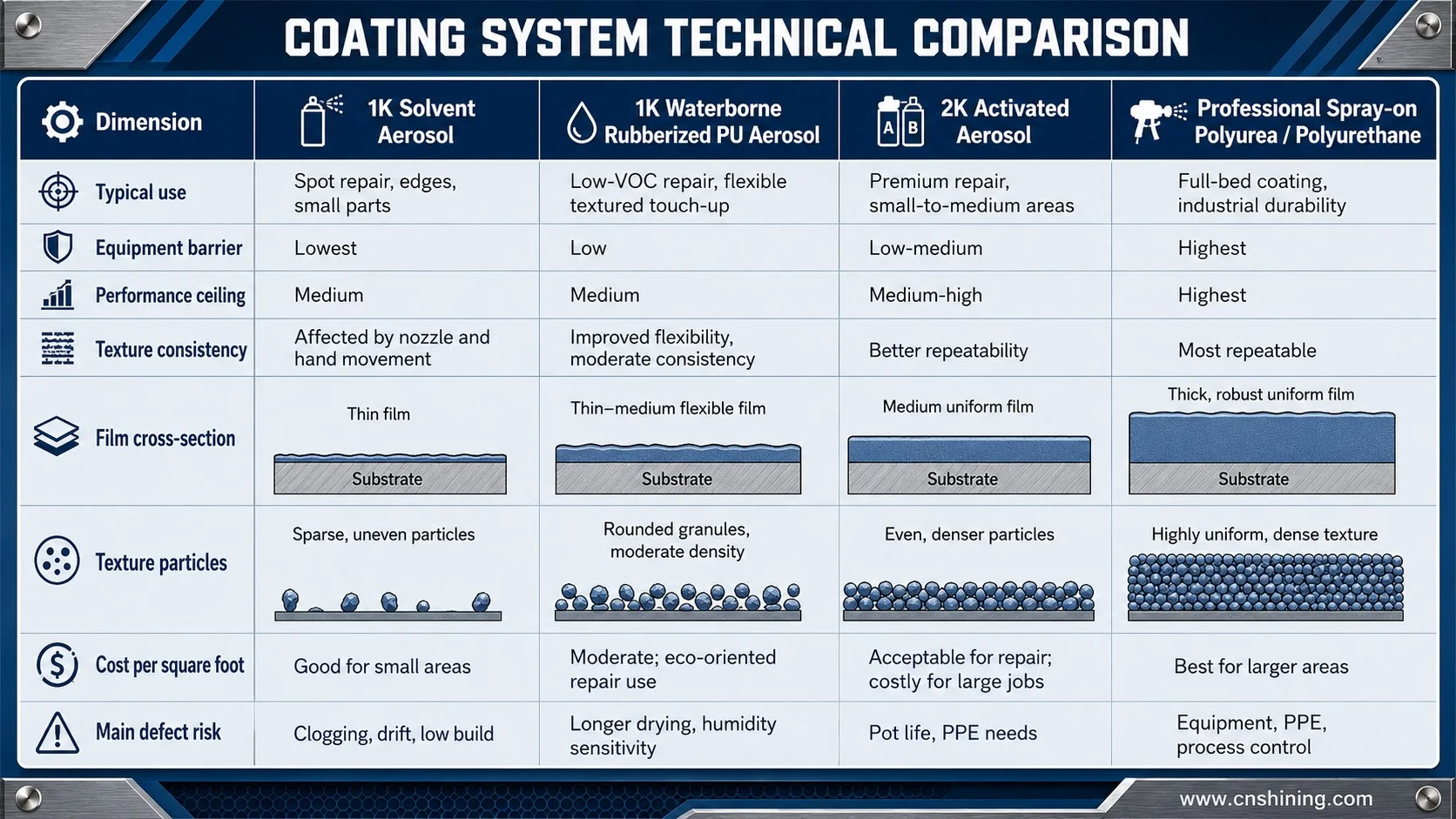
| Dimension | 1K bed liner aerosol | 2K bed liner aerosol | Professional spray-on bedliner | Roll-on | Brush-on |
|---|---|---|---|---|---|
| Typical use | Small repair, corners, wheel arches, local protection. | Higher-end repair, small to medium areas. | Full bed, high film build, industrial durability. | DIY full-bed jobs with lower overspray. | Cut edges, corners and thick local coating. |
| Equipment barrier | Lowest. | Low. | Highest. | Low. | Lowest. |
| Performance ceiling | Medium. | Medium-high. | Highest. | Medium. | Medium. |
| Texture consistency | Strongly affected by nozzle and hand movement. | Better, but still package-dependent. | Most repeatable. | Medium. | Rougher and slower. |
| Cost per square foot | Good for small areas; weak for a full bed. | Acceptable for repair; expensive for full-bed use. | Better for large areas. | Economical for DIY full-bed use. | Cheap but weaker in appearance. |
| Main defect risk | Clogging, low coverage, spray-pattern drift, odor. | Pot life, price, PPE and user education. | Equipment, PPE and process control. | Vertical surfaces and corners. | Low efficiency and rough appearance. |
A mature product line usually does not rely on one format. Aerosol works as a repair and touch-up SKU. Roll-on works for DIY full-bed jobs. Professional plural-component spray systems remain the route for thick, consistent, long-term heavy-duty film.
3.1 Formula Categories and Working Windows
The following concentration ranges are industry working windows based on public product structures, TDS/SDS information and aerosol engineering logic. They are not exact formulas for any brand.
| Category | Resin / cure route | Typical components | Typical wt% window | Public basis |
|---|---|---|---|---|
| 1K solvent textured aerosol | PU/acrylic, modified alkyd, moisture cure or air dry. | Resin, carbon black or iron oxide, talc/silica/calcium carbonate, rubber or texture particles, ketone/ester/aromatic solvents, DME/LPG propellant, wetting/defoaming/anti-settling additives. | Resin 20–35; solvent 20–35; propellant 15–30; pigment/filler/texture 10–25; additives 0.5–3. | EZ Liner TDS and oil-based textured aerosol examples. |
| 1K waterborne rubberized PU aerosol | Waterborne polyurethane dispersion, self-film formation. | PUD, water, rubber particles, reinforcement particles, mineral filler, coalescent, defoamer, wetting agent, thickener and propellant system. | Water 25–45; PUD 20–35; rubber/reinforcement 5–15; filler 5–15; coalescent 3–10; additives 0.3–2; propellant or compressed gas 5–15. | Dupli-Color Bed Armor waterborne rubberized polyurethane positioning. |
| 2K activated aerosol | OH resin plus isolated isocyanate hardener. | Hydroxy acrylic or polyester polyol, isocyanate hardener, pigment/filler, texture agent, solvent, propellant and rheology additives. | Main resin 30–45; hardener 8–18; solvent 10–25; pigment/filler/texture 10–25; propellant 5–15; additives 0.3–2. | RAPTOR 2K, Mipa Protector, NOVOL COBRA Spray 2K DTM and ProXL ToughOX. |
| Professional two-component hot-spray system | Polyurea, polyurethane or hybrid system. | Isocyanate prepolymer A-side; amine/polyol, pigment, filler and additives B-side. | Not an aerosol format. | Polyurethane/polyurea spray-on truck bed lining safety documents. |
3.2 Analytical Example Formulas
| 1K solvent repair aerosol component | wt% | Comment |
|---|---|---|
| Modified polyurethane/acrylic resin | 29 | Film formation and toughness. |
| Ketone/ester/aromatic mixed solvent | 27 | Viscosity and drying control. |
| DME/LPG propellant | 22 | Pressure and atomization energy. |
| Talc/wollastonite/silica | 11 | Body, texture and wear contribution. |
| Rubber or polymer texture particles | 6 | Roughness and non-skid feel. |
| Carbon black / anti-corrosion pigment | 2 | Color and substrate protection. |
| Defoamer, wetting agent, wax, anti-settling package | 3 | Can stability and sprayability. |
| 1K waterborne rubberized aerosol component | wt% | Comment |
|---|---|---|
| Waterborne polyurethane dispersion | 27 | Flexible film former. |
| Deionized water | 31 | Carrier phase. |
| Rubber particles | 10 | Texture and damping. |
| Mineral filler | 10 | Film body and cost control. |
| Coalescent / co-solvent | 7 | Film formation aid. |
| Reinforcement fiber or aramid-type particles | 2 | Mechanical reinforcement concept. |
| Pigment | 2 | Color. |
| Rheology, defoaming, wetting and preservative additives | 2 | Can and film stability. |
| Propellant system | 9 | Dispensing energy. |
| 2K activated aerosol component | wt% | Comment |
|---|---|---|
| Hydroxy acrylic / polyester polyol resin | 36 | Main reactive resin. |
| Isocyanate hardener in separate chamber | 12 | Crosslinking after activation. |
| Pigment / anti-slip filler | 18 | Color, grip and film build. |
| Solvent | 17 | Spray viscosity and wetting. |
| Texture control particles | 7 | Visual and tactile profile. |
| Propellant | 8 | Output and atomization. |
| Additives | 2 | Rheology, stability and surface control. |
| 2025 formula structure working model | Estimated share |
|---|---|
| 1K solvent-based | 52% |
| 1K waterborne rubberized PU | 18% |
| 2K activated PU / PUA | 24% |
| Other niche systems | 6% |
3.3 Key Terms
| Term | Plain technical meaning | Business meaning |
|---|---|---|
| 1K | Single component, ready to use. | Lower cost, easier retail, mass DIY. |
| 2K | Two components activated or mixed before use. | Higher unit price, better repair-performance claim. |
| Pot life | Usable time after activation. | Controls education, returns and user error risk. |
| DTM | Direct to Metal. | May reduce one primer step. |
| Texture / ripple | Particle and orange-peel visual profile. | Strongly affects the “professional spray” impression. |
| Non-skid | Anti-slip surface behavior. | Relevant for truck beds, steps and camping accessories. |
| VOC | Volatile organic compounds. | Affects odor, regulation, storage and channel access. |
| MIR / PWR | Aerosol coating reactivity metrics. | Relevant for EPA and CARB compliance. |
| Flash time | Time between coats. | Controls sagging, striping and surface defects. |
| Full cure | Time until the coating reaches final use properties. | Controls when cargo, water and abrasion exposure are acceptable. |
| Coverage | Area covered by one can. | Directly affects whether full-bed DIY use is realistic. |
| Adhesion promoter | Surface treatment for difficult substrates. | Important for plastics, edges and refinish substrates. |
| Clog-free nozzle | Nozzle designed to resist blockage. | Directly linked to review quality and repeat purchase. |
| Fan-pattern actuator | Actuator producing a flatter spray pattern. | Improves texture uniformity and reduces stripe defects. |
| BOV | Bag-on-Valve barrier package. | Useful for waterborne, low-VOC or high-purity systems, at higher cost. |
| Internal liner | Can interior coating. | Determines storage compatibility with waterborne and aggressive solvent systems. |
4. Regulation, Safety and Transport Compliance
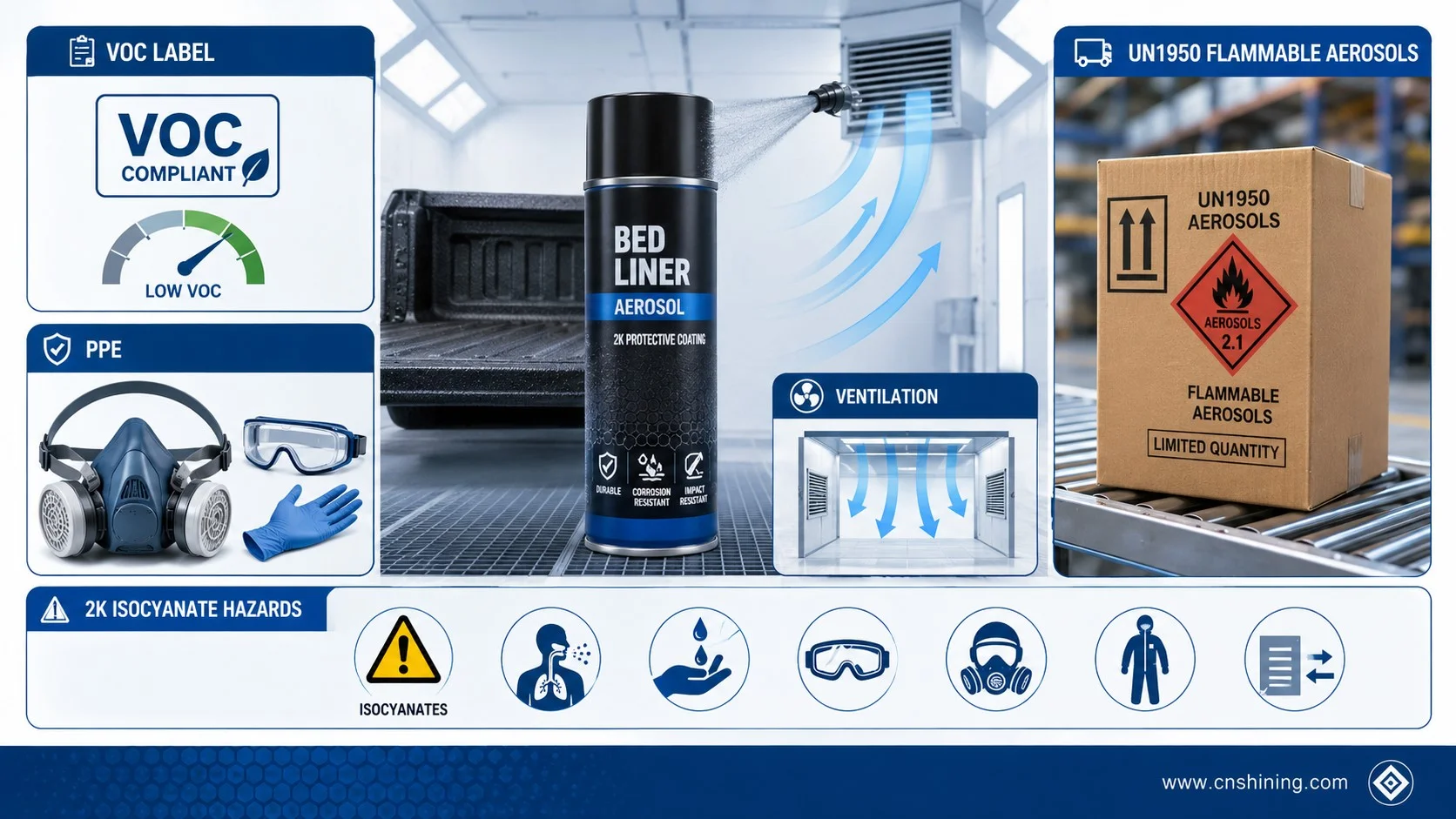
For bed liner aerosol, compliance is not only a label issue. It is a system problem involving formulation, package, SDS, transport classification, warehouse policy and user instructions. Higher solids, stronger texture and 2K chemistry often raise VOC, dangerous goods and occupational health pressure at the same time.
| Region | Regulation or standard | Direct impact on bed liner aerosol |
|---|---|---|
| United States | EPA aerosol coatings VOC rule, CARB Aerosol Coating Products Regulation, PHMSA dangerous goods rules, OSHA/NIOSH health control logic. | Solvent and propellant choices affect national and California access. 2K aerosols raise PPE, ventilation and training needs. |
| European Union | Aerosol Dispensers Directive, CLP, REACH diisocyanate restriction and EU-format SDS. | 2K aerosol needs clear labeling, professional-use controls and training logic. |
| Other major markets | UN1950 aerosol dangerous goods logic and local VOC/label systems. | Courier, air shipment, warehouse temperature control and carton marking may define actual channel access. |
Transport is easy to underestimate. PHMSA interpretation on UN1950 flammable aerosols reflects the practical point: the product may be good, but storage, shipping and carton marking decide where it can be sold.
Health exposure matters more for 2K and professional spray-on systems. Spray-applied polyurethane and polyurea truck bed lining has been linked to isocyanate exposure. The American Chemistry Council safety note and its worker protection PDF are worth reading before treating “2K aerosol” as a simple DIY upgrade.
5. Top 10 Brands in Bed Liner Aerosol
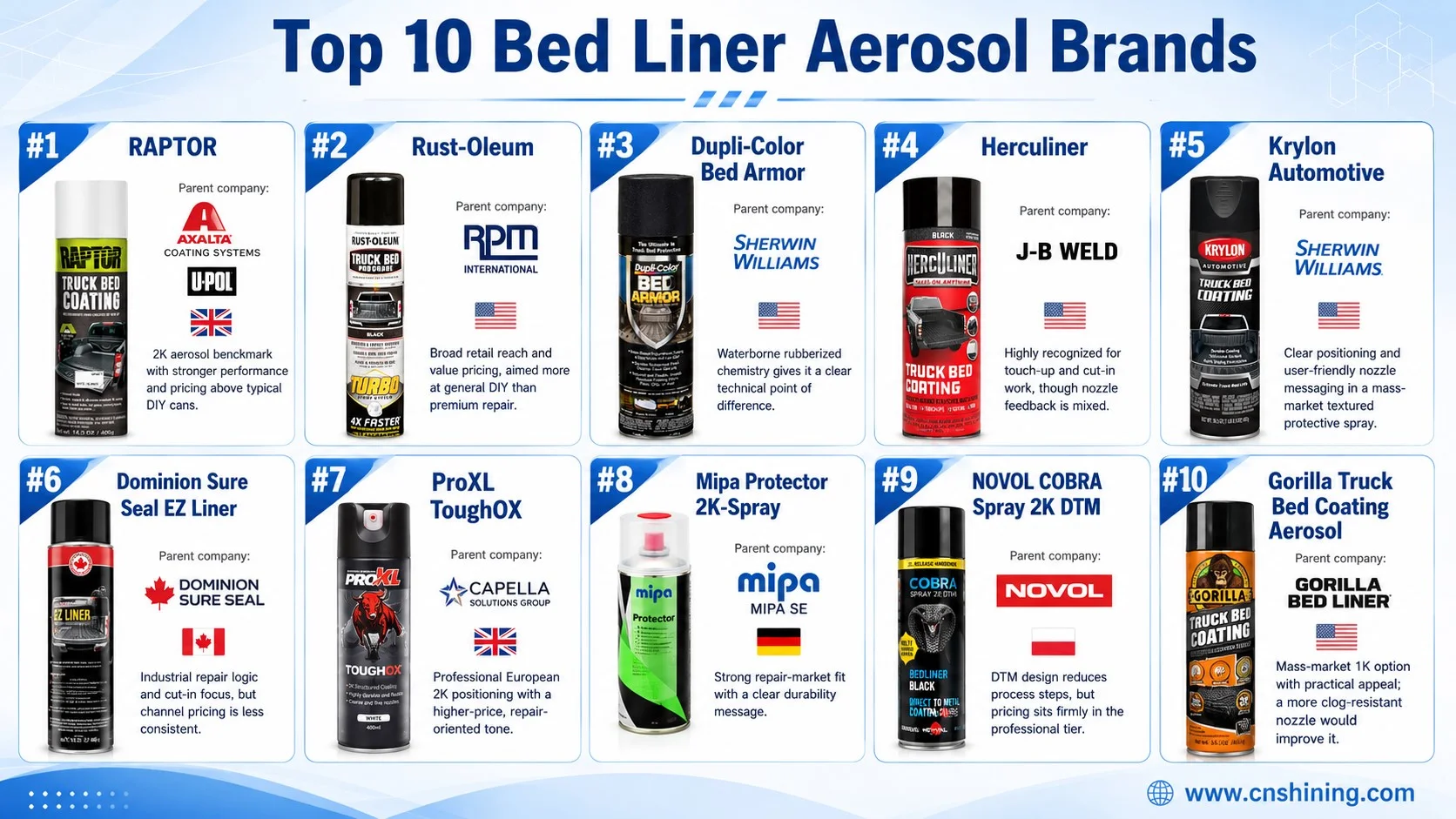
This brand table is kept as a separate section because it describes market structure, not only product chemistry. The selection is based on global public visibility, retail availability, technology recognition and aerosol SKU clarity. It is not a strict sales ranking. Price ranges reflect 2025–2026 public retail snapshots and can shift quickly by region, color and seller.
| Brand | Country / origin | Parent company | Typical size | Public retail range | Technical reading |
|---|---|---|---|---|---|
| RAPTOR | United Kingdom | Axalta | 13.2 oz / 400 ml | about 19.95$–41.79$ | 2K aerosol reference product. Performance and price sit above mass DIY cans. |
| Rust-Oleum | United States | RPM International | 15 oz | about 11.97$–14.48$ | Strong retail penetration. More general DIY than high-end repair. |
| Dupli-Color Bed Armor | United States | The Sherwin-Williams Company | 16.5 oz | about 11.88$–18.99$ | Waterborne rubberized route creates technical differentiation. |
| Herculiner | United States | J-B Weld | 15 oz | about 11.99$–21.99$ | High brand recognition. Good for touch-up and cut-in, but nozzle feedback varies. |
| Krylon Automotive | United States | Sherwin-Williams | 16.5 oz | about 10.92$–30.96$ | Clear positioning and user-friendly nozzle language; still a mass-market textured protective spray. |
| Dominion Sure Seal EZ Liner | Canada | Dominion Sure Seal | 467 g / 16.5 oz | about 14.53$–29.18$ | Industrial repair and cut-in logic. Price structure is less clean across channels. |
| ProXL ToughOX | United Kingdom | Capella Solutions Group | 400 ml | about 22.69$–43.50$ | European 2K aerosol logic. Professional tone, naturally higher price. |
| Mipa Protector 2K-Spray | Germany | MIPA SE | 400 ml | about 31.30$–36.89$ | Repair-market fit with clear durability positioning. |
| NOVOL COBRA Spray 2K DTM | Poland | NOVOL | 400 ml | about 52.67$–70.77$ | DTM concept reduces process steps, but price is professional-grade. |
| Gorilla Truck Bed Coating Aerosol | United States | Gorilla | 14.3 oz | about 15.99$–21.99$ | Mass-market 1K direction. A reliable clog-resistant nozzle would be meaningful. |
6. User Pain Points and Packaging Engineering Fixes
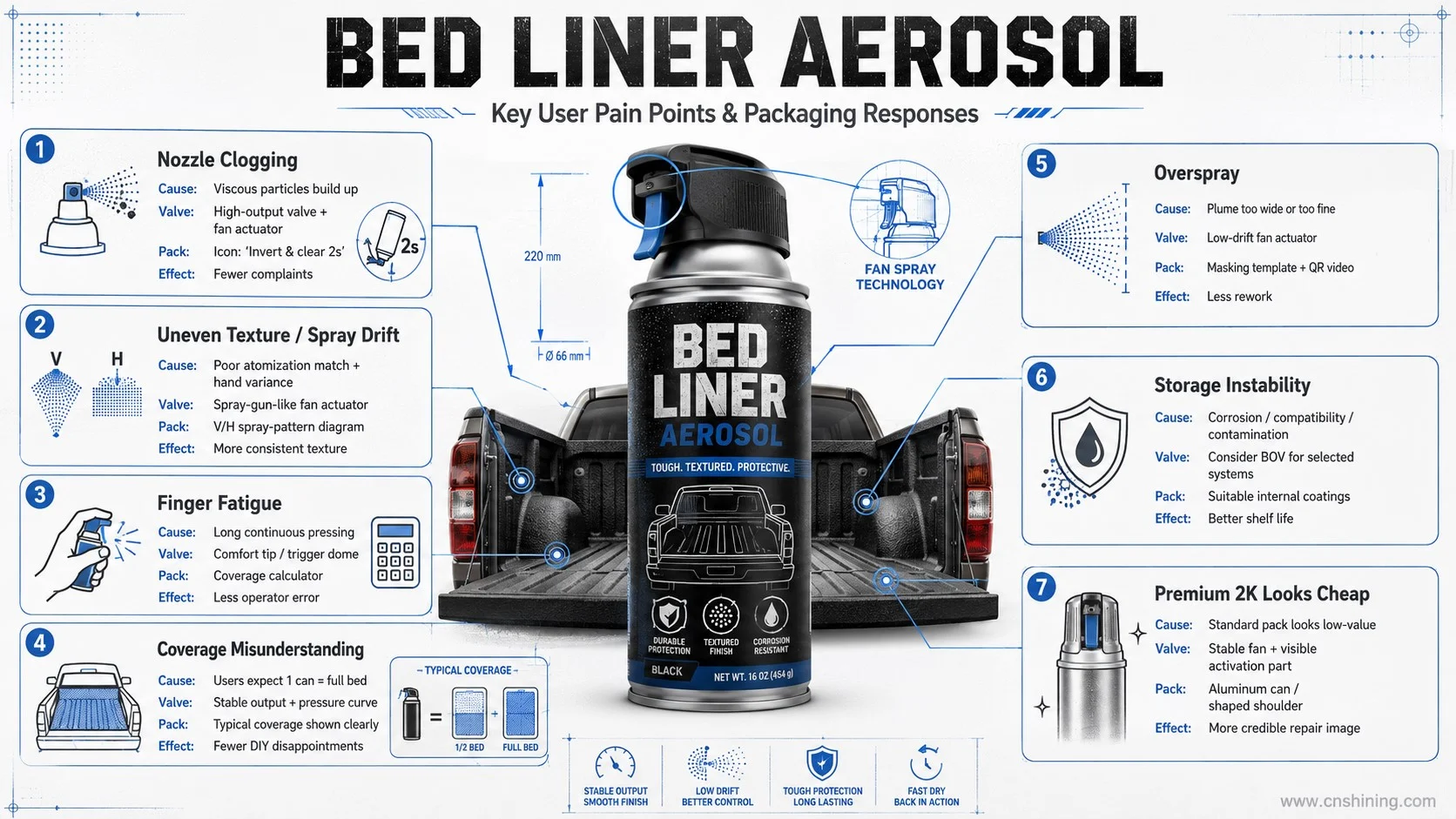
Public feedback keeps returning to five defects: clogged nozzle, uneven texture, wrong coverage expectation, overspray preparation burden and blocked holes or threads during heavy coating jobs. The same complaints appear across marketplaces, forums and social content. That points to category-level engineering limits, not one weak SKU.
| Signal source | Observed issue | Likely root cause | Commercial meaning |
|---|---|---|---|
| Reddit overlanding thread | Spray-can bedliner clogged and sprayed inconsistently. | Texture particles, viscosity window, shaking and actuator/valve mismatch. | Direct path to poor reviews and returns. |
| DIY bedliner preparation discussion | Sanding, masking and overspray control take time. | Wide spray mist and weak boundary control. | Labels and spray pattern control need more attention. |
| Spray-in liner hole and thread discussion | Drain holes and threaded holes can be blocked in heavy spray jobs. | Film thickness and masking process not controlled. | Large-area bedliner work depends on SOP discipline. |
| Marketplace reviews | Clogged nozzle, color confusion and coverage disappointment. | Nozzle deposit, label hierarchy and unclear coverage guidance. | Packaging information is part of product performance. |
| Short-video commerce signals | Spray handle, trigger and nozzle-control accessories appear often near bedliner spray searches. | Users want a spray-gun-like feel from a disposable can. | Actuator ergonomics can create real differentiation. |
| Pain point | Root cause judgment | Valve / actuator response | Can / label / liner response | Expected effect |
|---|---|---|---|---|
| Nozzle clogging | Texture particles and high-viscosity coating deposit at the valve or actuator exit. | Paint-grade high-output valve, fan-pattern actuator, clear reverse-spray cleaning instruction, spare nozzle. | Front-label icon: “Invert and clear for 2 seconds after use.” | Lower clog complaints and lower service cost. |
| Uneven texture and spray drift | Nozzle atomization does not match coating rheology; hand movement varies. | Spray-gun-like fan actuator, wide finger pad or trigger-style overcap. | Vertical/horizontal spray-pattern diagram on label. | More consistent texture and less stripe defect. |
| Finger fatigue | Long continuous pressing during coating build. | Comfort tip, trigger dome or removable handle accessory. | Coverage calculator on pack to reduce unnecessary spraying. | Fewer interruptions and less operator error. |
| Coverage misunderstanding | User expects one can to do a full truck bed. | Stable valve output and pressure curve. | Large front-pack statement of typical coverage, texture level and full-bed can estimate. | Fewer negative full-bed DIY experiences. |
| Overspray | Spray plume too wide or too fine. | Low-drift fan actuator; optional narrow/wide spray inserts. | Masking template and QR process video. | Lower preparation burden and less rework. |
| Waterborne or high-reactivity storage instability | Can corrosion, resin compatibility or propellant contamination. | For selected systems, evaluate Bag-on-Valve or higher-compatibility valve platforms. | Waterborne systems need suitable internal coatings; high-solvent systems need proven epoxy/polyester/BPA-NI options. | Better shelf life and more stable output. |
| Premium 2K positioning looks cheap | Standard can and cap do not support high-value repair pricing. | Stable fan actuator and clear activation part inside the cap. | Aluminum can, shaped shoulder, embossing or full-body sleeve. | More credible professional repair presentation. |
Bag-on-Valve is not a universal fix, but the Shining Packaging BOV technical explanation shows why barrier packaging is relevant to low-VOC, waterborne or high-viscosity systems. Actuator choice is just as direct: paint-style aerosol actuators are not cosmetic parts; they shape the first user judgment of whether the spray looks controlled.
Internal can lining also needs formulation-specific selection. The Pirlo interior coating notes reflect the practical split: waterborne systems, solvent-rich systems and technical chemicals do not all want the same liner.
7. Shining Packaging: Aerosol Cans, Valves and Actuators for Bed Liner Aerosol
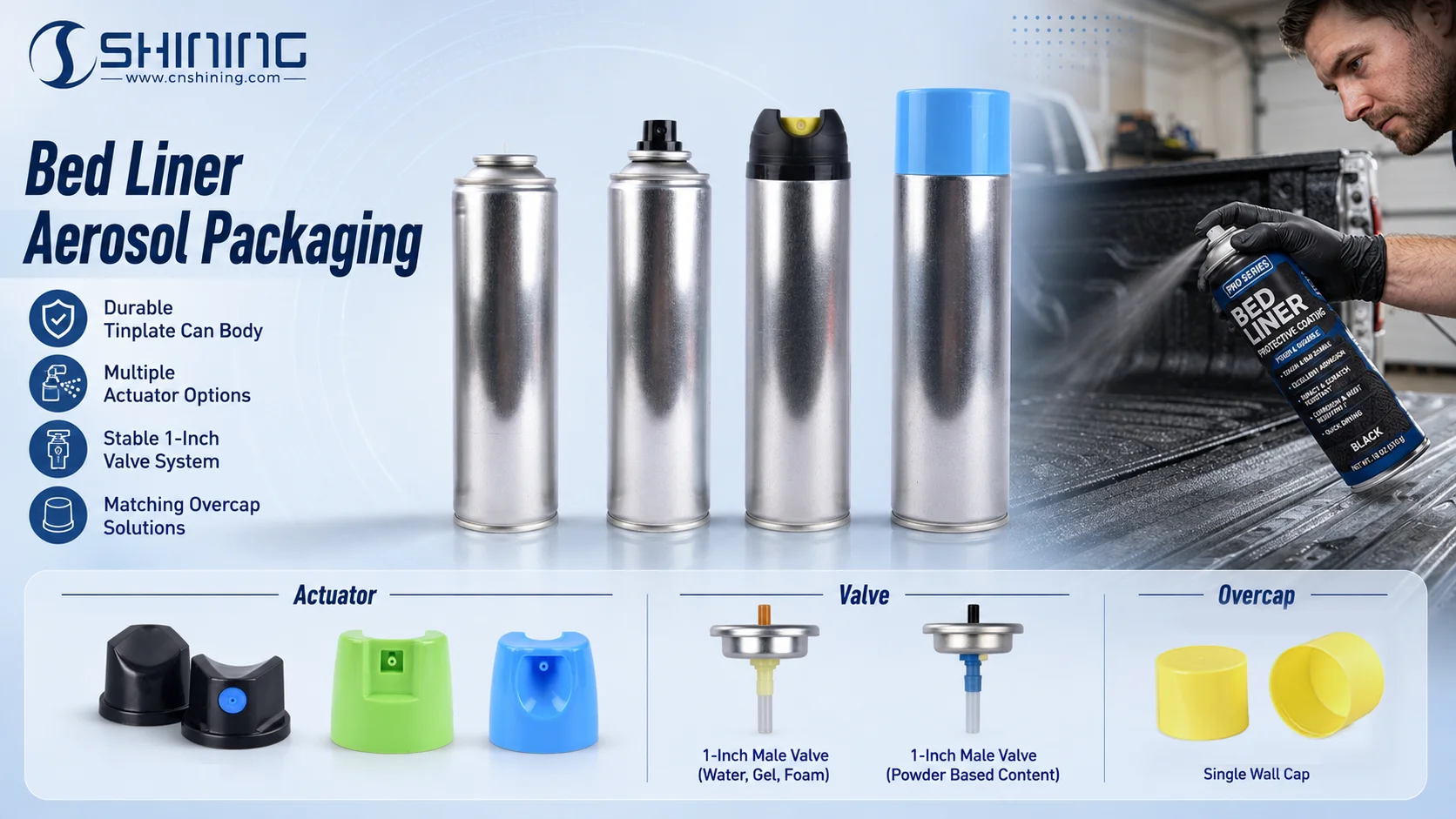
For bed liner aerosol, the package is part of the coating system. A textured coating with rubber particles or mineral filler puts more stress on the valve and actuator than a normal decorative spray paint. The can also has to tolerate solvent, waterborne chemistry or 2K separated components without corrosion or output drift.
Shining Packaging can be positioned naturally in this context through three components: aerosol cans, valves and actuators. The discussion should stay practical. A bed liner aerosol pack needs stable pressure, compatible internal coating, enough valve output, a spray insert that can handle texture particles, and an actuator that does not tire the user during repeated passes. A good-looking can is useful, but it cannot compensate for clogging.
| Packaging part | Technical requirement for bed liner aerosol | Practical design direction |
|---|---|---|
| Aerosol can | Compatibility with solvent or waterborne coating, pressure stability and corrosion resistance. | Select can material and internal lining by formula family, not by a single default specification. |
| Valve | High-output delivery without particle bridging or pressure loss. | Use coating-grade valve architecture and test with real texture particles, not only base resin. |
| Actuator | Controlled spray width, reduced clogging and less finger fatigue. | Use fan-pattern or comfort-style actuator when the product aims for repair-grade texture consistency. |
| Cap / overcap | Protection during transport and optional ergonomic function. | For premium SKUs, a trigger-style overcap or clear activation instruction can reduce misuse. |
| Label / sleeve | User education on coverage, flash time, pot life and cleaning. | Make the coverage estimate and cleaning step visible on the front or side panel, not hidden in small text. |
8. Technical Takeaway
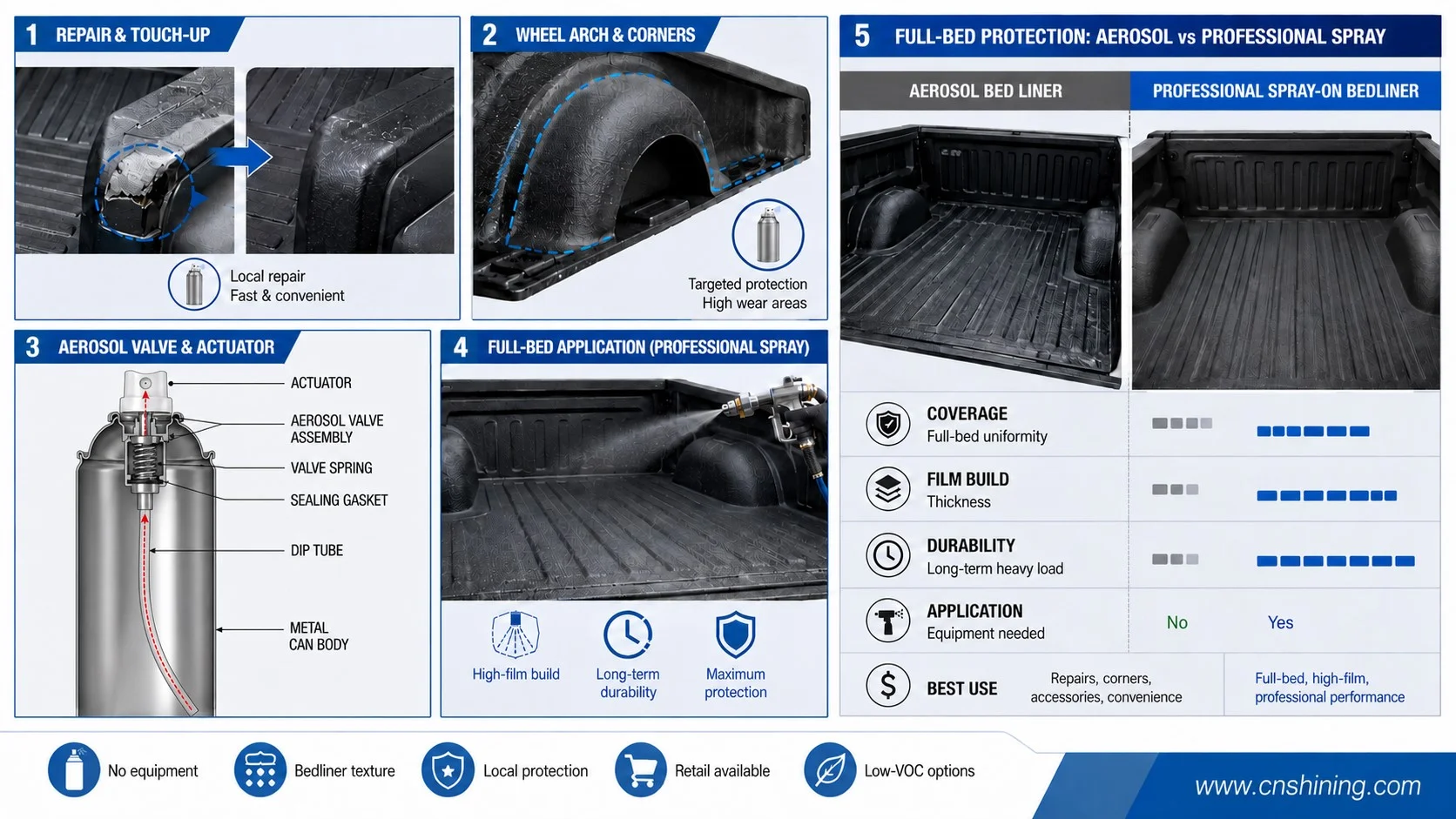
Bed liner aerosol is not a replacement for professional spray-on bedliner in full-bed, high-film, long-term heavy-load work. It is a stable niche built around repair, corners, accessories and convenience. Its technical value is clear: no equipment, acceptable bedliner texture, enough protection for local use, and retail availability.
The product will improve fastest where chemistry and packaging are developed together. For entry 1K products, reduce clogging and improve hand feel before chasing extreme performance claims. For 2K products, make activation, pot life, spray pattern and PPE instructions hard to misunderstand. For waterborne or low-VOC systems, do not ignore can lining and valve compatibility. In this category, the spray can is not only a container. It is part of the process.
9. FAQ: Bed Liner Aerosol
Bed liner aerosol is used for local protective coating on truck beds, wheel arches, steps, bumpers, off-road accessories and repair edges. It is most practical where a spray gun is not available or where the repair area is small. For a full truck bed under heavy use, professional spray-on or roll-on systems usually give better economics and film control.
Usually yes, because 2K aerosol uses a reactive hardener after activation and builds a crosslinked film. That can improve chemical resistance, abrasion resistance and durability. The tradeoff is pot life, higher price and stronger PPE requirements. A 2K can is not simply a stronger 1K can; it needs clearer user control and safer handling.
Clogging often comes from high viscosity, rubber particles, mineral fillers or texture agents settling or depositing near the valve and actuator outlet. Poor shaking, cold cans and long pauses during spraying can make the problem worse. A paint-grade valve, suitable actuator, reverse-spray cleaning step and spare nozzle can reduce complaints.
One can is rarely enough for a full truck bed at a useful texture and film thickness. Aerosol products make more sense for touch-up, cut-in, wheel arches and small panels. Full-bed aerosol use often becomes expensive and uneven. Coverage claims should be read together with recommended dry film thickness, number of coats and surface roughness.
Pot life is the usable time after the 2K can is activated. In many activated aerosol systems, the hardener is released into the main resin chamber, and chemical crosslinking begins. Once pot life ends, spray quality and film properties can fail. The user must plan the job before activation, not after the can is already mixed.
Waterborne systems can reduce odor and solvent load, but they do not remove all engineering problems. Early water resistance, low-temperature film formation, microbial stability, valve compatibility and can corrosion must still be controlled. For waterborne aerosol coatings, internal can lining and propellant selection are part of the formulation work.
The surface should be clean, dry and mechanically prepared. Oil, salt, loose rust, peeling paint and sanding dust reduce adhesion. Bare metal may need spot primer, and plastics may need adhesion promoter. Bed liner aerosol can cover texture visually, but it cannot hide weak surface preparation for long-term service.
Spray pattern controls film uniformity, texture profile and overspray. A round mist can make striping, heavy spots or dry edges more likely. A fan-pattern actuator can help the user keep passes more even. For textured coatings, actuator design is not a minor packaging detail; it directly affects the visible coating result.
Many aerosol coatings fall under flammable aerosol transport logic, often associated with UN1950 classification. The exact requirement depends on formulation, propellant, package and destination market. Warehouse rules, courier policy, air shipment restrictions and outer carton marks can affect sales more directly than many product teams expect.
Start with dispensing reliability. Users notice clogging, finger fatigue, uneven texture and wrong coverage expectations before they can judge long-term abrasion performance. A stable valve, suitable actuator, clear coverage statement, cleaning instruction and compatible can lining are often more valuable than adding more resin without fixing spray behavior.