
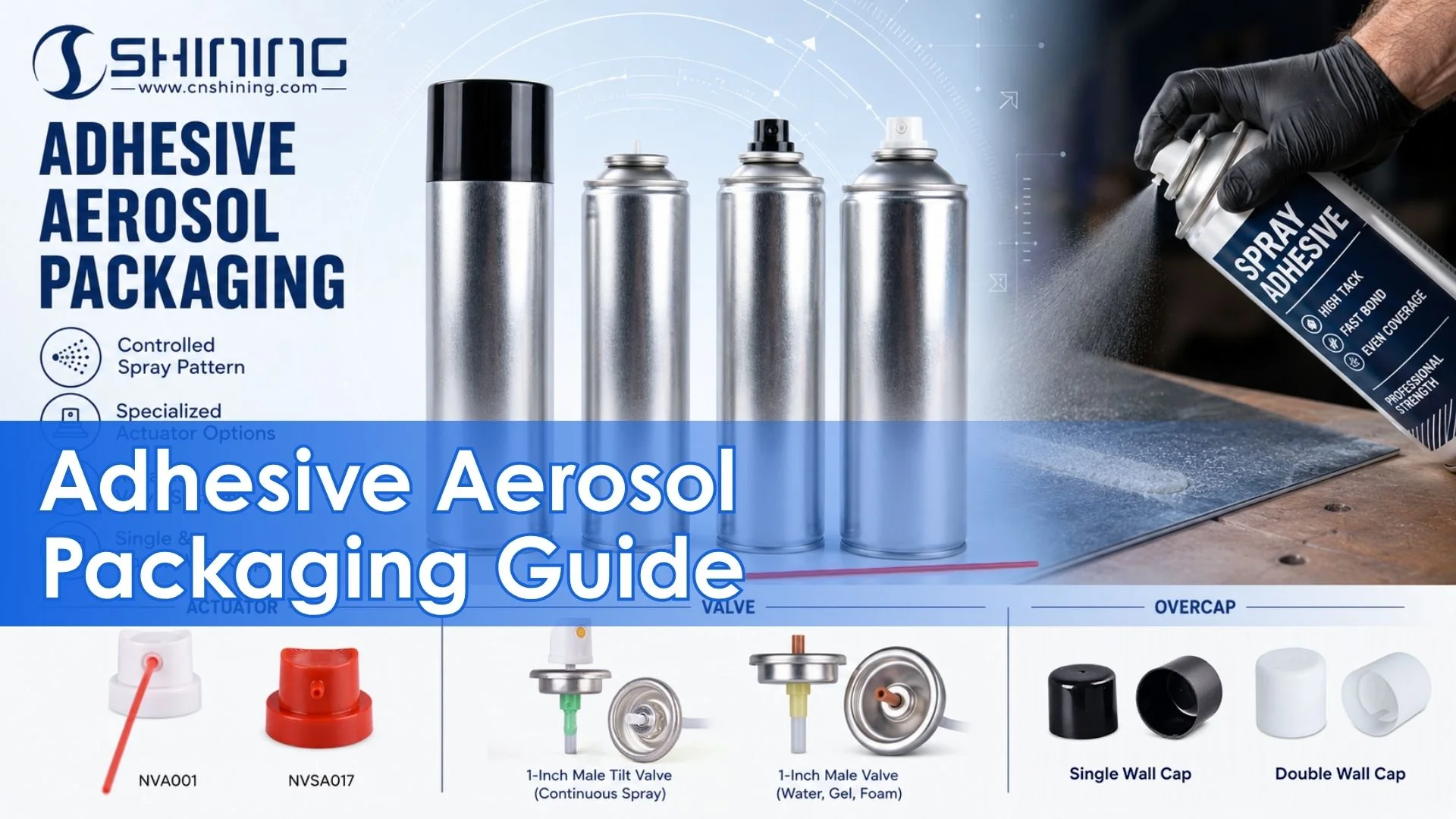
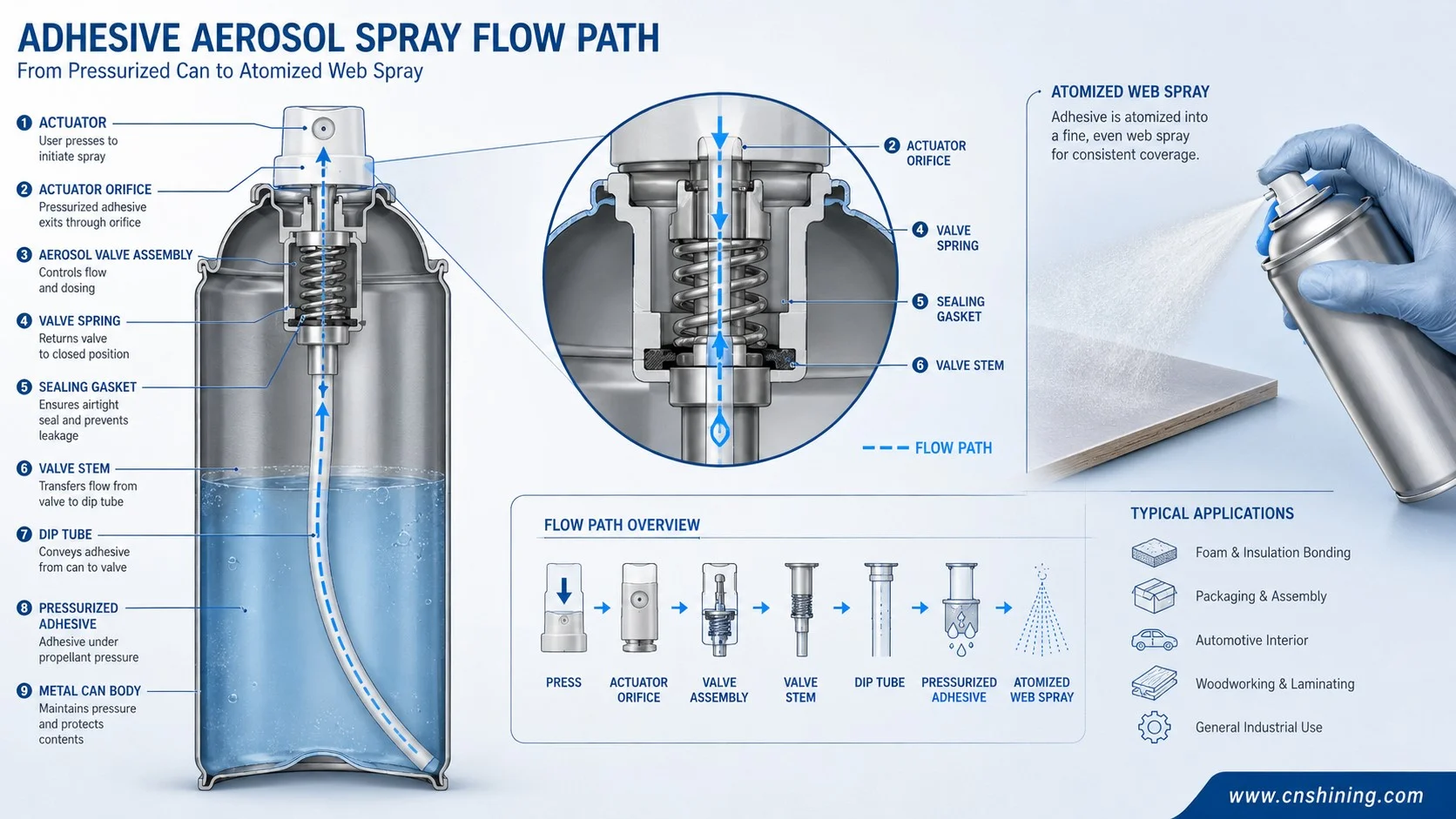
Adhesive aerosol spray is a pressurized adhesive delivery system, not a pump spray. The adhesive formula is packed into a self-pressurized aerosol package. Propellant pressure pushes the adhesive through the dip tube, valve, stem and actuator, then breaks it into mist, web or fan spray. Bonding then happens through solvent or water evaporation, pressure-sensitive contact, hot-melt cooling, or a combination of these mechanisms.
The technical problem is not only whether the adhesive bonds. In the field, many complaints come from nozzle clogging, clumpy spray, overspray, broken actuators and cans that cannot be fully emptied. That makes adhesive aerosol spray a combined problem of chemistry, aerosol valve design, can compatibility, transport regulation and user handling.
1. Definition and Working Principle
From a regulatory and measurement view, the product starts as an aerosol product. The NIST aerosol product definition describes pressurized systems that dispense product through a propellant. This distinction matters because pump sprays are outside that definition.
A typical adhesive aerosol spray system contains the container, adhesive concentrate, propellant, dip tube, valve body, valve stem, gasket and actuator. When the actuator is pressed, the valve stem moves, the seal opens and internal pressure drives the adhesive through the valve path. Spray pattern is then shaped by valve dimensions, actuator geometry and nozzle orifice design.
The adhesive layer forms in three stages:
- Wetting and spreading: solvents, waterborne latex systems or heated hot-melt rheology help the adhesive reach the substrate surface.
- Tack window formation: solvent or water evaporates, pressure-sensitive adhesive contacts develop, or hot-melt adhesive cools and sets.
- Final cohesive strength: resin-elastomer networks, polymer entanglement, polarity and substrate surface energy decide peel, shear, heat and moisture performance.
The practical variables are pressure, propellant ratio, stem diameter, nozzle geometry, adhesive viscosity, solids content, spray distance, spray width and substrate energy. In high-solids adhesive aerosol spray, the actuator and valve may influence perceived quality faster than the resin itself.
2. Market Size and Regional Structure: Read the Boundary First
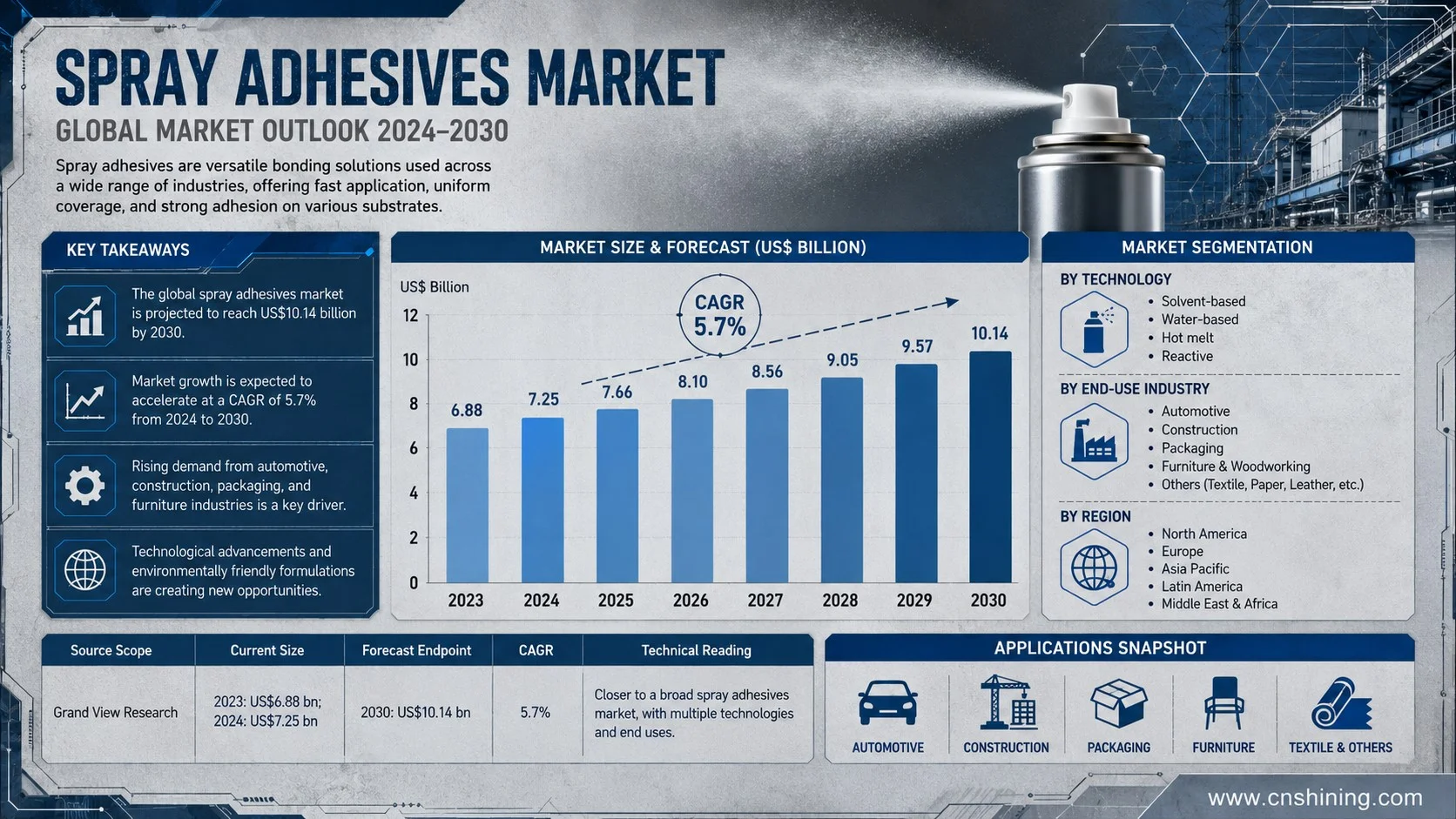
Spray adhesive market data needs boundary control. Does the number include industrial spray systems? Does it include only retail aerosol cans? Does it include hot-melt spray systems? Without that separation, market values look contradictory.
| Source Scope | Current Size | Forecast Endpoint | CAGR | Technical Reading |
|---|---|---|---|---|
| Grand View Research | 2023: US$6.88 bn; 2024: US$7.25 bn | 2030: US$10.14 bn | 5.7% | Closer to a broad spray adhesives market, with multiple technologies and end uses. |
| Mordor Intelligence | 2025: US$3.30 bn; 2026: US$3.46 bn | 2031: US$4.37 bn | 4.81% | A narrower spray adhesive scope with clearer product, resin and geography segmentation. |
| IMARC Group | 2025: US$3.90 bn | 2034: US$5.40 bn | 3.49% | Close to Mordor’s narrower reading, suggesting a public estimate around US$3.9 bn for that boundary. |
| Future Market Insights | 2025: US$9.50 bn | 2035: US$14.8 bn | 4.5% | A wider statistical boundary. Useful for regional signals, but not directly comparable with narrower estimates. |
| TechSci Research, United States | 2025: US$307.68 mn | 2031: US$384.62 mn | 3.79% | A single-country view, linked to residential construction and lightweight automotive interior assembly. |
Asia-Pacific is the strongest volume center in the narrower public estimates. Mordor gives Asia-Pacific 46.30% share in 2025. IMARC places the region above 43%. Using those totals, Asia-Pacific is roughly US$1.53–1.68 billion. That is a working estimate, not a universal market truth.
The technology structure is moving toward lower emissions. Water-based spray adhesives are reported around 38.9% to 43% in different public summaries. Hot-melt spray adhesives still grow because they solve VOC exposure at the material level and support fast production cycles. The market is not replacing one system with another in a straight line.
3. Engineering Comparison with Brush, Hot-Melt and Contact Adhesives
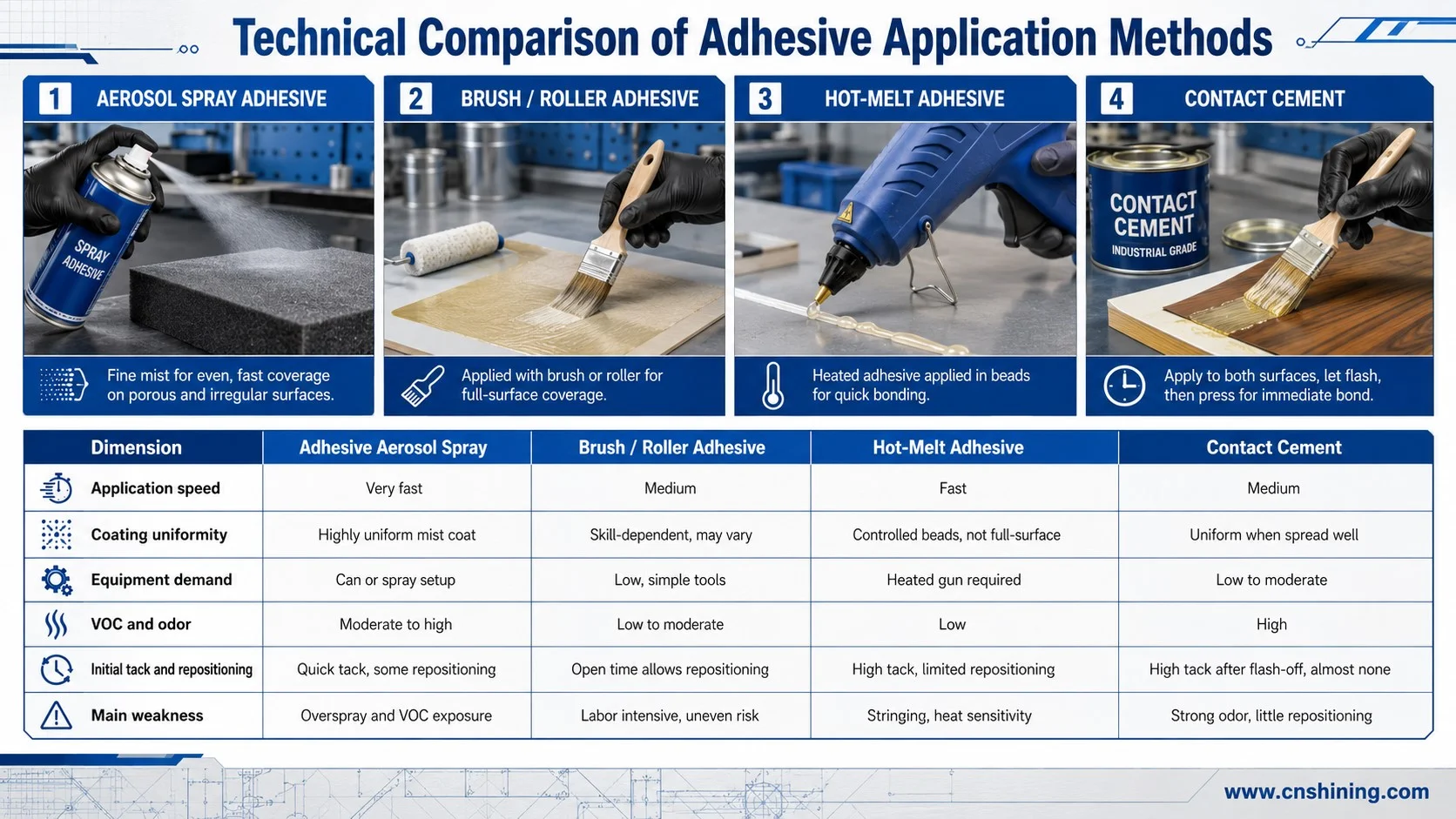
The advantage of adhesive aerosol spray is not absolute bond strength. Its real advantage is coverage speed, coating uniformity and handling of large or irregular lightweight substrates. That is why it keeps a place in foam, textile, fiber, sign, decorative laminate, packaging and jobsite work.
| Dimension | Adhesive Aerosol Spray | Brush / Roller Adhesive | Hot-Melt Adhesive | Contact Cement |
|---|---|---|---|---|
| Application speed | High. Suits large area and complex contours. | Medium to low. Strongly depends on operator skill. | Very high on automated lines. | Medium. Often needs two-sided application and tack waiting. |
| Coating uniformity | High, but nozzle, pressure and spray distance control overspray and clumping. | Medium. Edges and wide panels can vary. | High when equipment is stable. | Medium to high if coverage and open time are controlled. |
| Equipment demand | Low. Single can is ready to use. | Low. | Higher. Needs melter, gun, hose or heated system. | Low to medium. |
| VOC and odor | Formula-dependent. Solvent systems can be high; water-based and low-VOC systems reduce pressure. | Formula-dependent. | Often low because many hot melts are 100% solids. | Solvent-based systems can carry strong VOC and drying demands. |
| Initial tack and repositioning | Can be designed as temporary, removable or permanent. | Depends on formula. | Strong initial tack, short repositioning window. | Poor repositioning once pressed together. |
| Main weakness | Flammability, clogging, overspray, residue and partial-can waste. | Slow work, uneven film, cleanup burden. | Equipment cost and thermal management. | Two-sided process discipline and waiting time. |
Why do many shops still accept flammable aerosol adhesive and clogging risk? Because the speed gain is real. Why has it not replaced hot melt and contact cement? Because its weak points sit in regulation, spray stability and packaging usability, not only adhesive strength.
4. Formulation Systems and Representative Public Formulas
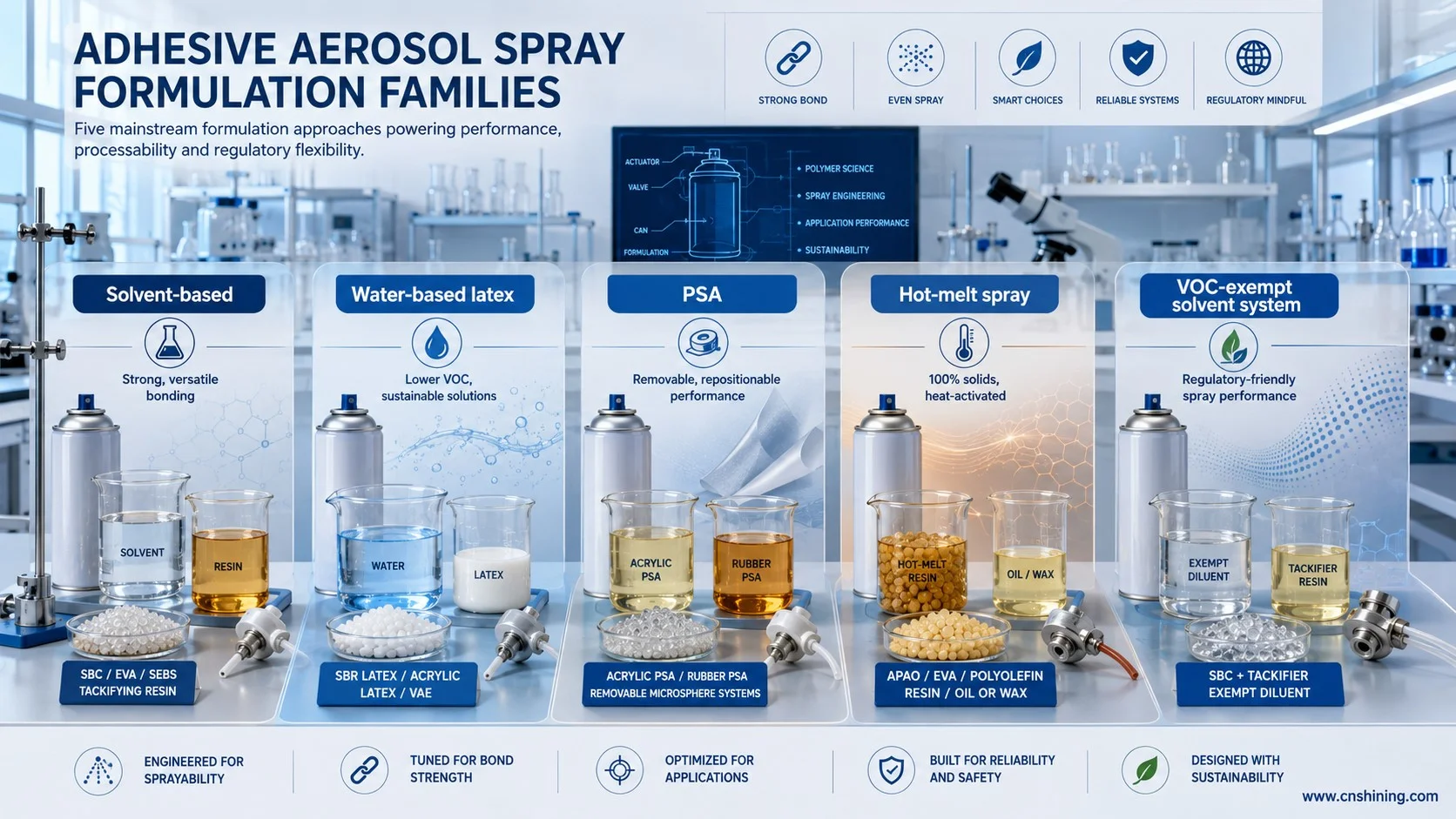
Adhesive aerosol spray is not one chemistry. It is a packaged system: adhesive polymer, carrier, additives, propellant and packaging compatibility. Public patents and product literature show several mainstream directions.
| System | Typical Base | Technical Function | Representative Uses | Handling Point |
|---|---|---|---|---|
| Solvent-based spray adhesive | SBC, synthetic rubber, EVA, SEBS, tackifying resin | Elastomer gives cohesion; resin increases tack; hydrocarbon solvent lowers viscosity; LPG or DME gives pressure and atomization. | Multipurpose bonding, automotive interiors, foam, fabric, construction laminates. | Often highly flammable. Ventilation and ignition control are not optional. |
| Water-based aerosol adhesive | SBR latex, acrylic latex, VAE | Water acts as continuous phase; surfactants support stability; defoamer, stabilizer and filler tune spray behavior. | Low-VOC work, flooring, assembly, sustainability-oriented SKUs. | Lower solvent hazard, but still a pressurized package. High-solids spray stability is hard. |
| PSA spray adhesive | Acrylic PSA, rubber PSA, removable microsphere systems | Balances low coat weight, tack and removability. | Layout mounting, craft, stencil positioning, temporary fixture work. | Residue, whitening and paper wrinkling need control. |
| Hot-melt spray adhesive | APAO, EVA, polyolefin, hydrocarbon resin, oil or wax | 100% solids; viscosity falls under heat; resin and oil tune tack and flow. | Hygiene products, furniture, foam, industrial lamination. | Usually not a normal retail aerosol can. It needs heated spray equipment. |
| VOC-exempt solvent system | SBC plus tackifier and exempt diluent | Uses exempt diluent to reduce calculated VOC while keeping solvent-like application feel. | California or OTC compliance-oriented spray adhesives. | Regulation-friendly does not mean non-hazardous. Flammability and spray behavior still need validation. |
| Formula Style | Public Example | Technical Reading |
|---|---|---|
| VOC-free water-based aerosol | US7713365B2 water based aerosol adhesive discloses about 65–77 wt% adhesive and 23–35 wt% propellant, with acrylic, surfactant and optional stabilizer, defoamer or filler. | This is a high-solids latex plus aerosol engineering route. The hard part is stable spray, not only adhesion. |
| VOC-exempt solvent aerosol | US11530341B1 spray adhesive discloses styrenic block copolymer adhesive mixture, hydrocarbon solvents or propellants and VOC-exempt diluent. | A practical route for regulated markets. It keeps solvent application feel but narrows the formulation window. |
| High-tack SEBS / EVA retail aerosol | CN110734721B aerosol spray glue includes SEBS, EVA, tackifying resin, solvents, surfactants, butane-propane and DME in a public example. | Close to traditional strong spray glue logic: wetting, initial tack and cohesion, with more solvent and flammability pressure. |
| Sprayable hot-melt adhesive | WO2000017286A1 sprayable hot-melt adhesive describes APAO, oil, hydrocarbon resin and stabilizer, with spray viscosity controlled around industrial temperatures. | This is not “hot melt in a normal aerosol can.” It is rheology design for heated spray systems. |
5. Terms That Matter in Development and Packaging Review
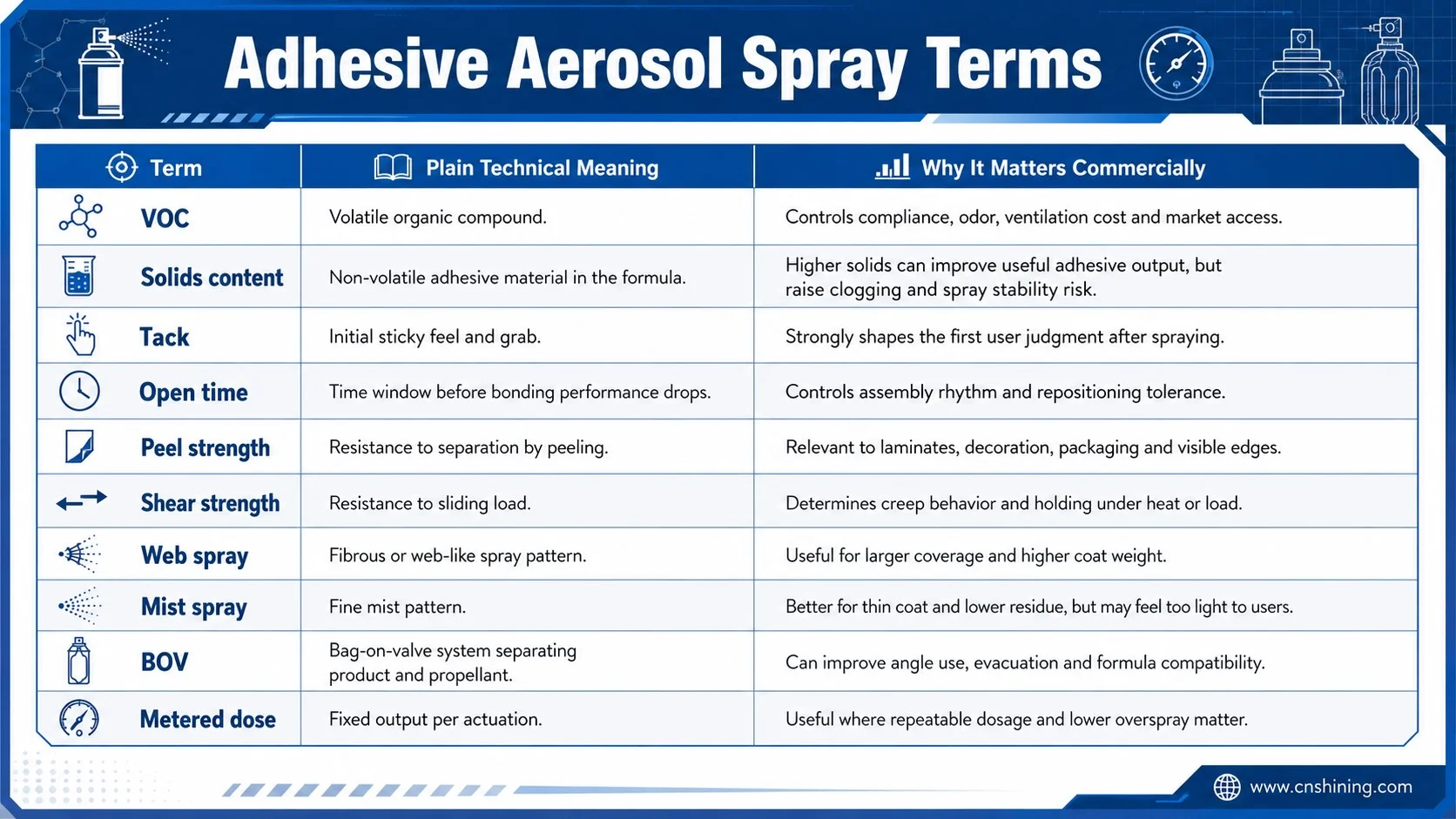
| Term | Plain Technical Meaning | Why It Matters Commercially |
|---|---|---|
| VOC | Volatile organic compound. | Controls compliance, odor, ventilation cost and market access. |
| Solids content | Non-volatile adhesive material in the formula. | Higher solids can improve useful adhesive output, but raise clogging and spray stability risk. |
| Tack | Initial sticky feel and grab. | Strongly shapes the first user judgment after spraying. |
| Open time | Time window before bonding performance drops. | Controls assembly rhythm and repositioning tolerance. |
| Peel strength | Resistance to separation by peeling. | Relevant to laminates, decoration, packaging and visible edges. |
| Shear strength | Resistance to sliding load. | Determines creep behavior and holding under heat or load. |
| PSA | Pressure-sensitive adhesive. | Used for temporary, removable or light-load bonding. |
| Web spray | Fibrous or web-like spray pattern. | Useful for larger coverage and higher coat weight. |
| Mist spray | Fine mist pattern. | Better for thin coat and lower residue, but may feel too light to users. |
| BOV | Bag-on-valve system separating product and propellant. | Can improve angle use, evacuation and formula compatibility. |
| Metered dose | Fixed output per actuation. | Useful where repeatable dosage and lower overspray matter. |
6. Regulations, Standards and Transport: Adhesive + Aerosol + Dangerous Goods
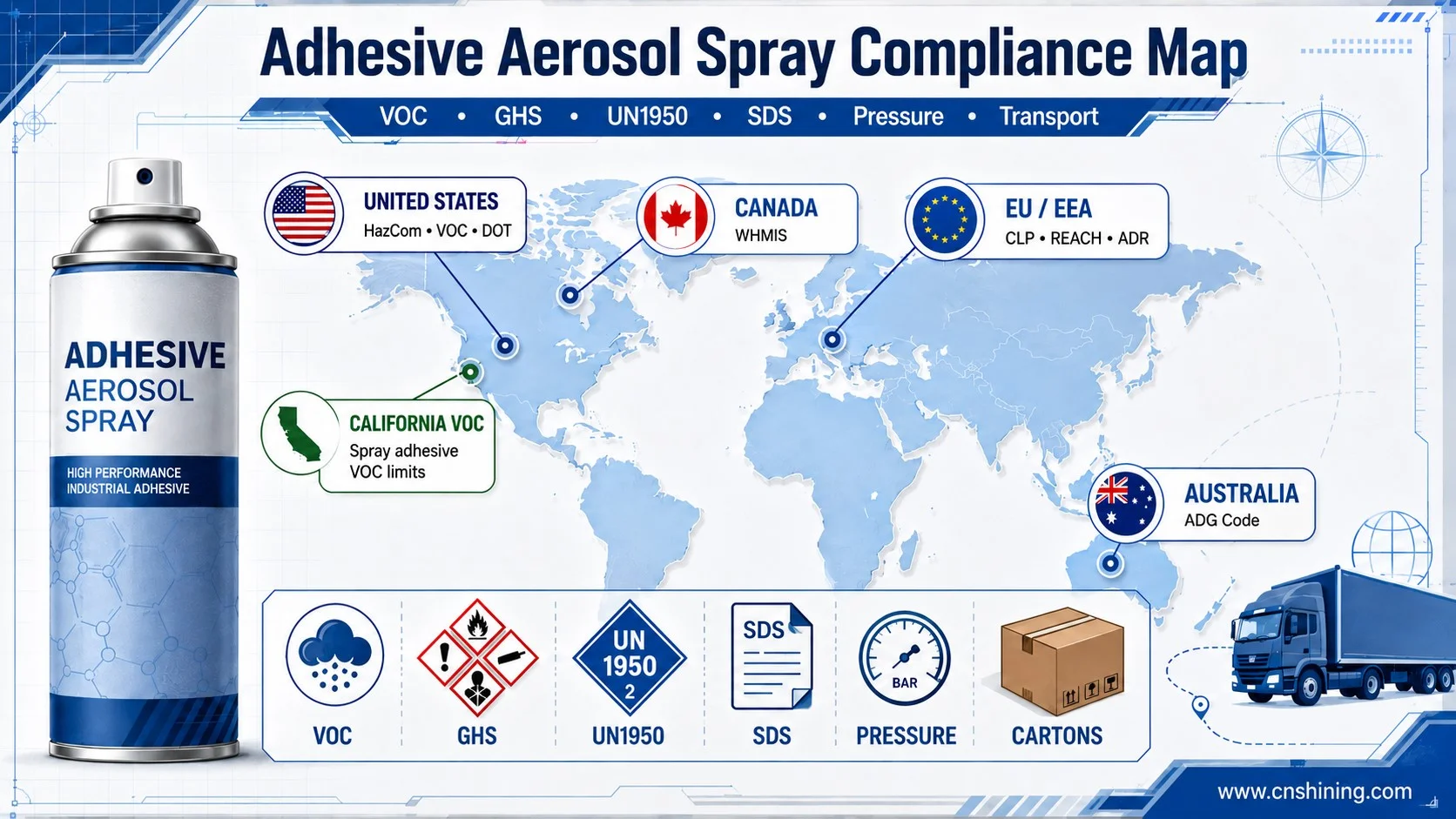
The practical compliance rule is simple: do not treat adhesive aerosol spray as only an adhesive. It is an adhesive, an aerosol dispenser and often a dangerous goods item. Labeling, VOC limits, SDS, storage and transport have to be reviewed together.
| Region | Main Framework | Practical Effect on Adhesive Aerosol Spray |
|---|---|---|
| United States | OSHA Hazard Communication Standard, CPSC / FHSA, EPA SNAP, DOT and state VOC rules. | Workplace labels and SDS must fit HazCom. Consumer and retail products may need FHSA warnings. CARB-style VOC categories affect mist, web and screen-printing aerosol adhesives. |
| California VOC reference | CARB spray adhesive VOC category discussion. | Commonly cited limits include Mist Spray Adhesive 30%, Web Spray Adhesive 40% and Screen Printing Adhesive 55% VOC by weight, plus GWP restrictions. |
| United States transport | 49 CFR 173.306 limited quantities of compressed gases. | Aerosol shipment has pressure, capacity and limited quantity conditions. Retail cans are not ordinary parcels in cross-border logistics. |
| European Union / EEA | EU Aerosol Dispensers Directive, CLP, REACH and ADR. | Aerosol dispensers are mature but tightly controlled products. Flammable aerosol labels such as H222/H229 or H223/H229 are common for solvent and LPG/DME systems. |
| Canada | Health Canada WHMIS supplier guidance. | WHMIS alignment with GHS revisions expands aerosol classification detail and tightens workplace communication expectations. |
| Australia | Australian Dangerous Goods Code. | UN number, hazard diamonds, shipping documentation and carton marks need to match the ADG framework. |
7. Top 10 Adhesive Aerosol Spray Brands and Positioning Signals
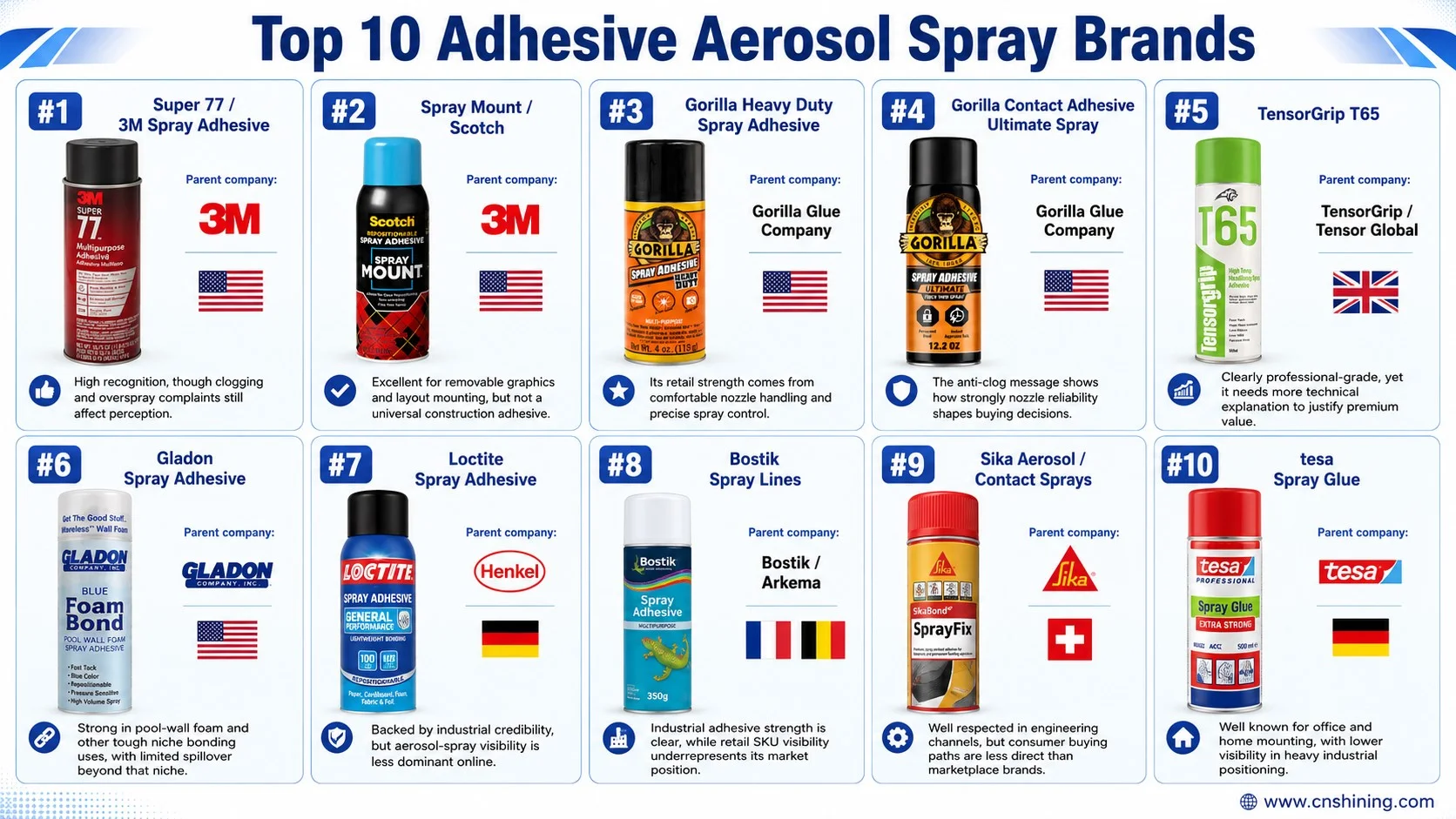
| Brand / Line | Headquarters Country | Parent Company | Publicly Visible Typical Size | Technical Reading |
|---|---|---|---|---|
| Super 77 / 3M Spray Adhesive | United States | 3M | 13.5–16.75 oz range | Strong recognition, but classic high-strength products face low tolerance for clogging and overspray complaints. |
| Spray Mount / Scotch | United States | 3M | 10.25 oz | Clear position in removable graphic and layout mounting; not a universal construction spray adhesive. |
| Gorilla Heavy Duty Spray Adhesive | United States | Gorilla Glue Company | 14 oz | Modern retail communication. The real competitive point is nozzle comfort and spray control. |
| Gorilla Contact Adhesive Ultimate Spray | United States | Gorilla Glue Company | 12.2 oz | Putting anti-clog in the selling language shows how strongly nozzle failure shapes user judgment. |
| TensorGrip T65 | United Kingdom | TensorGrip | 500 ml aerosol | Professional positioning is clear, but it needs technical channel explanation to justify its value. |
| Gladon Spray Adhesive | United States | Gladon | 17 oz can | Specific to pool wall foam and difficult bonding niches; lower brand spillover outside that use case. |
| Loctite Spray Adhesive | Germany | Henkel | Unspecified | Industrial credibility is strong, but online aerosol spray adhesive visibility is less dominant. |
| Bostik Spray Lines | France | Bostik | Unspecified | Strong in industrial adhesives, but retail SKU visibility does not fully reflect industry position. |
| Sika Aerosol / Contact Sprays | Switzerland | Sika | Unspecified | Strong engineering channel, but consumer buying paths can be less direct than marketplace brands. |
| tesa Spray Glue | Germany | tesa | Unspecified | Good office and home mounting recognition; less visible in heavy industrial spray adhesive positioning. |
The brand language has shifted. “High strength” is no longer enough. Stronger current claims move toward comfort nozzle, controlled fine mist, variable-width spray pattern, low VOC and anti-clog actuator design. That is a packaging engineering signal.
8. User Pain Points and Packaging System Improvements
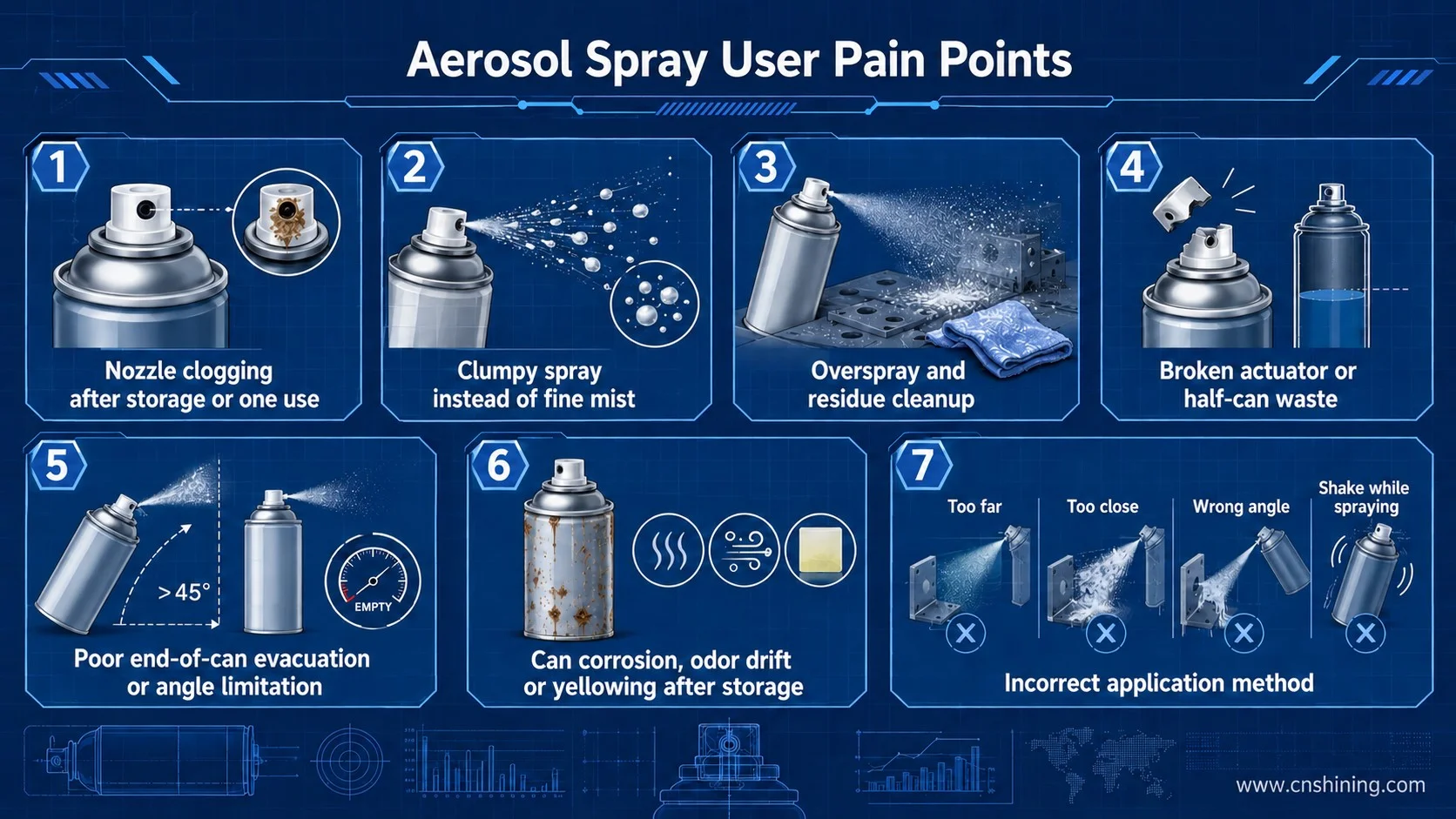
Public user traces are repetitive. Nozzle clogging appears in craft, textile, stencil and repair discussions. A quilting discussion on spray nozzle clogging and a stencil discussion on clumpy spray adhesive show the same pattern: users often blame the can, not the spraying condition.
| User Pain Point | Likely Technical Cause | Packaging / Spray System Improvement | Commercial Effect |
|---|---|---|---|
| Nozzle clogging after storage or one use | Dried adhesive in stem or orifice; small spray path not tolerant of high solids or high tack. | Anti-clog valve route, more tolerant orifice, reverse-spray cleaning instruction, spare actuator under cap. | Fewer returns and higher usable content rate. |
| Clumpy spray instead of fine mist | Phase separation, pressure drop, poor swirl or fan insert compatibility. | Switchable mist / web / fan actuator; more stable insert; printed spray distance and temperature window. | Less user error and fewer “bad can” complaints. |
| Overspray and residue cleanup | Spray fan too wide, poor boundary control, excessive output per actuation. | Hooded actuator, narrow fan tip, local spray extension, metered dose on higher-control SKUs. | Lower adhesive waste and cleaner small-area work. |
| Broken actuator or half-can waste | Exposed stem, weak cap protection, drops during e-commerce logistics. | Lockable actuator, rotating lock, deeper cap, drop-resistant shipping pack. | Lower damage claims and fewer unusable cans. |
| Poor end-of-can evacuation or angle limitation | Traditional dip tube pickup depends on can angle and liquid level. | Bag-on-valve, compressed air or nitrogen platform, improved dip tube geometry. | Better all-angle spraying and higher perceived value. |
| Can corrosion, odor drift or yellowing after storage | Solvent package attacks metal, coating, gasket or plastic parts. | Separate aggressive solvent SKUs by internal coating and gasket compatibility validation. | Lower hidden failure cost and more stable shelf life. |
| Incorrect application method | User does not understand spray distance, one-sided/two-sided use, tack waiting time or pressure application. | Process-style printing on can: shake, spray distance, wait to tack, press, clean nozzle; QR video for handling. | Moves user education onto the package instead of after-sale support. |
Packaging improvements are not cosmetic. Metered aerosol valve technology, bag-on-valve systems, compressed gas platforms and switchable actuators already exist in adjacent aerosol categories. The technical work is matching them to adhesive viscosity, tack level, solvent load and target spray pattern.
9. Packaging Components for Adhesive Aerosol Spray: Shining Packaging Focus
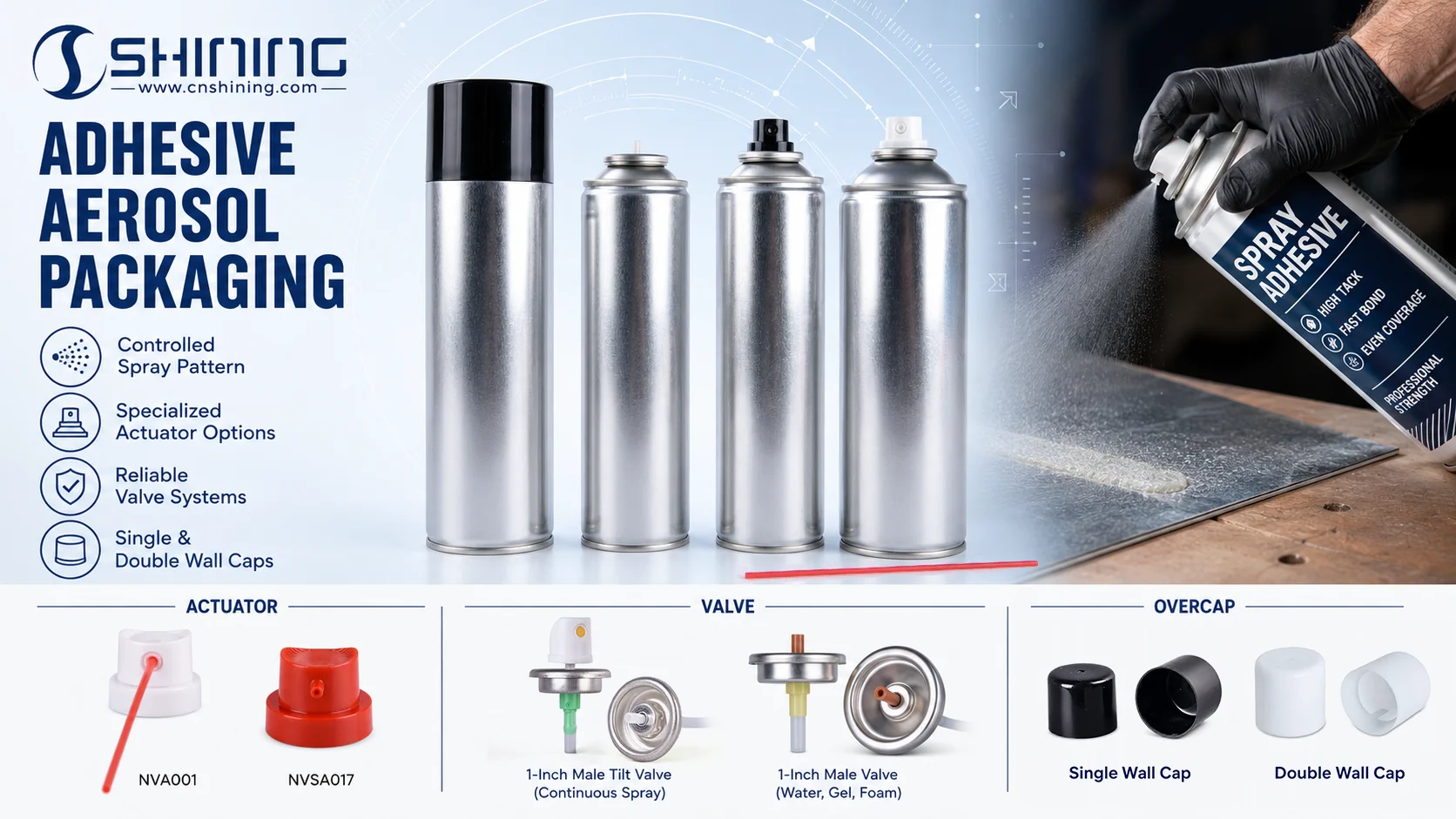
For adhesive aerosol spray, Shining Packaging should be discussed at the component level: actuators, aerosol cans and valves. The adhesive formula decides bond performance, but these parts decide whether the user actually gets a stable spray pattern through the full can.
The actuator has to match the intended pattern: mist for thin coating, web for higher deposit, fan for controlled strips. The valve and gasket must tolerate the adhesive carrier and propellant. The can body and internal coating must resist solvent attack, waterborne corrosion risk and pressure cycling. A trigger-style actuator may also improve ergonomics for large-area work, but it has to protect the stem during shipping.
For Shining Packaging, the useful engineering question is not “can this part fit an aerosol can?” It is narrower: can this actuator-valve-can set handle high-tack adhesive, restart after storage, limit overspray and survive e-commerce transport? That is where packaging design becomes part of adhesive aerosol spray performance.
10. Closing Technical View
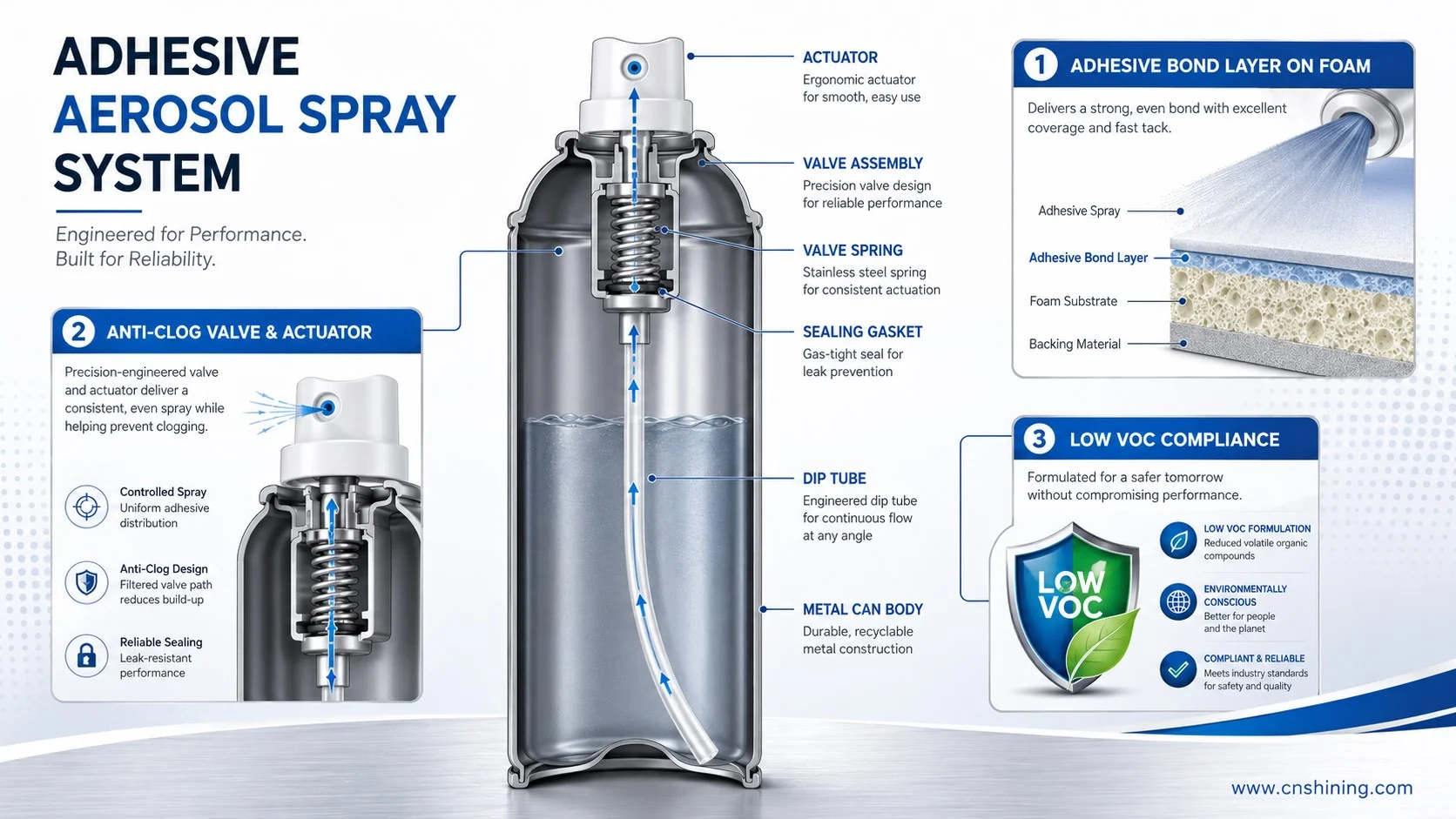
Adhesive aerosol spray will not be judged only by laboratory peel strength. The next practical improvement sits at the crossing point of low-VOC formulation, stable atomization, actuator durability, valve cleanliness, can compatibility and dangerous goods compliance. A can that sprays cleanly, restarts reliably and empties predictably often solves more user problems than a formula that adds a little more bond strength under ideal test conditions.
11. FAQ: Adhesive Aerosol Spray
Adhesive aerosol spray is a self-pressurized adhesive product. The adhesive formula is packed with a liquefied or compressed propellant and released through a valve, dip tube and actuator. The spray forms a mist, web or fan pattern on the substrate. It is different from a pump spray because propellant pressure drives dispensing and atomization.
Clogging usually comes from adhesive drying in the valve stem, actuator orifice or internal spray path. High solids, high tack and small nozzle geometry make the problem worse. Storage after partial use is a typical trigger. Anti-clog actuators, larger-tolerance spray paths, reverse-spray cleaning and spare nozzles can reduce the failure rate.
Mist spray gives a fine, lighter coating and is useful when appearance, thin film and lower residue matter. Web spray produces a fibrous pattern with a higher coat feel and stronger grab on large surfaces. The choice depends on substrate, coat weight, open time and whether the user needs repositioning or fast permanent bonding.
Water-based systems reduce solvent burden and can help with VOC targets, but they are still pressurized aerosol products. The can, valve and actuator must still handle pressure, storage and spray stability. High-solids waterborne systems can be difficult to atomize cleanly, so lower solvent risk does not remove packaging or dispensing validation.
The main reason is scope. Some reports count broad spray adhesives across industrial equipment, hot-melt systems and multiple end uses. Others focus more narrowly on spray adhesive products. That is why public 2025 estimates can differ by several times. Before using the number, check whether it means spray adhesives or retail aerosol spray adhesive cans.
Aerosol spray adhesive is usually a portable pressurized package that deposits adhesive through atomization. Hot-melt adhesive is normally applied through heated equipment and sets by cooling. Hot melt can offer fast production and low VOC because many systems are 100% solids, but it has higher equipment and thermal management requirements.
Overspray happens when the spray width, output rate or user distance is not matched to the work area. Wide fan patterns, excessive pressure, light substrates and poor masking make it worse. Packaging fixes include narrow fan tips, hooded actuators, metered output and clearer spray distance instructions printed directly on the can.
Valve selection should start with adhesive viscosity, solids content, solvent or water system, propellant type, target spray pattern and storage conditions. A good bench test includes first spray, restart after partial use, warm and cold storage, end-of-can evacuation, actuator force, gasket compatibility and spray pattern stability over the product’s shelf life.
Many adhesive aerosol sprays contain flammable propellants or solvents and are packed under pressure. Heated containers can burst, and ignition sources can create fire risk. Transport frameworks often classify retail aerosol cans under aerosol dangerous goods rules, commonly linked to UN1950. Correct labeling, carton marking and shipping documents are part of the product design.
Packaging can reduce complaints by controlling the dispensing experience. Anti-clog valves, compatible gaskets, stronger actuators, deeper caps, switchable spray patterns, BOV options and clear can printing all help. The best technical target is simple: the can should spray consistently, restart after storage, avoid unnecessary overspray and empty more predictably.