
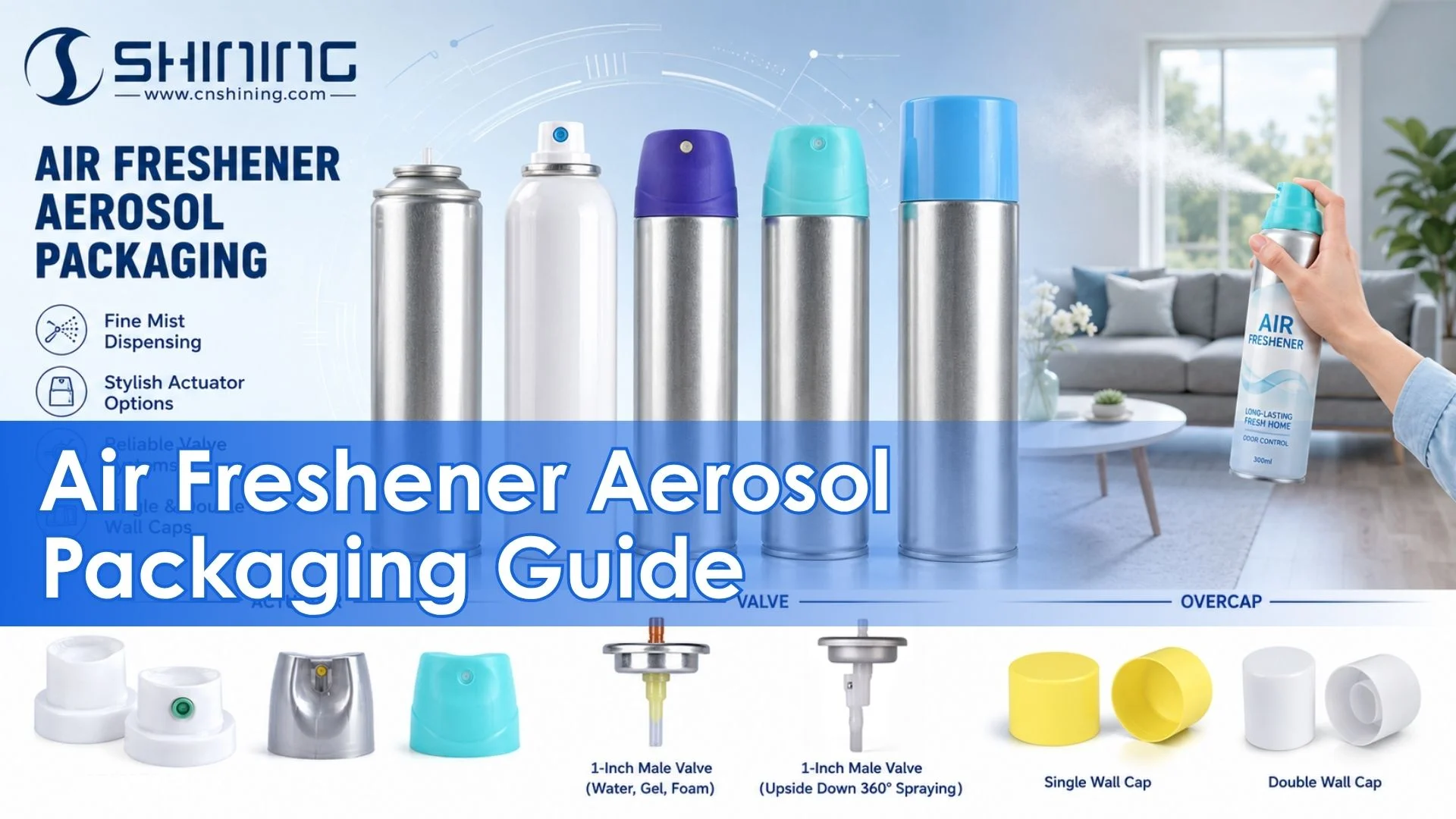
An aerosol air freshener is a pressurized dispensing system, not just a scented product in a can. Fragrance, deodorizing actives, solvent and propellant are packed inside a pressure-resistant container. The valve and actuator release the formulation as a short mist cloud.
This matters because the main value of an air care aerosol is not “more perfume”. The value is instant coverage, atomized diffusion, controlled dose and shelf stability. Poor spray hardware can make a good fragrance feel wet, harsh or unreliable.
1. What Counts as an Aerosol Air Freshener?
Aerosol dispenser is a non-reusable container holding gas under pressure, fitted with a release device that ejects the contents as particles, foam, paste, powder or liquid.
In consumer use, aerosol air fresheners usually fall into two groups: manual room spray and automatic air freshener refill cans. They are not the same as ordinary pump spray, plug-in oil, gel, reed diffuser or scented candle.
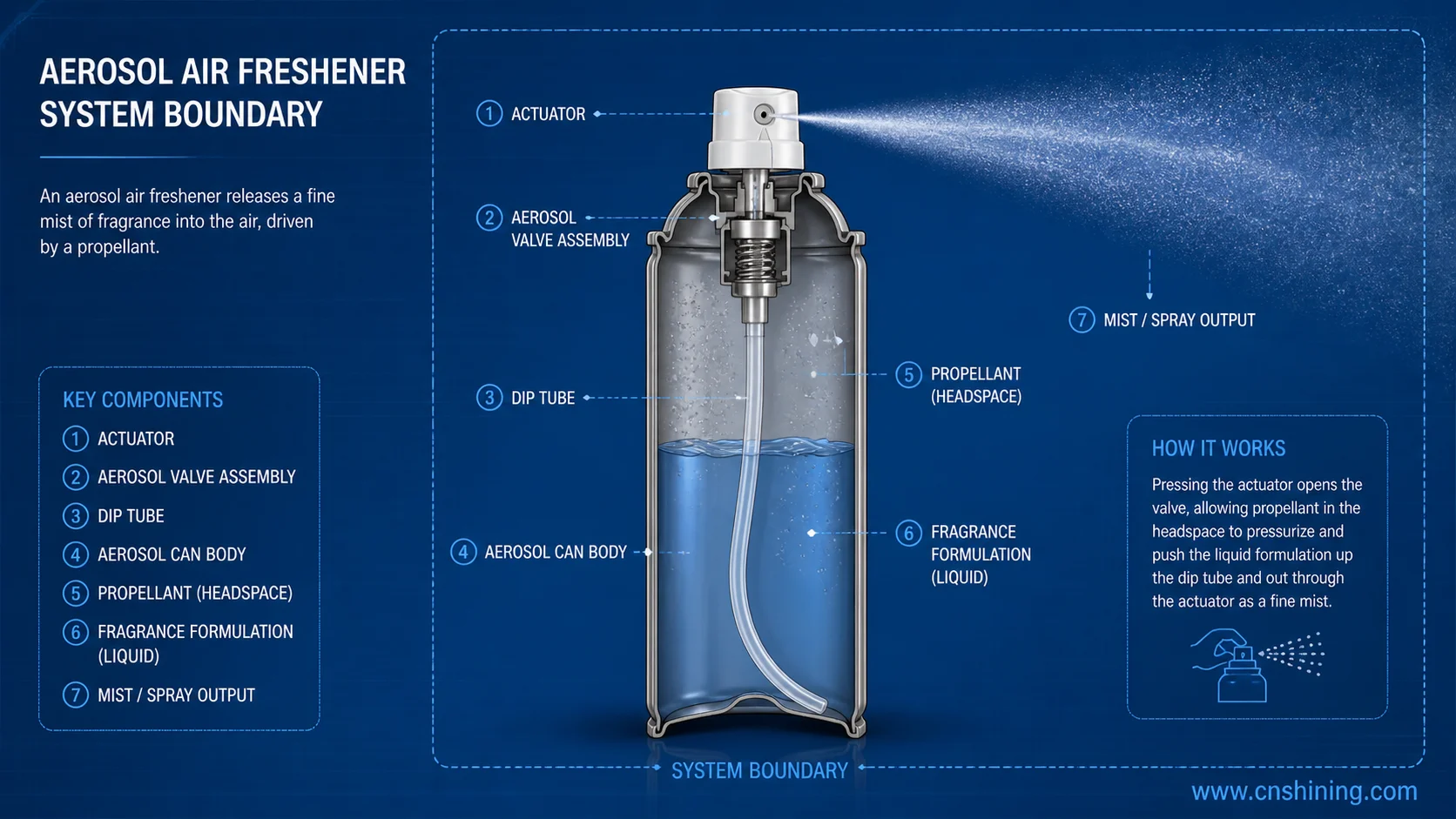
A narrow engineering definition includes at least five subsystems: can body, valve assembly, dip tube, actuator or nozzle, and fragrance concentrate with propellant. Automatic dispensers add an external pressing mechanism, usually based on motor, gear, cam or electromagnetic actuation.
2. How the System Works: Pressure, Valve and Actuator
The physical chain is simple but unforgiving. The formulation sits under pressure. When the actuator is pressed, the valve opens. Liquid travels up the dip tube, passes through valve orifices, and reaches the actuator insert. At the nozzle, pressure drops sharply. Liquefied propellant flashes or compressed gas expands. The liquid column breaks into droplets.
Mist quality depends on four variables: propellant pressure, actuator geometry, formulation rheology and solvent volatility. A small change in spray insert, vapor tap or valve stem orifice can shift the product from fine mist to wet jet.
Liquefied gas systems, often based on propane, butane or isobutane, give strong atomization and low cost. Their weak points are flammability, VOC pressure and transport limits. Compressed air or nitrogen systems reduce propellant odor and can support lower-VOC positioning, but they need tighter valve and actuator design to avoid coarse droplets or weak late-stage spray.
3. Chemistry: Masking Is Only One Part
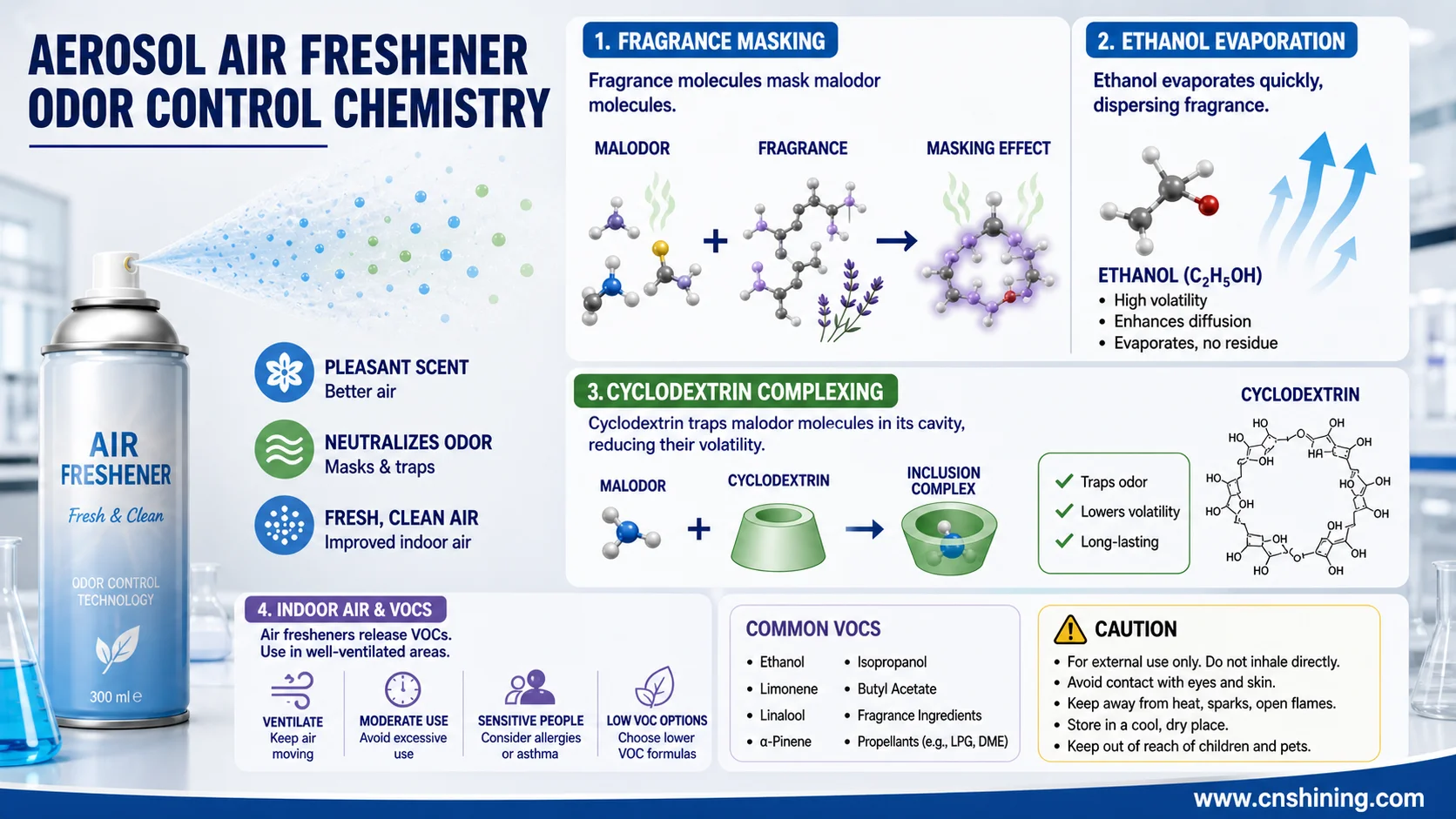
An aerosol air freshener does not work only by covering odor. Public ingredient disclosures and patents show four common routes: sensory masking, solvent-assisted evaporation, malodor complexing or adsorption, and chemical deodorizing.
Water and ethanol are common carriers in modern soft mist products. Solubilizers such as PEG-40 or PEG-60 hydrogenated castor oil help carry fragrance oil in water-rich systems. Ingredient pages such as the Febreze SmartLabel ingredient disclosure, SC Johnson Glade Lavender ingredient disclosure, and SC Johnson Glade Lavender & Vanilla ingredient disclosure show how water, alcohol, fragrance, solubilizers and propellant choices appear in real products.
There is also a downside. Air fresheners can contribute to indoor VOC load. The U.S. EPA notes that indoor VOC levels are often higher than outdoor levels and lists air fresheners among indoor sources on its VOC and indoor air quality page. Terpene-rich fragrance systems can also react with indoor ozone and form secondary pollutants.
4. Market Size and Regional Logic
The regional reading is also directional. Europe and North America remain mature large markets. Asia-Pacific adds faster volume.
| Region | 2025 estimated size | 2020 estimated size | 2025–2035 CAGR view | 2035 estimated range | Main driver | Main constraint |
|---|---|---|---|---|---|---|
| North America | USD 4.09 billion | USD 3.43 billion | 3%–5% | USD 5.5–6.7 billion | Stable home, bathroom and automotive use. | VOC debate, sensitive users and channel price pressure. |
| Europe | USD 4.47 billion | USD 3.75 billion | 2.5%–4% | USD 5.7–6.6 billion | Premium scent positioning and packaging sustainability. | REACH, CLP and aerosol container compliance cost. |
| China | USD 1.28 billion | USD 1.07 billion | 5%–7% | USD 2.1–2.5 billion | Urban households, small-space odor control and e-commerce. | Cost competition, scent preference spread and unclear public data. |
| Asia-Pacific, excluding China | USD 1.92 billion | USD 1.61 billion | 6%–8% | USD 3.4–4.1 billion | India, Southeast Asia, Japan and Korea growth. | Fragmented regulation and channels. |
| Latin America | USD 0.64 billion | USD 0.54 billion | 4.5%–6.5% | USD 1.0–1.2 billion | Urban consumption upgrade and home care penetration. | Currency pressure and low-price substitution. |
| Middle East and North Africa | USD 0.38 billion | USD 0.32 billion | 4%–6% | USD 0.57–0.69 billion | Hotel, commercial space and home fragrance culture. | Limited public data and import dependence. |
5. Competing Formats: Where Aerosol Still Wins
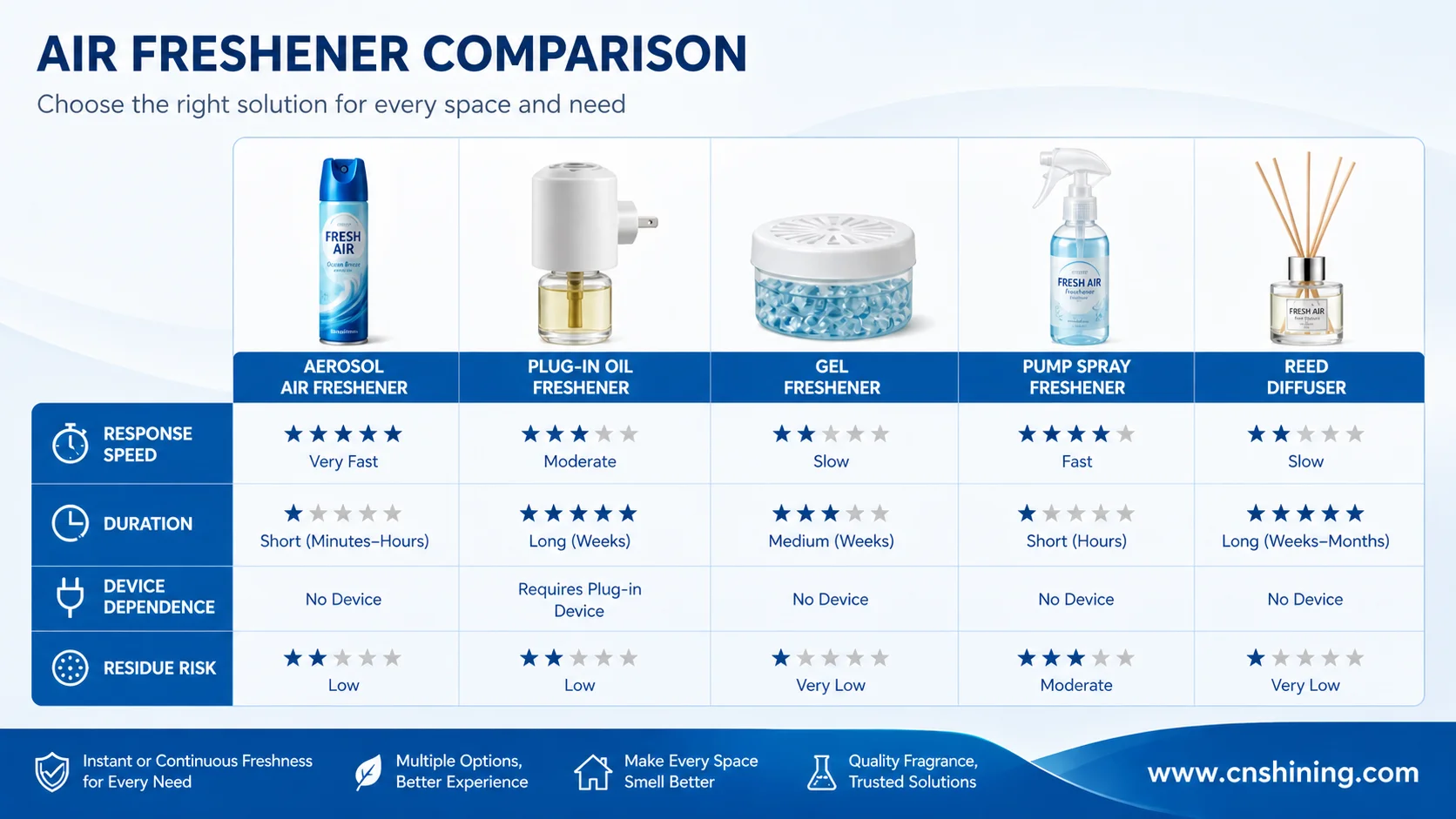
Aerosol is not the universal answer. It is the format with the strongest instant response. Plug-in oils and diffusers are better for background scent. Gels are low-cost and passive. Pump sprays avoid pressurized aerosol transport logic but often feel wetter.
| Format | Response speed | Lasting effect | Device need | Main advantage | Main weakness | Best-fit use |
|---|---|---|---|---|---|---|
| Aerosol air freshener | Seconds | Short to medium | None, or automatic dispenser | Fast, portable, low entry price, easy scent switch. | Overspray, wet floors, flammability and short duration. | Kitchen, toilet, guest arrival, hotel turnover. |
| Plug-in oil | Minutes | Long | Outlet required | Stable background fragrance. | Device lock-in and refill dependence. | Living room, entrance, bedroom. |
| Gel | Slow | Medium to long | None | Cheap and simple. | Weak diffusion and temperature sensitivity. | Small space, low budget, auxiliary use. |
| Pump spray | Seconds | Short to medium | None | Not a typical pressurized aerosol shipment. | Atomization often feels wetter. | Fabric refresh, local odor treatment. |
| Reed diffuser | Slow | Medium to long | None | Passive diffusion and decorative value. | No instant control. | Entrance, bedroom, gift sets. |
The stable conclusion is practical: aerosol stays strong in emergency odor correction. Continuous fragrance formats dominate background odor management. The two are not direct replacements.
6. Formulation System and Component Roles
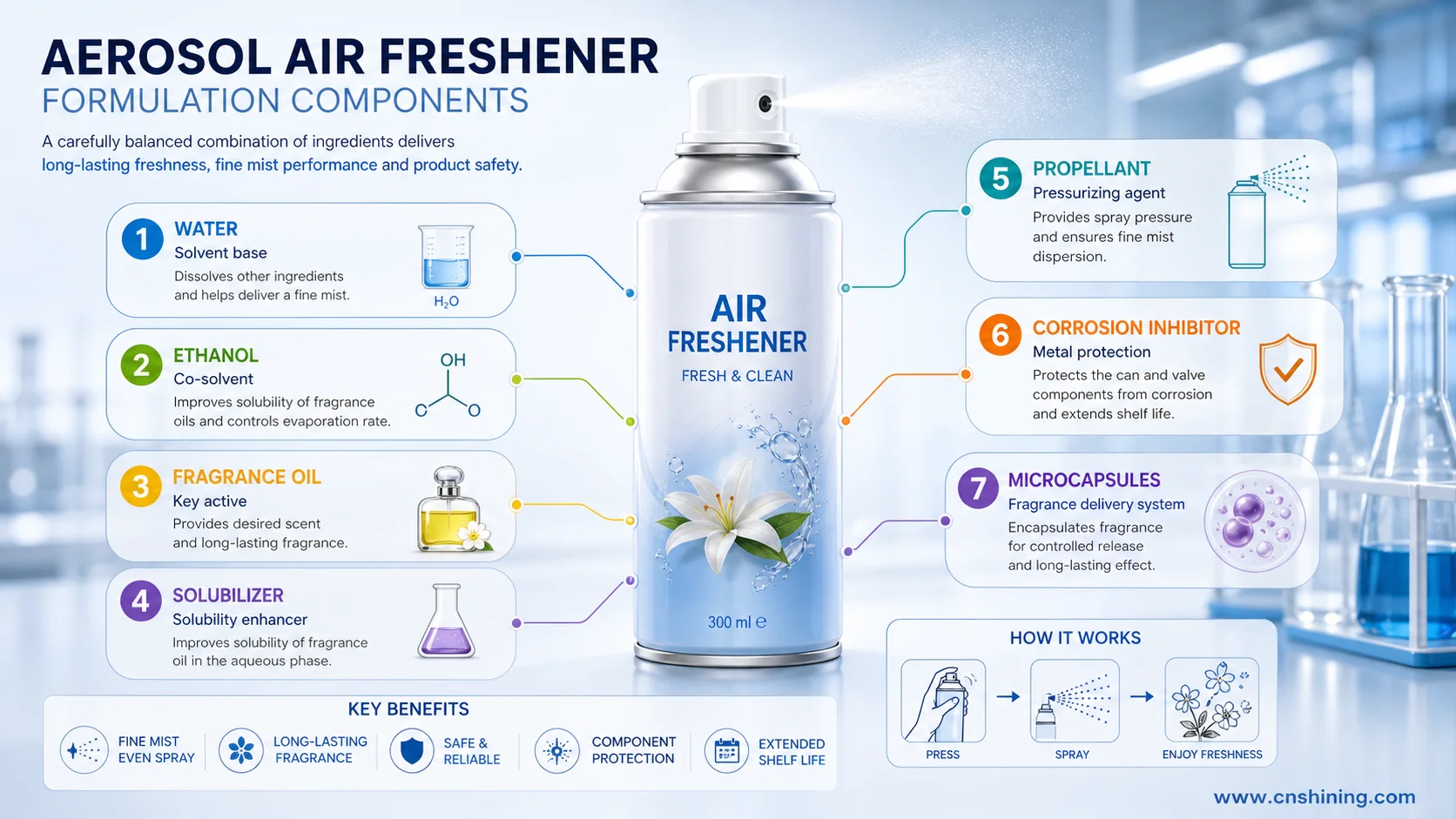
Public patents, ingredient disclosures and propellant material pages point to four formulation families: solvent-rich concentrate, water-alcohol soft mist, emulsified or microemulsified aerosol, and compressed gas or Bag-on-Valve systems. A representative patent on concentrated fragrance aerosol systems is available through Google Patents.
| Component | Typical role | Engineering meaning |
|---|---|---|
| Water | Carrier and dilution phase. | Helps lower irritation feel and supports water-based positioning. |
| Ethanol | Solvent and fast-evaporating carrier. | Improves fragrance solubility and dry-down, but affects flammability. |
| Co-solvent | Fragrance solubilization and evaporation curve control. | Improves clarity and compatibility, but may affect VOC status. |
| Fragrance | Main sensory phase. | Drives purchase, allergen exposure, irritation risk and cost. |
| PEG-40/60 hydrogenated castor oil | Solubilizer or emulsifier. | Makes water-rich fragrance spray feasible. |
| Propellant | Discharge and atomization energy. | Controls spray feel, flammability, VOC logic and transport classification. |
| Cyclodextrin | Malodor molecule complexing. | Moves the product from simple masking toward odor reduction. |
| Buffer salt | pH and system stability. | Supports long shelf life and compatibility. |
| Preservative | Microbial control. | Needed in water-based systems. |
| Antioxidant | Fragrance stabilization. | Reduces yellowing, off-odor and fragrance loss. |
| Corrosion inhibitor | Can and valve protection. | Reduces rust, leakage, sediment and color change. |
| Microcapsule wall material | Suspension and delayed release. | Can extend scent tail, but raises clogging and stability risk. |
| Formulation type | Representative range | Commercial fit | Typical advantage | Typical difficulty |
|---|---|---|---|---|
| High-concentrate automatic refill | Solvent 25%–50%, propellant 30%–67%, fragrance and additives as balance. | Automatic dispenser, strong scent burst. | High presence per shot. | Flammability, irritation, transport and regulatory pressure. |
| Low-VOC water-alcohol soft mist | Water 48%–52%, ethanol 26%–30%, DPnP 18%–22%, fragrance 1%–3%, inhibitor below 0.5%. | Manual soft mist and mild-positioned room spray. | Lighter spray feel. | Narrow solubilization window. |
| Low-propellant emulsified aerosol | Propellant 10%–30%, polyglycerol ester surfactant 0.1%–1.0%, balance water phase, fragrance and co-solvent. | Water-based fine mist. | Lower propellant loading. | Emulsion stability and nozzle cleanliness. |
| Microcapsule long-tail system | Encapsulated fragrance 0.5%–3%, surfactant 1%–5%, suspending agent 0.1%–3%, solvent 85%–98%, low propellant. | Longer-lasting scent and lower spray frequency. | Delayed release. | Clogging, suspension and cost. |
| Low-VOC or non-VOC carrier system | Fragrance oil 0.1%–40%, water phase at least 30%, low-VOC carrier solvent 10%–30%. | Compliance-oriented or sensitive-user products. | Easier low-VOC claim pathway. | Fragrance loading and transparency limits. |
7. Standards, VOC and Transport Control
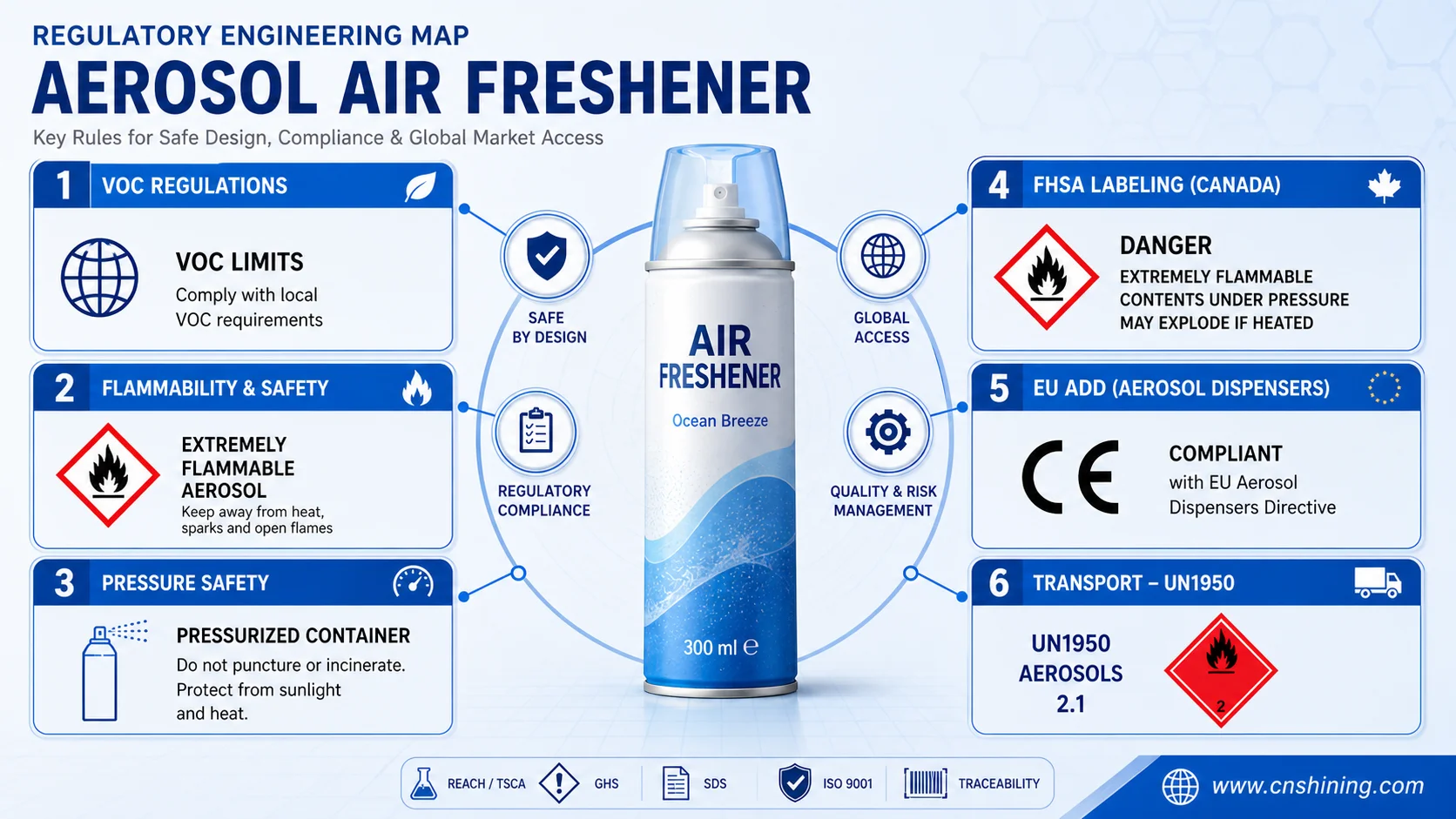
An aerosol air freshener has to answer four compliance questions: what is sprayed, whether the container is safe, whether the label gives the right warning, and whether the packed unit can move as an aerosol dangerous good.
| Region | Main rule or standard | Practical impact |
|---|---|---|
| United States | FHSA and 16 CFR Part 1500, plus VOC rules such as 40 CFR Part 59 Subpart C. | Hazard signal words, flammability, toxicity, irritation and category-based VOC logic must be checked SKU by SKU. |
| United States labeling | CPSC FHSA guidance. | Signal word, principal hazard statement and label prominence matter when the product is flammable, irritant or pressurized. |
| European Union | REACH, CLP and ADD. EU public answers also note restrictions on 1,4-dichlorobenzene in air fresheners and toilet deodorants through European Parliament documentation. | Chemical restrictions, hazard classification, pressure testing and aerosol-specific marking all interact. |
| International transport | UN 1950 aerosol classification and related dangerous goods rules. | Flammable systems can affect air shipment, outer carton marking, storage temperature and logistics cost. |
The practical route is not to memorize one VOC number. Start with the exact product category, exact market, propellant, fragrance allergens, claim language and transport mode.
8. Technology Trends: Less Harsh, More Controlled
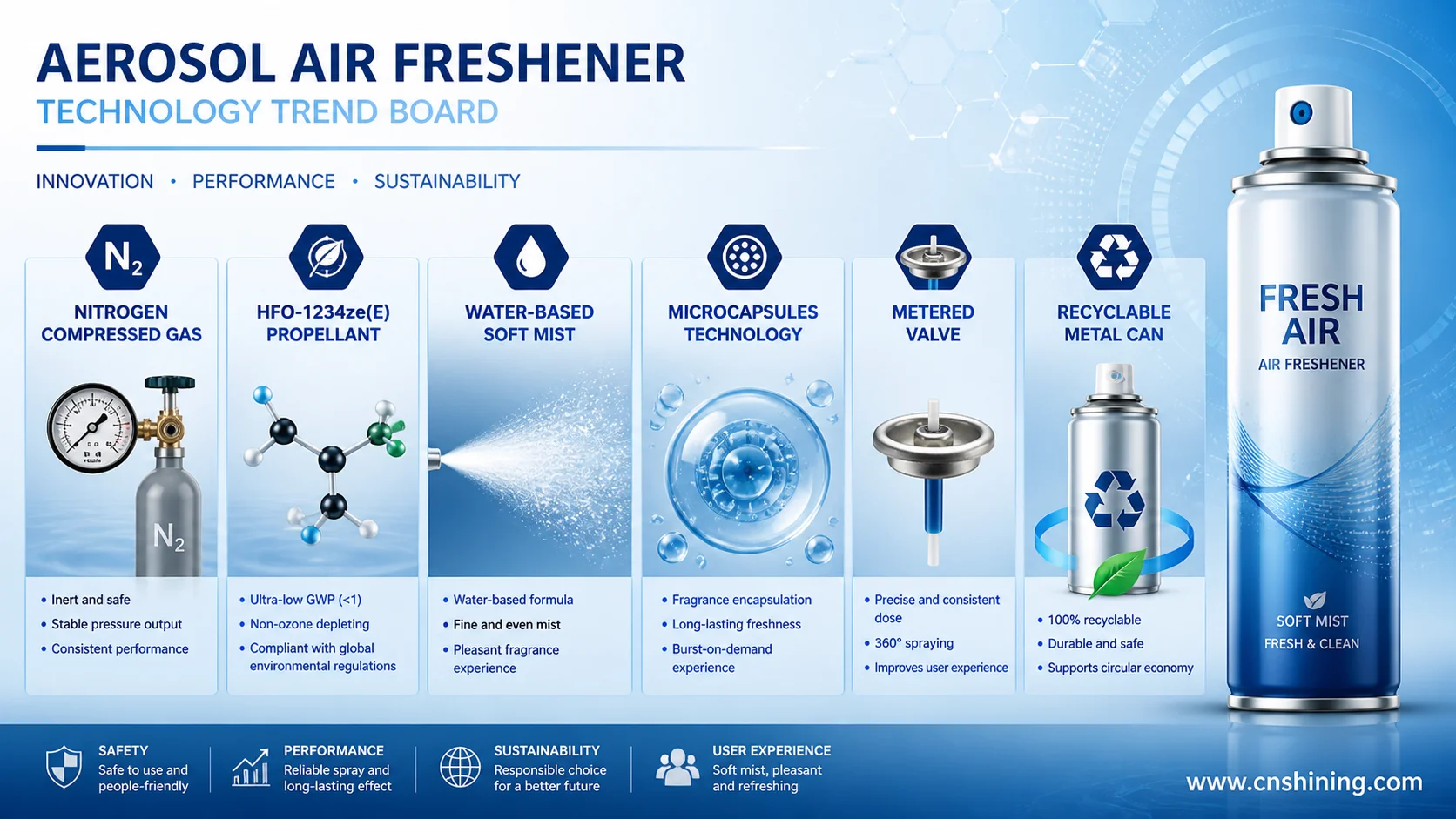
The strongest technology direction is propellant reform. Cheap and powerful is no longer enough. Compressed air, nitrogen and HFO-1234ze(E) are used to reduce odor, lower GWP pressure and support cleaner labeling.
The second direction is low-VOC water-based soft mist. The formulation has to stay stable, spray fine and avoid wet surfaces. That is harder than simply replacing solvent with water.
The third direction is controlled release. Microcapsules can reduce direct exposure of aromatic molecules, slow evaporation and improve storage stability. A review on stimulus-responsive microcapsules and aromatic applications supports this longer-tail fragrance route.
The fourth direction is dose control. Automatic dispensers and metered valves need repeatable press force, stroke control and refill interface consistency. A patent on an automatic air freshener spraying device shows the mechanical issue clearly: the system must create enough instant pressing force to form mist, not droplets.
9. Top 10 Aerosol Air Freshener Brands
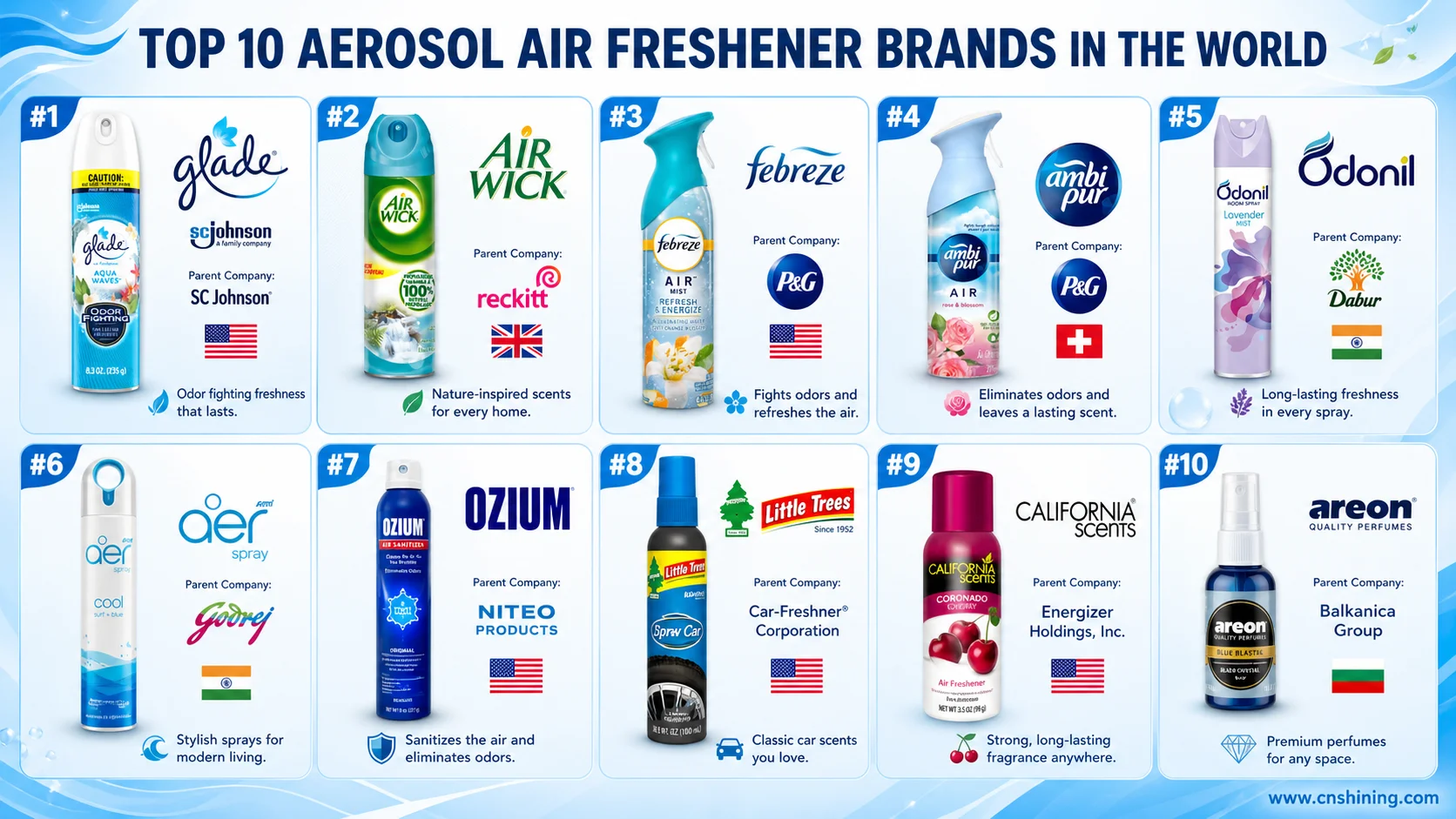
| Brand | Country | Owner | Capacity | Price | Technical note |
|---|---|---|---|---|---|
| Glade | United States | SC Johnson | 7.3–8.3 oz manual spray; 6.2 oz automatic refill | USD 3.8–7.2 per unit | Strong retail education and broad format coverage; scent profile is mass-channel oriented. |
| Air Wick | United Kingdom | Reckitt | 8 oz manual spray; 6.17 oz Freshmatic refill | USD 5.5–8.5 per unit | Automatic spray ecosystem is strong, but refill lock-in is obvious. |
| Febreze | United States | Procter & Gamble | 8.8 oz aerosol spray | About USD 4.6–7.6 per can by pack calculation | Odor-removal association is strong; scent style is clean rather than premium perfume-like. |
| Ambi Pur | United States | P&G | 275 g / 300 ml common | About ₱211 per 300 ml; some markets Ks12,200–17,500 | Good Asia visibility; premium positioning is weaker globally. |
| Odonil | India | Dabur | 108 g, 153 g, 240 ml, 550 g, 600 g | ₹165–195 per 240 ml | Cost-effective and strong in Indian channels; international image is limited. |
| Godrej aer | India | Godrej Consumer Products | 240 ml, some 300 ml | ₹150–167 per 240 ml | Design language is stronger than many local peers; price remains accessible. |
| Ozium | United States | 3.5 oz, 8 oz | USD 5.99 for 3.5 oz official reference; Amazon packs about USD 24–33 | Closer to air sanitizing and odor reduction than pure home fragrance. | |
| Little Trees Spray | United States | Car-Freshner Corporation | 3.5 oz | USD 2.97–4.33 | Very strong car air freshener association; weaker in home interior use. |
| California Scents Spray | United States | California Scents | 3.5 oz | USD 8.30 single-unit reference | Recognizable scent identity; unit capacity price is not low. |
| Areon Spray | Bulgaria | Balev Corporation | Small spray twin packs; 50 ml glass spray common | USD 11.69–12.34 for some twin spray packs | Visible in Eastern Europe and car fragrance, but wider household penetration is narrower. |
10. User Pain Points and Packaging Fixes
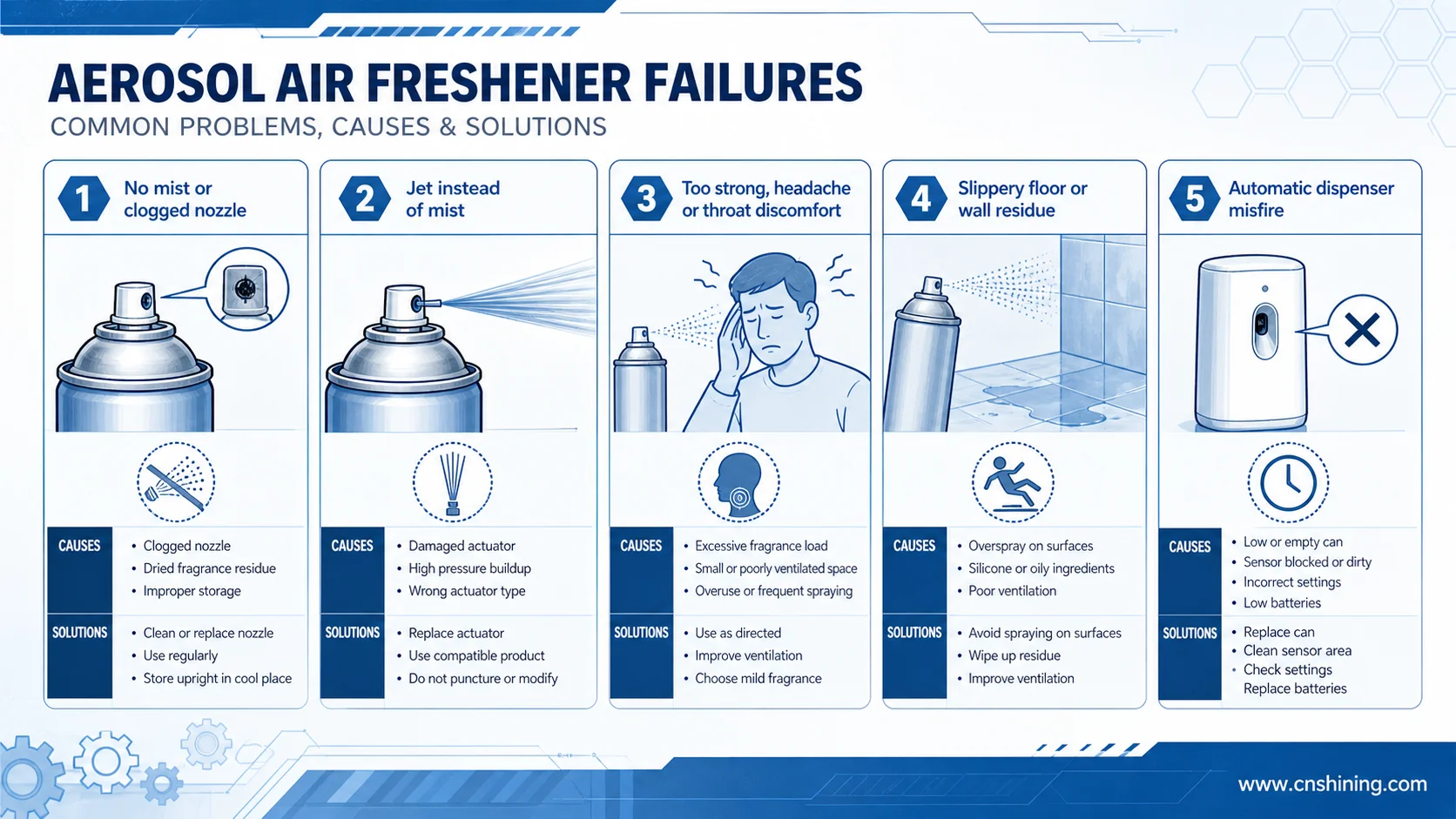
Public user complaints cluster around the same failures: no spray, clogged nozzle, water-jet discharge, strong artificial odor, headache, slippery floor, automatic dispenser misfire and fast scent drop-off. These are not only fragrance issues. Many are valve-actuator-can system issues.
| User pain point | Likely root cause | Packaging, valve or actuator fix |
|---|---|---|
| No mist or clogged nozzle | Orifice deposits, surfactant or microcapsule residue, poor stem-to-actuator clearance. | Anti-clog two-piece actuator, 100–150 µm filtration, cleaner vapor tap, removable spray head and lower high-boiling residue. |
| Jet instead of mist | Oversized nozzle, weak swirl chamber or pressure drop at end of life. | Swirl insert, tighter valve body orifice tolerance, better end-stage pressure control. |
| Too strong, headache or throat discomfort | High shot weight, overly fine long-suspending droplets, weak dose guidance. | Metered valve, lower discharge-rate actuator, dual-strength actuator, clear room-size spray guidance. |
| Slippery floor or wall residue | Large droplets, excessive flow, high non-volatile content. | Shift D50 into a finer mist range, reduce shot volume, use faster evaporating carrier, improve warning graphics. |
| Transport misfire or accidental press | No actuator lock, weak shroud, top-load pressure during packing. | Twist-to-lock or click-lock actuator, protective overcap and extended shroud to absorb top pressure. |
| Automatic dispenser instability | Mismatch between dispenser drive, rim, actuator height and refill tolerance. | Standardized rim-actuator interface, stronger actuator bridge, stiffer shroud and clearer batch coding. |
| User cannot judge remaining use or safety | Weak front-label hierarchy and hidden back-label instructions. | Front label should show strength level, estimated sprays, flammability icon, floor-slip caution and room-size guide. |
11. Product Fit: Shining Packaging Actuators, Cans and Valves
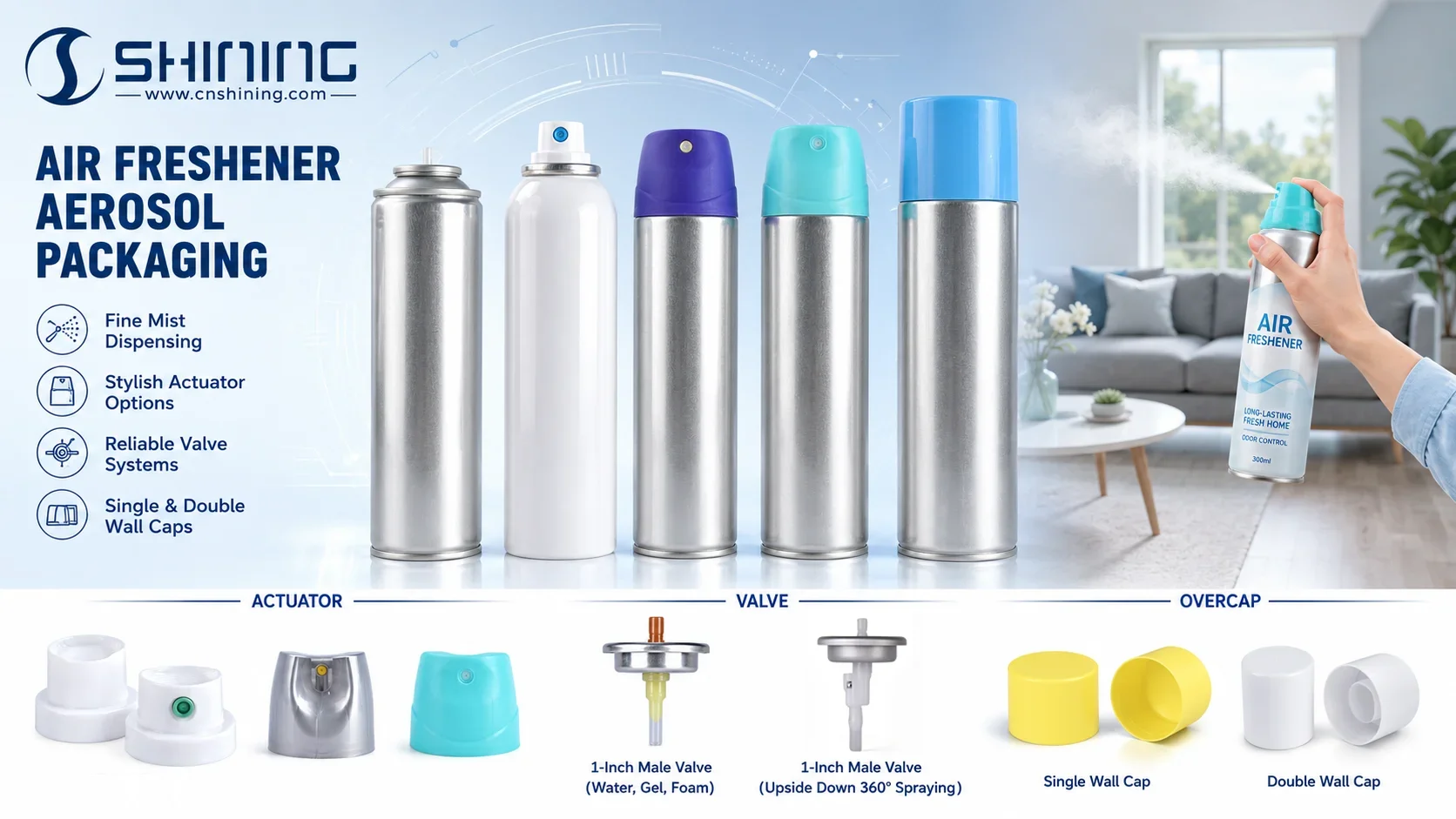
For aerosol air freshener projects, the packaging system should be selected around the spray target first. Shining Packaging’s relevant parts are mainly actuators, aerosol cans and aerosol valves. The actuator affects spray cone, touch feel, clogging risk and dose perception. The valve affects discharge rate, leakage control, propellant compatibility and end-of-life spray. The can affects pressure safety, corrosion resistance, print readability and transport robustness.
A practical development path is to define the formulation family first: LPG concentrate, nitrogen soft mist, compressed air system or BOV. Then match valve orifice, dip tube, actuator insert and can coating. If the target is an automatic air freshener refill, the rim, actuator height and shroud stiffness also need to match the dispenser stroke.
The target is not to make the spray “stronger”. The target is to make it repeatable, clean and controllable. A stable aerosol air freshener should spray as mist, avoid wet surfaces, resist accidental pressing, keep the last spray close to the first spray, and carry label information that users can see before use.
12. Conclusion
Aerosol air freshener will not disappear. It will be redefined. Cheap, powerful and able to spray is no longer enough. The next better product must spray accurately, spray consistently, avoid harsh odor, reduce floor wetting, hold spray quality to the last shot, and make regulatory logic clear.
That is a system job. Fragrance matters, but it is only one layer. The real work sits in propellant choice, valve tuning, actuator geometry, can compatibility, label design and transport control.
13. FAQ: Aerosol Air Freshener Technical Questions
An aerosol air freshener uses internal pressure from liquefied or compressed gas to discharge and atomize the formulation. A pump spray depends on manual pump force. Aerosol systems usually produce a faster and finer mist, but they also bring pressure safety, flammability, VOC and dangerous goods transport requirements that ordinary pump sprays may not face.
A water-jet spray usually points to poor atomization, not weak fragrance. Common causes include oversized actuator orifice, weak swirl chamber design, low late-stage can pressure, formulation viscosity shift or valve-actuator mismatch. The fix is normally hardware tuning: actuator insert, valve orifice, vapor tap and discharge rate need to be tested together.
Common propellant routes include LPG hydrocarbons such as propane, butane and isobutane, functional propellants such as DME or HFC-152a, and compressed gases such as air or nitrogen. HFO-1234ze(E) is also used in low-GWP propellant discussions. Each route changes spray force, VOC logic, flammability, odor and valve design requirements.
Not always. Water-based or water-alcohol systems are common for low-VOC soft mist positioning, but VOC status depends on the market definition, solvent choice, propellant, exemptions and product category. A formulation can contain water and still fail a category rule if the remaining volatile organic fraction or claim language is not controlled.
Slippery floors usually come from large droplets, excessive shot weight or non-volatile ingredients settling on hard surfaces. If the mist falls too quickly, the user experiences fragrance and residue at the same time. Better actuator atomization, lower discharge rate, faster evaporating carrier and clearer “avoid hard surfaces” labeling can reduce the issue.
The valve controls flow path, sealing, discharge rate and compatibility with the propellant and formulation. Valve stem orifice, body orifice, gasket material, dip tube and vapor tap can all change spray quality. A good fragrance can still fail if the valve gives unstable flow or allows clogging, leakage or poor end-of-life discharge.
Automatic refill cans must fit a mechanical dispenser stroke. The actuator height, rim geometry, shroud strength and required pressing force need tight control. If the motor or cam cannot deliver enough instant force, the product may spray weakly or in droplets. Refill compatibility is a mechanical packaging issue as much as a fragrance issue.
Both routes exist. Simple products mainly use fragrance masking, where the user’s odor perception is redirected. More technical formulas may include malodor counteractants, cyclodextrin-type complexing agents, oxidizing systems or buffering components. The real effect depends on the active chemistry, odor type, dose and ventilation, not only the fragrance strength.
The full spray system should be revalidated. Nitrogen or compressed air changes pressure behavior through the can life. Engineers should check actuator insert, valve orifice, spray rate, droplet size, residue, remaining usable product and last-shot quality. Keeping the original LPG actuator often gives coarse droplets or weak late-stage spray.
The most useful upgrades are practical: anti-clog actuator inserts, tighter valve tolerances, metered valves, twist-lock actuators, stronger shrouds, better can coating compatibility and front-label dose guidance. These changes target actual complaints such as no spray, wet jet, overpowering scent, slippery floor, accidental pressing and poor automatic dispenser performance.