
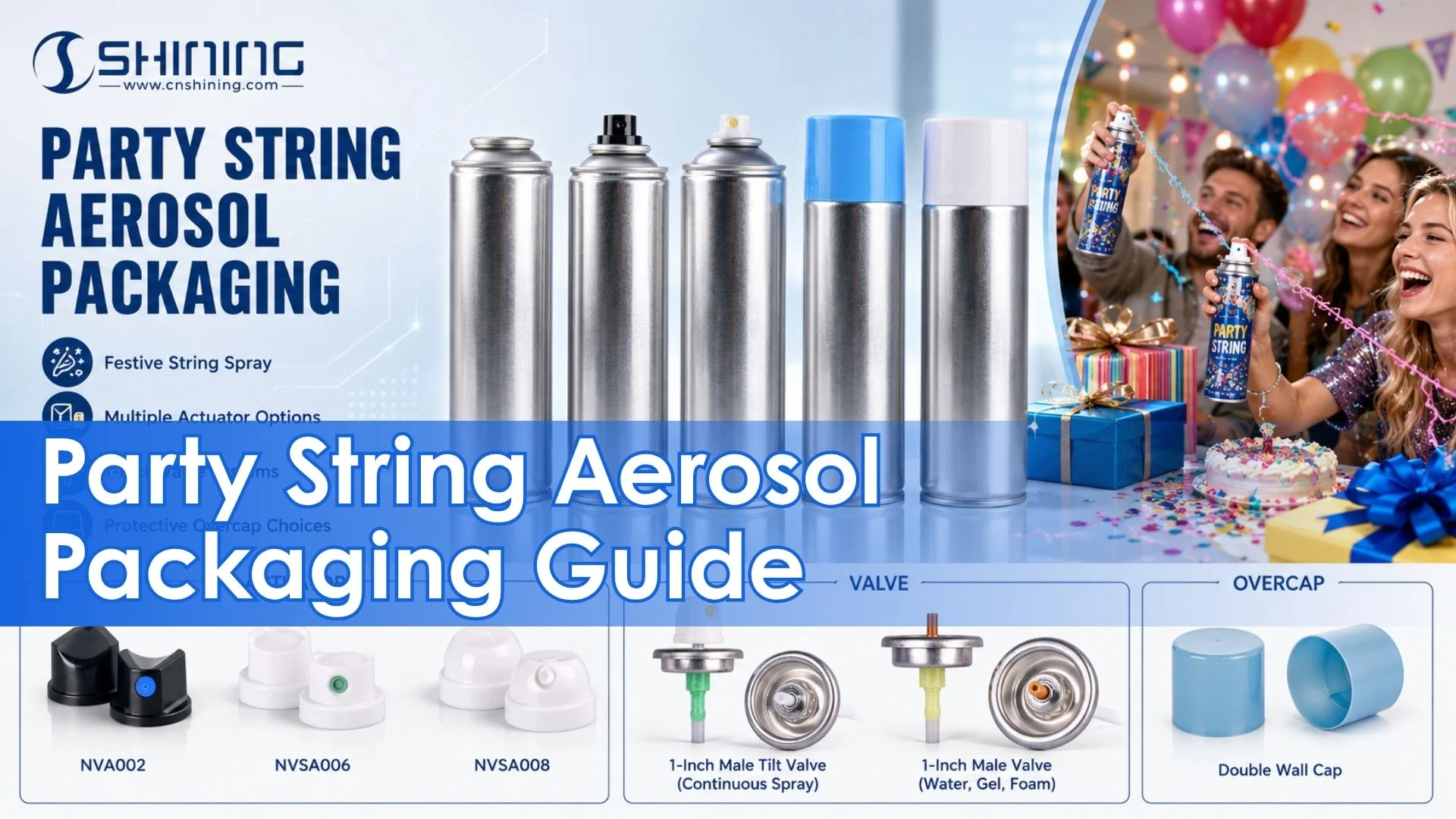
Party String Spray, also called aerosol string streamer, party streamer spray, silly string spray, or confetti string, is a small novelty aerosol with a surprisingly strict technical logic. A pressurized can holds a resin, solvent, surfactant, pigment, and propellant system. When the actuator is pressed, the formula passes through a valve and a small orifice. Pressure drops fast. Volatile components flash off. A continuous semi-solid string forms in the air.
The product looks simple at retail level. The failure modes are not simple. Sputtering, short spray distance, clogged nozzles, residue, surface staining, eye exposure, and transport limits all point to one practical conclusion: Party String Spray is a packaging-engineering problem as much as a formulation problem.
1. Definition and Working Principle
The classic technical description comes from the 1972 patent US3705669A, Foamable resinous composition. It describes a pressurized container that dispenses a plastic foam string with enough cohesion to remain continuous, but only limited adhesion, so it can temporarily attach to inert surfaces such as walls or glass and still be peeled away.
A modern SDS gives a shorter field definition. The IG Design Group Party String SDS describes the product as a semi-solid string dispensed from an aerosol container, used as a party novelty.
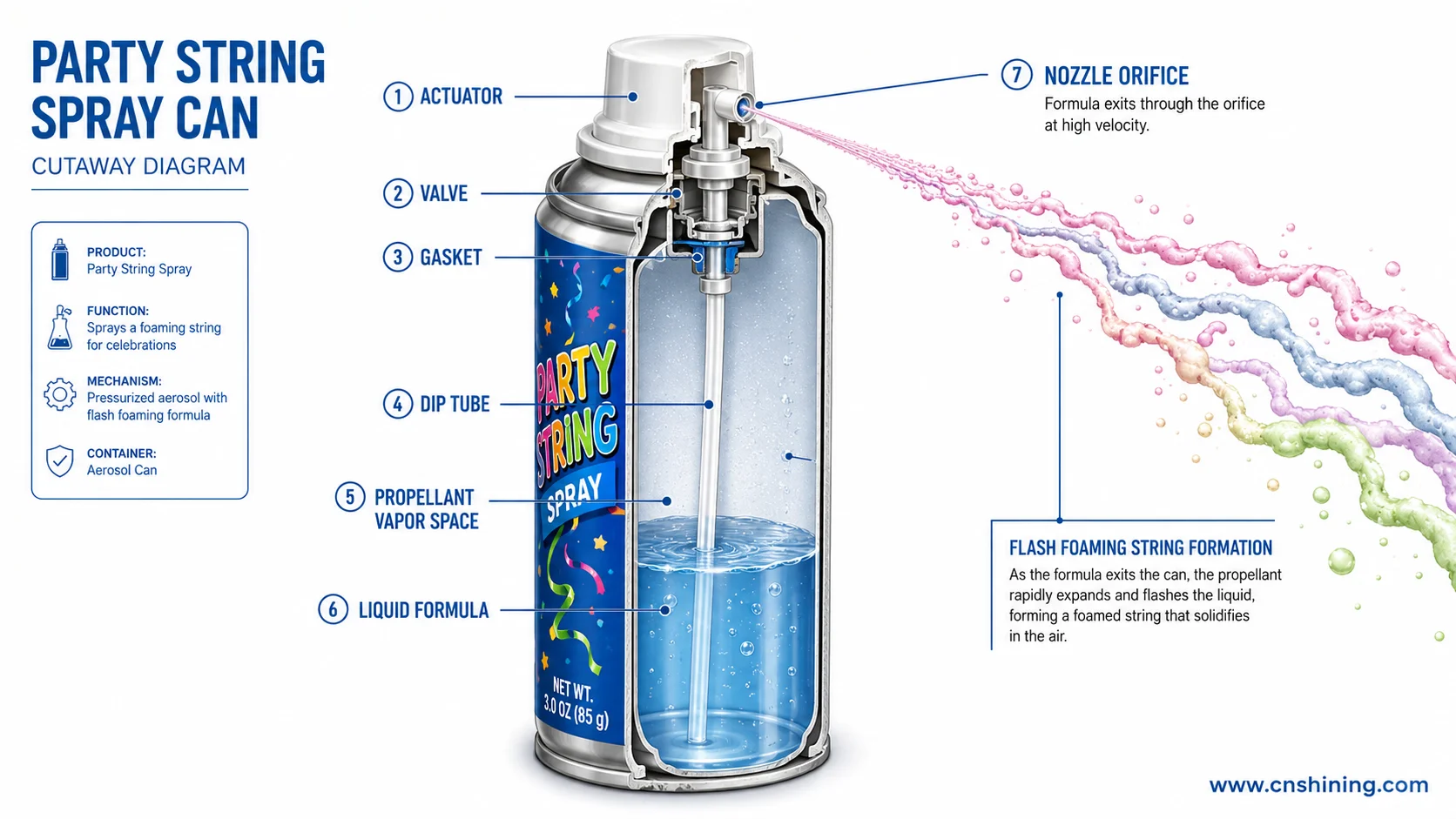
The physical sequence is usually:
| Stage | What Happens | Packaging Relevance |
|---|---|---|
| Nozzle forming | The liquid exits through a small orifice as a fine stream. | Orifice size and actuator geometry control string shape. |
| Flash foaming | Propellant and solvent vaporize quickly after pressure release. | Valve flow rate must match formula viscosity and vapor pressure. |
| Skin formation | A tougher outer skin forms as volatile materials leave the string surface. | Over-fast evaporation can cause brittle string or sputter. |
| Internal expansion | Gas inside the string continues expanding briefly. | Spray pattern depends on pressure stability through the valve. |
| Retraction and set | The string reaches a stable diameter and keeps moderate cohesion. | Too much tack creates cleaning complaints; too little tack reduces hanging effect. |
The patent discloses a typical nozzle aperture of about 0.014–0.018 inch. That small range matters. A slightly unstable orifice can turn a clean string into sputter, mist, blobs, or a spray-paint-like discharge.
Surfactant balance is another control point. The patent highlights HLB, or hydrophilic-lipophilic balance. Classic solvent-based systems prefer low-HLB surfactants. Sorbitan trioleate, with HLB around 1.8, is cited with a suggested level of 0.5–4.0 wt%. Too little surfactant can make the discharge behave like foam liquid. Too much can make the string too sticky.
Historical formulas used methacrylate resins for the structural backbone, plasticizer for flexibility, silicone oil for release from surfaces, pigment for color, and propellant for both pressure and foam expansion. Modern commercial SDS documents show a clear shift away from ozone-depleting and high-risk older solvents. The Silly String SDS discloses HFC-134a at 21–23 wt%, identifies compressed gas pressure risk, and states transport classification as UN1950, class 2.2. IG Design Group discloses water at 30–40%, Norflurane at 30–40%, liquid hydrocarbon at 20–25%, and other non-hazardous ingredients at 0.3–0.5%.
2. Market Size and Development Trends
| Layer | Public Metric | Value | Interpretation |
|---|---|---|---|
| Upper demand market | Global party supplies market | 2025: about $18.41 billion; 2026: about $20.07 billion; 2034 forecast: about $41.52 billion | This is the demand ceiling, not Party String Spray itself. Source: Fortune Business Insights party supplies market page. |
| Industrial supply proxy | European aerosol output | 2013: 5.428 billion units; 2023: 5.288 billion units | A stable aerosol base. Source: FEA 2024 Annual Report. |
| Packaging supply proxy | Global aluminum aerosol can shipment trend in 2024 | Most regions grew; Africa declined 5.5%; EU including UK plus the Americas accounted for about 72% of global deliveries | Shows resilient metal aerosol packaging capacity. Source: Packaging Journal report on AEROBAL data. |
Europe is a useful time series because the data comes from an aerosol association report. Output moved from 5.428 billion units in 2013 to 5.288 billion units in 2023. The ten-year line is almost flat. Mature, stable, but not high-growth.
| Regional Proxy Sample | 2013 | 2023 | Ten-Year Change | Comment |
|---|---|---|---|---|
| Europe | 5528 | 5288 | -2.5% | Full association statistics |
| North America proxy: USA + Mexico | 4262 | 4478* | +5.1% | Part of 2023 data marked as estimated in source notes |
| Asia-Pacific proxy: China + Japan + Thailand + Australia | 2524 | 3442* | +36.4% | Four-country sample only |
| Latin America proxy: Brazil + Argentina | 1543 | 2066* | +33.9% | Mexico excluded |
| Africa proxy: South Africa | 258 | 323* | +25.2% | South Africa only |
Demand scenes are clear: birthdays, weddings, festivals, sports celebrations, concerts, clubs, raves, shows, and New Year events. The growth logic is not functional necessity. It is celebration density × instant visual effect × social media spread × low unit price.
| Segment | Observed Demand Evidence | Commercial Meaning | Published Quantitative Share |
|---|---|---|---|
| Parties | Commonly placed under birthday, party favors, and party spray categories | Mass retail scene driven by weekends and holidays | Not public |
| Festivals and carnivals | Retail language often points to festivals and celebrations | Seasonal demand may be stronger in carnival-heavy regions | Not public |
| Weddings | Wedding use appears in party spray product descriptions | White, light-color, low-residue SKUs may fit better | Not public |
| Children | Some SDS and retail pages frame the product in children’s party context | Age marking, face protection, and clear pictograms affect risk and conversion | Not public |
| Professional events | Concerts, shows, clubs, and raves appear in product language | Venue rules, cleaning time, and transport classification matter more | Not public |

3. Competitor Comparison and Formula Analysis
Party String Spray competes with paper streamers, foam spray, colored smoke, and party poppers. It wins when the user wants one-hand triggering and instant interaction. It loses when the venue cannot tolerate residue, odor, pressure vessels, or dangerous goods transport rules.
| Category | Typical Effect | Unit Cost Signal | Main Safety / Regulatory Point | Cleanup / Recyclability | Practical Judgment |
|---|---|---|---|---|---|
| Party String Spray | Continuous airborne string with high interaction | about $2.78–6.79 per 2.5–3 oz can in the source retail sample | Pressurized container; UN1950; may be class 2.1 or 2.2 depending on formula and tests | Empty cans may be recyclable where accepted; residue is a common complaint | Good for interactive celebration, weak for clean venue control |
| Paper or plastic streamers | Static hanging decoration | Low, often about $1 for a paper roll in retail samples | Few dangerous goods issues; fire source still matters | Paper is easier to handle than plastic or metallized film | Lowest cost for room setup, not a spray effect |
| Foam spray | Wide wet coverage, snow or foam fight effect | Often larger can formats such as 11 oz | Eye exposure, slip risk, and aerosol rules | Usually wetter and harder to clear than string | Better for outdoor scene volume, not equivalent to string |
| Colored smoke | High-visibility photo and stage effect | about $3–6 per unit or higher in source samples | Often tied to smoke, pyrotechnic, outdoor, or venue permit rules | Single-use shell and possible ash or dye residue | Strong visual effect with heavier compliance limits |
| Party poppers | Short burst of confetti | about $0.90–1.30 per unit in source samples | US warning language appears under 16 CFR Part 1500 | Confetti and mixed parts complicate cleanup | Good for one ceremonial moment, not continuous interaction |
Formula information falls into two groups: older patent systems with explicit ratios, and modern SDS documents that disclose only hazardous or legally required ingredients. Public SDS data is not a full formulation sheet.
| Formula Type | Public Ingredients and Function | Public Ratio / Example | Safety and Toxicology Concern | Commercial Judgment |
|---|---|---|---|---|
| Classic solvent-based aerosol string | Methacrylate resin for string body; low-HLB surfactant for foam and tack; plasticizer for flexibility; silicone oil for release; pigment for color; fluorinated propellant and solvent for discharge and foaming | Patent example: resin 12.2%, surfactant 2.49%, plasticizer 0.44%, silicone oil 0.35%, pigment 2.07%, solvent 6.60%, propellant 75.85% | Historical use of CFC/HCFC materials and older additives creates modern compliance pressure | Good for understanding mechanism; not a formula to copy directly today |
| Modern HFC-led low-flammability / 2.2 type | HFC-134a provides pressure and discharge force | Silly String SDS: HFC-134a 21–23 wt%; UN1950 class 2.2; not flammable under 16 CFR testing | Pressure burst risk when heated; HFC climate policy pressure | Retail-friendly, but long-term low-GWP substitution remains likely |
| Modern water / HFC / hydrocarbon mixed type | Water lowers irritation and VOC intensity; Norflurane provides propulsion; liquid hydrocarbon supports system behavior; minor ingredients manage colloid and color function | IG Design SDS: water 30–40%, Norflurane 30–40%, liquid hydrocarbon 20–25%, other non-hazardous ingredients 0.3–0.5% | H319 eye irritation; pressurized container may burst if heated | A practical public sample of a modern retail version |
| Foam-spray relative | Designed for foam volume rather than continuous string | Public detailed ratios not found in the source report | Slip risk, eye exposure, and wet residue | Useful for high-atmosphere events, not a direct string substitute |
| Biodegradable or bio-based direction | Research exists around biodegradable or water-soluble polymers, but not mature public Party String formulas | No mature commercial ratio found | Must solve string formation, storage stability, can corrosion, nozzle clogging, and compliance together | Future direction, not a strong public shelf reality yet |
| Low-GWP propellant direction | HFO-1234ze(E) and related options are entering aerosol uses | EPA technical support material mentions some novelty aerosols such as party string | Application boundaries, safety data, cost, and formula compatibility still control adoption speed | Trend is clear, but conversion is not automatic |
4. Terms and Regulatory Compliance
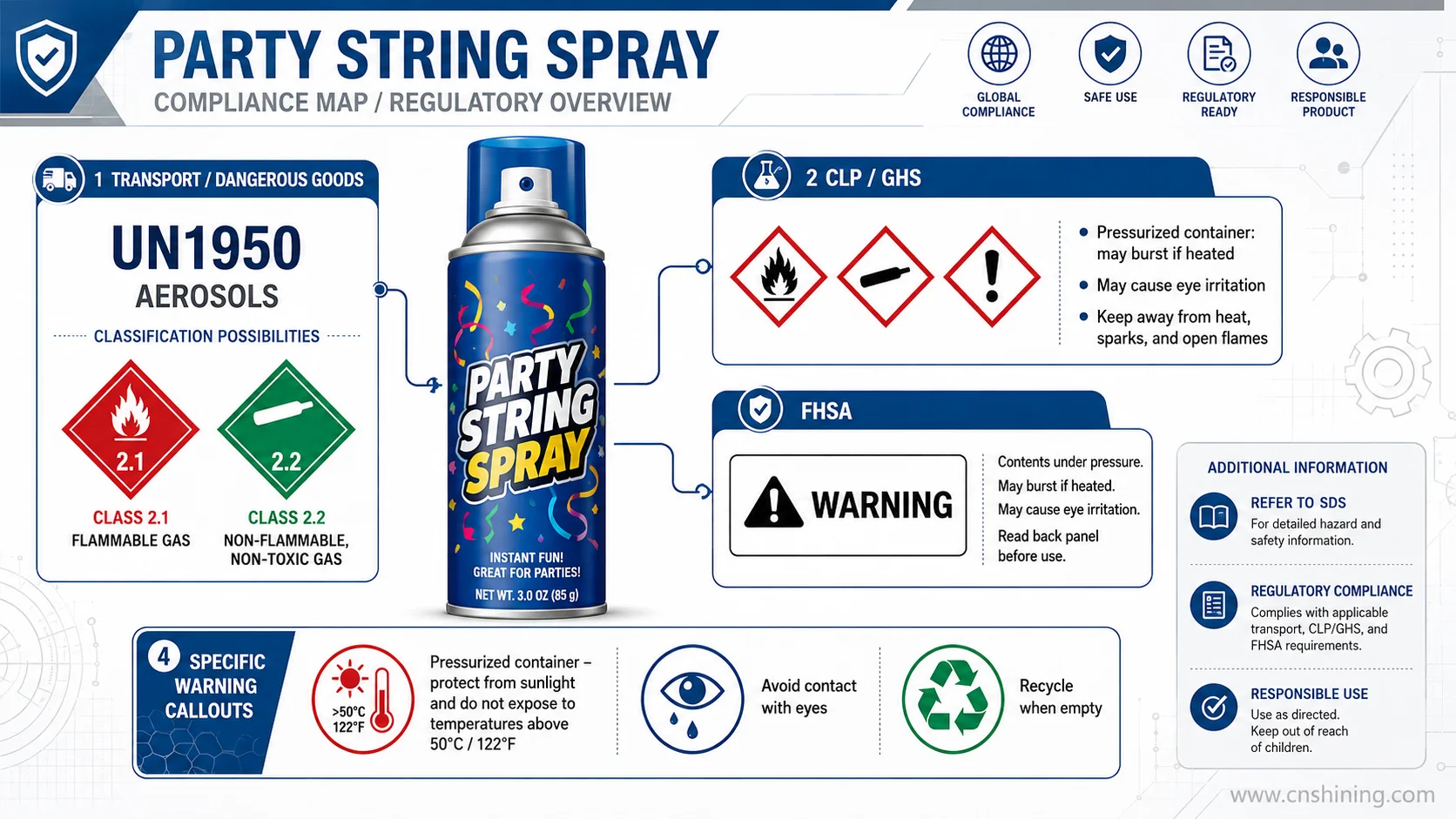
Party String Spray has to satisfy chemical regulations, consumer product rules, dangerous goods transport, warehouse rules, and retail platform policies. Looking at only one layer is a common mistake.
| Term | Plain Meaning | Commercial Meaning |
|---|---|---|
| Propellant | Gas or liquefied gas that provides can pressure and discharge force | Controls flammability, spray feel, transport class, and climate compliance |
| Actuator | Plastic press button used by the consumer | Controls mis-spray probability, ergonomics, and spray direction |
| Valve | Release-control assembly | Core component for leakage, life, and spray consistency |
| Dip tube | Tube that pulls product from the bottom of the can to the valve | Affects residual volume, inverted use, and extraction efficiency |
| Nozzle / orifice | Final flow path where the stream forms | Directly affects string formation, clogging, and sputter |
| HLB | Surfactant hydrophilic-lipophilic balance | Controls foam stability and string tack |
| Cohesion | Ability of the string to remain continuous | Determines whether the product forms string instead of mist or blobs |
| Adhesion | Ability to attach to surfaces | Must balance decoration effect and clean removal |
| Tackiness | Light surface stickiness | Too low fails to hang; too high triggers cleaning complaints |
| Norflurane / HFC-134a | Common non-ODS propellant | Useful for class 2.2 systems, but under climate policy pressure |
| UN1950 AEROSOLS | UN dangerous goods number for aerosols | Controls road, sea, air, and e-commerce logistics |
| Class 2.1 / 2.2 | Flammable gas / non-flammable, non-toxic gas | Same aerosol form, different storage and shipping consequences |
| CLP | EU classification, labeling, and packaging regulation | Defines EU hazard labels, signal words, and H/P statements |
| FHSA | US Federal Hazardous Substances Act | Basis for consumer hazardous product warnings |
| AICIS / REACH | Australian and EU chemical control frameworks | Control ingredient legality and registration routes |
| Inner lacquer | Internal coating of the metal aerosol can | Controls corrosion, odor, color shift, and shelf life |
| Limited Quantity | Simplified dangerous goods transport threshold | Can reduce logistics burden when conditions are met |
| Market | Main Public Basis | Practical Meaning for Party String Spray |
|---|---|---|
| United States | CPSC FHSA requirements, CPSC recall history, EPA enforcement, and SDS examples | Pressure, irritation, flammability, inhalation, and consumer warning risks can bring the product into FHSA/CPSC logic. EPA rules also matter for ODS and HFC transition. |
| Canada | Consumer Chemicals and Containers Regulations, 2001 | Hazard classification, labeling, and packaging rules may apply. Child-resistant packaging can be relevant in certain classifications. |
| European Union / EEA | CLP Regulation (EC) No 1272/2008 and REACH Annex XVII consolidated text | Decorative and entertainment sprays face detailed chemical restrictions. A consumer SKU cannot carry legacy formulation baggage. |
| United Kingdom | Aerosol dispenser regulations and UK conformity routes | EU-style aerosol logic remains relevant, but labeling and conformity details must follow GB requirements. |
| Australia / New Zealand | IG Design SDS shows UN1950 class 2.2, ADG logic, AICIS statement, H229, and H319 | Storage below 30°C, sun protection, road transport, and GHS labeling are practical control points. |
| Japan | High Pressure Gas Safety Act | The propellant and pressure container are regulatory core issues, not secondary packaging details. |
| Brazil | ANTT dangerous goods transport information | High festival demand does not remove dangerous goods handling, import, road transport, and warehouse obligations. |
The environmental compliance thread has two parts. First, historical ODS materials are no longer acceptable in mainstream markets. Second, aerosol can recycling and correct labeling are becoming more visible. The HCPA Aerosol Recycling Initiative targets broad recycling access and clearer recyclable labeling by 2030.
5. Top Party String Spray Brands and User Pain Points
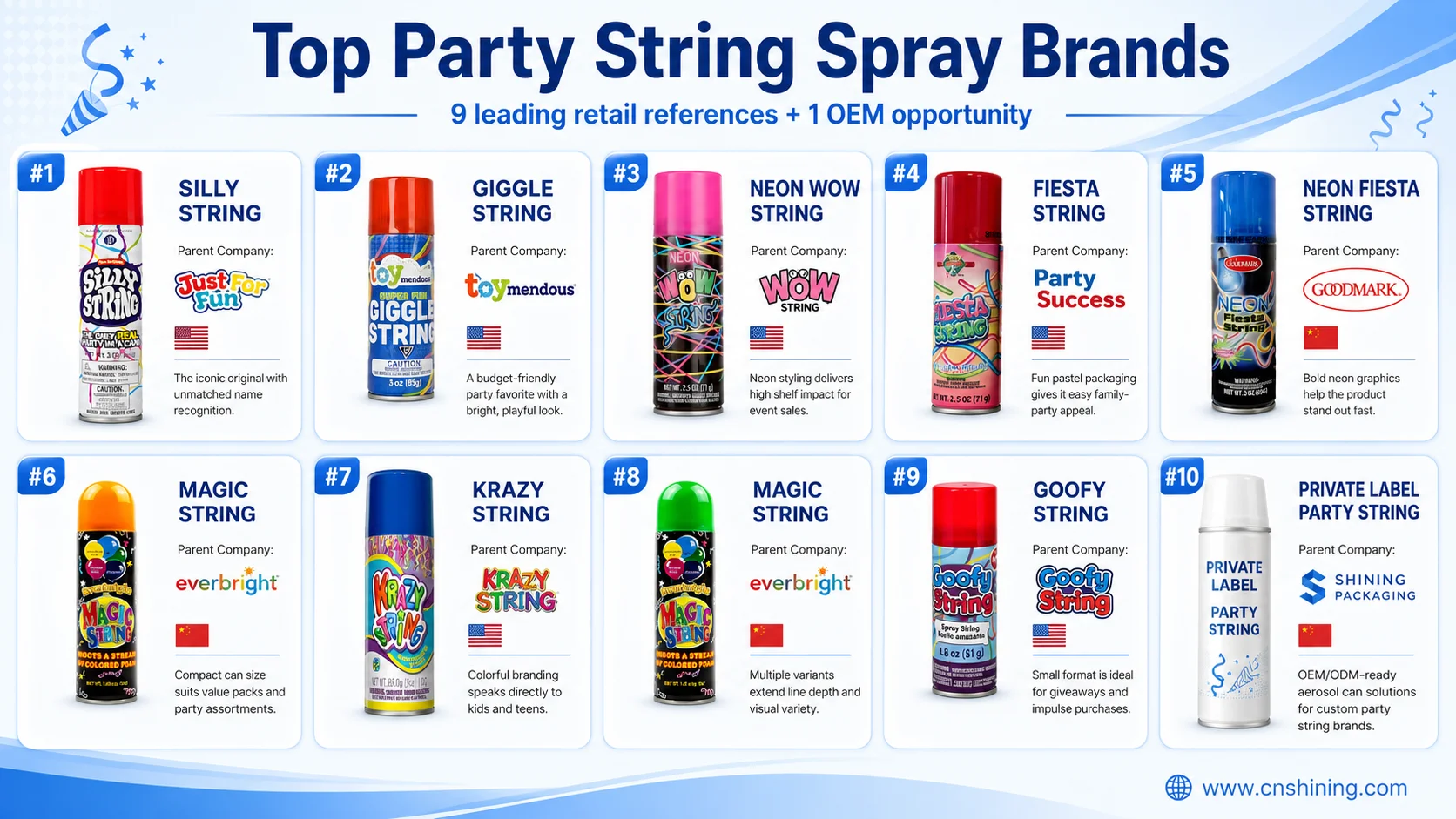
| Brand / Series | Country | Parent / Seller | Common Capacity | Public Price Range | One-Line Comment |
|---|---|---|---|---|---|
| Silly String | USA | Silly String Products / CAR-FRESHNER Corporation | 3 oz | about $3.27–8.20 per can; 24-pack about $83.30 | Original brand and still the strongest category synonym |
| Party City Streamer String | USA | Party City | 3 oz | about $6.79 per can | Strong retail channel and multiple color SKUs |
| WOW String | Public listing does not state country | WOW String / Walmart retail listing | 2.5 oz | about $2.78 per can | Low-price high-volume Walmart-visible line |
| Party Success Fiesta String | China country-of-origin appears in public marketplace listing | Goodmark / Party Success | 2.5-3 oz | about $2.78 per can | Low-price positioning with non-flammable and easy-clean claims |
| Neon Fiesta String | Public listing does not state country | Good Mark / Neon Fiesta String | 2.5 oz; also 24-pack visible | about $2.78 per can | Fluorescent festival color positioning |
| Toysery Party Streamer Spray | Public listing does not state country | Toysery / Startech trading sample seller | 3 oz; often 12 or 24 cans | about $73.99 per 24 cans; about $3.08 per can | Bulk-pack e-commerce representative, suitable for party kits |
| JA-RU Krazy Silly String | USA | JA-RU | 3 oz | about $5.98–11.49 per can | Common SKU in novelty channels |
| Velocity Toys Blue Box Party Silly String | Public listing does not state country | Velocity Toys / marketplace seller | 24-pack | about $49.99 per 24 cans; about $2.08 per can | Typical value-pack option |
| Goofy String Party Spray | Public listing does not state country | Goofy String / Dollar Tree and marketplace listings | 1.8 oz | about $1.75–4.00 per can; 6-pack about $20.00–26.99 | Smaller capacity, closer to gift or add-on SKU |
User pain points are very consistent across public samples. They are not only formula complaints. Most can be translated into actuator, valve, nozzle, can, label, coating, and secondary packaging actions.
| Platform / Context | Observed Pain Point | Packaging Interpretation | Practical Packaging Response |
|---|---|---|---|
| Retail reviews | Small can, short use time, sputter before string appears, odor, spray-paint-like discharge | Flow instability and expectation mismatch | Improve valve-actuator fit, stabilize orifice tolerance, show net content clearly, add shake and first-spray pictograms |
| Outdoor cleanup complaints | Easy cleanup claim fails after trampling | String transfers into porous or rough surfaces under pressure | Adjust release aid and resin Tg; label “outdoor use, clean promptly, avoid porous surfaces” |
| Vehicle, fabric, and wall complaints | Residue, stain, or cleaning cost | User does not see back-label restrictions before spraying | Move no-wall, no-car, no-fabric pictograms to the front label |
| Indoor odor complaints | Unpleasant smell or discomfort | Formula-coating interaction, propellant odor, or poor ventilation | Verify inner lacquer compatibility, improve closure seal, add “use in well-ventilated area” icon |
| Children’s party use | Mis-spray toward face or eyes | Actuator permits uncontrolled direction | Use actuator wings, directional groove, twist-lock or snap-lock cap, and bigger face/eye warning pictogram |
| Logistics and storage | No air shipping, heat limits, pressure risk | Aerosol dangerous goods constraints | Use correct UN1950/LQ outer carton marking, leak testing, crimp control, and heat warning icons |
6. Packaging Components from Shining Packaging
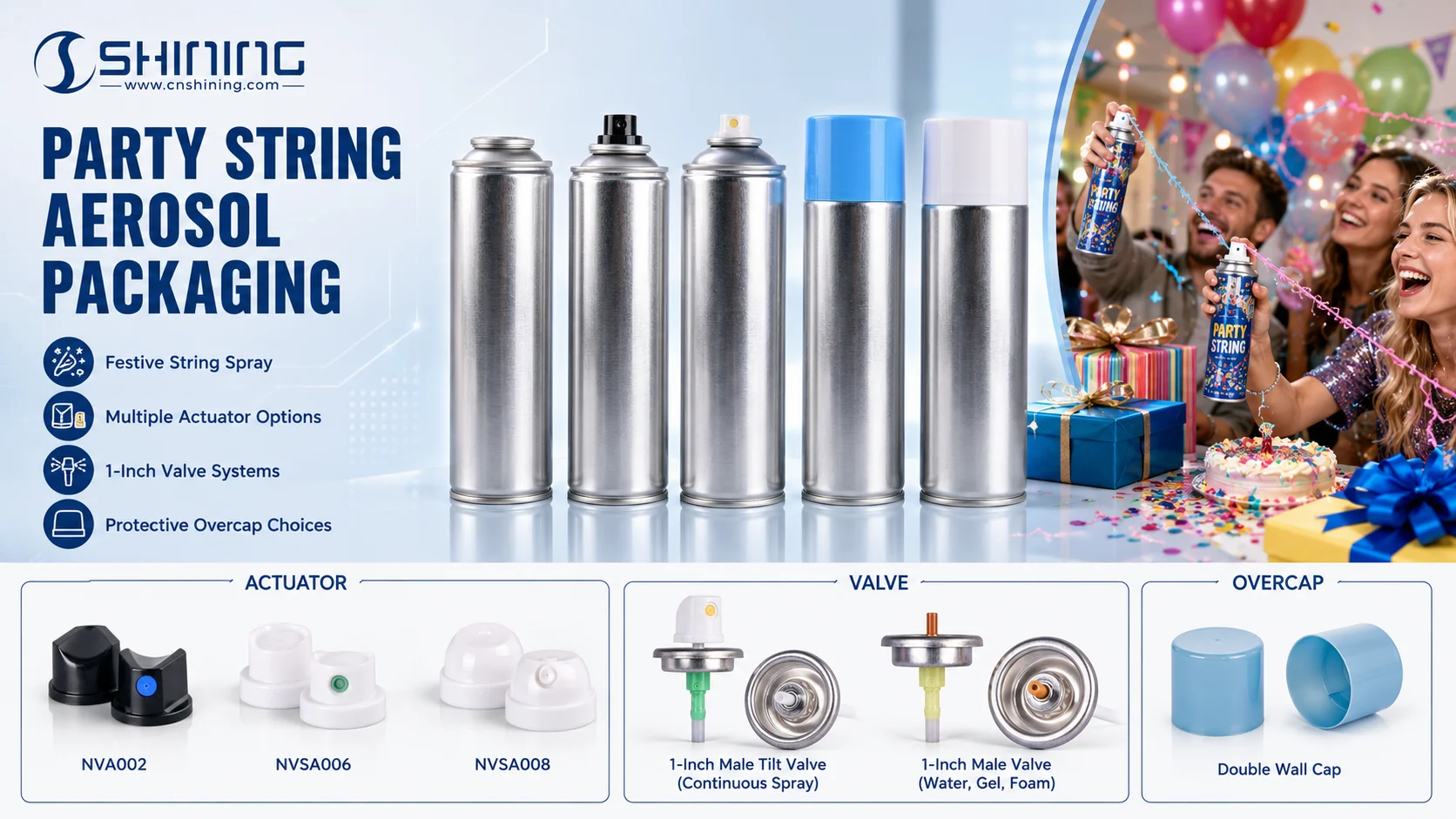
For Party String Spray, packaging selection starts with three parts: actuator, aerosol can, and valve. The formula may be correct, but the product will still fail if the actuator over-restricts flow, the valve is not compatible with the viscosity, the dip tube leaves too much residue, or the can coating reacts with pigment, solvent, or propellant.
Shining Packaging is relevant in this context as a metal aerosol packaging partner. For this product type, the practical focus is not decoration first. It is component matching: stable valve release, clean actuator direction, crimp and gasket sealing, internal lacquer compatibility, can strength, print space for warnings, and secondary packaging for UN1950 handling.
| Component | Party String Spray Requirement | Engineering Checkpoint |
|---|---|---|
| Actuator | Directional, child-manageable, resistant to accidental triggering | Orifice match, finger force, spray direction, lock or cap protection |
| Valve | Stable continuous flow for resinous or semi-solid formula | Stem size, gasket compatibility, cup sealing, flow rate, sputter control |
| Aerosol can | Pressure resistance, coating compatibility, warning-label area | Diameter, shoulder profile, bottom dome, inner lacquer, printing layout, crimp consistency |
7. Latest Trends and Useful Technical References
The recent direction of Party String Spray is less about spraying farther and more about safer and more acceptable systems. Five trends matter.
7.1 Propellant transition
Older CFC and HCFC logic is no longer suitable for mainstream markets. HFC-134a helped remove ODS risk but now faces climate pressure. Lower-GWP options such as HFO-1234ze(E) are being discussed or used in some aerosol fields, including novelty aerosols.
7.2 Low-flammability and class 2.2 routes
Public SDS samples show that Party String Spray can be designed toward UN1950 class 2.2, depending on formula and testing. That can reduce practical pressure in storage and distribution compared with flammable aerosol routes.
7.3 Recyclable aerosol packaging and clearer labels
The empty can question is becoming more visible. Correctly emptied aerosol cans may be recyclable where local systems accept them, but consumer instructions must be simple. A small can with dense warning text is a poor teaching surface.
7.4 Recycled-content and lightweight metal packaging
Most recycled-content aerosol can examples come from larger categories such as personal care. Even so, the packaging supply chain trend will affect small novelty aerosols. Metal can light-weighting and recycled aluminum will likely become stronger buyer questions.
7.5 QR code and digital instruction layers
A small Party String Spray label cannot carry everything: hazard warnings, age advice, cleaning methods, recycling routes, surface restrictions, and batch details. GS1 Digital Link makes QR-based information more structured, not just a marketing link.
8. Conclusion
Party String Spray is a small aerosol category with a narrow tolerance window. The string needs enough cohesion to stay continuous, enough tack to be visible on surfaces, and low enough adhesion to be removed without damage. The aerosol package has to deliver that behavior consistently through shelf life, transport, and mixed user handling.
The most realistic improvement path is not one single claim. It is a tighter system: stable valve-actuator-nozzle matching, compatible inner lacquer, reliable crimp and gasket sealing, clearer front-label pictograms, safer actuator protection, and realistic cleaning guidance. That is where this category still has room to improve.
9. FAQ: Party String Spray Technical Questions
A continuous string depends on resin structure, surfactant balance, propellant behavior, and nozzle geometry. The resin gives cohesion, the propellant expands the material after discharge, and the orifice shapes the stream. If viscosity, pressure, or nozzle tolerance drifts, the product can sputter, break into blobs, or behave like a spray paint rather than a string.
The classic patent range of about 0.014–0.018 inch shows how narrow the forming window is. A small orifice forms the initial stream before flash foaming. If the hole is too large, too rough, or partly blocked, flow becomes unstable. That instability appears to users as sputtering, weak distance, string breakage, or clogging.
HLB describes the hydrophilic-lipophilic balance of a surfactant. In classic solvent-based string systems, low-HLB surfactants help control foam surface behavior and tack. Too little surfactant may leave the discharge as unstable foam liquid. Too much or the wrong balance can make the string excessively sticky and harder to clean from surfaces.
It depends on the formula and test result. Some modern SDS examples show UN1950 class 2.2, meaning non-flammable and non-toxic gas classification for transport. Other aerosol formulas may fall into class 2.1 if flammability criteria are met. Retail wording alone is not enough; SDS and transport classification need to be checked.
The string needs limited adhesion to hang briefly, but that same tack can transfer to walls, car paint, fabric, carpets, or porous surfaces. Pigments and resin residues can become harder to remove after trampling, heat, or delayed cleaning. This is why front-label surface warnings are more useful than small back-label text.
The actuator, valve, dip tube, nozzle, gasket, and can pressure all affect consistency. A formula can test well in one valve but sputter in another. Stem size, flow path, actuator slot, nozzle orifice, dip tube length, and seal compatibility should be evaluated together, especially after storage and temperature cycling.
Paper streamers are mainly physical decorations. Party String Spray is a pressurized chemical product. It can involve propellant, irritation warnings, pressure burst risk, flammability classification, dangerous goods transport, and disposal instructions. The user sees a party item, but regulators see an aerosol container with chemical and pressure hazards.
Empty aerosol cans may be recyclable where local recycling systems accept them, but this depends on local rules, residual pressure, and contamination. Clear labeling matters because users often do not know how to dispose of aerosol containers. Future packaging will likely need better recycling icons and simple QR-linked disposal instructions.
Lower-GWP propellants must still deliver pressure, solubility, foaming behavior, safety, and storage stability. A direct propellant swap can change spray distance, string diameter, tack, odor, valve compatibility, and can pressure. The challenge is not only climate compliance. It is keeping the string mechanism stable after the propellant system changes.
Testing should cover spray pattern, sputter, total discharge time, residual content, valve leakage, actuator misfire, can coating compatibility, heat exposure, shipping classification, surface residue, odor, and cleanup. Child-use scenarios need extra attention. A clean first spray in the lab is not enough; stored samples and mishandling cases matter more.