
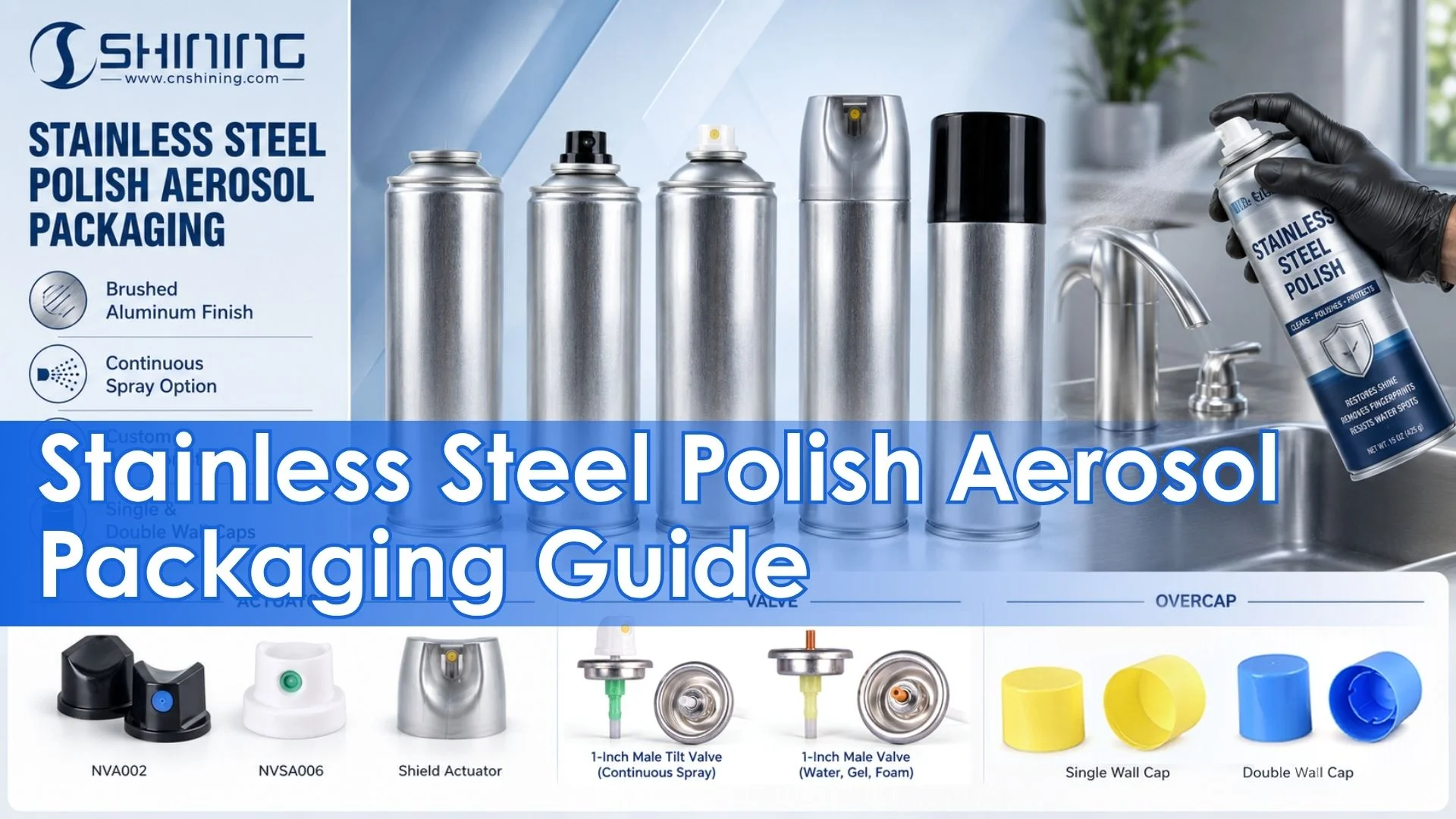
Stainless steel polish aerosol is not a heavy-duty degreaser. It is a ready-to-use surface care format, also called stainless steel cleaner aerosol, metal polish spray, appliance polish spray, or stainless steel cleaner and polish aerosol. Its real job is to clean light soil, restore appearance, reduce visible fingerprints, and leave a thin protective film without making the surface look oily.
1. Executive View
A stainless steel polish aerosol normally combines solvent or water, surfactants, mineral oil or silicone oil, fragrance, and propellant. The valve atomizes the formula as mist or foam. On the metal, the product builds a thin cleaning-lubricating-anti-fingerprint film.
The core value is not aggressive stain removal. It is fast visual recovery: less visible fingerprinting, lower re-soiling, and better surface appearance on commercial equipment, kitchens, appliances, lift panels, decorative metal, and foodservice fixtures.
Public product and technical materials from brands such as 3M and Zep describe the same logic: clean, polish, resist streaks, reduce fingerprints, and leave a protective appearance film. Older patent work such as US4330422A on white-oil treatment emulsions shows why mineral oil, surfactants, corrosion inhibitors, water, and propellant became a common formulation route.
2. Definition, Working Mechanism, and Terminology
2.1 Definition and Mechanism
A stainless steel polish aerosol is a metal surface care product packed in an aerosol can. It is dispensed through a valve and actuator by liquefied or compressed propellant. The spray may be a fine mist or foam. The suitable surface list often extends beyond stainless steel to chrome, aluminum, laminate, some plastics, and indoor metal surfaces.
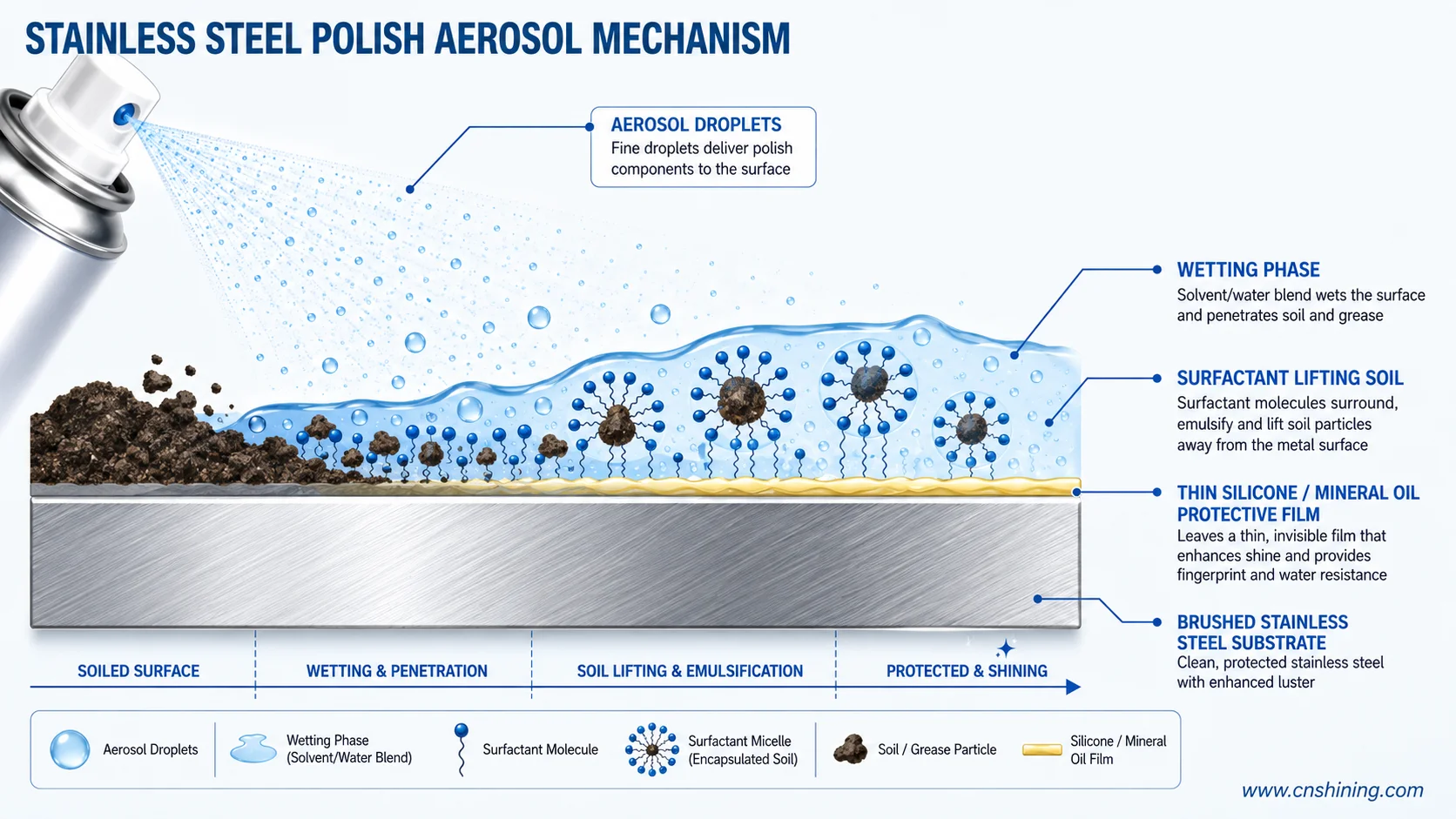
The mechanism can be read in four steps. First, the liquid phase wets the surface and loosens skin oil, cooking mist, water marks, and light films. Water, isopropanol, light hydrocarbons, or terpene-type materials may support this step. Second, surfactants emulsify and carry soil away during wiping. Third, mineral oil, dimethicone, wax, or silicone microemulsion leaves a very thin film that reduces wipe drag, fills microscopic roughness, and makes fingerprints less visible. Fourth, the propellant and valve set the deposition pattern. Foam versions can stay longer on vertical surfaces.
Not every formula aims for the same “clean” feel. Oil-rich formulas usually give stronger gloss, masking, and fingerprint reduction, but they are more likely to leave a detectable film. Water-based or low-residue formulas give less haze, less odor, easier VOC positioning, and better compatibility with sensitive surfaces.
2.2 Terminology Table
| Term | Simple explanation | Commercial meaning |
|---|---|---|
| VOC | Volatile organic compounds. Many cleaners and aerosols are controlled by VOC limits or emission rules. | Directly affects access to California, Canada, China, and other controlled markets. It also supports or blocks a low-VOC claim. |
| Propellant | The compressed or liquefied gas that drives the formula out of the can. It may be HC, HFC, HFO, nitrogen, or another compressed gas. | Defines spray feel, flammability, logistics class, carbon profile, and cost. |
| HC propellant | Hydrocarbon propellant such as propane, butane, or isobutane. Sprayway SDS materials show propane/butane systems in similar aerosol products. | Low cost and mature spray behavior, but stricter storage, labeling, transport, and occupational safety control. |
| HFC / HFO | HFCs are fluorinated greenhouse gases. HFO-1234ze is a lower-GWP alternative used where nonflammability is required. | HFO can replace HFC in selected nonflammable routes, but cost is higher and regulatory tracking remains needed. |
| White mineral oil | High-purity mineral oil used as a polish and protective film agent. Ingredient disclosures often list mineral oil as a polishing agent. | Drives shine, slip, and fingerprint resistance. Too much can create oily feel and dust pickup. |
| PDMS / Dimethicone | Polydimethylsiloxane or silicone oil used for gloss, lubrication, and anti-streak behavior. The Weiman ingredient disclosure lists dimethicone as a gloss-related component. | Small additions can change wipe feel and appearance. It is a useful tool for low-addition anti-streak design. |
| HLB | Hydrophilic-lipophilic balance. White-oil emulsion patents discuss HLB for oil-in-water and water-in-oil systems. | Controls emulsion stability, spray form, and residue behavior after wiping. |
| Oil-in-water / water-in-oil | Two common emulsion directions. Betco describes its product as an oil-in-water emulsion. | Defines whether the product behaves more like an oil-polish system or a lighter water-based cleaner. |
| UN 1950 | UN number for aerosols in dangerous goods transport. SDS files commonly classify aerosol cans under UN 1950. | Impacts sea, air, road, warehouse, and e-commerce logistics. |
| BPA-NI coating | “BPA non-intent” internal coating for cans, used as one route away from traditional epoxy systems. | Affects regulatory narrative, ESG claims, and compatibility testing with fragrance, oil, solvent, and propellant. |
| Microplastics restriction | EU/ECHA restrictions extend to intentionally added microplastics in cleaning and detergent products. | Limits some pearlizers, particles, and functional polymer choices. |
3. Market Size, Regional Signals, and Forecasts
3.1 Global Market Estimate Range
| Source | Scope | Historical / baseline value | Forecast value | CAGR | Comment |
|---|---|---|---|---|---|
| Cognitive Market Research | Stainless Steel Cleaner Market | 2021: US$1.218bn; 2025: US$1.486bn | 2033: US$2.212bn | 5.1% for 2025-2033 | Broad cleaner scope, not aerosol-only. |
| Verified Market Research | Stainless Steel Cleaner Market | 2024: US$1.358bn | 2032: US$2.298bn | 6.8% | More optimistic growth view. |
| Market Research Intellect | Stainless Steel Cleaner Market | 2024: US$1.2bn | 2033: US$1.8bn | 5.0% | More conservative scope. |
| Growth Market Reports | Stainless Steel Cleaner Market | 2024: US$2.41bn | 2033: US$3.77bn | 5.2% | Wider scope, likely more commercial and industrial inclusion. |
| Future Market Insights | Glass & Metal Cleaner Market | 2025: US$4.9bn | 2035: US$7.5bn | 4.4% | Adjacent upper category reference. |
If all public estimates are read together, the related stainless steel cleaner and polish market sits roughly in a US$1.2bn-US$2.4bn public valuation band for 2024/2025. Public forecasts for 2032/2033 land roughly in the US$1.8bn-US$3.8bn band. The wide range is a definition problem, not a signal that the product has no demand.
3.2 Trend Charts and Regional Proxy Indicators
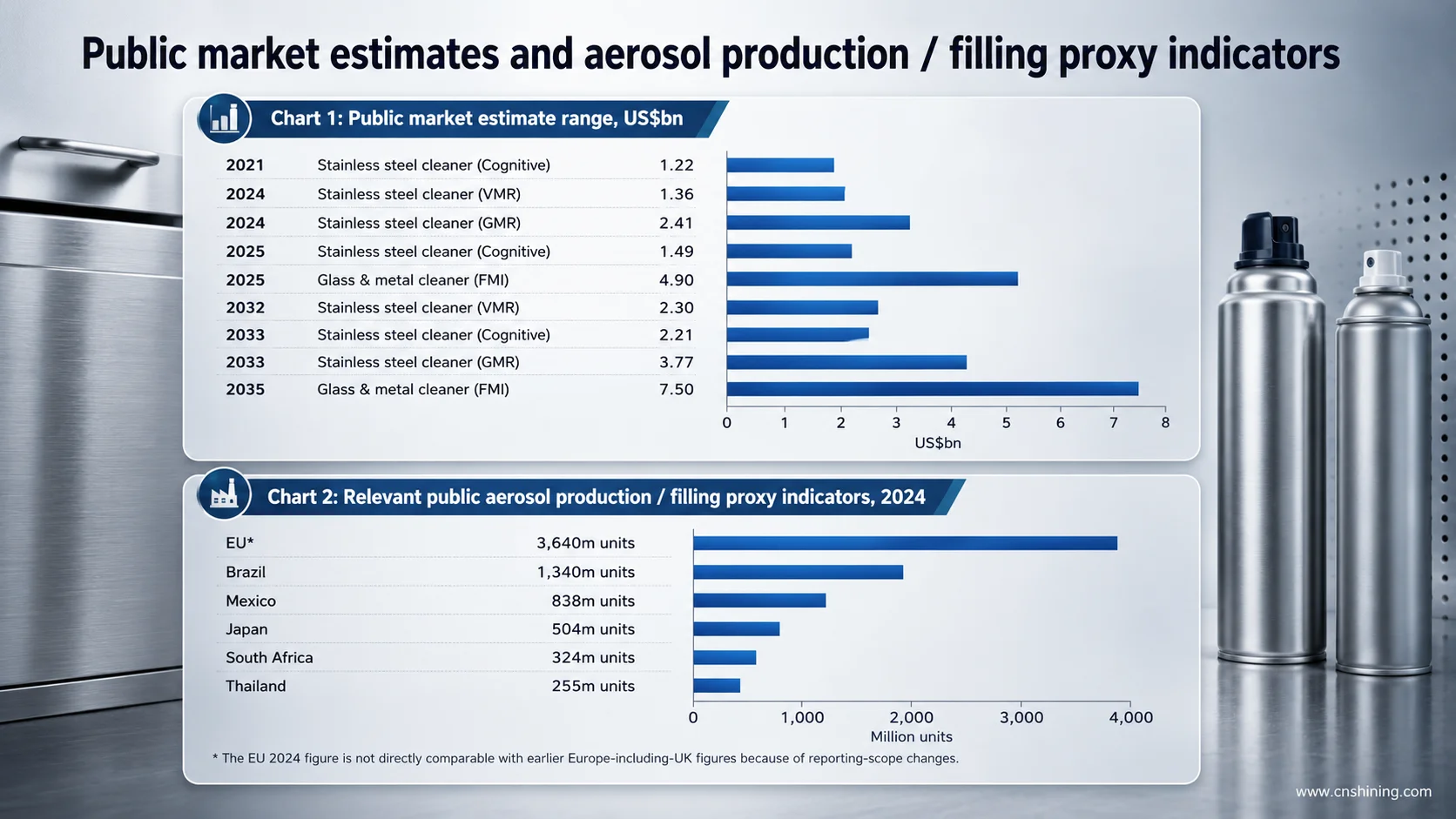
3.3 Recent Regional Direction
| Region | Relevant public data | Recent direction | Meaning for stainless steel polish aerosol |
|---|---|---|---|
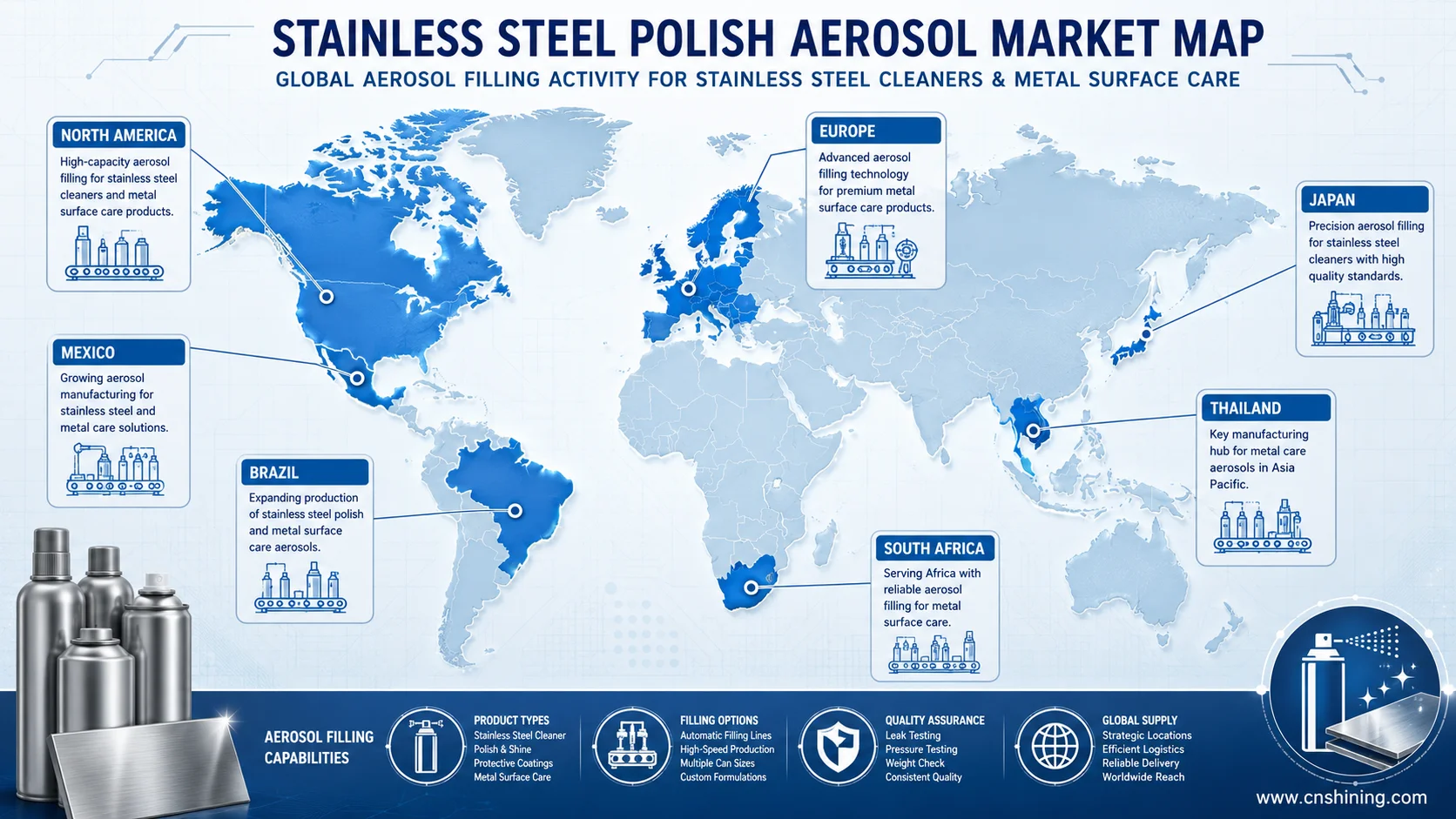
| North America | The U.S. aerosol market was estimated at US$15.54bn in 2024 and forecast at US$21.56bn in 2033. Mexico aerosol volume rose from 785.61m units in 2023 to 838m units in 2024. | Mature U.S. base, faster Mexico growth, strong commercial cleaning and e-commerce channels. | Premium kitchen care and commercial foodservice/facility maintenance remain the main demand bands. |
| Europe | FEA 2022 data reported 5.319bn European aerosol units. Home care accounted for 21.1%, including cleaning products at 60.509m units and care products at 107.032m units. | High regulatory pressure on low VOC, microplastics, F-gas, and recycling claims. | Better fit for water-based, low-residue, regulation-friendly SKUs. |
| Asia-Pacific | Japan reached 503.891m units, up 4.3%. Thailand reached 255m units, up 4.38%. | Large volume, strong manufacturing base, and more room for penetration in Southeast Asia. | Suitable for multiple price tiers, sizes, OEM/ODM programs, and regional compliance planning. |
| Latin America | Latin America 2024 data showed Brazil at 1.34bn units and Mexico at 838m units. | Growth continues, with strong price sensitivity and broad home-care scenes. | Cost, scent profile, local transport, and regulatory differences need early design work. |
| Middle East and Africa | South Africa 2024 data showed 324.471m domestically filled units and home care at 37% of consumption. | South Africa is a useful public observation point. Gulf standardization is strengthening. | B2B hotel and facility channels may be the safer first route before broad retail. |
3.4 Segments and Growth Drivers
The adjacent glass and metal cleaner category reports household as the largest user pool. That matches visible brand structure: Weiman and Sprayway lean strongly toward home appliance care, while 3M, Zep, Betco, Ecolab, CRC, and Spartan fit facility maintenance, commercial kitchens, jan-san distribution, and industrial equipment surfaces.
Five drivers matter most. Stainless steel surface stock keeps expanding. Commercial kitchens and foodservice spaces keep adding metal equipment. Users like stainless steel appearance but dislike fingerprints and water marks. E-commerce lowers replenishment friction. Regulation pushes old high-odor, high-residue, high-VOC formulas out of the mainstream.
4. Competitive Forms, Formulation Routes, and Brand Landscape
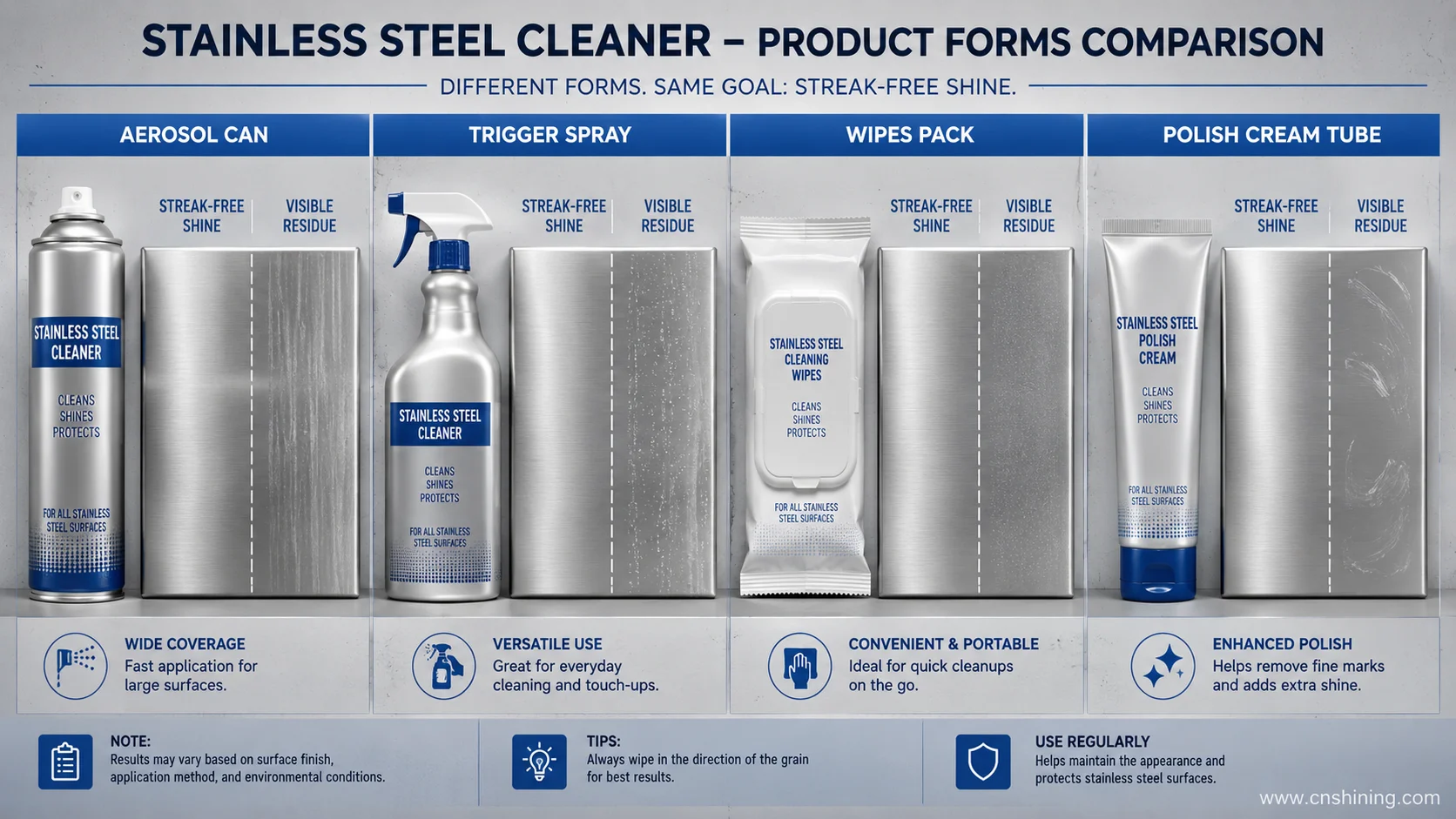
| Form | Cleaning / gloss behavior | Convenience | Single-use cost | Environmental and safety points | Typical pros and cons |
|---|---|---|---|---|---|
| Aerosol | Even deposition, strong appearance gain, good fingerprint reduction, foam or fine mist possible. 3M technical data describes an aerosol cleaner and polish foam with light protective film and reduced fingerprints. | Highest. Spray and wipe; good for large and vertical surfaces. | Medium, driven by can, valve, actuator, and propellant costs. | Transport, flammability, VOC, and propellant constraints. | Fast and uniform. Main issues are odor, oily film, logistics, and regulation complexity. |
| Wipes | Good for daily maintenance, but usually weaker than aerosol for deeper polishing. Sprayway wipes are positioned for daily streak-free cleaning. | Very high. No separate cloth needed. | Medium to high, because cost is counted by sheet. | No propellant, but more packaging waste. | Useful for touch-up and light soil. Poor fit for large heavy-oil areas. |
| Emulsion / trigger spray | Can be low VOC, low odor, and low residue. Stepan 1177 is a 0.5% VOC stainless steel cleaner starting formula. | High, but spray distribution is usually less even than aerosol. | Low to medium. | Easier low-flammability and compliance route. | Good for household and regulation-sensitive channels. May not match high-oil aerosol gloss. |
| Paste / cream | Strong local physical correction. Some patent work combines paste-like stainless steel polish with alumina. | Lowest. Longer buffing time. | Depends on dosage. | No propellant, but abrasion and dust behavior need control. | Useful for restoration, not daily equipment care. |
Aerosol remains strong where appearance gain per unit time matters: kitchen appliances, hotel back-of-house equipment, front-desk metal trim, beverage equipment, and facility maintenance. When users care more about low odor, low residue, or sustainability claims, water-based trigger sprays and high-performance wipes can replace traditional oil-rich aerosols quickly.
| Ingredient class | Typical materials | Main function | Substitution route | Public range / evidence |
|---|---|---|---|---|
| Solvent / continuous phase | Water, IPA, ethanol, aliphatic hydrocarbons, terpenes | Wetting, soil loosening, drying-speed control | Shift from hydrocarbon/alcohol toward high-water, low-VOC systems | Stepan 1177: water 98.7%, IPA/ethanol 0.5%. PDMS aqueous patent: IPA about 0.42%. |
| Surfactants | SDS, amphoteric surfactant, sorbitan ester / polysorbate types | Emulsifies oil soil and stabilizes emulsions | Low-foam, low-residue, potentially bio-based surfactants | Stepan 1177: anionic 0.5% + amphoteric 0.3%. White-oil emulsion patent: emulsifier 0.5%-10%. |
| Polish / film former | White mineral oil, wax, acrylic polymer | Gloss, masking, protective film | Move toward low-oil wax, acrylic, and microemulsion systems | White-oil emulsion patent: 20%-50% white oil in concentrate; solvent-free polish patent: wax + acrylic + amino silicone. |
| Lubricant / anti-fingerprint | Dimethicone, PDMS, amino silicone | Improves wipe feel, reduces drag marks, lowers fingerprint visibility | Lower-dose PDMS and silicone microemulsions | Ingredient disclosures list dimethicone; aqueous PDMS patent uses very low silicone oil addition. |
| Corrosion inhibitor | Monoethanolamine and similar materials | Helps inhibit in-can corrosion and stabilize the package system | Morpholine, sodium nitrite, or other inhibitors depending on regulation and compatibility | White-oil emulsion patent gives 0.1%-2% preferred inhibitor range. |
| Fragrance | Citrus, lemon, essential oils | Masks solvent odor and improves user perception | Low-allergen fragrance or fragrance-free route | 3M and Zep disclose citrus/lemon fragrance; aqueous patent allows essential oils. |
| Propellant | Propane, butane, isobutane, blends, HFO-1234ze, nitrogen | Dispensing, atomization, foam generation | Shift from HC/HFC toward HFO or compressed gases where needed | White-oil aerosol patent suggests 8%-15% liquefied propellant, with a broader 5%-25% range. |
| Internal can coating | Epoxy phenolic, polyester, BPA-NI, acrylic or hybrid systems | Prevents formula/propellant contact with metal and reduces corrosion or off-odor risk | BPA-NI, non-PFAS, lower-solvent coating routes | Packaging coating suppliers publicly describe BPA-NI and non-BPA systems for metal packaging. |
Prototype 1: low-VOC water-based quick-clean type. Stepan 1177 is a public light-polish quick-wipe formula: STEPANOL WA-EXTRA 0.50%, AMPHOSOL CA 0.30%, isopropanol or ethanol 0.50%, and deionized water 98.70%, with VOC stated at 0.5%. The commercial meaning is clear: easy regulatory path, lighter odor, low residue, but weaker film and masking than high-oil products.
Prototype 2: white mineral oil emulsion polish type. US4330422A defines a traditional route: mineral oil 20-50 parts, emulsifier 0.5-10 parts, corrosion inhibitor 0.1-2 parts, balance water, then 8-15 parts liquefied propellant in the finished aerosol. The benefit is gloss, slip, and fingerprint masking. The risk is oily feel and film buildup.
Prototype 3: low-residue silicone anti-streak type. US20240376403A1 gives an aqueous hard-surface cleaner concept with water, small isopropanol, SDS, and low-dose PDMS. It points to a practical route for fingerprint-resistant stainless, black stainless, mirror metal, and other haze-sensitive surfaces.
Formula structure comparison
The low-VOC water-based quick-wipe prototype represented by Stepan 1177 is mainly composed of water, with water accounting for about 98.70% of the total formula. The remaining components are used at very low levels, including approximately 0.50% IPA or ethanol, 0.50% anionic surfactant, and 0.30% amphoteric surfactant. This structure indicates a highly water-based, low-residue system designed primarily for quick cleaning, wetting, and wiping performance rather than heavy polishing or film formation.
By contrast, the white-oil emulsion aerosol polish type disclosed in US4330422A has a much higher oil phase. White mineral oil generally accounts for 20–50% of the formula, supported by 0.5–10% emulsifier and 0.1–2.0% corrosion inhibitor, with water making up the balance. In the finished aerosol can, the propellant typically accounts for 8–15%. This formulation structure is therefore more polish-oriented, relying on mineral oil to provide gloss, slip, fingerprint masking, and a protective surface film, but it may also create a heavier oily feel and potential film build-up compared with the low-VOC water-based quick-wipe system.
Top 10 Stainless Steel Polish Aerosol Brand
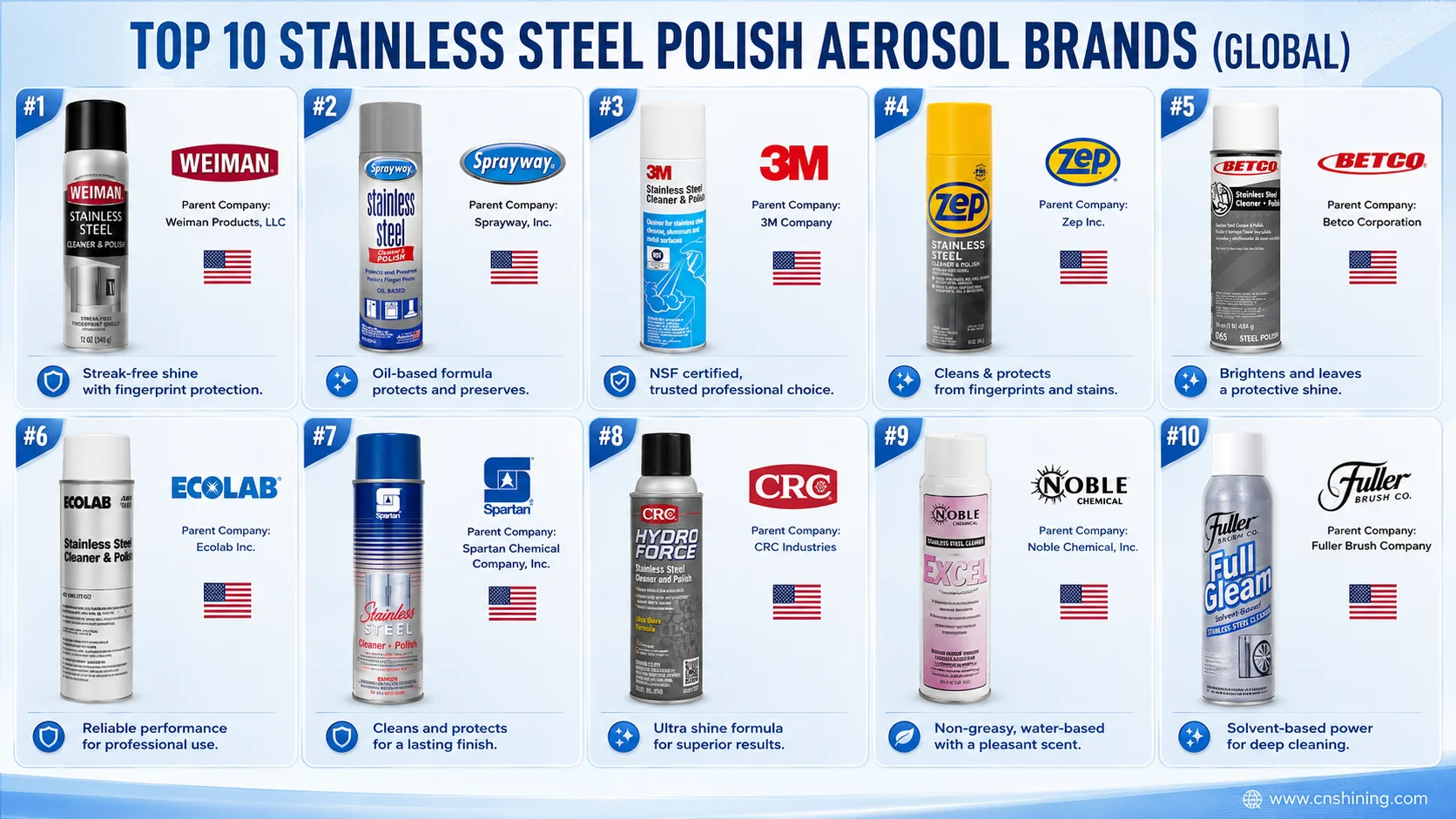
| Brand | Country | Parent company | Common capacity | Price range | Direct technical comment |
|---|---|---|---|---|---|
| Weiman | United States | Weiman Products, LLC | 17 oz aerosol; also related 12 oz / 22 oz SKUs | about 8.49$ single; two-pack about 22.07$ | Strong retail recognition. Fingerprint reduction and kitchen-appliance appearance are mature. |
| Sprayway | United States | Highline Warren | 15 oz oil-based / water-based | about 10.14$ single; two-pack about 21.07$; six-pack about 28.99$ to 34.48$ | Strong professional cleaning reputation. Oil-based version gives more shine; water-based version is easier for low-residue positioning. |
| 3M | United States | 3M Company | 10 oz / 21 oz aerosol | about 14.99$ single | B2B and facility-maintenance logic. Stable performance, soil resistance, and certification matter. |
| Zep | United States | Zep Professional / Zep Inc. | About 14 oz / 20 oz | about 24.99$ to 30.48$ case listing | Clear route: water-based, no oily residue, VOC compliant. |
| Betco | United States | Betco Corporation | 17 oz aerosol | about 8.11$ each; 12-count carton about 97.32$ | Commercial cleaning and property-maintenance DNA. Oil-in-water balance is the key story. |
| Ecolab | United States retail visibility | Ecolab / Scientific Clean | 16-17 oz aerosol | six-case price about 81.13$; about 13.52$ per can | Good fit for foodservice and service industries. More equipment-maintenance product than home-appearance product. |
| Spartan | United States | Spartan Chemical Company, Inc. | 15 oz aerosol | 12-case price about 114.40$; about 9.53$ per can | Typical jan-san channel product. Efficiency matters more than consumer-style packaging. |
| CRC | United States | CRC Industries | 18 wt oz / 20 fl oz | about 22.41$ single | More industrial and equipment-maintenance oriented. Better fit where dirt, environment, and certification matter. |
| Noble Excel | United States | Noble Products / Webstaurant channel | 18 oz aerosol | about 7.99$ single | Typical commercial-kitchen value route. Water-based oil-out emulsion is representative. |
| Fuller | United States | Fuller Industries / Fuller Brush channel | 15 oz | about 20.99$ single | Older “clean, polish, protect” style. Better for a heavier feel than for minimal-residue positioning. |
5. Regulations, Compliance, and Recent Innovation
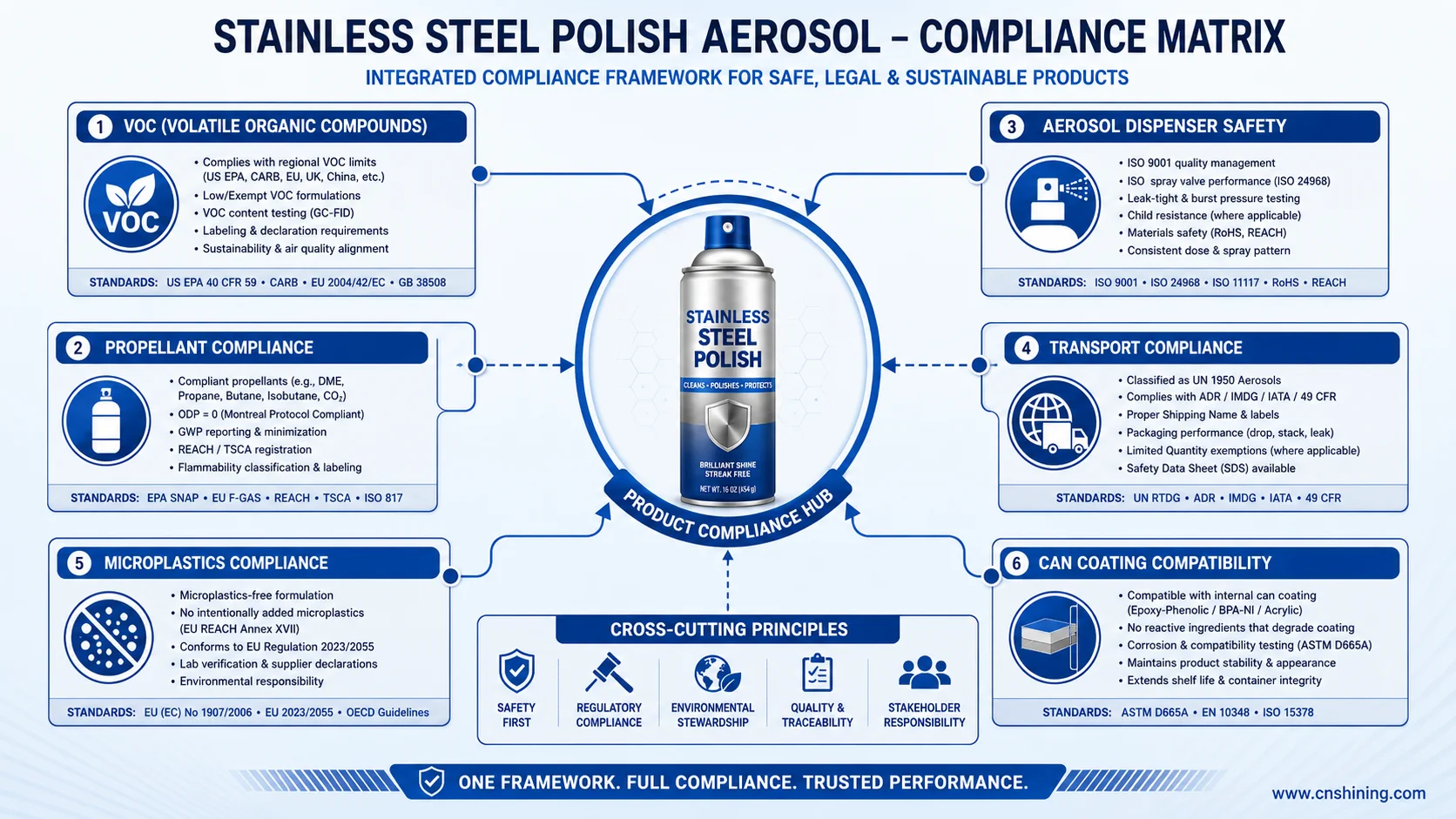
| Market | Key regulation / standard | Most relevant point for this category |
|---|---|---|
| U.S. federal | EPA Consumer Products National VOC Emission Standards, 40 CFR Part 59 Subpart C | Basic VOC framework for household care aerosol formulation. |
| U.S. state | California CARB Consumer Products Regulation | California is often stricter than federal rules. Low-VOC formula and category classification must be checked early. |
| U.S. propellants | EPA AIM Act / Technology Transitions | HFC use in aerosol subsectors is increasingly restricted. Fluorinated propellant SKU planning needs active tracking. |
| U.S. transport | DOT / 49 CFR; SDS often marks UN 1950 and Class 2.1 | E-commerce, warehousing, and interstate logistics require dangerous goods or limited-quantity handling. |
| Canada | VOC Concentration Limits for Certain Products Regulations, SOR/2021-268 | VOC limits, labeling, records, and compliance-unit planning affect consumer and commercial products. |
| Canada transport | TDG aerosol container and gas cartridge requirements | Aerosol container design, testing, and transport must follow dangerous goods container standards. |
| EU aerosol safety | Aerosol Dispensers Directive 75/324/EEC | Basic EU law for aerosol can manufacturing, filling, capacity, and safety requirements. |
| EU fluorinated gases | Regulation (EU) 2024/573 on fluorinated greenhouse gases | Tightens fluorinated greenhouse gas use. HFC propellant routes carry higher medium-term risk. |
| EU microplastics | ECHA microplastics restriction information | Intentionally added microplastics in cleaning products face restrictions. Polymer particles need screening. |
| Japan | High Pressure Gas Safety Act | High-pressure gas, containers, and household goods labeling need joint review. |
| Brazil | ANVISA public portal | Health regulation, dangerous goods transport, and chemical inventory issues are handled through different systems. |
| Gulf / Middle East | GSO 917:2021 Aerosol Dispensers | Standardization helps align package and label requirements across GCC markets. |
| South Africa | SABS standards system | Pressure equipment and compressed/liquefied gas container safety are established through the SANS/SABS system. |
5.1 Compliance Decision Points
Four failure points appear repeatedly. VOC category misclassification can change the allowed solvent profile. Late propellant strategy can trap a product in HFC risk when HFO, HC, or compressed gas would have been more durable. Transport planning affects UN 1950 classification, Class 2.1 or 2.2 handling, limited quantities, temperature control, and e-commerce cost. Package compatibility decides whether fragrance, hydrocarbon, silicone oil, gasket materials, and internal coating can survive storage without corrosion, odor shift, leakage, or bulging.
5.2 Recent Technical Direction
Environmental and low-VOC formulation. Stepan 1177 shows 0.5% VOC. Zep technical one-sheet states water-based, VOC compliant, and no oily residue. The direction is simple: not maximum shine, but enough shine with cleaner touch and easier compliance.
Low-fluorine / non-HFC propellant transition. EU 2024/573 and U.S. AIM Technology Transitions reduce the comfort of old HFC routes. Where nonflammability is required, HFO-1234ze is a realistic route. Where it is not required, water-based formula plus HC or compressed gas can be more cost-effective.
Recyclable cans and recycling narrative. HCPA and CMI aerosol recycling white paper moves aerosol-can recyclability from a slogan toward system-level discussion. For a home-care SKU, package material, empty-can instruction, and consumer communication increasingly matter to channel acceptance.
Smart and anti-misfire actuators. Shining Twist-Lock actuator information highlights ergonomic pressing, twist-to-lock behavior, and e-commerce reliability. The actuator job has moved from “make it spray” to “avoid accidental discharge, improve grip, work left or right handed, and survive shipping.”
Microplastic substitution. Stainless steel polish aerosol usually does not need abrasive beads. If visual particles, functional polymer particles, or durable scrubbing particles are considered, the EU restriction boundary should be checked before prototype work.
Patent hotspots. Recent activity is not only about gloss. It clusters around low-residue aqueous anti-streak systems, solvent-free microemulsion polish, low-migration internal coatings, BPA-NI options, and actuator lock or ergonomics. That points to integrated design: formula, valve, coating, propellant, and compliance tested together.
6. User Pain Points and Packaging Improvement
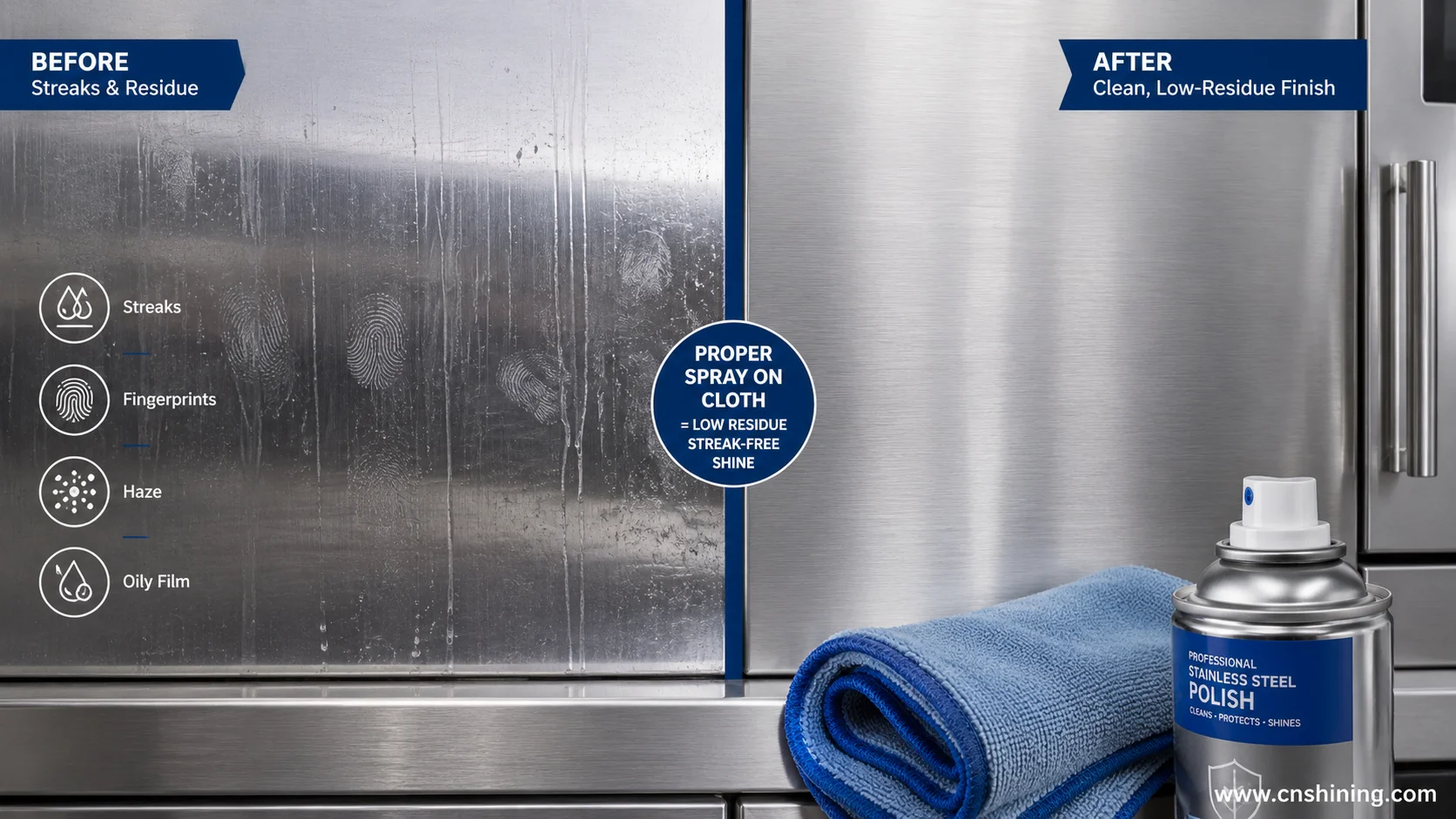
User Pain Point Pattern
The main complaint is not “it cannot remove everything.” The main complaint is that the surface can look worse after use: haze, oily film, dust pickup, strong odor, smearing on fingerprint-resistant stainless, and too much buffing. Brand education pages such as Weiman’s streaking explanation keep returning to the same issues: heat, wrong wipe direction, air drying, residue buildup, and product overuse.
| Platform / source | Example observation | Pain point | Meaning |
|---|---|---|---|
| Amazon / Walmart | High review counts for Weiman and Sprayway show mature repeat purchase demand. | Fingerprint removal and appearance recovery are real needs. | The category is not dead. Users still buy it when it works. |
| TikTok Shop | Listings emphasize easy aerosol spray, fast even coverage, and no-rinse use. | Users prefer immediate visible effect. | Visual result often sells faster than technical language. |
| Posts report old stains that water, vinegar, alcohol, and stainless steel cleaner did not solve; some fingerprintless surfaces become smeared. | Old buildup and special substrates are not the same as daily care. | Labels must separate daily polish from deep cleaning. | |
| Forum | Cybertruck forum discussion reports film and a thin oil sheen on exposed stainless panels. | High-oil formulas can be too visible on bare or highly visible metal. | A low-oil / low-visible-residue version is worth building. |
| Home media | The Kitchn stainless steel cleaner review flags strong chemical odor as a disliked point. | Odor affects retention. | Fragrance alone cannot hide solvent and propellant perception. |
| Professional cleaning advice | ServiceMaster cleaning guidance connects persistent streaks with residue buildup and recommends spraying onto cloth first. | Users often apply too much product directly to the appliance. | Packaging and front-label instructions should force correct use. |
Condensed into six issues, the pattern is clear: streaks, haze, oily feel, strong odor, substrate incompatibility, extra buffing, and weak performance on old heavy soil. The best product direction is not “stronger cleaner.” It is cleaner-looking residue, better spray control, clearer usage instruction, and lower regulatory risk.
Packaging Improvement Suggestions
| Design point | Suggestion | User problem addressed | Regulatory / cost impact |
|---|---|---|---|
| Valve and actuator | Use a lockable anti-misfire actuator, preferably twist-to-lock or audible-click type. Tune spray angle so users can spray on cloth rather than flooding the panel. | Accidental spray, run-off, shipping leakage, poor press feel. | Higher component cost, but fewer e-commerce failures and complaints. |
| Spray pattern | Use fine emulsion mist or light foam with lower flow rate to reduce local over-deposition. | Oil film, haze, repeated buffing. | Narrower valve and viscosity window. |
| Can shape | Use slim cans for household single-hand control; use higher net weight and anti-slip shoulder for professional users. | Slippery grip at home; frequent replenishment in commercial use. | Package cost changes, but clearer household/professional segmentation. |
| Formula-package coordination | Create a low-residue variant for fingerprint-resistant or black stainless surfaces. Print “spray on cloth first” on the front label. | Special substrates turning smeared or cloudy. | Mostly label and education cost. |
| Internal coating | Evaluate BPA-NI coating by default. Run 40-50°C accelerated compatibility testing with fragrance, silicone oil, hydrocarbon, and propellant. PPG Hoba coating information is one public packaging-coating reference. | In-can corrosion, odor migration, long-term stability complaints. | Higher validation cost, lower late-stage failure risk. |
| Printing and label | Front label: “light spray, wipe with grain, finish with a second dry cloth.” Back label: “test coated or fingerprint-resistant metal first.” | User misuse and treating polish as deep cleaner. | Very low cost and high education value. |
| Sustainable design | Use fewer separate-material parts where possible, reduce overcaps, and give clear empty-can recycling instructions. | Pushback against aerosol waste perception. | Improves retail communication; may support premium positioning. |
| Propellant strategy | If nonflammability is not needed, consider HC or compressed gas with more water-based formula. If nonflammability is required, evaluate HFO-1234ze instead of old HFC. | Future HFC and GWP risk. | HFO costs more; HC costs less but needs flammability management. |
7. Packaging Components for Stainless Steel Polish Aerosol: Actuators, Cans, and Valves
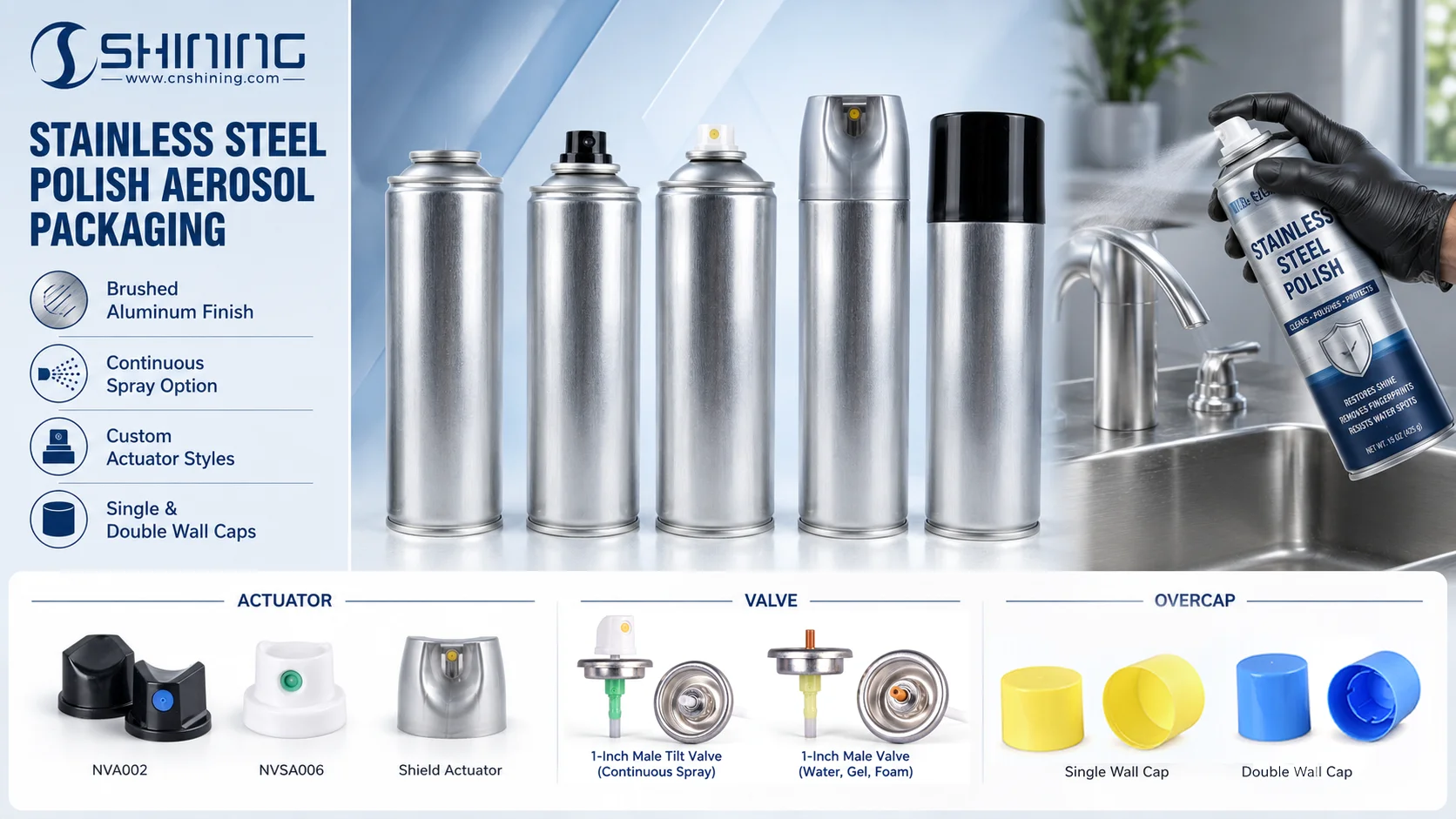
For stainless steel polish aerosol, the packaging is part of the product function. A good formula can still fail if the actuator lays down too much liquid, if the valve sputters after storage, or if the can coating is not compatible with fragrance, silicone oil, hydrocarbon propellant, or corrosion inhibitor.
Shining Packaging can be positioned in this category around three practical components: actuators, aerosol cans, and valves. The actuator should support controlled, low-flow application and preferably a lock function for e-commerce safety. The valve must match formula viscosity, foam or mist target, propellant pressure, and required spray rate. The aerosol can and internal coating need compatibility screening before scale-up, especially for water-based or semi-water-based formulas that contain surfactant, perfume, silicone, and corrosion inhibitor.
This is not only an appearance question. It affects leakage rate, spray consistency, user over-application, transport classification, shelf-life complaints, and the chance of residue buildup on stainless steel panels. For a low-residue product, actuator and valve selection should be tested with actual wipe behavior, not only with spray weight per second.
8. Conclusions
First, this is an old category with active demand. Public estimates differ, but most point to stable growth. Regional aerosol proxy data confirms that the base category remains active in Europe, North America, Asia, and Latin America.
Second, the key technical battle is residue and substrate compatibility. Users reject the product when the metal looks like it has been coated with oil. Fingerprint-resistant stainless, black stainless, mirror metal, and exposed decorative panels need lower-oil and lower-visible-residue design.
Third, formula, propellant, internal coating, valve, and actuator must be designed together. Changing fragrance or making the spray “stronger” will not fix VOC risk, in-can corrosion, gasket compatibility, or e-commerce leakage.
Fourth, a two-SKU strategy is technically cleaner. A home retail version can be water-based or semi-water-based, low odor, low residue, lockable, and printed with “spray on cloth first.” A professional version can allow a stronger protective film, higher net weight, and heavier soil handling, while giving more weight to foodservice, jan-san, and equipment-maintenance requirements.
Stainless steel polish aerosol still has a clear use case: fast visual recovery on metal surfaces. The weak point is equally clear: residue. Users leave when the product smells strong, feels oily, or makes fingerprint-resistant stainless look cloudy. The technical direction should be direct: lower visible film, better surface compatibility, controlled spray output, reliable valve and actuator behavior, future-ready propellant choice, and proven can-coating compatibility. That is where the next product improvement will come from.
9. FAQ: Stainless Steel Polish Aerosol
Its main function is surface appearance recovery, not deep degreasing. The formula wets light soil, helps surfactants remove fingerprints and cooking film, then leaves a very thin lubricating and protective layer. That layer reduces wipe drag, lowers visible fingerprints, and slows re-soiling. Heavy old buildup still needs a stronger cleaning step before polish is applied.
Streaks usually come from over-application, wiping against the grain, hot surfaces, air drying, or residue buildup from repeated oil-rich use. The problem is often not missing gloss, but too much visible film. A lower-flow actuator, spray-on-cloth instruction, and a second dry cloth can reduce streaking more effectively than adding more polish agent.
Oil-based systems usually give stronger gloss, better scratch masking, and more fingerprint reduction, but they can feel oily and may collect dust. Water-based systems usually give lower odor, lower residue, easier VOC compliance, and better behavior on sensitive surfaces. The trade-off is weaker masking and sometimes less “rich” shine on older stainless steel panels.
PDMS, also called dimethicone in many ingredient systems, gives slip and anti-streak performance at low addition levels. It can reduce friction during wiping and improve visual uniformity without building a heavy mineral-oil film. For fingerprint-resistant stainless steel, mirror metal, or black stainless, this low-dose silicone route can be safer than increasing oil content.
The propellant affects spray force, particle size, foam behavior, flammability, pressure curve, transport class, and cost. Hydrocarbon propellants are cost-effective and mature, but flammable. HFO routes may help where nonflammability is needed, but cost is higher. Nitrogen or other compressed gases can support some water-based routes but need careful valve and can-pressure design.
Stainless steel cleaner and polish formulas may contain alcohols, hydrocarbons, fragrance solvents, or other volatile components. Different jurisdictions can classify the product differently, which changes allowed VOC content. A formula that works technically may still fail in California, Canada, China, or the EU if the category, solvent level, or propellant route is not checked early.
Not reliably. Brushed appliance panels, commercial kitchen equipment, fingerprint-resistant coated stainless, black stainless, chrome, aluminum, and exposed decorative panels behave differently. A high-oil formula may look good on one surface and smear another. Labels should tell users to test coated metal first and, for sensitive surfaces, apply product to cloth rather than directly spraying.
Useful tests include spray rate, spray angle, droplet or foam quality, wipe residue, actuator leakage, valve recovery after storage, hot and cold stability, can corrosion, gasket swelling, fragrance migration, and compatibility with internal coating. The package should be tested with the actual formula and propellant, because small changes in silicone oil or fragrance can change long-term behavior.
The actuator controls how much product lands on the surface. Too much output increases streaks, oil film, and buffing time. A controlled low-flow spray, ergonomic press feel, and lockable design can reduce misuse and shipping leakage. For e-commerce, twist-to-lock or similar anti-misfire functions are practical, not decorative, packaging choices.
The most realistic direction is a lower-residue, lower-odor, water-based or semi-water-based aerosol with controlled spray, clear spray-on-cloth instruction, compatible internal coating, and a propellant route that can survive near-term regulation. For professional use, a second SKU may keep a stronger protective film and higher net weight, but it should still control residue and transport risk.