
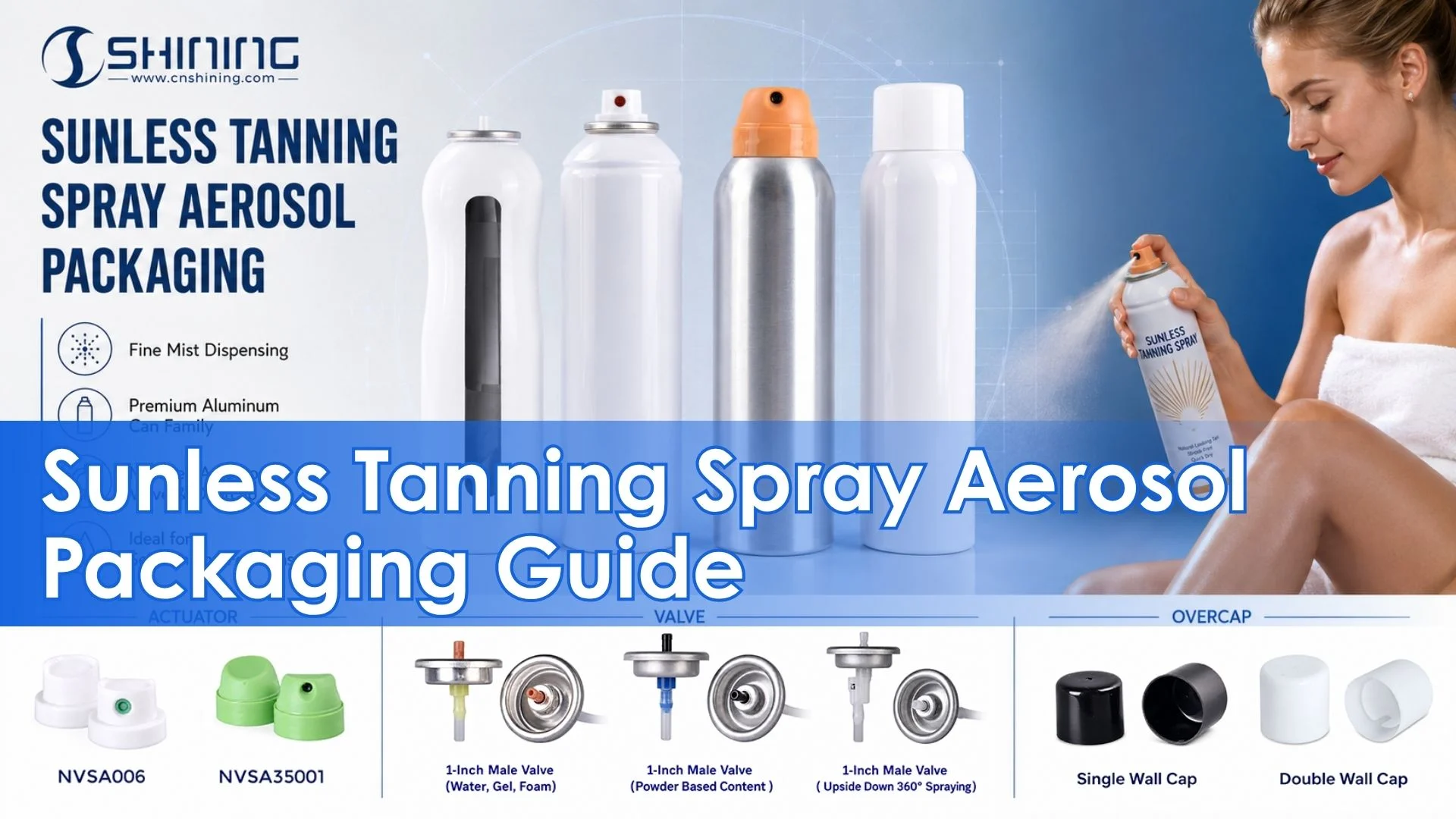
Sunless tanning spray deposits self-tanning actives onto the stratum corneum without UV exposure. That simple definition hides a lot of engineering work. In retail language, “spray,” “mist,” and “water” are often mixed together. From a packaging view, they are not the same thing.
A true pressurized aerosol, a Bag-on-Valve system, and a non-aerosol pump mist behave differently in droplet size, inverted spraying, flammability, VOC profile, formula compatibility, and user control. For this category, that difference is not cosmetic. It decides whether the consumer sees a smooth airbrush-like finish or a wet, streaked, orange patch.
The main color chemistry is still based on dihydroxyacetone, or DHA. DHA reacts with amino acids and proteins in the outer skin layer and forms brown melanoidin-type polymers. Erythrulose is often paired with DHA because it develops more slowly and can soften tone development and fade behavior. The FDA’s sunless tanning page also makes one point clear: a sunless tan is not sun protection unless the product carries a valid SPF statement and sunscreen formulation basis.
1. Product Definition and Skin Chemistry
A sunless tanning spray is a leave-on cosmetic that delivers self-tanning actives through an atomized carrier. It may be a clear alcohol/water spray, a tinted guide-color spray, a liquid-gas aerosol, a compressed-air or nitrogen-driven BOV pack, or a pump mist.
The mechanism is shallow. DermNet’s DHA explanation describes DHA as a self-tanning agent that reacts in the skin surface. FDA guidance on sunless tanners and bronzers also states that DHA is used to darken the skin by reacting with amino acids in the skin’s surface and is restricted to external application.
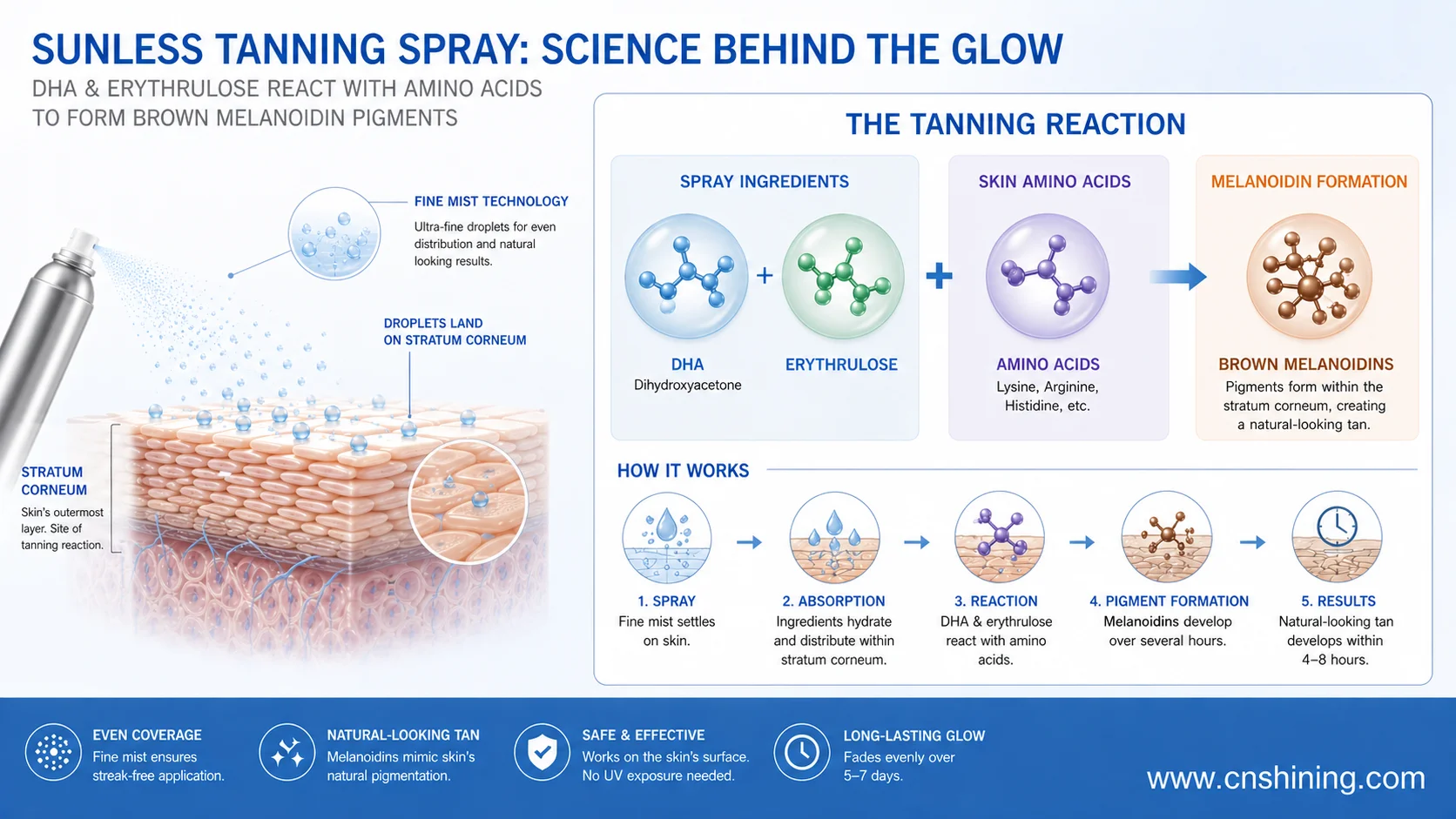
- 1. Spray droplets deposit on the stratum corneum.
- 2. DHA and erythrulose contact amino acids and keratin proteins.
- 3. A Maillard-like browning reaction occurs.
- 4. Brown melanoidin-type polymers form.
- 5. Color develops over several hours to about one day.
- 6. The color fades as the stratum corneum naturally sheds.
DHA is fast and visible, but it can bring odor, orange tone, and local darkening when the film is uneven. Erythrulose is slower. It is used to improve tone and make fading less patchy. DSM’s erythrulose formulation guidance gives a useful formulation point: erythrulose is more stable in a low-pH range, while tanning performance on skin is closer to a higher pH environment. That tension matters for valves, gaskets, internal coatings, and storage color stability.
2. Market Size, Regions, and Channel Movement
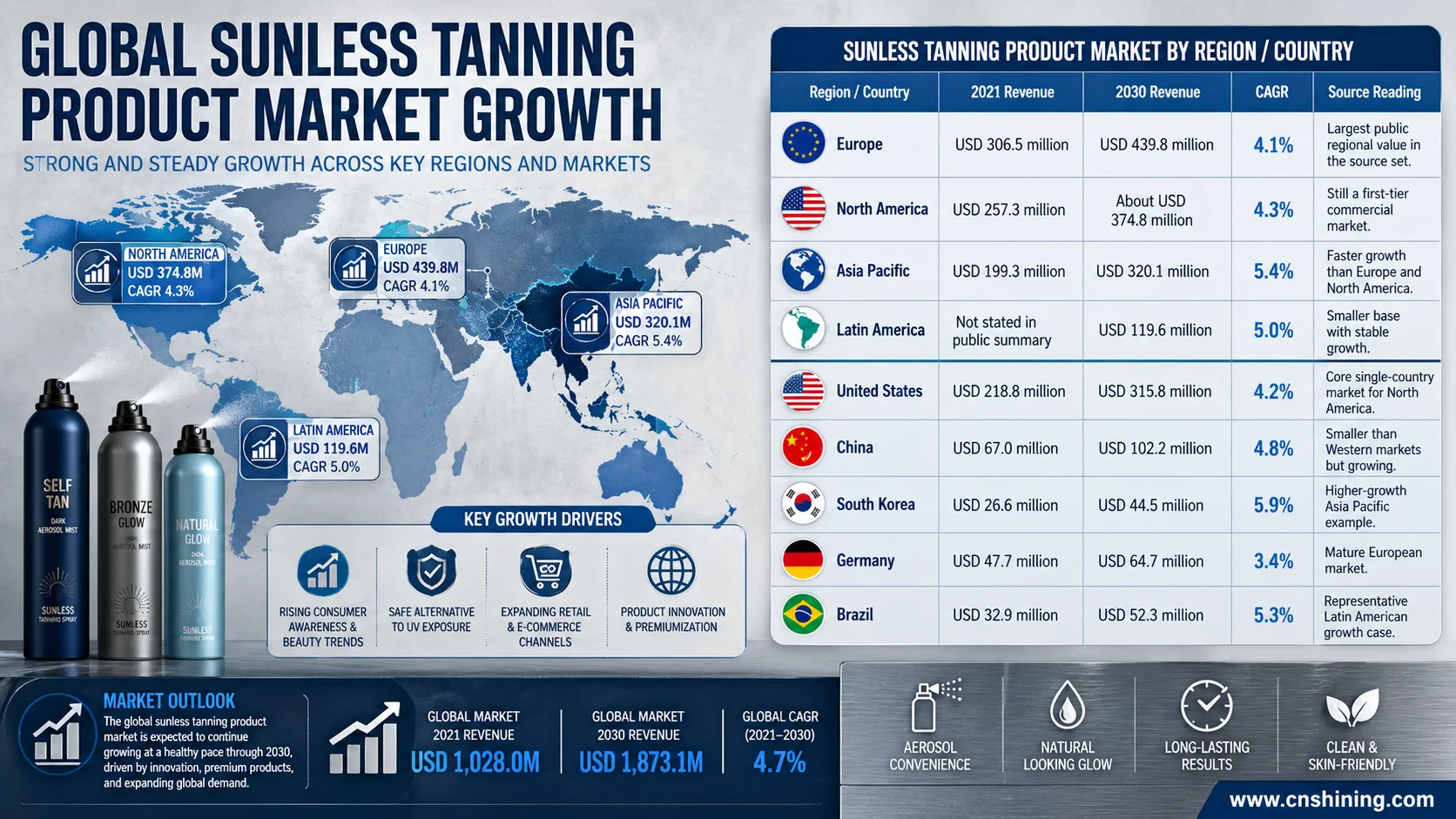
USD 1.0–1.4 billion for the global self-tanning product category around 2025–2026, with a center growth range of about 5%–7%. Spray is not the largest format, but it has high perceived value because it promises speed, low hand contact, back coverage, and an airbrush finish.
| Region / country | 2021 revenue | 2030 revenue | CAGR | Source reading |
|---|---|---|---|---|
| Europe | USD 306.5 million | USD 439.8 million | 4.1% | Largest public regional value in the source set. |
| North America | USD 257.3 million | About USD 374.8 million | 4.3% | Still a first-tier commercial market. |
| Asia Pacific | USD 199.3 million | USD 320.1 million | 5.4% | Faster growth than Europe and North America. |
| Latin America | Not stated in public summary | USD 119.6 million | 5.0% | Smaller base with stable growth. |
| United States | USD 218.8 million | USD 315.8 million | 4.2% | Core single-country market for North America. |
| China | USD 67.0 million | USD 102.2 million | 4.8% | Smaller than Western markets but growing. |
| South Korea | USD 26.6 million | USD 44.5 million | 5.9% | Higher-growth Asia Pacific example. |
| Germany | USD 47.7 million | USD 64.7 million | 3.4% | Mature European market. |
| Brazil | USD 32.9 million | USD 52.3 million | 5.3% | Representative Latin American growth case. |
Europe and North America still define much of the category volume. Asia Pacific adds the growth story. For spray development, that means two different briefs. Western markets can accept deeper tone, faster drying, and larger body formats. Asian markets often need lighter, skincare-linked, gradual, and more controllable mist systems.
Channel behavior is also shifting. Grand View’s public press summary identifies supermarkets and hypermarkets as the largest 2021 channel, while FMI’s 2026 view puts online retail at 31.9%. That is consistent with the format itself. Mist quality, spray cone, before/after tone, and back-application are easier to sell in video than on a shelf tag.
3. Format Comparison: Spray, Lotion, Mousse, Wipes, and Drops
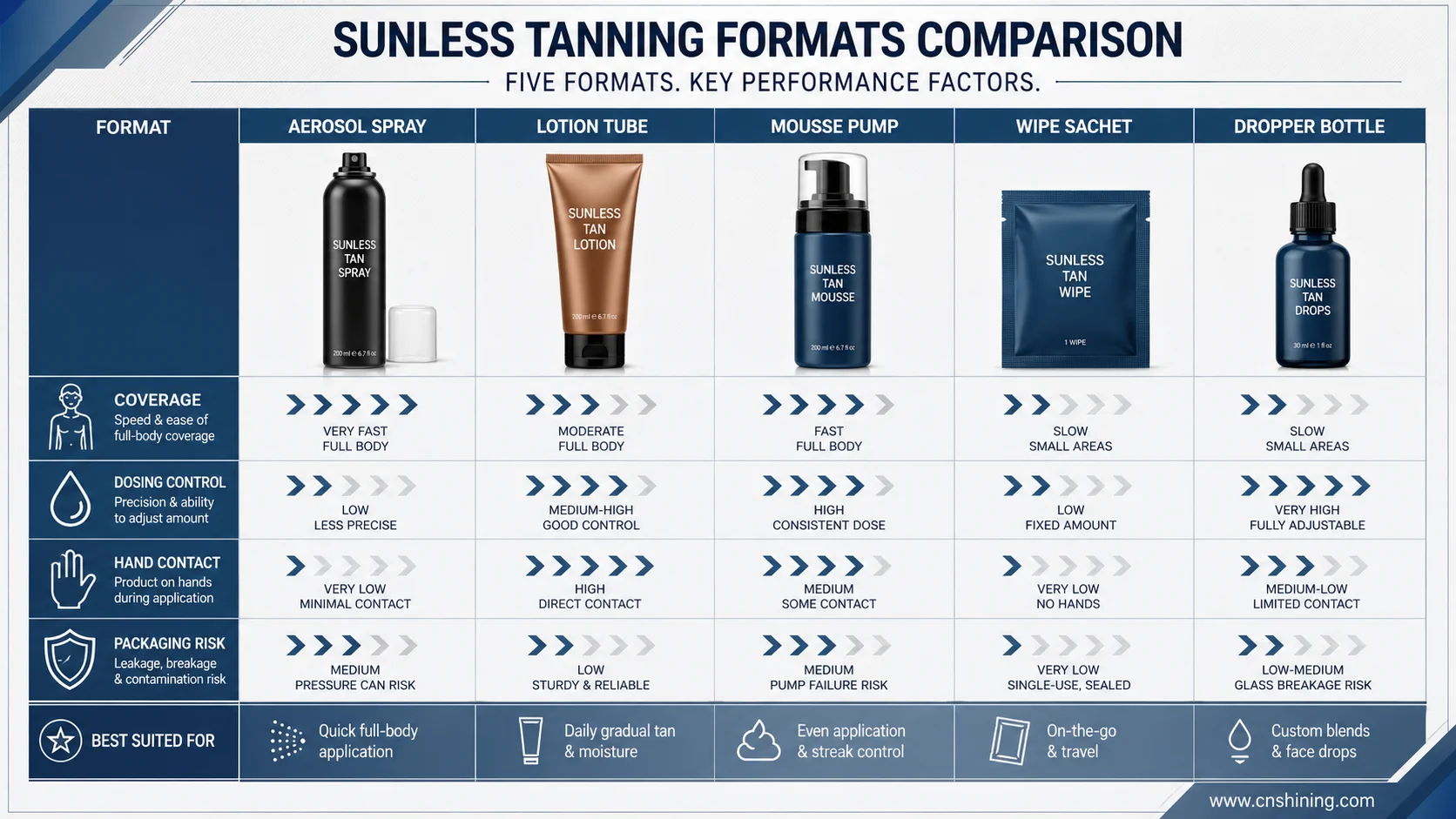
The spray format does not win because it makes the darkest tan. It wins when it covers large body areas quickly, reduces hand contact, reaches the back and rear legs more easily, dries fast, and feels close to a salon airbrush spray.
| Format | Main advantages | Main weak points | Best-fit use case | Packaging implication |
|---|---|---|---|---|
| Spray / aerosol spray | Fast coverage, low hand contact, easier back application, airbrush perception. | Overspray, nozzle clogging, wet spots, face dosing risk, inhalation concern. | Large body areas and quick-use occasions. | Most dependent on valve, actuator, can, and spray engineering. |
| Lotion | Best dose control, strong moisturization, easier correction for beginners. | Slow spreading, more hand contact, poor back access. | Beginners, dry skin, gradual tan users. | Less packaging differentiation; formula feel carries more weight. |
| Mousse | Fast drying, visible coverage path with mitt, lightweight feel. | Still needs manual spreading; foam stability matters. | Experienced users who want fast dry-down. | Competes with spray for “easy application” positioning. |
| Wipes | Travel-friendly, single-use hygiene, good for localized correction. | Higher cost per use, weak full-body efficiency, edge-line risk. | Face, travel, repair zones. | Repeat purchase logic is strong, but scale per pack is limited. |
| Drops | Customizable with cream or serum; face-friendly. | Needs mixing; uneven mixing creates hot spots. | Face and skincare-led routines. | High education load; less instant demonstration than spray. |
The pattern is clear. Lotion and drops fail mostly through inconvenience and hand contact. Spray fails through hardware behavior: clogging, spitting, uneven cone, wet deposition, poor inverted spraying, and uncontrolled face application. If a spray product wants repeat purchase, the packaging system has to reduce those failure points before the formula is judged.
4. Formulation System and Technical Terms
A mature sunless tanning spray usually has five formulation layers: tanning actives, solvent/co-solvent system, wetting and surface-control system, humectant or film-forming system, and preservative/fragrance/color/propellant system.
| Category | Common materials | Function | Typical technical window | Commercial reading |
|---|---|---|---|---|
| Main tanning active | DHA | Core surface browning activity. | Often mid-single digit in retail; wider technical references may reach 0.1%–15% or higher patent windows. | Fast color, but higher odor and uneven-darkening risk. |
| Co-active | Erythrulose | Slower color development and smoother fade. | Often 1%–5% based on formulation guidance. | More natural tone, slower response, higher cost. |
| Low-pH stabilizer / co-solvent | Ethoxydiglycol, diethoxyglycol, polyethoxyglycol systems | Solubility, uniformity, DHA stability. | EP0884045A1 shows stabilization logic with polyethoxyglycol and polyol systems. | Still one of the old but useful DHA stability levers. |
| Humectant | Glycerin, sorbitol, propylene glycol | Reduces dry feel and helps film comfort. | Often low to mid-single digit in commercial feel work. | Controls the “fast dry but not stripped” balance. |
| Wetting system | Nonionic or amphoteric surfactants, spreading aids | Reduces beading and local dark spots. | Often around 0.1%–5%, depending on system. | Directly affects evenness after droplets land. |
| Rheology control | Cellulose derivatives, xanthan gum, crosslinked polymers | Controls run-off and film uniformity. | EP1810659A1 is a useful self-tanning composition reference. | Too thin runs; too thick clogs or spits. |
| Preservative | Phenoxyethanol, ethylhexylglycerin, compatible boosters | Microbial control. | Often low percentage, validated by challenge test. | Water-rich sprays cannot use weak preservation. |
| Guide color | Caramel, temporary colorants, microcapsule systems | Shows where the product has landed. | q.s., validated for transfer and staining. | Reduces missed areas but can transfer to fabric. |
| Propulsion | DME, hydrocarbons, compressed air, nitrogen | Atomization and continuous spray. | Liquid-gas systems differ from BOV, where propellant does not contact bulk formula. | Controls droplet size, flammability, VOC profile, and formula compatibility. |
Useful terms
| Term | Meaning | Why it matters |
|---|---|---|
| DHA | Dihydroxyacetone, the main sunless tanning active. | Drives color speed and many odor complaints. |
| Erythrulose | Slow-developing tanning co-active. | Used for tone control and less patchy fading. |
| Guide color | Temporary visible color during application. | Helps users see coverage and reduce streaks. |
| TEWL | Transepidermal water loss. | Higher TEWL can mean drier feel and deeper color on dry patches. |
| BOV | Bag-on-Valve aerosol system. | Separates formula from propellant, supports inverted spray and high evacuation. |
| DME | Dimethyl ether propellant. | Useful for atomization, but compatibility and flammability must be checked. |
| Metered valve | Valve that delivers a fixed dose per actuation. | Better suited to face products than body continuous spray. |
| Fine mist | Small droplet spray with stable cone. | Directly affects evenness, dry-down, and spitting risk. |
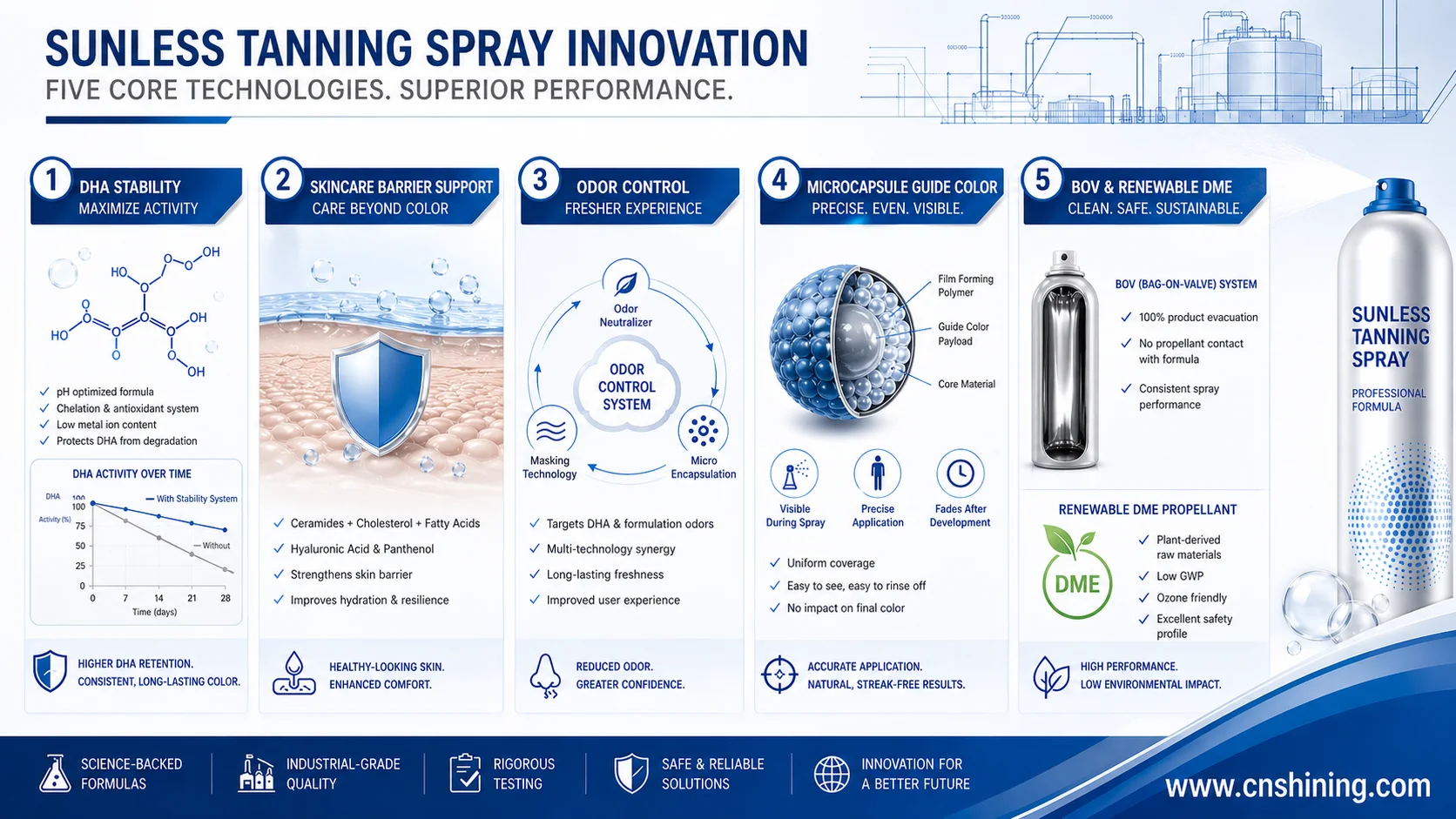
5. Research Direction: Stability, Odor, Microcapsules, BOV, and Renewable Propellants
| Direction | Representative source | Engineering meaning |
|---|---|---|
| Skin-care and tanning fusion | EP3709956B1 | Self-tanning is moving from “color only” toward color plus barrier and dry-skin management. |
| DHA stability | EP0884045A1, linked above | Storage discoloration, degradation odor, and low-pH compatibility are still active problems. |
| Odor reduction | US5514367A | Cyclodextrin-type odor management remains relevant because DHA reaction odor is persistent. |
| Immediate color plus delayed color | WO2015132791A1 | Microcapsule colorant systems can help solve the “I cannot see where I sprayed” problem. |
| Melanogenesis route | University of Bradford and Coegin Pharma NPP-4 work | If commercialized, peptide-based pigmentation could challenge the DHA-stain model. |
| Renewable propellant | Nouryon Demeon ReNu100 announcement | Lower-carbon propellant options may become part of aerosol differentiation. |
| DME technical handling | Nouryon DME technical bulletin | DME can assist atomization and solubility, but pack compatibility and flammability classification need early review. |
| Continuous 360° spray | Shining Packaging All Over Spray BOV | BOV and 360° dispensing directly address back application, inverted use, and product evacuation. |
The next three years will likely reward products that combine stable actives, controlled spray mechanics, and cleaner propulsion choices. New ingredients help, but the consumer mainly notices whether the spray works every time.
6. Regulatory and Exposure Control
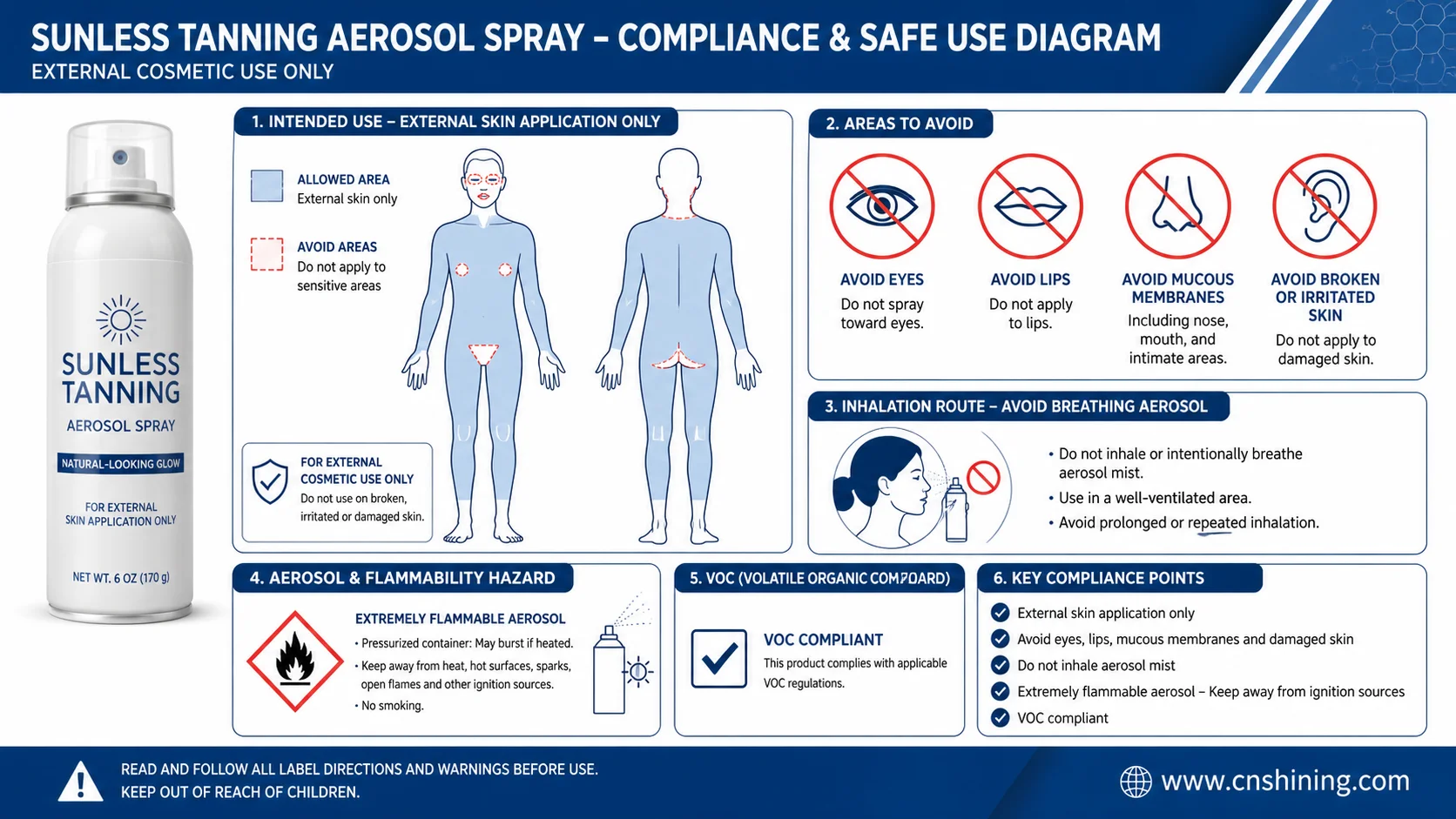
The main safety issue is not whether DHA should exist in cosmetics. The practical issue is exposure boundary. FDA recognizes DHA for external application, not for eyes, lips, mucous membranes, or internal exposure by inhalation or ingestion. This is especially relevant for all-over spray formats and spray booths.
| Region | Core framework | Key point for sunless tanning spray |
|---|---|---|
| United States | FDA color additive and cosmetic safety rules; advertising overseen by FTC truth-in-advertising rules. | DHA is external-use only; avoid sunscreen implication unless SPF is valid; endorsements and reviews must not mislead. |
| European Union | Cosmetics Regulation (EC) No 1223/2009, aerosol dispenser rules, CLP, REACH context. | Responsible person, PIF, CPSR, INCI labeling, batch identification, function, nominal content, and aerosol safety labeling are required. |
| Australia | AICIS cosmetic ingredient introduction rules and consumer product safety / labeling framework. | Ingredients must fit the correct introduction route; therapeutic or primary sunscreen claims can change the regulatory category. |
| California / VOC context | CARB consumer products regulation. | No simple “sunless tanning spray VOC number” should be assumed; classification depends on the applicable consumer product category. |
Four claim mistakes create avoidable risk: saying or implying the product is sunscreen, using absolute promises such as “100% streak-free,” using influencer content without disclosure, and managing reviews in a misleading way. A technically safe product can still create regulatory trouble if the label and content claims are careless.
7. Top 10 Brand Samples and Packaging Signals
| Brand | Country | Parent or control | Representative spray | Packaging signal |
|---|---|---|---|---|
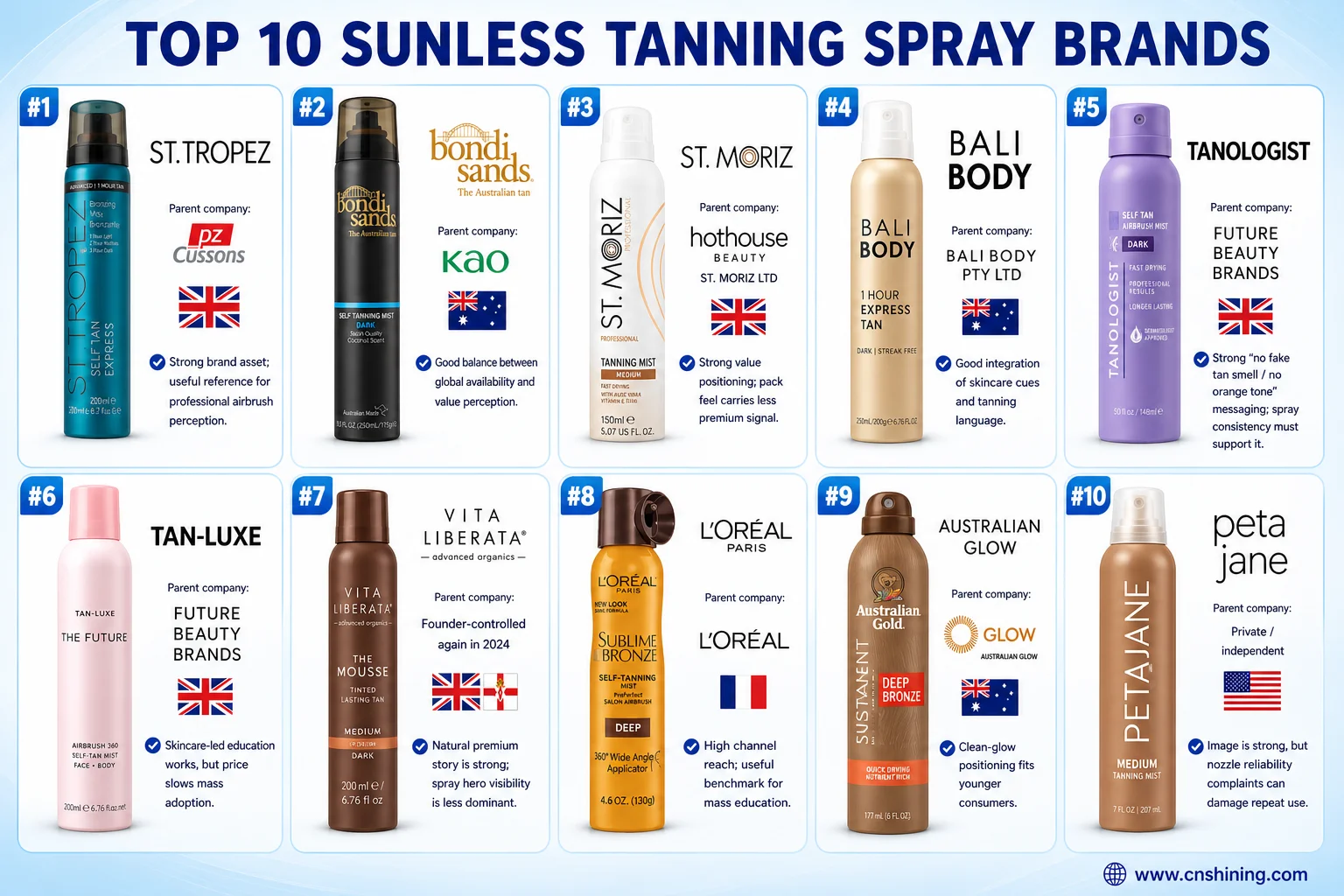
| St.Tropez | United Kingdom | PZ Cussons | Purity Face Mist / Express Mist, 100–200 mL class | Strong brand asset; useful reference for professional airbrush perception. |
| Bondi Sands | Australia | Kao | Self Tanning Mist, 250 mL class | Good balance between global availability and value perception. |
| St. Moriz | United Kingdom | Hothouse Beauty | Face Tanning Mist, 150 mL class | Strong value positioning; pack feel carries less premium signal. |
| Bali Body | Australia | Bali Body Pty Ltd | Face Tan Mist 100 mL; Body Mist 200 mL | Good integration of skincare cues and tanning language. |
| Tanologist | UK | Future Beauty Brands | Airbrush Mist 148 mL; Face Mist 100 mL | Strong “no fake tan smell / no orange tone” messaging; spray consistency must support it. |
| TAN-LUXE | UK | Future Beauty Brands | The Water / Express Water | Skincare-led education works, but price slows mass adoption. |
| Vita Liberata | UK | Founder-controlled | Premium tanning mist / blur-mist route | Natural premium story is strong; spray hero visibility is less dominant. |
| L’Oréal Paris | France | L’Oréal | Sublime Bronze Facial Water Mist, 4.6 oz class | High channel reach; useful benchmark for mass education. |
| Australian Glow | Australia | Glow | Miracle Mist and related mist line | Clean-glow positioning fits younger consumers. |
| Peta Jane | United States | Private | Sunless Tanning Mist, 7 oz class | Image is strong, but nozzle reliability complaints can damage repeat use. |
The market separates into three groups. The first group has strong brands and strong channels: St.Tropez, Bondi Sands, and L’Oréal Paris. The second group uses skincare language, visual identity, and content better: Bali Body, Tanologist, TAN-LUXE, and Vita Liberata. The third group can be sharp in a niche or price band: Peta Jane, Australian Glow, and St. Moriz. For a new spray product without strong brand pull, packaging experience has to become a visible difference, not a hidden component.
8. Packaging Design: Where Spray Products Fail
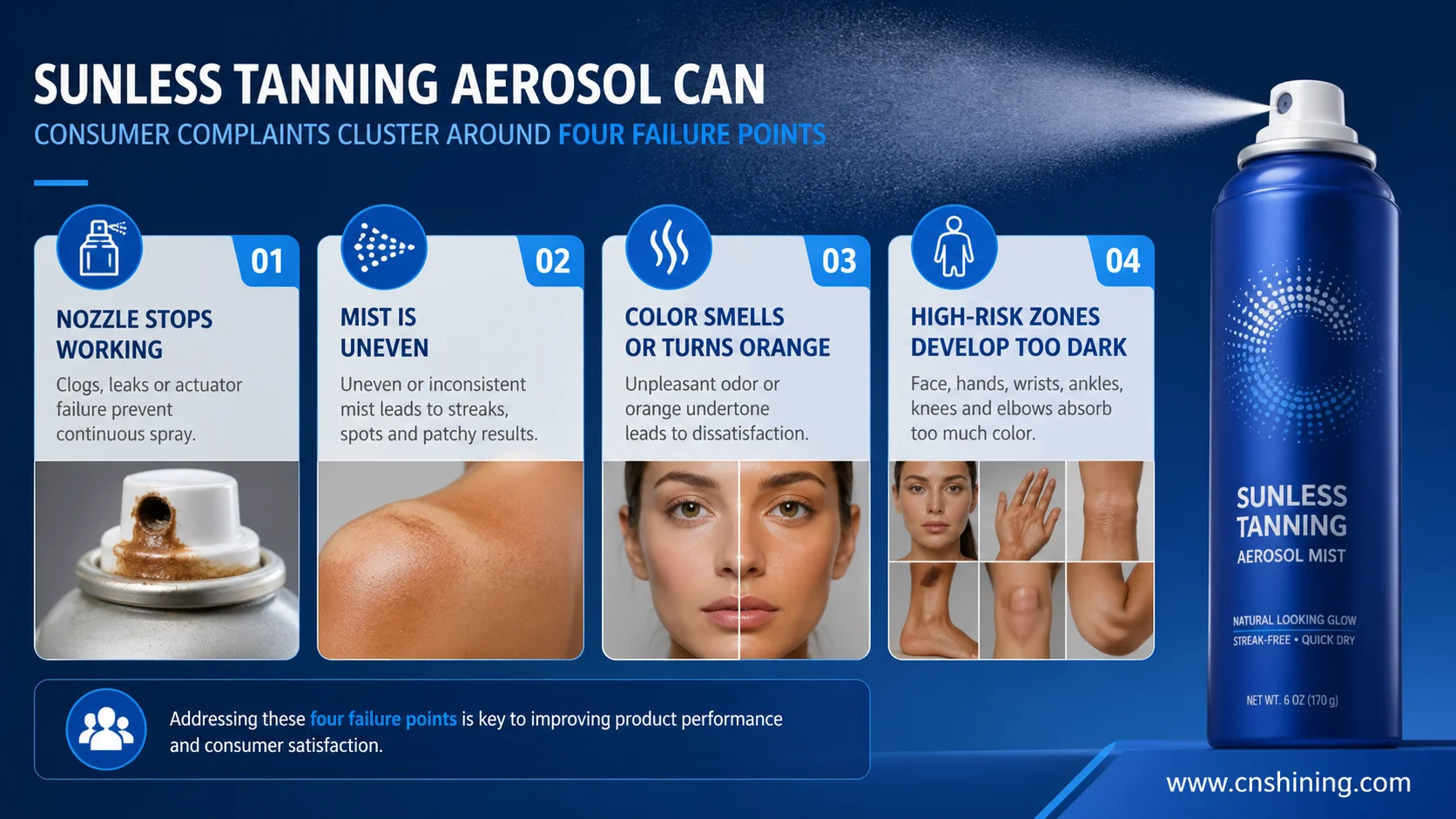
Consumer complaints usually cluster around four failure points: the nozzle stops working, the mist is uneven, the color smells or turns orange, and high-risk zones such as face, hands, wrists, ankles, knees, and elbows develop too dark. Only one of these is mainly formula chemistry. The rest are packaging, application education, or pack-formula interaction.
| Pain point | Packaging area | Practical solution | Why it helps |
|---|---|---|---|
| Nozzle clogging, spitting, no spray | Valve + actuator | Use anti-clog orifice geometry, compatible elastomers, correct viscosity window, and endurance testing under low-pH DHA formula. | Reduces the most visible failure: product cannot be dispensed evenly. |
| Overspray and wet patches | Actuator | Use wide, fine, continuous body spray output; avoid excessive local dose. | Lower wet film thickness reduces dark spots and run marks. |
| Face over-application | Valve + actuator | Use a separate metered fine-mist face SKU with lower output and narrower spray cone. | The face tolerates less dose variation than legs or torso. |
| Back application and inverted failure | Valve system + can handling | Use 360° dispensing, BOV, and a grip-friendly can profile. | Back and rear-leg use are key reasons consumers choose spray. |
| Storage odor and color shift | Internal coating + valve cup + seals | Validate lining, gasket, and metal exposure against low-pH, alcohol, DHA, erythrulose, fragrance, and propellant system. | Reduces storage degradation, not the skin reaction odor itself. |
| Unclear coverage path | Printing + guide color + instructions | Use application-map graphics and optional light guide color. | Many streak complaints come from use error rather than formula failure. |
| Low evacuation and “expensive residue” | BOV bag, can volume, valve matching | Match bag, can, and valve to maximize usable product evacuation. | High-priced tanning sprays are judged harshly if residue remains. |
| Transport leakage and counterfeit doubt | Cap, lock, batch code | Use twist-lock actuator, tamper-evident feature, laser batch code, and verification code if needed. | Leakage or counterfeit suspicion quickly damages reviews. |
My engineering preference is an aluminum aerosol can with BOV and compressed air or nitrogen, designed for 360° continuous spray. The actuator should have a large press area and a travel lock. The decoration should be light-resistant and give direct application instructions: sweep from ankle upward, keep distance, do not hold the spray on one point.
9. Shining Packaging Fit: Actuators, Aerosol Cans, and Valves
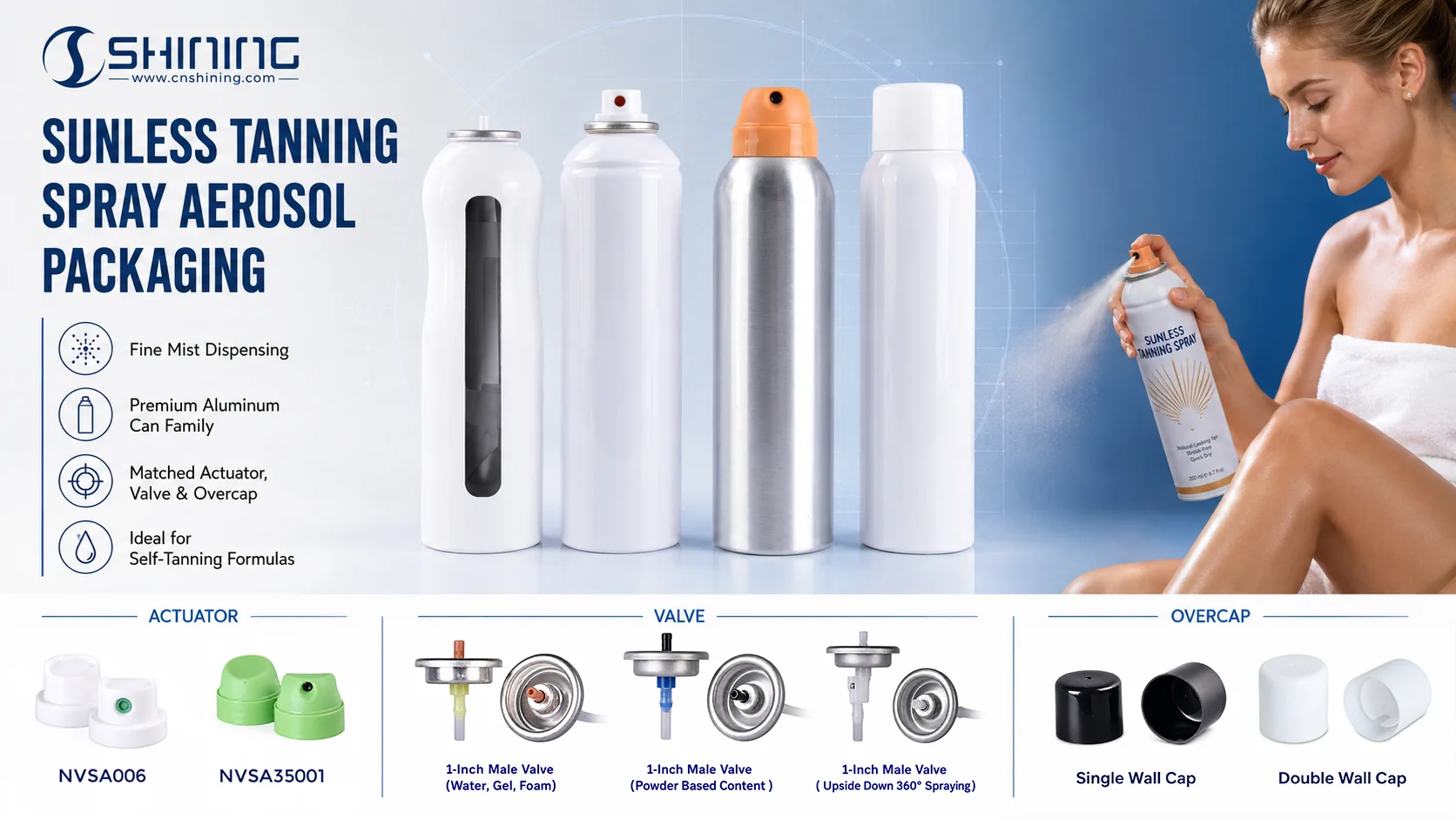
For sunless tanning spray, the packaging bill of materials is not a back-end purchasing item. It is part of the product performance. Shining Packaging can be naturally positioned around three engineering areas: actuators, aerosol cans, and valves.
The actuator defines spray cone, droplet feel, finger comfort, lock function, and spitting behavior. For body tanning spray, a wider and finer continuous actuator is usually more useful than a hard, narrow jet. For face mist, a lower-output actuator or metered valve gives better dose discipline.
The aerosol can must handle low-pH formula stress, light exposure, decoration requirements, transport impact, and internal coating compatibility. DHA and erythrulose systems may include water, ethanol, glycols, fragrance, guide color, and sometimes DME. That is enough reason to run internal coating checks before scale-up.
The valve decides whether the product sprays cleanly through the pack life. For a tanning formula, the valve must tolerate viscosity drift, guide-color particles or colorants, low-pH chemistry, and repeated use after partial drying at the orifice. A good valve choice reduces the most visible consumer complaint: “the spray stopped working.”
10. Conclusion
Sunless tanning spray is a real product opportunity, but the winning factor is not a louder “dark tan” claim. The category has growth support from UV-risk awareness, online retail, and convenient application formats. The technical battle is lower failure rate.
The best development route is a dual system: body BOV continuous spray plus face metered fine mist. The body pack solves coverage, back application, and airbrush perception. The face pack controls dose and exposure. The formula should use a stable DHA/erythrulose system with moisture support and realistic odor language. The pack should use compatible internal coatings, anti-clog valves, well-matched actuators, clear instructions, and transport-safe locking. That is how a sunless tanning spray moves from “nice mist” to dependable product.
11. FAQ: Sunless Tanning Spray
Sunless tanning spray is designed to create a temporary tan-like color on the outer skin layer, usually through DHA chemistry. Sunscreen spray is designed to reduce UV exposure using approved sunscreen filters and SPF testing. A sunless tanning spray should not imply sun protection unless it also contains sunscreen ingredients and carries a valid SPF label.
DHA works because it reacts with amino acids and proteins in the stratum corneum, creating brown melanoidin-type color. The reaction is shallow and does not create real melanin. It gives visible color within hours, but it also brings known issues: reaction odor, uneven darkening on dry patches, orange tone risk, and storage stability challenges.
Erythrulose develops color more slowly than DHA and is often used to soften tone development and reduce patchy fading. It does not replace DHA in most formulas because the response is slower and lighter. The common approach is a balanced DHA plus erythrulose system, supported by humectants and a stable low-pH formula base.
The familiar fake-tan odor is partly created after DHA reacts on the skin. Fragrance can improve the opening smell and mask some formula notes, but it cannot fully stop the skin reaction odor. Packaging can reduce storage degradation odor by limiting oxygen, metal interaction, and incompatible propellant contact, especially when internal coatings and seals are well selected.
Clogging usually comes from a mismatch between formula solids, viscosity, drying behavior at the orifice, valve geometry, actuator design, and storage conditions. Guide color, polymers, and low-pH systems can increase risk. A good development program tests repeated spraying, partial-use storage, inverted use, and low-temperature recovery instead of checking only first-spray appearance.
BOV is often attractive because the formula is separated from the propellant, which can help compatibility and reduce contamination risk. It also supports 360° spraying and high product evacuation when designed well. It is not automatically better for every formula. The bag, valve, actuator, can, fill process, and target spray pattern still need validation together.
Body application needs broad coverage, continuous spray, and easier back or leg access. Face application needs lower dose, finer mist, controlled spray cone, and stronger exposure instructions. Using one high-output body actuator for the face increases risk of over-application, inhalation, lip or nose exposure, and local darkening around dry or textured areas.
The most useful tests are pack compatibility under low pH, accelerated storage, spray pattern stability, actuator anti-clog endurance, valve leakage, inverted spraying, product evacuation, and transport locking. For formulas containing DHA, erythrulose, ethanol, glycols, fragrance, or guide color, internal coating and elastomer compatibility should be treated as early design gates.
Streaks usually come from uneven deposition, overly wet droplets, poor spreading, dry skin patches, or unclear application technique. The spray system can reduce the risk with a stable fine mist, controlled output, and good spray cone geometry. The label also matters. Users need distance, sweeping direction, dry-zone warnings, and joint-area instructions.
A practical architecture is a two-SKU system: body BOV continuous spray and face metered fine mist. The body SKU focuses on 360° coverage and airbrush feel. The face SKU focuses on low output and exposure control. The formula should avoid extreme DHA loading and use stability, moisturization, guide color, and packaging compatibility as core design points.