
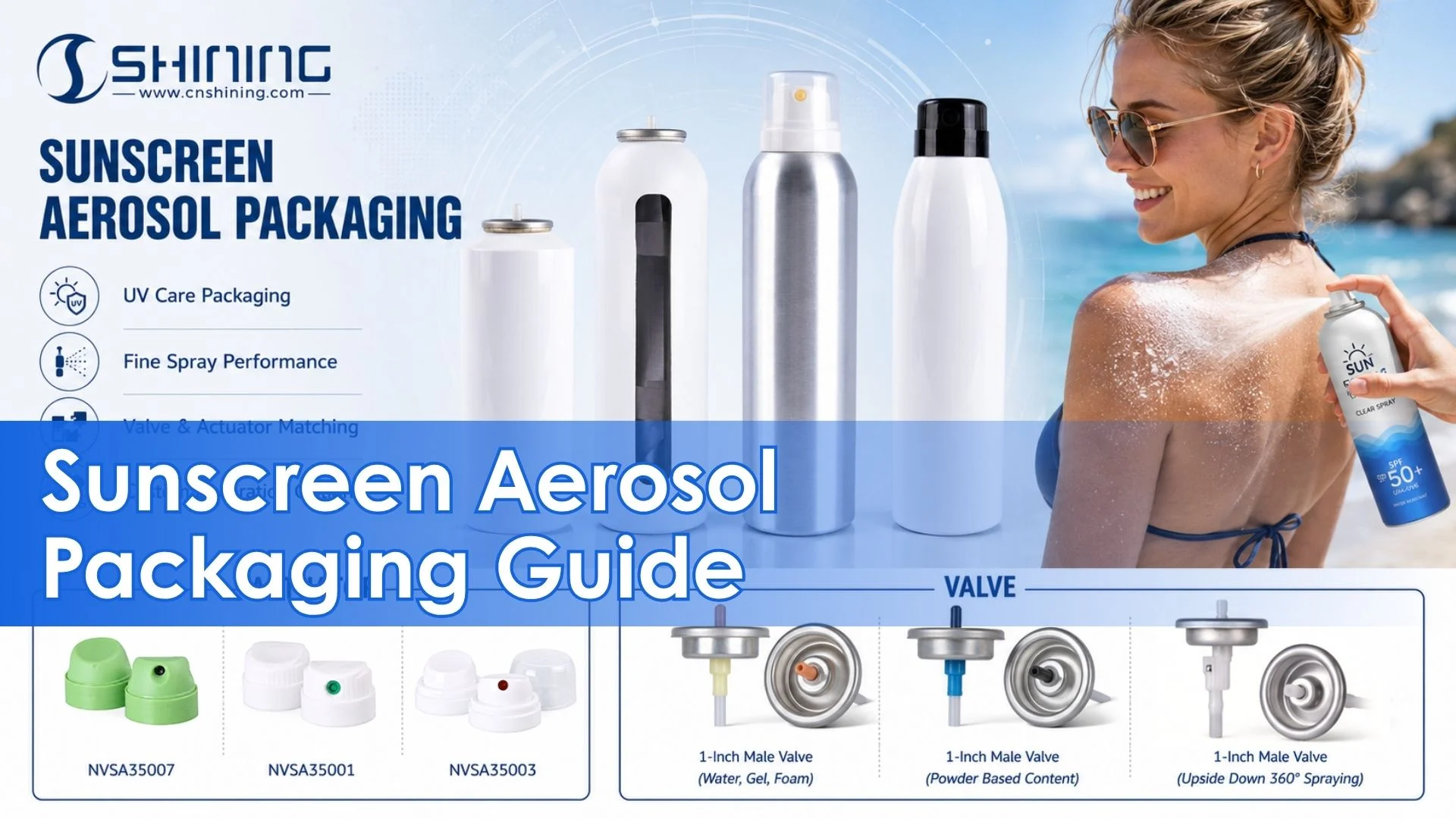
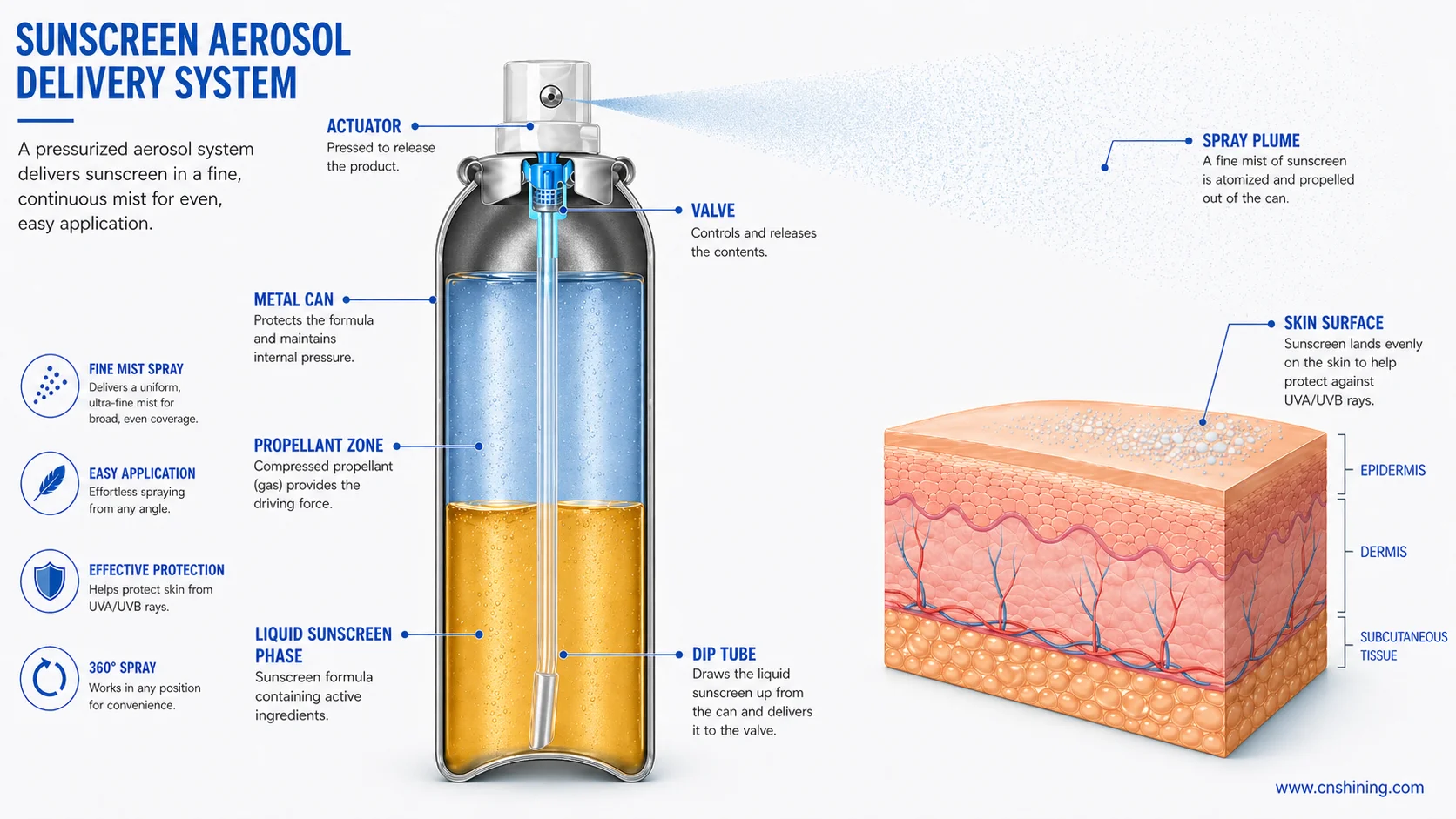
A sunscreen aerosol is not just sunscreen placed inside a pressurized can. It is a controlled delivery system where formula rheology, propellant behavior, valve geometry, actuator design, spray pattern and user technique all affect the protection film on skin.
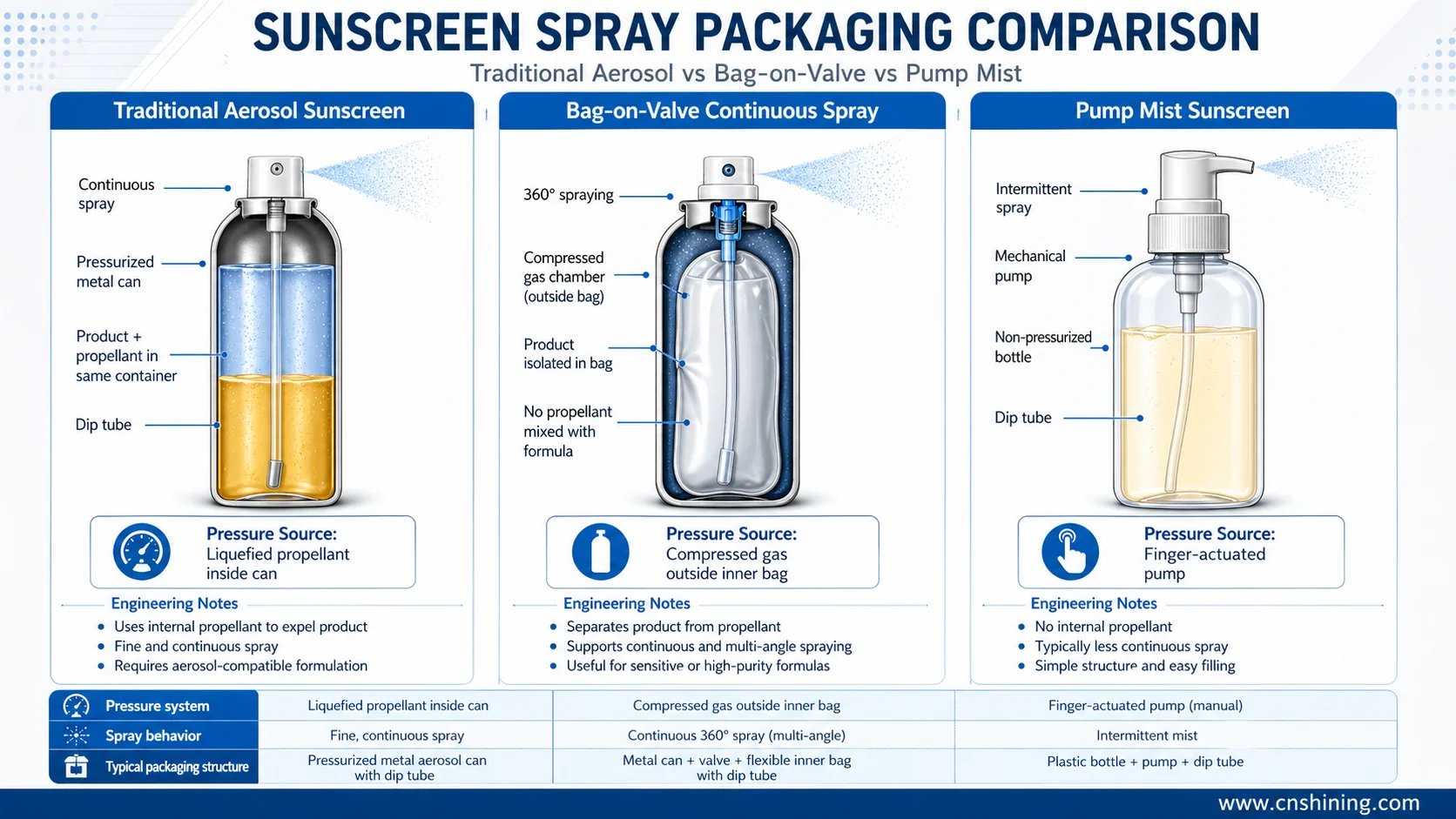
On retail shelves, the term “spray sunscreen” usually mixes three related formats: traditional pressurized aerosol sunscreen, bag-on-valve or compressed-gas continuous spray, and non-pressurized pump spray or fine mist. Consumers may see them as one category. Engineers should not. Their cost structure, inhalation risk, sustainability claim, filling process and regulatory burden are different.
1. What Counts as Sunscreen Aerosol?
In this article, sunscreen aerosol mainly refers to a product that uses a metal can, valve and actuator to atomize sunscreen liquid, emulsion or suspension under pressure. For commercial comparison, continuous non-aerosol sprays and pump mists are also included because brands often place them in the same “spray sunscreen” shelf language.
This distinction matters. A hydrocarbon-propelled aerosol, a compressed-air BOV pack and a fine mist pump may all produce sunscreen droplets, but they do not behave the same way during filling, shipment, hot storage, spraying, skin deposition or disposal.
| Commercial Format | Pressure / Delivery Logic | Engineering Meaning |
|---|---|---|
| Traditional aerosol sunscreen | Propellant contacts the product and drives discharge through valve and actuator. | Good fine spray and fast coverage, but flammability, inhalation and compatibility must be controlled. |
| BOV / compressed-gas continuous spray | Product is separated from compressed gas by a bag or barrier system. | Useful for 360° use, reduced propellant contact and higher-viscosity or more sensitive formulas. |
| Pump spray / fine mist | Mechanical pump creates spray without traditional aerosol propellant. | Better fit for daily use and face mists, but spray speed and coverage are usually lower. |
2. How Spray Sunscreen Works
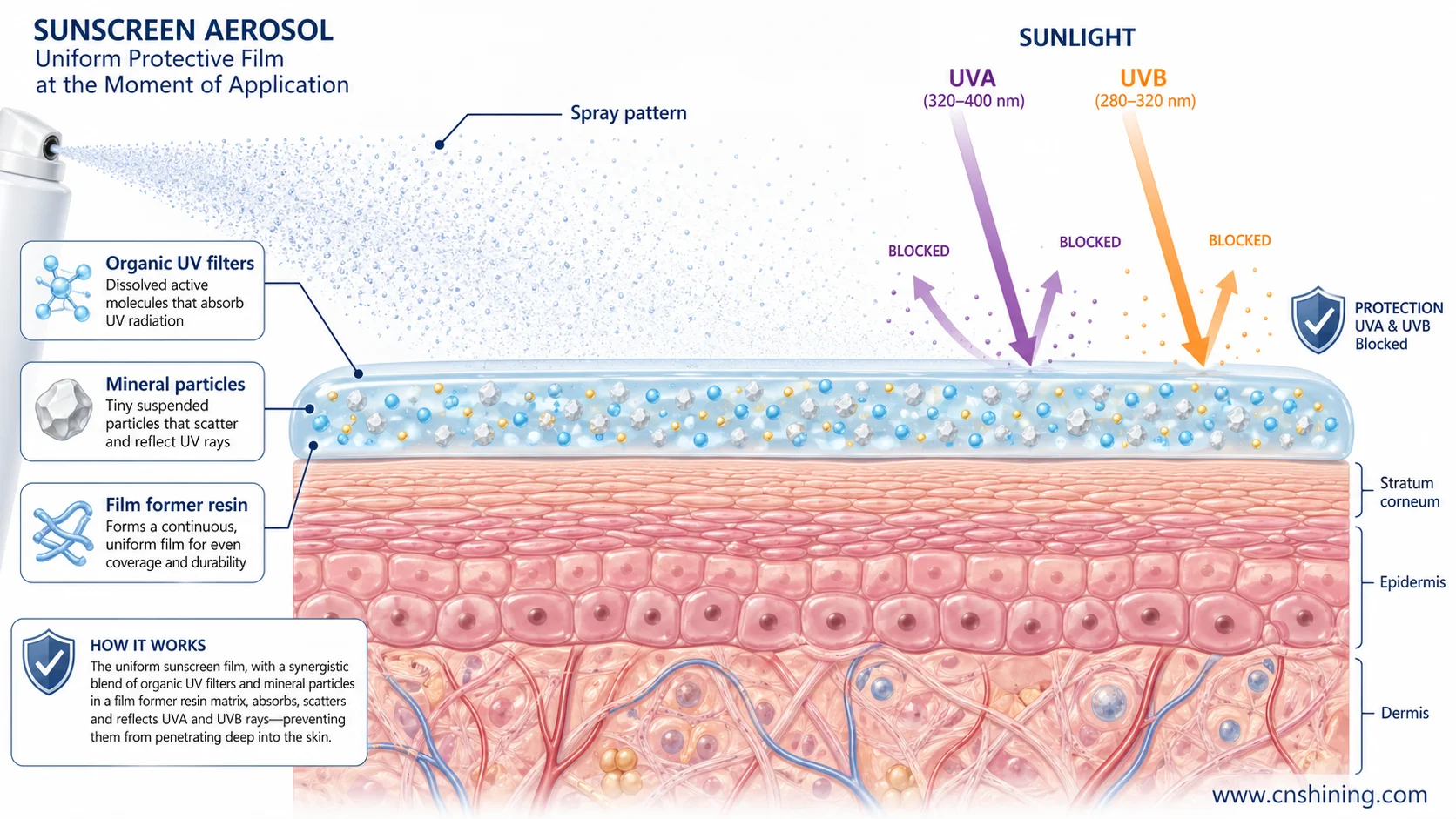
Sunscreen works by forming a functional film on the skin surface. That film must cover both UVA and UVB exposure. SPF mainly reflects UVB erythema protection, while broad-spectrum protection needs coverage across a wider UV range. Public health bodies continue to treat UV exposure as a skin cancer and photoaging risk, not only a summer cosmetic issue, as described by the WHO skin cancer protection guidance.
The old split between “physical sunscreen” and “chemical sunscreen” is too simple for spray products. Organic UV filters mainly absorb UV radiation and dissipate energy. Inorganic filters such as zinc oxide and titanium dioxide also absorb a large part of UV energy and provide some reflection and scattering. For spray sunscreen, the deciding factor is often not the filter family alone. It is whether the product can create enough uniform film on skin.
A spray system adds more variables than a lotion. Droplets leave the actuator, travel through air, partially evaporate, land on skin, spread, and then form a film. Wind, spray distance, nozzle angle, user impatience and failure to rub in can all reduce real protection.
3. Market Size and Competitive Structure
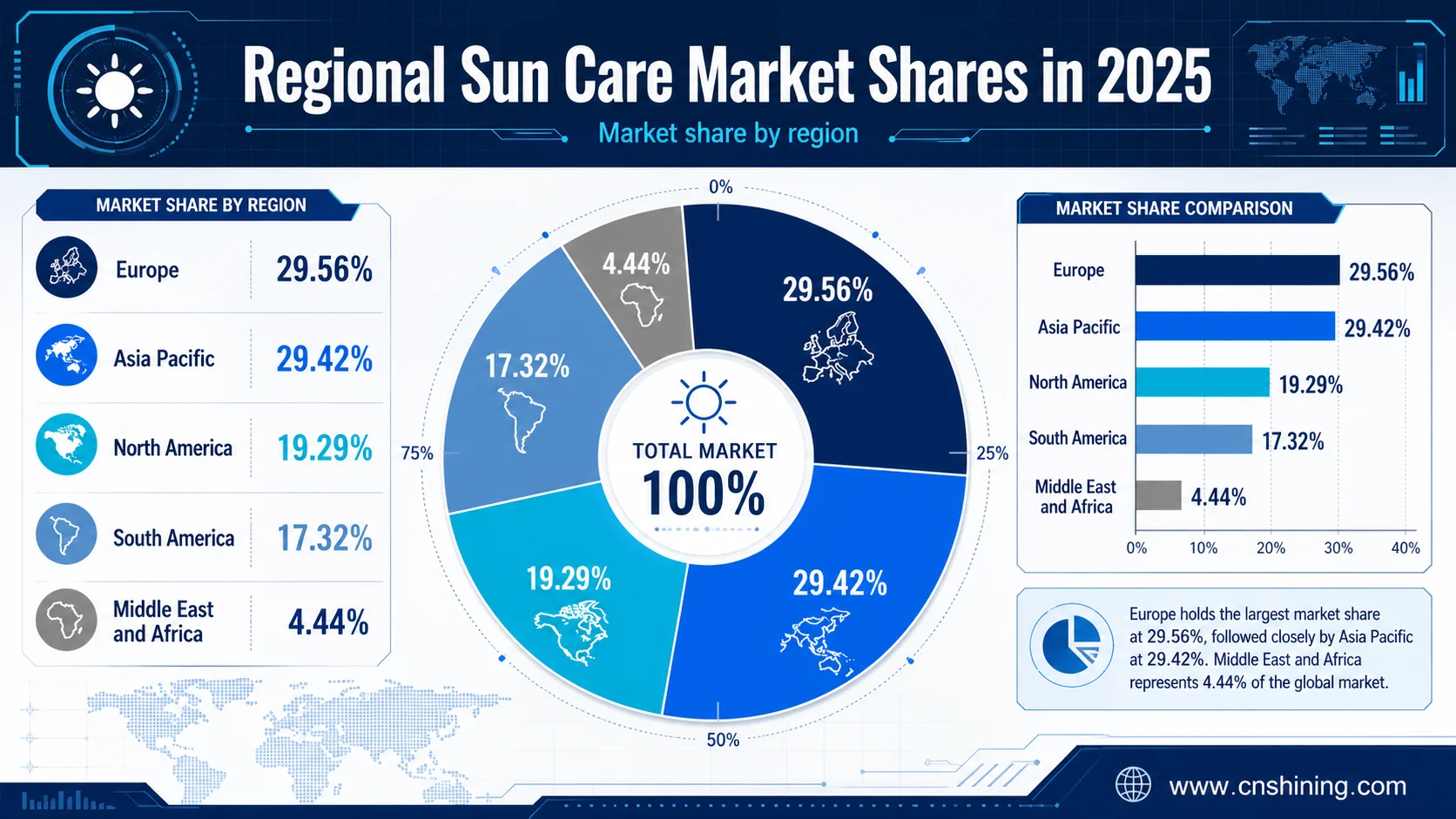
The broader sun care market remains a medium-growth category. One public estimate places the global sun care products market at USD 12.44 billion in 2024 and projects USD 15.92 billion by 2030, while another estimates USD 15.47 billion in 2025, rising to USD 25.63 billion by 2034. See the public market summaries from Grand View Research and Fortune Business Insights.
| Region | 2025 Market Size (USD Billion) |
2025 Share | 2035 Baseline Scenario (USD Billion, author extrapolation) |
|---|---|---|---|
| Europe | 4.57 | 29.56% | 8.02 |
| Asia Pacific* | 4.55 | 29.42% | 7.99 |
| North America | 2.98 | 19.29% | 5.23 |
| South America | 2.68 | 17.32% | 4.71 |
| Middle East & Africa | 0.69 | 4.44% | 1.21 |
| Global | 15.47 | 100% | 27.16 |
Cream and lotion remain the largest sunscreen forms. Spray sunscreen is not the largest format, but it keeps attracting development because users want quick body coverage, easy reapplication, sports use, beach use and makeup-over SPF misting. High SPF, mineral sunscreen, sunscreen plus skincare, online reviews and short video demonstrations keep this subcategory active.
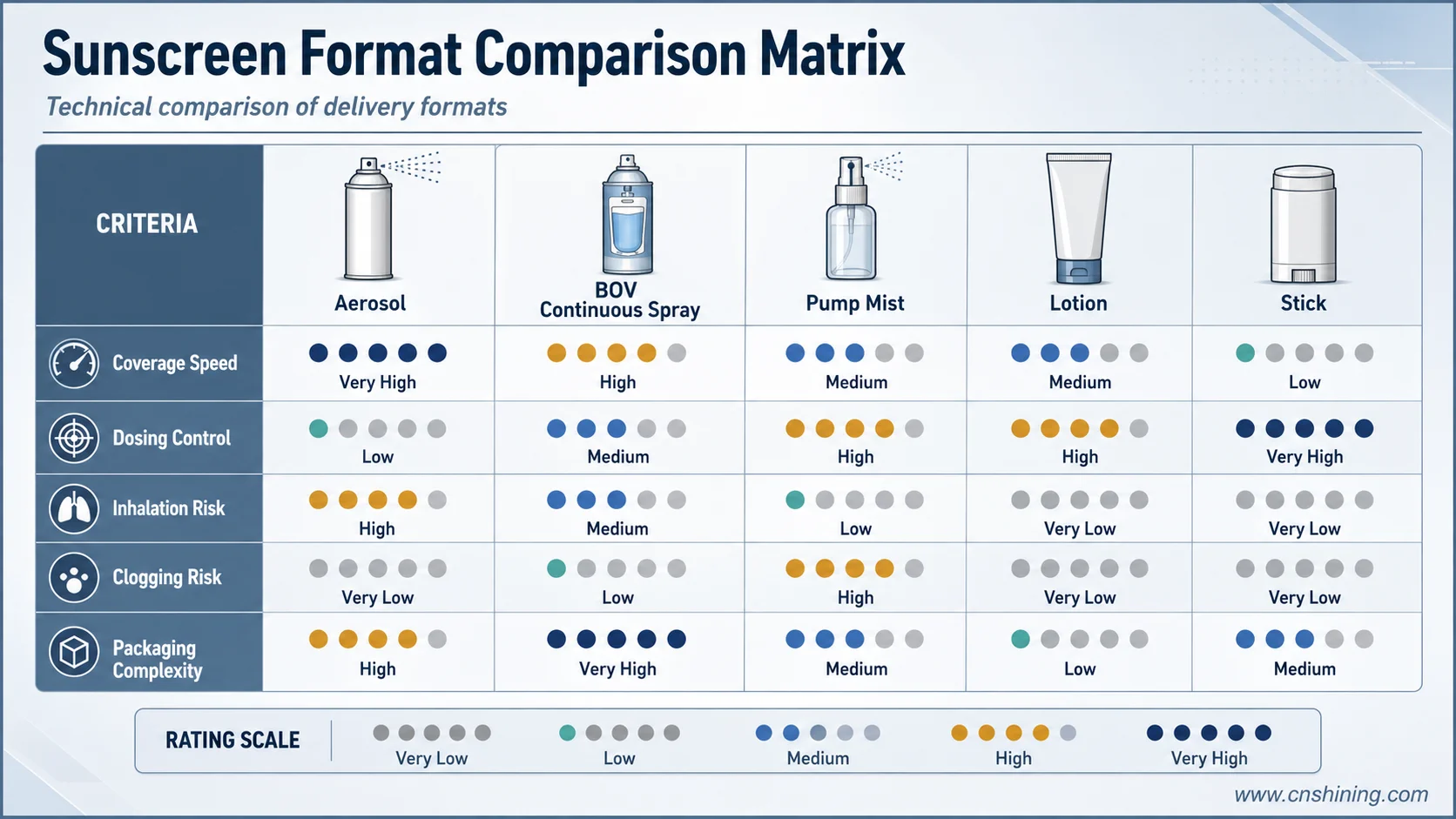
4. Aerosol, BOV, Pump Mist, Cream and Stick: Form and Engineering Comparison
Spray sunscreen has clear user benefits: fast large-area coverage, easier back application, quick drying, cleaner hands and convenient reapplication. The same benefits create the failure modes. People spray too fast, apply too little, skip rubbing, spray in wind, spray near the face or use the product in poorly ventilated spaces.
| Format | Advantages | Weaknesses | Best Fit | Packaging / Engineering Difficulty |
|---|---|---|---|---|
| Traditional aerosol | Fast coverage, quick drying, transparent light feel, good for body and sport reapplication. | Inhalation and drift risk, flammability, under-application, valve failure can waste half a can. | Beach, sport, seasonal body reapplication. | Valve-actuator match, propellant compatibility, internal coating, spray pattern consistency. |
| BOV / compressed gas continuous spray | 360° use, reduced propellant contact, better fit for higher-viscosity or skincare-like systems. | Higher packaging cost, more complex filling, spray pattern still needs careful design. | Mineral, sensitive skin, premium sport and sustainability-positioned products. | Bag material, weld reliability, gas tightness, residual rate. |
| Pump spray / non-pressurized mist | Good for daily use, face mist and makeup reapplication; inhalation concern can be easier to manage. | Coverage speed is usually lower than pressurized aerosol; droplets can be coarse. | Daily reapplication, face mist, portable SPF. | Fine mist pump clogging, leakage, cap damage, transport protection. |
| Lotion / cream | Easier dose control, more predictable film, mature testing path. | Slow application, oily feel, sticky hands, weaker body reapplication convenience. | Children, face, accurate dosing, core sun protection base. | Pump or tube selection, skin feel, water resistance balance. |
| Stick | Portable, precise for nose, ears, lips and small areas, low leakage risk. | Poor full-body efficiency; missed edges are common. | Outdoor spot reapplication, travel, children’s targeted areas. | Stick breakage, softening, turn-up mechanism, heat stability. |
The practical conclusion is simple: spray sunscreen should not be judged only by sensory feel. It must be judged by whether the system helps the user apply enough product in a repeatable way.
5. Formulation, Process and Safety
5.1 Active system types
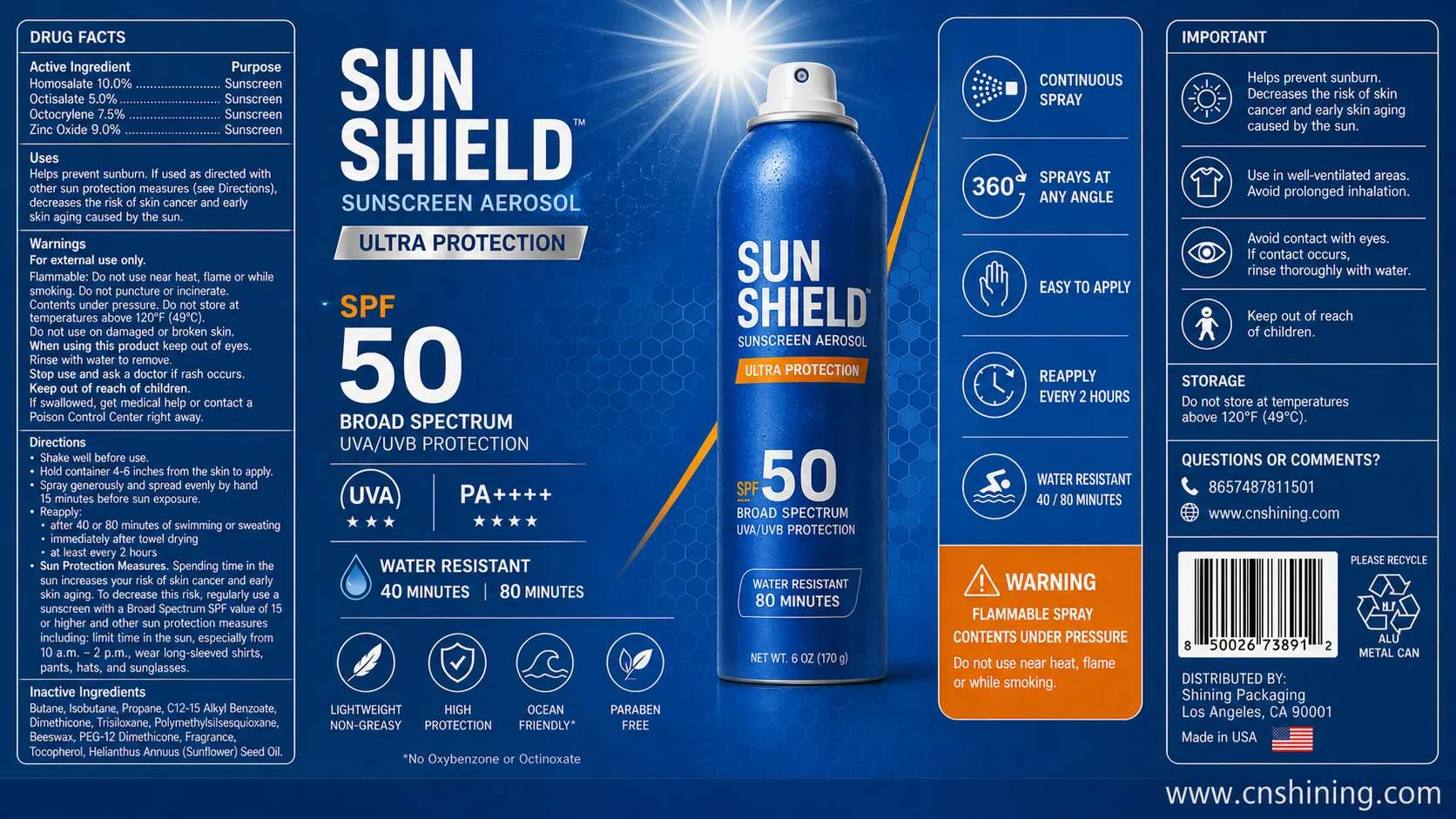
Sunscreen aerosol formulas can be grouped into three active systems: chemical or organic filters, mineral filters and mixed systems. Chemical systems usually absorb UV energy and release it as heat. Mineral systems use zinc oxide and titanium dioxide and are usually described through reflection, scattering and partial absorption. Mixed systems are common in high SPF commercial products because they can balance UVA and UVB coverage, film feel and photostability.
US OTC concentration limits historically include avobenzone up to 3%, octinoxate up to 7.5%, octisalate up to 5%, octocrylene up to 10%, oxybenzone up to 6%, homosalate up to 15%, zinc oxide up to 25% and titanium dioxide up to 25%. The eCFR sunscreen active ingredient page is useful background, even though aerosol manufacturability is a separate issue.
| Type | Representative Actives | Common Industry Range | Main Strengths | Aerosol Design Meaning |
|---|---|---|---|---|
| Chemical filter system | Avobenzone, octocrylene, octisalate, octinoxate, homosalate | About 8% to 25%, depending on SPF target and local rules | Clear, dry-feel, easy to make light textures | Better fit for transparent body aerosol; must manage photostability, alcohol feel and ingredient concerns |
| Mineral filter system | Zinc oxide, titanium dioxide | About 10% to 25% | Broad-spectrum image, often preferred for sensitive-skin positioning | Higher risk of white cast, sedimentation and valve clogging; often better suited to BOV, pump spray or lotion |
| Hybrid system | Chemical + mineral or multi-chemical blend | Depends on SPF and UVA target | Flexible route to high SPF and high UVA-PF | Needs stronger solvent balance, film-former design and compatibility testing |
5.2 Excipients, propellants and typical levels
A commercial sunscreen aerosol rarely succeeds because of the UV active alone. The carrier, film former, propellant and valve system must work together.
| Component Group | Common Materials | Typical Level | Function | Design Note |
|---|---|---|---|---|
| Volatile carrier | Alcohol denat., isododecane, light hydrocarbons, volatile silicone | 10% to 60% | Fast drying, lower viscosity, better atomization | High alcohol feels clean but may sting around eyes or damaged skin |
| Emollient / solvent oil phase | C12-15 alkyl benzoate, butyloctyl salicylate, dibutyl adipate | 5% to 40% | Dissolves UV filters and improves spreading | One of the main drivers of oily or sticky after-feel |
| Film former | Acrylates copolymers, VP/eicosene copolymer, polyurethane or hydrocarbon film formers | 0.5% to 5% | Water resistance, sweat resistance, rub-off control, SPF retention | This is what turns a mist into a functional film |
| Dispersion / suspension system | Silica, clays, cellulose derivatives, polymeric suspending agents | 0.1% to 3% | Controls settling, agglomeration and valve blockage | High ZnO or TiO2 systems depend heavily on this part |
| Antioxidant / chelator | Tocopherol, BHT, EDTA | 0.05% to 1% | Limits oxidation, discoloration and degradation | Useful for fragrance and octocrylene-containing systems |
| Propellant | Propane, butane, isobutane, DME; air, nitrogen or CO2 in BOV | 15% to 70% in many traditional aerosols | Provides pressure and atomization | High propellant can feel lighter but makes effective sunscreen dose harder to sense |
5.3 Manufacturing and compatibility
A typical development route starts with a UV filter oil phase or mineral dispersion. Inorganic powders may need high shear or milling to reduce agglomerates. Film formers, volatile carriers and stabilizers are then adjusted. The lab then checks viscosity, spray visual, package compatibility, valve output, leakage, corrosion, stability, SPF, UVA and water resistance.
The hard part is often not the mixing tank. It is the three-way compatibility between formula, internal coating and valve elastomer. High alcohol, high ester, high salt, acidic dispersants or high ZnO/TiO2 loading can stress the can lining, gasket and valve channel. In traditional aerosol systems, the propellant is also part of this compatibility system.
5.4 Safety concerns
Use safety has two recurring topics: inhalation and misuse. Consumers should not spray directly into the face. Spray-to-hand, then apply to the face, is a safer use pattern. Children add another risk layer because they are more likely to inhale drifting mist.
System safety includes flammable propellant, impurity control, photodegradation and formula separation. Propellant impurity control should sit in the supplier specification, not only in the regulatory file. Benzene-related sunscreen spray recalls showed that contamination risk may come from the propellant or supply chain, not only from UV active selection.
6. Regulatory Testing and Label Claims
| Market | Regulatory Position | Active / Filter Framework | Key Label Requirements | Testing and Claim Notes |
|---|---|---|---|---|
| United States | OTC drug | OTC monograph framework; bemotrizinol proposed with spray limits tied to pump or BOV support | Broad Spectrum SPF X or SPF X; water resistance limited to 40 or 80 minutes; warning needed for SPF below 15 or failed broad-spectrum test | SPF is in vivo; broad-spectrum relies on in vitro critical wavelength at 370 nm or higher; reapply instructions remain central |
| European Union | Cosmetic under Regulation 1223/2009 | UV filters must be permitted | Should avoid sunblock, 100% protection and all-day prevention type language | Recommendation framework commonly uses SPF 6 minimum, UVA-PF at least one third of SPF and critical wavelength at least 370 nm |
| China | Special cosmetics path for sunscreen | Permitted sunscreen agents managed under cosmetic safety technical specifications | SPF, broad-spectrum and PA claims follow measured results and allowed label rules | SPF, PFA and water resistance testing are part of claim support |
| Australia | Primary sunscreens usually therapeutic goods | Therapeutic sunscreens must use permitted ingredients and meet TGA requirements | AUST L often appears on therapeutic sunscreen labels; excluded secondary sunscreens have limits | Spray sunscreens should include a warning not to inhale. See TGA sunscreen regulation in Australia. |
| Japan | Cosmetic; JCIA standards widely used | SPF follows ISO 24444; UVA follows ISO 24442; water resistance follows ISO 18861 | PA grades are based on UVAPF thresholds; water resistance stars are now standardized | 40-minute and 80-minute water immersion correspond to water resistance star levels |
For packaging teams, regulation changes the physical brief. Dose guidance, face-use warning, direction of spray, lockable actuator and reapplication graphics now act like functional label components. They are not decoration.
7. Top 10 Sunscreen Spray Brands
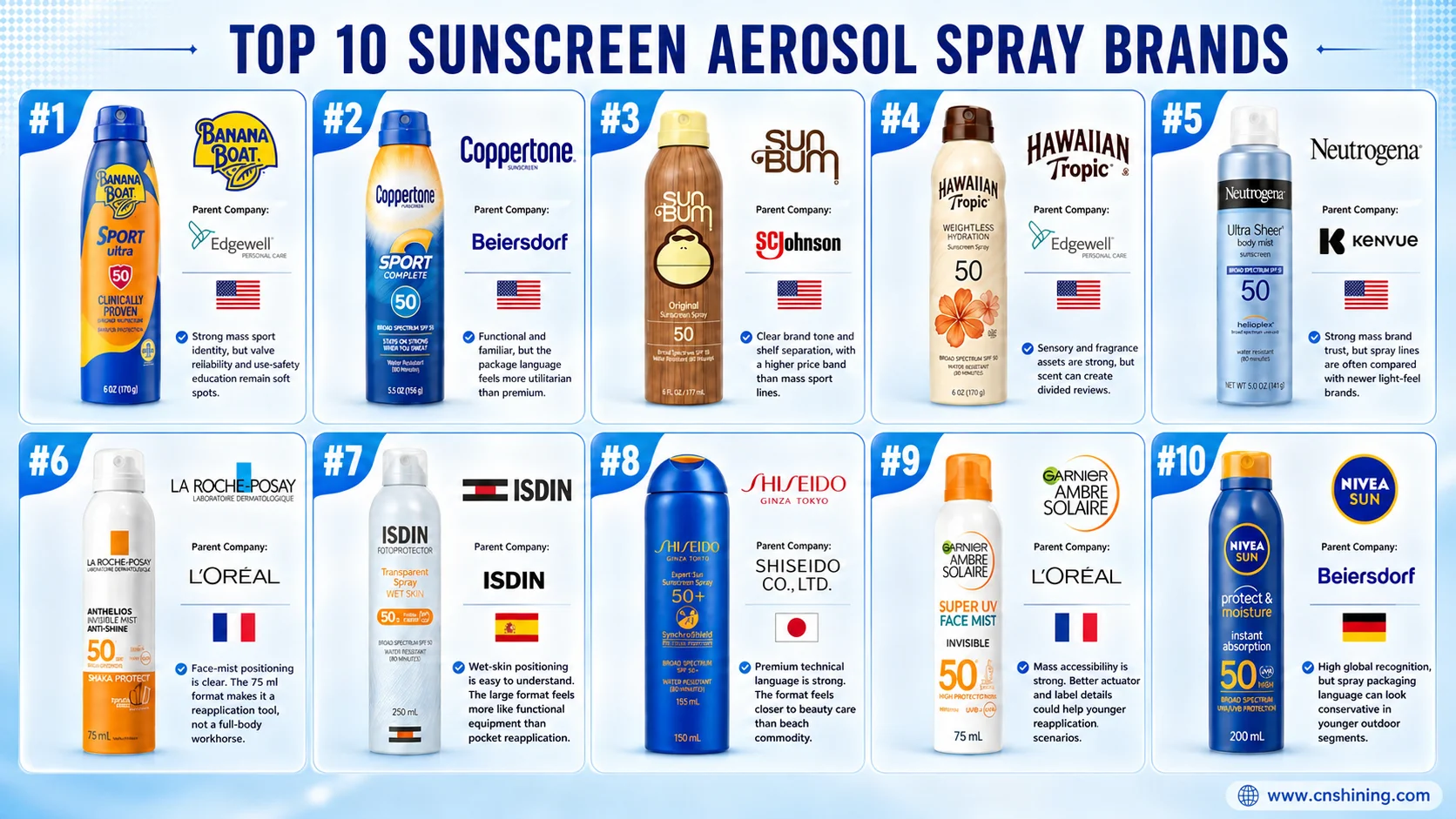
The following table is not a strict global sales ranking. It is a brand sample set based on public visibility, spray category presence, parent-company resources and cross-market awareness. .
| Brand | Country / Region | Parent Company | Representative Spray SKU | Public Price Snapshot | Packaging Comment |
|---|---|---|---|---|---|
| Banana Boat | United States | Edgewell Personal Care | Sport Ultra Spray, commonly 6 oz | USD 10.97 | Strong mass sport identity, but valve reliability and use-safety education remain soft spots. |
| Coppertone | United States | Beiersdorf | Sport / Complete Spray, commonly 5.5 oz | USD 8.26 | Functional and familiar, but the package language feels more utilitarian than premium. |
| Sun Bum | United States | SC Johnson | Original Spray, commonly 6 oz | USD 17.48 | Clear brand tone and shelf separation, with a higher price band than mass sport lines. |
| Hawaiian Tropic | United States | Edgewell Personal Care | Weightless / Silk Hydration Spray, commonly 5.5 to 6 oz | Price varies by region and channel | Sensory and fragrance assets are strong, but scent can create divided reviews. |
| Neutrogena | United States | Kenvue | Spray series, commonly 5 to 6.5 oz | Region-dependent retail pricing | Strong mass brand trust, but spray lines are often compared with newer light-feel brands. |
| La Roche-Posay | France | L’Oréal | Anthelios Invisible / Anti-Shine Mist, commonly 75 ml | GBP 10.50 to GBP 18.50 | Face-mist positioning is clear. The 75 ml format makes it a reapplication tool, not a full-body workhorse. |
| ISDIN | Spain | ISDIN | Transparent Spray Wet Skin, 250 ml | EUR 21.78 to 35.84 | Wet-skin positioning is easy to understand. The large format feels more like functional equipment than pocket reapplication. |
| Shiseido | Japan | Shiseido Co., Ltd. | Ultimate / Expert Sun Spray, commonly 150 ml | Regional price varies | Premium technical language is strong. The format feels closer to beauty care than beach commodity. |
| Garnier Ambre Solaire | France | L’Oréal | Face mist / spray, commonly 75 to 200 ml | Region-dependent pricing | Mass accessibility is strong. Better actuator and label details could help younger reapplication scenarios. |
| NIVEA Sun | Germany | Beiersdorf | Protect & Moisture / Spray, commonly 200 ml | Region-dependent pricing | High global recognition, but spray packaging language can look conservative in younger outdoor segments. |
8. Consumer Feedback: Why Spray Sunscreen Fails
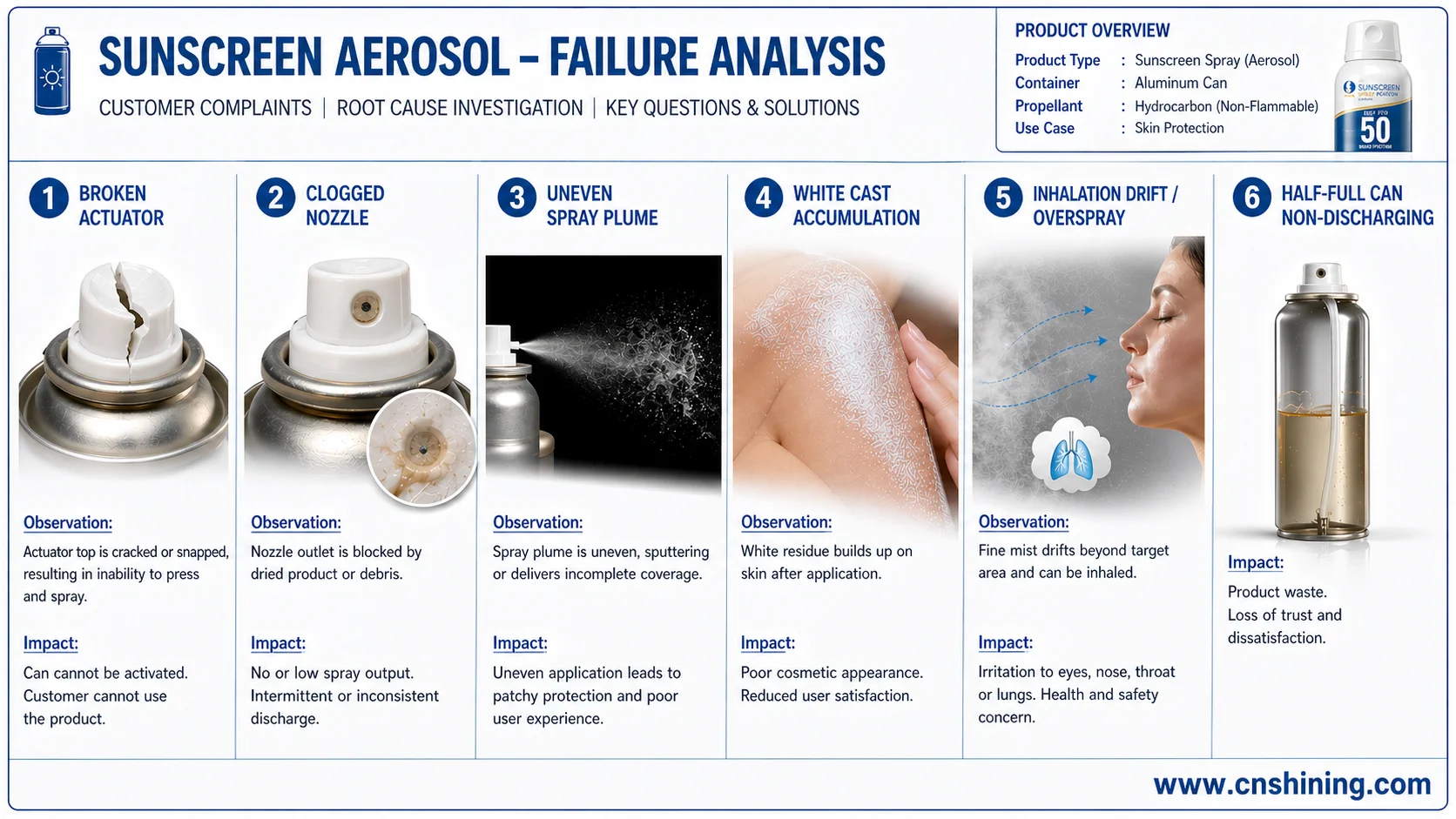
Consumer complaints point in the same direction: packaging and application context cause many failures. The active ingredient list matters, but a clogged actuator or broken nozzle can destroy the whole use experience before SPF performance is even considered.
| Pain Point | Typical Public Feedback Theme | Engineering Interpretation |
|---|---|---|
| Nozzle / valve failure | Nozzle broke early; can still contains product. | Assembly tolerance, cap protection, actuator resin toughness and transport impact need review. |
| Repeated actuator breakage | Half a can left but spray stops. | This is one of the fastest ways to lose trust in aerosol sunscreen. |
| Mineral or high-viscosity spray cannot discharge | Too thick to spray properly. | Solid loading, emulsion viscosity and stem/orifice size are not matched. |
| Oiliness and harsh odor | Very oily, chemical smell, glue-like odor. | Volatile solvent, fragrance, oil phase and propellant balance are off. |
| Clogging | Nozzle keeps getting clogged. | Mineral deposition, drying at the nozzle and lack of self-cleaning design can amplify the issue. |
| Inhalation concern | User feels they are breathing in sunscreen. | Fine droplets, wind, indoor use and face spraying increase exposure concern. |
| Uneven coverage | Streaky protection if spray is not layered or rubbed in. | Spray pattern and user education fail together. |
| Strong fragrance polarity | Some users like makeup-over misting; others find tropical fragrance too strong. | Beauty-style mists are judged like fragrance products, not only SPF products. |
From a product management view, sunscreen aerosol has lower tolerance for functional failure than lotion. If a lotion feels oily, the user may still use it. If an aerosol does not spray, sprays everywhere, smells harsh, or feels unsafe to breathe, the user questions the whole format.
9. Packaging Improvements and 3–5 Year Trends
The most useful improvements are not cosmetic color changes on the cap. They come from system-level design: valve, actuator, can, coating, gasket and formula must be developed together. Modern actuator platforms already point in this direction. Twist-to-lock, dual trigger operation, spray insert options and optional 360° dispensing with BOV.
Material compatibility also needs more attention. Alcohol, fragrance, UV filters and oils may interact with gaskets, valve components, printed surfaces and internal can coatings. Metal aerosol cans are recyclable, but the internal coating is not decorative. It protects the container and reduces product-metal interaction. BPA-NI and higher-compatibility coating systems are becoming more relevant as regulations and brand requirements move.
| Packaging / Structure Improvement | Main Problem Addressed | Best Formula Route | Cost / Caution |
|---|---|---|---|
| 360° BOV + compressed gas | Any-angle use, reduced hydrocarbon contact, better high-viscosity discharge. | Premium sport spray, mineral spray, sensitive-skin products. | Higher packaging and filling cost; residual rate must be controlled. |
| Lockable hoodless actuator | Accidental discharge, lost overcap, actuator breakage in e-commerce. | Online-heavy brands, travel sizes, sport packs. | Wet-hand and one-hand operation still need validation. |
| Anti-clog nozzle / larger stem / filtration | ZnO/TiO2, high-solid and lotion spray clogging. | Mineral suspension spray, spray lotion. | Spray pattern must be redesigned; “larger hole” alone is not enough. |
| BPA-NI or high-compatibility internal coating | Interaction between formula and metal wall or coating system. | All long-shelf-life aerosol sunscreen products. | Longer development cycle, but fewer batch surprises. |
Five trends are likely to shape the next 3–5 years. Mineral sunscreen sprays will keep growing, but the white-cast, clogging and inhalation issues must be solved together. If bemotrizinol is finalized in the U.S., broader-spectrum and lighter-feel formulas may gain room. BOV, compressed-air and non-aerosol narratives will keep gaining ground in premium and sensitive-skin lines. Short video will expose bad spray behavior faster. Channels will split: mass retail for fast body coverage, pharmacy for sensitive-skin claims, social commerce for makeup reapplication and lifestyle use.
10. Shining Packaging: Actuators, Aerosol Cans and Valves for Sunscreen Spray Systems
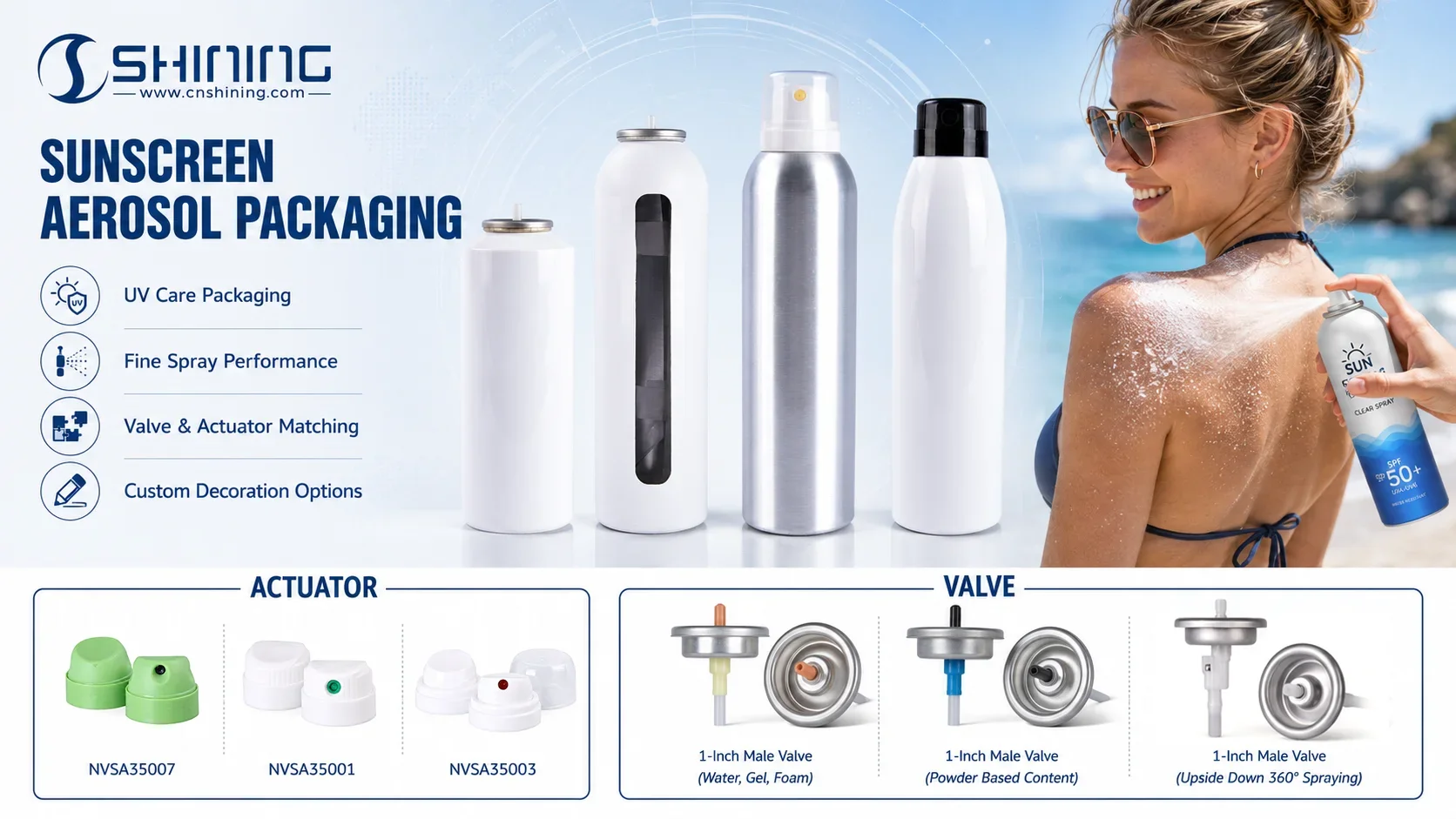
For Shining Packaging, the relevant engineering zone is the discharge path. SPF claims sit with the formula owner and testing lab. Packaging decides whether the formula leaves the can in a usable way. In sunscreen aerosol, that means actuator comfort, valve flow, spray insert selection, can compatibility, internal coating choice and transport reliability.
A sunscreen aerosol project should usually begin with three checks. First, does the valve and actuator combination produce the required spray pattern without excessive drift? Second, does the can and internal coating tolerate alcohol, fragrance, UV filters, oils and propellant during accelerated aging? Third, does the actuator survive shipment, wet-hand use and repeated consumer operation without breaking or clogging?
Shining Packaging can place its aerosol cans, valves and actuators into this discussion as engineering components, not as decoration. For transparent chemical sprays, the priority is compatibility and repeatable fine spray. For mineral or spray-lotion systems, the priority shifts toward clog resistance, flow control and residual rate. For BOV-style development, sealing reliability and any-angle discharge become the working questions.
11. Conclusion: What Packaging Teams Should Prioritize
The near-term direction is clear. Sunscreen aerosol will keep its place because it solves real use problems: large-area application, fast reapplication, back coverage and sport or beach convenience. The failure points are also clear: under-application, inhalation concern, flammability, mineral clogging, white cast and unreliable actuators.
The better engineering bet for 2026-2030 is not stronger propellant or a more invisible mist by default. It is BOV and continuous pump routes where appropriate, lower-clog valves, controlled spray patterns, better dose visualization, coating compatibility and supplier-level impurity control. In this category, packaging is not a container afterthought. It is part of the sunscreen delivery system.
12. FAQ: Sunscreen Aerosol Technical Questions
Sunscreen lotion mainly depends on formula spreadability and user dosing. Sunscreen aerosol adds a delivery system: propellant, valve, actuator, spray insert, can coating and droplet behavior. The protection film still needs enough product on skin, but the route to that film is less direct. Drift, evaporation and uneven spray can reduce real coverage.
Direct face spraying increases the chance of inhaling droplets and overspraying into the eyes, nose or mouth. U.S. aerosol sunscreen labels commonly instruct users to spray into hands first, then apply to the face. This is not just legal wording. It reflects a real exposure issue created by fine droplets near breathing zones.
SPF is tested under controlled application conditions. Real aerosol use often involves short spray time, wind, long spray distance, uneven pass patterns and no rubbing after application. The result may be a thin or broken film. A high SPF value cannot compensate for insufficient deposited mass or poor film continuity on the skin.
Mineral sprays contain zinc oxide or titanium dioxide particles. These particles can settle, agglomerate or dry around the nozzle. If viscosity, dispersant package, valve orifice and actuator insert are not matched, the product may spray unevenly or stop spraying. Mineral aerosol design needs particle stability and discharge-path design together.
BOV is useful when the formula benefits from separation from the propellant or needs any-angle spraying. It can help mineral, sensitive-skin or higher-viscosity systems. It is not automatically better. Cost, filling complexity, bag material, seal reliability, spray pattern and residual rate must be validated for the specific sunscreen formula.
Useful tests include spray rate, spray pattern, droplet size distribution, actuator force, actuator drop and impact resistance, valve leakage, hot storage, cold storage, transport vibration, residual content and compatibility with alcohol, fragrance, oils, UV filters and propellant. Testing with water is not enough for sunscreen formulas.
Sunscreen formulas may contain alcohol, oils, fragrance, UV filters, emulsifiers or suspended particles. These materials can interact with bare metal or with a weak coating system. Internal lacquer helps reduce corrosion and product-metal interaction. For long shelf life, coating choice should be checked by accelerated aging with the final formula.
White cast usually comes from visible mineral particles on the skin, mainly zinc oxide or titanium dioxide. Poor dispersion, large particles, local over-deposition and uneven spray pattern can make it worse. It is not only a formula issue. A nozzle that concentrates a mineral suspension in spots can create stronger white or gray patches.
The actuator is the part consumers touch, press and blame when spraying fails. If it breaks, clogs, leaks or sprays in the wrong direction, the formula cannot show its value. In aerosol sunscreen, actuator reliability directly affects perceived product quality because a half-full can that cannot spray feels like product waste.
Start with formula type, viscosity, solids content and target spray feel. Then select valve, actuator and can structure around that formula. Run compatibility, spray pattern and stability tests before final artwork or claim language. Packaging should not be selected after the formula is finished; it is part of the performance system.