
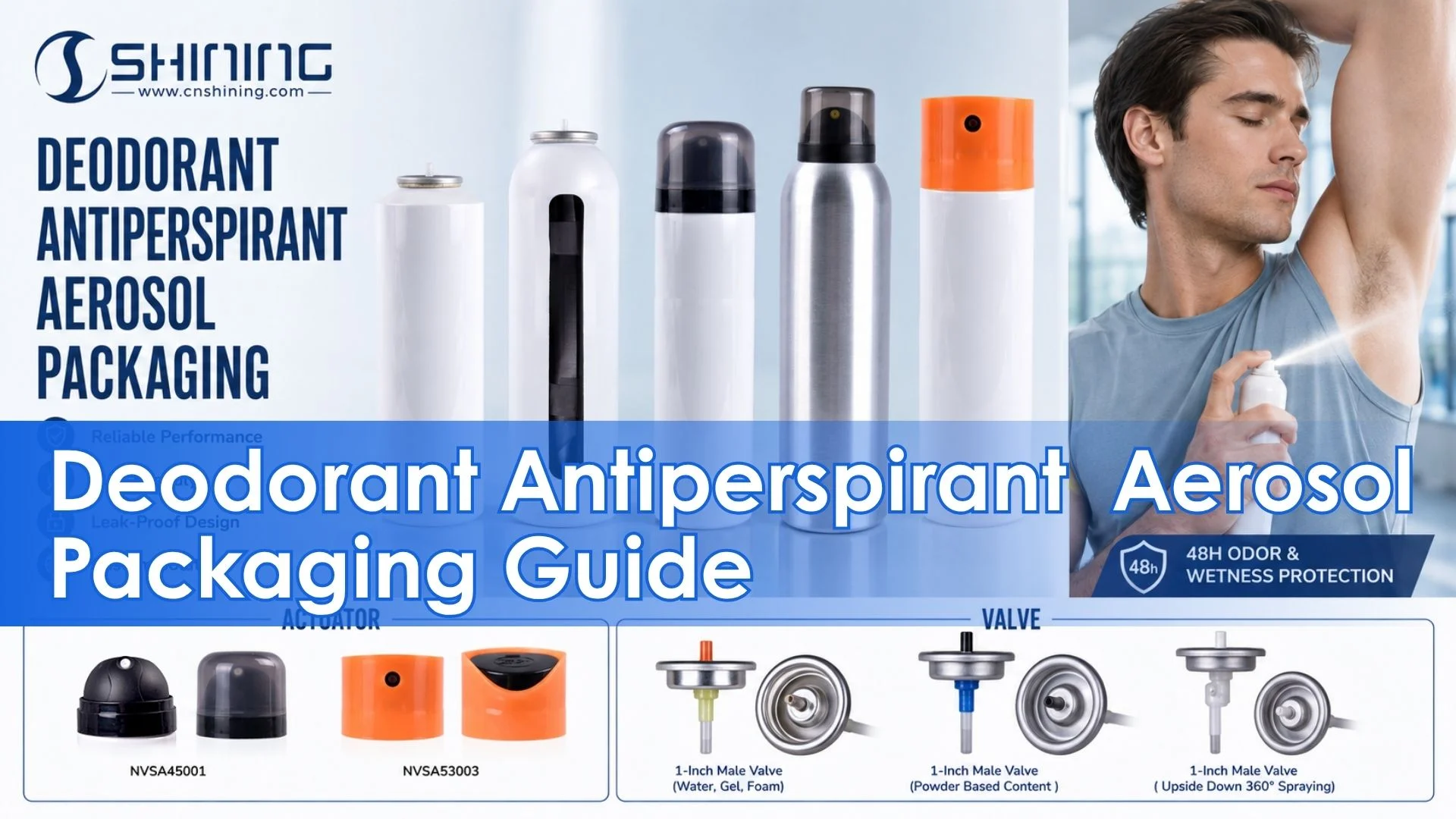
Deodorant aerosol and antiperspirant aerosol are often placed on the same shelf, but they are not the same product from a formulation, packaging or regulatory point of view. A deodorant aerosol mainly manages odor. An antiperspirant aerosol reduces sweat. One spray can also do both, which is where label claims, OTC drug rules, formula stability and aerosol hardware start to overlap.
The practical lesson is simple. A good dry spray is not built by fragrance alone. It is built through the fit between active system, carrier, propellant, valve, actuator, can body and internal coating. If that match is weak, consumers see the same failures again and again: clogged nozzles, stuck buttons, choking powder clouds, white marks, corrosion, residual product and cans that stop spraying halfway.
1. Definition, Function and Delivery Format
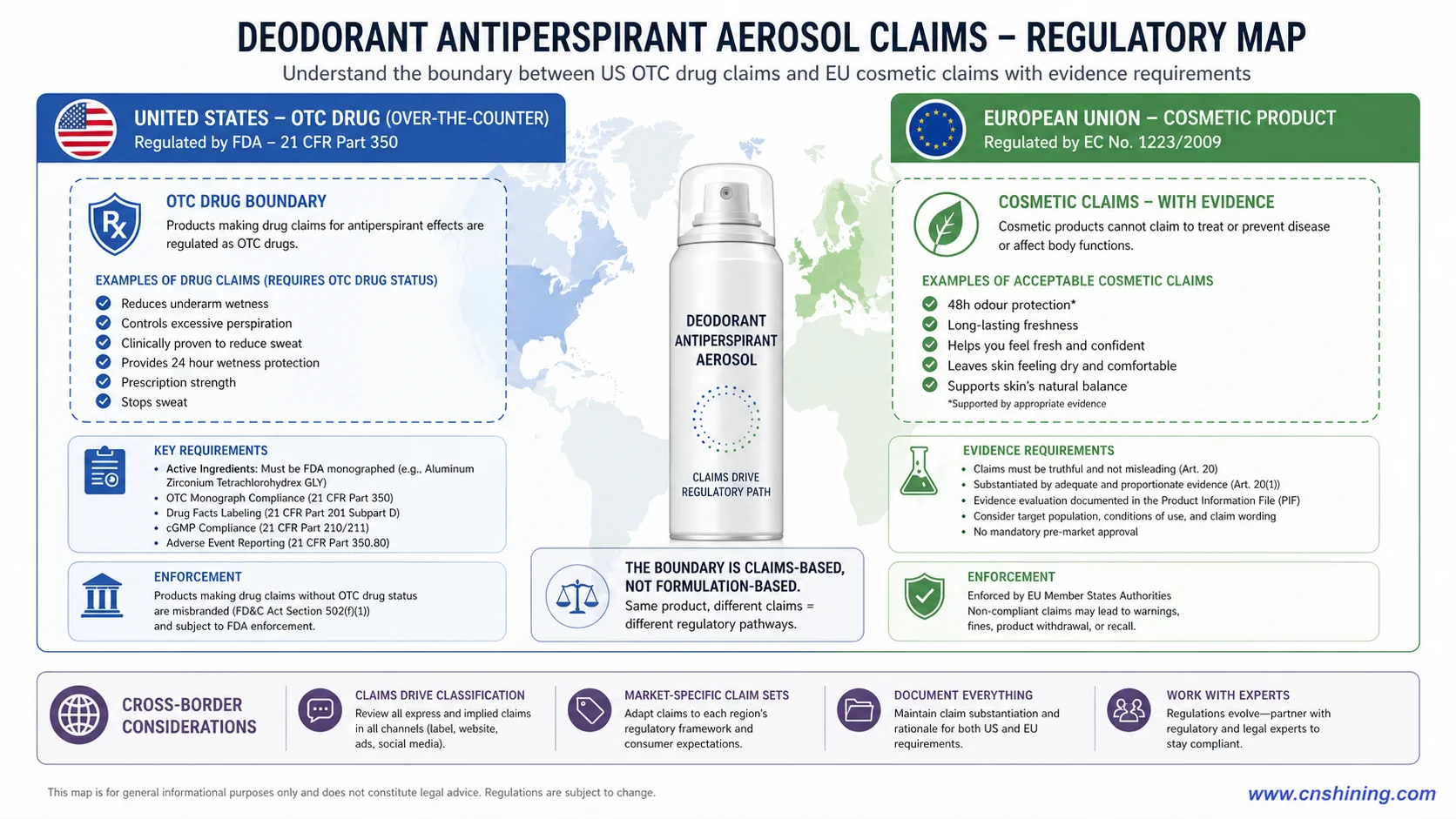
Under the U.S. framework, deodorant is generally treated as a cosmetic when its purpose is odor control. Antiperspirant is treated as an OTC drug when its purpose is sweat reduction. The FDA OTC Monograph M019 for antiperspirant drug products defines antiperspirant as a topical drug product that reduces perspiration at the applied site.
In the EU, deodorant and antiperspirant products are usually handled under cosmetic frameworks, but claims still need evidence. “72h protection”, “clinical strength”, “anti-white mark” and “sensitive skin” are not decoration. They need test logic, claim files and packaging warnings that match the market.
How the mechanisms differ
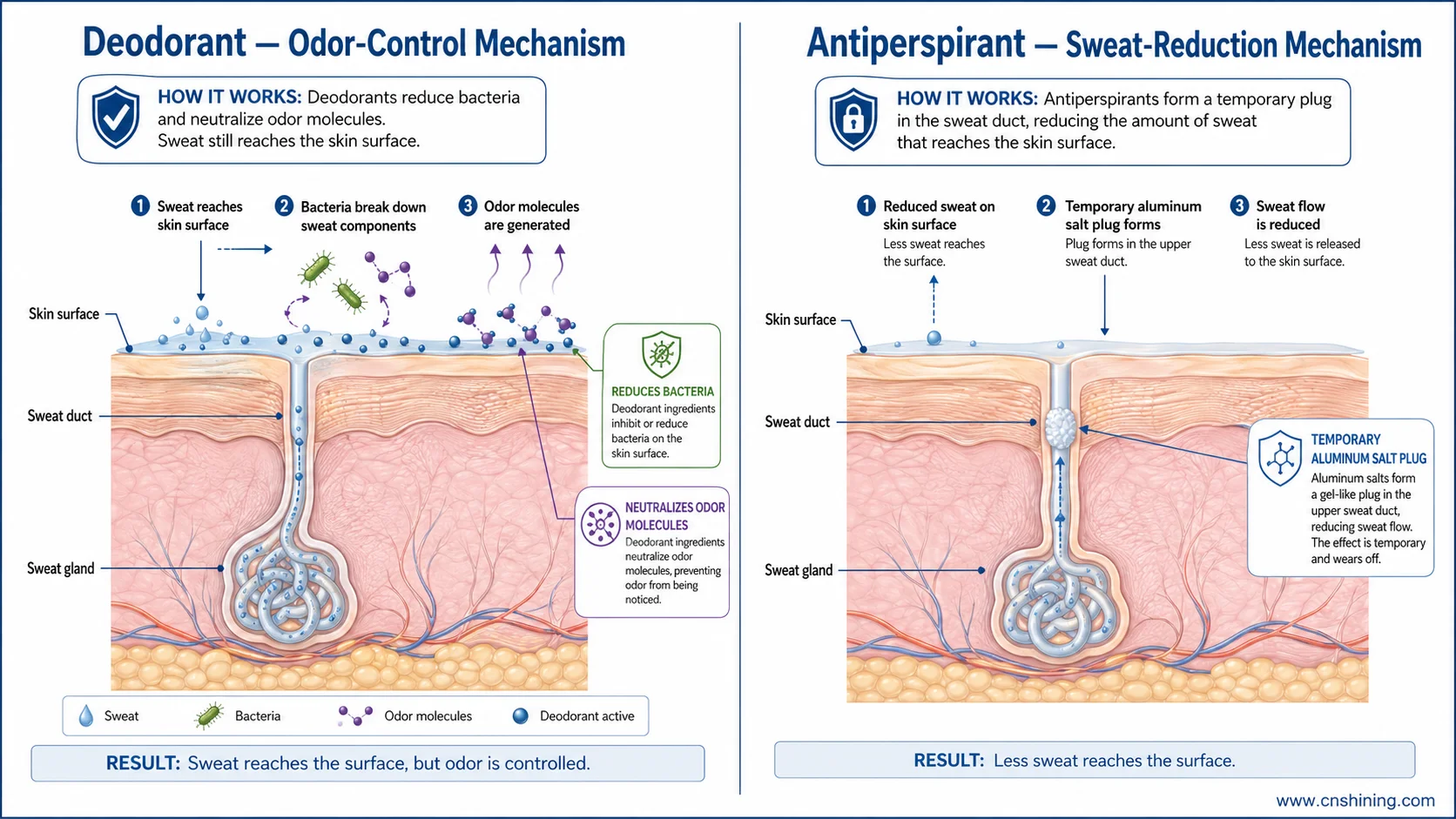
Antiperspirant efficacy comes mainly from aluminum salts or aluminum-zirconium systems. These interact with sweat and proteins to form a temporary, shallow plug at the sweat duct opening. This is not permanent gland closure. Deodorant works differently. It may use alcohol, antimicrobial systems, zinc salts, odor absorbers or fragrance masking to control odor generation and perception.
The RSC microfluidics study on aluminum salt sweat-pore plugging is useful here because it explains why particle behavior, sweat environment and deposition pattern matter. The active must reach the skin in the right state. That is why aerosol delivery design is part of efficacy.
| Dimension | Deodorant Aerosol | Antiperspirant Aerosol | Design Meaning |
|---|---|---|---|
| Core benefit | Odor control, freshness, fragrance experience | Sweat reduction, odor control, garment protection | Deodorant is more sensory. Antiperspirant is more efficacy-driven. |
| Typical active system | Alcohol, fragrance, zinc salts, odor absorbers, antimicrobial systems | Aluminum salts, aluminum-zirconium salts | Antiperspirants have higher risk of white marks, valve clogging and claim restrictions. |
| Regulatory role | Mostly cosmetic | OTC drug in the U.S.; cosmetic in many other markets | U.S. antiperspirant labels and tests are more constrained. |
| Packaging sensitivity | Fragrance stability, spray feel, odor diffusion | Deposition, clogging, white marks, delivered dose | Antiperspirant aerosol depends more on valve, actuator and particle distribution. |
| Typical failure mode | Too much fragrance, overspray, poor indoor comfort | Half-can clogging, powdery plume, garment residue, corrosion | Packaging engineering has higher influence on user experience. |
2. Aerosol Compared with Stick, Roll-on, Gel and Pump Spray
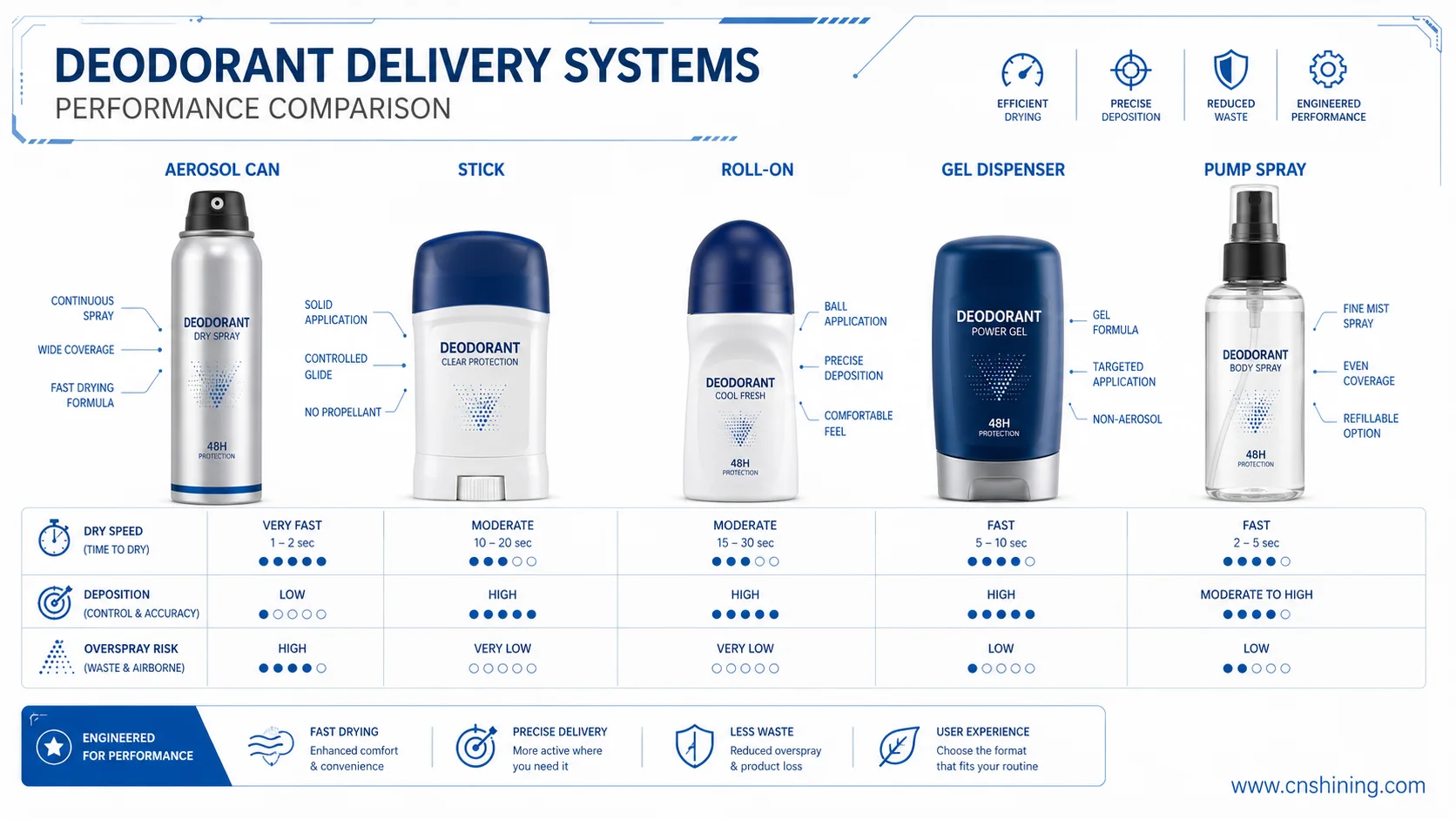
Aerosol remains attractive because it dries quickly, covers a large area and leaves less finger contact. The trade-off is also clear. It carries pressure-container requirements, propellant issues, overspray risk and inhalation concerns. Roll-on and pump formats are gaining attention because they answer two consumer worries: precise application and lower propellant anxiety.
| Format | Dryness Speed | Targeted Deposition | White Mark Risk | Inhalation / Overspray Risk | Packaging Complexity | Typical Use Case |
|---|---|---|---|---|---|---|
| Aerosol | Very fast | Medium | Medium to high for antiperspirants | High | High | Instant dry feel, non-sticky application, large-area coverage |
| Stick | Medium | High | Medium to high | Very low | Low | Strong efficacy, travel use, low overspray |
| Roll-on | Slow to medium | Very high | Low to medium | Very low | Medium | Precise application, sensitive skin, cost control |
| Gel | Medium | High | Low to medium | Very low | Medium | Clear appearance, low powder feel |
| Pump spray | Medium | Medium | Low to medium | Medium | Medium | Propellant-free positioning, lower transport complexity |
Spray is still a large format, but roll-on and pump formats are not just “alternatives”. They are a direct response to overspray, indoor comfort, transportation and sustainability concerns.
3. Market Scale and Regional Signals
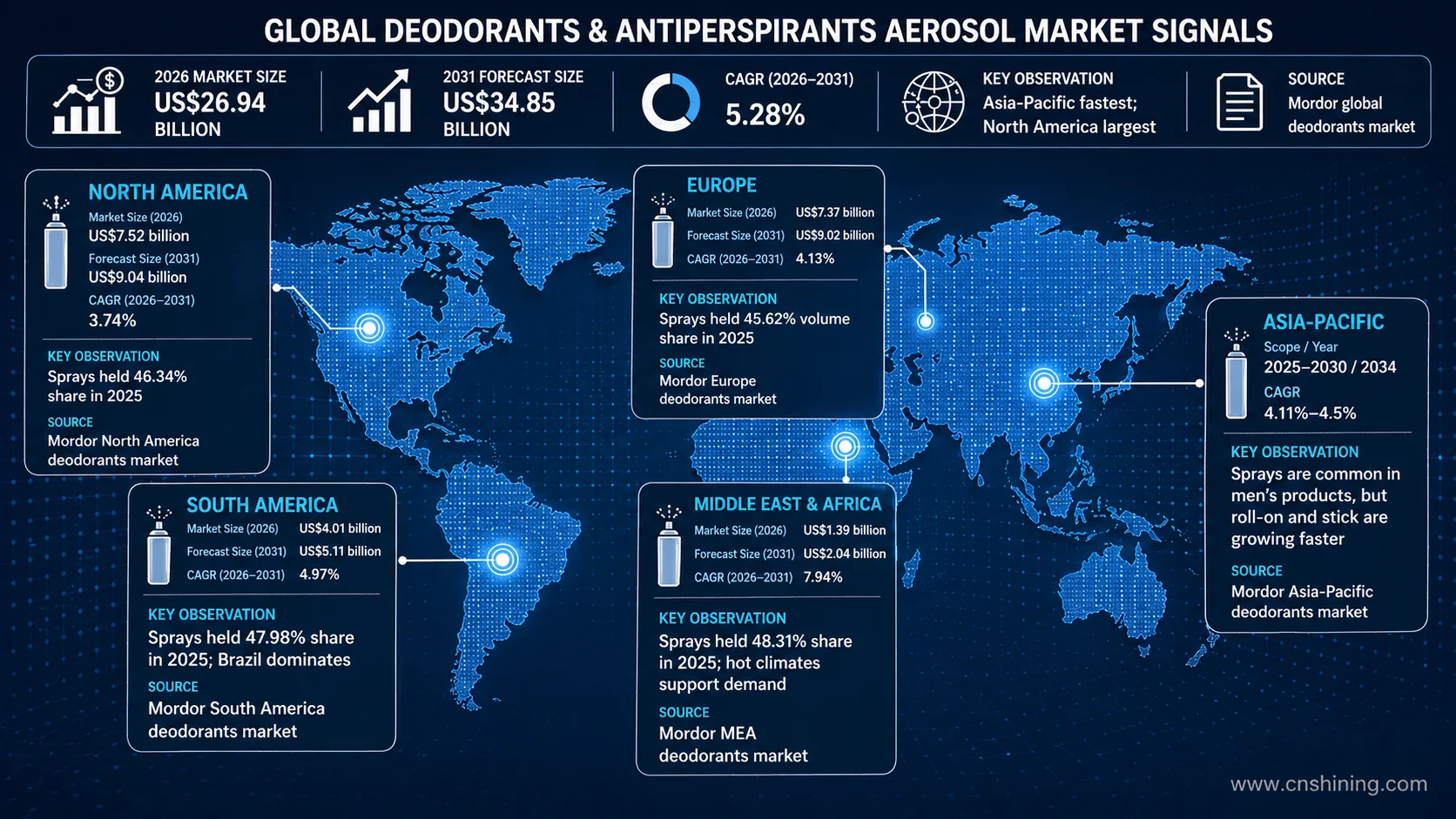
Public market reports do not use one single scope. Some count deodorant only. Some include antiperspirant. Some include body spray or whole-body deodorant. The safest reading is not a single “perfect” number. The useful signal is structural: spray remains large, while growth is moving toward natural positioning, whole-body use, sensitive-skin claims, anti-white-mark design and more sustainable aerosol packaging.
| Market | Scope / Year | Market Size | Forecast Size | CAGR | Key Observation | Source |
|---|---|---|---|---|---|---|
| Global deodorants | 2026–2031 | US$26.94 billion in 2026 | US$34.85 billion in 2031 | 5.28% | Asia-Pacific fastest; North America largest | Mordor global deodorants market |
| North America | 2026–2031 | US$7.52 billion | US$9.04 billion | 3.74% | Sprays held 46.34% share in 2025 | Mordor North America deodorants market |
| Europe | 2026–2031 | US$7.37 billion | US$9.02 billion | 4.13% | Sprays held 45.62% volume share in 2025 | Mordor Europe deodorants market |
| South America | 2026–2031 | US$4.01 billion | US$5.11 billion | 4.97% | Sprays held 47.98% share in 2025; Brazil dominates | Mordor South America deodorants market |
| Middle East and Africa | 2026–2031 | US$1.39 billion | US$2.04 billion | 7.94% | Sprays held 48.31% share in 2025; hot climates support demand | Mordor MEA deodorants market |
| Asia-Pacific | 2025–2030 / 2034 | Public free pages do not align on absolute value | Different scopes show different figures | 4.11%–4.5% | Sprays are common in men’s products, but roll-on and stick are growing faster | Mordor Asia-Pacific deodorants market |
From the aerosol industry side, the signal is stronger. Europe produced 3.64 billion aerosol units in 2024. Personal care took 47.8%, and deodorants / antiperspirants reached 824.347 million units, the largest personal-care aerosol subcategory. The source document is the European aerosol production 2024 report.
For aerosol deodorant and antiperspirant development, Europe and Brazil remain useful reference markets. They show what high aerosol density looks like: mature valve supply, familiar consumer behavior, clear pack sizes and pressure-container labelling habits.
4. Formulation System, Propellant and Stability
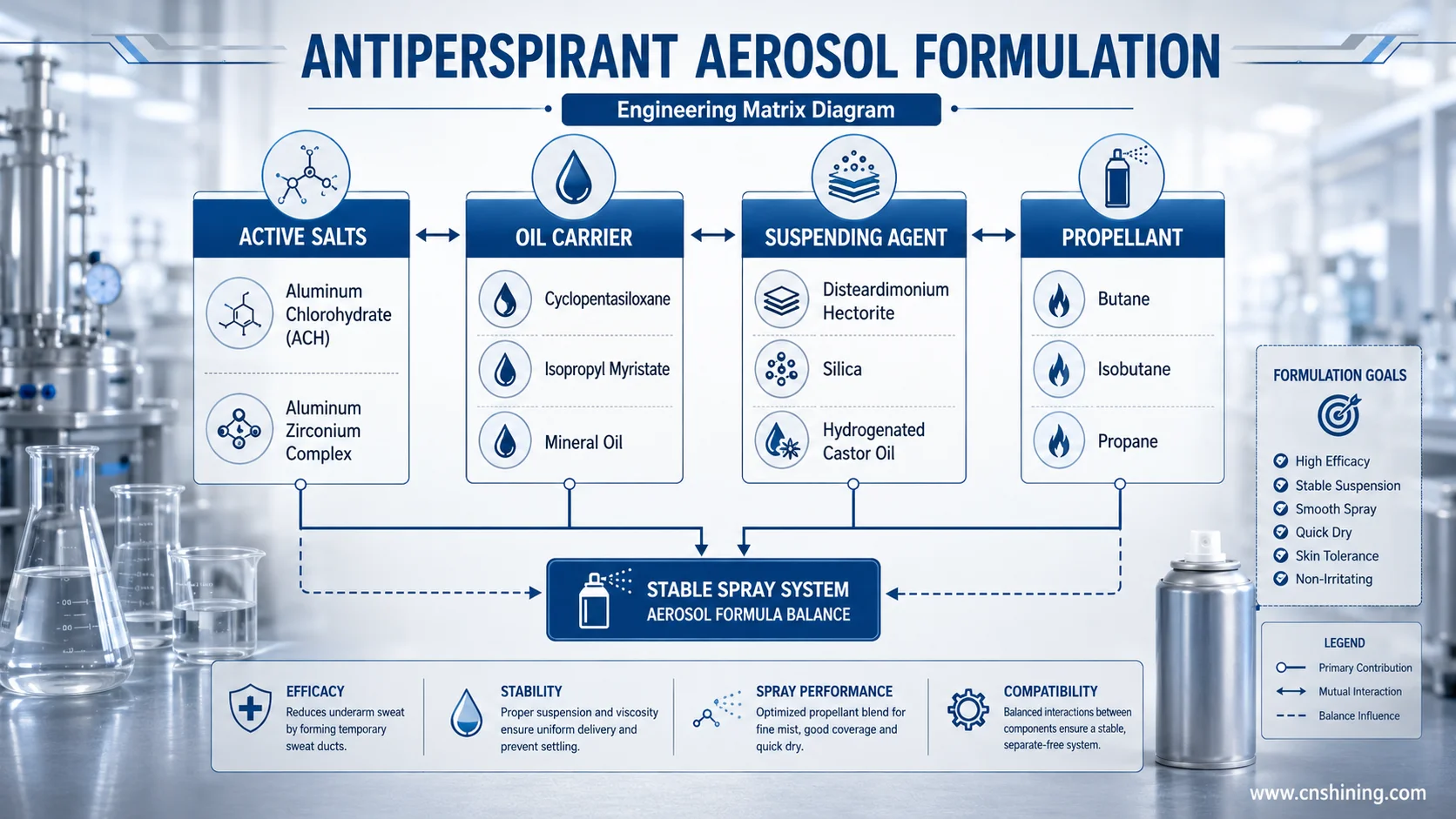
A deodorant antiperspirant aerosol is not “liquid plus gas”. It is a system made of active material, carrier phase, suspension structure, propellant, valve, actuator, can and internal coating. The part often underestimated is material compatibility. Aluminum salts, water, alcohol, DME, silicone fluids, high fragrance load and zinc systems can all interact with gaskets, springs, coatings and valve plastics.
| Ingredient Group | Typical Examples | Main Role | Typical Range or Public Range | Stability / Compatibility Risk |
|---|---|---|---|---|
| Antiperspirant salts | Aluminum chlorohydrate, aluminum zirconium tetrachlorohydrex gly | Reduce sweat by forming shallow temporary duct plugs | U.S. OTC range: ACH up to 25%; many AZG / AZCH systems up to 20%; dry spray retail often 10%–20.2% | White marks, sedimentation, valve clogging, corrosion in water-containing systems, claim limits |
| Liquid carrier / oil phase | Cyclopentasiloxane, PPG-14 Butyl Ether, C12-15 Alkyl Benzoate, Octyldodecanol | Skin feel, spreading, dry touch, active suspension | Patent examples often show 15%–55% liquid carrier in concentrate | Elastomer swelling or shrinkage; too oily a feel reduces dry-spray perception |
| Propellant | Butane, isobutane, propane, HFC-152a, DME, HFO-1234ze(E), nitrogen, compressed air | Spray energy, droplet size, cooling, gas odor, GWP profile | Patent examples range from 20%–50% low-propellant suspensions to 60%–95% high-propellant systems | Flammability, GWP, VOC pressure, gasket compatibility, spray stability |
| Suspending / structuring agents | Disteardimonium hectorite, silica, starch, colloidal systems | Keep particles suspended, reduce settling | Patent examples often show 0.05%–3% | Too low causes sedimentation; too high raises viscosity and clogging risk |
| Functional silicones / gums | Functionalized siloxane, dimethiconol, silicone gum | Adhesion, sensory feel, film after spraying | Patent examples show functionalized siloxane around 0.005%–6% | Excess loading increases viscosity and nozzle deposits |
| Alcohol deodorant system | Ethanol, alcohol denat. | Fast evaporation, fragrance solvent, some antimicrobial effect | Retail labels usually do not state exact percentage | Irritation, flammability, odor release, coating and gasket compatibility |
| Fragrance / deodorizer | Parfum, zinc salts, odor absorbers | Odor masking, odor capture, fragrance curve | Usually not disclosed on retail labels | Solubility, discoloration, over-fragrance, residue |
| Water-based route | Water plus DME or related systems | Supports natural-origin or low-silicone positioning | Patent examples exist for water-based aerosol antiperspirant routes | Water in a metal system increases corrosion and coating pressure |
Three engineering conflicts appear repeatedly. Stronger antiperspirant efficacy usually means higher active deposition, which raises white mark and clogging risk. A drier spray often means higher propellant or more aggressive spray geometry, which may raise inhalable fine particles. A low-GWP or water-based route often transfers more burden to coatings, elastomers and corrosion testing.
5. From Formula to Package: The System Chain
The aerosol package converts a stored formula into a controlled spray event. The continuous valve, vapor phase tap(VTP), restrictive tailpiece(RTP), stem, gasket, dip tube, actuator orifice and can pressure determine spray rate, droplet size, plume shape, cooling feel, noise, deposition and residual rate.
Patent literature such as US10682293B2 on aerosol antiperspirant products uses VPT and RTP relationships as design parameters for dry feel, reduced clogging and lower powder sensation. That is a practical signal: the valve is not a neutral commodity.
Target claim
  → deodorant / antiperspirant decision
  → active system: alcohol / zinc salt / aluminum salt
  → continuous phase: oil / alcohol / water
  → propellant: HC / HFC-152a / DME / HFO / nitrogen
  → valve and actuator: continuous valve / VPT / BOV / orifice geometry
  → can and coating: aluminum / tinplate / epoxy-phenolic / polyester
  → user experience: dry feel / white marks / clogging / inhalation / residual product
  → compliance output: label / claims / hazard warning / traceability
This chain explains a common production surprise: the same formula can change dramatically when the actuator or valve is changed. White marks, throat hit, residue and delivered dose may all move at once.
Key terms
| Term | Short explanation | Why it matters |
|---|---|---|
| ACH | Aluminum Chlorohydrate | Mature and common antiperspirant active |
| Al-Zr Gly | Aluminum-zirconium complex with glycine | Common in higher-efficacy routes |
| RTP | Restrictive Tail Piece | Controls flow and spray behavior |
| VPH / VPT | Vapor Phase Hole / Tap | Changes gas-liquid ratio; useful for powder and low-VOC systems |
| Actuator | Button or spray head | Defines hand feel, spray angle, and first user impression |
| Plume angle | Spray cone angle | Impacts coverage, overspray, and inhalation risk |
| BOV | Bag-on-valve | Separates product from propellant and supports 360-degree use |
| BPA-NI | Bisphenol A non-intent coating approach | Relevant to can lining, compatibility, and sustainability claims |
| Clogging | Blockage in actuator, valve stem, or flow path | One of the most direct drivers of aerosol complaints |
6. Regulatory and Claim Boundaries
6.1 United States
The U.S. is one of the most sensitive markets for aerosol antiperspirant because some products are cosmetics and some are OTC drugs. For antiperspirants, active ingredients and maximum levels are defined. Aluminum chlorohydrate can be used up to 25%, while several aluminum-zirconium systems are capped at 20%. The product must also be identified as an antiperspirant, and allowed “Uses” language is restricted.
Aerosol antiperspirants also need inhalation and pressure-container warnings. Advertising is not separate from technical files. The FTC advertising substantiation policy expects objective claims to have reasonable support. In practice, long-duration sweat claims and anti-white-mark statements need evidence.
6.2 European Union
In the EU, deodorant and antiperspirant products usually stay in the cosmetic pathway, but claims are not loose. The EU technical document on cosmetic claims sets the logic for legality, truthfulness, evidence support, honesty, fairness and informed consumer choice.
Another factor is the EU restriction on intentionally added microplastics. It may affect certain texture particles, film formers or claim language. “Microplastic-free” must be precise, not a broad shortcut.
7. Consumer Pain Points and Packaging Engineering
Real-world complaints cluster around the same problems: clogged nozzles, stuck actuators, uncontrolled discharge, half-can spray failure, choking powder clouds, strong indoor fragrance, white marks, residual waste and safety misuse. These are not random complaints. Most of them can be traced back to formula-package interaction.
| Pain Point | Likely Technical Root | Packaging / Formula Lever | Trade-off |
|---|---|---|---|
| Nozzle clogs before the can is empty | Solid active buildup, high viscosity, dry-back at the orifice | VPT continuous valve, optimized VPT/RTP ratio, anti-clog actuator geometry, lower coarse-particle load | May change spray rate and deposition amount |
| Actuator sticks or sprays uncontrollably | Poor stem return, actuator fit tolerance, weak lock design | Stable cup-fitting actuator, better button travel, twist-lock or anti-mispress design | More tooling control or more component cost |
| Spray feels choking or powdery | Too many fine particles, dense plume, aggressive propellant release | Softer actuator, wider spray pattern, compressed gas or BOV route for deodorant sprays | Higher cost; different can fill efficiency |
| White marks on clothing | High active deposition, poor particle distribution, point-loaded spray | Thin-layer wide coverage, anti-white-mark spray insert, better film-forming balance | Too thin a layer may reduce perceived antiperspirant strength |
| Corrosion, odor or product instability | Water, DME, salts or fragrance attacking coating / elastomer | Stricter pack test, coating screening, gasket compatibility matrix | Longer development cycle |
| Indoor overspray and misuse | Weak user instruction, excessive spray duration, poor hazard communication | High-contrast pictograms: shake, 15 cm distance, short spray, ventilated place, keep away from flame | Less front-panel space for branding |
| Sustainability pressure | High-GWP propellant, excess overcap, heavy package | Low-GWP propellant roadmap, lightweight can, overcapless actuator where feasible | Low-GWP routes may require harder spray engineering |
For high-solids antiperspirant aerosols, the DVT list should include residual rate, clogging after repeated actuation, spray-rate drift, valve opening force, storage orientation, thermal cycling and corrosion. Do not rely only on initial spray feel.
8. Packaging Development Recommendations
8.1 Valve
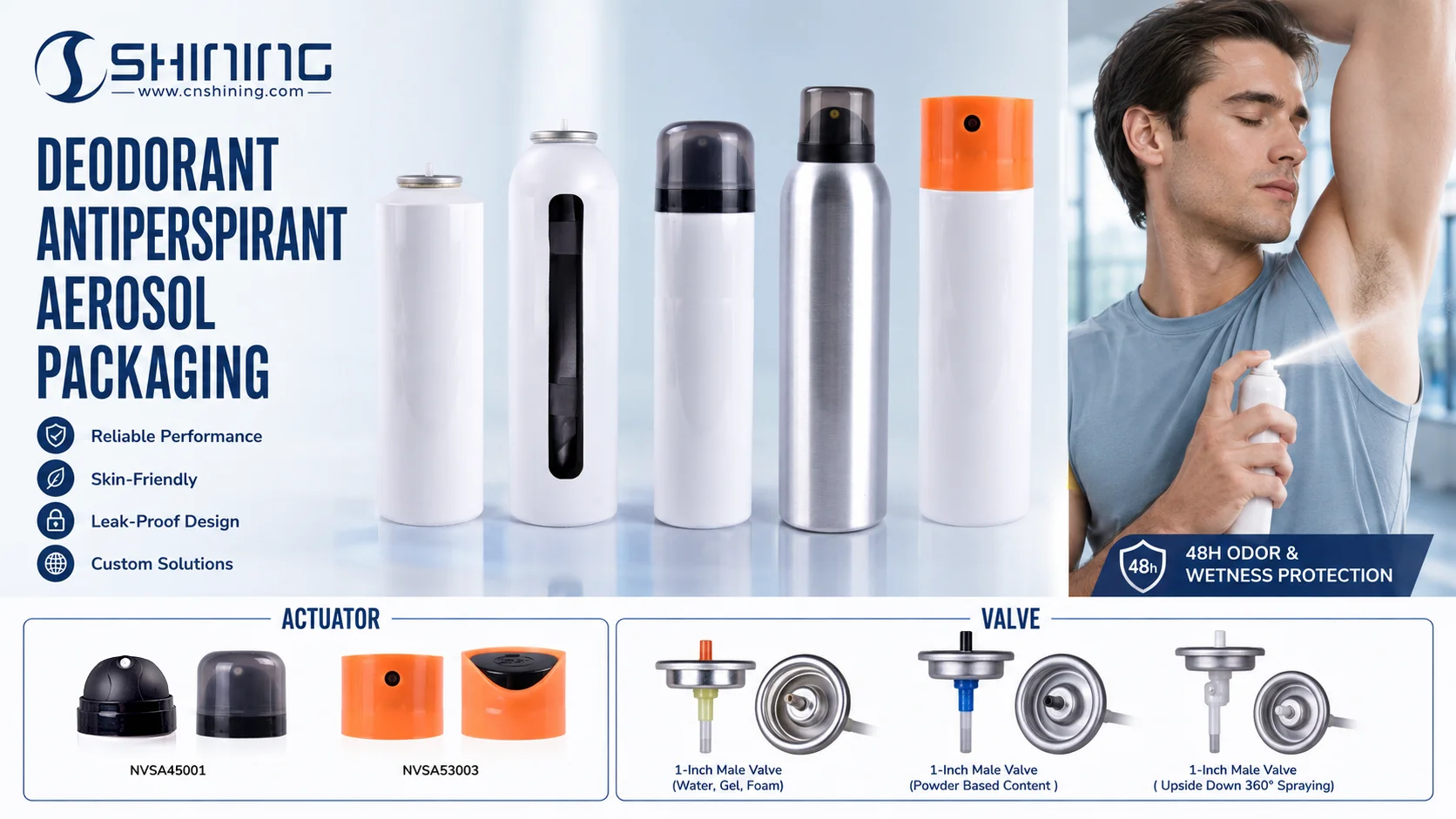
For antiperspirant aerosol, the valve is an efficacy component. If the formula contains a high load of particulate active salt, test a 1-inch continuous valve with VPT options. Include residual rate, clogging after 100 continuous sprays, spray-rate drift and opening force in the validation plan.
8.2 Actuator
Compare actuators on spray coverage, finger force and mispress risk. For male body spray or fragrance-forward deodorant aerosol, a larger finger pad and integrated lightweight actuator can improve use. For antiperspirant dry spray, the insert geometry should be judged by deposition uniformity, not appearance alone.
8.3 Can shape and printing
Most deodorant aerosol problems are not about whether the formula fits in the can. They are about whether users can hold, press and spray correctly. For 100–150 ml female SKUs or 3.8–4.3 oz U.S. SKUs, a slightly waisted or easy-grip straight-shoulder can can help wet-hand handling. Separate the efficacy zone from the hazard warning zone in artwork.
8.4 Internal coating
Anhydrous dry spray usually has a wider safety window. Water, DME, low-silicone routes, high fragrance loading and dissolved salts require a new coating and elastomer compatibility matrix. The clean technical rule is this: there is no universal gasket.
9. Shining Packaging Components for This Product Type
For deodorant antiperspirant aerosol projects, Shining Packaging’s relevant work is concentrated in three practical areas: actuators, aerosol cans and valves. These parts should be selected together, not as isolated purchase items. A dry antiperspirant spray with suspended aluminum salts needs different spray control from a fragrance-led deodorant body spray. A water-containing or DME-based system also needs more careful can coating and valve gasket review.
The useful engineering sequence is: define the formula risk first, then select the valve and actuator, then verify the can and coating. For example, a high-solids dry spray should start with anti-clog spray geometry and stable continuous valve behavior. A lower-GWP deodorant spray may need softer actuation, smoother plume formation and compatibility checks for compressed gas or BOV-style concepts.
Shining Packaging can be positioned naturally in this workflow as a packaging component partner for aerosol actuators, metal aerosol cans and valve matching. The aim is not to make the front panel look busier. The aim is to help the product spray consistently, empty properly, avoid obvious residue and survive storage without corrosion or actuator failure.
10. Top 10 Deodorant and Antiperspirant Brands
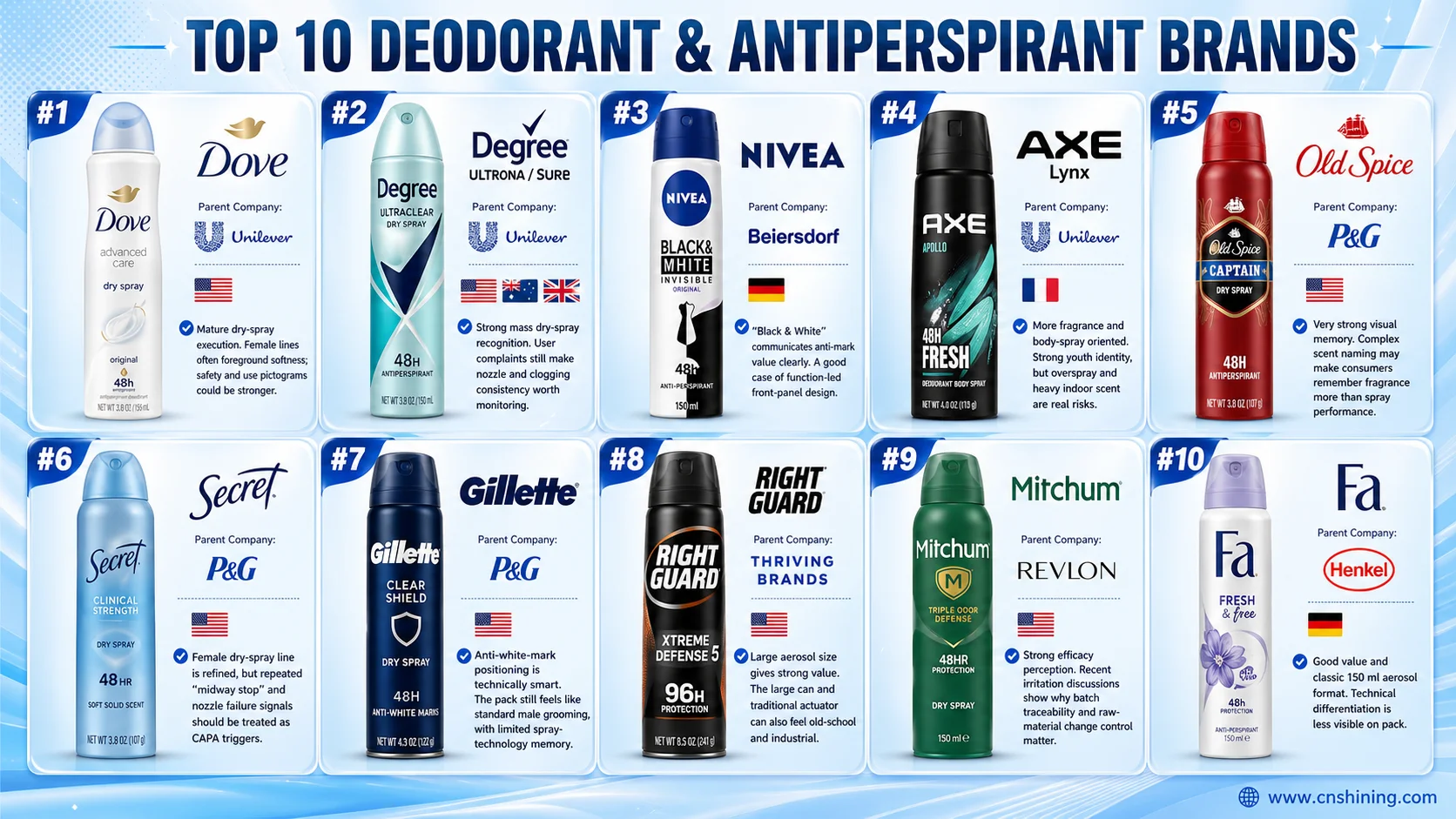
The following Top 10 benchmark set is not a strict global revenue ranking. It is based on public shelf presence, active aerosol SKU visibility and packaging relevance.
| Brand | Country / Origin | Parent Company | Typical Aerosol SKU Size | Public Retail Range | Packaging Comment |
|---|---|---|---|---|---|
| Dove | United States | Unilever | 3.8 oz / 150 ml | About US$6.53–12.99 | Mature dry-spray execution. Female lines often foreground softness; safety and use pictograms could be stronger. |
| Degree / Rexona / Sure | United States / Australia / UK naming system | Unilever | 3.8 oz / 150 ml / 250 ml | About US$5.27–6.63 in the U.S.; 150–250 ml common in Europe | Strong mass dry-spray recognition. User complaints still make nozzle and clogging consistency worth monitoring. |
| NIVEA | Germany | Beiersdorf | 150 ml | About €4.11 in Europe | “Black & White” communicates anti-mark value clearly. A good case of function-led front-panel design. |
| AXE / Lynx | French market development roots | Unilever | 4.0–5.07 oz / 150 ml | About US$8.04–11.45 in the U.S.; multipacks lower the unit price | More fragrance and body-spray oriented. Strong youth identity, but overspray and heavy indoor scent are real risks. |
| Old Spice | United States | Procter & Gamble | 3.0–3.8 oz dry spray / body spray | About US$8.97–13.97 | Very strong visual memory. Complex scent naming may make consumers remember fragrance more than spray performance. |
| Secret | United States | Procter & Gamble | 3.8–4.1 oz | About US$8.69–10.49 | Female dry-spray line is refined, but repeated “midway stop” and nozzle failure signals should be treated as CAPA triggers. |
| Gillette | United States | Procter & Gamble | 4.3 oz | About US$5.88–8.89 | Anti-white-mark positioning is technically smart. The pack still feels like standard male grooming, with limited spray-technology memory. |
| Right Guard | United States | Thriving Brands | 6–8.5 oz | About US$13.53 for an 8.5 oz single can | Large aerosol size gives strong value. The large can and traditional actuator can also feel old-school and industrial. |
| Mitchum | United States | Revlon | 150 ml | About £5.68 / €3.15–3.66 in UK and Ireland markets | Strong efficacy perception. Recent irritation discussions show why batch traceability and raw-material change control matter. |
| Fa | Germany | Henkel | 150 ml | About €2.29–4.95 | Good value and classic 150 ml aerosol format. Technical differentiation is less visible on pack. |
What this benchmark says about packaging strategy
The benchmark brands fall into three groups. The first is mass dry-spray efficacy: Dove, Degree / Rexona, Secret, Gillette and Mitchum. Their real challenge is not a cooler can. It is stable spray to the end, less white mark and lower indoor discomfort. The second group is fragrance-led male body spray: AXE / Lynx, Old Spice and Right Guard. Their risk is overspray and scent overload. The third group is value aerosol: NIVEA and Fa. Their strength is clear benefit communication, classic pack size and reliable execution.
11. Conclusion
Deodorant antiperspirant aerosol performance is a system problem. The active ingredient controls part of the efficacy, but the user experiences the whole release system: valve flow, actuator geometry, propellant behavior, powder suspension, can coating, gasket compatibility, and label instruction.
The strongest near-term engineering work is not to make the fragrance louder. It is to reduce clogging, stabilize spray behavior, control overspray and white marks, lower avoidable inhalation exposure, and improve can-valve-formula compatibility. These are practical changes. They reduce complaints, help regulatory exposure, and make the product easier to use correctly.
12. FAQ: Deodorant Antiperspirant Aerosol
A deodorant aerosol mainly controls body odor through fragrance, alcohol, antimicrobial systems, zinc salts or odor absorbers. An antiperspirant aerosol reduces sweat, usually by depositing aluminum or aluminum-zirconium salts that form temporary shallow plugs at sweat duct openings. One product may do both, but the claim, active system and package testing requirements become more demanding.
Antiperspirant aerosols often contain suspended solid active salts. These particles can settle, dry back at the actuator orifice, react with moisture or build residue around the valve path. If viscosity, particle size, valve restriction and actuator geometry are not matched, the spray rate drifts and the nozzle may clog before the can is empty.
A dry spray usually depends on rapid propellant expansion and fine droplet or particle formation. If the plume is too dense or the particle distribution contains too many fine inhalable particles, users may feel throat irritation. This is not only a formula issue. Actuator insert design, spray angle, propellant type and spray duration all contribute.
White marks usually come from visible deposition of aluminum salts, powders or film residues on skin and clothing. High active loading, poor particle dispersion, point-loaded spray patterns and excessive application can all increase the effect. A wider, thinner and more uniform spray pattern can reduce marks, but it must still deliver enough active for sweat control.
The actuator controls how the pressurized formula leaves the can. Its insert, orifice size, spray angle and finger force affect plume shape, droplet distribution, deposition and user control. In high-solids antiperspirant aerosols, actuator geometry can also influence nozzle buildup. A good actuator is not just comfortable; it protects spray consistency.
Propellant affects pressure, spray rate, droplet size, cooling sensation, flammability, gas odor and environmental profile. Hydrocarbon propellants support strong dry-spray performance but raise flammability concerns. DME and HFO routes can support different positioning but need compatibility work. Compressed gas can reduce propellant odor, yet may give a wetter or changing spray profile.
Internal coating becomes high-risk when the formula contains water, DME, salts, high fragrance loading, alcohol or natural-origin systems that may interact with metal or lining chemistry. Corrosion can lead to odor, leakage, pressure loss or product failure. Pack testing should include storage orientation, temperature cycling and coating compatibility, not only visual inspection.
Test spray rate, valve opening force, clogging after repeated actuation, residual product, particle deposition, white marks, corrosion, gasket swelling, storage stability and thermal cycling. Also test user instructions such as shake time, spray distance and ventilation. A can that sprays well during the first trial may still fail after settling or long storage.
Lower-GWP routes often change the pressure profile, solubility behavior, droplet formation and material compatibility of the system. Replacing a familiar hydrocarbon dry-spray platform with HFO, DME, compressed gas or BOV may reduce environmental pressure, but it can also change spray feel, cost, fill efficiency and component selection. The package must be redesigned, not simply refilled.
Design the formula and package as one system. The active material, solvent, propellant, valve, actuator, can coating and label instructions must be tested together. Most consumer-visible failures come from mismatch: clogged nozzles, choking spray, white residue, corrosion, stuck buttons or residual product. Reliable spray to the end matters more than a crowded front label.