
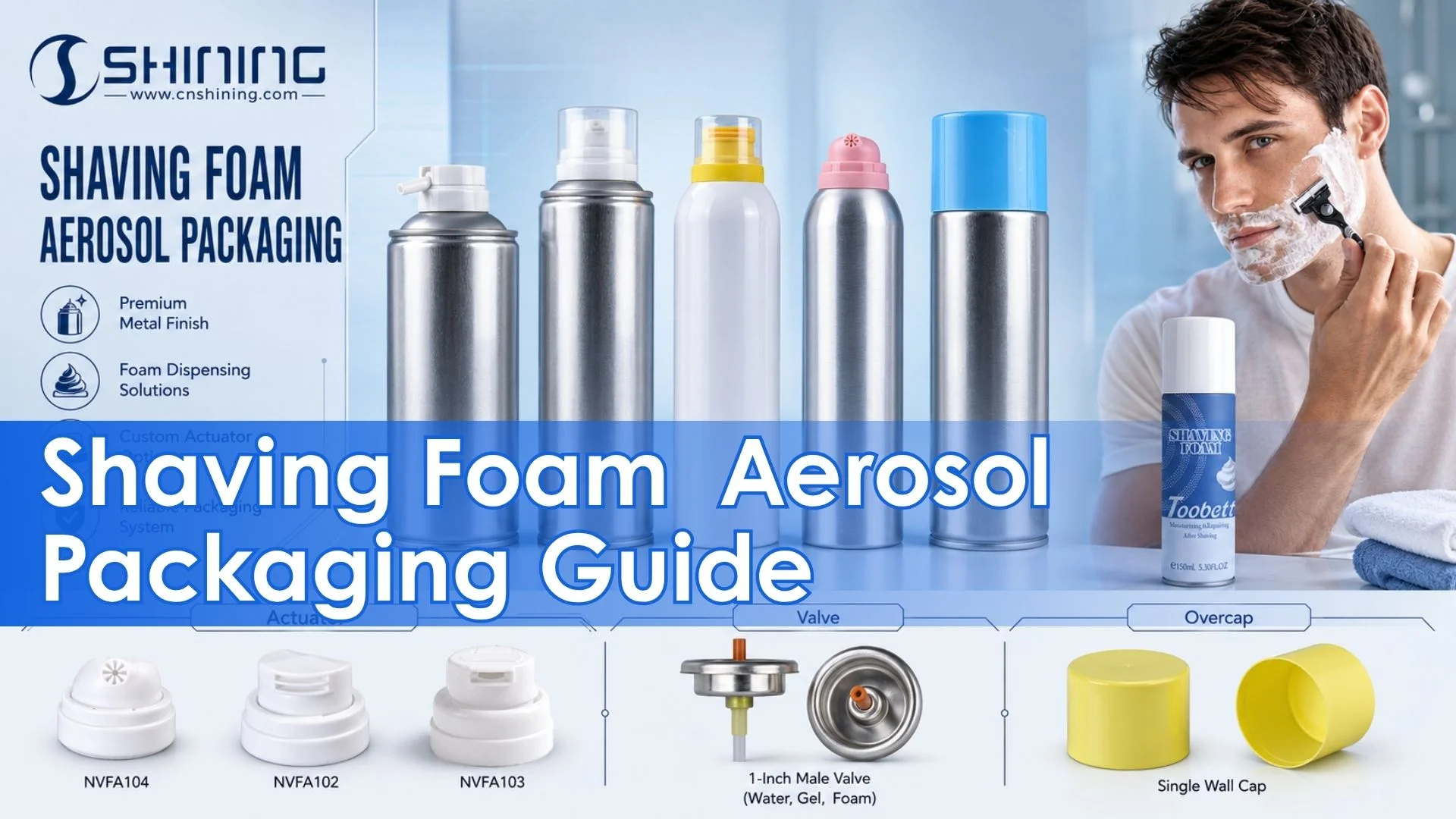
1. Executive View: Foam Performance Starts Inside the Can
Aerosol shaving foam is not just foam. It is a pressurized system where formulation, propellant, valve, actuator, can body and internal coating work together. When the user presses the actuator, the valve opens. Pressure from the propellant drives the bulk product through the valve stem, housing and discharge path. Foam forms during release.
In practice, shaving comfort is not controlled by formulation alone. Valve orifice size, top-up or inverted dispensing, actuator channel length, bottom corrosion resistance and coating compatibility all affect the final shave feel. That is why a canned shaving cream with a good formula can still fail if the dispensing package is unstable.
2. Definition and Working Principle
Aerosol shaving foam is a pressurized shaving preparation used to lubricate the skin, soften beard hair and reduce friction between blade and skin. The U.S. FDA lists aerosol shaving creams under shaving preparation products. Commercially, aerosol shaving foam is usually treated as an aerosol subcategory of shaving cream or shaving foam.
Most traditional products use liquefied gas propellants. The propellant coexists with the concentrate inside the can and maintains internal pressure. After actuation, the content passes through the stem and outlet orifice. In hydrocarbon systems, propellant flashes off after leaving the can, producing bubble nuclei. Surfactants arrange at the gas-liquid interface. Thickeners and foam stabilizers strengthen the foam film and slow drainage.
- Bulk concentrate inside the can: surfactants, humectants, oils and stabilizers.
- Propellant builds and maintains system pressure.
- User presses the actuator.
- Valve opens; stem and housing guide product flow.
- Pressure drops at discharge; propellant flashes and foam forms.
- Foam spreads on skin as a lubricating cushion.
- Friction decreases; beard hair softens; blade glide improves.
Chemically, classic aerosol shaving foam often relies on fatty acid soap and synthetic surfactant systems. Stearic acid and palmitic acid are commonly neutralized with triethanolamine to form soap bases. Anionic, amphoteric and nonionic surfactants adjust foam fineness, cleansing and skin feel. Glycerin, sorbitol and propylene glycol help reduce post-shave tightness. Mineral oil, silicone oil or plant oil can improve glide. Carrageenan, cellulose gum and carbomer increase foam retention.
3. Propellant Types and Commercial Meaning
| Propellant type | Typical examples | Technical behavior | Commercial meaning |
|---|---|---|---|
| Liquefied hydrocarbons | Propane, butane, isobutane | Low cost, mature supply, strong foaming; usually flammable | Mainstream for mass retail; often treated as Division 2.1 flammable gas in logistics |
| Oxygenated organic propellant | DME | Some solvent power; can tune discharge feel | Useful for formula uniformity, but odor, irritation and regulatory fit need review |
| Traditional fluorinated propellants | HFC-152a, HFC-134a | Historically used in some aerosols | Facing stronger environmental replacement pressure |
| Low-GWP new propellant | HFO-1234ze(E) | Honeywell sample formulation states GWP below 1 | Relevant for low-carbon positioning, but cost and supply chain still matter |
| Compressed gas | Nitrogen, compressed air, CO2 | Often used with separated product systems; pressure decay differs from liquefied gas | Fits BOV and “powered by air” concepts; can reduce flammability and contamination risk |
HFO-1234ze(E) is worth watching. A Honeywell public sample sheet describes Solstice Propellant as a non-ozone-depleting option with GWP below 1. That does not mean every shaving foam can move directly to HFO. Foam structure, valve choice, filling line, cost and regional supply must still be checked.
4. Valves, Actuators and Can Components
Valve and actuator geometry decides whether the product feels controlled or messy.Aerosol valve stem orifice size affects spray behavior, spray rate and particle size. Different RTP tail-piece orifices generate different spray characteristics, and foam or mousse valves can be designed for inverted use without a dip tube.
| Component | Function | Effect on user experience |
|---|---|---|
| Valve stem | Creates the path from valve body to actuator | Controls flow rate, foam expansion and first-second feel |
| Housing / mounting cup | Holds valve system, supports sealing and filling | Affects pressure resistance, leakage rate, filling efficiency and shelf stability |
| Gasket / spring | Controls opening, closing and return action | Influences leakage, press feel and storage life |
| Dip tube | Guides bottom product to valve | Affects residual content and top-up or inverted dispensing options |
| Actuator | Shapes the secondary flow path and outlet | Defines foam shape, spread area, clogging tendency and ergonomics |
| Internal coating | Separates can metal from formulation and propellant | Controls corrosion, migration, odor and complaint risk |
5. Market Size and Regional Trends
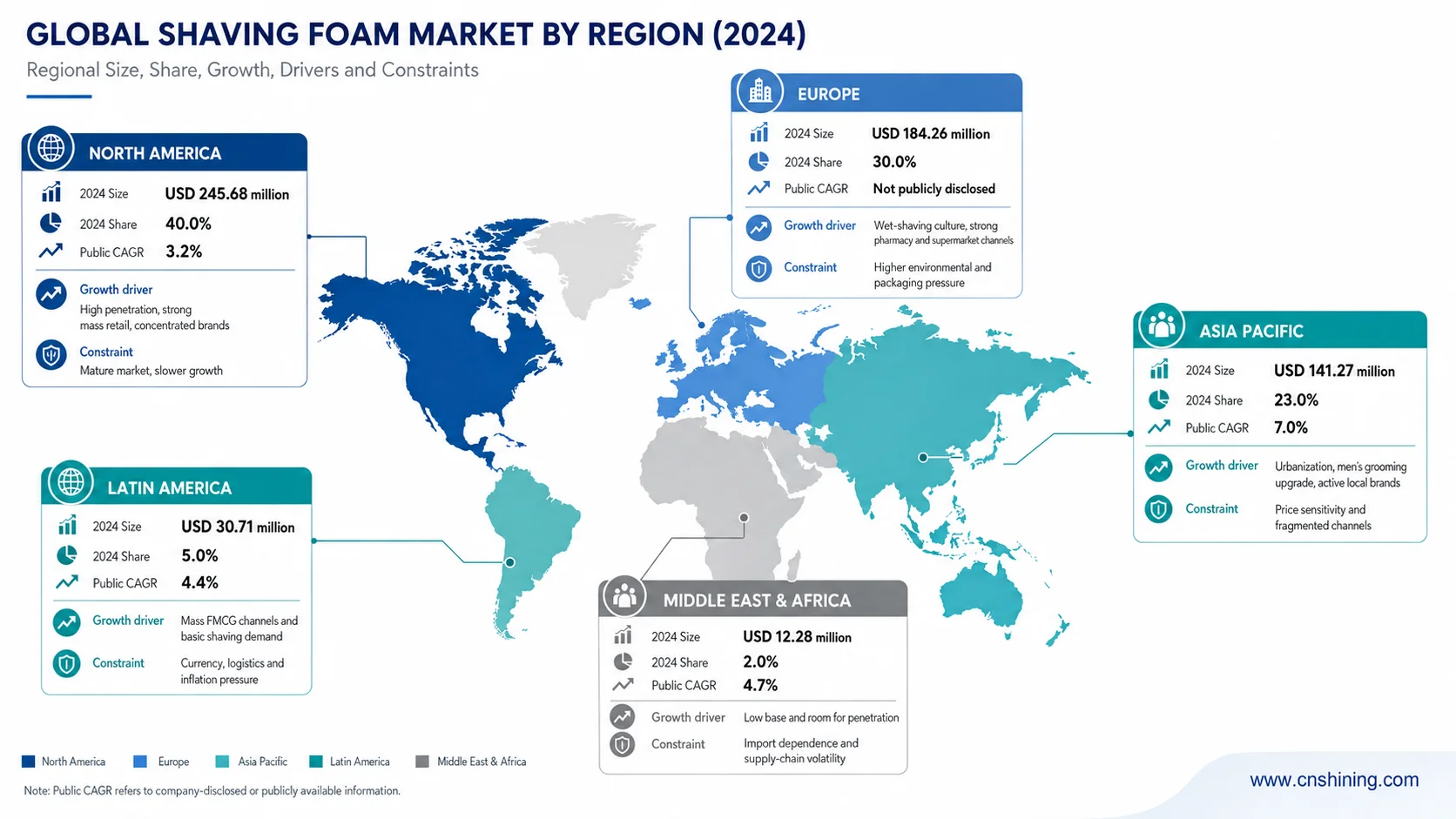
| Region | 2024 size (USD million) |
2024 share | Public CAGR | Growth driver | Constraint |
|---|---|---|---|---|---|
| North America | 245.68 | 40.0% | 3.2% | High penetration, strong mass retail, concentrated brands | Mature market, slower growth |
| Europe | 184.26 | 30.0% | Not publicly disclosed | Wet-shaving culture, strong pharmacy and supermarket channels | Higher environmental and packaging pressure |
| Asia Pacific | 141.27 | 23.0% | 7.0% | Urbanization, men’s grooming upgrade, active local brands | Price sensitivity and fragmented channels |
| Latin America | 30.71 | 5.0% | 4.4% | Mass FMCG channels and basic shaving demand | Currency, logistics and inflation pressure |
| Middle East & Africa | 12.28 | 2.0% | 4.7% | Low base and room for penetration | Import dependence and supply-chain volatility |
Growth is driven by men’s grooming habits, convenience and channel fit. Aerosol foam suits supermarkets, drugstores and e-commerce because the format is standardized. Sensitive skin, body shaving, women’s shaving and precision trimming create higher-value subsegments. The constraints are equally clear: dangerous goods logistics, sustainability pressure, microplastic restrictions and migration toward transparent gel, shaving oil or propellant-free formats.
6. Comparison With Shaving Cream, Gel, Soap and Oil
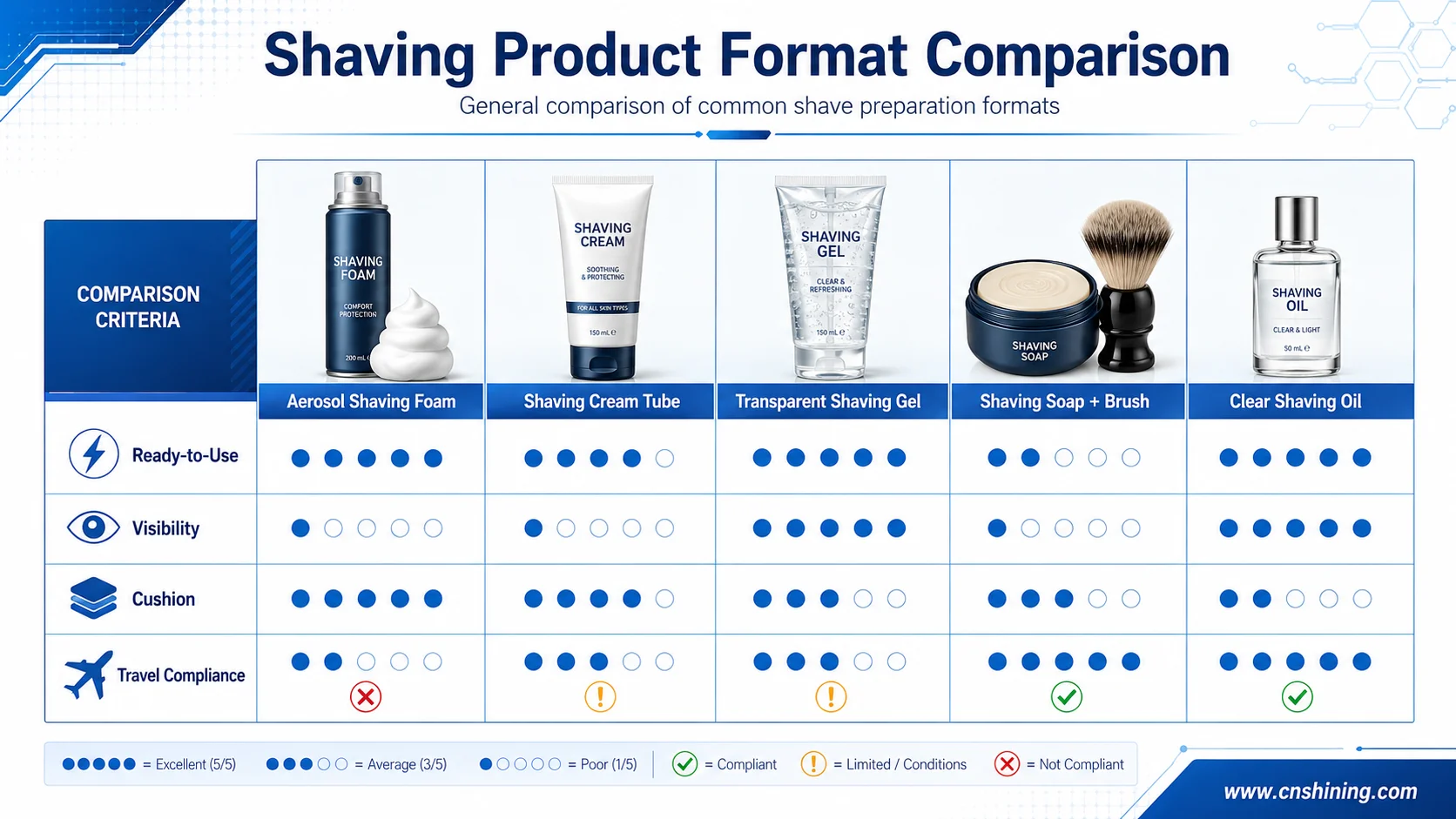
| Dimension | Aerosol shaving foam | Shaving cream | Shaving gel | Shaving soap | Shaving oil |
|---|---|---|---|---|---|
| Ready-to-use | Highest; shake and dispense | Medium; needs spreading | High; squeeze and apply | Lowest; usually needs brush lathering | High; direct application |
| Visibility | Low | Medium | Medium to high; transparent gel is clearer | Low | High; often clear and low-foam |
| Foam consistency | High; packaging controls output | Medium | Depends on gel and post-foaming design | High, but user technique matters | Low or no foam |
| Lubrication and cushion | High | High | High; strong skin contact feel | High | High glide, less thickness |
| Edge trimming | Average | Average | Good | Average | Best |
| Travel and compliance | More affected by aerosol and dangerous goods rules | Friendlier | Friendlier | Most friendly | Most friendly |
| Main weakness | Low skin visibility; packaging pressure | Variable experience | Can leave heavier film | Higher learning cost | Small volume can feel expensive |
The conclusion from field use is direct: foam wins on speed, gel wins on visibility and texture, soap wins on tradition and lower packaging load, oil wins on edge work.
| Term | Short meaning | Commercial meaning |
|---|---|---|
| Propellant | Gas or liquefied gas that expels content | Affects dangerous goods class, carbon footprint, foam efficiency and cost |
| Liquefied-gas propellant | Maintains can pressure through vapor pressure | Mainstream and low cost, but often flammable |
| Compressed-gas system | Nitrogen, air or CO2 pressure system | Fits BOV and lower-flammability stories, but discharge curve differs |
| BOV | Bag-on-Valve; product separated from gas | Supports “no propellant contact” positioning and cleaner evacuation |
| Valve stem | Connection between housing and actuator | Central point for flow rate, foam shape and clogging risk |
| Mounting cup | Valve cup sealed to can opening | Controls leakage, coating compliance and crimp quality |
| Actuator | Press button and outlet path | Controls press feel, spray pattern, residual foam and complaints |
| Metered valve | Valve delivering fixed dose | Useful for dosage consistency and premium positioning |
| Top-down dispensing | Inverted use | Valuable for foam and mousse in bathroom use |
| Post-foaming gel | Gel dispensed first, foam forms during rubbing | Improves visibility before foam development |
| GWP | Global Warming Potential | Core metric for propellant replacement and ESG reporting |
| BPA-NI | BPA not intentionally added coating | Packaging compliance and consumer reassurance label |
| UN1950 | UN number for aerosols | Controls warehousing, air/sea shipping and cross-border cost |
| INCI | International cosmetic ingredient naming | Basis for label, registration and raw material control |
| CSAR | China Cosmetics Supervision and Administration Regulation | Defines China filing, claims and safety assessment pathway |
7. Formulation System and Public Patents
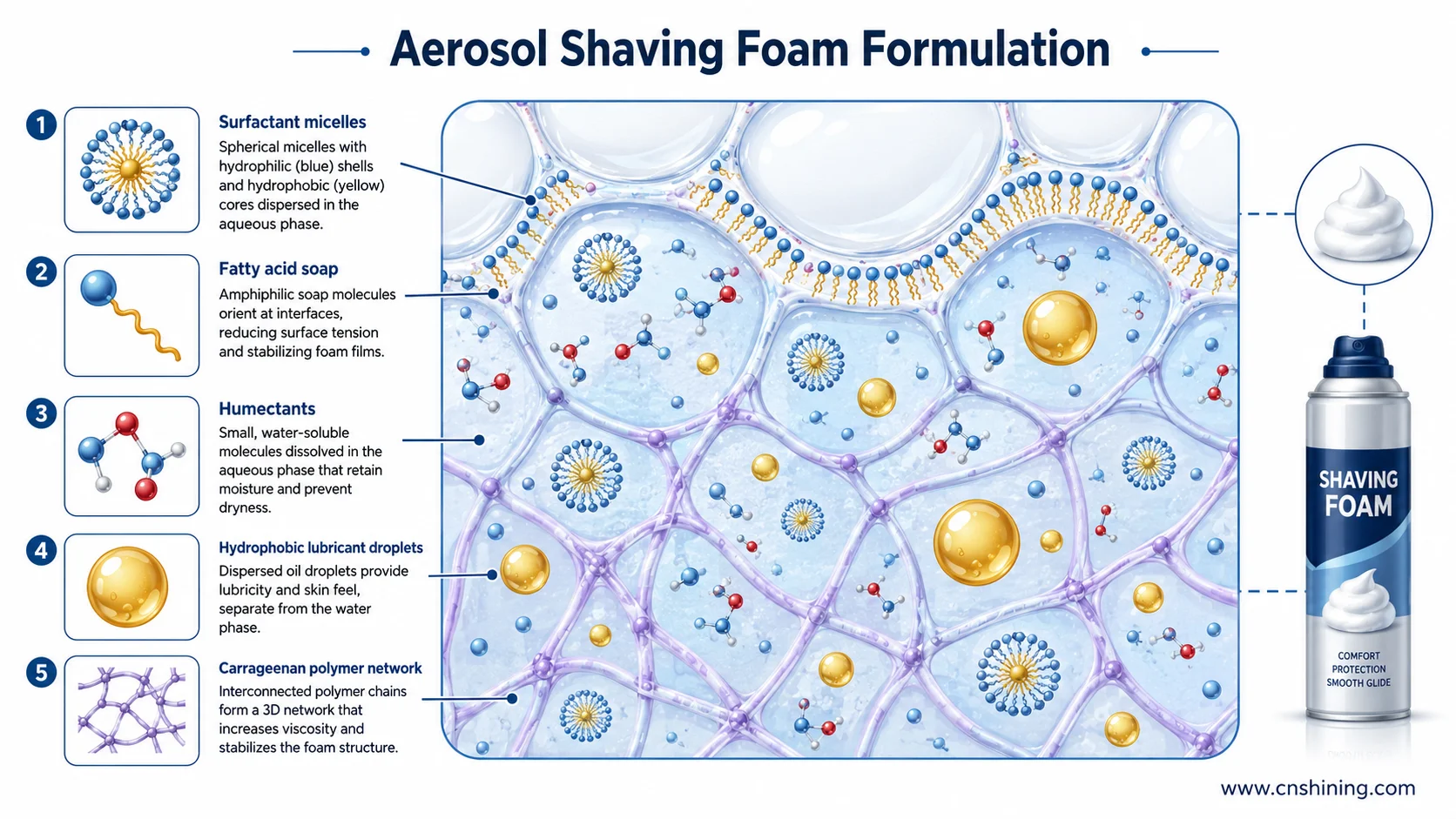
Formula design is a balance between foaming, cushion, blade glide, residue, rinse-off, skin feel, can compatibility and cost. Bigger foam is not automatically better. The foam film must protect skin during a short residence time without clogging the razor or leaving a heavy residue.
| Function | Typical ingredients | Main role |
|---|---|---|
| Main surfactant system | Anionic surfactants, fatty acid soap | Foaming, lubrication, cleansing |
| Anionic surfactant boost | AES/SLES, sulfosuccinates | Foam boost, cleansing, razor rinsing |
| Soap neutralizer | Triethanolamine | Forms TEA soap, adjusts pH and foam feel |
| Humectants | Glycerin, sorbitol, propylene glycol | Reduces tightness and improves post-shave feel |
| Hydrophobic glide agents | Mineral oil, silicone oil, plant oil, esters | Improves glide and reduces dry drag |
| Foam stabilizers | Carrageenan, PEG-90M, cellulose gum, carbomer | Foam stability, viscosity and face retention |
| Post-foaming agent / propellant | Propane, butane, isobutane, HFO, compressed gas | Pressure, foaming and discharge |
| Water phase | Water, alcohol | Main carrier |
| Fragrance / cooling | Fragrance, menthol, eucalyptus oil | Odor identity and sensory difference |
| Can and cup coating | Epoxy, epoxy phenolic, polyester, BPA-NI | Corrosion barrier and odor control |
8. Regulations and Dangerous Goods Transport
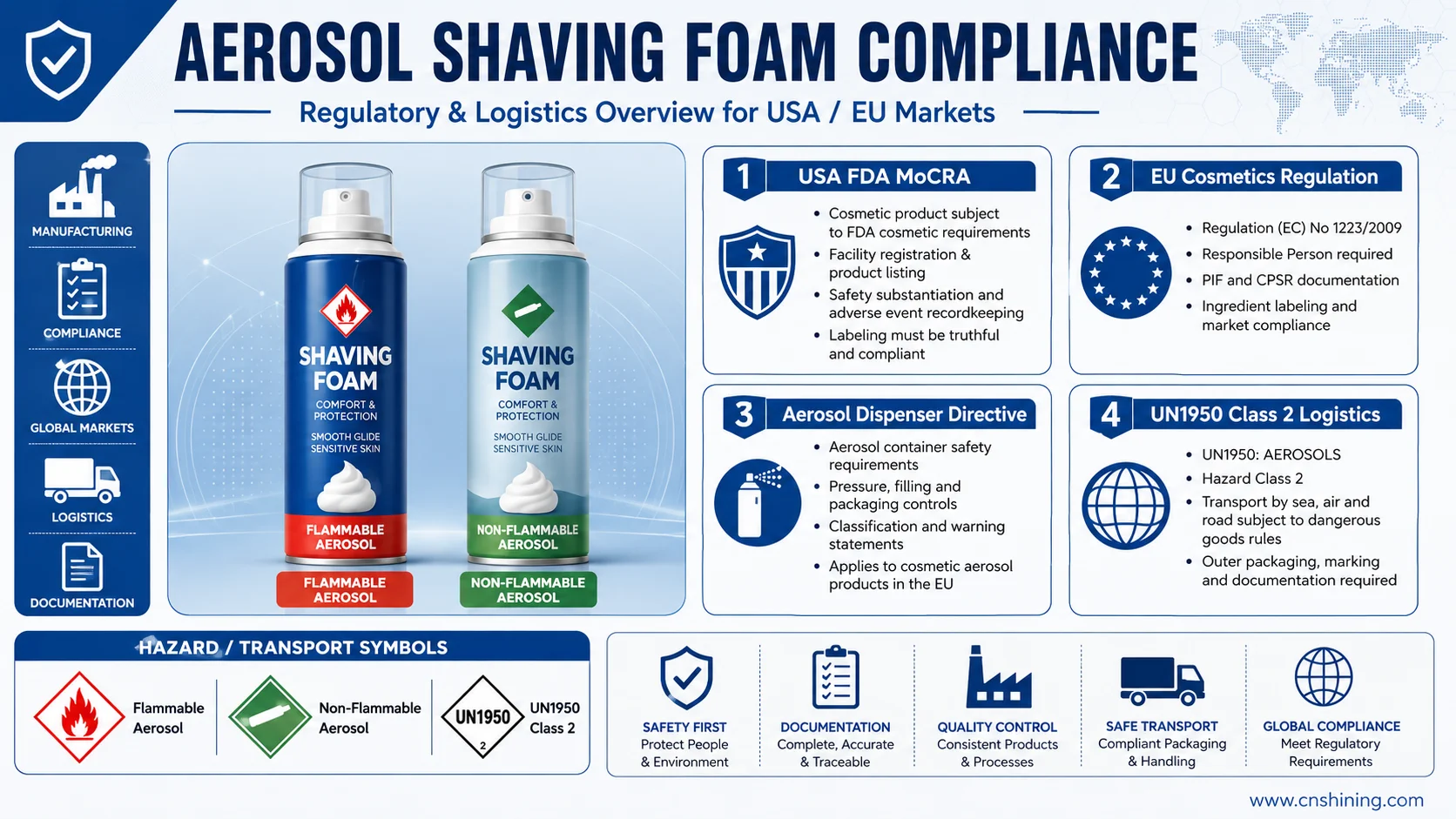
| Market | Main framework | Key requirement for aerosol shaving foam |
|---|---|---|
| United States | FDA + MoCRA | Usually treated as cosmetic if claims stay within lubrication, comfort and beard softening. Company remains responsible for safety, facility/product listing and serious adverse event records under MoCRA. |
| European Union | Cosmetics Regulation (EC) No 1223/2009 + Aerosol Dispensers Directive + REACH/CLP | Requires PIF/CPSR, INCI label, responsible person and CPNP notification. Aerosol-specific pressure, flammability and inhalation risks must also be reviewed. |
In the U.S., MoCRA is the most significant expansion of FDA cosmetic authority since 1938. The FDA explains this under its Modernization of Cosmetics Regulation Act page. In the EU, finished cosmetic products are governed by Cosmetics Regulation (EC) No 1223/2009, while aerosol dispensers are covered by the Aerosol Dispensers Directive.
The claim boundary matters. “Lubricates skin” and “helps soften beard hair” are normal cosmetic claims. “Treats razor bumps,” “anti-inflammatory,” “antibacterial” or “repairs damaged skin” may push a product toward drug or OTC review in some markets.
Aerosol Transport Classification
Logistics are controlled by UN1950. The FEA transport guide states that aerosols are Class 2 articles, assigned mainly to Division 2.1 flammable or 2.2 non-flammable, non-toxic. It also notes that metal aerosols must not exceed 1000 ml capacity in the cited context. See the FEA Guide on the Transport of Aerosols.
9. Top 10 Brands in Retail Visibility
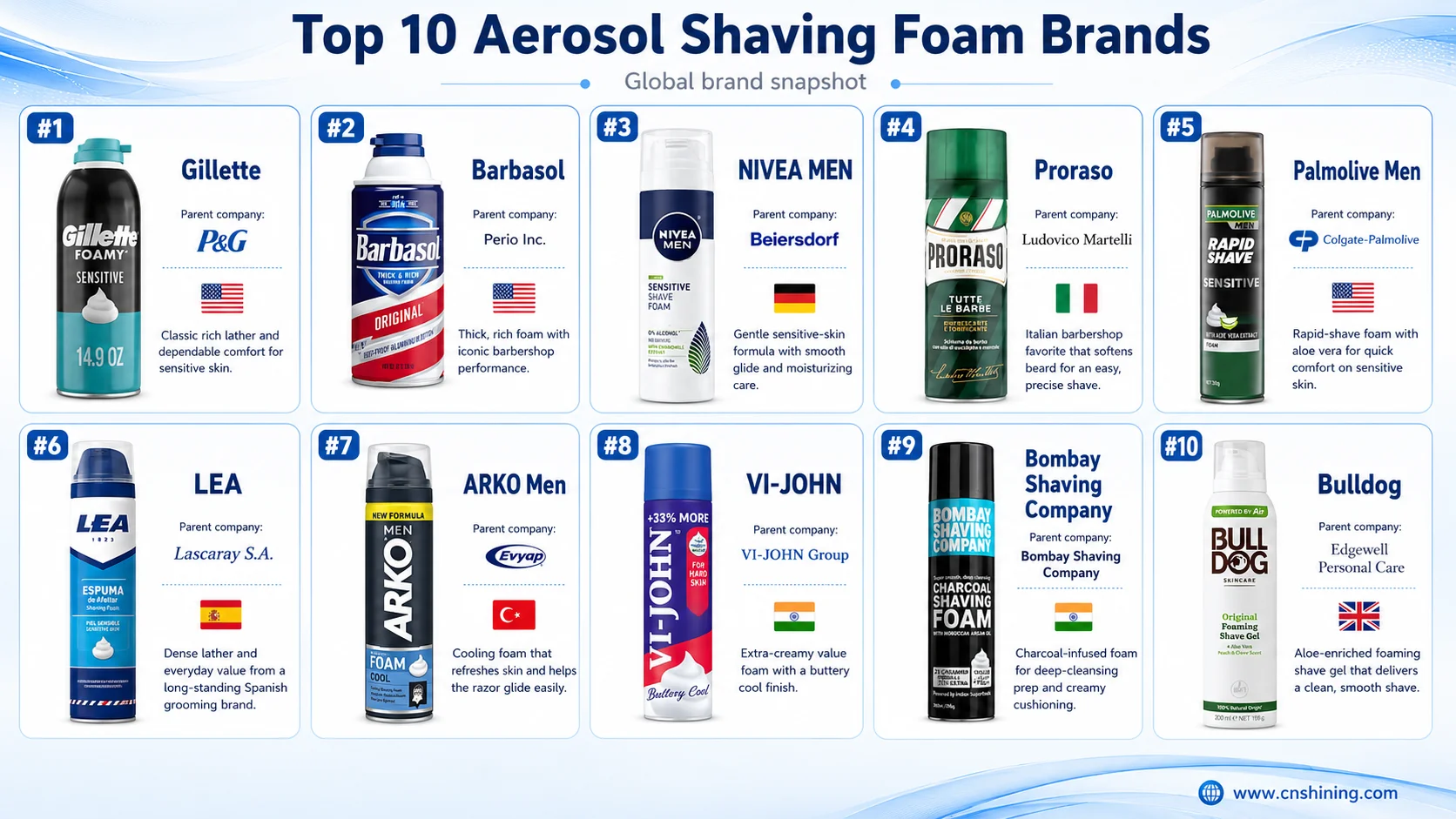
| Brand | Country / origin | Parent company | Common size | Sample price range | Technical / market comment |
|---|---|---|---|---|---|
| Gillette | United States | Procter & Gamble | 11 oz; 200 ml | about 2.97$ / 11 oz | One of the mass-retail benchmark formats for aerosol shaving foam. |
| Barbasol | United States | Perio | 10 oz; 7 oz | about 2.47$ / 10 oz to about 13.39$ | Strong North American mass channel presence; packaging complaints scale quickly due to volume. |
| NIVEA MEN | Germany | Beiersdorf | 200 ml; 7 oz | about 3.79$ per can in 6× | Sensitive-skin segmentation is well developed. |
| Proraso | Italy | Ludovico Martelli | 300 ml; 400 ml | about 5.68$–10.71$ | Barbershop heritage, larger sizes and clearer fragrance identity. |
| Palmolive Men | International brand | Colgate-Palmolive | 300 ml | about 3.71$–9.38$ | Representative European mass-price shaving foam line. |
| LEA | Spain | Lascaray | 250 ml | about 2.61$–6.90$ | Traditional Spanish brand balancing value and wet-shaving usage. |
| Arko Men | Türkiye | Evyap | 200 ml | about 4.24$–5.35$ | Strong emerging-market feel with accessible price positioning. |
| VI-JOHN | India | VI-JOHN Group | 400 g | about 2.48$–2.59$ | Typical India large-volume value format. |
| Bombay Shaving Company | India | Bombay Shaving Company | 200–425 g | about 0.51$ to about 2.62$ | Newer brand with stronger online and functional-skin messaging. |
| Bulldog Skincare | United Kingdom | Edgewell Personal Care | 200 ml | about 4.02$–6.70$ | Not a traditional hydrocarbon aerosol foam, but represents the “powered by air” direction. |
10. User Pain Points and Packaging Optimization
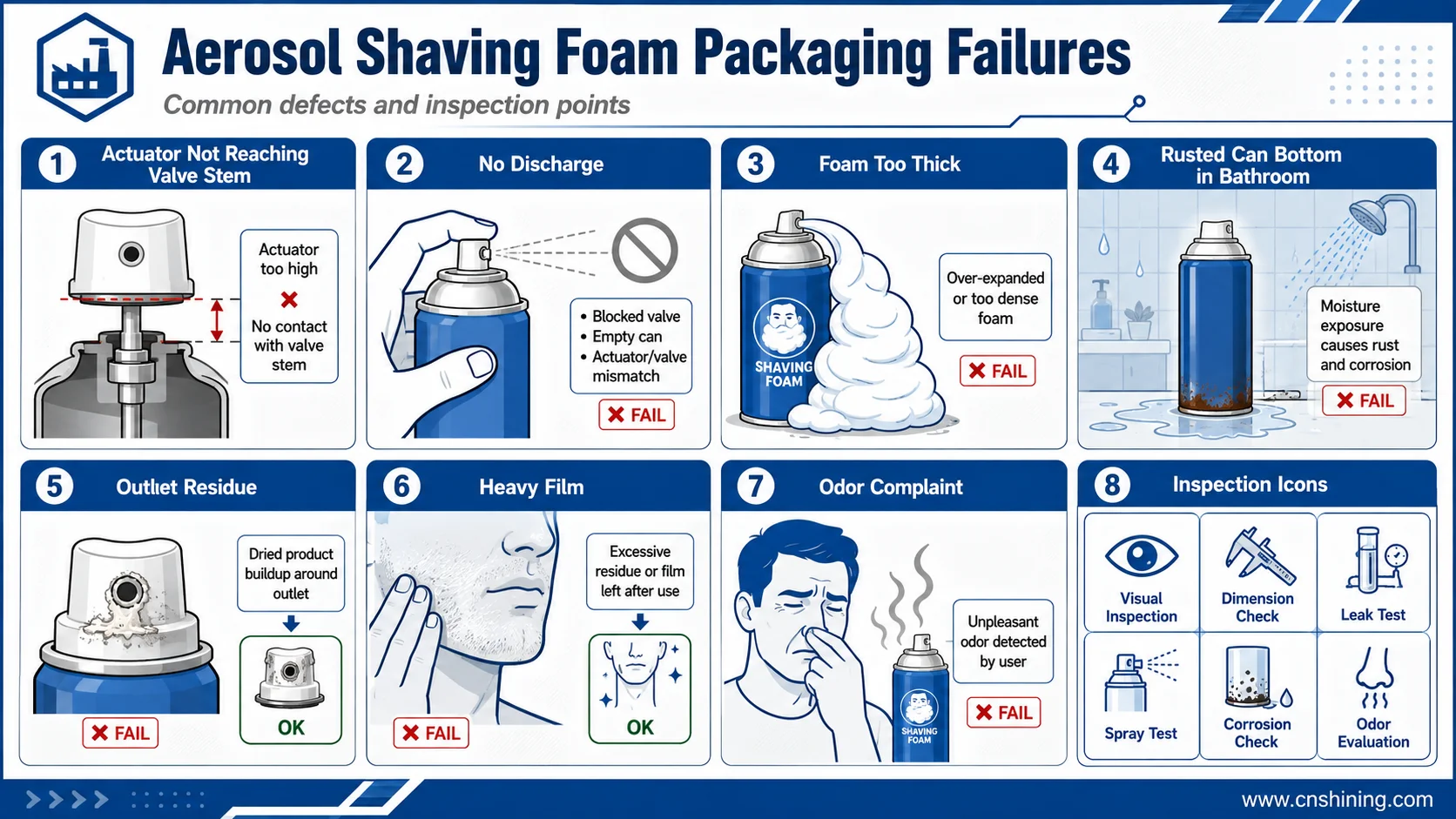
| Observed issue | Likely technical category | Packaging-side action |
|---|---|---|
| Actuator does not reach stem; no foam dispenses | Actuator-stem engagement failure | Reduce tolerance-chain risk, inspect contact surface, test batch interchangeability |
| Foam is too thick and hard to spread | Foam density / expansion mismatch | Review stem orifice, foam valve, actuator outlet geometry and shear path |
| Can bottom rusts after bathroom storage | Bottom corrosion resistance | Use aluminum aerosol can, not steel aerosol can |
| New scent receives negative response | Fragrance expectation mismatch | Use fragrance intensity scale and clearer front-label sensory cue |
| Heavy film after shaving | Rinse-off and hydrophobic residue balance | Recheck oil phase, polymer level, surfactant system and actuator wetness |
| Itching, irritation, redness search demand | Sensitive skin fit | Align formula claims, fragrance level, alcohol content and low-irritation messaging |
Packaging optimization should target complaint reduction first. Fancy graphics do not fix poor discharge. For actuator-to-stem failures, use engagement gauges and run wet-heat aging, drop tests and multi-batch interchangeability checks. For mass retail SKUs, a mature foam or gel actuator platform is usually safer than a complex custom button designed only for shelf appearance.
Foam shape is also a packaging issue. If users say the foam is too thick, lowering surfactant alone may not solve it. Look at stem orifice, valve body, actuator outlet and channel shear. Fast shaving usually works better with a wide, slightly wet, lower-expansion foam band. Barbershop-style products can tolerate thicker, creamier foam.
11. Shining Packaging Components for Aerosol Shaving Foam
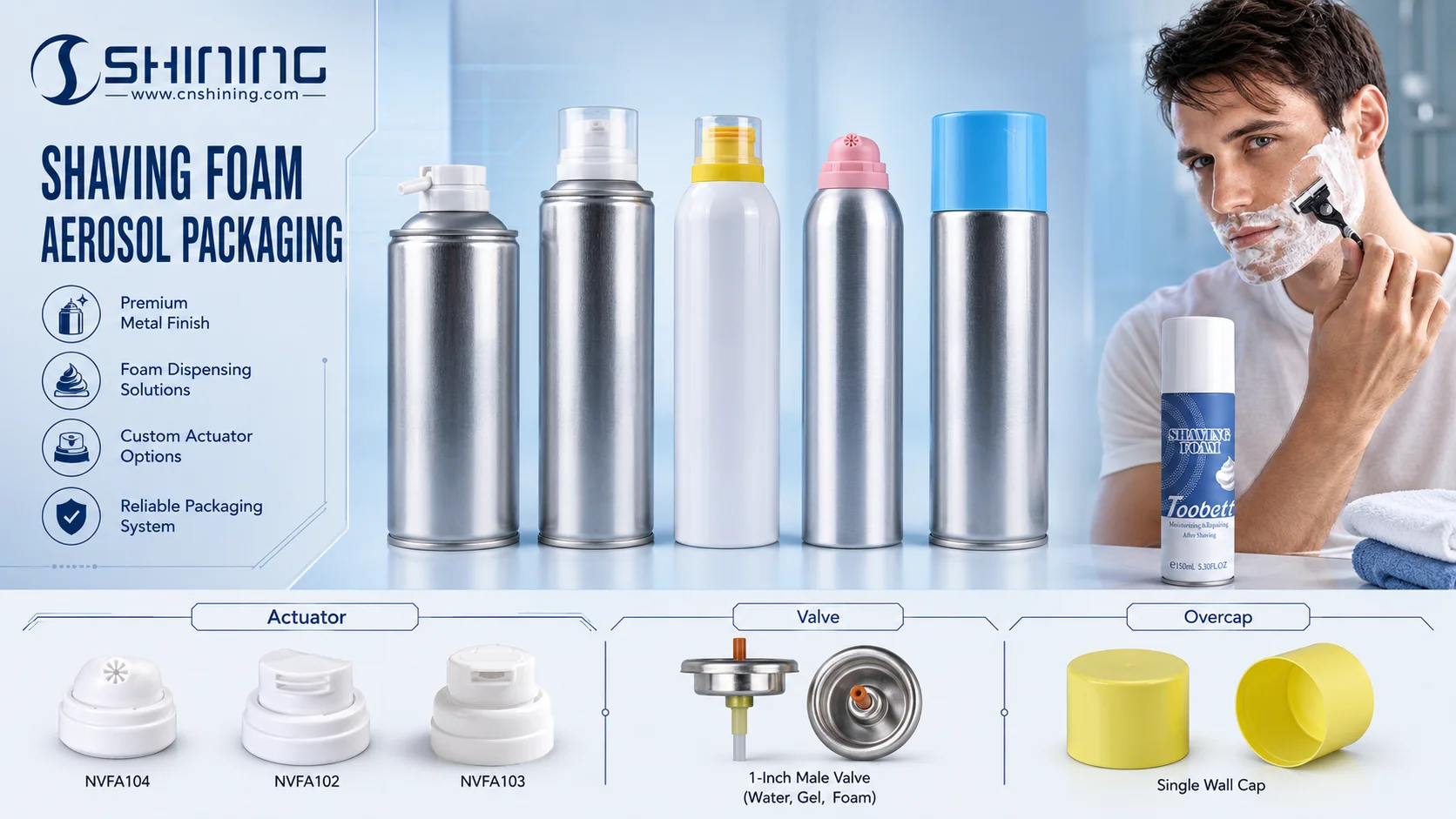
For aerosol shaving foam, the package is part of the formula system. Shining Packaging’s related work focuses on the three parts that normally decide field reliability: foam actuators, aerosol cans and valves. The target is not to make the outlet look unusual. The target is stable discharge, controlled foam expansion, acceptable residual content and a can structure that survives bathroom storage.
In a shaving foam project, actuator selection should be checked with the intended valve stem and target foam width. Valve selection should match propellant type, filling method, top-up or inverted use and desired output rate. Can selection should include internal coating compatibility, base corrosion resistance, pressure rating, print requirements and recycling route. These checks are ordinary engineering work, but they prevent many late-stage complaints.
12. Closing Technical Notes
Aerosol shaving foam remains useful because it is fast, consistent and easy to understand. The risk is that teams treat it as a simple cosmetic foam. It is not. A stable product depends on formula rheology, propellant pressure, valve geometry, actuator flow path, can coating and transport classification. When these items are designed together, the product is easier to fill, ship, store and use. When they are separated, problems usually show up as leakage, rust, residue, clogging, bad foam texture or unexpected logistics cost.
13. FAQ: Aerosol Shaving Foam Packaging and Performance
Aerosol shaving foam is a pressurized package system, not only a cosmetic bulk formula. The product depends on propellant pressure, valve opening, actuator flow path and foam formation during discharge. Ordinary shaving cream mainly relies on user spreading. Aerosol foam offers stronger output consistency, but it also brings can compatibility, pressure safety and dangerous goods transport requirements.
Valve stem orifice, housing restriction and outlet geometry control flow rate and shear during discharge. These parameters influence bubble formation, foam wetness, expansion ratio and first-second feel. A formula that performs well in one valve may become too dry, too wet or unstable in another valve. Valve selection should be tested with the real propellant and actuator.
Thick foam is usually a system issue. It may come from high surfactant structure, strong stabilizer, high expansion ratio, narrow outlet geometry or excessive flow restriction. Reducing surfactant alone can damage cushion and rinse-off. A better check is to compare formula viscosity, stem orifice, foam valve body and actuator channel shear under the target filling pressure.
Traditional aerosol shaving foam often uses liquefied hydrocarbons such as propane, butane and isobutane because they are mature, low-cost and effective for foam formation. DME can also be used when solvent behavior is useful. Newer directions include HFO-1234ze(E), compressed air, nitrogen and BOV systems. Each option changes pressure behavior, flammability, cost and logistics.
Bag-on-Valve can work when the formulation and discharge target fit the system. It separates product from compressed gas, which can support cleaner evacuation and lower propellant contact. The discharge curve differs from liquefied gas systems, so foam density, residual content, actuator choice and user feel must be retested. It is not a drop-in replacement for every hydrocarbon foam.
Bathroom storage exposes the can base to water, surfactant residue, warmth and long contact time. Rust risk increases when the bottom design traps moisture or the external coating is weak. For mass products, Replacing tinplate aerosol cans with aluminum ones can prevent rusting.
Residual formulation can remain inside the actuator channel after the user releases pressure. If that residue contains volatile foaming agent, it may continue to expand outside the outlet. This creates messy post-foaming, crusting or abnormal first discharge next time. Anti-residue actuator design, shorter flow paths and better cut-off behavior can reduce this complaint.
Aerosols are generally handled under UN1950 and Class 2 transport rules. The final division depends on contents and flammability, commonly 2.1 for flammable aerosols or 2.2 for non-flammable, non-toxic aerosols. Traditional hydrocarbon shaving foam often falls into flammable aerosol handling. This affects air freight, sea freight, warehouse acceptance and cross-border e-commerce planning.
Fragrance and pH changes can alter coating compatibility, valve gasket behavior, odor stability, corrosion risk and foam drainage. A formula may pass early sensory tests but fail during long stability storage. When fragrance, pH or propellant changes, repeat compatibility testing with the actual can coating, mounting cup, gasket, valve and actuator instead of checking the bulk alone.
The main trend is system optimization rather than larger foam volume. Brands are moving toward lower-GWP propellants, compressed air or BOV options, recyclable packaging, mono-material actuators, anti-residue outlet structures, sensitive-skin formulas and reduced microplastic dependence. These changes require joint validation because packaging changes can alter foam output, residual content and shelf stability.