
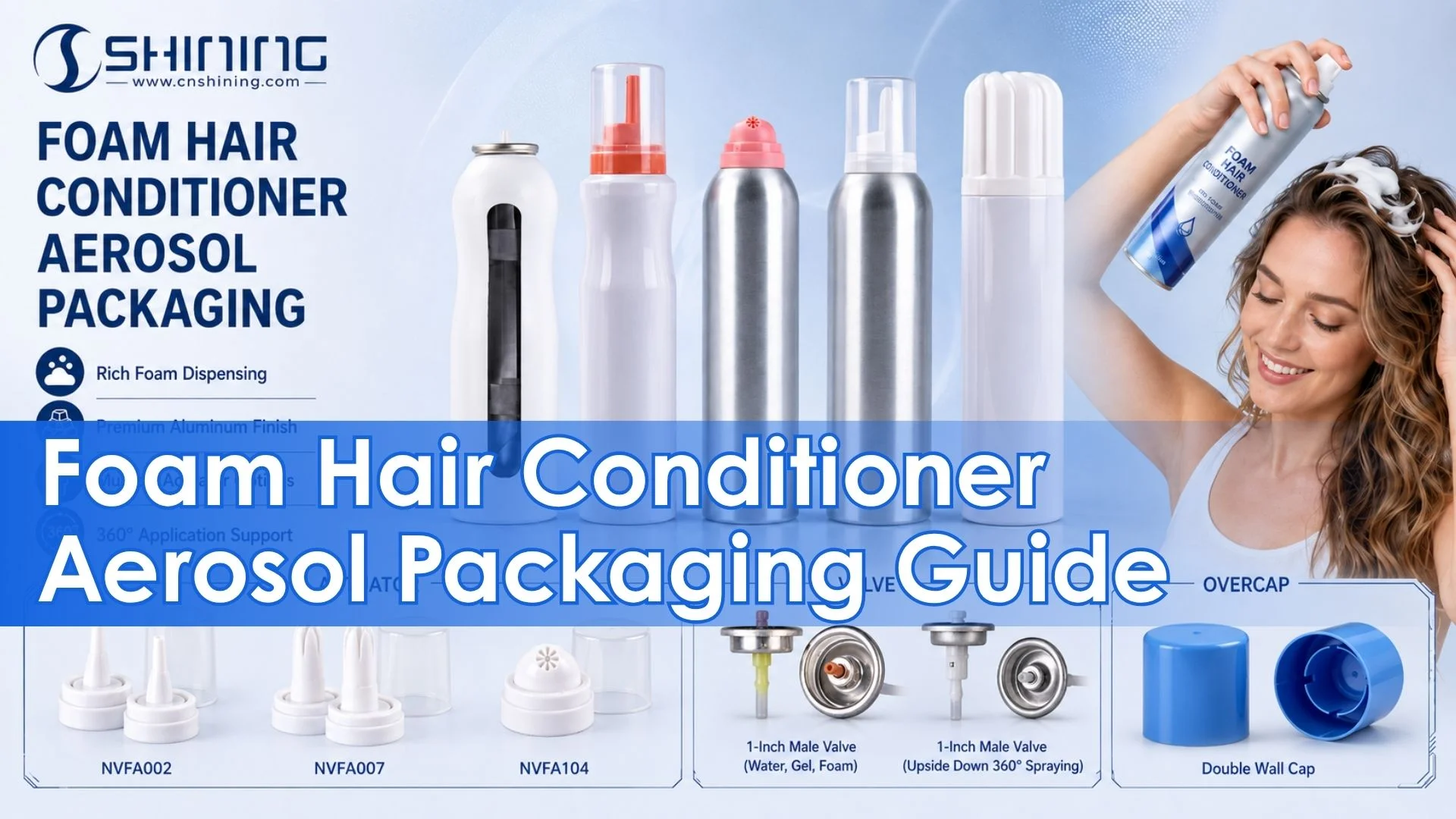
Foam hair conditioner aerosol is a pressurized hair-care format that releases a conditioning formula as foam, cream-like mousse, or a soft ribbon. Its role is not the same as classic styling mousse. The main job is conditioning: slip, detangling, softness, moisture feel, frizz control, and sometimes color care or light repair support.
The format sits between leave-in conditioner, rinse-off conditioner, light cream, dry conditioner foam, and conditioner-mousse hybrid. That is why naming varies: conditioning foam, whipped hair conditioner, leave-in foam conditioner, dry conditioning foam, and conditioning mousse may refer to products with similar hardware but different user promises.
The engineering conclusion is simple. If the product is positioned as an affordable, dense, sensory foam, a standard 1-inch aerosol can with LPG/DME-type propellant still gives strong cost-to-foam performance. If the product carries sensitive actives, low-VOC claims, or higher e-commerce complaint risk, BOV, nitrogen, compressed air, or inert-gas valve technology deserves early testing.
1. Product Boundary and Working Principle
The most accurate way to define the category is not by appearance, but by function. If the formula is built mainly for softness, slip, detangling, moisture feel, and frizz reduction, it belongs to the conditioner side. If the main promise is hold, body, curl support, or volume, it moves closer to styling mousse.
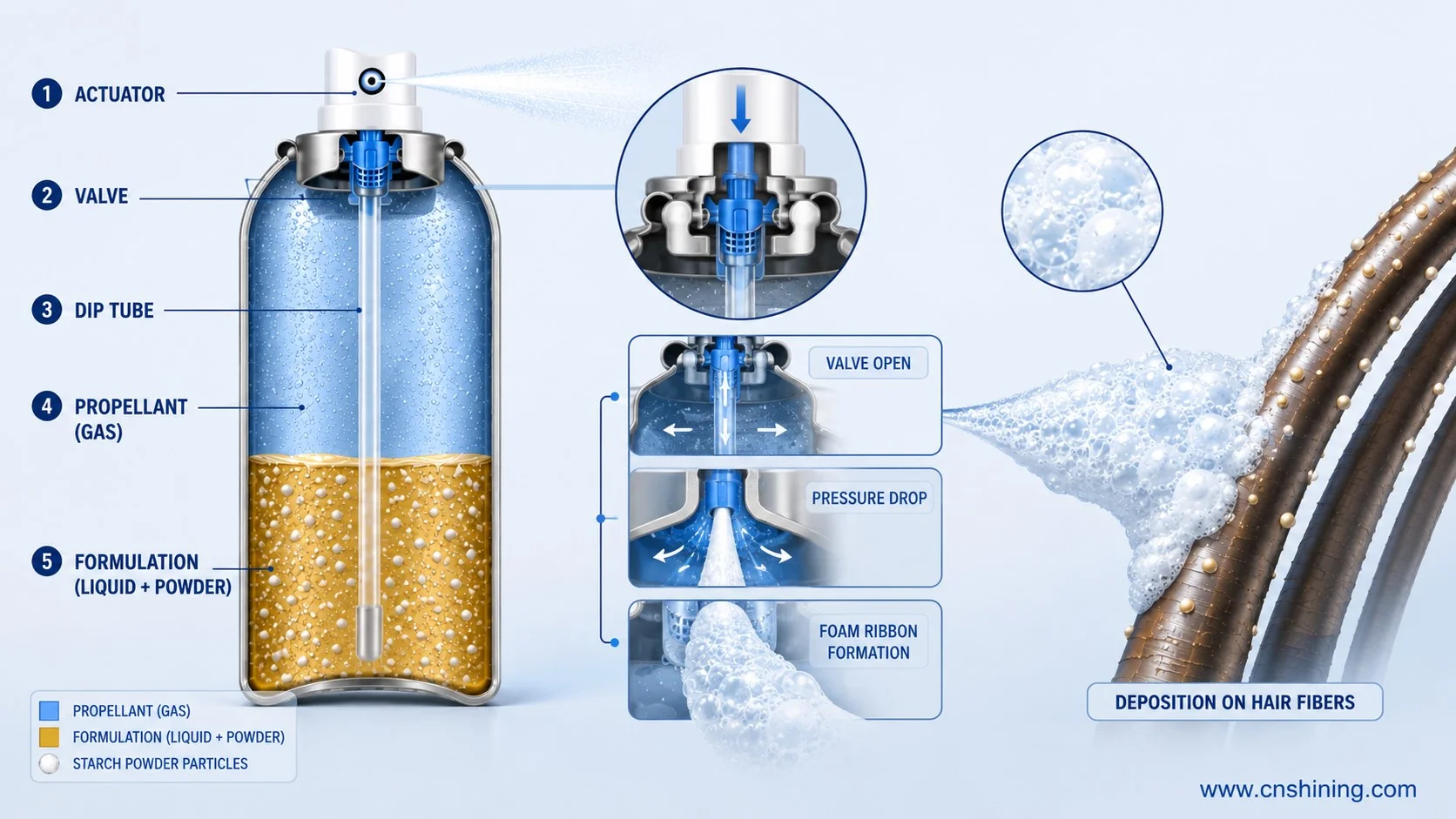
The EU definition of an aerosol dispenser is broad. It covers containers that release contents as spray, foam, paste, powder, or liquid. A foam hair conditioner using a pressurized container therefore has to be treated as both a cosmetic product and an aerosol package. The EU Aerosol Dispensers Directive page explains that an aerosol dispenser includes a container, actuator, valve, propellant, and active product.
Formula inside can → Valve pressed → Stem and actuator restrict flow → Pressure drops → Propellant flashes or gas expands → Foam ribbon forms → Foam spreads on hair → Cationic conditioner / silicone / polymer deposits
| Dimension | Foam Hair Conditioner Aerosol | Traditional Mousse | Leave-in Cream / Milk | Spray |
|---|---|---|---|---|
| Main value | Light conditioning, uniform spread, fast application | Hold, body, styling support | Stronger nourishment and repair feel | Quick detangling, light moisture, heat protection |
| Fine-hair compatibility | High | Medium | Low to medium | High |
| Resistance to flatness | High | Medium | Low | High |
| Care active loading | Medium to high | Medium | High | Medium |
| User tolerance | Medium; depends on shaking, inversion, and dosage | Medium | High | High |
| Packaging and regulatory load | High | High | Low | Medium to high |
| Common complaints | Unstable foam, leakage, hard-to-control dosage | Sticky, hard, shell-like feel | Heavy, oily, residue | Uneven wetting, inhalation concern, weak conditioning |
This does not mean foam conditioner is better than every nearby format. It means it occupies a narrow but useful zone: lighter than cream, more enveloping than spray, and more conditioner-oriented than styling mousse. Fine damaged hair, curl refresh, between-wash dry-end management, and tangle-prone mid-lengths are the strongest use cases.
2. Market Size, Regional Logic, and Growth Judgement
| Scope | Base Size | Forecast Size | Years | Practical Reading |
|---|---|---|---|---|
| Leave-on foam conditioner | USD 1.6 billion | USD 3.2 billion | 2024 → 2033 | Closest direct public scope; useful as directional reference, not as the only budget base. Source: Market Intelo. |
| Global leave-in conditioner | USD 2.49 billion | USD 3.56 billion | 2022 → 2033 | Useful adjacent scope for the leave-in care pool. Source: Fact.MR. |
| Global leave-in conditioner | USD 2.2999 billion | USD 2.9516 billion | 2019 → 2027 | Older historical-to-midterm view. Source: Polaris Market Research. |
| Global leave-in conditioner | USD 3.12 billion | USD 4.08 billion | 2026 → 2030 | More recent and more active growth assumption. Source: Research and Markets. |
| North America hair care | USD 23.67 billion | USD 31.24 billion | 2024 → 2030 | Not conditioner-specific, but shows capacity for high-value care formats. Source: TechSci Research. |
| Europe hair care | USD 13.57 billion | USD 24.98 billion | 2024 → 2035 | Regulation, sustainability, and packaging upgrades shape the category. Source: Market Research Future. |
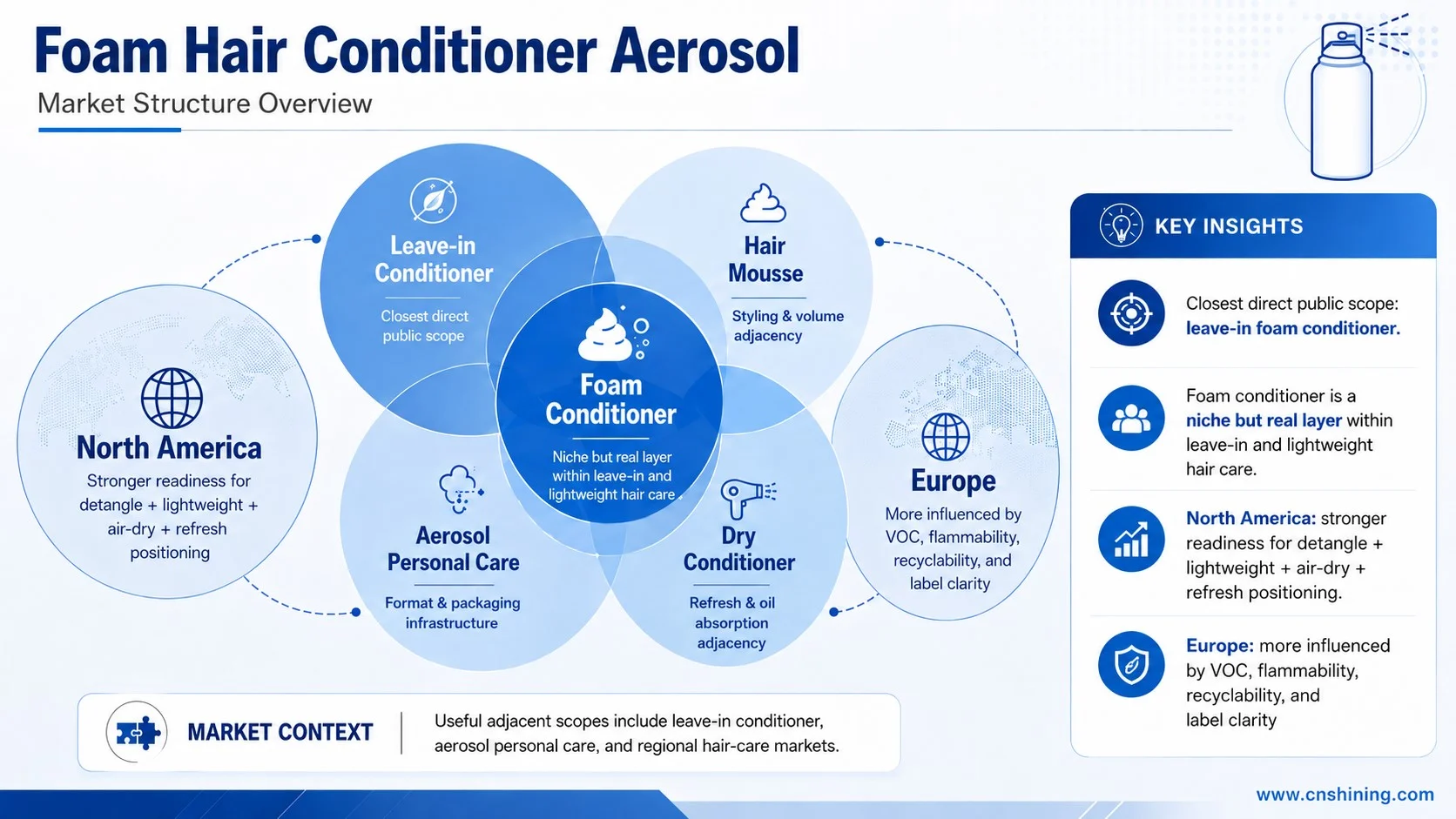
Three market judgements are more useful than a single headline number. First, foam conditioner is not a false demand; it is a real format layer inside leave-in and lightweight hair care. Second, it is still a niche format, not a universal shampoo-and-conditioner mass product. Third, failure often comes from poor alignment between SKU positioning and packaging engineering.
Regionally, North America, the UK, Australia, and New Zealand are more ready for “detangle + lightweight + air-dry + refresh” positioning. Continental Europe pushes harder on VOC, flammability, recyclability, and label clarity. China and Southeast Asia move faster through content-driven education around heat damage, color care, curl refresh, and soft volume without stiffness.
3. Formula Structure, Key Ingredients, and Manufacturing Points
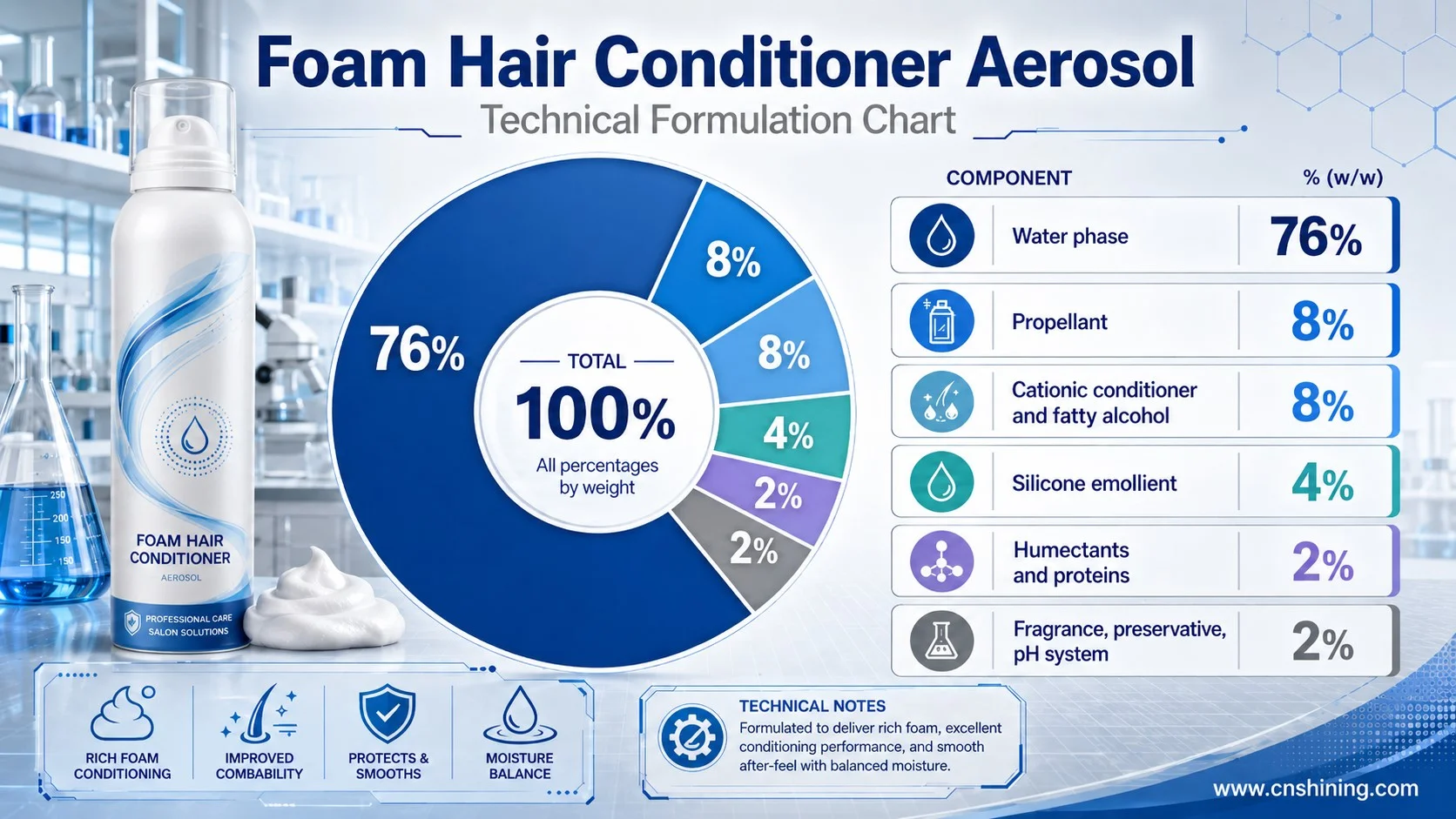
The formula backbone is stable across many public examples: water phase + cationic conditioning system + fatty alcohol / emulsifying structure + silicone or emollient + humectant / protein / repair narrative ingredients + fragrance / preservative / pH system + propellant or foaming architecture.
| Type | Typical Use | Technical Character |
|---|---|---|
| Leave-in whipped conditioning foam | After washing on damp hair; also for daily refresh | Light, slippery, easy to comb, built around softness without collapse |
| Dry conditioner foam | Between washes, dry ends, tangles | Usable on dry hair, quick revive, lighter and faster-drying |
| Rinse-off foam conditioner | Fine or flat hair needing rinse-off care | Conditioning feel without the weight of a dense cream |
| Ingredient Class | Examples | Main Function | Typical Working Range |
|---|---|---|---|
| Propellant / foaming system | Butane, isobutane, propane; compressed air or N₂ in BOV | Builds foam, drives discharge, controls foam body and evacuation | LPG often several percent to low double digits; BOV separates gas and product |
| Cationic conditioner | Cetrimonium chloride, quats, amine salts | Adsorbs to damaged negatively charged hair, reduces friction | Usually low single digits; rinse-off systems may carry more |
| Fatty alcohol / structure | Myristyl, cetyl, stearyl alcohol | Emulsion structure, creaminess, soft feel | Usually low single digits |
| Silicone / emollient | Amodimethicone, dimethicone, PEG-8 dimethicone | Slip, combing force reduction, frizz control, gloss | Low to medium single digits |
| Polymer | Polyquaternium, guar derivatives, cationic cellulose | Improves deposition, combing, and touch consistency | Low single digits or lower |
| Humectant | Glycerin, butylene glycol, panthenol, hyaluronic acid | Moisture feel, softness, reduced dryness | Low single digits |
| Protein / amino acid / repair narrative | Hydrolyzed milk protein, quinoa, keratin, amino acids | Surface conditioning and sensory repair support | Trace to low single digits |
| Fragrance / preservative / chelant / pH | Parfum, phenoxyethanol, ethylhexylglycerin, citric acid | Odor, preservation, stability, pH control | Often below 2% |
In public INCI lists for representative whipped products, water, LPG propellants, cationic conditioners, fatty alcohols, and amodimethicone appear before the fine details of proteins, humectants, and fragrance. That pattern is instructive. A good foam conditioner is usually decided first by the front-end structure and discharge architecture, not by a single fashionable active.
| Formula Block | Illustrative Share |
|---|---|
| Water phase | 76% |
| Propellant / foaming system | 8% |
| Conditioner + fatty alcohol + emulsifying structure | 8% |
| Silicone / emollient | 4% |
| Humectant / protein / repair-active narrative | 2% |
| Fragrance / preservative / pH / other | 2% |
Manufacturing usually starts with water phase and structure phase preparation, followed by heated emulsification, controlled shear, and cooling. Heat-sensitive actives, fragrance, and fine-tuning materials often enter near 40°C. Aerosol filling then moves to pressure filling, cold filling, or BOV charging, followed by pressure, net weight, crimp, leak, water-bath, foam texture, and compatibility checks.
4. Regulatory, Standard, and Label Testing Requirements
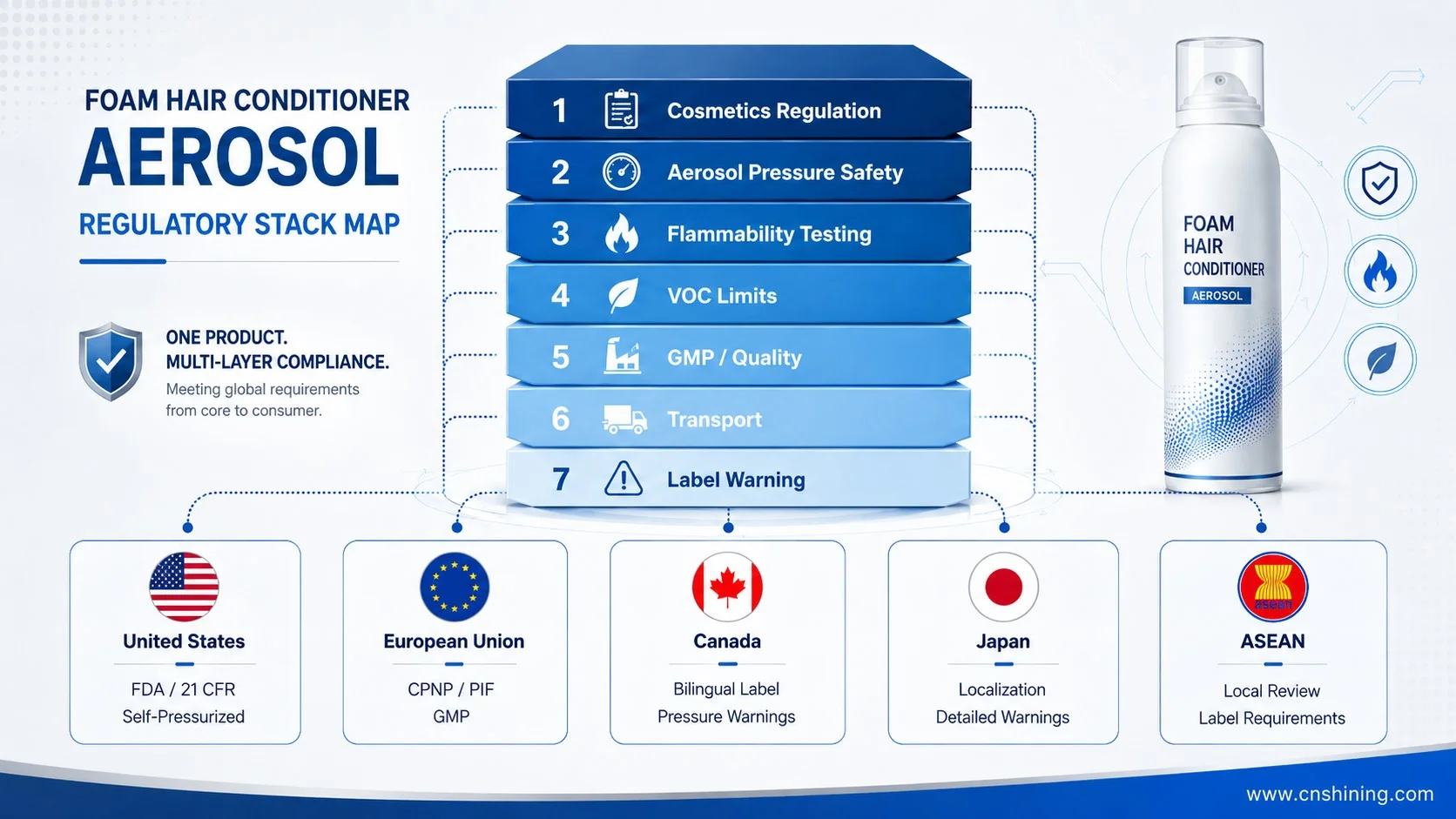
Foam hair conditioner aerosol is not regulated by one simple rule. It is a stack: cosmetic regulation + aerosol packaging and pressure safety + flammability and warning labels + VOC / environmental rules + GMP / quality system. This stack is where many launch delays start.
| Region | Main Framework | Practical Requirement | Testing / Label Focus |
|---|---|---|---|
| United States | FDA cosmetic labeling, 21 CFR 701/740, 16 CFR 1500, MoCRA, state VOC rules | Identity, net contents, ingredients, warnings, self-pressurized container statements | FDA Cosmetics Labeling Guide; 21 CFR 740.11 self-pressurized container warnings |
| European Union | Cosmetics Regulation 1223/2009, ADD 75/324/EEC, CLP, EN ISO 22716 | Responsible person, CPSR, PIF, CPNP notification, GMP, aerosol pressure and flammability compliance | Regulation (EC) No 1223/2009; ADD foam and mousse testing logic |
| Canada | Cosmetic Regulations and pressurized-container cosmetic labeling | Pressure warnings and bilingual presentation are material points | Health Canada pressurized cosmetics labeling summary |
| Japan | Cosmetic standards and aerosol-related industry labeling practice | Ingredient restrictions and local warnings need careful localization | Use and disposal warnings are usually more detailed than many export teams expect |
| ASEAN | ASEAN Cosmetic Directive and local implementation | Ingredient restrictions and label structure are partly harmonized | Country language and local administrative requirements still need review |
In the US, 21 CFR 740.11 is often missed. A self-pressurized cosmetic container needs clear warnings about eyes, pressure, puncture, incineration, heat, and children. If hydrocarbon or halogenated hydrocarbon propellants are used, extra warning logic may apply, although aerosol foam or cream products with less than 10% propellant may fall under a specific exemption condition.
In the EU, the gate is not just the front label. GMP, CPSR, PIF, CPNP notification, and complete label content form the path. The aerosol side then adds pressure, flammability, construction, testing, and marking requirements.
5. Patents, Technology Evolution, and Top 10 Brand Formats
5.1 Patent and Technology Direction
Technology development in this category runs along four lines: lighter conditioning deposition, more stable foam texture, lower VOC and flammability burden, and fewer clogging or corrosion failures. The following patents and technical routes are worth reading before claim writing or hardware selection.
| Patent / Technology | Key Information | Commercial Reading |
|---|---|---|
| US7597898B2 | Cationic cellulose and chitosan in aerosol or pump foam hair-treatment products | Represents polymer-network deposition and light conditioning direction |
| US9993419B2 | Concentrated conditioner delivered from an aerosol foam dispenser, with reduced high-melting-point fatty compounds and efficient silicone deposition | One of the key directions for “light but still conditioning” foam |
| US20200188255A1 | Hair conditioning spray treatment discussing foaming agents and stabilizers | Shows foam structure being treated as a performance variable, not just appearance |
| EP0796611B1 | Hair styling mousse that may include conditioning agents | Confirms the long-standing overlap between conditioner and mousse formats |
| US20080138293A1 | Alcohol-free cosmetic foam carrier | Supports lower dryness and lower irritation routes for foam bases |
| Salvalco Eco-Valve / Eco-Inverted | N₂ or compressed-air valve route replacing traditional LPG in some applications | Relevant for low-VOC, lower-flammability personal care aerosol formats |
The timeline is clear. Early products focused on making hair-care lotions and styling aids foam. Later work focused on real conditioning deposition inside foam. Recent work is moving toward low-VOC systems, inert gas, BOV, lower flammability, and better compatibility with sensitive actives.
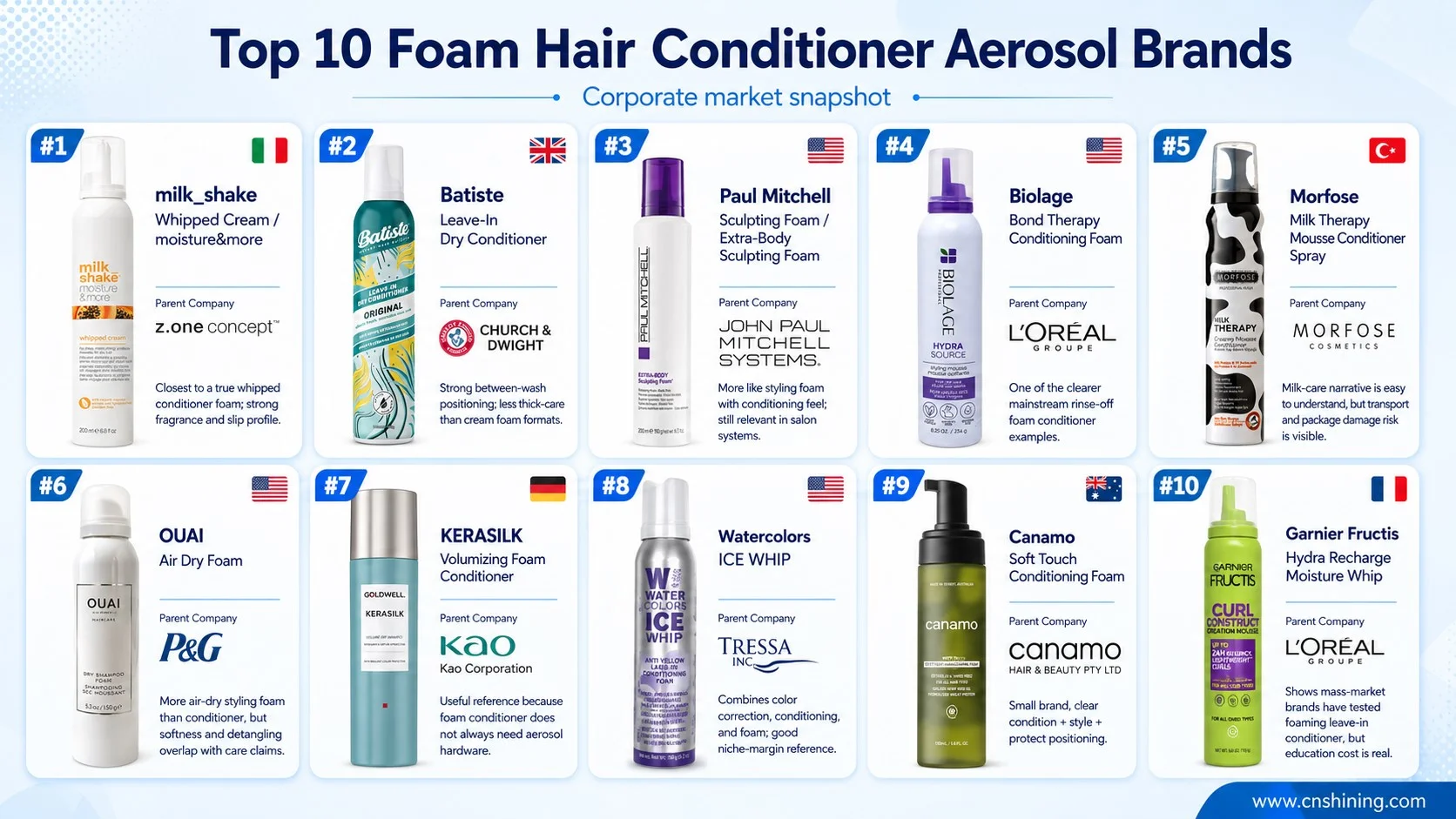
5.2 Top 10 Foam Hair Conditioner Aerosol Brand
| Brand / Product Line | Country | Parent Company | Typical Size | Technical Comment |
|---|---|---|---|---|
| milk_shake Whipped Cream / moisture&more | Italy | z.one concept | 50 mL / 200 mL | Closest to a true whipped conditioner foam; strong fragrance and slip profile |
| Batiste Leave-In Dry Conditioner | UK | Church & Dwight | 100 mL | Strong between-wash positioning; less “thick care” than cream foam formats |
| Paul Mitchell Sculpting Foam / Extra-Body Sculpting Foam | United States | John Paul Mitchell Systems | 2 oz / 6 oz / 16.9 oz | More like styling foam with conditioning feel; still relevant in salon systems |
| Biolage Bond Therapy Conditioning Foam | United States | L’Oréal | 8.45 oz / 16.9 oz | One of the clearer mainstream rinse-off foam conditioner examples |
| Morfose Milk Therapy Mousse Conditioner Spray | Turkey | Morfose Cosmetics | 200 mL / 350 mL | Milk-care narrative is easy to understand, but transport and package damage risk is visible |
| OUAI Air Dry Foam | United States | Procter & Gamble | 4 oz | More air-dry styling foam than conditioner, but softness and detangling overlap with care claims |
| KERASILK Volumizing Foam Conditioner | Germany | Kao Corporation | 150 mL | Useful reference because foam conditioner does not always need aerosol hardware |
| Watercolors ICE WHIP | United States | Tressa Inc. | 6.5 oz | Combines color correction, conditioning, and foam; good niche-margin reference |
| Canamo Soft Touch Conditioning Foam | Australia | Canamo Hair and Beauty Pty Ltd | 150 mL | Small brand, clear condition + style + protect positioning |
| Garnier Fructis Hydra Recharge Moisture Whip | France | L’Oréal | About 5 oz / 13 oz | Shows mass-market brands have tested foaming leave-in conditioner, but education cost is real |
6. User Pain Points and Packaging Engineering Actions
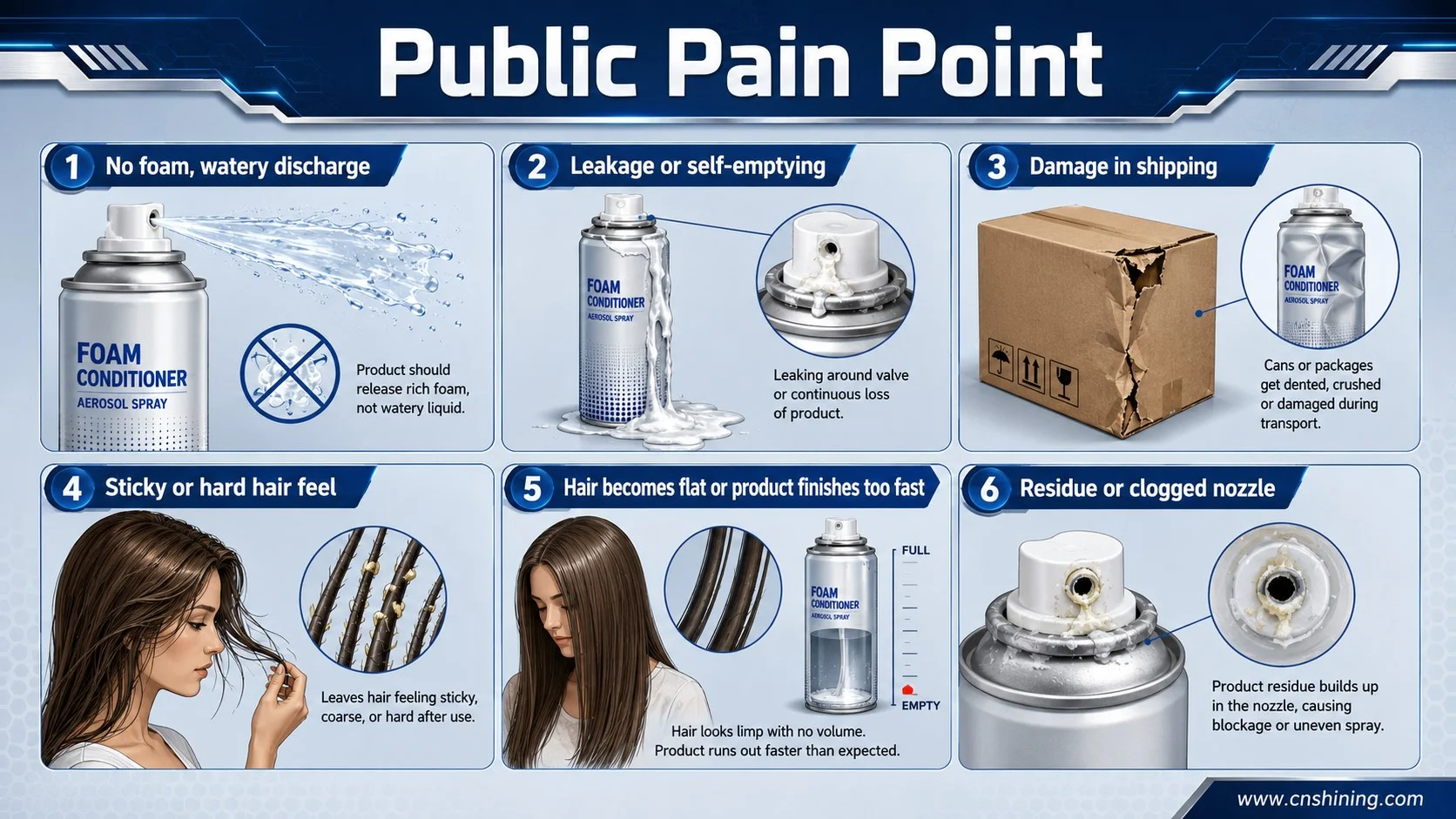
The most useful complaint pattern is not “the product has no effect.” It is often “the package is unstable,” “I do not know how much to use,” or “the foam does not come out correctly.” That points to a hardware-formula problem, not only a formula problem.
| Public Pain Point | Example Wording | More Likely Root Cause | Packaging / Structure Action |
|---|---|---|---|
| No foam, watery discharge | “Nothing seems to come out” | Valve / actuator mismatch, no inversion, low-end pressure decay | Use mousse actuator, clearer inverted-use graphic, improve tail-end discharge stability |
| Leakage or self-emptying | “Emptied itself” | Crimp leakage, valve cup seal instability, accidental actuator press | Improve crimp control, add locking overcap, reduce transport misfire risk |
| Damage in shipping | “Broke in the box” | Weak overcap protection, head impact | Use stronger overcap, e-commerce secondary packaging, reduce exposed tall head design |
| Sticky or hard hair feel | “Sticky and dry” | Too much discharge, high actuator impulse, styling-biased formula sold as care | Lower discharge rate, smoother flow path, show “golf-ball size” dosage on front panel |
| Hair becomes flat or product finishes too fast | “Travel size is such a rip off” | Small can, low foam density, user overdosage | Main SKU at 150–200 mL, higher foam density, printed estimated use count |
| Residue or clogged nozzle | Repeated “not sticky” claims in social content imply fear of residue | Dried polymer, fragrance, protein, or colorant around outlet | Lower dead angle flow path, anti-residue cap structure, user instruction for post-use clearing |
At least half of these complaints can be reduced by packaging engineering. If every negative review is pushed back to the formulator, the redesign cycle becomes slow and expensive.
| System | Valve / Actuator Direction | Can / Coating Direction | What It Solves | Cost and Trade-off | Best Fit |
|---|---|---|---|---|---|
| Traditional LPG aerosol can | 1-inch mousse valve, inverted actuator, ribbon-like continuous discharge | Aluminum or tinplate; internal coating compatibility test required | Dense foam, low cost, familiar use | Higher flammability and VOC pressure; more misuse and clog risk | Mass line, sensory foam line |
| BOV with N₂ / compressed air | BOV valve with foam actuator; multi-angle use if needed | Often aluminum; bag material and active compatibility need testing | Low VOC, less contact between product and propellant, better active protection | Higher cost, filling line requirement, foam may be less rich than LPG | Premium leave-in, sensitive active, export compliance route |
| Inert-gas valve route | Eco-Valve / Eco-Inverted type logic | Must be tuned with viscosity and target foam form | Lower flammability and environmental pressure | Fewer supply-chain choices, longer sampling cycle | Brands wanting lower-carbon aerosol experience |
| Non-aerosol foamer bottle | Mechanical foam pump | PET / PP / PE recycle route easier | Avoids aerosol flammability and pressure labeling | Foam feel is not the same; oxygen and contamination risk can rise | Regulation-conservative or cost-sensitive line |
For package development, three tests should be pulled forward. First, actuator discharge rate and foam density over the full life of the can. Second, crimp and leakage performance after transport simulation. Third, internal coating compatibility against water phase, cationic salts, pH, fragrance, and any pigment or color-correcting material.
7. Packaging Components for Foam Conditioner Aerosols: Actuator, Can, and Valve
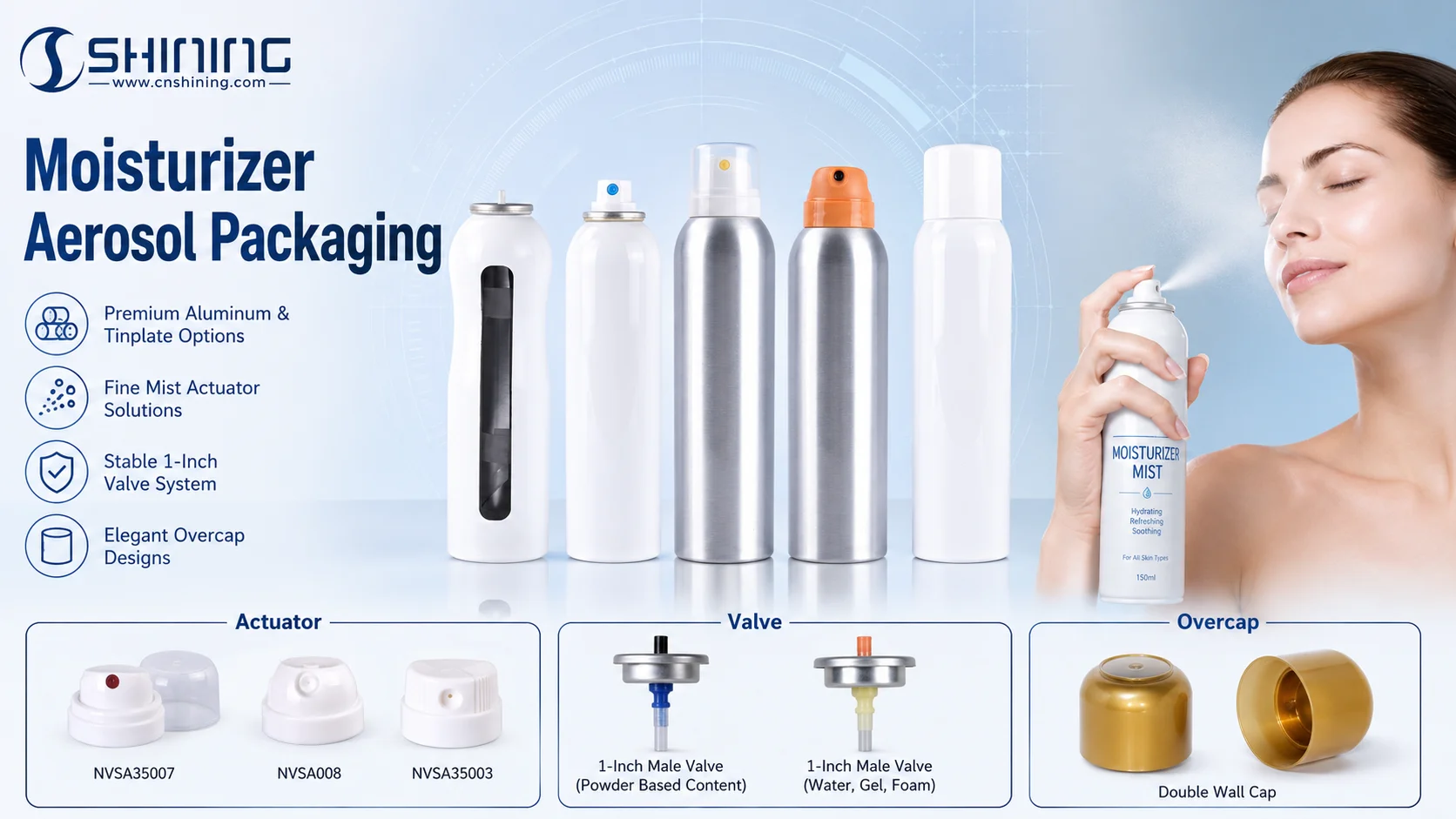
For a foam hair conditioner aerosol, the package should be selected as a system, not as three separate purchased parts. The actuator controls the user’s hand feel and foam shape. The valve controls discharge stability and flow restriction. The can and internal coating control pressure safety, corrosion resistance, and shelf stability.
In Shining Packaging projects for foam-type personal care aerosols, the practical starting point is usually the expected foam behavior: dense whipped cream, softer ribbon foam, quick-breaking dry conditioner foam, or rinse-off foam with controlled dosage. From there, actuator channel, valve type, stem orifice, dip tube or inverted-use logic, overcap protection, can material, and internal coating are matched to the formula.
This is not just about looking neat on the shelf. A good actuator-can-valve set can reduce watery discharge, post-use residue, accidental transport pressing, and “too much product per press” complaints. The cost of a slightly better actuator or overcap is often lower than the cost of repeated complaint handling after launch.
8. Conclusion
Foam hair conditioner aerosol works when it is treated as a lightweight conditioning format, not as a styling mousse with softer claims. The formula must deliver slip and deposition without weight. The valve and actuator must make the foam stable, clean, and repeatable. The can and internal coating must survive water phase, cationic chemistry, fragrance, pressure, and transport.
The shortest engineering rule is this: define the hair-care job first, then tune the formula and package as one system. Only after that does it matter whether the front label says leave-in foam conditioner, whipped cream, dry conditioner foam, or conditioning mousse.
9. FAQ: Foam Hair Conditioner Aerosol
A foam hair conditioner aerosol is a pressurized hair-care product that dispenses a conditioning formula as foam or cream-like mousse. Its main purpose is slip, detangling, softness, moisture feel, and frizz reduction. It may also include color-care, repair, or light styling support, but it is not technically the same as a classic hold-focused hair mousse.
The difference is the main function. Foam conditioner focuses on conditioning benefits such as combing, softness, reduced friction, and lightweight feel. Traditional mousse is usually built around hold, volume, curl support, or styling memory. Many commercial products sit between the two, which is why names like conditioning mousse and whipped conditioner often overlap.
The actuator shapes the flow path, foam ribbon, discharge speed, residue level, and user dosage. A small change in actuator geometry can turn a dense cream foam into a wet loose foam. For foam hair conditioner aerosol, the actuator is not a decorative cap. It is part of the product performance system.
Common aerosol foam systems often use LPG-type propellants such as butane, isobutane, and propane. BOV systems may use compressed air or nitrogen while keeping gas separated from the formula. LPG usually gives rich foam and lower cost. BOV can reduce VOC and formula-propellant contact, but it costs more and needs careful foam testing.
Watery discharge usually points to a system mismatch. Possible causes include poor valve-actuator selection, insufficient shaking, wrong use angle, near-empty pressure decline, or formula instability. For inverted mousse systems, user handling is also important. Clear shake-and-invert graphics and a mousse-specific actuator can reduce this complaint.
The core conditioning effect usually comes from cationic conditioners, fatty alcohol structure, silicones or emollients, polymers, and humectants. Cationic materials help reduce friction on damaged hair. Silicones improve slip and frizz control. Humectants improve moisture feel. Proteins or amino acids often support repair storytelling and surface conditioning.
BOV is not automatically better. It is useful when low VOC, lower flammability, sensitive actives, or formula isolation are high priorities. Traditional LPG aerosol systems still give strong foam richness and cost efficiency. The right choice depends on target foam texture, price band, regulation, compatibility risk, and the expected complaint profile.
Key tests include pressure, net weight, crimp quality, leakage, water-bath safety, foam density, discharge rate, tail-end evacuation, and actuator residue. Compatibility testing should include formula pH, cationic salts, fragrance, internal coating, and can material. Transport simulation is important because actuator damage and slow leakage often appear after shipping.
Sticky or hard feel can come from formula design, but dosage and discharge rate are often involved. If the actuator delivers too much product per press, even a reasonable formula can feel heavy. Styling-biased polymers can also create stiffness when the product is sold as care. Front-panel dosage guidance helps reduce misuse.
Packaging engineers can improve the actuator flow path, stem orifice, overcap protection, crimp control, can coating, and usage graphics. A locking or stronger overcap can reduce transport damage. A cleaner actuator can reduce clogging. A controlled discharge rate can reduce overuse, stickiness, and the feeling that the product finishes too fast.