
Aerosol whipped cream forms its foam at the moment of dispensing. It is not whipped cream that has simply been packed into a pressure can. The product is a refrigerated dairy or non-dairy emulsion held under pressure, usually with nitrous oxide, N2O / E942, and it becomes a light foam when the valve opens.
The technical core is the short event inside the valve and nozzle: gas release, pressure drop, expansion, bubble formation, and foam setting. Wageningen research treats the product as an instant foam system. Classic data puts typical overrun around 400%–600%, with overrun mainly controlled by dissolved nitrous oxide and by choking behavior in the dispensing path. See the referenced instant foam physics research.
The product sells convenience, portion control, repeatable output, low training load and clean operation. That explains its fit in coffee drinks, home desserts, holiday baking, bakery decoration and quick food-service plating.
1. Product Definition, Mechanism, and Terminology
1.1 Definition and Working Principle
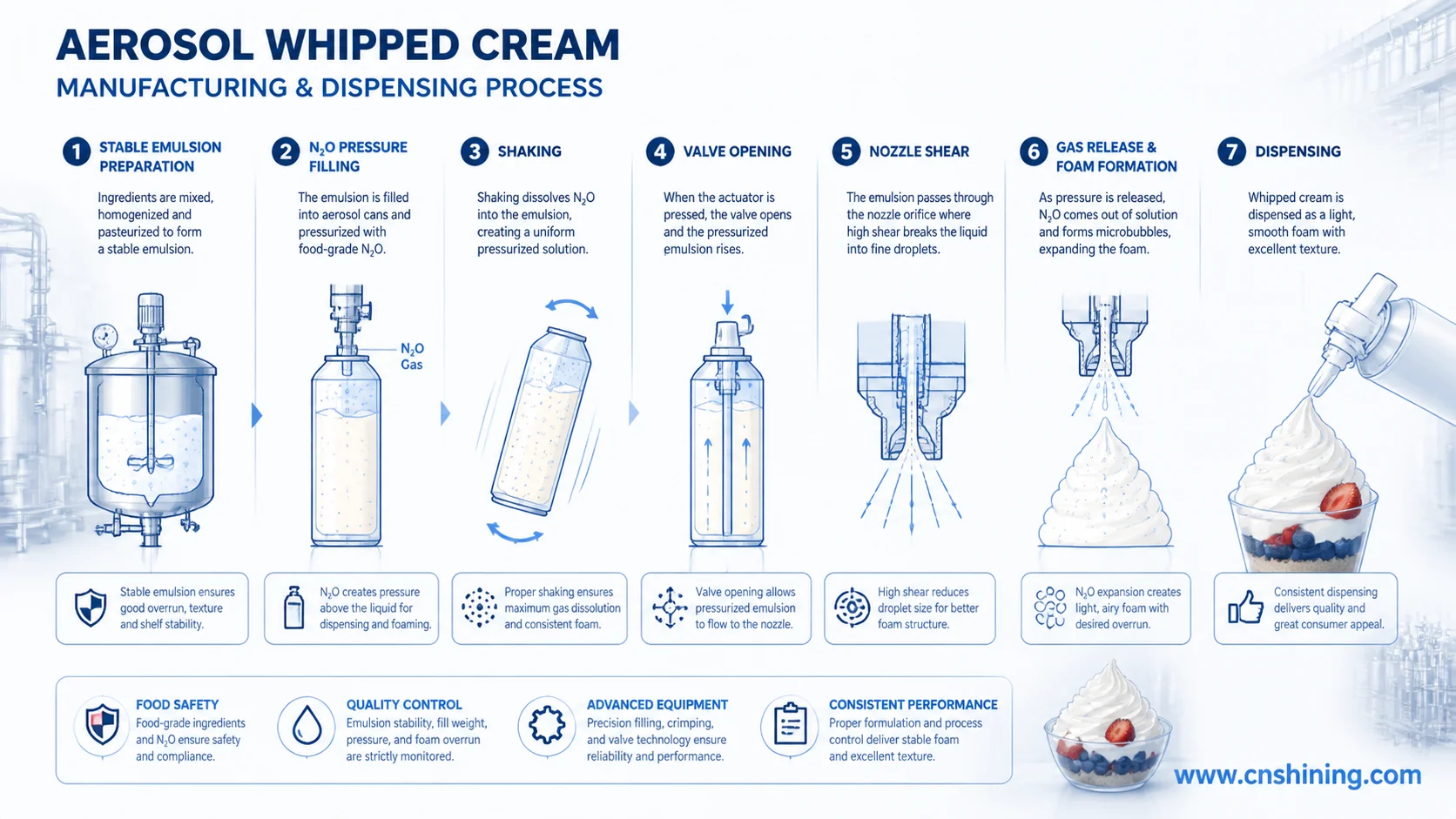
Aerosol whipped cream is a two-phase-to-three-phase transformation system. Inside the can, it should stay as a stable emulsion. At dispensing, it turns into foam. The usual process is simple to describe but hard to control:
- Prepare a stable dairy or plant-based emulsion.
- Fill it into a pressure-resistant aerosol container.
- Charge the can with food-grade N2O.
- Shake to distribute gas through the emulsion.
- Open the valve and let the emulsion pass through the valve and nozzle at high speed.
- The pressure drop makes dissolved gas come out, expand and form a foam structure.
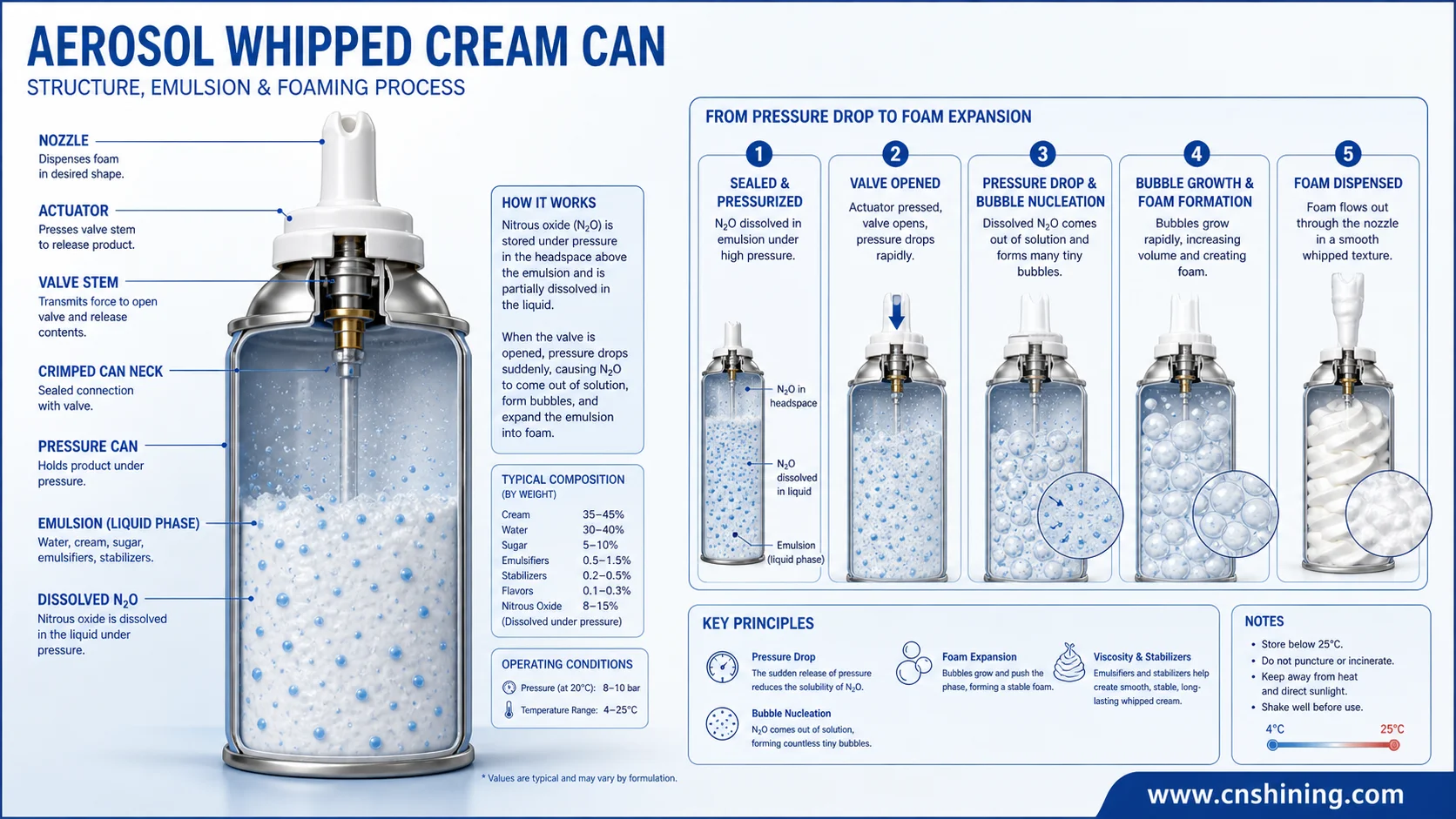
The mechanism has three practical layers. The first is gas dissolution. N2O must dissolve well enough at realistic can pressure. The second is flow and foaming. Once the valve opens, flow restriction and pressure drop create a fast foaming event. The third is foam stability. Milk fat, proteins, emulsifiers and hydrocolloids hold the bubbles long enough for use.
Chemically, the important issue is not a new reaction between cream and propellant. The important issue is interface behavior. Emulsifiers such as mono- and diglycerides, their chain length, saturation and dosage, affect both storage emulsion stability and post-dispense foam stability. That is why aerosol whipped cream is less forgiving than hand-whipped cream.
1.2 Technical Terminology
| Term | Technical Meaning | Commercial Meaning |
|---|---|---|
| Aerosol whipping cream | Emulsion stored in a pressure container and foamed during dispensing. | A separate formulation and packaging category, not only a pack format. |
| Propellant | Gas that creates pressure and supports foam formation. | Controls compliance, texture, spray stability and misuse risk. |
| Overrun | Volume increase after aeration compared with the original liquid. | Affects perceived lightness, yield and unit economics. |
| Choked flow | Critical flow through a restricted path controlled by pressure conditions. | Impacts spray speed, sputtering and bubble size. |
| Valve stem / valve body | Main dispensing path and opening-closing structure. | Controls leakage, durability and output repeatability. |
| Actuator | External pressed part connecting the user’s finger to the valve and nozzle. | Affects comfort, accidental discharge and breakage risk. |
| Nozzle orifice | Final outlet geometry. | Controls peak shape, decoration quality and clogging probability. |
| Emulsifier | Ingredient that reduces oil-water interfacial tension. | Must balance storage stability with fast foam formation. |
| Stabilizer / hydrocolloid | Thickener or water-control ingredient used to slow foam collapse. | Determines whether the cream stands or melts too quickly. |
| GMP | Good Manufacturing Practice. | Common regulatory boundary for propellant and additive use. |
| E942 | EU food additive code for nitrous oxide. | Relevant to EU ingredient declaration and sourcing. |
| BOV | Bag-on-Valve structure separating product from propellant gas. | Useful in some categories, but not automatically equal to classic N2O whipped cream texture. |
2. Propellant, Valve, Actuator, and Nozzle
2.1 Why N2O Is the Mature Propellant
In mainstream food-grade aerosol whipped cream, the propellant is almost always nitrous oxide. Public product labels use terms such as nitrous oxide or E942, and US regulation recognizes nitrous oxide as a direct food substance when used under current good manufacturing practice as a propellant and aerating agent.
Why not just use air, nitrogen or carbon dioxide? The source material supports three practical judgments. First, N2O has the best proven balance because it gives pressure and dissolves enough in the cream phase to generate high overrun. Second, CO2 is used as a water-soluble propellant in food aerosols, but public retail examples of aerosol whipped cream still point strongly to N2O. Third, nitrogen or compressed air is more often associated with Bag-on-Valve or mechanical extrusion concepts. It is harder to copy the light, smooth texture of an N2O whipped cream can.
2.2 Why the Valve and Actuator Decide the Complaint Rate
Valves, actuators and nozzles are not minor plastic details. They decide whether the user sees clean peaks or gets sputtering, liquid discharge, clogging, broken heads or half-used cans that no longer dispense.
Older patents make the engineering logic clear. One whipped cream dispenser patent uses a shoulder on a tilt-type actuator to reduce stem stress. An aerosol valve patent uses a flow-deflector actuator to reduce sputtering. See US5553755A whipped cream dispenser and US6607106B2 aerosol valve.
From the user’s side, nozzle geometry directly controls the cream pattern. A narrow, poorly cleaned or badly shaped nozzle increases clogging and uneven output. A better nozzle improves line definition, peak shape and rinse behavior. For food-service use, the benefit is less waste and fewer operator errors.
3. Top 10 Aerosol Whipped Cream Brands
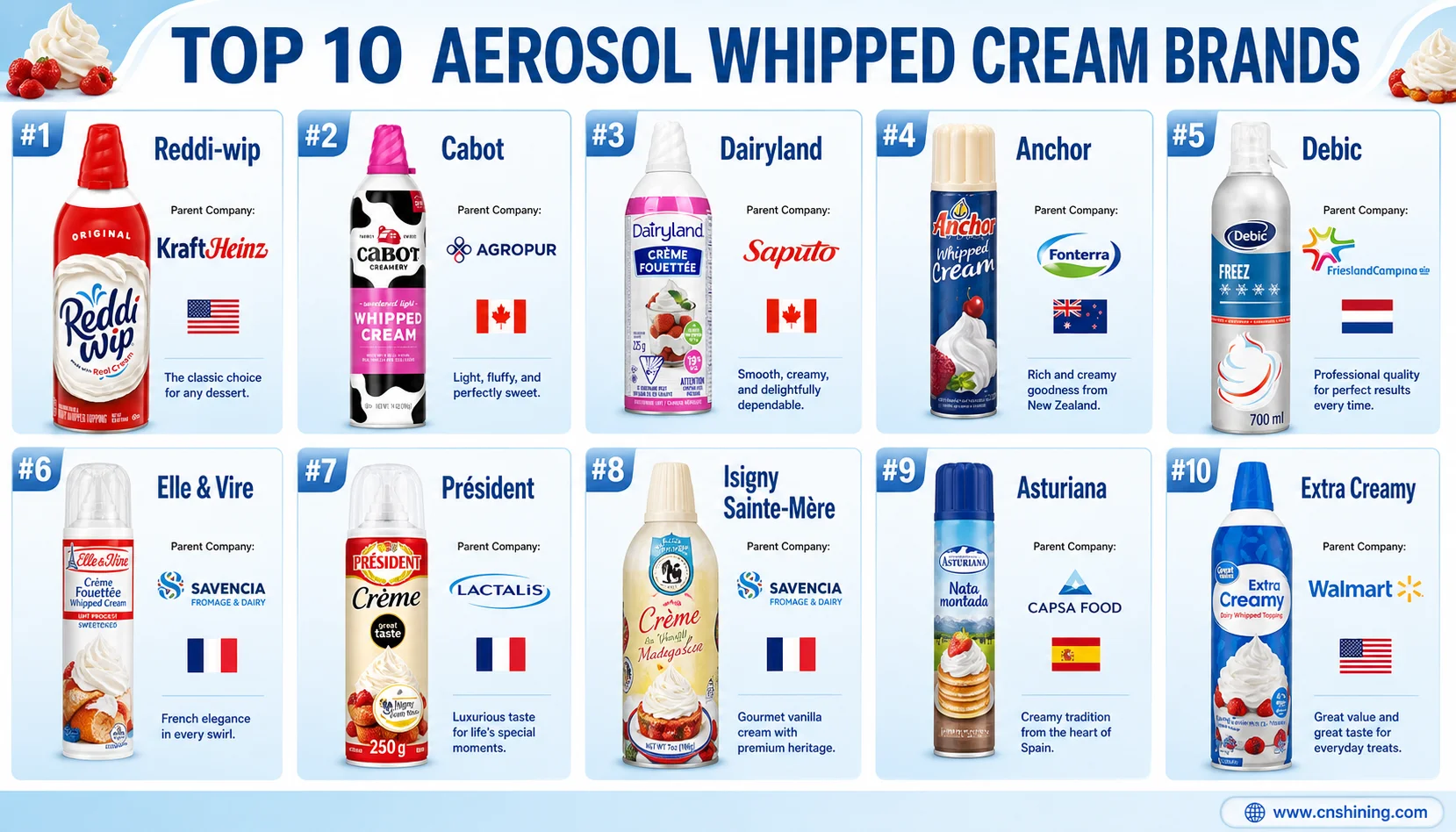
| Brand | Country | Parent Company | Common Capacity | Price Range | Short Technical / Market Note |
|---|---|---|---|---|---|
| Reddi-wip | United States | Conagra Brands | 6.5 oz, 13 oz | US$4.62 / 13 oz snapshot | Strong North American shelf visibility, broad SKU extension into zero-sugar, low-fat and non-dairy variants. |
| Cabot | United States | Agri-Mark | 7 oz | US$1.89–4.99 / 7 oz | Positions around real farm cream and natural flavor; smaller capacity, more boutique retail feel. |
| Dairyland | Canada | Saputo | 225 g | CAD$5.29–5.68 | Mainstream Canadian supermarket SKU, typical household aerosol whipped cream format. |
| Anchor | New Zealand | Fonterra | 250 g | £2.25–2.60 | Recognized in Commonwealth markets, positioned for frequent household use and value. |
| Debic | Netherlands | FrieslandCampina | 700 ml | €7.57–11.16 | Professional bakery and food-service orientation; larger pack improves output efficiency per can. |
| Elle & Vire | France | Savencia | 250 g | ₹695–900 import channel | French premium image, often found in import bakery and specialty retail channels. |
| Président | France | Lactalis | 250 g, 10 oz | £2.00–2.75 or €3.50 / 250 g | Uses French Chantilly positioning and professional nozzle language to support price premium. |
| Isigny Sainte-Mère | France | Isigny Sainte-Mère | 7 oz, 200 g | US$4.99–12.00 / 7 oz | High-end origin and vanilla story; price is clearly above mass-market aerosol whipped cream. |
| Central Lechera Asturiana | Spain | CAPSA FOOD | 250 ml, 500 ml | €3.19–3.68 / 250 ml | Highlights special nozzle and recyclable packaging, serving both home and light food-service use. |
| Great Value | United States | Walmart | 13 oz | About US$3–4 mass retail band | Private-label presence pressures the mainstream price band and shelf strategy. |
4. Formulation Systems and Product Comparison
4.1 Functional Ingredients
Commercial aerosol whipped cream formulation is not just “cream plus gas”. The formula must survive storage, accept gas under pressure, foam quickly, keep a pleasant mouthfeel and still pass through a small nozzle. Research on technical emulsifiers in aerosol whipping cream shows why emulsifier composition changes both emulsion and foam properties.
| Ingredient Group | Main Function | Common Ingredients | Public Example Direction |
|---|---|---|---|
| Cream base / fat phase | Provides mouthfeel, milk-fat network and foam skeleton. | Cream, light cream, milkfat, coconut oil, sunflower oil. | Dairy SKUs use cream or light cream; plant-based patents use oil plus plant protein. |
| Water phase / milk solids | Controls viscosity, dispersion and flavor balance. | Water, skim milk, nonfat milk, whey protein. | Used to manage cost, body and dairy flavor. |
| Emulsifier | Maintains oil-water emulsion and supports partial coalescence during foaming. | Mono- and diglycerides, E471, lecithin, citrate or lactate esters. | Small composition shifts can change storage and foam behavior. |
| Stabilizer / hydrocolloid | Increases continuous phase viscosity and slows drainage. | Carrageenan, guar gum, xanthan, HPMC. | Helps the dispensed cream stand instead of collapsing quickly. |
| Sweetener | Builds sweetness and improves mouthfeel. | Sugar, corn syrup, dextrose, alternative sweetener systems. | Needed for flavor and texture, but low-sugar variants need reformulation. |
| Flavor | Builds vanilla, dairy or dessert profile. | Natural flavor, vanilla flavor, Madagascar vanilla. | Often used for premium positioning and dessert pairing. |
| Freshness strategy | Controls microbial risk and shelf life. | UHT, pasteurization, refrigeration, sealed pressure pack. | Mainstream dairy aerosol SKUs often rely more on process and cold chain than classic preservatives. |
| Propellant | Builds pressure and releases gas during dispensing. | Nitrous oxide / E942. | The mature route for classic canned whipped cream texture. |
4.2 Common Formulation Routes
Mass retail dairy type: usually cream, water, sugar, milk solids, E471/E407 and N2O. It aims for easy spraying, stable refrigeration and familiar sweetness.
French-style premium type: often shorter in ingredient story, with a stronger focus on vanilla, origin or Chantilly positioning. The price is higher, and the expected peak shape is cleaner.
Professional large-can type: often around 700 ml and designed for bakery, café and food-service efficiency. Ergonomics and repeatable output matter more than they do in a small household can.
Plant-based and low-fat type: recent work uses plant proteins, sunflower lecithin, guar gum, HPMC and polysaccharide-emulsifier synergy. The problem is no longer only “can it be non-dairy?” The harder question is: can it spray like dairy whipped cream?
4.3 Comparison with Adjacent Products
| System | Convenience | Output Consistency | Foam Stability | Cost Structure | Typical Use |
|---|---|---|---|---|---|
| Aerosol whipped cream | Very high | High when pack and formula are stable | Medium; often below mechanical whipping | Higher pack, valve and propellant cost; lower labor cost | Home retail, coffee, dessert, fast food service |
| Hand / electric whipped cream | Lower | Operator-dependent | Often stronger and can reach harder peaks | Lower material cost, higher labor and failure cost | Bakery kitchens, pastry shops, high-control dessert work |
| Cream siphon + N2O charger | Medium-high | High when cleaned and filled correctly | Can be stable and more professional | Equipment, chargers and cleaning cost | Professional kitchen, specialty coffee, menu development |
| Nitrogen / BOV foam system | Medium | High | Often not the same as classic N2O cream texture | Higher structure cost and reformulation demand | Food concepts needing gas separation, hygiene or low residue |
| Helium concept | Low | No mainstream commercial evidence | No reliable public support as a category route | Not a useful benchmark | Not recommended as a serious comparison route |
Recent work comparing mechanically whipped cream and aerosol whipping cream states the point clearly: aerosol foam stability is not the same as mechanical whipping. See the study similar but not equal. Better peak shape requires formula, heat treatment, fat structure and nozzle geometry to be tuned together.
5. Regulations, Recycling, and Technology Direction
5.1 Main Regulatory Paths
| Market | Practical Compliance Reading | Technical Link |
|---|---|---|
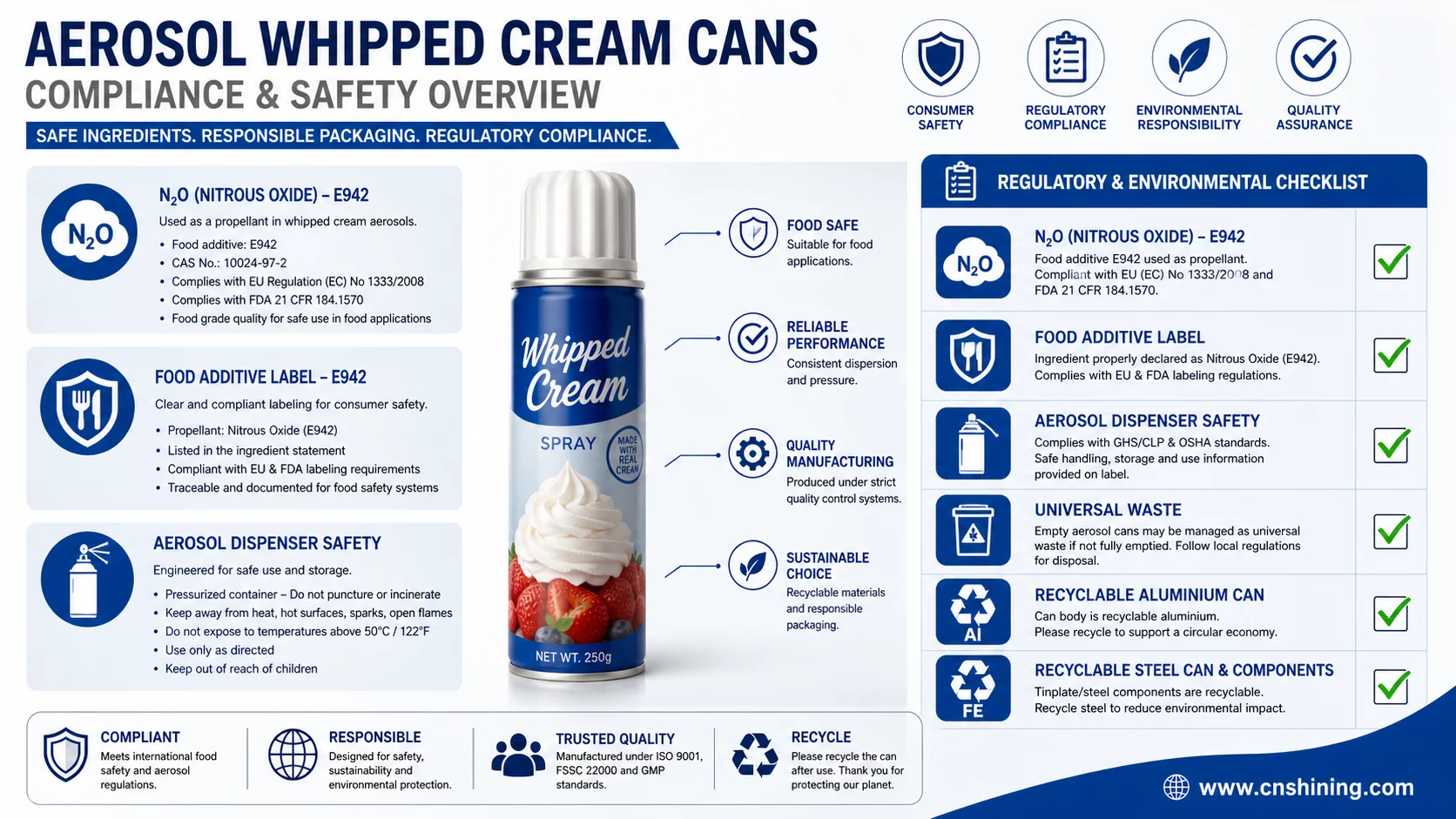
| United States | Nitrous oxide is recognized for food use as a propellant and aerating agent when used under current good manufacturing practice. Aerosol can disposal may also fall under applicable waste rules. | 21 CFR 184.1545 Nitrous oxide |
| European Union | N2O corresponds to E942. Aerosol dispensers are covered by the EU aerosol dispenser safety framework, including pressure and labeling requirements. | EU Food Additive E942 entry and EU aerosol dispenser amendment |
| Japan | Japan’s review materials describe nitrous oxide as a propellant for whipped cream in pressure containers, including dairy-fat or vegetable-fat systems. | MHLW nitrous oxide material |
| Brazil | Prepackaged food must include core label items such as ingredient list, shelf-life statement and nutrition information. Food-contact packaging also needs local compliance review. | ANVISA food labeling portal |
5.2 Recycling and Packaging Sustainability
For aerosol whipped cream, the environmental discussion is mostly about metal can recyclability, lightweighting, label design and waste handling. It is not mainly about moving away from HFC propellants, because this food category already uses N2O / E942 as the standard propellant route.
Aluminium aerosol packaging has a strong recycling argument. AEROBAL states that recycling aluminium takes about 5% of the energy required for primary aluminium and can reduce CO2 emissions by about 95%.
Still, recyclable does not mean automatically recycled. Aerosol cans need to be emptied and accepted by local collection systems. Caps, actuators and labels also influence sorting and user behavior.
5.3 Recent Technology Direction
Three technical directions are visible.
First, low-fat and plant-based foam systems. The 2022 patent route combines plant protein, oils, lecithin and gums to hold refrigerated distribution stability. See the plant-based dairy whipping cream alternative patent. In 2025, low-fat dairy spray emulsion work focused on polysaccharide-emulsifier synergy and aeration performance; see low-fat spray dairy emulsion research.
Second, fat-structure engineering. New work uses wax-based oleogels to improve overrun, stability and gas retention in aerosol whipped cream. The idea is to mimic solid-fat function without relying only on traditional hard fats. See the binary-wax soybean oil oleogel study.
Third, consumer experience design. Actuator finger pads, 360° dispensing concepts, capless structures, anti-sputter flow paths and better nozzle cleaning are now part of the pack design conversation.
6. User Pain Points and Packaging Improvement Routes
6.1 What Users Actually Complain About
Consumer feedback does not separate valve tolerance, nozzle geometry, coating condition, cold-chain exposure and misuse risk. The complaint is usually much simpler: the can does not spray properly.
| Observed Feedback Type | Pain Point | Packaging / System Meaning |
|---|---|---|
| Nozzle stopped working | Spray path blockage or actuator failure | Improve nozzle cleanability, actuator durability and residual product drainage. |
| Only half full | User suspects leakage, underfill or gas loss | Net-content perception and leak control must be handled together. |
| Runny liquid | Product exits without proper foam formation | Check gas dissolution, pressure retention, cold chain, shaking and use orientation. |
| Broken tab or head | Actuator fracture | Material strength and drop/transport conditions need review. |
| Need to keep can upside down | User instruction gap | Use clearer visual instructions on the primary label. |
| Rinse nozzle with hot water | Residue dries around the orifice | Nozzle geometry should reduce retained cream and allow simple cleaning. |
| Not coming out although product remains | Unreachable residue or pressure loss | Valve path, dip behavior and gas retention affect perceived waste. |
| N2O misuse discussion | Tampering or gas abuse can damage product experience | Tamper-evident design and retailer education are practical risk controls. |
6.2 Packaging Improvement Routes
Valve: improve sealing consistency, stem durability and leakage control. “Half-can” complaints often point to pressure loss or poor output consistency rather than only fill volume.
Actuator: use a broader finger pad, clearer press direction and stronger anti-break design. The actuator is a durability part, not a decorative accessory.
Nozzle: design for three functions at once: stable peak shape, quick rinsing and low residue retention. A beautiful nozzle that clogs is not a good nozzle.
Can shape: consider grip, condensation, upside-down use and food-service hand fatigue. Large professional cans benefit more from ergonomics than small home cans.
Print and user education: make “refrigerate, shake, invert, rinse briefly, cap after use” visible. Back-label fine print is not enough for a product used quickly in kitchens and coffee stations.
Coating and corrosion control: cap moisture, valve-cup area, spill-back and internal coating should be reviewed. Visible rust, even if localized, damages trust quickly in a dairy aerosol product.
Tamper evidence: N2O misuse creates both public health and product-experience problems. Seal integrity, retail handling and visible “seal intact” cues can reduce risk.
7. Shining Packaging: Actuators, Aerosol Cans, and Valves for Aerosol Whipped Cream
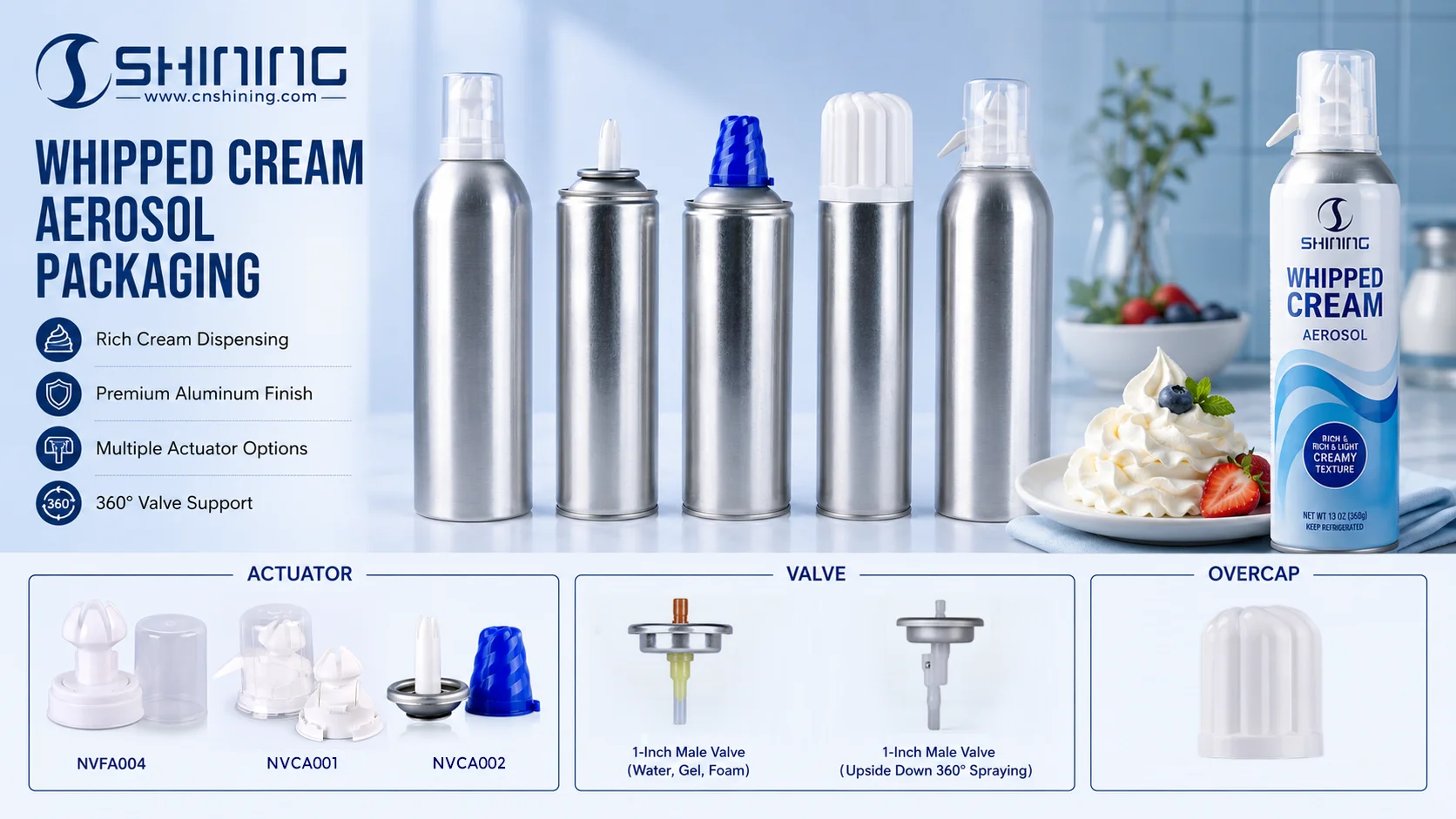
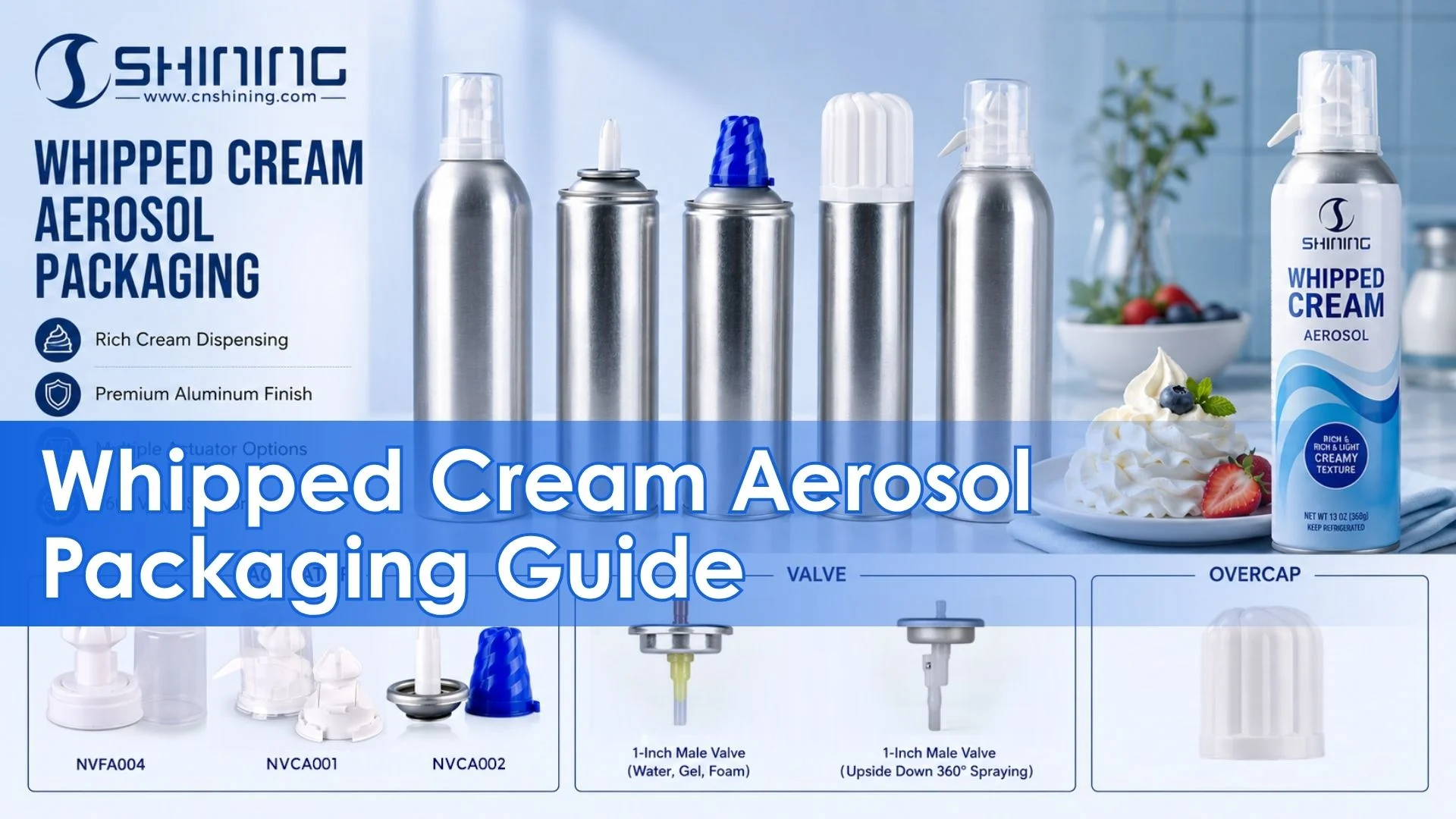
For aerosol whipped cream, the packaging system must be evaluated as a flow-control system. Shining Packaging’s relevant work sits around three parts: actuators, aerosol cans and valves. These are the parts that decide sealing reliability, press feel, outlet geometry, spray cleanliness and transport resistance.
In practical development, the discussion should start with use conditions. Is the can for home dessert topping, café drinks, bakery decoration or larger food-service output? A household can may need simple operation and easy cleaning. A professional can needs repeated dispensing, grip comfort, stable pressure behavior and a nozzle that keeps a clear decorative line over many uses.
For actuators, the useful checks are finger force, stem load, breakage resistance, accidental discharge and residue around the outlet. For cans, the checks include pressure safety, internal coating compatibility, corrosion resistance, print readability and recyclability. For valves, the checks are leakage, flow rate, gasket compatibility, stem movement, clogging tendency and consistency after cold storage.
This is not about making the package look more complicated. The aim is simpler: reduce the common failure modes that users describe as “runny,” “blocked,” “broken,” or “half empty.”
8. Conclusion
The practical conclusion is direct. Aerosol whipped cream is a packaged instant foam system. Its value depends on fast foam formation, stable dispensing and low user error. N2O remains the mature propellant because it supports pressure and dissolves well enough to create high overrun.
The weak points are also clear. Runny output, clogged nozzles, broken actuators, leakage, corrosion marks and misuse risk all come back to the same system boundary: formulation, propellant, valve, actuator, nozzle, can and user instructions must be developed together. Brands that treat the aerosol can as only a container will keep seeing the same complaints.
9. FAQ: Aerosol Whipped Cream
No. The product is mainly a stable emulsion inside a pressure container. It becomes foam during dispensing. When the valve opens, pressure drops and dissolved nitrous oxide comes out of solution. The gas expands, the product passes through the valve and nozzle, and a foam structure forms at the outlet.
Nitrous oxide is used because it gives pressure and dissolves well enough in the cream system to support high overrun. When pressure falls during dispensing, the dissolved gas releases quickly and forms bubbles. Air or nitrogen can provide pressure, but they do not easily reproduce the same classic light texture in this format.
Overrun is the volume increase after aeration compared with the original liquid volume. In aerosol whipped cream, classic research reports high overrun, often around 400%–600%. This gives the product its light body. Overrun depends strongly on dissolved N2O, pressure conditions, fat structure and nozzle flow behavior.
Runny output can come from low gas retention, loss of pressure, poor shaking, incorrect dispensing orientation, warm storage, valve leakage, nozzle clogging or formulation imbalance. It is rarely just one visible defect. A useful diagnosis checks cold-chain history, remaining pressure, actuator movement, nozzle cleanliness and emulsion stability.
The nozzle orifice controls the final flow path and surface pattern of the cream. A well-designed nozzle gives cleaner lines and a stable peak. A poor geometry can create sputtering, weak definition or residue build-up. The nozzle must also be easy to rinse because dried dairy residue quickly changes spray behavior.
Yes. The valve controls sealing, flow rate and pressure retention. The actuator controls press force, stem load and user handling. In aerosol whipped cream, these parts directly affect leakage, broken heads, sputtering and half-can complaints. They should be tested under cold storage, transport vibration and repeated dispensing conditions.
Not always. Mechanically whipped cream can often form stronger and more adjustable peaks because the operator can control whipping time, fat condition and air incorporation. Aerosol whipped cream is more convenient, but foam stability is constrained by formula, dissolved gas, pressure drop and nozzle geometry. It is a different system.
Yes, but it needs careful structure design. Dairy fat and milk proteins naturally help build foam. Plant-based systems must replace that function with oils, plant proteins, lecithin, gums or other stabilizing systems. The challenge is not only making foam; it is keeping storage stability and achieving a dairy-like peak after dispensing.
The main checks are food additive approval for the propellant, ingredient labeling, allergen labeling, nutrition labeling, food-contact packaging compliance and aerosol container safety. N2O is regulated differently by market, often under GMP or additive-code frameworks. Aerosol pressure, labeling and disposal rules also need local review before launch.
The most useful changes are consistent valve sealing, stronger actuators, clearer press direction, better anti-clog nozzle geometry, improved cap drainage, corrosion-resistant can and valve-cup design, and visible use instructions. The instructions should show refrigeration, shaking, inverted dispensing, brief nozzle rinsing and recapping. Small usability details reduce many returns.