
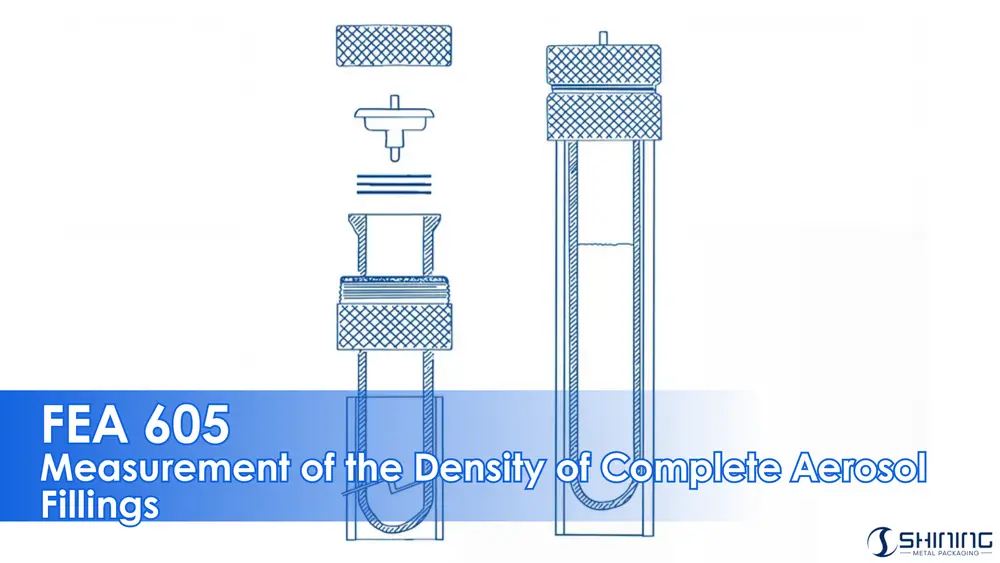
Standard Overview
FEA 605 is an industry test method from the European Aerosol Federation (FEA) that focuses on determining the density (specific gravity) of a complete aerosol filling—meaning the finished mix of concentrate and propellant as used in production.
For engineering and compliance work, density is the bridge between net weight and liquid volume. It supports fill-level control, maximum filling rules, and consistent product performance across plants and markets.
What “Density of Complete Filling” Means
FEA 605 commonly deals with apparent density of the finished formulation at a defined temperature. This is the value most relevant when you need to convert a declared net weight into a liquid volume for filling rules or packaging statements.
Practical Application Scenarios
Manufacturing
Density supports setting target fill weights that produce the intended liquid volume across seasonal temperature changes. It also helps compare batch-to-batch consistency when the concentrate composition or propellant ratio changes.
Filling / Line Control
When legal or customer requirements specify a maximum filling level by volume, density becomes the calculation basis to translate “grams filled” into “millilitres filled”. This is especially important for flammable products where headspace and pressure safety margins are tight.
Procurement / Technical Alignment
For multi-sourcing, the same “net weight” can correspond to different “liquid volumes” if the propellant type or concentrate solvent changes. Density is a fast technical check to prevent specification drift between suppliers.
Data Presentation
| Output Item | What It Represents | Why It Matters |
|---|---|---|
| Specific gravity (s.g.) at temperature t° | Density relative to water at that temperature | Converts net weight to liquid volume |
| Liquid volume (ml) | Calculated from net weight and s.g. | Supports maximum filling compliance |
| Component s.g. (x, y, …) | Concentrate and propellant density inputs | Used for the appendix calculation estimate |
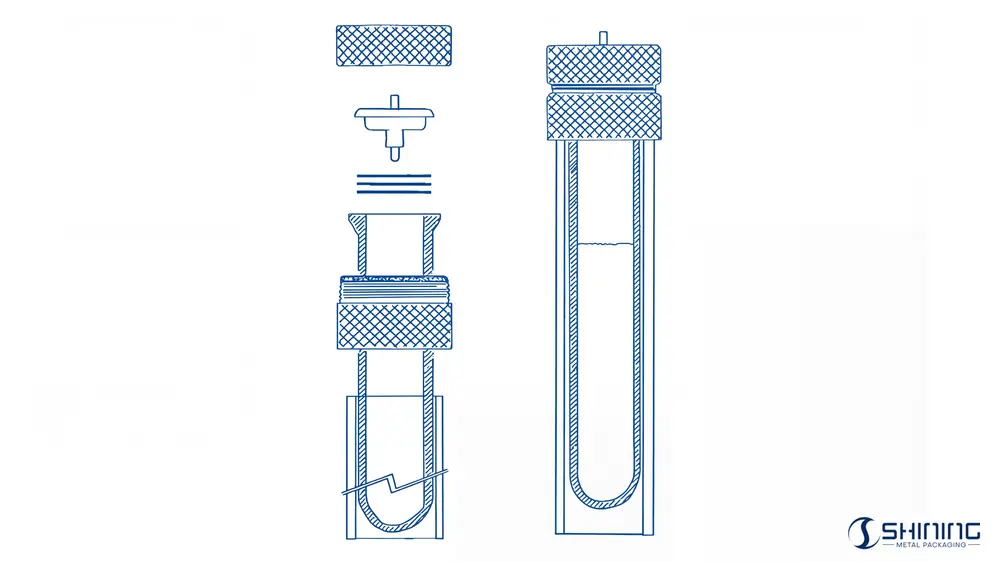
Appendix: Calculation Method for Determining Density of a Complete Filling
The appendix provides a calculation estimate for density of the finished product using component specific gravities. This is useful for planning and quick checks before running a full measurement, but it has important limitations (see Notes).
Definitions
- x = specific gravity of concentrate at temperature t°
- y = specific gravity of propellant at temperature t°
- a% = concentrate fraction (w/w)
- b% = propellant fraction (w/w)
Case 1: a + b = 100% (Two-component system, total fill = 100 g)
Assume a total fill of 100 g. Then:
- Volume of a grams concentrate =
a / x(ml) - Volume of b grams propellant =
b / y(ml)
Total liquid volume:
V = (a / x) + (b / y)
Therefore, specific gravity of the finished product:
s.g.(product) = 100 / [(a / x) + (b / y)]
Once s.g. is known, liquid volume for any net weight can be estimated as:
Liquid volume (ml) = Net weight (g) / s.g.(product)
Note 1: When a + b ≠ 100% (e.g., premix situations)
If the mass fractions do not total 100% (for example, when using premixes), the method can be written more generally:
s.g.(mixture) = (a + b) / [(a / x) + (b / y)]
Note 1 Extended: Generalisation to n-component systems
For a system with n components, where each component has mass a, b, c … and specific gravity x, y, m …:
s.g.(mixture) = (a + b + c + … + n) / [(a / x) + (b / y) + … + (n / m)]
Note 2: Where do x and y come from?
In typical factory practice:
- x (concentrate s.g.) is usually measured directly (e.g., hydrometer, density bottle).
- y (propellant s.g.) is usually taken from published propellant property data at temperature t°.
Note 3: What the calculation does NOT cover
The appendix calculation method has two important limitations:
- It makes no allowance for volume change on mixing (non-ideal behaviour).
- It makes no allowance for the weight of headspace vapour, which can be relevant depending on propellant and temperature.
Download the Standard PDF
This document provides FEA 605, describing a direct method for measuring the apparent density of complete aerosol formulations. It defines procedures using a compatibility vessel to determine liquid volume, enabling accurate fill level calculations and regulatory compliance.
FAQ – Engineering & Regulatory
It is a strong starting point for setting targets and doing quick feasibility checks. However, real formulations can deviate due to non-ideal mixing and vapour distribution, so you should verify by measurement when limits are tight.
Propellant properties change significantly with temperature and composition, and the propellant fraction often dominates the “weight-to-volume” conversion. Small errors in y can translate into noticeable liquid-volume error at the same net weight.
Beyond net weight, specify the propellant type (and blend ratio if applicable) plus the temperature basis for density. This prevents two suppliers from delivering different liquid volumes under the same “grams filled” label.
Yes, using the n-component generalisation. In practice, you either treat the blend as one component with an effective density, or calculate each propellant component separately if data is available.
Use the temperature relevant to your compliance or process requirement (often 20°C unless specified otherwise). If the product is filled cold or stored in hot climates, it is wise to document additional reference temperatures for robustness.
No, it supports them by providing density inputs. Maximum filling limits also depend on container capacity, headspace requirements, and relevant transport / safety rules.