
Standard Overview
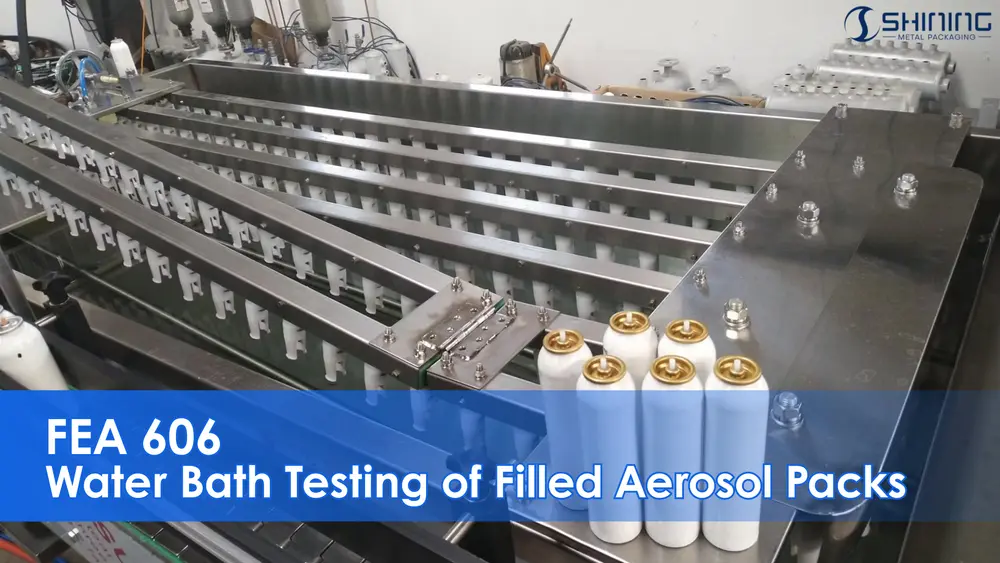
FEA 606 is an industry test method issued by the European Aerosol Federation (FEA) that defines how filled aerosol packs are verified for compliance with legal pressure requirements using a hot water bath test.
The method supports the requirements of Directive 75/324/EEC, which mandates that every filled aerosol dispenser must undergo a final test ensuring it can safely withstand the internal pressure generated at an equivalent temperature of 50 °C.
Position in the Regulatory Framework
The Directive allows three alternative final test methods:
- Hot water bath test
- Hot final test methods
- Cold final test methods
FEA 606 specifically addresses the hot water bath approach and provides a checking procedure to confirm that the bath conditions actually cause the aerosol to reach its equilibrium pressure at 50 °C.
Purpose of the Method
Because the speed at which internal pressure rises depends on several variables—such as formulation, container size, propellant type, and bath design— it is not sufficient to rely on nominal bath temperature alone.
FEA 606 therefore establishes a method to:
- Determine the true equilibrium pressure at 50 °C
- Verify that production-line bath conditions achieve this pressure
- Adjust bath temperature or dwell time if necessary
Scope of Application
The method may be applied to:
- All types of aerosol dispensers
- Any production line equipped with a water bath
- Both continuous and batch-based bath systems
Apparatus
- Pressure gauge with resolution of 0.1 bar
- Water bath maintained at a nominal minimum of 50 °C
- Conveyor system or immersion device providing controlled dwell time
Test Principle
The method compares:
- The equilibrium pressure at 50 °C, determined under controlled laboratory conditions, and
- The actual internal pressure of production samples immediately after exiting the water bath
If the production samples reach at least the equilibrium pressure, the bath conditions are considered compliant.
Test Procedure – Engineering Interpretation
Select, mark, and weigh nine empty containers and valves.
Fill nine samples on the production line, checking component weights at each filling stage.
Verify purging efficiency by measuring equilibrium pressure at 25 °C on three samples according to FEA 604.
Determine the equilibrium pressure at 50 °C on another three samples using FEA 604.
Stabilize the water bath and conveyor until thermal equilibrium is reached.
Pass the remaining three filled samples through the water bath.
Immediately measure internal pressure at bath exit without shaking the containers.
Compare measured pressure with the equilibrium pressure at 50 °C.
Bath settings are validated. Record temperature, dwell time, water level, and circulation conditions.
Increase bath temperature or increase dwell time (reduce conveyor speed), then repeat verification with new samples.
Adjustment of Bath Conditions
If any measured pressure is lower than the equilibrium pressure:
- Increase the bath temperature, or
- Reduce conveyor speed to increase dwell time
The test must then be repeated with new samples until measured pressures meet or exceed the equilibrium value.
Recording and Reporting
Once compliant conditions are achieved, the following must be recorded:
- Bath temperature
- Water level
- Water circulation rate
- Container dwell time or conveyor speed
The test report should also include:
- Formulation description
- Packaging specification
- Fill level
Important Technical Notes
- Bath conditions must be checked at regular intervals.
- Any change in product or container size requires revalidation.
- Compressed gas systems may require additional evaluation.
- Products forming stable foam may show slower pressure rise.
Relationship with Other Standards
- FEA 604 – Determination of equilibrium pressure
- FEA 605 – Density measurement of aerosol formulations
- Directive 75/324/EEC – Aerosol Dispensers Directive
Download the Standard PDF
This document provides FEA 606, defining a water bath test method to verify conformity of filled aerosol packs with Directive 75/324/EEC. It establishes pressure comparison procedures at 50°C to ensure production lines achieve required equilibrium pressure conditions.
FAQ – Engineering & Compliance
Yes, unless an alternative approved hot or cold final test method is used. FEA 606 supports compliance with European legislation.
Shaking lowers liquid temperature and gas-phase pressure. Even slight agitation can produce falsely low readings.
Not necessarily. The can must reach the pressure equivalent of 50 °C, which depends on dwell time and heat transfer.
At regular intervals and after any change in formulation, container size, or line configuration.
Yes. The method can be adapted to batch immersion, provided agitation is avoided and conditions are well controlled.