
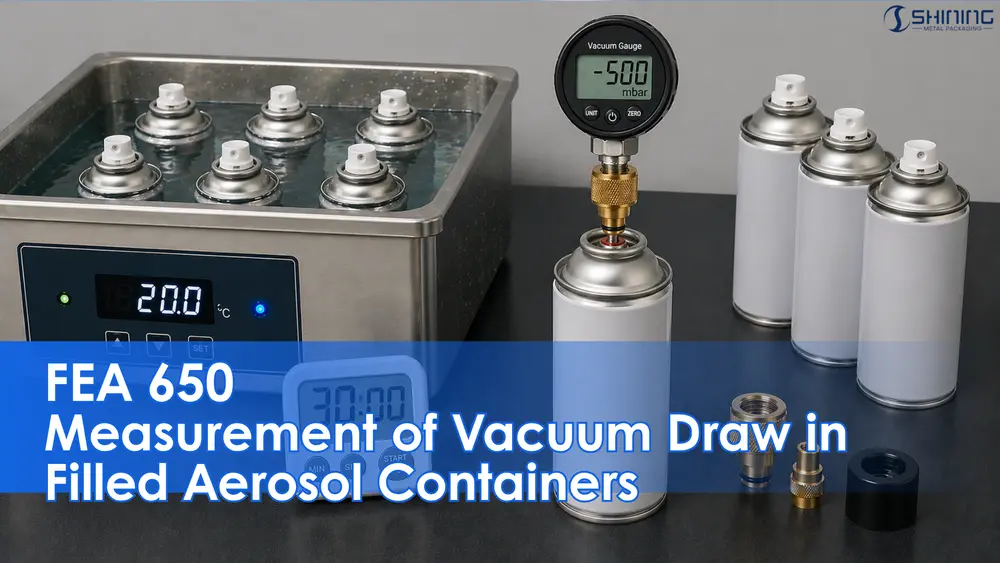
Standard Overview
FEA 650 is an industry test method issued by the European Aerosol Federation (FEA) for measuring the level of vacuum achieved inside a filled aerosol container that has been evacuated and sealed with a valve.
Unlike pressure tests, this method focuses on negative internal pressure, which is typical for vacuum aerosols such as cream dispensers, food aerosols, and specialty cosmetic products.
Scope and Measurement Philosophy
The vacuum level achieved in a vacuum aerosol container depends on three independent factors:
- The efficiency of the evacuation process
- The ability of the valve to retain vacuum (not assessed by this method)
- The accuracy of the measurement technique itself
FEA 650 specifically addresses the third factor by defining a repeatable, industry-accepted way to connect a vacuum gauge to an aerosol valve and interpret the result.
Test Apparatus
The minimum equipment required includes:
- Vacuum gauge with a measurement range of 0–1000 mbar
- Gauge resolution of 100 mbar or better
- Adapter capable of forming a tight seal on the valve stem
- Water bath controlled at 20 °C ± 1 °C
- Precision balance readable to 0.01 g (for correction method)
Sample Conditioning
Before measurement, the aerosol container shall be:
- Fully assembled and sealed
- Immersed in the water bath for at least 30 minutes
- Allowed to reach thermal equilibrium with the bath
Handling should be done using a cloth or towel to minimise heat transfer from the operator’s hands, which could affect the vacuum reading.
Measurement Procedure
- Remove the actuator or overcap, if present
- Apply the gauge adapter to the valve stem
- Actuate the valve
- Allow the gauge reading to stabilise
- Record the indicated vacuum value
The reading obtained represents an approximate vacuum level, as a small amount of air from the gauge and adapter is inevitably introduced into the container during measurement.
Reporting of Results
Vacuum values shall be reported as negative pressure in mbar.
The test report shall clearly state:
- The measured vacuum value
- The test temperature
- Whether a correction for gauge dead volume has been applied
Accuracy of Method and Dead-Volume Correction
For higher accuracy, FEA 650 describes a correction method that compensates for the volume of air contained within the gauge and adapter, commonly referred to as the dead volume.
Principle of the Correction
When the gauge is connected to the valve, the air trapped in the gauge is drawn into the container. This artificially reduces the measured vacuum.
By determining the volume of this trapped air, the true vacuum inside the container can be calculated.
Determination of Gauge Dead Volume
The dead volume is determined experimentally using two containers with approximately the same vacuum level as the test sample.
Through repeated underwater actuations, water replaces the air trapped in the gauge. The increase in mass of the second container is used to calculate the gauge volume.
Vacuum Correction Formula
The true vacuum can then be calculated using:
Vactrue = Vacgauge + (Vacgauge × (V2 ÷ V1))
Meaning of the Parameters
- Vactrue – Corrected (true) vacuum inside the aerosol container
- Vacgauge – Vacuum value indicated by the gauge
- V1 – Headspace volume inside the aerosol container
- V2 – Internal air volume of the gauge and adapter
Relationship with Other FEA Standards
- FEA 606 – Hot water bath safety testing
- FEA 623 – Mechanical resistance of filled aerosols
- FEA 646 – Resistance to top load during storage
Download the Standard PDF
FEA 650 standard describing a method for measuring the vacuum level in vacuum-sealed aerosol containers fitted with valves. It outlines procedures using a vacuum gauge and controlled temperature conditions to determine the negative pressure achieved during the vacuum drawing process.
FAQ – Engineering, QA & Procurement
No. It measures the vacuum level at the time of testing. Long-term vacuum retention must be evaluated separately.
No. For routine checks, the uncorrected gauge value is usually sufficient. Correction is mainly used for high-accuracy analysis.
Vacuum readings are highly sensitive to temperature. Even small deviations can cause significant measurement errors.
Yes, provided their range and resolution meet the requirements of the method.
Yes. Once actuated for measurement, the container should not be reused.