
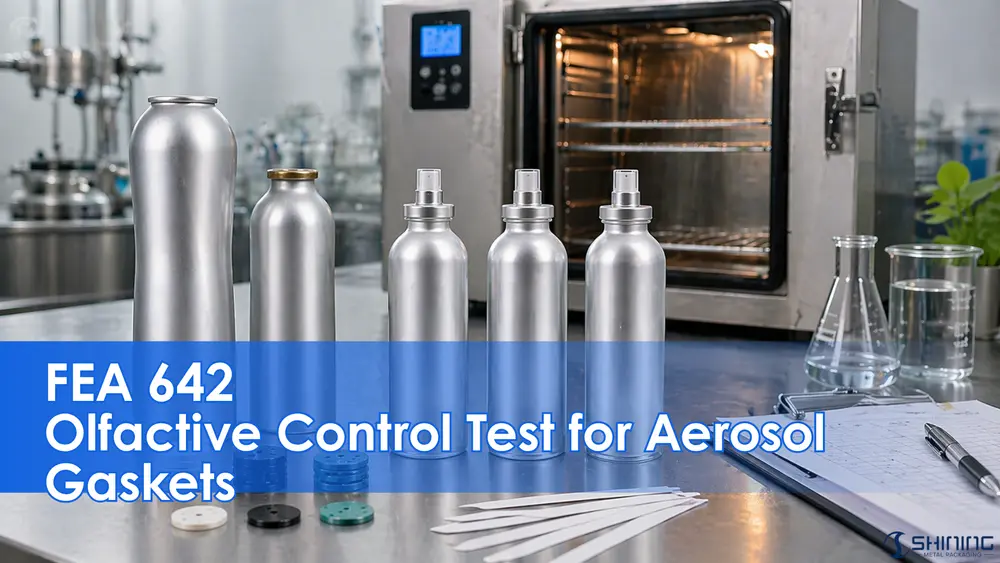
Standard Overview
FEA 642 is an industry standard issued by the European Aerosol Federation (FEA) that defines an olfactive control test for aerosol valve gaskets.
The method is designed as a receiving inspection tool, allowing incoming gasket batches to be compared against a previously approved reference batch.
Objective of the Test
The objective of FEA 642 is to detect:
- Unacceptable odours released by gasket materials
- Changes in smell compared to an approved reference batch
- Potential sensory contamination of the aerosol formulation
This test is particularly critical for:
- Perfumed cosmetic aerosols
- Household products with fragrance claims
- Pharmaceutical or medical sprays
Scope of Application
The standard applies primarily to:
- Cup gaskets for aerosol valves
It may also be applied to other gasket types (e.g. inner gaskets), provided the number of samples is adjusted so that the total exposed surface corresponds to that of five cup gaskets.
Principle of the Olfactive Test
The test relies on comparative sensory evaluation performed by at least three experienced assessors.
Odour intensity and persistence are evaluated by spraying test solutions onto blotters and comparing them with reference solutions.
Test Equipment
- Glass aerosol containers
- Crimping machine adapted to valve diameter
- Inert aerosol valves with polyethylene cup gasket
- Oven controlled at 40 ± 3 °C
- Blotters for olfactive evaluation
Sample Preparation
Each test container is prepared as follows:
- Five uncut cup gaskets are placed inside a glass aerosol container
- The container is filled with:
- 5 g ethyl alcohol (96% vol.)
- 2.5 g liquefied propellant
- An inert valve (without dip tube) is crimped onto the container
Reference Solutions
Three types of samples are prepared:
- Solution without any gasket (blank)
- Solution with approved reference gaskets
- Solution with gaskets from the batch under evaluation
Storage Conditions
All samples are stored:
- For 72 hours
- At 40 ± 3 °C
- In upright position
After storage, samples are allowed to return to room temperature.
Olfactive Evaluation
Two hours after removal from the oven:
- Samples are sprayed onto blotters
- Evaluation is performed 10 seconds after spraying
Assessors assign a score from 1 to 6:
| Score | Description |
|---|---|
| 1 | Slight but evanescent smell |
| 2 | Slight but lasting smell |
| 3 | Clear but evanescent smell |
| 4 | Clear but lasting smell |
| 5 | Strong but evanescent smell |
| 6 | Strong but lasting smell |
Evaluation and Acceptance
Two aspects are evaluated:
- Odour intensity
- Odour persistence
Both evaluations are made on the same spray. The final result is the average score of the three assessors.
In parallel, the physical appearance of the solution is compared with the reference:
- Sedimentation
- Suspension
- Opalescence
- Colour change
Reference Gaskets Management
Reference gaskets must be:
- Stored in glass containers
- Protected from light
- Kept under inert atmosphere
To avoid ageing effects:
- Reference batches must be renewed
- Maximum storage time: 6 months
Relationship with Other Standards
Download the Standard PDF
FEA 642 standard describing an olfactive control test used to evaluate aerosol valve gasket materials. It outlines procedures for comparing the odour of tested gaskets with approved reference batches to ensure material consistency and prevent unwanted smell contamination in aerosol products.
FAQ – Quality, Engineering & Purchasing
No. It is a best-practice quality control method, especially in fragrance-sensitive applications.
Sensory perception varies between individuals. Multiple assessors reduce subjective bias.
No. It complements but does not replace analytical methods for identifying volatile compounds.
It is a neutral, highly extractive medium that accelerates odour release from gasket materials.
Repeat the test and consult both gasket and valve suppliers before approving the batch.