
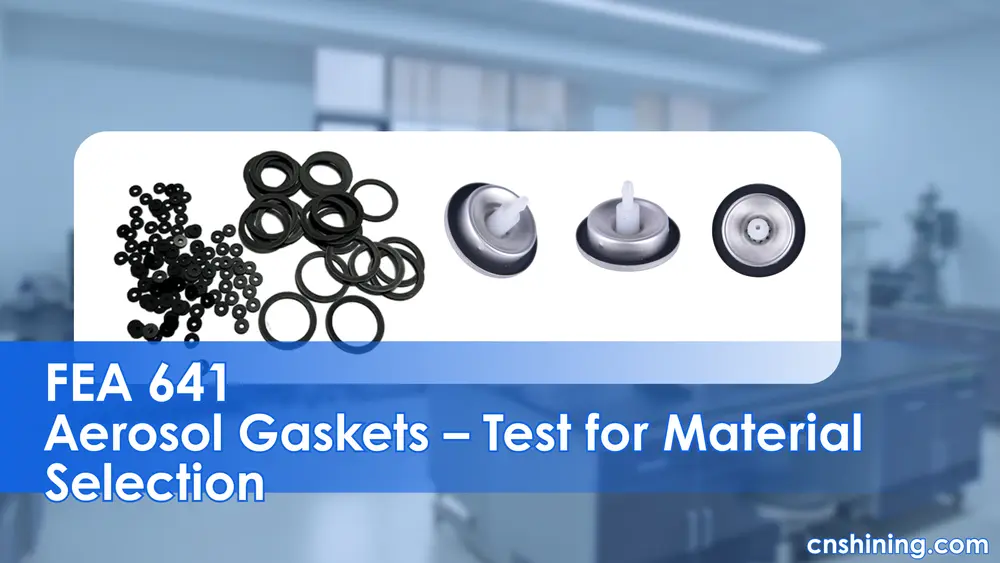
Standard Overview
FEA 641 is an industry standard issued by the European Aerosol Federation (FEA) that defines a laboratory swell test used for the selection of aerosol valve gasket materials.
The standard focuses exclusively on the dimensional behavior of gasket materials when exposed to a complete aerosol formulation, recognizing that chemical interaction between gasket and product is one of the most frequent root causes of valve leakage.
Why Gasket Swell Testing Is Critical
Valve gaskets are polymer-based materials containing fillers, plasticizers, and curing systems. When in contact with an aerosol formulation, they may:
- Swell due to absorption of solvents or propellants
- Shrink due to extraction of plasticizers
- Suffer irreversible changes in mechanical properties
These changes affect:
- Sealing force
- Valve actuation behavior
- Long-term leakage performance
Scope of FEA 641
FEA 641 addresses:
- Swell test procedure
- Evaluation of equilibrium behavior
- Material classification and nomenclature
It does not assess:
- Chemical degradation of the product
- Perfume stability
- Colour change or precipitation
Swell Test – Engineering Interpretation
Measurement Principle
Gasket swelling is evaluated by comparing the original gasket thickness with the thickness after exposure to the aerosol formulation.
Measurements are performed using:
- Dial gauge with approximately 50 g constant spring load
- Measuring anvil surface of approximately 50 mm²
Initial Measurement (D1)
The original thickness (D1) is measured with a precision of ±0.01 mm, either:
- On three individual gaskets and summed, or
- On a stacked set of three gaskets
Exposure to Aerosol Formulation
Three gaskets of the same material are placed in a suitable container filled with the complete aerosol formulation and pressurised with the appropriate propellant.
Recommended exposure intervals:
- 3 days
- 7 days
- 2 weeks
- 4 weeks
- 8 weeks
Samples are stored at room temperature.
Final Measurement (D2)
After each interval:
- The container is opened safely
- Gaskets are removed and measured within 5 seconds
- No drying or wiping is permitted
Calculation of Percentage Swell
The percentage swell is calculated as:
(3D2 − 3D1) × 100 / 3D1
Where:
- D1 = original gasket thickness
- D2 = thickness after exposure
Equilibrium Behavior and Material Selection
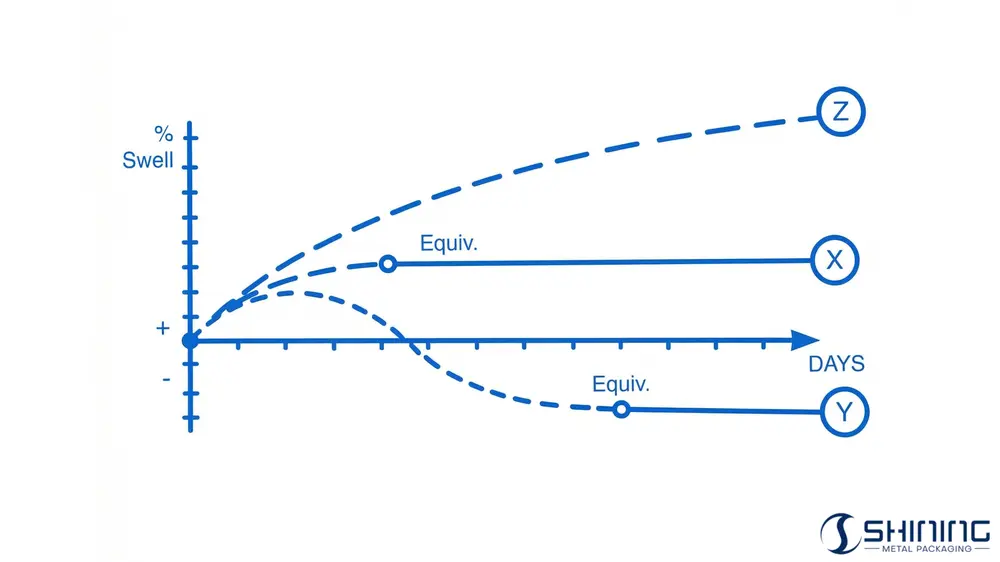
A suitable gasket material must reach a stable equilibrium.
- Curve X: Stable equilibrium – acceptable
- Curve Y: Swell followed by shrinkage – high risk
- Curve Z: Continuous swell – unacceptable
Recommended Evaluation Strategy
- Measure swell after 3 or 7 days
- Re-check after 2 weeks
- If stable, equilibrium is confirmed
- If not, continue at 4 and 8 weeks
If equilibrium is not achieved after 8 weeks, the formulation/gasket combination should be rejected.
Material Nomenclature (ISO 1629)
| Class | Denomination | Common Name | Chemical Formula (Simplified) |
|---|---|---|---|
| BR | Butadiene rubber | Poly-butadiene | (–CH₂–CH=CH–CH₂–)n |
| NBR | Nitrile-butadiene rubber | Nitrile | (–CH₂–CH(CN)–)n |
| SBR | Styrene-butadiene rubber | Styrene-butadiene | (–CH₂–CH(Ph)–)n |
| EPDM | Ethylene-propylene-diene rubber | EPDM | (–CH₂–CH₂–CH₂–)n |
| IR | Isoprene rubber | Poly-isoprene | (–CH₂–C(CH₃)=CH–CH₂–)n |
| IIR | Isobutylene-isoprene rubber | Butyl | (–CH₂–C(CH₃)₂–)n |
| CR | Chloroprene rubber | Polychloroprene | (–CH₂–CCl=CH–CH₂–)n |
| CIIR | Chloro-isobutylene-isoprene | Chlorobutyl | (–CH₂–C(CH₃)₂–)n |
| FPM | Fluorocarbon rubber | FKM / Fluoro | (–CF₂–CF₂–)n |
| PU | Polyester rubber | Polyurethane | –NH–CO–O– |
Relationship with Other Standards
- FEA 405 – Valve leak testing
Download the Standard PDF
FEA 641 standard describing a test method for selecting suitable aerosol valve gasket materials. It outlines procedures for measuring gasket swelling when exposed to complete aerosol formulations, helping evaluate material compatibility and ensure proper valve sealing performance.
FAQ – Engineering & Purchasing
No, but it is widely used as a best-practice method for selecting compatible gasket materials during development.
No. Controlled swell can improve sealing, but only if equilibrium is stable and within valve design limits.
Solvent evaporation begins immediately. Delays lead to artificially low swell values.
It is a strong indicator, but must be combined with functional valve leak tests.
Yes. Different valve designs tolerate different swell ranges.