
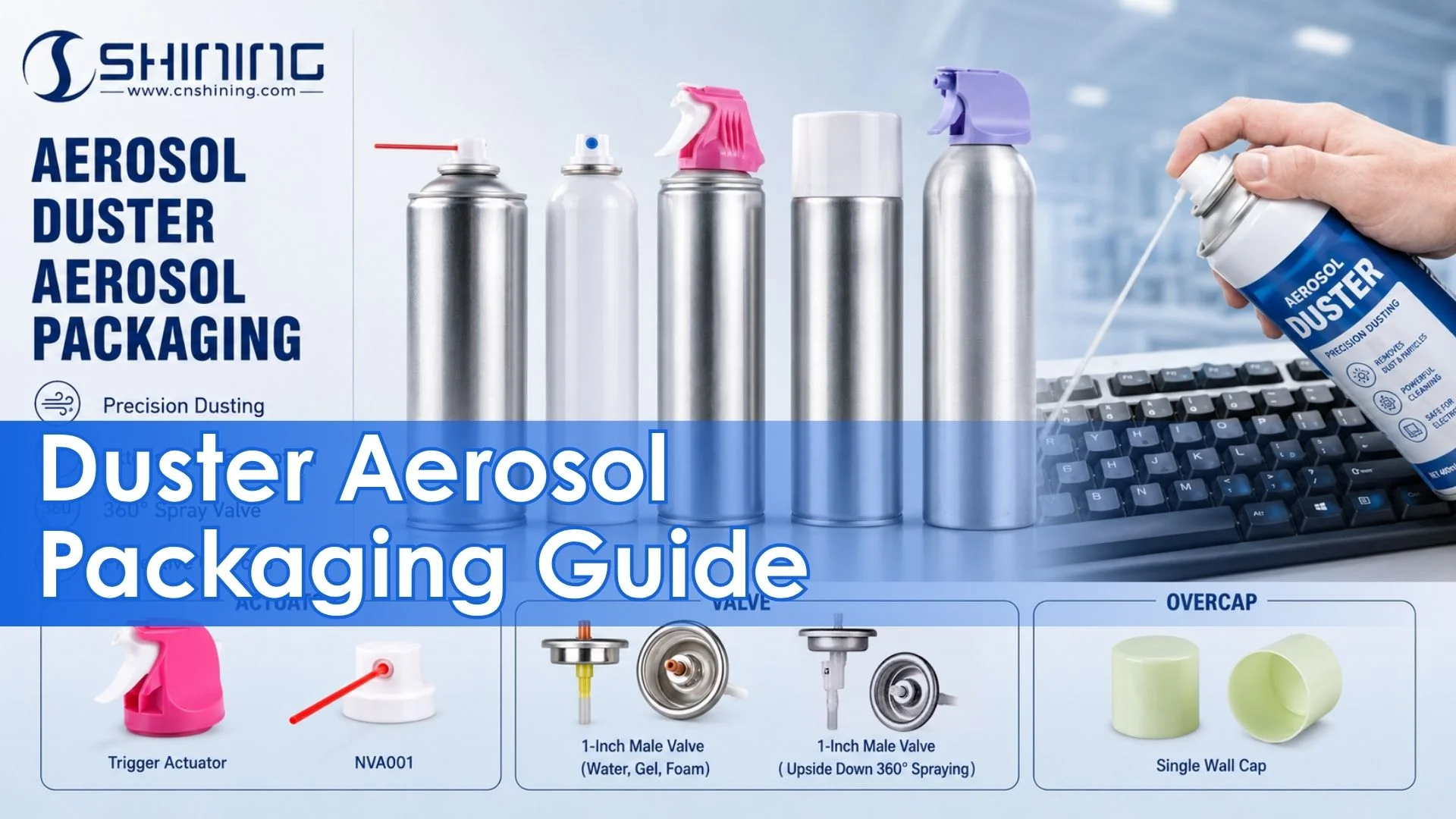
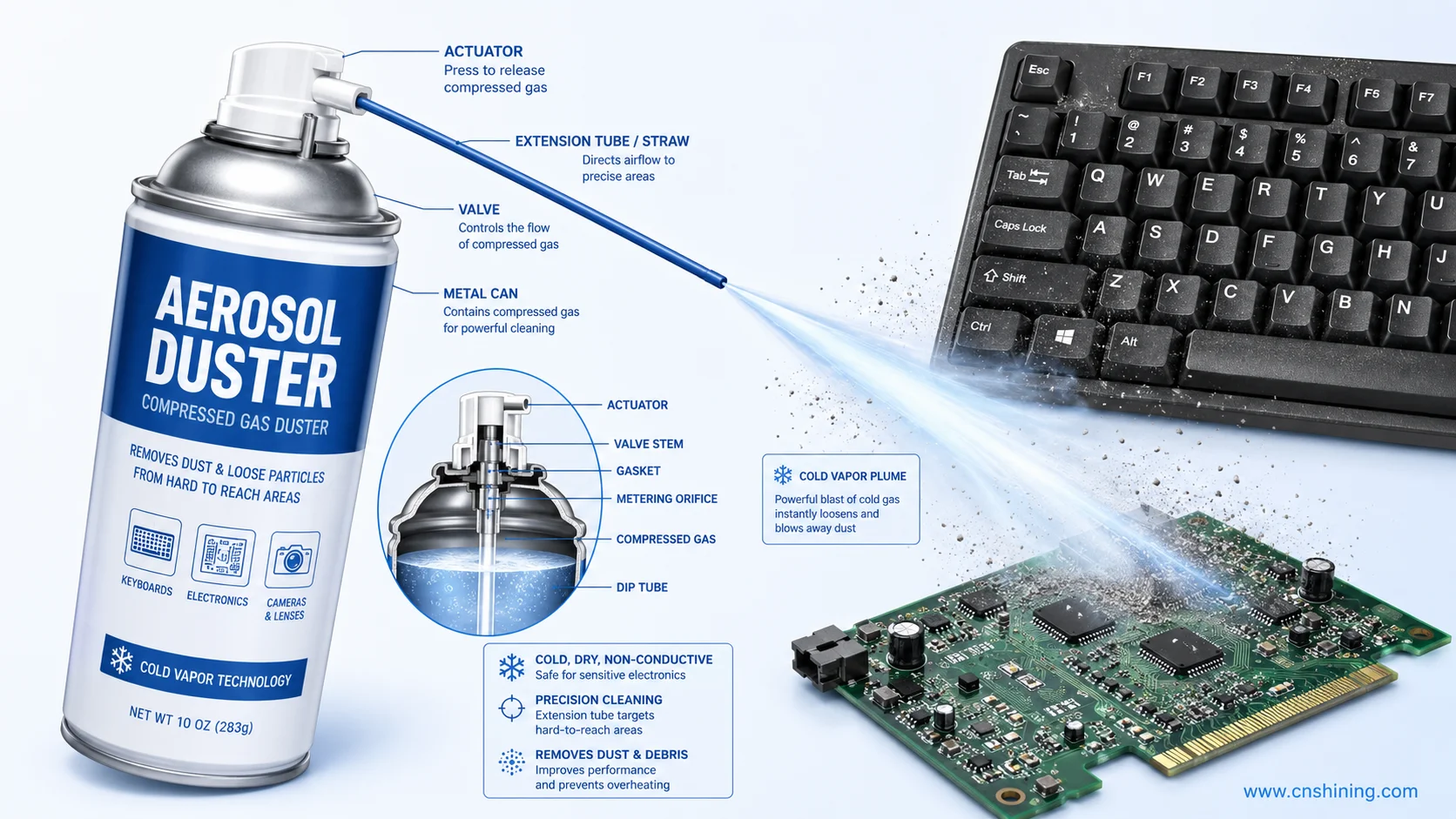
An aerosol duster is not a can of air. It is a pressurized metal package filled with liquefied propellant, often sold under names such as canned air, compressed air duster, compressed gas duster or pressurized gas duster. When the actuator is pressed, propellant flashes through the valve, nozzle and extension tube, producing a short high-velocity jet that removes loose dust from keyboards, PCBs, printer gaps, camera-adjacent areas and other surfaces that should not be cleaned with water or aggressive wiping.
The U.S. CPSC market study describes aerosol dusters as pressurized containers filled with liquefied gas propellants, and the EPA fact sheet explains their use for removing dust and debris from electronics that cannot be safely cleaned with water or liquid cleaners. CPSC aerosol duster market study EPA compressed air duster fact sheet
This operating principle explains most field complaints: cold can body, liquid spitting, condensation, bitterant residue, unstable spray after half a can, and weak value perception for high-frequency users. These are not random defects. They come from the interaction of propellant, valve geometry, actuator control, user angle and label instruction.
1. What the Aerosol Duster Market Is Really Optimizing
The aerosol duster category still has a clear use case: instant availability, strong peak jet, narrow-gap cleaning, no charging and no maintenance. That is why 10 oz consumer cans remain common in office and electronics channels.
The pressure on the category is coming from three sides. The first is safety regulation. In 2024, CPSC proposed that aerosol duster products containing more than 18 mg of HFC-152a and/or HFC-134a would be treated as banned hazardous substances under the FHSA. The same proposal cited 1,039 deaths and about 21,700 emergency department-treated injuries related to aerosol duster inhalation abuse during 2012–2021. CPSC proposed aerosol duster rule package
The second pressure is climate policy. High-GWP HFC routes are under tighter review in the U.S. and Europe. The third pressure is substitution. Electric dusters and rechargeable blowers are not perfect, but they keep pushing the “one tool replaces many cans” argument into mainstream retail.
The strongest product trend is not simply “more blast force.” It is the combined improvement of spray control, low-GWP compliance, recyclability, misuse resistance, cold-touch reduction and liquid-spit control. That moves the discussion from chemistry alone to a full metal packaging system.
2. Product Definition and Working Principle
The product is best defined by its function: a pressurized gas duster removes loose surface dust by gas mass flow rather than by solvent cleaning. CARB defines Pressurized Gas Duster as a pressurized product used only to remove dust from a surface by a gas stream, with examples such as photos, negatives and computer keyboards. CARB consumer products regulation
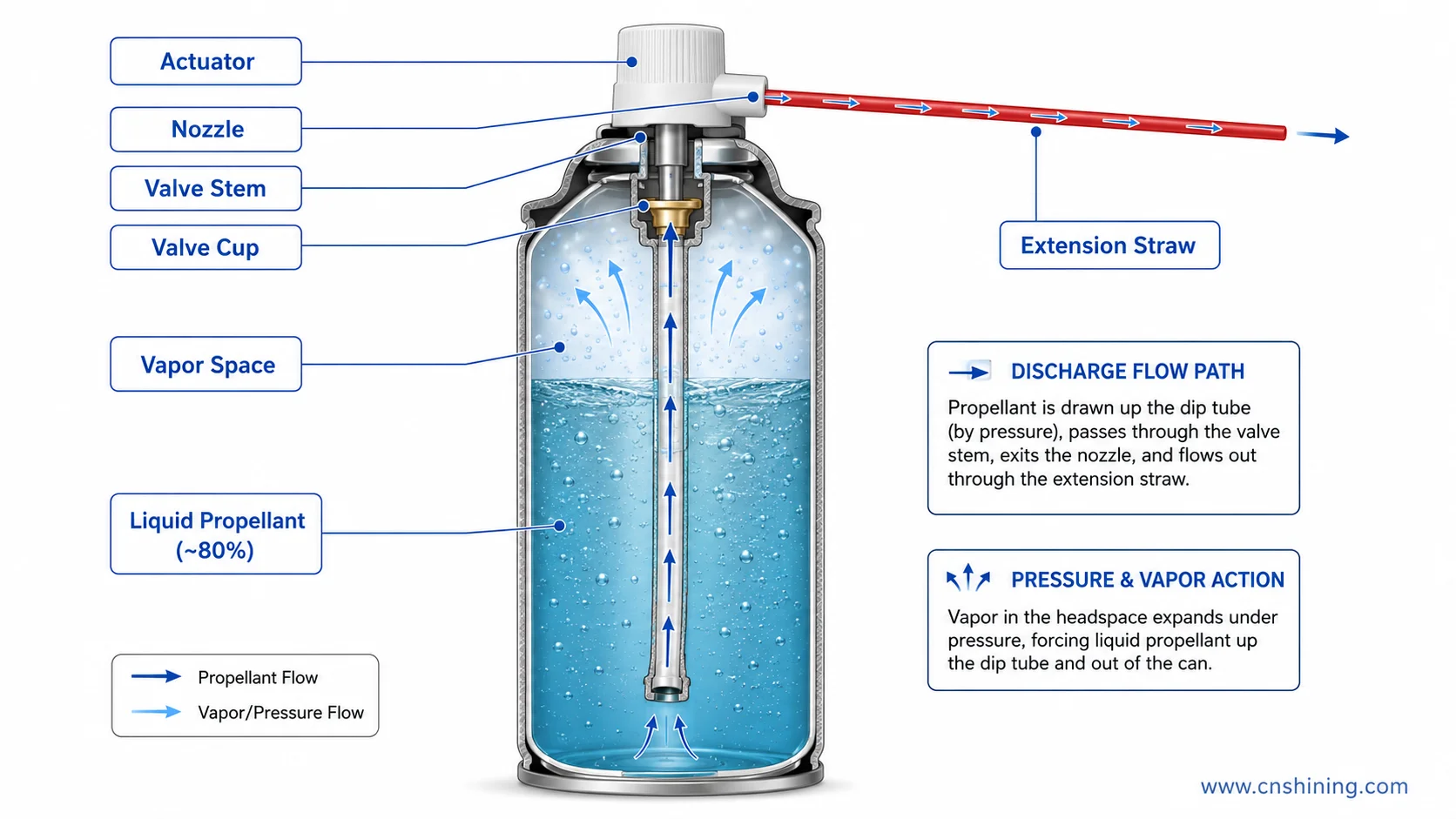
A typical aerosol duster consists of a metal can, mounting cup, valve, valve stem, actuator, orifice and extension tube. The CPSC proposed rule package shows a typical structure in which much of the can volume is liquid propellant, with vapor space above it. When the user presses the actuator, the valve opens. The pressure difference drives liquefied propellant through the valve and nozzle. The rapid expansion produces the jet.
This is why aerosol dusters feel stronger than bulb blowers and many low-end rechargeable devices during the first short burst. They do not rely on a small fan. They rely on stored pressure and phase change.
First, if the can is inverted, tilted too far or held down for a long continuous spray, unevaporated liquid can reach the nozzle. This is the usual cause of “wet keyboard” or frost complaints.
Second, fast propellant release cools both the can and the target area. A water-like mark on the surface may be environmental condensation, not water inside the can.
Third, bitterant can help discourage inhalant abuse in consumer products, but it may leave taste or residue concerns in professional electronics maintenance.
3. Market Size and Regional Outlook
| Source | Visible public data | Scope judgment | Usefulness here | Main limitation |
|---|---|---|---|---|
| Intel Market Research global Air Duster page | 2024: about USD 132 million; 2032: about USD 177 million; CAGR about 4.3%; U.S. share about 40%; China + Europe above 35% | Relatively narrow, close to can-dominant air duster | High | Detailed regional values are not fully public. Intel global air duster market page |
| Intel Asia-Pacific Air Duster page | Asia-Pacific 2024: about USD 41 million; 2034: about USD 55 million | Clearer regional sub-scope | High | Only Asia-Pacific is directly visible. Intel Asia-Pacific air duster market page |
| Research and Markets | 2025: USD 171.05 million; 2026: USD 183.56 million; 2032: USD 236.02 million | Broader air duster category including canned, electric and manual products | Medium | Useful as a category ceiling, not aerosol-only. Research and Markets air duster page |
| Business Research Insights | Shows regional values that do not align cleanly with the narrower global pages | Likely wider or differently sampled | Low to medium | Not suitable for direct stitching into the narrow aerosol duster table. |
| CPSC / EPA / technical data | Product definitions, use cases, propellant structure, safety and environmental context | Regulatory and technical, not full sales data | High | No global time-series sales database. |
Growth Drivers and Barriers
Demand is not driven mainly by household cleaning. The stronger drivers are electronics density, maintenance of servers and IT assets, and continued concentration of electronics manufacturing in Asia. The IEA projects global electricity generation used to supply data centers to grow from about 460 TWh in 2024 to over 1,000 TWh in 2030. That does not directly equal duster volume, but it expands the asset base that needs non-contact dust removal. IEA Energy and AI data center electricity outlook
Barriers are unusually strong for a low-ticket consumable. They include inhalant abuse regulation, HFC climate policy, dangerous goods transport, warehouse constraints, e-commerce age gates, and electric substitutes. Regional logic is also uneven: North America has mature channels but sensitive safety regulation; Europe is pulled by low-GWP and recycling claims; Asia-Pacific benefits from manufacturing and data centers; Latin America is more price-sensitive; Africa remains small and import-led.
4. Solution Comparison, Formulation and Terms
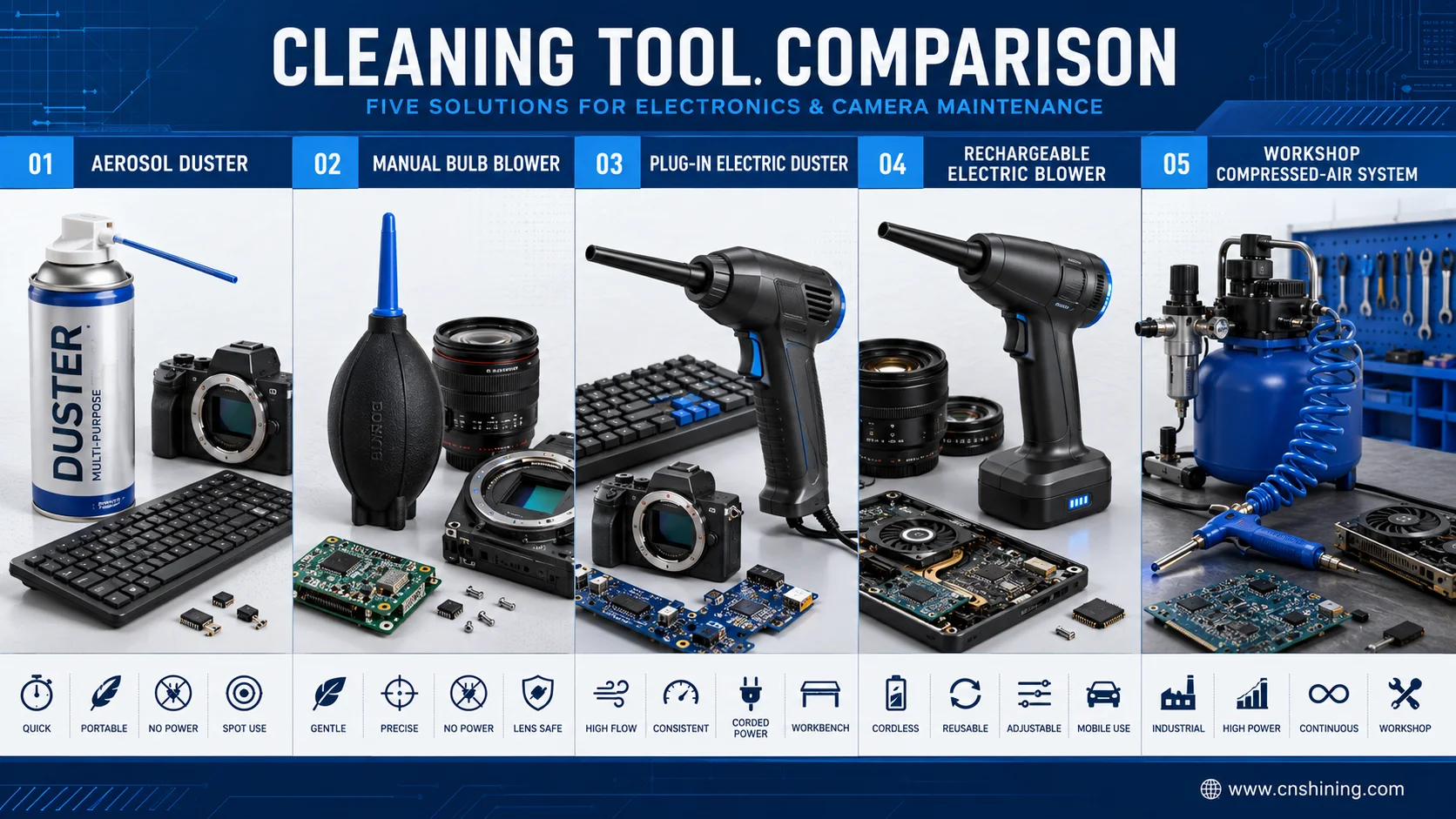
Consumer language often calls aerosol dusters “compressed air.” Strictly, most of them are not pure compressed-air tanks. They are pressurized propellant containers. The real commercial alternatives are manual bulb blowers, plug-in electric dusters, rechargeable blowers, and filtered compressed-air or nitrogen workstations.
| Route | Typical advantages | Typical limits | Better use case | Commercial judgment |
|---|---|---|---|---|
| Aerosol duster | Ready to use, strong short burst, extension tube, good for narrow gaps | Cold can, possible liquid spit, bitterant residue, high long-term cost, transport and age constraints | Low-frequency home and office cleaning | Easy retail SKU, but not the strongest value for high-frequency users |
| Manual bulb blower | No propellant, no battery, gentle on lens surfaces | Low peak airflow, weak on packed keyboard dirt or case dust | Camera, lens and light floating dust | Safer for imaging gear, weak as a PC deep-cleaning tool |
| Plug-in electric duster | Reusable, lower long-term cost, good for maintenance teams | Larger body, motor noise, cable limits | Repair benches and IT departments | Strong B2B substitute where cleaning is frequent |
| Rechargeable electric blower | Portable and reusable | Runtime, noise and jet concentration vary by model | Frequent home users, car interiors and digital desktops | Fast-growing substitute, but noise and battery feel create complaints |
| Compressed-air workstation | True compressed air, continuous output, low consumable cost | Large, noisy, needs filtration and pressure control | Industrial benches, laboratories and repair shops | Professional infrastructure, not normal retail competition |
The real substitute threat is not the manual bulb blower. It is the plug-in or rechargeable electric duster. Once a user cleans equipment once or twice a month, the “one electric unit replaces many cans” argument starts to make sense.
| Formulation type | Common component | Main role | Visible ratio range | Example | Replacement route |
|---|---|---|---|---|---|
| Economy retail mainstream | HFC-152a / 1,1-difluoroethane | Strong spray at lower cost | Often 100% or near 100% main propellant | Dust-Off SDS and similar consumer products | HFO-1234ze or reusable electric duster |
| Non-flammable electronics preference | HFC-134a / 1,1,1,2-tetrafluoroethane | Lower ignition sensitivity for professional electronics positioning | Usually pure or high-ratio main propellant | MG Super Cold 134 type products | HFO-1234ze, filtered compressed air or nitrogen |
| Low-GWP generation | HFO-1234ze | Low-GWP propellant route | Often promoted as single main propellant | Techspray Renew-Duster uses HFO-1234ze as a low-GWP alternative to HFC routes. Techspray Renew-Duster HFO-1234ze page | HFC-free systems or reusable electric tools |
| Consumer misuse-resistant SKU | Main propellant + bitterant | Discourages intentional inhalation | Usually trace and not fully disclosed | Many consumer aerosol dusters claim bitterant | Age control, locking actuator, channel control and safer propellant strategy |
| Professional clean SKU | No bitterant, low residue, filtered output | For sensitive electronics and labs | Main propellant may be disclosed; filtration and residue control create the difference | Professional pages often stress residue control and bitterant-free positioning. Chemtronics bitterant technical note | Low-GWP clean route or dedicated gas system |
Modern product planning should not be limited to one “10 oz duster” SKU. At minimum, the category splits into four technical logics: economy retail, non-flammable professional, low-GWP upgrade, and bitterant-free clean professional.
| Term | Plain meaning | Business / engineering meaning |
|---|---|---|
| HFC-152a | 1,1-difluoroethane | Common low-cost retail propellant, but flammability and inhalant-abuse regulation are sensitive |
| HFC-134a | 1,1,1,2-tetrafluoroethane | Used historically for non-flammable electronics positioning, but climate pressure is high |
| HFO-1234ze | Low-GWP hydrofluoroolefin propellant | Important low-GWP upgrade route |
| Bitterant | Bitter-tasting misuse deterrent | Consumer safety feature, but may conflict with clean electronics maintenance |
| Moisture-free | No water-based cleaning medium | Does not mean the surface can never show condensation |
| Residue-free | No intended cleaning film after evaporation | Must be used carefully if bitterant or additives are present |
| Ozone-safe | No CFC/HCFC ozone-depleting propellant | A threshold statement, not a low-carbon statement |
| GWP | Global warming potential | Increasingly relevant to EU and enterprise procurement |
| 360° valve / up-down valve | Valve designed for spraying in multiple orientations | Targets angle-related liquid spitting and flow interruptions |
| Twist-to-lock actuator | Actuator that mechanically locks against accidental discharge | Useful for transport, storage and misuse risk reduction |
| Vapor tap valve | Valve design that introduces vapor phase into the flow path | Can help control droplet behavior and spray consistency |
| Filtered to 0.2 microns | Cleanliness claim for emitted gas or system filtration | Relevant for labs, medical electronics and sensitive surfaces |
5. Regulatory and Compliance Framework
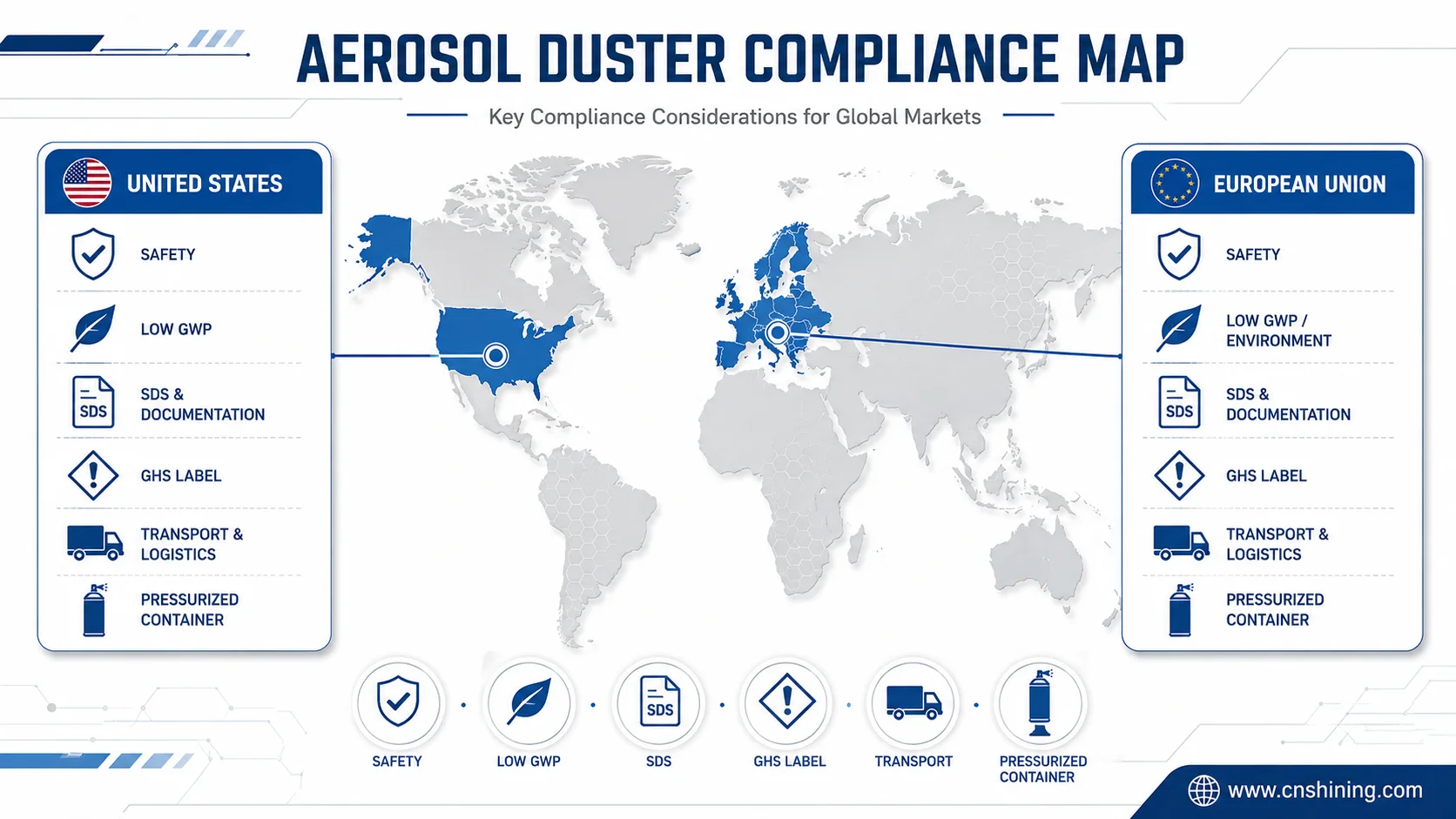
Compliance is not one chemical approval question. Aerosol dusters sit at the intersection of safety, environment, hazard communication, aerosol dispenser rules, transport, e-commerce policy and channel labeling.
5.1 United States
The largest U.S. variable is the CPSC proposed rule on HFC-152a and HFC-134a in aerosol duster products. If adopted as drafted, a product containing more than 18 mg of these propellants in any combination would be treated as a banned hazardous substance under the FHSA. This changes long-term formulation assumptions. A product team should not assume that HFC-152a can remain the only U.S. consumer route.
The EPA’s SNAP and AIM Act-related programs add a separate climate and substitution layer. These environmental rules are not the same as the CPSC inhalation-abuse proposal, but they influence the same formulation roadmap. EPA SNAP regulations and rules page
5.2 Europe
Europe is driven by REACH/CLP for chemical registration and labeling, F-gas rules for HFC phase-down, and aerosol dispenser requirements for pressure and labeling. The EU climate policy page states the direction clearly: the F-gas framework tightens controls on fluorinated greenhouse gases and moves HFCs toward long-term phase-out. EU F-gas legislation page
For classification and labeling, CLP remains the core framework. Claims such as “ozone-safe” are no longer enough for professional buyers. GWP, substance registration, label phrases and safety data sheets need to line up. EU CLP Regulation 1272/2008
| Market | Priority check | Meaning for product and purchasing teams |
|---|---|---|
| United States | CPSC HFC-152a / HFC-134a threshold, EPA/AIM direction, SDS and transport file alignment | Do not rely on a single 152a consumer route; keep a low-GWP alternative path |
| California | Correct CARB product classification as Pressurized Gas Duster | Review claims and label wording before channel listing |
| European Union | REACH source, CLP label, F-gas direction and aerosol dispenser rules | Low-GWP and recyclable packaging are becoming procurement factors, not only PR points |
6. Technology Progress, Brand Structure and User Pain Points
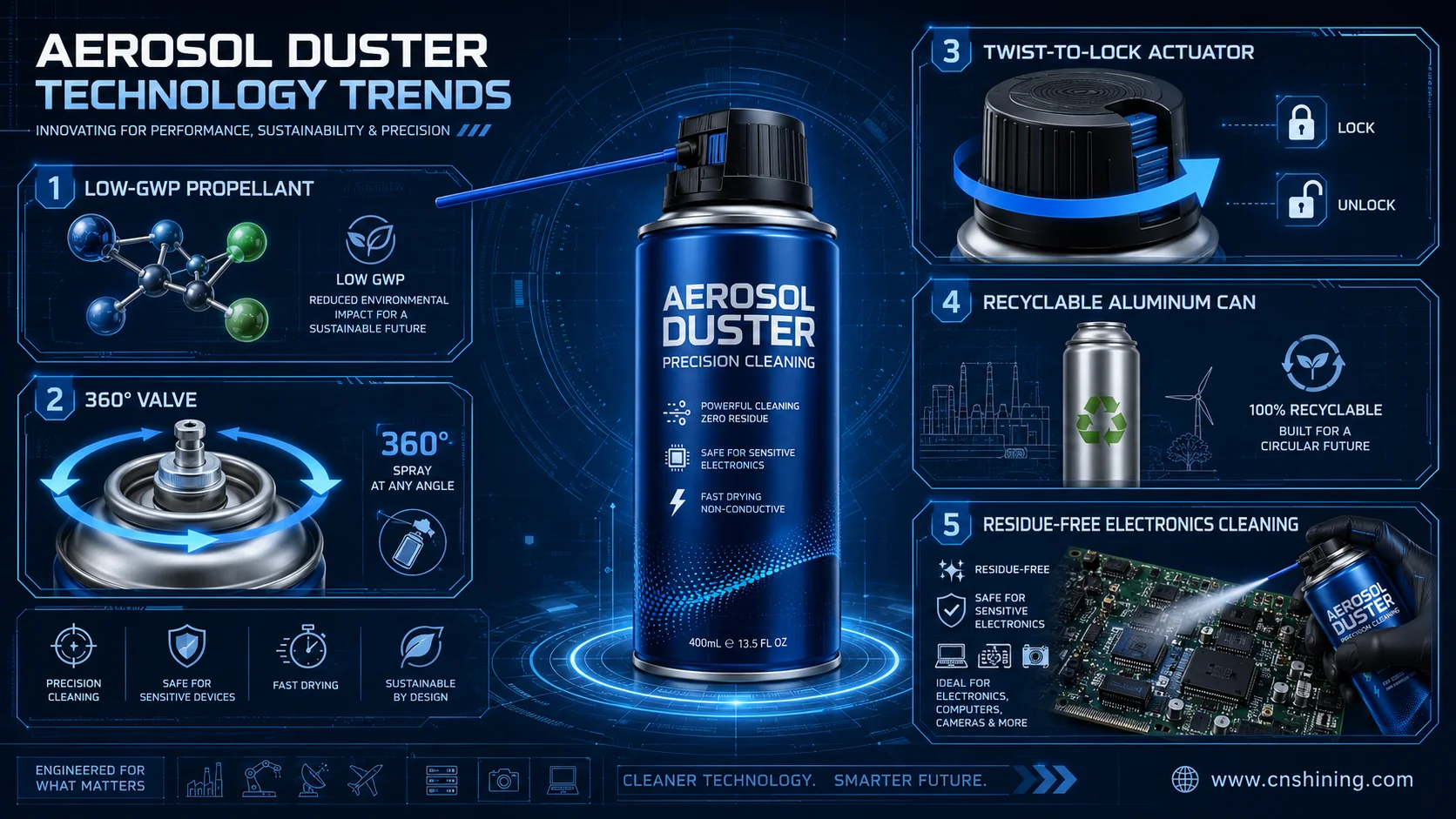
Latest Technical and Market Direction
The most visible shift is the move from high-GWP HFC language toward lower-GWP commercial products. HFO-1234ze is already being used in professional low-GWP duster positioning.
A second route is system-level substitution. Pressurized packaging using compressed air or inert gas does not copy a dusting gas can one-to-one, but it shows that spray performance and reduced traditional propellant reliance can be engineered together.
A third route is packaging circularity. Aerosol cans have a strong recycling story when they are empty and correctly sorted. For electronics cleaning products with a low product weight but high environmental concern, clearer recycling instructions will matter more in enterprise procurement. Aerosol cans recyclability
Valve and actuator development is becoming more important. A 360° valve directly addresses angle-related flow problems, and a twist-to-lock actuator reduces accidental discharge and lost-cap problems. 360° / up-down valve page
The fifth trend is cleaner professional positioning: low residue, no bitterant where appropriate, and tighter filtration claims. This is where aerosol duster starts to behave less like an office consumable and more like an electronics maintenance material.
| Pain point | Typical platform evidence | Meaning |
|---|---|---|
| Ineffective on caked-on dirt | Retail Q&A and user comments | Aerosol dusters remove loose particles. They do not dissolve oil, skin residue or sticky dirt. |
| Liquid droplets or wet surface | Forum posts about liquid building up on keyboards | Usually linked to angle, long spray, overcooling or weak valve control. |
| Cold can and frosting sensation | Short-video and review comments | Users may interpret cooling as a defect instead of a physics effect. |
| Expectation gap | Comments comparing the effect to blowing by mouth | Marketing demos often show loose dust, not household grime. |
| Bitterant taste or residue | Repair-user discussions | High-frequency indoor users and technicians notice bitterant more than casual users. |
| Half-can spray failure | Office retail reviews | Points to valve, stem, internal pressure and usage-angle stability. |
| Too cold to hold | Office retail reviews | Can geometry, actuator leverage and local insulation become user-experience factors. |
| Single-can price concern | Retail and forum comments | High-frequency users are pulled toward electric substitutes. |
| Precision imaging risk | Camera and CMOS advice posts | High pressure and condensation risk reduce trust for sensor-adjacent cleaning. |
| Electric substitutes are loud | Electric blower reviews | Aerosol cans remain useful because the substitutes also have discomfort points. |
These complaints reduce to four design tasks: prevent liquid spit and overcooling, manage bitterant side effects, improve spray consistency after partial use, and make single-use cost feel technically justified.
7. Top 10 Aerosol Duster Brands
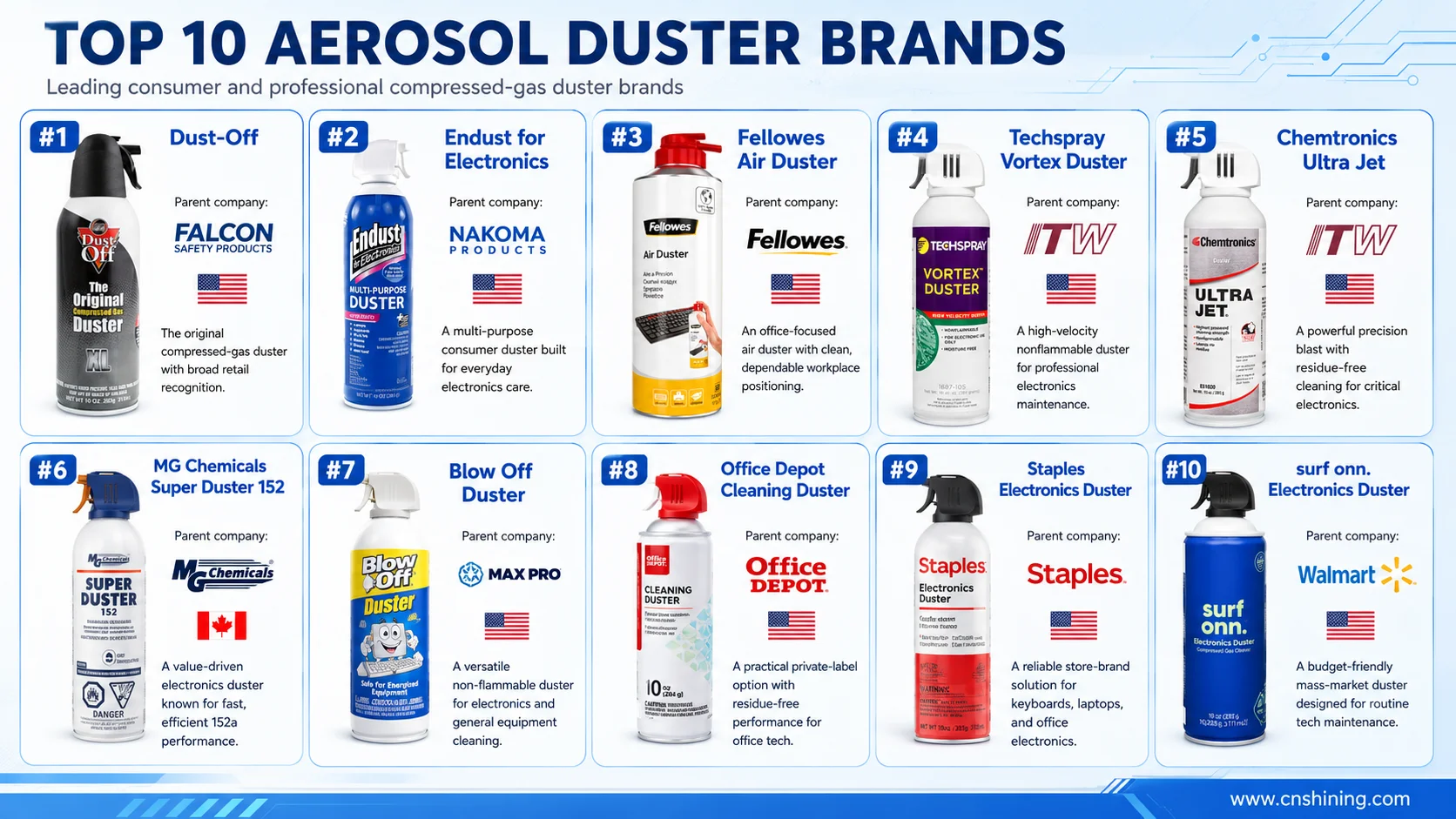
| Brand | Country | Parent / operating entity | Common capacity | Retail price range | Direct technical comment | Main channels |
|---|---|---|---|---|---|---|
| Dust-Off | United States | Falcon Safety Products | 3.5 / 7 / 10 / 12 / 17 oz | about $6–9 per can | Strong consumer recognition; often the default retail choice | Amazon, Walmart, Staples, Office Depot |
| Endust for Electronics | United States | Norazza / Endust for Electronics | 10 oz | about $12 per 10 oz can | Office retail brand; emphasizes bitterant and electronics-safe positioning | Official shop, office supplies channels |
| Fellowes | United States | Fellowes, Inc. | 350 ml | about $16–18 per 350 ml can | Strong office channel; duster works as part of office consumables | Office distributors, regional sites and resellers |
| Techspray | United States | Techspray / ITW | 10 oz and professional series | about $24–26 per 10 oz can | Industrial and lab orientation; professional documentation matters more than low price | Official shop and industrial distributors |
| Chemtronics Ultrajet | United States | ITW Chemtronics / Illinois Tool Works system | 10 oz and industrial formats | about $19–21 per 10 oz can | Established electronics maintenance line; residue-free positioning is important | Industrial distributors, lab and electronics maintenance channels |
| MG Chemicals | Canada | MG Chemicals | 285 g / 400 g and 14 oz professional formats | about $19 per 285 g can | Engineering brand; documentation and professional cleanliness claims are a strength | Official site, industrial distribution, selected e-commerce |
| Max Professional Blow Off | United States | Public parent information is limited | 8 / 10 oz | about $4–11 per can | Price-competitive channel product | Walmart, Office Depot, Amazon |
| Office Depot | United States | Private label under The ODP Corporation retail system | 10 oz | about $5–7 per 10 oz can by multipack calculation | Private-label logic: adequate, convenient, office-compatible | Office Depot, Walmart, Amazon |
| Staples | United States | Staples private-label system | 10 oz | about $8–13 per 10 oz can | Office retail private label with store-network advantage | Staples and enterprise procurement |
| onn. | United States | Walmart private-label system | 10 oz, often 4-pack | about $6.7–7.5 per 10 oz can by multipack calculation | Large-retail private label for price-sensitive buyers | Walmart mainly |
8. Packaging and Structural Improvement Suggestions
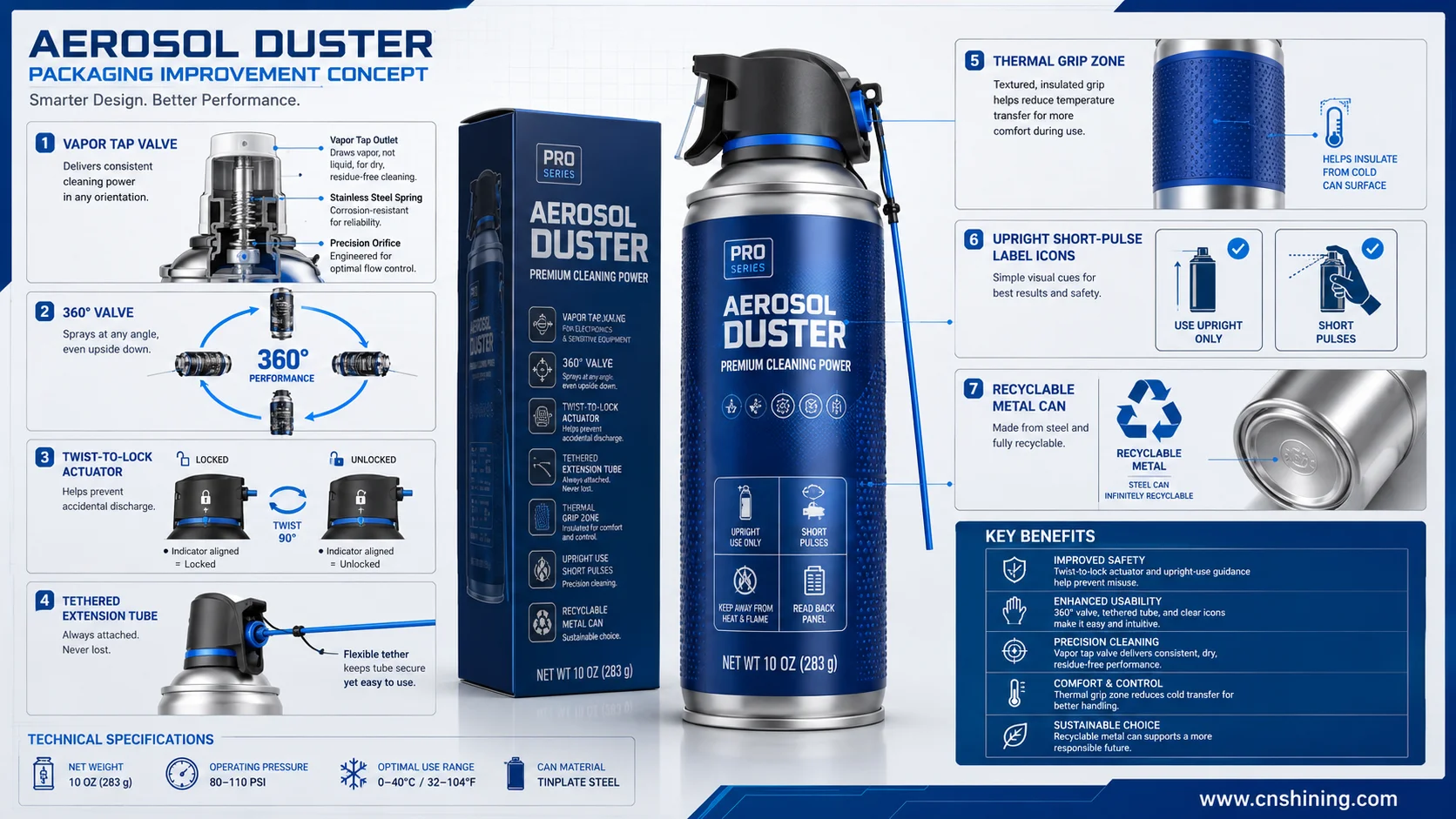
Users are not only complaining about propellant. They are reacting to the whole system: valve, actuator, can body, tube, label and use instruction. Product improvement should be treated as a system project, not a graphics refresh.
| Part | Actionable design suggestion | Pain point addressed | Advantage | Cost / risk |
|---|---|---|---|---|
| Valve | Use vapor-tap or anti-liquid guidance valve; evaluate 360° valve behavior at high tilt angles. Vapor tap valve patent reference | Liquid spit, frosting, angle limitation | Directly improves “wet keyboard” and unstable spray complaints | Higher cost and need for propellant-flow revalidation |
| Valve | Add short-pulse metering or half-stroke flow limit for consumer SKU; keep full-flow version for professional SKU | Long-spray misuse | Reduces novice overcooling and droplet risk | Heavy users may feel the spray is weaker |
| Actuator | Use twist-to-lock or hoodless lock structure | Accidental discharge, cap loss, transport risk | Better e-commerce storage and handling safety | Mold cost and supplier complexity rise |
| Actuator | Replace small button with a larger lever trigger; add thermal isolation ribs or local PP/TPE overmolding | Cold hand feel, pressing fatigue | More stable single-hand operation | Part complexity and recycling separation need review |
| Extension tube | Use tethered straw or integrated clip slot on actuator | Lost straw, loose small parts | Reduces user frustration and small-part loss | Assembly validation needed |
| Can body | Add finger flat, narrowed waist line or recyclable thermal sleeve / paper insulation band in holding zone | Cold grip and unstable handling | Visible improvement without changing fill size | Extra material and labeling operation |
| Can printing | Add large upright-short-pulse icon, nozzle direction arrow, cold warning and QR tutorial | Misuse and expectation gap | Reduces avoidable complaints | Needs multilingual artwork control |
| Internal coating | Run compatibility matrix for bitterant, HFO route and additive systems; check BPA-NI epoxy phenolic, polyester or PET lining options | Long-term stability and metal interaction | Improves shelf-life confidence and export quality control | Requires storage and extraction testing |
| SKU architecture | Split consumer bitterant safety SKU from professional no-bitterant low-residue SKU | Conflict between consumer safety and professional residue needs | Prevents one SKU from failing both use cases | Label and channel management become more complex |
If only three upgrades can be funded, start with the valve’s liquid-spit and angle consistency, then improve actuator locking and cold isolation, then simplify user instructions. Those three changes address the most visible complaints: wet spray, cold handling and incorrect use.
9. Product Fit: Shining Packaging Actuators, Cans and Valves
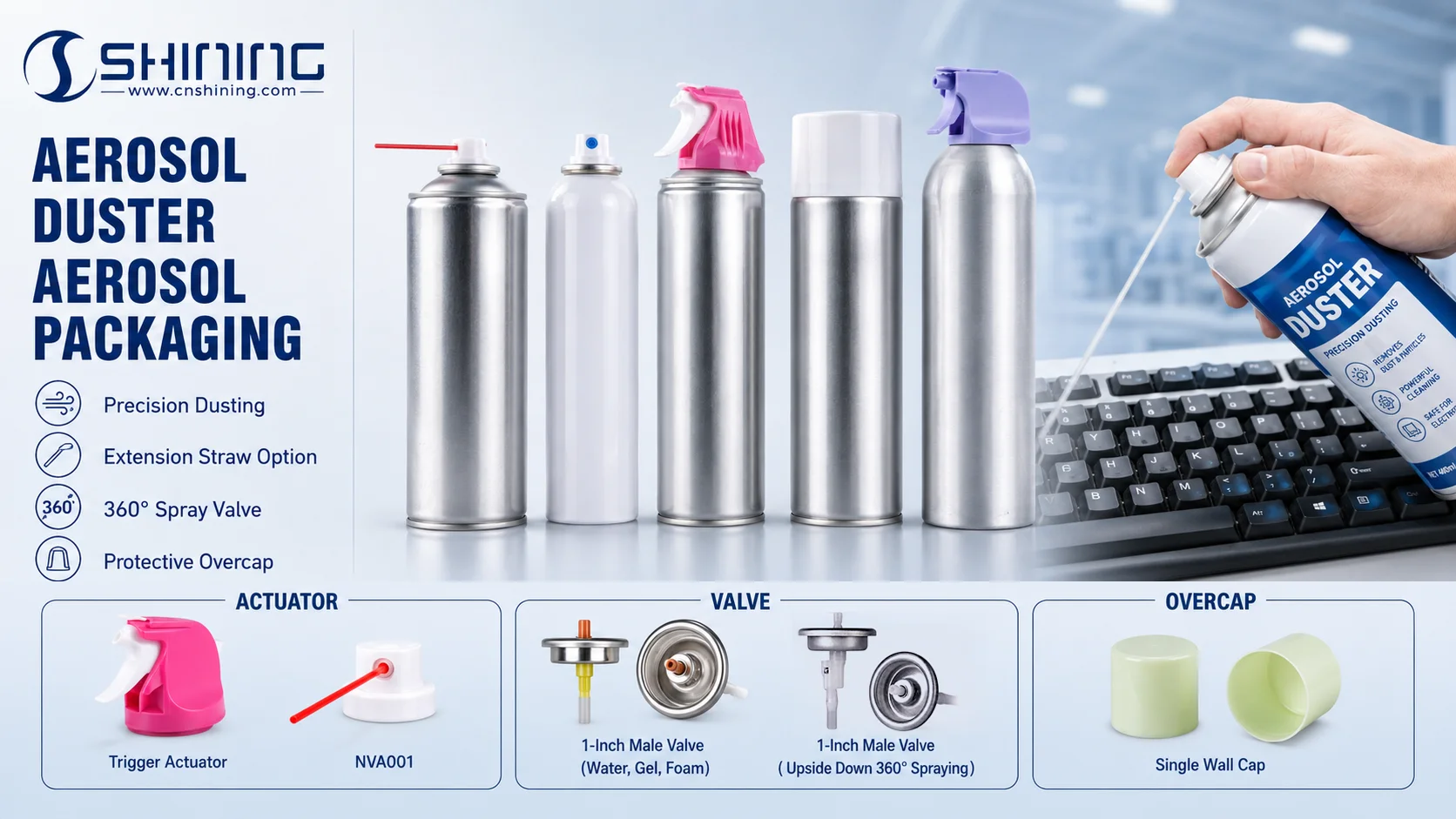
For an aerosol duster, the package is part of the performance. The actuator determines finger control and misuse resistance. The valve determines flow stability, orientation tolerance and liquid-spit behavior. The metal can and internal coating determine pressure integrity, shelf life and compatibility with propellant and additives.
Shining Packaging’s relevant work sits in these system parts: actuators, aerosol cans and valves. In a duster project, these parts should be reviewed together with propellant type, fill ratio, desired spray force, target market regulation and user instruction. A stronger can alone will not solve liquid spitting. A new actuator alone will not solve poor vapor control. The useful engineering work is the matching of can, valve and actuator to the actual duster use case.
For consumer aerosol dusters, the main packaging questions are locking behavior, short-pulse control, tube retention, cold-touch comfort and clear label space. For professional electronics dusters, the focus shifts to low residue, flow repeatability, documentation, coating compatibility and tighter part consistency.
10. Conclusion
Aerosol duster remains useful because it gives a strong short jet from a simple package. The weak points are equally clear: cold feel, liquid spit, bitterant concerns, partial-can inconsistency, regulatory pressure and competition from reusable electric tools.
The next good aerosol duster will not be defined only by a larger can or louder spray. It will be defined by a better matched system: lower-GWP propellant where required, valve design that controls liquid and angle, actuator design that reduces misuse, metal packaging that supports compatibility and recycling, and instructions that match how users actually handle the can.
11. FAQ: Aerosol Duster Technical Questions
Usually no. Most aerosol dusters sold as “canned air” are pressurized containers filled with liquefied propellant, not pure compressed air. The propellant vaporizes during discharge and creates a fast gas jet. This difference matters because propellant selection controls flammability, cooling, liquid-spit behavior, environmental impact and regulatory exposure.
The can cools because liquefied propellant evaporates and expands rapidly as it leaves the valve. That phase change absorbs heat from the can body, valve area and nearby surface. Long continuous spraying makes the effect stronger. A cold surface can also condense moisture from surrounding air, creating a wet-looking mark.
Liquid droplets usually appear when the can is tilted too far, inverted, sprayed continuously, or fitted with a valve that does not manage liquid-vapor separation well. The liquid propellant has not fully vaporized before exiting the nozzle. Better valve design, short-pulse use and clear upright-use labeling reduce this problem.
Bitterant is a very bitter additive used in many consumer aerosol dusters to discourage intentional inhalation abuse. It can support misuse prevention, but professional electronics users may dislike it because taste or residue can transfer through dust and air. That is why some technical dusters are positioned as no-bitterant, low-residue products.
HFC-152a and HFC-134a are common duster propellants, but they face two pressures. One is safety, especially inhalant-abuse risk in consumer products. The other is environmental policy, because HFCs have global warming impact. U.S. and EU regulatory directions both push product teams to evaluate lower-GWP or non-HFC routes.
HFO-1234ze is a useful low-GWP route, but it should not be treated as a simple label change. Valve, actuator, fill weight, pressure behavior, sealing material, coating compatibility and spray force need validation. It is more accurate to call it a lower-GWP platform that must be engineered into the package.
Spray performance after partial use depends on remaining propellant mass, vapor pressure, can temperature, valve condition and user angle. If the actuator or stem sticks, or if the vapor-liquid balance is poor, the user may feel weak or unstable flow. Consistent valve selection and short-pulse instruction help control this complaint.
Electric dusters are better for frequent use because they are reusable and avoid repeated propellant cans. They are not always better for every task. Many are noisy, larger and less precise in narrow gaps. Aerosol dusters still perform well for occasional, targeted bursts where a clean extension tube and strong short jet are useful.
Valve improvement usually gives the most direct technical gain because it affects liquid spit, angle sensitivity and flow consistency. Actuator locking and thermal grip design come next because they affect misuse, accidental discharge and cold handling. Label icons are also important because many failures come from long sprays or wrong can orientation.
It can, but it often becomes a compromise. Consumer users need misuse resistance, clear warnings and convenient handling. Professional electronics users care more about residue, bitterant absence, filtration, documentation and repeatable flow. A two-SKU structure usually gives cleaner engineering logic: consumer safety version and professional low-residue version.