1. A Bottle for the Outdoors, Not a Luxury Repositioning
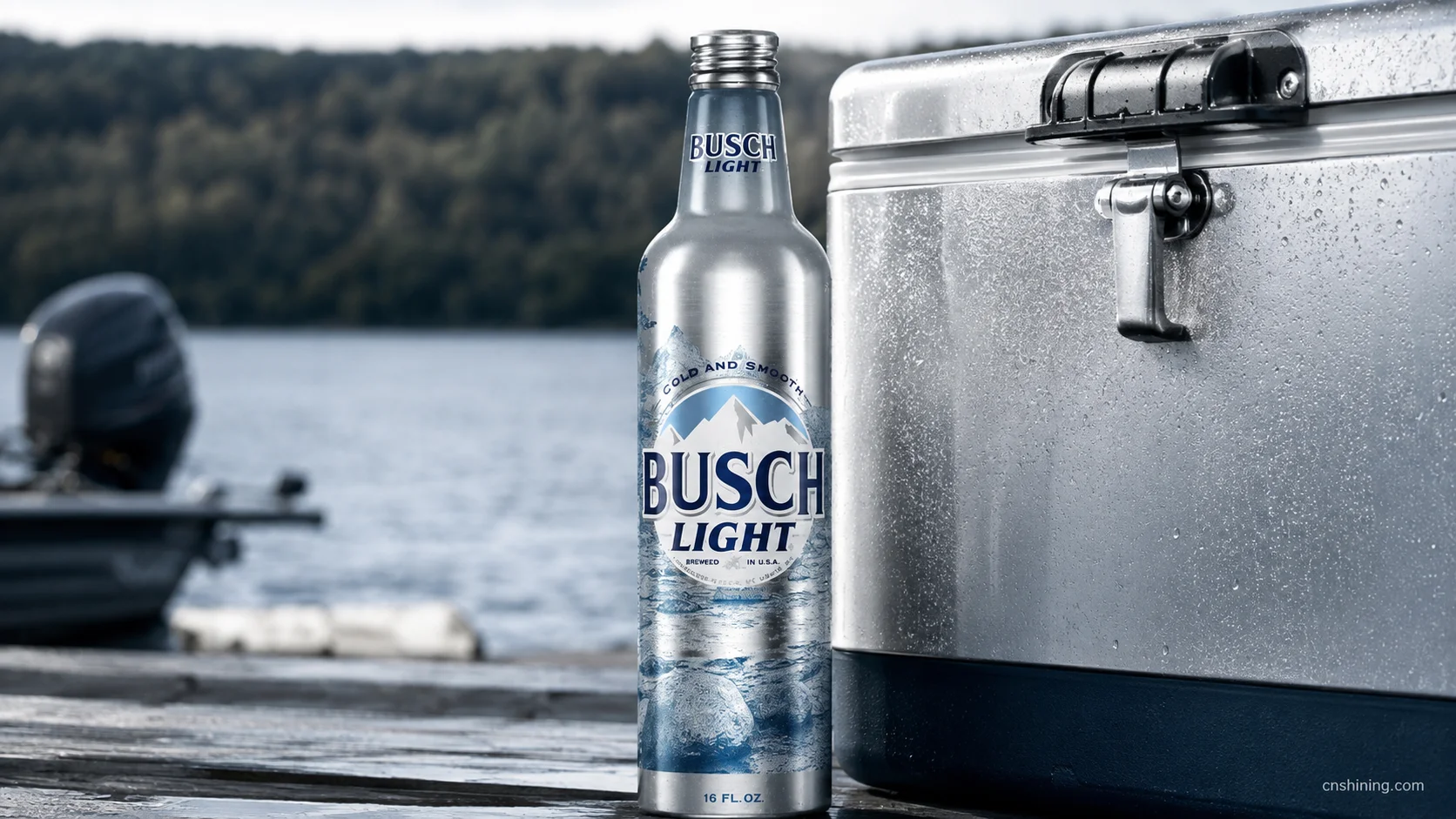
“We know our fans are passionate about the outdoors,” Busch Light’s marketing lead said when the brand introduced a fishing-focused collaboration in 2026. That is the useful starting point for the Busch Light aluminum bottle: it is not simply a more expensive version of a beer package. It is a 16 fl oz format that can make sense when drinking moves away from a table and into fishing trips, tailgates, coolers, campsites and other mobile social settings. Busch Light’s own communication repeatedly connects the brand with fishing, hunting, farming and the broader outdoors, while a current U.S. retail listing confirms a 15-pack of 16 fl oz aluminum bottles at 4.1% ABV. Busch Light’s 2026 fishing campaign and its continuing seasonal packaging programs make that context unusually explicit.
Packaging is already part of Busch Light’s cultural vocabulary. The brand has issued annual hunting designs, fishing cans and farming editions rather than treating the container as a static background. Its 2026 Farming Cans, for example, carried a U.S. Farmed seal and continued a multi-year connection with agricultural communities. The implication for an aluminum bottle is specific: the bottle should amplify an existing pattern of seasonal participation and outdoor identification, not introduce a detached “luxury beverage” language that the beer has never needed. The current farming program and the brand’s long-running hunting releases show how much storytelling work Busch already asks its primary package to do.
This creates the central packaging tension. Standard cans remain highly efficient for a mainstream, volume-led light lager, while the 16 oz bottle gives Busch Light a stronger handheld silhouette and a format better suited to a reclosable experience, seasonal graphics and event-oriented distribution. The bottle therefore works best as a differentiated layer within the package architecture rather than as a reason to abandon the high-volume can. That distinction is important because it keeps the material decision tied to a use case instead of turning “aluminum” into a generic premium claim.
2. Engineering the Busch Light Aluminum Bottle as a Complete Package System
Busch Light is a carbonated light lager, and the public retail product specification lists 4.1% ABV and 95 calories per 12 fl oz serving. For an aluminum bottle, those consumer-facing facts are less important technically than what they imply: the package must be qualified as a pressure-bearing, oxygen-sensitive beverage system in which the bottle body, internal coating, neck finish, cap liner and filling process interact. Brewing-industry guidance treats dissolved oxygen and total package oxygen as important finished-beer controls, while its 2026 over-pressurization guidance stresses the need to understand the pressure limits of the selected package.
| Packaging interface | Busch Light decision | Engineering reason | Validation focus |
|---|---|---|---|
| Bottle body | 16 fl oz aluminum beverage bottle | The larger single-serve format supports longer outdoor and social drinking occasions while giving the brand a bottle-shaped profile rather than another can silhouette. | Dent resistance, shoulder/base stability, cold handling and compatibility with the intended filling line. |
| Internal surface | Food-contact coating selected for the actual beer and process conditions | The liquid should not be treated as if it contacts bare aluminum. The coating is the functional separation layer and has to be evaluated for its intended food-contact use and migration conditions. | Coating integrity, migration documentation, sensory transfer, corrosion resistance and performance through the intended shelf life. |
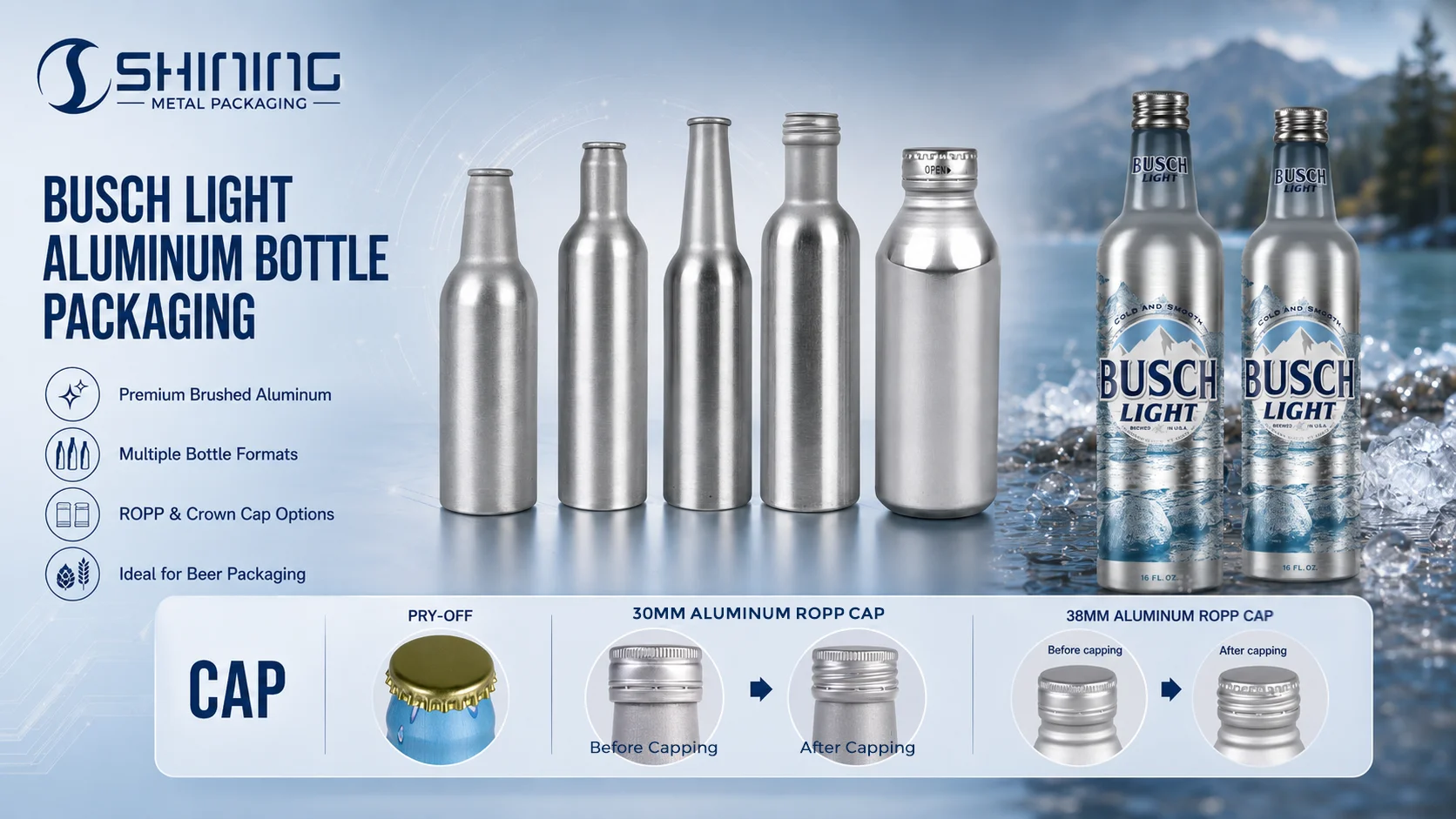
| Neck and closure | Threaded, tamper-evident reclosure architecture where reclosure is part of the intended experience | The bottle format gains much of its consumer distinction from the possibility of closing it again; that benefit depends on a controlled bottle-finish, liner and cap interface. | Opening torque, bridge break, leakage, pressure retention, reseal behavior and cap application window. |
| Beer quality control | Manage oxygen pickup and carbonation as filling parameters, not bottle-marketing claims | Package geometry alone cannot protect beer quality if filling introduces excessive oxygen or the closure loses pressure integrity. | Dissolved oxygen, total package oxygen, headspace control, leakage and retained carbonation after transport. |
| Exterior decoration | Seasonal artwork that survives real cooler and handling conditions | Busch Light relies heavily on limited-edition packaging, so a graphic surface that scuffs quickly would damage the very brand function the bottle is meant to strengthen. | Wet abrasion, condensation wiping, bottle-to-bottle rubbing, color consistency and code readability. |
The most brand-specific structural decision is the closure interface. Internal coating and oxygen control are non-negotiable beer-quality fundamentals, but the closure determines whether the bottle actually delivers a meaningful behavioral advantage over a can. A threaded bottle that opens poorly, leaks after reclosure or loses pressure under distribution has added complexity without preserving the use-case benefit that justified the bottle. FDA guidance also makes clear that food-contact packaging components must be authorized for their intended use and evaluated with migration and exposure in mind; that makes coating selection a verified technical input rather than a material assumption. FDA food-contact packaging guidance provides the regulatory baseline.
Shining Packaging can coordinate bottle-neck and closure matching, internal-coating compatibility, decorated samples and production validation so the bottle is qualified as one system rather than as disconnected components.
3. Seasonal Graphics Have to Share the Bottle with Mandatory Beer Information
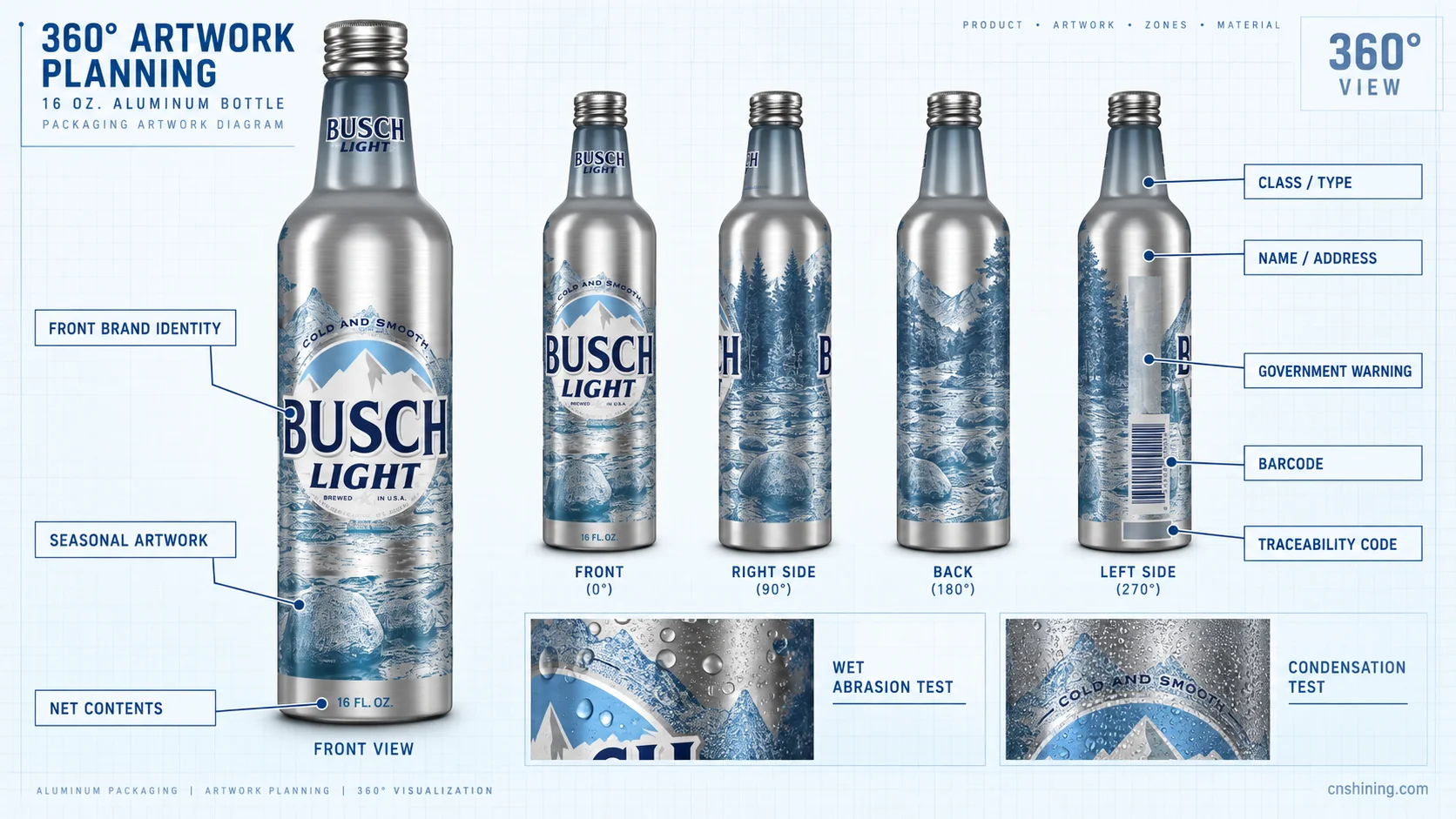
Busch Light’s packaging strategy gives graphics unusually high responsibility. Hunting, fishing and farming editions work because the package becomes a visible token of a specific community or season. On an aluminum bottle, that approach gains a taller, more object-like surface, but it also creates a layout problem: the campaign artwork must coexist with regulated information instead of pushing it onto the cap or secondary pack. In the United States, TTB guidance requires malt-beverage labels to accommodate items including the brand name, class or type, net contents and name and address, while the federal alcohol health warning must also appear on qualifying alcoholic beverage containers.
The 16 fl oz size has one particularly practical consequence. TTB’s net-contents guidance says a 16 fl oz malt-beverage container is stated as “1 Pint”; 473 mL can be added as a metric equivalent but does not replace the U.S. measure. That means a seasonal bottle design should establish its compliance zones before the hero artwork is finalized. For Busch Light, a sensible hierarchy would keep the blue-and-silver brand recognition and seasonal narrative visually dominant while protecting a consistent information panel for mandatory copy, traceability and retail coding. TTB’s malt-beverage net-contents guidance makes the 16 oz rule explicit.
The surface specification should also reflect where Busch Light is actually consumed. A finish intended for a dry shelf sample is not enough for bottles that may sit in ice, collect condensation, rub against other metal containers and then be photographed or carried around an event. The useful development question is therefore not simply whether a graphic can be printed, but whether its color, varnish and code legibility remain acceptable after the wet-abrasion and handling conditions associated with the brand’s outdoor positioning. That conclusion follows directly from the brand’s continuing use of fishing, hunting and farming occasions as packaging-led touchpoints.
4. Competitor Landscape: 16 oz Aluminum Bottles in U.S. Lager
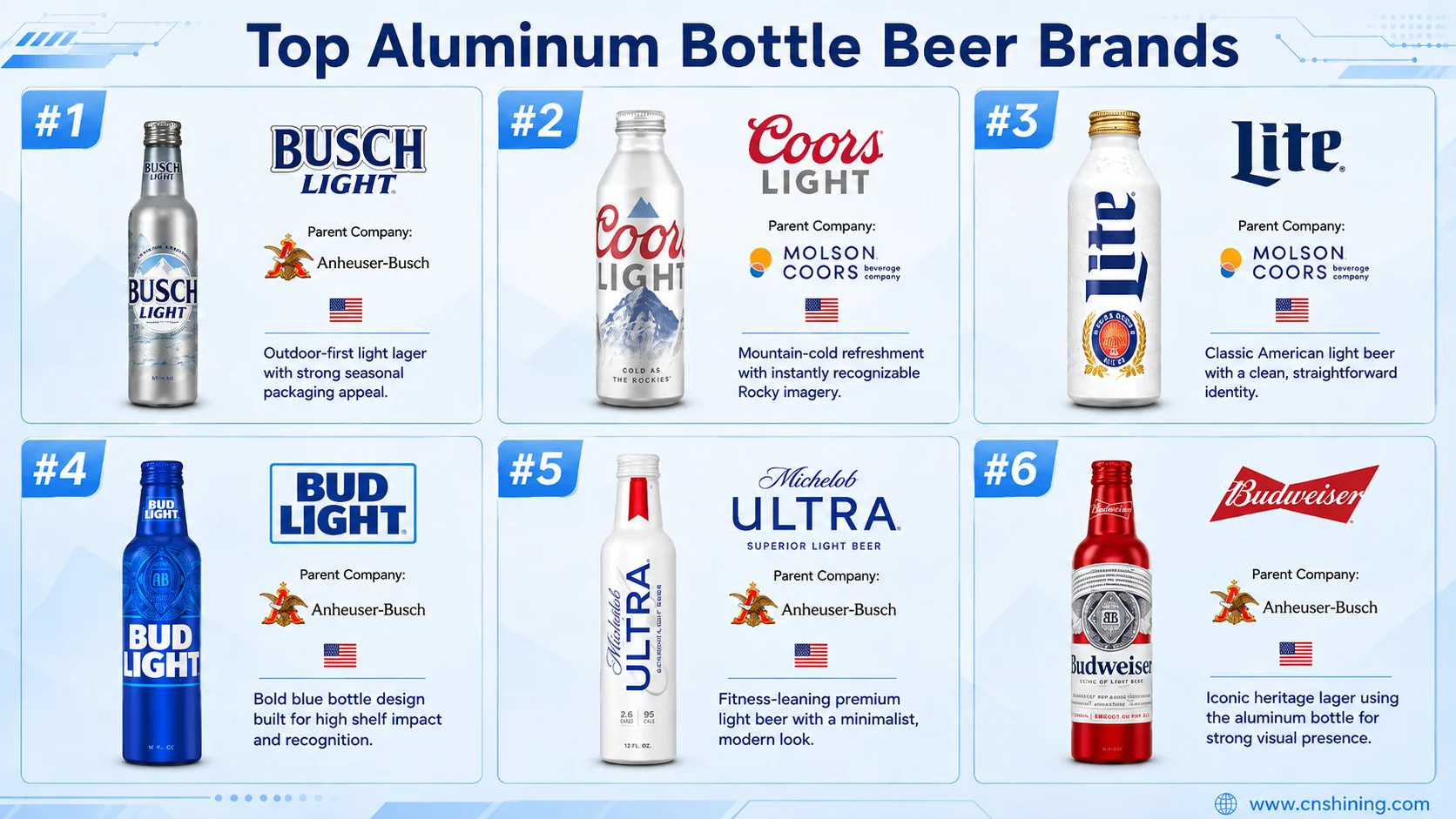
The relevant competitive set is not luxury spirits or specialty water. It is mainstream U.S. lager sold in the same 16 fl oz aluminum-bottle format. Current retailer listings confirm aluminum bottles for Coors Light, Miller Lite, Bud Light, Michelob ULTRA and Budweiser. Molson Coors identifies Coors Light and Miller Lite among its core beer brands, while Anheuser-Busch lists Bud Light, Michelob ULTRA and Budweiser in its U.S. beer portfolio.
| Brand | Country | Parent company | Capacity | Retail price | Core selling point |
|---|---|---|---|---|---|
| Coors Light | United States | Molson Coors Beverage Company | 16 fl oz | Approx. USD 1.33/bottle | Crisp, clean light lager with a strong cold-refreshment and mountain-associated identity. |
| Miller Lite | United States | Molson Coors Beverage Company | 16 fl oz | Approx. USD 1.67/bottle | Taste-led positioning around the “Original Light Beer,” with 4.2% ABV and a low-calorie proposition. |
| Bud Light | United States | Anheuser-Busch | 16 fl oz | Approx. USD 1.25/bottle | Clean, crisp light lager framed around gatherings, beach days, games and backyard occasions. |
| Michelob ULTRA | United States | Anheuser-Busch | 16 fl oz | Approx. USD 1.50/bottle | Active-lifestyle light lager with 95 calories, 2.6 g carbohydrates per serving and strong sports associations. |
| Budweiser | United States | Anheuser-Busch | 16 fl oz | Approx. USD 1.25/bottle | Classic American lager positioned around heritage, celebrations, gatherings and a fuller 5% ABV profile. |
The competitive pattern is revealing. Coors Light already owns a particularly clear “cold mountain” territory; Miller Lite is more taste-and-heritage driven; Michelob ULTRA turns light beer into an active-lifestyle product; Bud Light is built around broad social occasions; and Budweiser uses the same bottle format without being a light lager at all. Busch Light’s strongest position is narrower and more culturally specific: fishing, hunting, farming and practical outdoor sociability. Its current Walmart 15-pack listing works out to roughly USD 0.92 per 16 oz aluminum bottle, below the five sampled unit prices above. That single retail snapshot should not be treated as a national MSRP, but it does reinforce an important point: the Busch Light aluminum bottle does not have to signal an upscale price tier in order to be differentiated. It can remain recognizably value-oriented while using bottle shape, seasonal art and reclosure to create a more occasion-specific package.
5. The Useful Question Is Where the Bottle Earns Its Extra Complexity
For Busch Light, the strongest packaging architecture remains a division of labor rather than a material takeover. Cans can continue doing the work that mass-market light lager demands from a high-volume package. The 16 oz bottle earns its place where the bottle form itself changes the experience: a closure that can be secured again, a taller object with more handheld presence, a surface suited to collectible seasonal execution and an outdoor occasion where glass would be less convenient. This is an engineering and portfolio decision, not an argument that one package is universally better than another. The brand’s current mix of aluminum cans, aluminum bottles and other established formats supports that interpretation.
For development teams, the practical sequence is equally clear: qualify beer-to-coating compatibility first; lock the neck, closure and liner interface against pressure and opening requirements; verify oxygen pickup and seal integrity on the intended filling process; then validate artwork durability and TTB information placement on filled, handled bottles rather than on empty presentation samples. Public retail information cannot substitute for those package-development parameters, which is why the engineering specification should be built from product and line data before scale-up.
Conclusion. The Busch Light aluminum bottle is most convincing when it stays unmistakably Busch Light: mainstream rather than precious, outdoor rather than ceremonial, and visually useful rather than decorative for its own sake. Its real value is not that aluminum automatically makes the beer more premium. It is that a carefully engineered 16 oz bottle can turn the brand’s existing outdoor culture into a package with a different handling behavior, silhouette and campaign role—without asking the bottle to replace the efficient formats that already support the brand’s scale.