
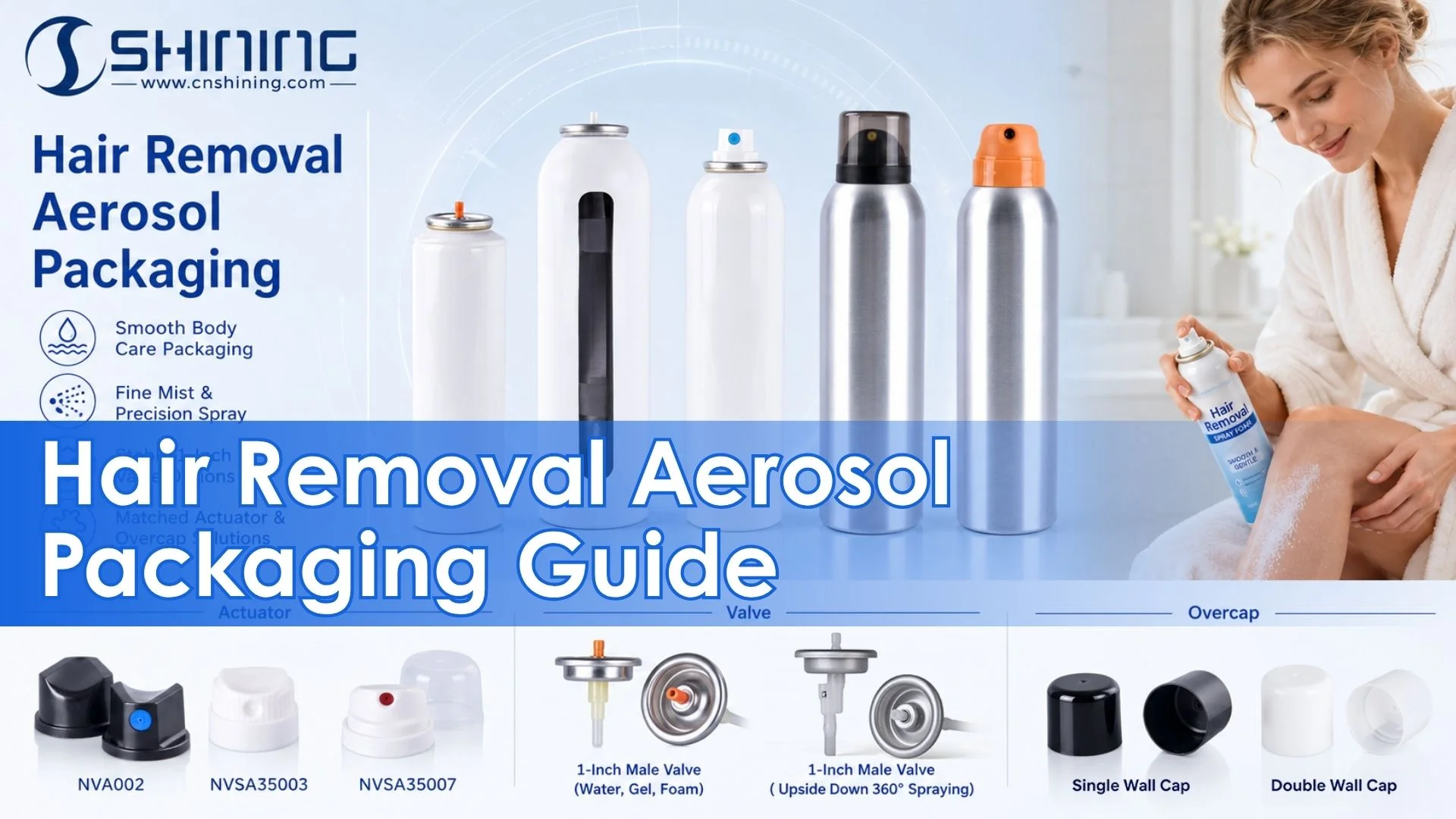
Hair removal aerosol spray is not a new depilatory chemistry. It is a different delivery system for a familiar alkaline thioglycolate hair removal formula.
1. Executive View
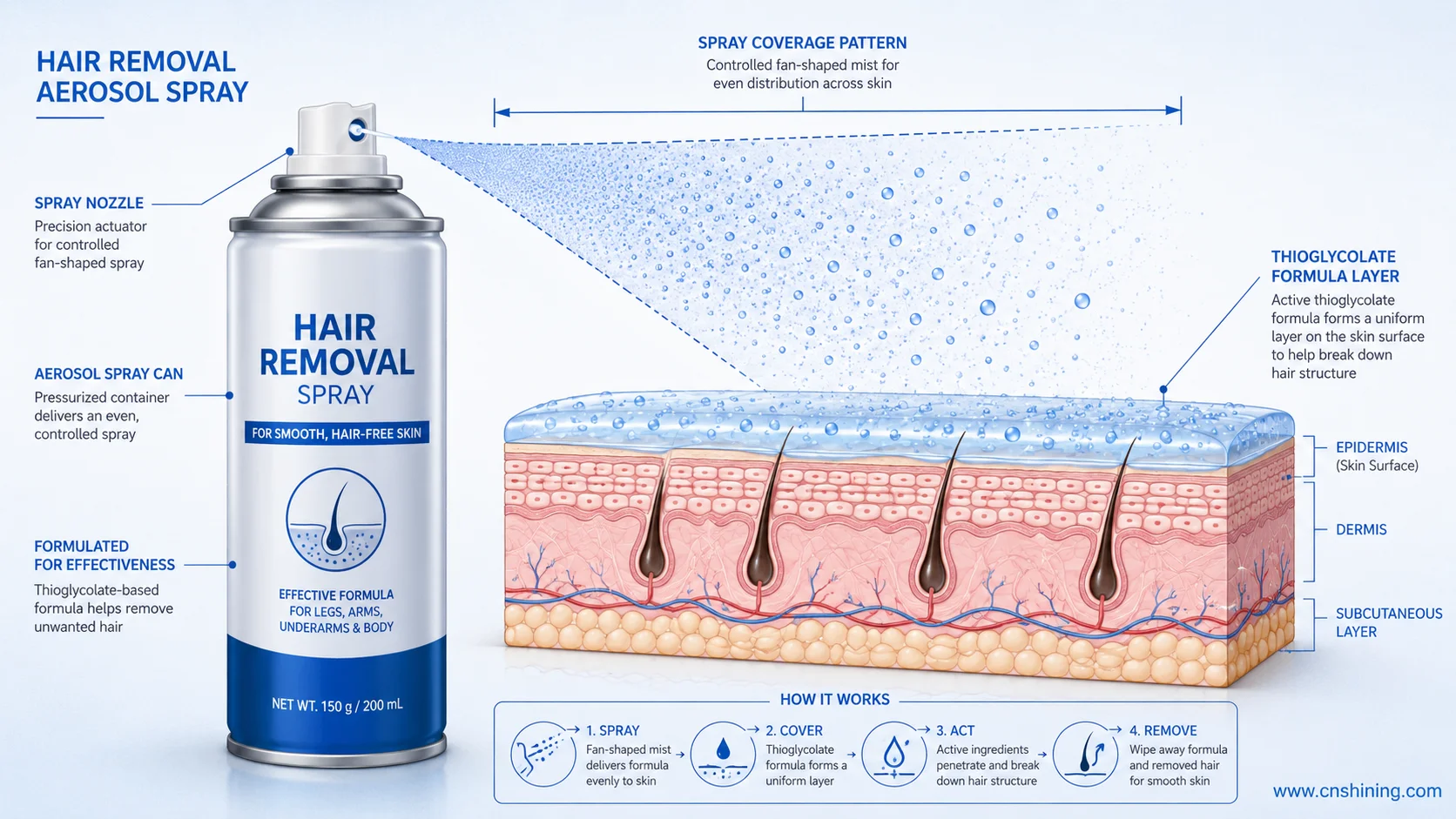
A hair removal aerosol spray, also called a spray-on hair removal cream or body depilatory spray, removes hair through the same core pathway used by conventional depilatory creams. Thioglycolate salts work in an alkaline system, reduce disulfide bonds in hair keratin, soften the shaft, and allow the weakened hair to be wiped or rinsed away.
The aerosol format changes the application mechanics. It improves coverage speed, helps users reach the back of the legs or shoulders, supports upside-down spraying when the valve is designed for it, and reduces direct hand contact with the formula. It does not change the biological limit of chemical depilation.
Typical public product instructions and patent examples place the contact time around 4–10 minutes. Common body areas include legs, arms, underarms and bikini line. Most body spray depilatories are not positioned for facial use, and a 24-hour patch test is usually required.
2. Definition, Mechanism and Use Boundaries
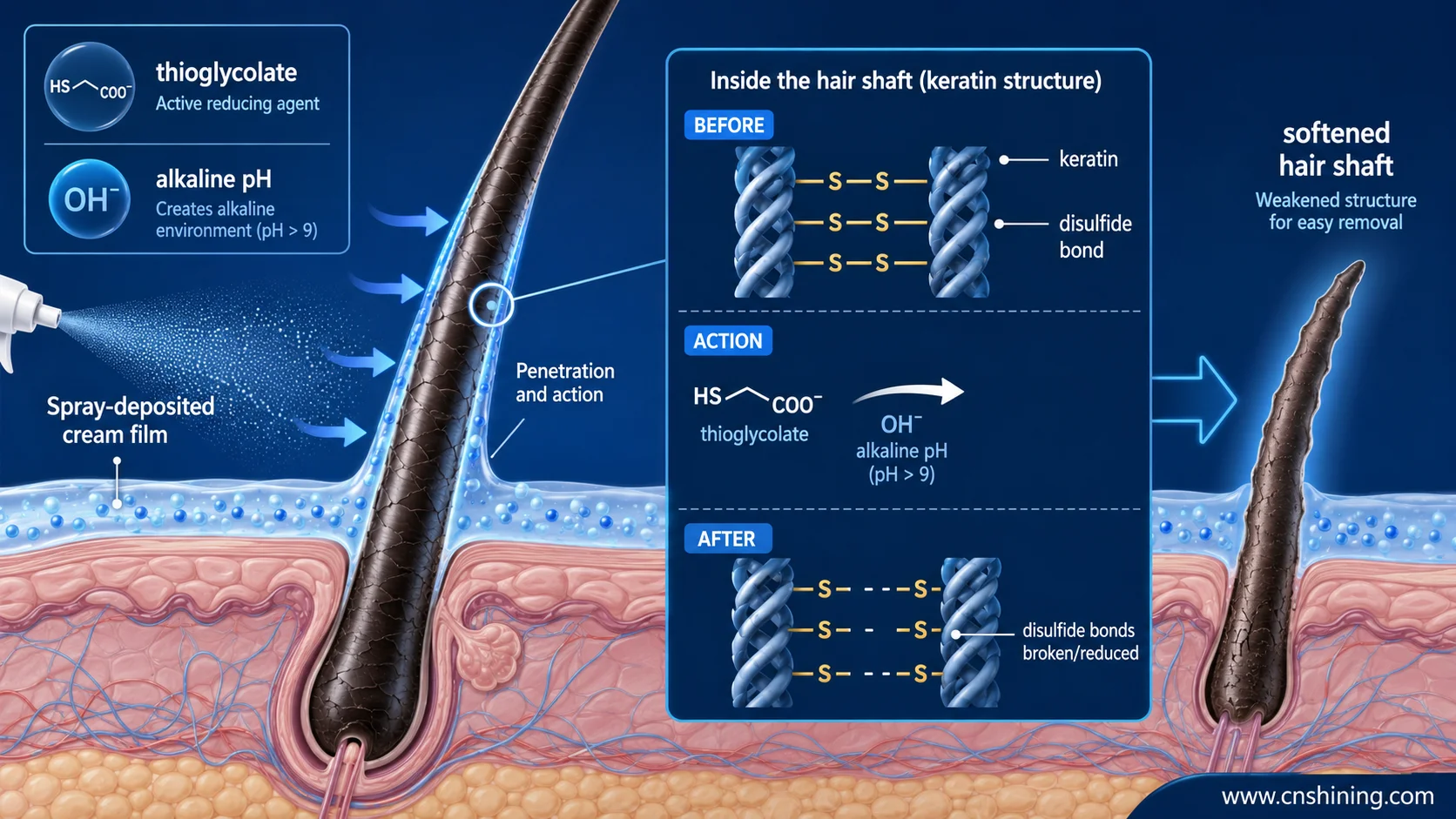
A hair removal aerosol spray can be defined as a self-pressurized personal care product that dispenses a chemical depilatory lotion, cream or foam through an actuator and valve. The formula forms a film on the skin and stays there for a controlled dwell time before hair is removed by wiping, scraping or shower rinsing.
Chemically, it is close to a traditional depilatory cream. Physically, it is different. The sprayable system needs a workable viscosity window, compatible propellant, suitable valve geometry, stable spray pattern, and preferably all-angle spray performance. A sprayable depilatory patent describes lower viscosity than conventional cream and refers to preferred initial viscosity around 1.5–4.5 Pa·s for spray delivery. See the public patent record for sprayable depilatory composition design.
2.1 Chemical mechanism
The main depilatory actives are usually potassium thioglycolate, calcium thioglycolate or thioglycolic acid derivatives. Under alkaline conditions, these sulfur-containing actives attack disulfide bonds in keratin. Alkali such as calcium hydroxide, potassium hydroxide, sodium hydroxide or sodium silicate raises pH and swells the hair shaft. Older depilatory patent literature describes thiol-based depilatories reducing hair protein disulfide bonds, with high alkalinity improving reactant ionization and penetration; see early depilatory composition patent data.
2.2 Skin boundary
The formula does not know the difference between hair keratin and skin barrier proteins in a friendly way. A human stratum corneum study published in the Journal of Investigative Dermatology reported that depilatory cream treatment for 10 minutes altered corneocyte integrity, lipid organization and keratin matrix structure. This is why over-time use, sensitive zones and repeated applications raise burn complaints. The study can be reviewed at ScienceDirect’s depilatory-agent skin barrier paper.
2.3 Use boundary
A practical use flow is simple but strict: patch test one day before use; apply on dry skin; spray from about 4 inches / 5 cm; wait; test a small area first; remove the full area only after hair releases; rinse thoroughly; clean the actuator; moisturize after use. Avoid broken skin, sunburned skin, inflamed skin, eye area, mucosa and genital-adjacent misuse.
3. Market Size and Regional Growth
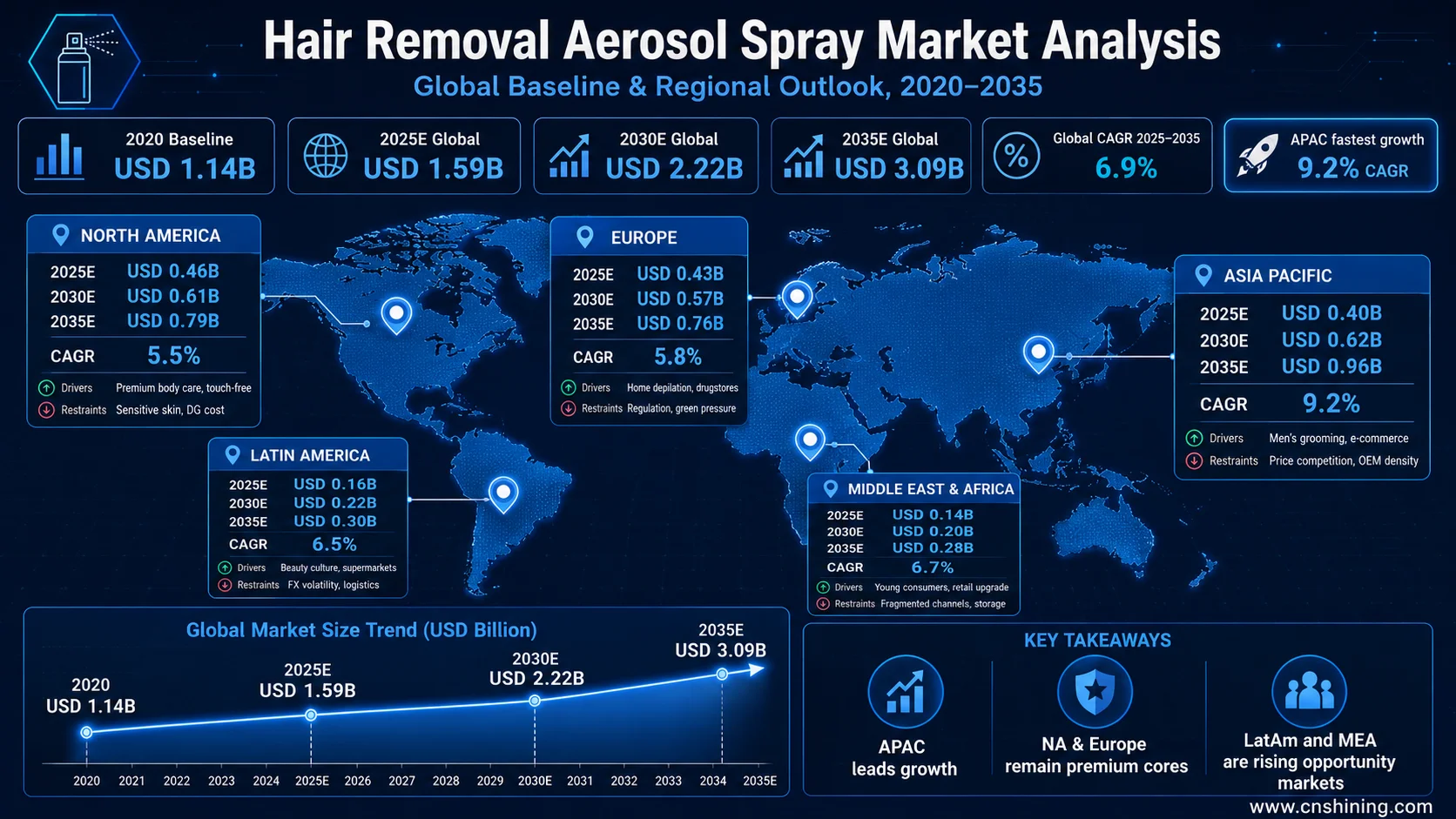
Publicly visible estimates include about USD 1.5 billion in 2023 and USD 2.6 billion by 2032 in one commercial report, with a 6.5% CAGR; see the DataIntelo hair removal spray market report.
Regional baseline
| Region | 2025E | 2030E | 2035E | 2025–2035 CAGR | Core drivers | Main restraints |
|---|---|---|---|---|---|---|
| North America | USD 0.46B | USD 0.61B | USD 0.79B | 5.5% | High unit value, mature body care, touch-free convenience, concentrated brands | Sensitive-skin complaints, dangerous goods cost, mature demand |
| Europe | USD 0.43B | USD 0.57B | USD 0.76B | 5.8% | Home depilation acceptance, drugstore penetration, sustainable packaging pressure | Detailed regulation, claims control, environmental expectations |
| Asia Pacific | USD 0.40B | USD 0.62B | USD 0.96B | 9.2% | Men’s grooming, fast e-commerce, India and Southeast Asia price segmentation | Price competition, OEM/private label density, quality variation |
| Latin America | USD 0.16B | USD 0.22B | USD 0.30B | 6.5% | Beauty culture, cross-border e-commerce, supermarket replenishment | Currency volatility, import cost, unstable dangerous goods logistics |
| Middle East & Africa | USD 0.14B | USD 0.20B | USD 0.28B | 6.7% | Younger consumers, beauty spending upgrade, cross-border retail | Fragmented channels, uneven regulation, harsh hot-zone storage |
The direction is more reliable than the exact number: North America and Europe remain strong value markets; Asia Pacific is the fastest growth pocket. The practical packaging implication is clear. APAC products will face more price pressure and OEM variation, while Europe will push harder on compliance, VOC profile, recyclability and claims discipline.
4. Advantages, Limitations and Alternatives
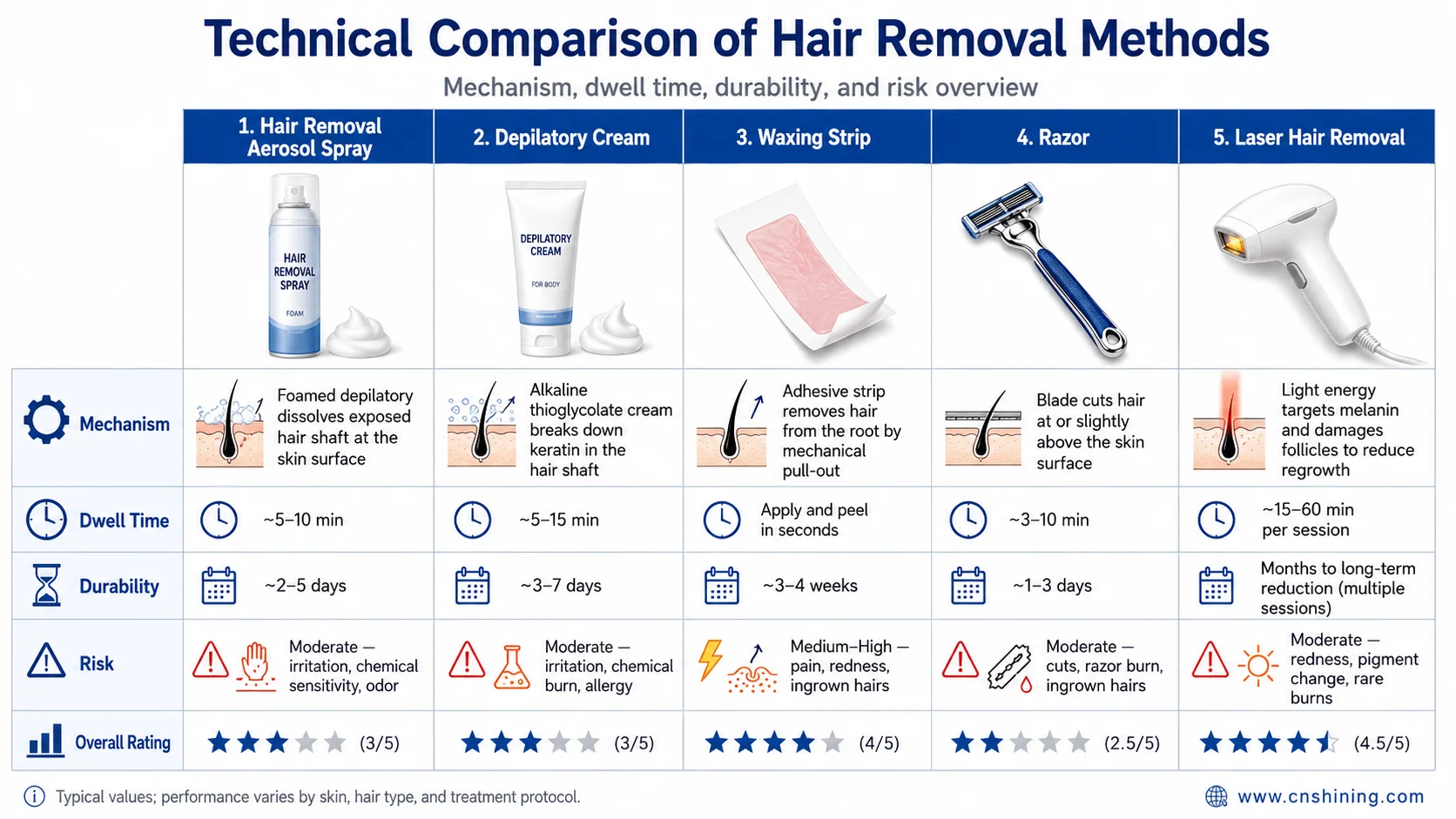
The main advantage of hair removal aerosol spray is a short application path. The user does not need to spread a cream by hand over a large area. That matters for the back of the legs, shoulders, back, chest and areas where hand reach is poor. For users with limited mobility, a low-force actuator and all-angle valve can make the format more usable.
The second advantage is smoother feel for a few days longer than shaving. Chemical depilation softens hair at the skin surface and slightly below the visible cut point. It does not remove hair from the root.
The limitations are just as clear. The product remains alkaline and sulfur-based. It can irritate skin, smell unpleasant, create overspray, make shower floors slippery and complicate air transport. Compared with non-aerosol depilatory cream, aerosol spray also adds valve, propellant, pressure vessel, can coating and dangerous goods classification work.
| Method | Main mechanism | Action time / treatment | Smoothness duration | Pain level | Typical risks | Best use case |
|---|---|---|---|---|---|---|
| Hair removal aerosol spray | Thioglycolate + alkali softens and breaks hair; spray spreads film | 4–10 minutes | Usually a few days longer than shaving | Low to medium | Chemical irritation, odor, overspray, slip, dangerous goods transport | Large areas, hard-to-reach areas, hands-free application |
| Depilatory cream | Same chemical pathway, hand or spatula application | 5–10 minutes | Similar to spray | Low to medium | Irritation, odor, messy application | Cost-sensitive use, precise spot application |
| Wax | Pulls hair from root | Single operation | About 3–4 weeks | Medium to high | Pain, erythema, folliculitis, burns from hot wax | Longer smoothness period |
| Wax strip | Pre-coated strip pulls hair from root | Single operation | About 3–4 weeks | Medium to high | Poor fit, wax residue, irritation | Small or medium areas, travel use |
| Razor | Cuts visible hair shaft at skin surface | Immediate | 1–3 days | Low | Cuts, razor burn, ingrown hair | Fastest and lowest-cost maintenance |
| Laser | Melanin absorbs light and heats follicle structures | Commonly 6–8 sessions | Long-term reduction, months to years | Medium | Burns, pigmentation changes, high cost | Long-term hair reduction |
The useful conclusion from this comparison is practical: spray and cream are the same chemistry with different delivery. Razors, wax and laser use different biological routes. Hair removal aerosol spray competes first with depilatory cream and shaving, not with laser treatment.
5. Top 10 Hair Removal Aerosol Brands
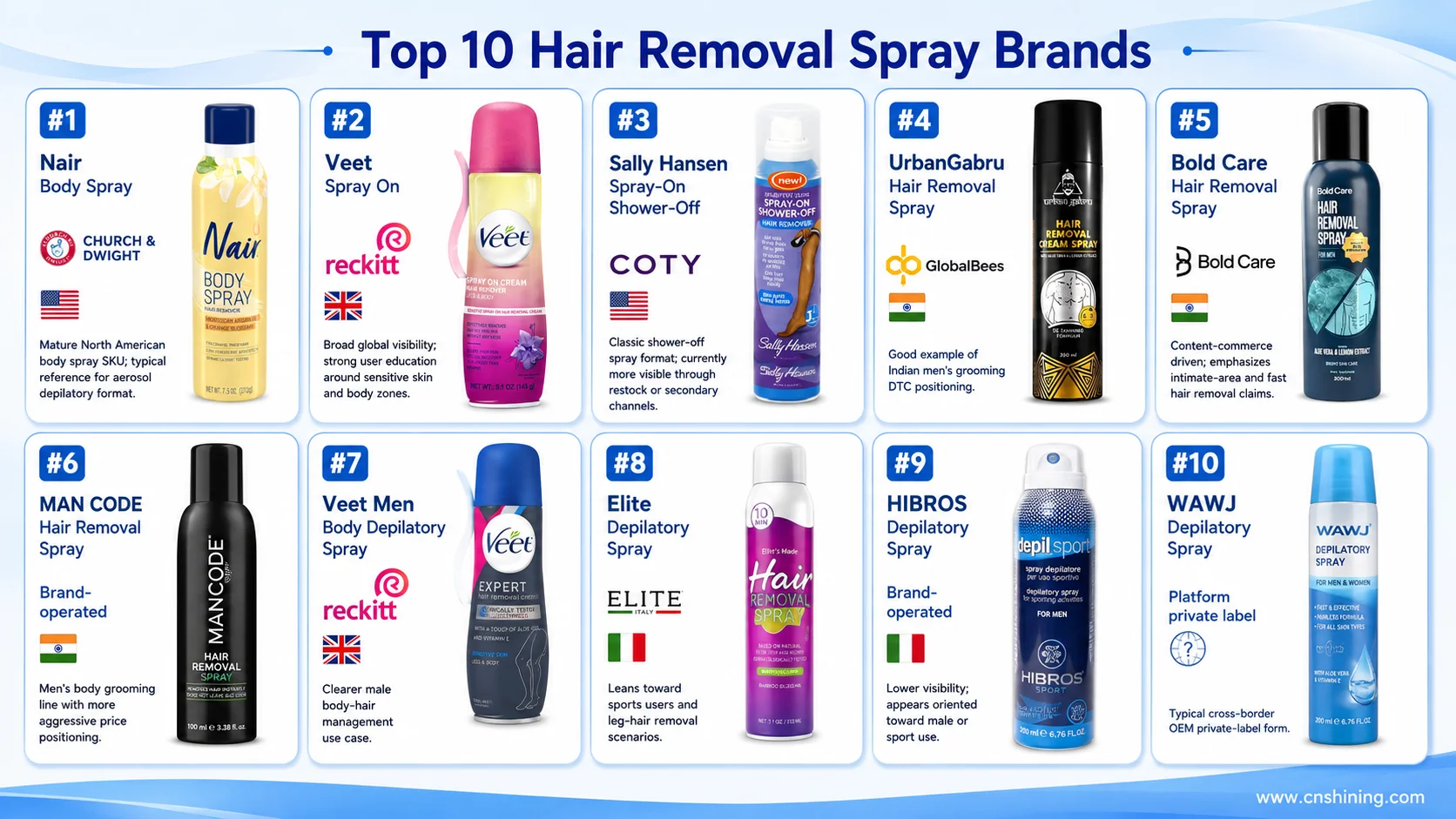
| Brand / brand line | Country | Parent company | Common size | Public price range | Technical / market note |
|---|---|---|---|---|---|
| Nair Body Spray | United States | Church & Dwight | 7.5 oz / 221.8 mL | about $13–15 per can | Mature North American aerosol depilatory SKU; strong reference for hands-free body spray positioning. |
| Veet Spray On | United Kingdom | Reckitt | 150 mL | about $12 per can | Broad global visibility; strong user education around sensitive skin and body zones. |
| Sally Hansen Spray-On Shower-Off | United States | Coty | 6 oz / 177 mL | about $6–40 per unit | Classic shower-off spray format; current public pricing varies from grocery listings to secondary channels. |
| UrbanGabru Hair Removal Spray | India | GlobalBees / UrbanGabru | 200 mL | about $4–6 per can | Good example of Indian men’s grooming DTC positioning. |
| Bold Care Hair Removal Spray | India | Bold Care | 200 g | about $4–5 per can | Content-commerce driven; emphasizes intimate-area and fast hair removal claims. |
| MAN CODE Hair Removal Spray | India | Saanvi Cosmetics Pvt. Ltd. | 200 mL | about $3–6 per can | Men’s body grooming line with aggressive price positioning and marketplace visibility. |
| Veet Men Body Depilatory Spray | United Kingdom | Reckitt | 150 mL | about $10–11 per unit | Clearer male body-hair management use case; public spray samples are more limited than cream samples. |
| Elite Depilatory Spray | Italy | Elite Srl | 200 mL | about $14–15 per unit | Leans toward sports users and leg-hair removal scenarios. |
| HIBROS Depilatory Spray | Italy | Laboratorio Chimico Hibros S.R.L. | 200 mL | about $11–17 per unit | Italian sports depilatory spray focused on athlete use and water-soluble removal. |
| WAWJ Depilatory Spray | Southeast Asia | WAWJ | 150–200 mL | about $8.99–12.99 per can | Typical cross-border OEM private-label form; public brand ownership and pricing signals are weak. |
The brand map shows two commercial directions: established Western depilatory brands still anchor consumer trust, while Indian men’s grooming and platform-native products are using spray format to make body hair removal feel faster, cleaner and more male-oriented.
6. Formulation System and Technical Terms
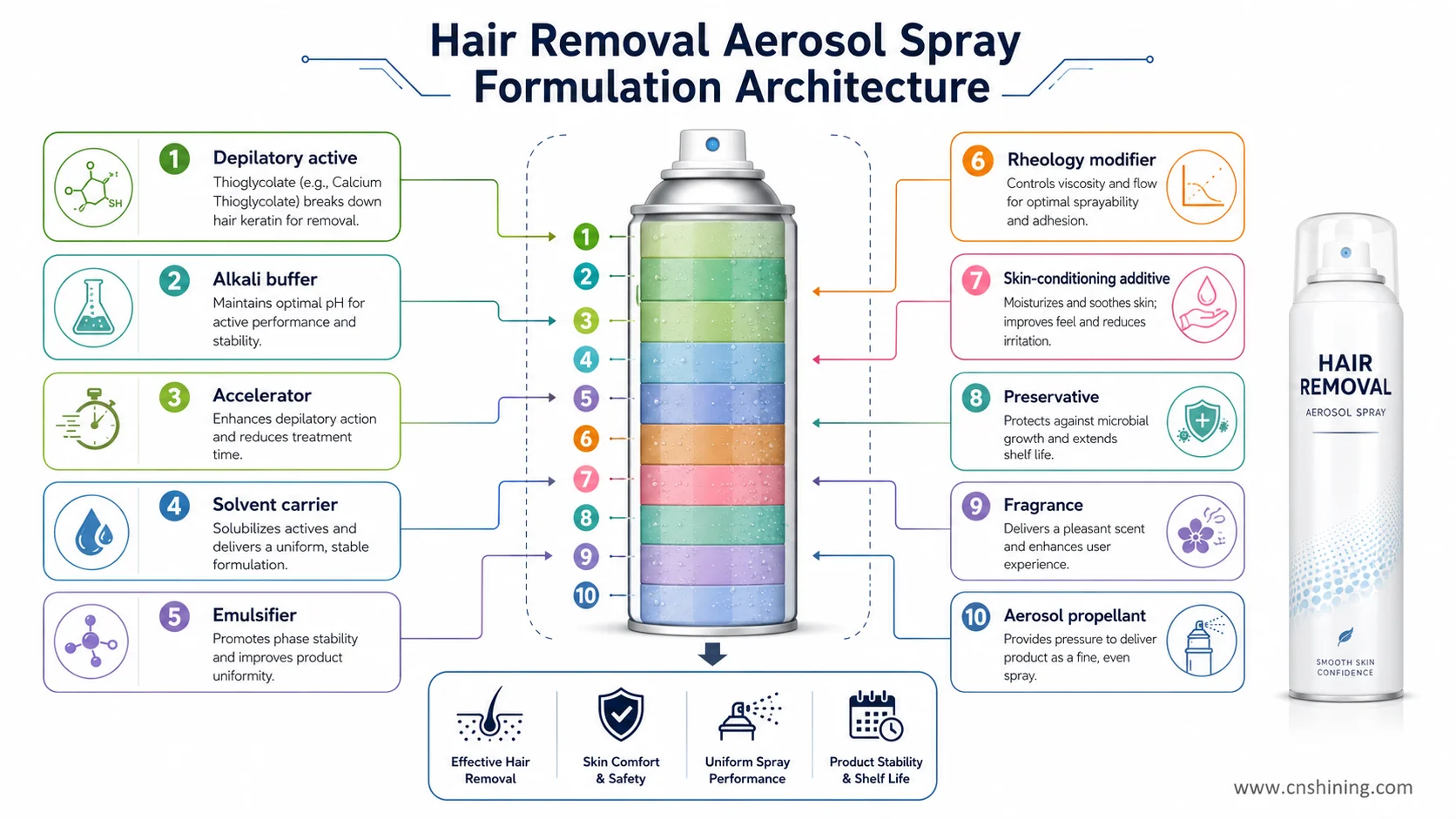
The concentration ranges below are development and patent-derived ranges, not universal regulatory limits. Thioglycolic acid and its salts must be recalculated by the target market’s own rule set before launch.
| Category | Typical ingredients | Function | Typical development range | Technical note |
|---|---|---|---|---|
| Depilatory active | Potassium thioglycolate, calcium thioglycolate, thioglycolic acid | Breaks keratin disulfide bonds and softens hair | Patent examples around 2–13 wt%; EU safety opinion often treats 5% TGA-equivalent as a key depilatory threshold | Controls efficacy and much of the sulfur odor burden. |
| Alkali / buffer | Calcium hydroxide, potassium hydroxide, sodium hydroxide, sodium silicate | Raises pH and swells hair shaft | KOH often 0.5–2.5 wt%; Ca(OH)2 often 1–4 wt% | Excessive alkalinity raises irritation and packaging stress. |
| Accelerator | Urea, thiourea, ethoxydiglycol, methyl propyl diol, aminomethylpropanol | Improves keratin degradation speed or skin tolerance | Urea often 5–15 wt%; AMP around 0.75–4.5 wt% in patent examples | Important in lower-pH depilatory design. |
| Solvent / carrier | Water, mineral oil, PPG-15 stearyl ether | Solubilizes and carries active film | Water commonly 30–70 wt% | Spray types are usually lighter and lower-viscosity than creams. |
| Emulsifier / surfactant | Ceteareth-20, Steareth-21, Ceteth-20 | Builds sprayable emulsion and spreading behavior | 0.1–5 wt% | Too much surfactant may affect spray and skin feel. |
| Rheology modifier | Acrylates copolymer, carbomer, hectorite, clay, silica, magnesium trisilicate | Controls flow, film hold and anti-drip behavior | Sprayable types often 0.1–1 wt% | Too high viscosity damages spray stability. |
| Skin-feel additive | Glycerin, aloe vera, shea butter, argan oil, vitamin E, bisabolol | Reduces harsh feel and improves after-feel | Usually 0.1–5 wt% | Does not remove the need for dwell-time control. |
| Preservative / chelator | Sodium benzoate, potassium sorbate, tetrasodium EDTA, sodium gluconate | Controls microbes and metal ions | 0.05–1 wt% | Strong alkaline systems require preservative re-check. |
| Fragrance / colorant | Fragrance, titanium dioxide, CI colorants | Masks sulfur odor and gives visible coverage cue | Often 0–1 wt% | Odor masking is a user-experience issue, not a mechanism change. |
| Propellant | Butane, propane, isobutane, DME | Dispenses formula and affects spray, cooling and flammability | Older patents mention 0–20 wt% | Directly affects UN1950 classification and storage rules. |
6.1 Three useful formulation archetypes
Patent sprayable formula: one public example uses water, calcium hydroxide, magnesium silicate, fragrance, sodium gluconate, silica, cetearyl alcohol, Ceteareth-20, mineral oil, almond oil, PPG-15 stearyl ether, urea, acrylates copolymer, potassium thioglycolate and potassium hydroxide. The patent notes about 0.25 mL per pump stroke.
Lower-pH tolerance formula: a later patent family uses depilatory active, potassium hydroxide and aminoalkylpropanol, with pH at 20°C in the range of 10–12.5. It also describes potassium thioglycolate or thioglycolic acid around 2–6 wt%, KOH around 0.5–5 wt%, and aminomethylpropanol around 0.75–4.5 wt%. See the public EP3402459B1 depilatory composition patent.
Commercial aerosol cream style: public ingredient disclosure for one body spray depilatory lists water, butane, potassium thioglycolate, urea, sodium hydroxide, propane, fragrance, isobutane, emulsion stabilizers, botanical oils, preservatives and antioxidants. This shows the modern product is not just “cream in a can”; it is a system of active chemistry, propellant, rheology, odor control and skin feel. See the public ingredient disclosure for a depilatory aerosol.
6.2 Technical terms that matter
| Term | Plain explanation | Commercial meaning |
|---|---|---|
| Thioglycolate | Main chemical depilatory active that weakens hair keratin | Controls hair removal speed, odor and irritation baseline |
| Contact time / dwell time | How long the formula stays on skin | Too short leaves hair; too long increases burn risk |
| pH window | Working alkalinity range of the formula | Higher pH can improve speed but raises irritation and packaging pressure |
| Spray pattern | Fan, cone or stream behavior from the actuator insert | Controls coverage, dripping, overspray and local overdose |
| All-angle / 360 valve | Valve that sprays upright or upside down | Key for back, leg and shower use |
| Evacuation rate | Percentage of product that can be dispensed from the can | Controls end-of-life complaints and residual waste |
| Bag-on-Valve / BOV | System separating product from propellant | Can improve all-angle spray and evacuation, but needs more compatibility testing |
| Internal coating | Protective coating inside the can | Important for alkaline and sulfur-containing products |
| PCR aluminum | Post-consumer recycled aluminum | Supports packaging carbon reduction claims where technically feasible |
| VOC | Volatile organic compound | Affects regulation, propellant choice and environmental communication |
7. Regulations, Safety and Transport
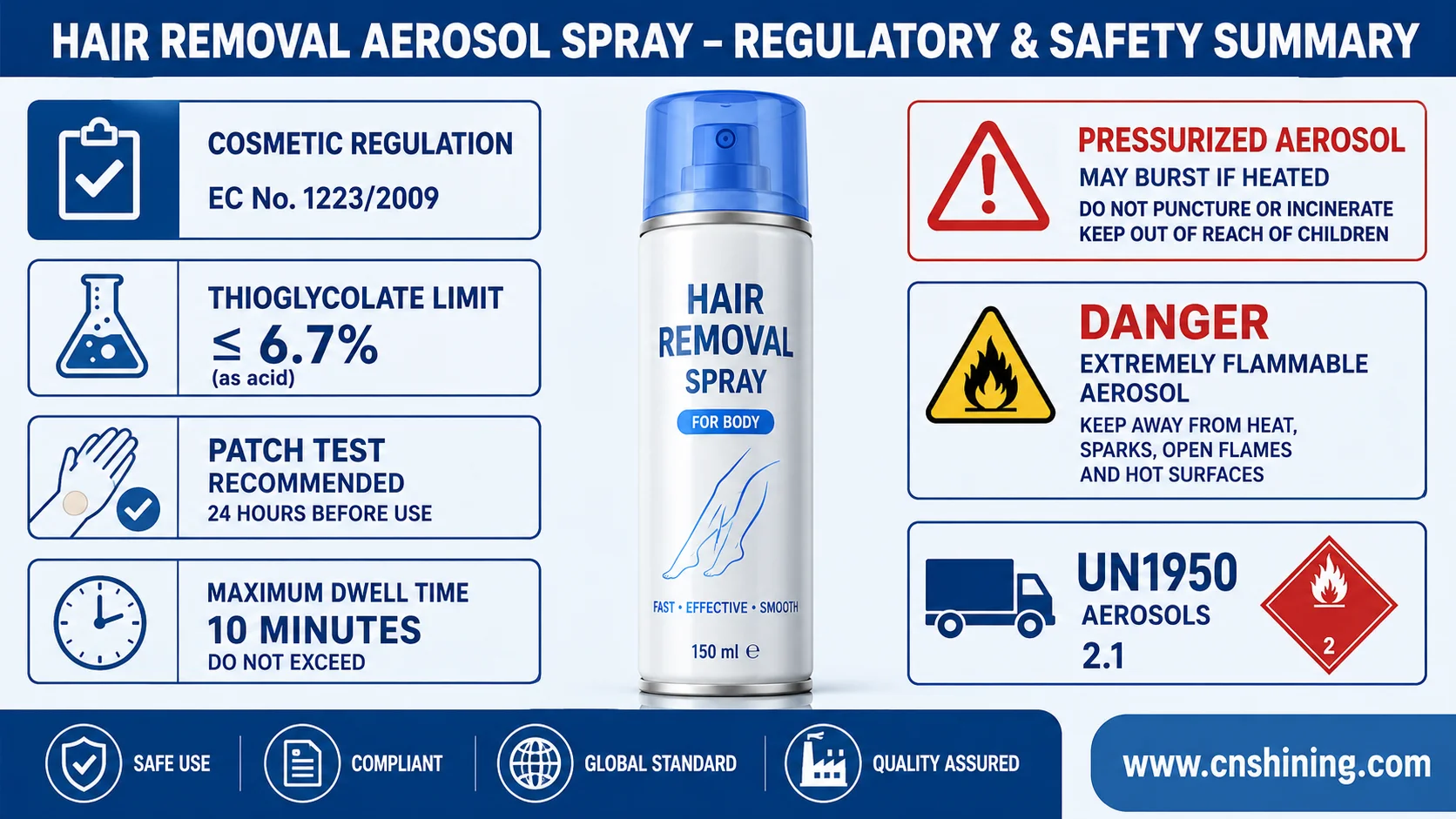
In the United States, depilatory aerosol spray is generally handled as a cosmetic when marketed for appearance-related hair removal. FDA states that cosmetic products and ingredients, except color additives, do not require premarket approval, but cosmetics are still regulated under applicable laws and labeling rules. See the FDA cosmetic authority explanation.
In the European Union, the core framework is Regulation (EC) No 1223/2009. It requires responsible person control, product information file, safety assessment and compliant labeling. The full text is available in the EU Cosmetic Products Regulation PDF.
Thioglycolic acid and its salts require close control. The European Commission’s public page on TGA links to the SCCS safety opinion, which is commonly used as a reference point for depilatory limits and intended-use conditions. See the European Commission page on thioglycolic acid and its salts.
7.1 Label risk points
The weak points in compliance are usually not the INCI list alone. The common failure is under-communicating risk. High-risk label items include: allowed and prohibited body areas, patch test instruction, maximum dwell time, eye and mucosa warning, child safety, pressurized container warning, heat and flame warning, and clear mention that the product contains alkali and thioglycolate.
7.2 Transport and dangerous goods
A hair removal aerosol spray is not shipped like a simple lotion. It may fall under pressurized aerosol dangerous goods logic. In the United States, compressed gas limited quantity rules are addressed in 49 CFR 173.306 for limited quantities of compressed gases. Internationally, aerosols commonly fall under UN1950 AEROSOLS and may be Class 2.1 flammable aerosols or Class 2.2 non-flammable non-toxic aerosols, depending on propellant and content.
This has commercial effects. Cross-border air shipping becomes harder. Hot-zone warehousing needs more control. Propellant change is not only a sensory decision; it changes classification, label wording and logistics cost. Pump spray alternatives may reduce dangerous goods complexity because EPA defines pump sprays as non-pressurized systems in its VOC rules; see 40 CFR Part 59 Subpart C.
8. Technology Trends and Commercial Movement
The technical direction is not mysterious. It is moving along five tracks.
Recent patents use aminomethylpropanol or related aminoalkylpropanols with KOH and thioglycolate chemistry to reduce pH while maintaining hair removal performance.
The challenge is shifting from “make a cream that works” to “make a sprayable film that covers evenly and does not overdose one spot.”
DME remains relevant in personal care aerosols. Technical literature describes it as water-miscible, high-solvency and lower GWP than some alternatives; see the Nouryon dimethyl ether technical bulletin.
PCR aluminum helps sustainability targets, but depilatory spray also needs internal coating resistance against alkaline sulfur chemistry.
Sustainable packaging is not just a recycled-metal claim. For hair removal aerosol spray, the inside of the can matters as much as the outside. Internal coating literature for aluminum packaging lists depilatories among applications requiring protection against aggressive contents; see this interior coating brochure for aluminum packaging.
A separate commercial shift is the men’s grooming repositioning in India and other APAC markets. Spray format fits short video demonstrations: spray, wait, wipe, show result. That makes it easier to explain than a conventional cream. The risk is that demonstration-driven marketing can underplay dwell time, sensitive-zone limits and patch testing.
The non-aerosol fork is also worth watching. High-adhesion pump spray, foam pump or stick formats are not a step backward. They may reduce flammable aerosol classification and transport friction while keeping part of the touch-free positioning.
9. User Pain Points and Packaging Design Priorities
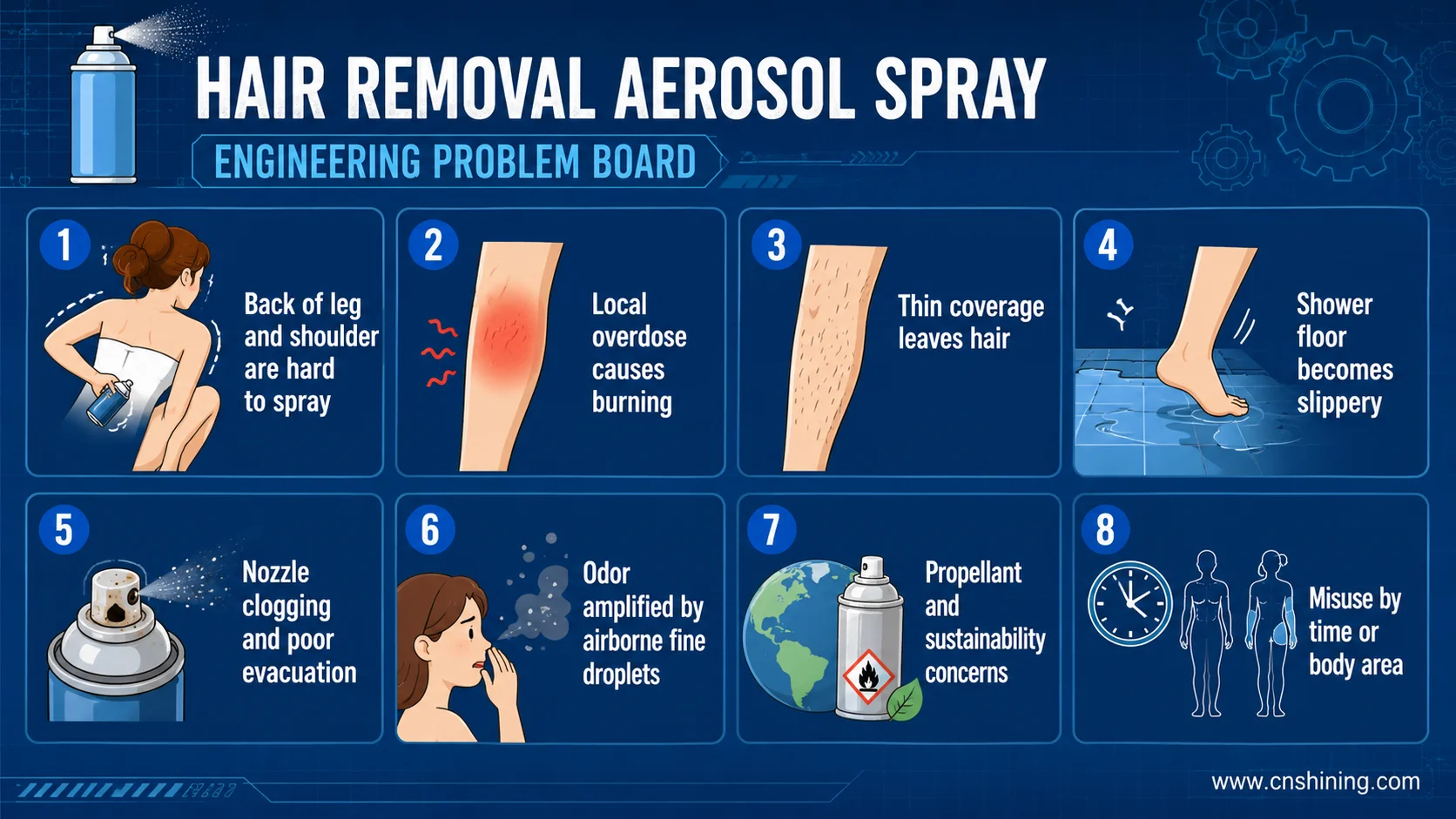
Public user complaints cluster around five issues: odor, burning or stinging, sprayer malfunction, slippery shower surface and unstable performance on coarse hair. The common theme is not “the chemistry never works.” The real problem is that efficacy and comfort sit close together. Users are tempted to wait longer when hair does not release, and that is where burns appear.
| Priority | Packaging problem | Design recommendation | Why it matters |
|---|---|---|---|
| P1 | Alkaline sulfur formula attacks valve, gasket, spring or can wall | Use coated aluminum or suitable metal packaging; test valve elastomers, spring and dip-tube materials under alkaline soak and stress conditions | Compatibility failure causes leakage, corrosion, blocked spray or pressure loss. |
| P1 | Back of leg and shoulder are hard to spray | Use a 360° up/down valve and a low-force actuator with larger finger pad | It supports the core “hard-to-reach” use case and helps users with weaker grip. |
| P1 | Local overdose causes burning; thin coverage leaves hair | Use a controlled fan spray insert, define 5 cm / 4 inch spray distance, and consider a physical distance cue on the overcap | Uniform loading reduces both under-performance and chemical hot spots. |
| P1 | Shower floor becomes slippery | Use anti-slip can shape, matte wet-grip zone, hanging feature and high-visibility slip warning | Slip risk is a package-use-environment problem, not only a formula issue. |
| P2 | Nozzle clogging and poor evacuation | Optimize insert diameter, rheology, dip tube and after-use purge instruction | Reduces “sprayer does not work” and “product left in can” complaints. |
| P2 | Odor amplified by airborne fine droplets | Reduce fine mist fraction, improve spray directionality, and evaluate lower-drift pattern | Packaging cannot eliminate sulfur odor, but it can reduce airborne spread. |
| P3 | Propellant and sustainability concerns | Evaluate DME, low-GWP options, PCR aluminum or selected non-aerosol formats where appropriate | Relevant for Europe, large retailers and brands with carbon-reduction targets. |
| P3 | Misuse by time or body area | Print large dwell-time numbers, prohibited-zone icons and patch-test steps on the can | Better information design is often cheaper than reformulating after complaints. |
The valve is not a commodity detail here. A 360° valve sprays reliably whether the can is upright or upside down and keeps spray quality stable. See the 360° up/down aerosol valve.
10. Packaging Components for Hair Removal Aerosol Spray: Actuators, Cans and Valves
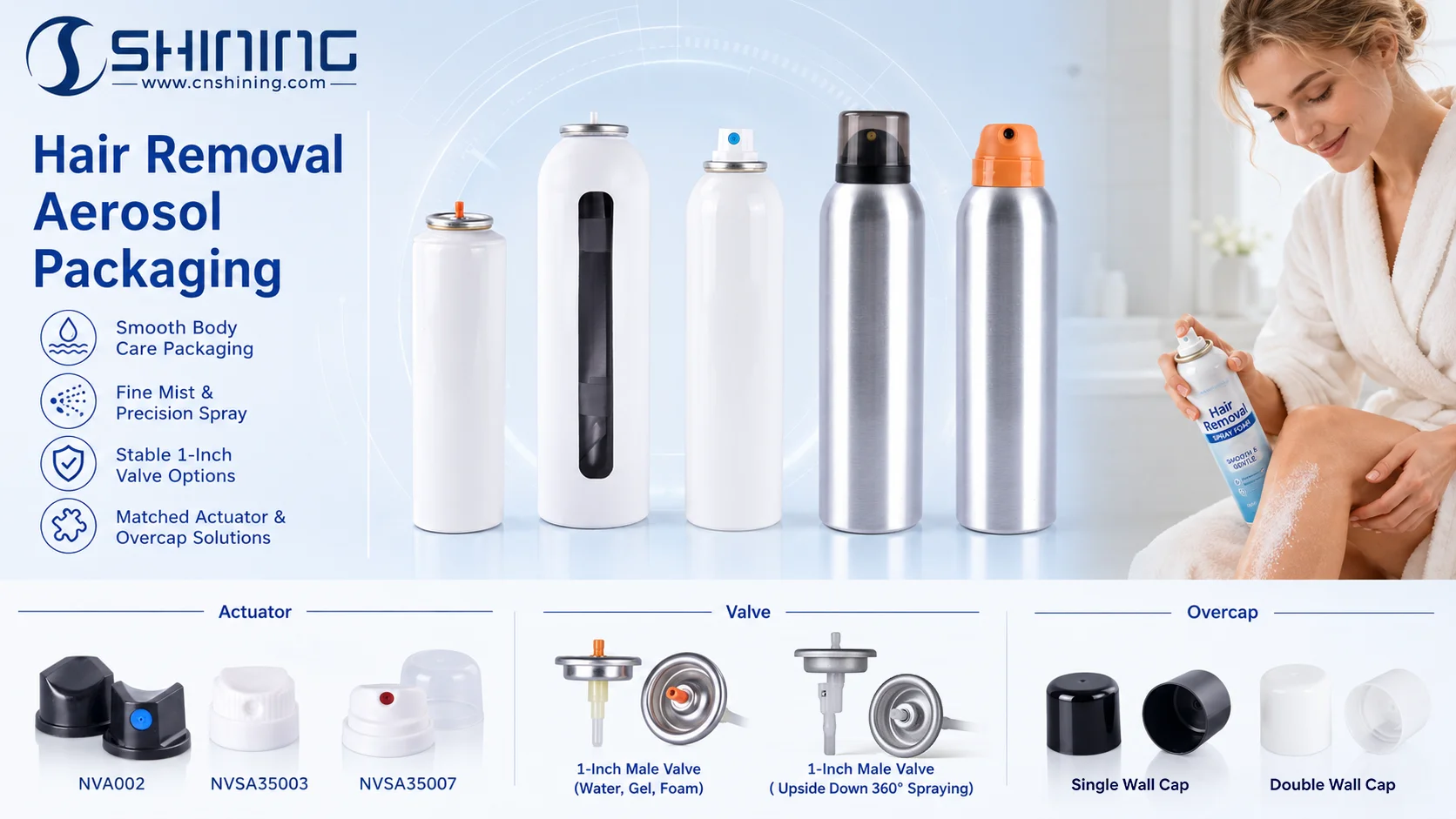
For this product type, packaging is part of the performance system. Shining Packaging’s relevant component scope is actuators, aerosol cans and valves. The engineering target is not decoration first. It is controlled spray width, stable evacuation, wet-hand usability and compatibility with alkaline sulfur-containing formulas.
A suitable actuator should avoid a narrow jet that deposits too much formula on one point. A fan-shaped insert is often more useful for body spray depilatory because it distributes the film across a larger area. Low operation force also matters. If the product promises hard-to-reach application but the button is stiff, the package has already failed the user.
The aerosol can needs internal coating validation. Thioglycolate, hydroxide and sulfur odor-masking systems can stress metal surfaces and coating layers. For a depilatory aerosol can, compatibility testing should include formula storage, temperature cycling, pressure retention, valve function, corrosion inspection and end-of-life evacuation.
The valve should match the use case. A 360° valve is more relevant than a standard upright-only valve when the product is used on the back, shoulders or leg rear side. For some formulas, Bag-on-Valve may reduce propellant contact and improve evacuation, but it adds cost and its own compatibility checks. The decision should follow testing, not habit.
11. Conclusion: What to Engineer First
Hair removal aerosol spray is a delivery-engineered depilatory, not a new removal biology. The formula still depends on thioglycolate chemistry and alkaline pH. The aerosol system decides whether that chemistry is applied evenly, safely and conveniently.
The most practical development priorities are clear: validate internal coating and valve compatibility, use a 360° valve where the use case needs it, control spray width and output rate, reduce overspray and fine mist, improve wet-hand grip, and print dwell-time warnings where users can see them. Fragrance and natural-positioning claims may help perception, but they do not fix corrosion, clogging, slipping or burns.
For packaging teams, the product should be treated as a chemical system inside a pressure package. That mindset prevents most late-stage failures.
12. FAQ: Hair Removal Aerosol Spray
Hair removal aerosol spray usually uses thioglycolate chemistry in an alkaline formula. The active reduces disulfide bonds inside hair keratin, while alkali swells the hair shaft and speeds reaction. The hair becomes weak enough to wipe or rinse away. The aerosol package only changes how the formula is delivered to skin.
Chemically, it is usually very close to depilatory cream. The main difference is delivery. Spray versions need lower viscosity, propellant compatibility, a suitable valve and a controlled spray pattern. The user benefit is faster coverage and easier access to hard-to-reach areas. The irritation mechanism remains similar.
Contact time controls the balance between hair breakdown and skin irritation. If the formula is removed too early, coarse hair may remain. If it stays too long, alkaline thioglycolate can disturb the stratum corneum and cause stinging or burns. Most public instructions stay around a 5–10 minute window.
The odor mainly comes from sulfur-containing depilatory actives and the reaction environment. Fragrance can mask part of it, but cannot remove the chemistry. Aerosol spray can make odor feel stronger if fine droplets drift into the air. A lower-drift spray pattern and better directional actuator can help reduce odor spread.
A 360° valve allows the can to spray upright or upside down. This matters because users often apply depilatory spray to the back of the legs, shoulders or other awkward areas. Without all-angle function, product flow may become unstable when the can is tilted, causing poor coverage or sputtering.
Depilatory aerosols combine alkaline pH, sulfur chemistry, water, oils, fragrance and propellant inside a pressurized package. This can stress can coatings, valve gaskets, springs and dip tubes. Compatibility testing should check corrosion, leakage, spray consistency, pressure retention, clogging and formula stability under storage and temperature cycling.
Many formulas contain emollients, surfactants, oils or cream-like film formers. When rinsed in a shower, these materials can spread on wet tile or tub surfaces and reduce friction. The issue is not only formulation. Can grip, use instructions, warning visibility and rinse behavior all affect the real slip risk.
Bag-on-Valve can separate formula from propellant, support all-angle spraying and improve evacuation. It may reduce direct propellant-formula interaction. The tradeoff is cost, filling requirements and added compatibility testing between formula, bag material, valve and actuator. It should be evaluated by spray rate, pattern and stability data.
Aerosol sprays are pressurized containers and often use flammable hydrocarbon propellants. They may fall under UN1950 AEROSOLS and require dangerous goods classification, temperature control, labeling and shipping restrictions. A non-aerosol cream tube avoids much of this pressure-vessel complexity, even when the active depilatory chemistry is similar.
Start with formula-package compatibility, spray pattern and dwell-time safety. Test coated can resistance, valve and gasket stability, actuator force, spray rate, all-angle performance, clogging tendency and evacuation rate. Then check label readability under real bathroom use. These tests catch more problems than fragrance preference panels alone.