
An aerosol spray moisturizer is best defined as a product that delivers a moisturizing formula to skin through a spray format. In the strict engineering sense, it means a pressurized aerosol system with propellant. In retail language, the same phrase is often mixed with non-aerosol continuous spray, pump mist, cream mist, hydrating mist, spray lotion, body oil mist, and moisturizing body spray.
From a product engineering view, commercial success is not just “making it spray.” It is a balance of droplet size and plume width, skin feel and occlusion, actuator and valve stability, and compliance with aerosol, VOC, transport, labeling, and packaging rules. Consumer complaints usually cluster around the same four variables: clogged actuator, tail-end stream instead of mist, greasy feel, overspray, slippery floor, fast depletion, and weak value perception.
1. Definition and Operating Principle
1.1 Atomization Mechanism
Spray formation means breaking a continuous liquid into many separate droplets. Spray engineering usually classifies spraying methods into hydraulic, two-fluid, ultrasonic, and other mechanisms. For consumer moisturizing sprays, two routes dominate: propellant-driven aerosol atomization and mechanical pump hydraulic atomization. review of spray methods and droplet-size distributions
Press actuator
    - Aerosol system
      - Valve opens
      - Internal/external pressure difference is released
      - Propellant expands or liquefied gas flashes
      - Liquid column breaks up and receives secondary atomization
      - Spray plume deposits on skin
    - Pump spray system
      - Mechanical pump builds hydraulic pressure
      - Liquid passes nozzle or swirl chamber
      - Liquid film breaks into droplets
      - Spray plume deposits on skin
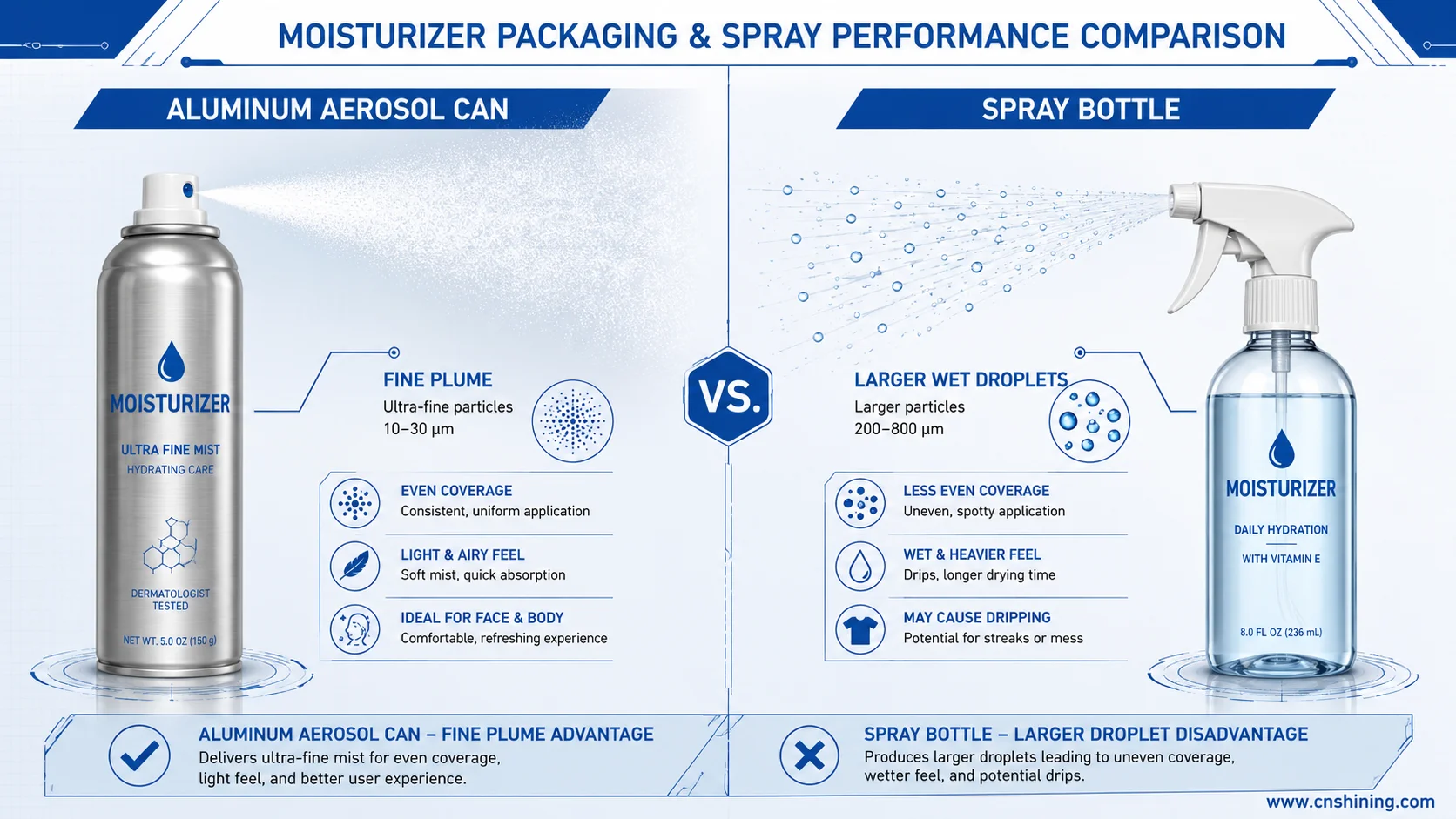
The physical difference is direct. A liquefied propellant system often involves fast pressure release and flash boiling, so it can form a finer, lighter spray. A pump system relies more on nozzle geometry, swirl, and liquid film breakup.
1.2 Aerosol Propellant System vs Pump Spray System
| Dimension | Aerosol Propellant System | Pump Spray System |
|---|---|---|
| Driving force | Internal can pressure from liquefied or compressed gas. | Manual pump pressure. The bulk product is normally not pressurized. |
| Atomization | Pressure release, possible flash boiling, nozzle breakup, and secondary atomization. | Pressure swirl or hydraulic breakup. Droplets are often larger and wetter. |
| Formula fit | Anhydrous oil, spray ointment, thermal water, and some O/W emulsions, after pressure and compatibility checks. | Water phase, light emulsion, milky mist, and functional sprays with lower dependence on flammable propellant. |
| User perception | Wide plume, fast coverage, back-friendly use, and a more “professional” spray feel. Overspray risk is higher. | More controllable, but often needs repeated pressing. It is more intuitive for close facial use. |
| Compliance load | VOC, flammability, pressure vessel, transport, propellant selection, and recycling controls are heavier. | Lower aerosol-specific load, but cosmetic labeling and ingredient rules still apply. |
1.3 Droplet Size, Inhalation Exposure, and Face/Body Use
Droplet distribution is commonly described by Dv10, Dv50, Dv90, or Sauter Mean Diameter. In real products, user experience is not decided by one average number. Distribution width, spray angle, near-field wetness, far-field drift, and deposition efficiency matter more. Spraying Systems drop size terminology
For moisturizer sprays, the question is not only “is the mist fine?” It is also “is it too fine for close facial use?” CIR’s 2024 inhalation discussion notes that pump cosmetic sprays usually release a low proportion of respirable particles, while some propellant-based products can release higher fractions. The cited examples include propellant-based hairspray averaging 15.25% of droplets or particles below 10 µm, and simulated propellant deodorant data up to 26.63% ± 13.43%. CIR 2024 inhalation exposure memo
These data are not specific to moisturizer sprays. They still explain why face mists often favor thermal water with nitrogen, pump milky mist, or BOV with compressed gas instead of high-velocity traditional aerosol systems.
2. Product Comparison, Formulation, and Terms
2.1 Comparison With Lotion, Pump Spray, and Dry Spray Powder
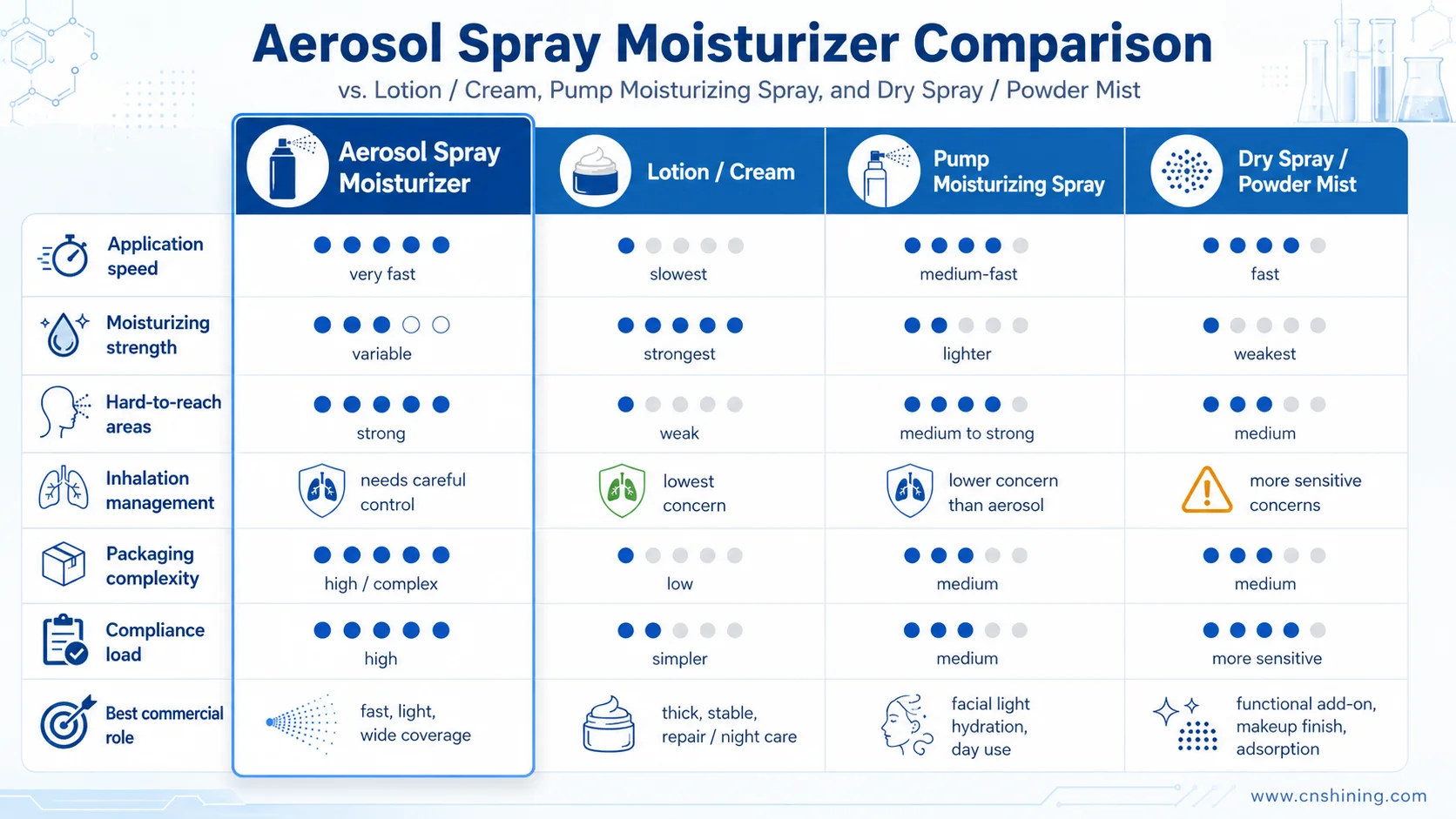
| Item | Aerosol Spray Moisturizer | Lotion / Cream | Pump Moisturizing Spray | Dry Spray / Powder Mist |
|---|---|---|---|---|
| Application speed | Very fast, good for large areas and back use. | Slowest; must be spread by hand. | Medium-fast, usually needs repeated pressing. | Fast, but more about oil control, blur, or tactile finish. |
| Moisturizing strength | Depends on system; can be light mist or anhydrous occlusive spray. | Easiest to build high oil phase and high occlusion. | Usually lighter. | Usually weakest for true moisturization. |
| Hard-to-reach areas | Strong. | Weak. | Medium to strong. | Medium. |
| Inhalation management | Needs droplet size and spray velocity control, especially for close facial use. | Lowest concern. | Usually lower than propellant aerosol. | More sensitive because fine powder can raise inhalation concerns. |
| Packaging complexity | High; valve, propellant, and pressure-resistant container are involved. | Low. | Medium. | Medium. |
| Compliance load | VOC, flammability, recycling, and transport are more complex. | Simpler. | Medium. | Inhalation safety is more sensitive. |
| Best commercial role | Fast, light, wide coverage, controlled spray feel. | Thick, stable, repair-oriented, night care. | Facial light hydration, day use, milky mist. | Functional add-on, makeup finish, adsorption. |
Why do users buy spray moisturizer? Not because it is automatically more moisturizing than cream. They buy it because it makes moisturizing easier to perform.
2.2 Formula Architecture
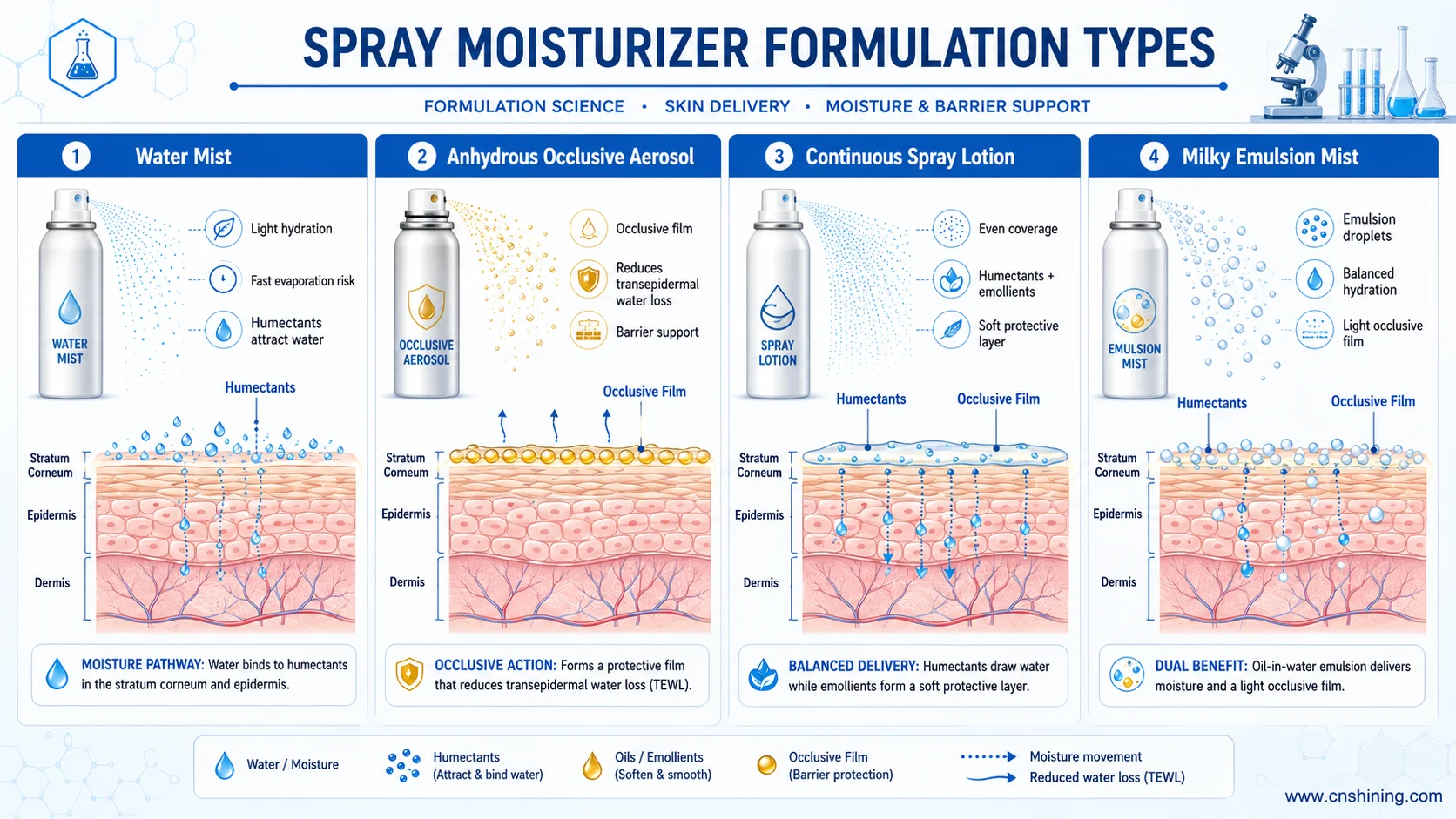
| Architecture | Public Example Type | Typical Ingredients | Technical Note |
|---|---|---|---|
| Single-phase water spray | Thermal spring water spray | Thermal water plus nitrogen. | Closer to soothing, cooling, and light hydration than complete moisturization. |
| Anhydrous occlusive aerosol | Ointment body spray | Butane, petrolatum, mineral oil, ceresin, lanolin alcohol, panthenol, glycerin, bisabolol. | Strong water-locking effect, but oiliness, floor slip, and actuator fouling are expected risks. |
| Continuous spray lotion | Spray lotion | Micro-droplets of petrolatum jelly, cocoa butter, aloe vera, or similar lotion ingredients. | Commercially accepted, but often not a strict aerosol. |
| Milky mist / functional mist | Cream skin mist, repair spray, hyaluronic acid mist | Ceramides, peptides, panthenol, hyaluronic acid, sodium hyaluronate. | More face-oriented; skin feel and repair positioning matter more than heavy occlusion. |
2.3 Common Ingredient Functions
| Function | Common Ingredients | Role | Public Ratio Information |
|---|---|---|---|
| Humectants | Glycerin, propylene glycol, panthenol, hyaluronic acid, sodium hyaluronate | Bind water, reduce dry feel, and improve softness. | Most consumer products do not disclose percentage. |
| Emollients / occlusives | Petrolatum, mineral oil, cocoa butter, jojoba oil, squalane | Reduce water loss and improve tactile feel. | Usually not disclosed. |
| Film formers | Polyurethane-11, acrylates copolymer | Improve film formation, adhesion, and post-makeup behavior. | Visible in filings or ingredient lists, not usually as ratios. |
| Emulsion stability | Emulsifiers, polyols, polymeric structuring agents | Keep oil, water, and silicone phases sprayable and stable. | More often seen in patents or filings than retail pages. |
| Preservation | Phenoxyethanol and related systems | Control microbial risk after opening. | Usually not disclosed. |
| Viscosity / structure | Ceresin, acrylates copolymer | Control viscosity, spray pattern, and wall adhesion. | Usually not disclosed. |
| Fragrance | Fragrance, rosewater, cocoa notes | Identity and sensory signal. | Usually not disclosed. |
| Propellant / compressed gas | Butane, nitrogen, DME, HFO-1234ze, compressed air or nitrogen in BOV | Controls discharge, atomization, VOC load, flammability, and carbon profile. | Usually chemical identity is public; amount is not. |
2.4 Key Technical Terms
| Term | Short Explanation | Commercial Meaning |
|---|---|---|
| Aerosol product | Pressurized spray system using propellant. Pump spray is excluded in strict definitions. | Determines exposure to pressure container, VOC, flammability, and transport rules. |
| Pump spray | Spray generated by mechanical pump action. | More suitable for close facial use and gentler positioning. |
| Propellant | Liquefied gas or compressed gas that expels and atomizes the product. | Directly affects cost, spray feel, VOC, GWP, and flammability. |
| BOV | Bag-on-Valve; product and propellant are separated. | Useful for sensitive formulas, lower contamination risk, 360-degree use, and premium repair mist. |
| Plume / spray pattern | The shape and spread of the mist. | Decides whether a product feels soft on face or wasteful on body. |
| Dv50 / SMD | Volume median diameter and Sauter Mean Diameter. | Core atomization KPIs. |
| Respirable fraction | Small droplets or particles that may be inhaled deeply, often discussed below 10 µm. | Important for face sprays and close-use aerosols. |
| Flash boiling | Rapid depressurization causes volatile components to flash and assist atomization. | Part of the physical basis for fine aerosol mist feel. |
| VOC | Volatile organic compound. | Affects propellant choice and regional launch strategy. |
| Continuous spray | Spray continues while the actuator or pump is held down. | Important for body care because it controls large-area efficiency. |
| Inner lacquer | Internal coating of a metal can. | Controls compatibility with acidic, saline, water-rich, or fragrance-containing formulas. |
| Locking actuator | Actuator with lock function. | Reduces accidental discharge during travel and e-commerce handling. |
3. Regulatory Compliance and Technology Frontiers
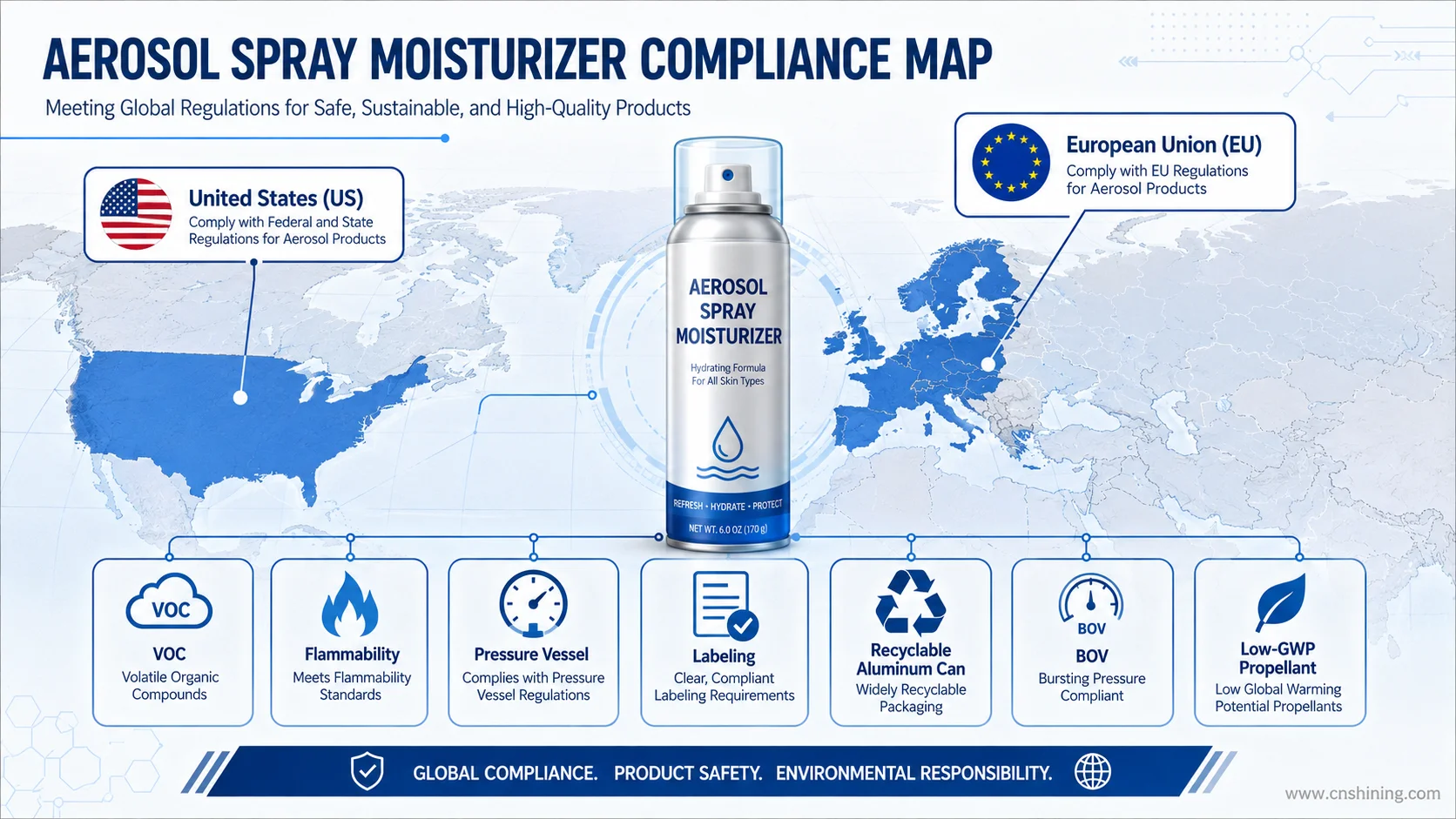
3.1 Main Market Compliance Requirements
| Market | Product Body | Propellant / VOC | Labeling / Claims | Ingredients / Packaging |
|---|---|---|---|---|
| United States | Cosmetics are regulated by FDA. MoCRA expanded FDA authority over cosmetics. FDA MoCRA information | EPA has national VOC standards for certain consumer products under Clean Air Act section 183(e) and 40 CFR Part 59 Subpart C. State rules, especially CARB, can be stricter. EPA consumer product VOC standards | FDA states cosmetic labeling is governed by FD&C Act and FPLA. Labels must be truthful and not misleading. Disease treatment or prevention claims may move the product into drug territory. FDA cosmetics labeling rules | Aerosol cans also involve flammability, pressure container, transport, and waste handling. EPA added aerosol cans to universal waste rules to support recycling. EPA aerosol cans universal waste rule |
| European Union | The core cosmetics framework is Regulation (EC) No 1223/2009. EU Cosmetics Regulation 1223/2009 | Substance restrictions are layered through REACH and F-gas rules, depending on material and propellant selection. | Safety assessment, PIF, CPNP notification, compliant labeling, and ingredient management are required. European Commission cosmetics legislation | Packaging and Packaging Waste Regulation 2025/40 entered into force on 2025-02-11 and generally applies from 2026-08-12, with recyclability targets toward 2030. EU packaging waste and PPWR information |
The easiest place to make a mistake is not the humectant. It is propellant choice, claim boundary, warning language, and recycling or transport requirements. If the same aerosol spray moisturizer is planned for the United States, EU,the team may find that one formula is easier than one package, and one package is easier than one claim set.
3.2 Technology Directions Worth Watching
The current technical shift is not a single new skincare ingredient. It is the combined movement of lower-VOC or lower-GWP propellants, BOV and compressed-gas systems, actuator design, and recyclable metal packaging.
| Technology Direction | Current Value | Difficulty | Technical Conclusion |
|---|---|---|---|
| Bio-based DME | Lower carbon route while keeping familiar aerosol performance. Nouryon Demeon ReNu100 propellant information | Supply, cost, and regional certification. | Good fit for mid-to-high-end body spray and personal care aerosol platforms. |
| HFO-1234ze | Very low GWP profile and VOC-exempt positioning in some regulatory contexts. Honeywell Solstice Air technical bulletin | Cost and formula compatibility validation. | Useful for premium or regulation-sensitive markets. |
| BOV | Product and propellant are separated; useful for product integrity, lower contamination risk, and 360-degree use. | Filling ecosystem and component availability are narrower than standard aerosol. | Highly relevant for facial, sensitive-skin, and repair-oriented mists. |
| Dual-pattern or lockable actuator | Improves use control, reduces accidental spray, and enables scenario-based spraying. | Spray validation and mold cost. | Strong short- to medium-term return because it addresses user complaints directly. |
| PCR aluminum can | Supports recycling and premium metal-packaging perception. | Cost, printing, procurement coordination, and supply continuity. | More valuable as a brand and compliance platform than as a simple cost reduction. |
4. Packaging Components for Aerosol Spray Moisturizer: Shining Packaging View
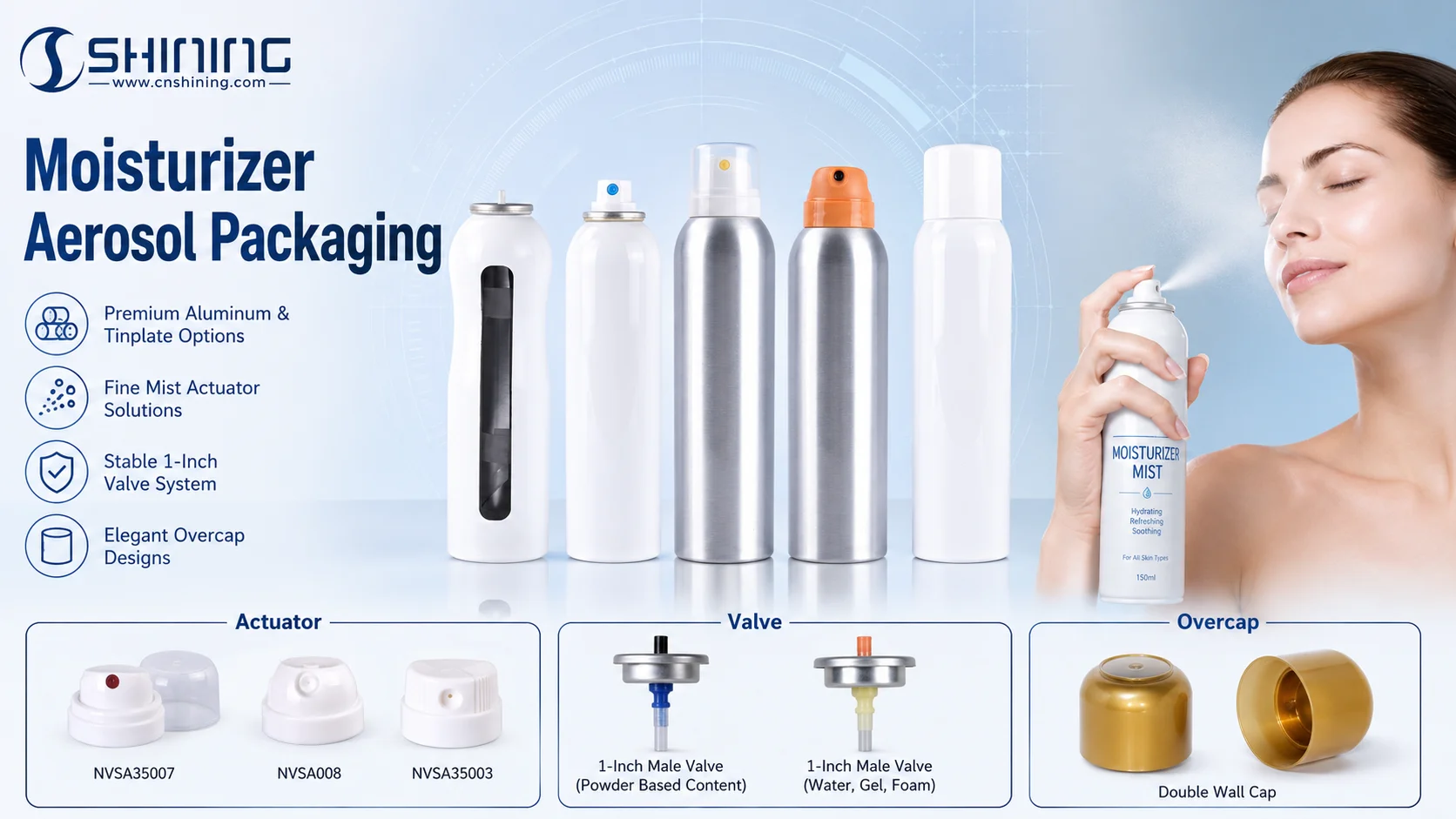
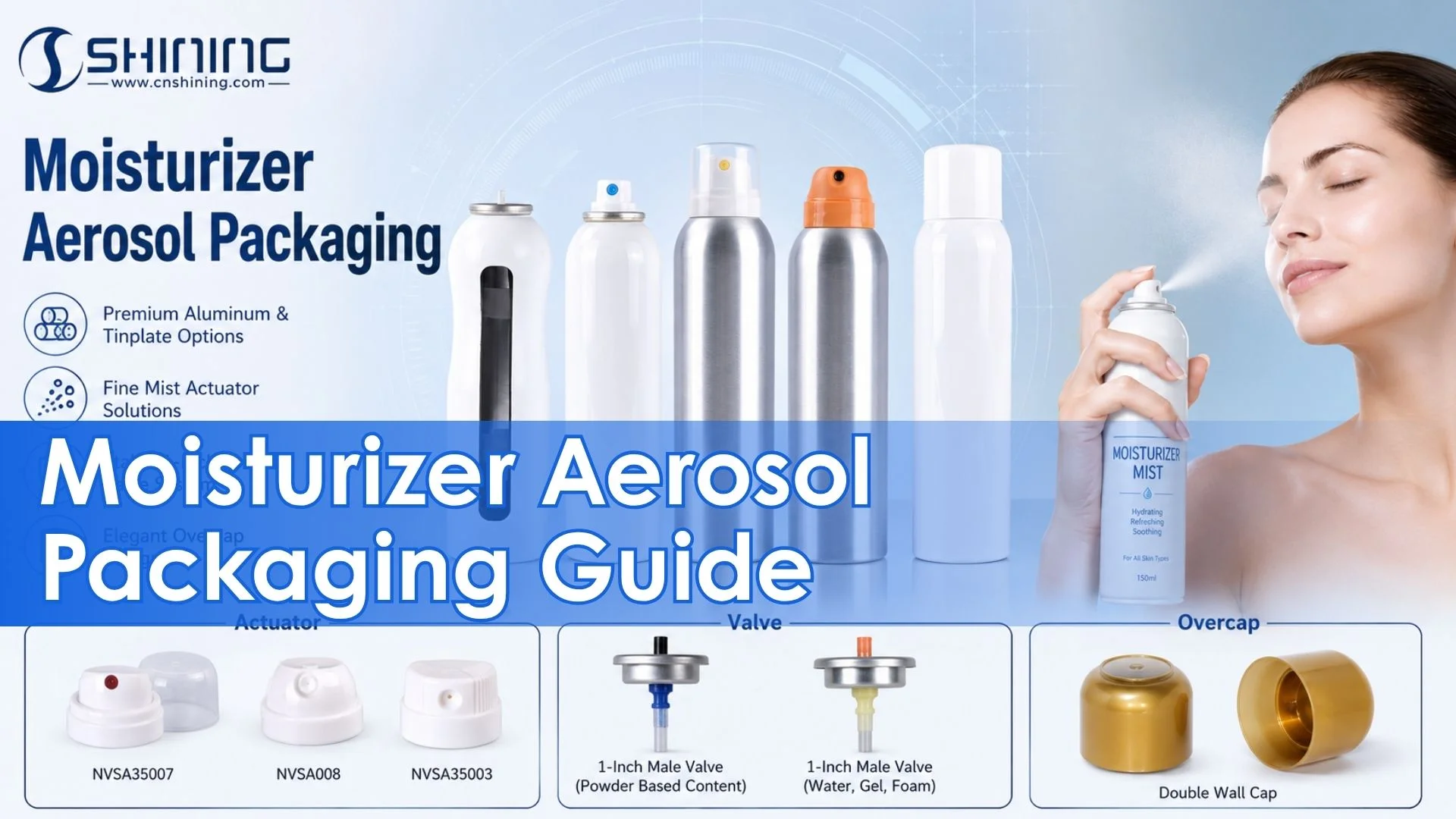
For an aerosol spray moisturizer project, packaging work starts with three components: actuator, aerosol can, and valve. Shining Packaging can be naturally evaluated in this context because these parts decide whether the formula can become a stable user experience.
The actuator is not just a plastic button. It sets finger force, plume direction, spray angle, flow rate, lock function, and perceived fineness. The valve controls discharge consistency, sealing, compatibility with oil or emulsion systems, and tail-end behavior. The metal aerosol can must handle pressure, lacquer compatibility, deformation resistance, filling-line requirements, and recyclability.
For body spray lotion, the priority is usually controlled wide coverage without excessive floor deposition. For facial hydrating mist, the priority moves toward soft plume, lower spray velocity, and inhalation-aware droplet distribution. For anhydrous occlusive sprays, oil compatibility and actuator cleanliness become more important. One hardware set rarely solves every formula. Testing should match the real formula architecture.
| Packaging Part | What It Controls | Typical Risk in Spray Moisturizer | Practical Check |
|---|---|---|---|
| Actuator | Spray pattern, discharge rate, lock function, finger feel. | Overspray, jetting, accidental discharge, inconsistent plume. | Test spray angle, distance, flow rate, tail-end mist quality, and e-commerce locking reliability. |
| Valve | Sealing, compatibility, discharge stability, dip-tube performance. | Clogging, leakage, valve swelling, late-stage poor atomization. | Run formula compatibility, storage stability, hot/cold cycles, and full-life discharge testing. |
| Aerosol can | Pressure safety, corrosion protection, decoration, recyclability. | Internal corrosion, odor pickup, deformation, coating mismatch. | Check lacquer compatibility, burst/deformation performance, filling process, and recycling claim limits. |
The packaging decision should follow the formula, not the catalog page. A water mist, milky emulsion, body oil spray, and petrolatum-based aerosol do not create the same valve and actuator demand.
5. Top 10 Representative Brands in Spray Moisturizer
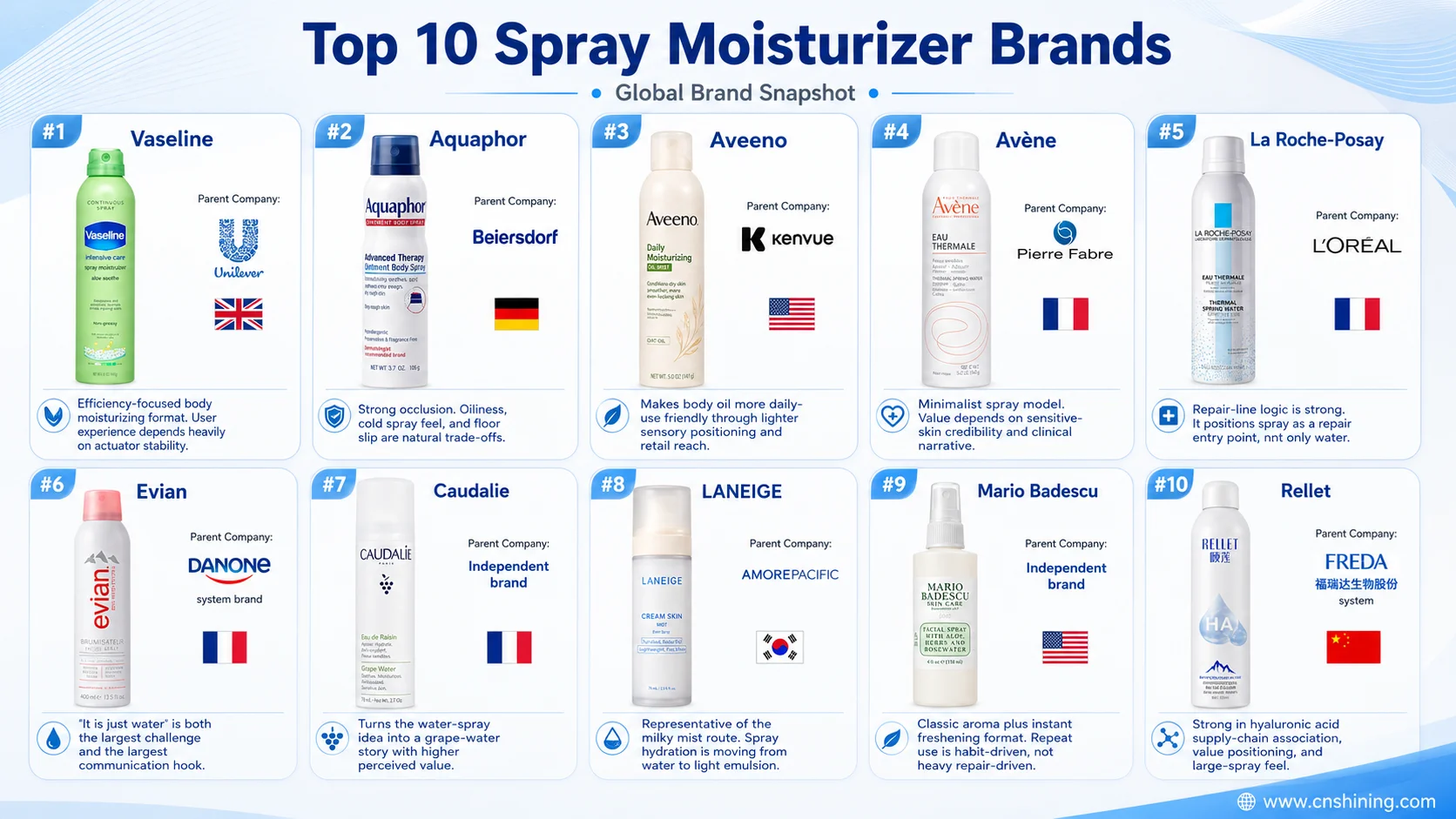
| Brand | Origin | Parent Company | Common Size | Public Price Snapshot | Direct Technical Comment |
|---|---|---|---|---|---|
| Vaseline | UK | Unilever | 6.5 oz | about 6.99$ | Efficiency-focused body moisturizing format. User experience depends heavily on actuator stability. |
| Aquaphor | Germany | Beiersdorf | 3.7 oz / 6.2 oz | about 12.78$ | Strong occlusion. Oiliness, cold spray feel, and floor slip are natural trade-offs. |
| Aveeno | United States | Kenvue | 0.8 oz / 6.7 oz | about 3.99$–9.99$ | Makes body oil more daily-use friendly through lighter sensory positioning and retail reach. |
| Avène | France | Pierre Fabre | 50 / 150 / 300 ml | about 11$ | Minimalist spray model. Value depends on sensitive-skin credibility and clinical narrative. |
| La Roche-Posay | France | L’Oréal | Multiple face/body formats | about 12.97$ | Repair-line logic is strong. It positions spray as a repair entry point, not only water. |
| Evian | France | Danone system brand | 1.7 / 5 / 10.1 fl oz | about 8.99$–20.99$ | “It is just water” is both the largest challenge and the largest communication hook. |
| Caudalie | France | Independent brand | Commonly 75 / 200 ml | about 12$–20$ | Turns the water-spray idea into a grape-water story with higher perceived value. |
| LANEIGE | South Korea | Amorepacific | Mini / regular sizes | about 42$ | Representative of the milky mist route. Spray hydration is moving from water to light emulsion. |
| Mario Badescu | United States | Independent brand | 1 / 2 / 4 oz and others | about 8.40$ | Classic aroma plus instant freshening format. Repeat use is habit-driven, not heavy repair-driven. |
| Rellet | Asia | Freda system | Large and small spray formats | about 27.74$ | Strong in hyaluronic acid supply-chain association, value positioning, and large-spray feel. |
6. User Pain Points and Packaging Responses
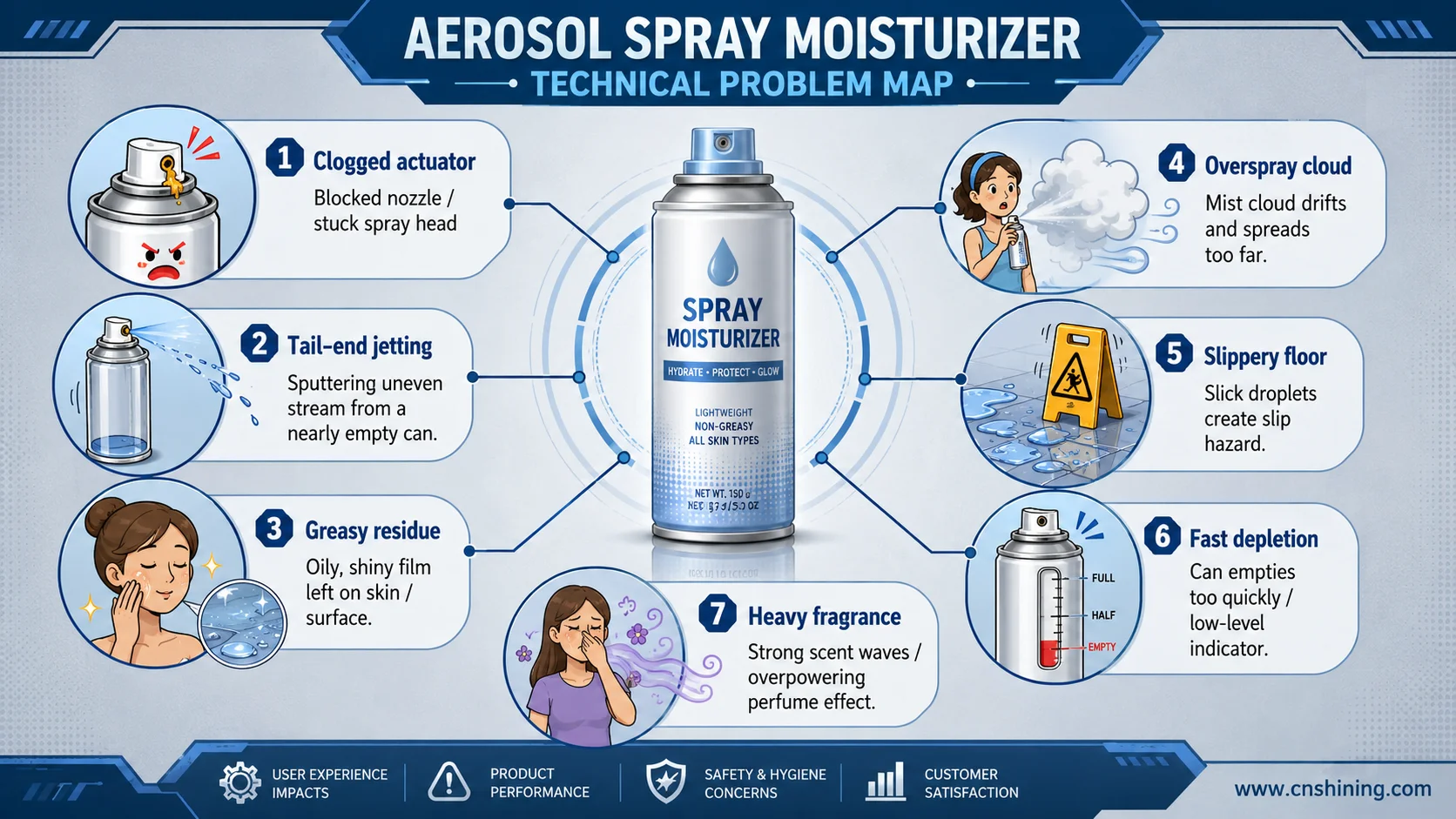
6.1 Typical User Complaints
| Pain Point | Typical Evidence Pattern | Technical Explanation |
|---|---|---|
| Actuator failure and tail-end jetting | Reviews frequently mention spray changing into a stream near the end, leakage, or failure to spray. | This destroys the main buying reason: fast and convenient application. |
| Too oily, sticky, or slippery | Occlusive sprays receive praise for locking moisture, but complaints about grease and slippery floors appear repeatedly. | Anhydrous occlusive aerosols have a real trade-off: strong moisture retention and higher residue risk. |
| Fast depletion and weak value | Continuous spray can be used up quickly and feel wasteful. | Continuous discharge improves efficiency but can make unit-use cost hard to control. |
| Fragrance too strong | Heavy or sweet fragrance can create rejection, especially for sensitive-skin users. | Body spray can use fragrance as a positive signal, but facial or sensitive positioning needs restraint. |
| “Is this just water?” | Water-based face sprays face direct value challenges. | The technical problem is not only effect. It is how to prove deposition, soothing, or repair value. |
| Not always suitable over makeup | Some users treat mists as pre-moisturizer toner rather than makeup-refresh spray. | Film formation, droplet size, and deposition uniformity decide makeup compatibility. |
| Facial or inhalation concern | Warnings often tell users to avoid inhalation and eyes. | Close facial use raises the priority of plume softness, respirable fraction, and label education. |
| Positive feedback still exists | Back reach, fine mist, and time saving are repeated benefits. | The demand is real. Execution quality decides repeat purchase. |
6.2 Packaging Solutions Matched to Pain Points
| Pain Point | Suggested Solution | Technical Benefit | Cost | Manufacturing Feasibility |
|---|---|---|---|---|
| Tail-end poor mist and actuator clogging | More stable valve core and nozzle insert; for viscous or oily systems, consider BOV or oil-suitable valve structures. | Reduces jetting and clogging. BOV separates product and propellant. | Medium | Feasible in existing aerosol filling systems, but compatibility and filling validation must be repeated. |
| Overspray and slippery floor | Narrower spray pattern or dual-pattern actuator; separate body mode and local mode. | One actuator can offer two spray patterns or flow rates with locking structure. | Low to medium | One of the easiest high-impact changes. |
| Waste and high unit-use cost | Semi-metered or lower-flow design; label the recommended spray duration and amount. | Continuous spray should be fast but not uncontrolled. | Low | Can start with actuator choice and usage instruction. |
| Formula oxidation or contamination | BOV plus compressed air or nitrogen for premium facial repair sprays. | Improves product separation and reduces back-contamination risk. | Medium to high | Filling ecosystem is narrower, but suitable for higher-value SKUs. |
| Sustainability pressure | PCR aluminum can, lighter can body, lower-resin actuator. | Supports recycling and resin reduction while keeping aerosol function. | Medium to high | Availability is improving, but procurement coordination is needed. |
| VOC and GWP compliance pressure | Evaluate bio-based DME, HFO-1234ze, compressed gas, or BOV routes. | Reduces long-term regulatory risk and supports lower-carbon positioning. | Medium to high | Requires regulatory, transport, filling, and compatibility validation. |
| Travel leakage and e-commerce damage | Locking actuator, cap optimization, stronger leakage and pressure testing. | Reduces consumer complaints and channel losses. | Low | Very practical to implement. |
If priorities must be set, the practical order is clear: first fix actuator, spray pattern, and locking structure; then evaluate BOV or compressed-gas systems for higher-value lines; then build the next platform around low-carbon propellant and PCR aluminum cans.
7. Final Technical Take
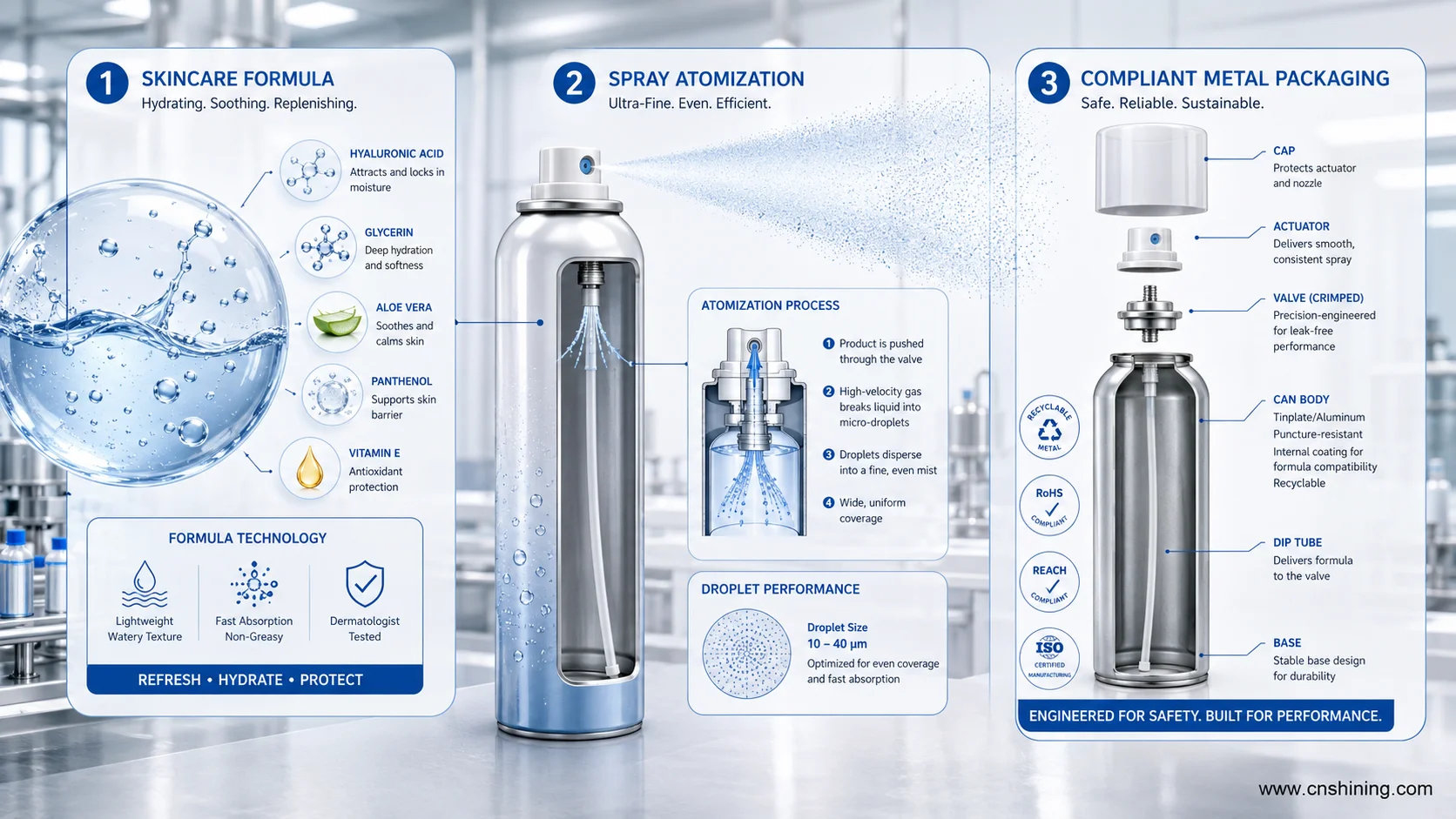
Aerosol spray moisturizer is a real opportunity, but it should be treated as a skincare formula plus spray engineering plus compliant packaging product. The weak points are predictable: unstable actuator, poor tail-end mist, excessive residue, overspray, unclear value, and regional compliance pressure. The practical improvement path is also predictable: better valve and actuator matching, BOV where formula integrity matters, low-VOC or lower-GWP propellant options, recyclable metal cans, and real droplet/deposition testing. The category grows when the spray system solves a usage problem, not when it simply changes the package of a lotion.
8. FAQ: Aerosol Spray Moisturizer Technical Questions
An aerosol spray moisturizer is a moisturizing skin-care formula delivered by a pressurized spray system. In strict terms, it uses a propellant inside a pressure-resistant package. In retail language, the same phrase is often mixed with pump mist, spray lotion, hydrating mist, cream mist, and body oil mist, so classification should start from the package mechanism.
Pump spray relies on mechanical force generated when the user presses the pump. The product is normally not stored under pressure. Aerosol spray uses internal pressure from compressed or liquefied gas, released through a valve and actuator. This changes atomization, compliance, flammability review, transport handling, and user perception of mist fineness.
The actuator-valve-formula match usually affects experience more than the ingredient story. Users quickly notice whether the mist is even, whether the spray becomes a jet near the end, whether the floor becomes slippery, and whether the can empties too fast. These issues are linked to spray pattern, discharge rate, viscosity, and valve stability.
A liquefied propellant aerosol can create rapid pressure release and flash boiling, which helps break liquid into finer droplets. Pump mists depend more on hydraulic pressure and nozzle swirl. A finer mist may feel lighter, but face-use products still need inhalation-aware droplet control, because very fine droplets can increase respiratory exposure concerns.
No. A fine mist may feel elegant, but facial use happens close to the breathing zone. If too many droplets are below the respirable range of concern, safety assessment becomes more demanding. Facial sprays need a balance of softness, deposition on skin, low drift, comfortable wetness, and clear label instructions for eyes and inhalation.
Bag-on-Valve separates the product from the propellant. This can help protect formula integrity, reduce back-contamination risk, support 360-degree spraying, and allow compressed air or nitrogen systems. It is especially relevant for sensitive facial mists, low-preservative repair sprays, and emulsion-style products where product-propellant interaction may create instability.
Tail-end jetting can come from pressure drop, poor dip-tube pickup, valve mismatch, formula thickening, oil residue around the actuator, or unstable propellant balance. It turns a mist into a wet stream near the end of use. Full-life discharge testing is therefore more useful than testing only the first few sprays.
Aerosol spray moisturizer adds pressure container, flammability, VOC, transport, and recycling issues to ordinary cosmetic rules. Claims must also stay within cosmetic boundaries unless the product is regulated differently. A formula that works technically may still fail launch planning if warning text, propellant choice, or regional packaging requirements are not resolved early.
Strong occlusive sprays often use petrolatum, mineral oil, or other oil-rich systems to reduce water loss. These materials can improve moisture retention but leave residue on skin, bathroom surfaces, or floors. Narrower spray pattern, lower discharge rate, clearer usage distance, and formula viscosity adjustment can reduce this problem.
Testing should include spray pattern, discharge rate, droplet distribution, near-field inhalation estimate for facial products, skin deposition, tail-end spray quality, valve compatibility, actuator clogging, can lacquer compatibility, leakage, pressure safety, hot and cold storage, transport simulation, and user residue perception. Skipping packaging tests usually moves the problem into reviews.