
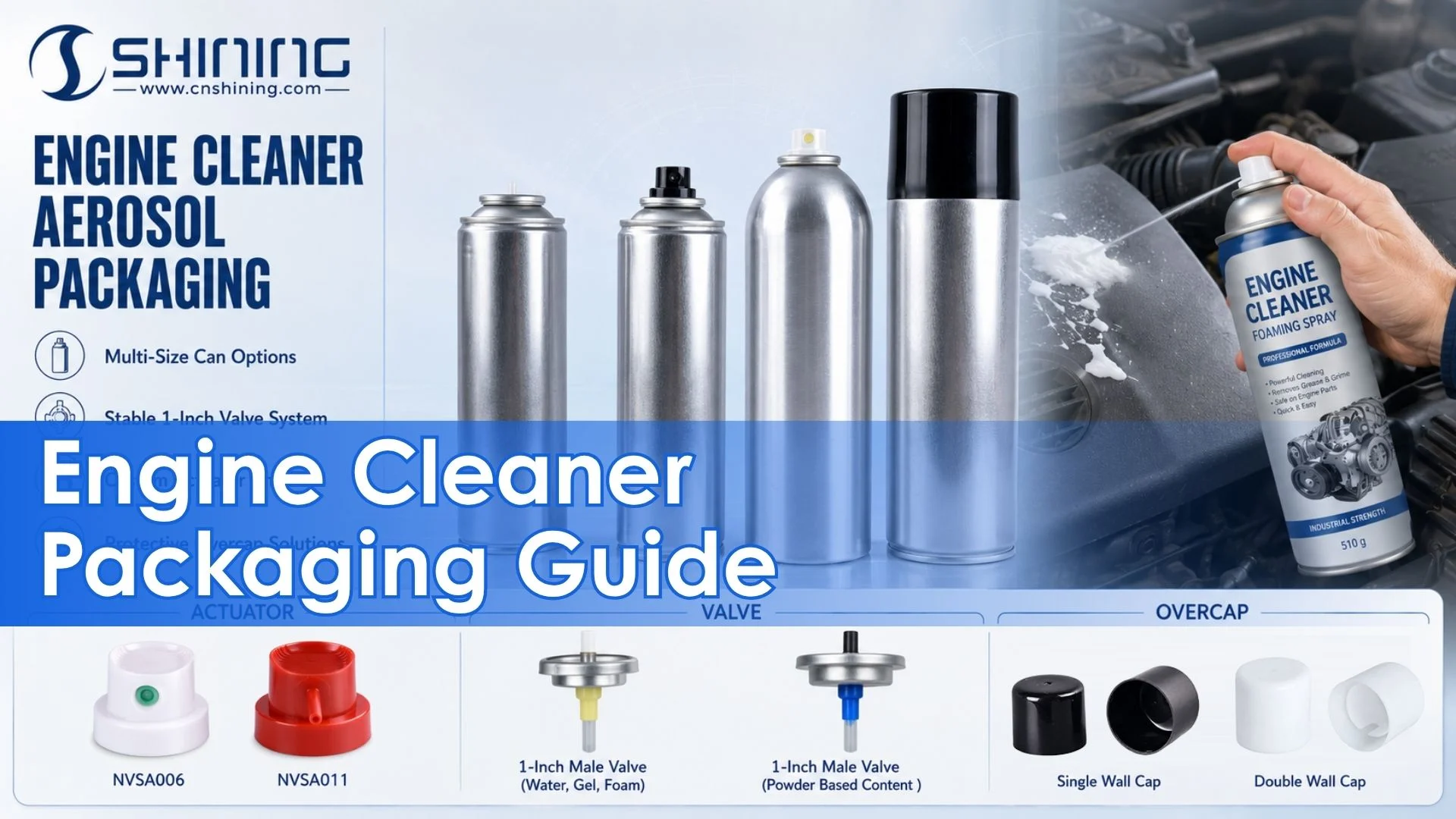
Engine cleaner aerosols solve a delivery problem before they solve a chemistry problem. The product is not just a degreasing formula in a pressurized can. It is a controlled system made from cleaning chemistry, propellant, valve, actuator, spray pattern, can compatibility, and user instructions.
A good engine cleaner has to wet oily soil, penetrate carbonized grime, break or disperse contamination, carry loosened residue away, and then leave the surface by evaporation, wiping, or rinsing. In engine bays, throttle bodies, carburetors, intake ducts, and GDI intake valve service, this sequence has to happen in tight geometry. That is why aerosol packaging still has a place in automotive maintenance.
The category is moving away from one general-purpose, high-solvent spray. The better direction is more segmented: engine bay degreaser, throttle body cleaner, carburetor cleaner, GDI intake valve cleaner, and low-VOC maintenance spray. The formulation changes with the surface. So should the actuator.
1. Definition and Working Principle
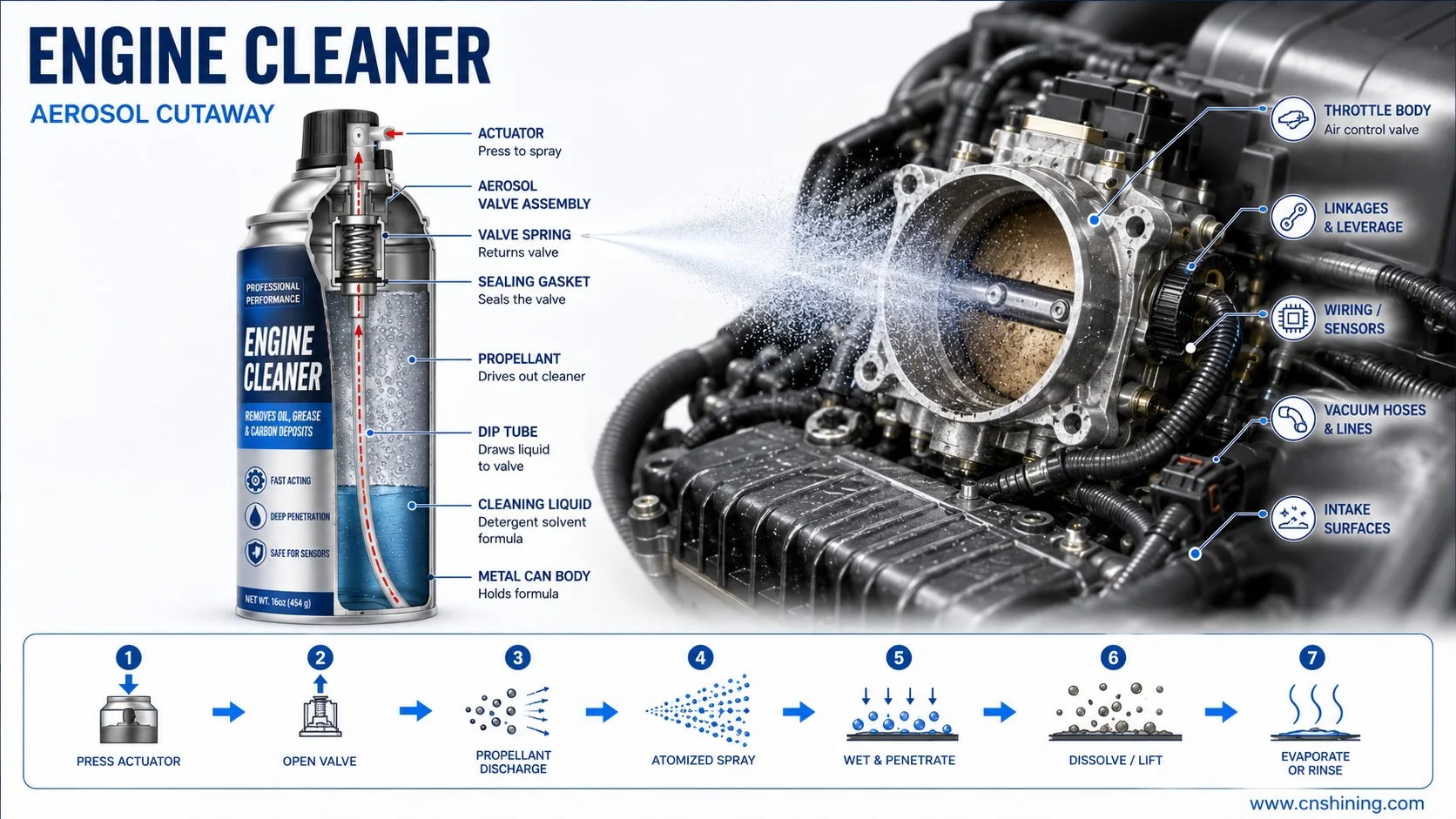
Engine Cleaner aerosol usually means a pressurized spray product used to remove external engine oil, mud, road grime, carbonized residue, intake deposits, or carburetor and throttle body contamination. The cleaning target changes the chemistry. External engine degreasers usually handle oil sludge and road film. Carburetor and throttle body cleaners target gum, varnish-like deposits, and throttle edge rings. GDI intake valve cleaners focus on carbon deposits on the back side of intake valves.
From an engineering view, the process is simple: press the actuator, open the valve, push the formula by propellant pressure, atomize through the nozzle, wet the soil layer, penetrate, dissolve or emulsify, then remove the contamination by evaporation, wiping, or rinsing.
Why does aerosol still survive in repair work when liquid trigger bottles are cheaper? Because aerosol gives reach and delivery force. A narrow jet can get behind wiring, engine mounts, throttle plates, linkages, and small covers. A fast-evaporating carrier also shortens the work cycle. The trade-off is clear: VOC pressure, flammability, odor, higher unit cost, and more hardware-related complaints.
2. Product Formats and Formulation Systems
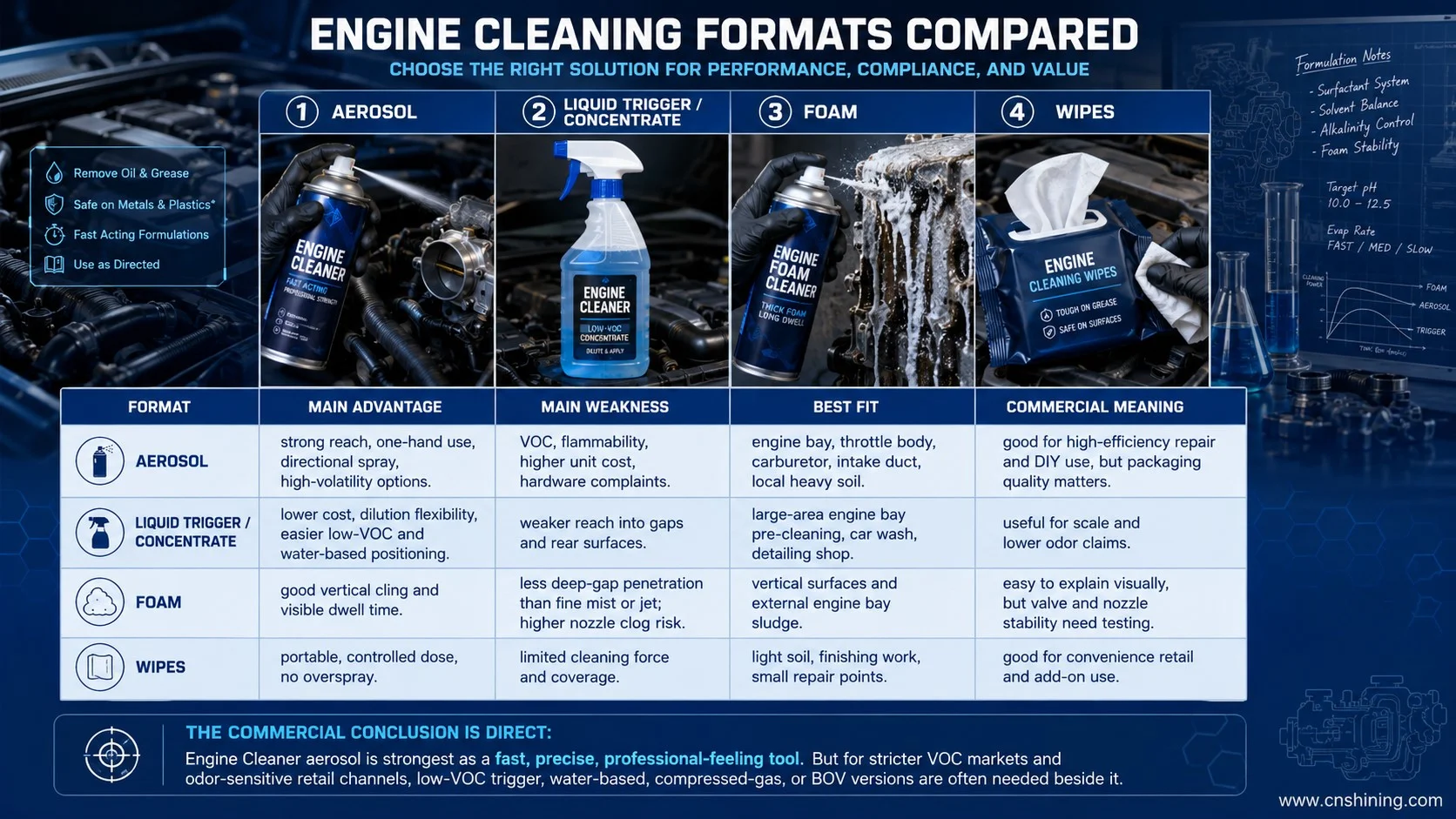
Aerosol does not win every format comparison. It wins where geometry and delivery force matter. Liquid trigger products, foams, and wipes can be better on cost, lower VOC routes, and broad surface spreading. The right answer depends on the contamination and the work site.
| Format | Main Advantage | Main Weakness | Best Fit | Commercial Meaning |
|---|---|---|---|---|
| Aerosol | Strong reach, one-hand use, directional spray, high-volatility options. | VOC, flammability, higher unit cost, hardware complaints. | Engine bay, throttle body, carburetor, intake duct, local heavy soil. | Good for high-efficiency repair and DIY use, but packaging quality matters. |
| Liquid trigger / concentrate | Lower cost, dilution flexibility, easier low-VOC and water-based positioning. | Weaker reach into gaps and rear surfaces. | Large-area engine bay pre-cleaning, car wash, detailing shop. | Useful for scale and lower odor claims. |
| Foam | Good vertical cling and visible dwell time. | Less deep-gap penetration than fine mist or jet; higher nozzle clog risk. | Vertical surfaces and external engine bay sludge. | Easy to explain visually, but valve and nozzle stability need testing. |
| Wipes | Portable, controlled dose, no overspray. | Limited cleaning force and coverage. | Light soil, finishing work, small repair points. | Good for convenience retail and add-on use. |
The commercial conclusion is direct. Engine Cleaner aerosol is strongest as a fast, precise, professional-feeling tool. But for stricter VOC markets and odor-sensitive retail channels, low-VOC trigger, water-based, compressed-gas, or BOV versions are often needed beside it.
Common formulation families
| Formulation Family | Public Example / Window | Key Components | Main Function | Safety and Compatibility Point |
|---|---|---|---|---|
| Solvent engine degreaser | GUNK sample: diesel-type petroleum distillates 80–100%, heavy aromatic naphtha 3–7%, CO2 1–5%, 2-butoxyethanol 0.5–1.5%. | Petroleum distillate, aromatic solvent, glycol ether, propellant. | Dissolves heavy oil, bitumen-like soil, carbonized grime. | Odor, flammability, coating, plastic, and label controls are needed. GUNK Engine-Brite Aerosol SDS |
| Solvent / surfactant degreaser | CRC sample: hydrotreated middle distillates 70–80%, xylene 10–20%, nonylphenol ethoxylate 5–10%, CO2 1–3%. | Hydrocarbon solvent plus nonionic surfactant. | Combines dissolving with emulsifying and rinse-off behavior. | Some surfactant systems have weaker environmental acceptance in certain markets. CRC Engine Degreaser SDS |
| Foaming engine cleaner | Public SDS data show 2-butoxyethanol at 1–5% in a foam-type engine degreaser. | Surfactant, co-solvent, foam system, propellant. | Improves dwell time and visibility on vertical areas. | Foam stability, valve clogging, and nozzle recovery must be tested. GUNK foam engine degreaser SDS |
| Water-based / low-VOC cleaner | China GB 38508-2020 sets VOC limits for water-based cleaning agents at ≤50 g/L. | Water, surfactant, co-solvent, corrosion inhibitor, chelant. | Lower odor, lower VOC, better material friendliness. | Traditional aerosol cans may need extra corrosion and compatibility control; BOV is often cleaner. GB 38508-2020 cleaning agent VOC standard |
| Brake-cleaner-type solvent | Non-chlorinated samples often use acetone, heptane, methanol, or toluene-type systems. | Fast-evaporating ketone, alcohol, hydrocarbon solvent. | Fast dry and low residue. | High material compatibility and flammability constraints. Not a general plastic-safe cleaner. non-chlorinated brake cleaner SDS |
| Carburetor / throttle body cleaner | CRC sample: acetone 80–90%, CO2 5–10%, n-heptane 3–5%. | Fast ketone, hydrocarbon, propellant. | Removes gum, varnish-like deposits, and throttle contamination. | One of the higher-risk groups for plastic, rubber, and coating damage. CRC carburetor and choke cleaner SDS |
| GDI intake valve cleaner | Public product information highlights intake delivery and PEA-based deposit control. | PEA detergent, petroleum carrier, propellant, directional tube. | Targets GDI intake valve deposits, rough idle, and hard-start symptoms. | Chemical cleaning has limits. It cannot replace every mechanical decarbonizing case. CRC GDI intake valve cleaner information |
The active functions can be grouped into six blocks: main solvent, co-solvent, surfactant or detergent, propellant, corrosion or metal protection system, and small additives such as fragrance, dye, or identification marker. PEA, or polyetheramine, deserves separate attention in GDI-related products because it is a recognized high-performance detergent chemistry for deposit control.
3. Regulatory and Compliance Framework
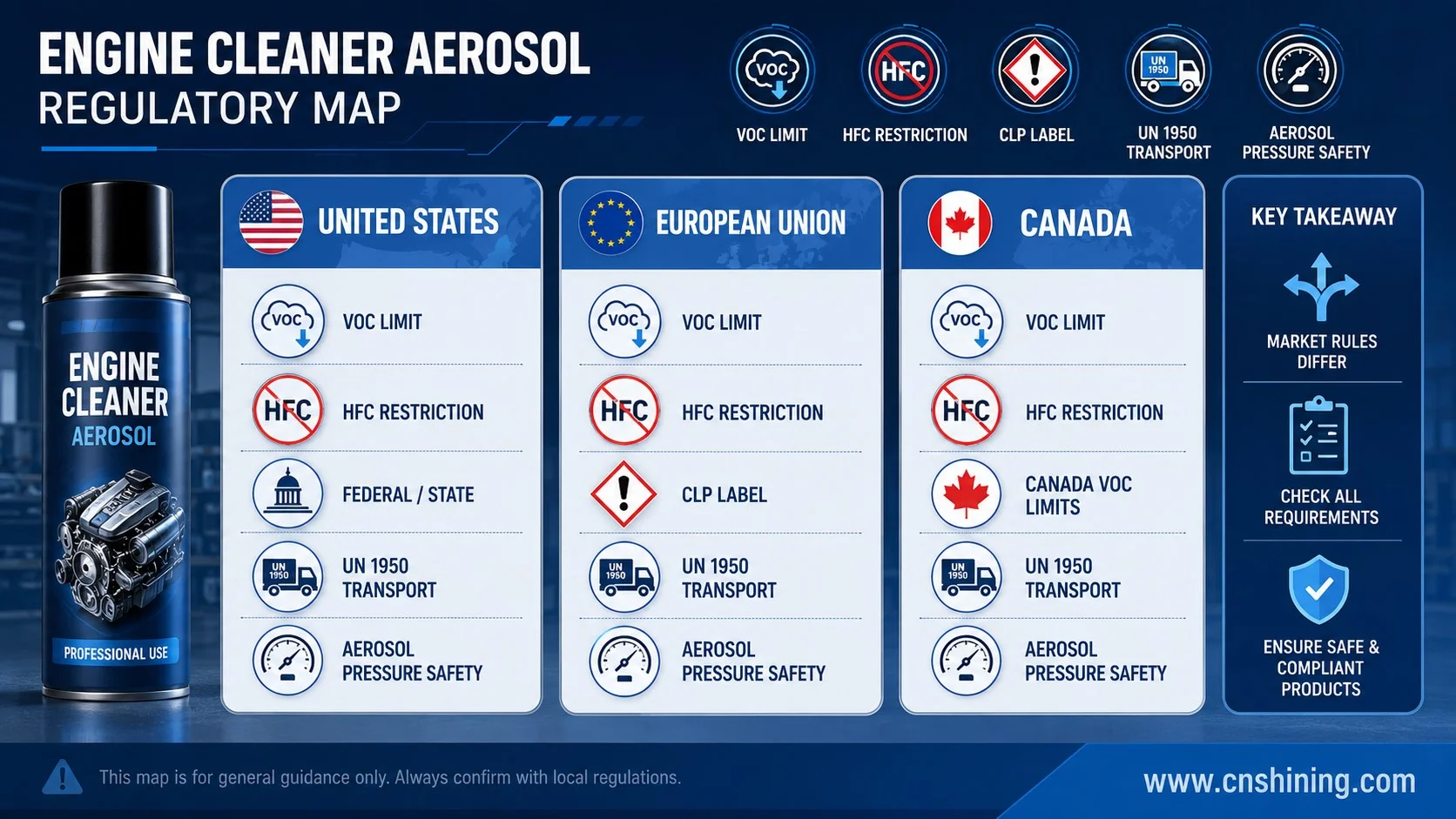
Compliance for Engine Cleaner aerosol is not one rule. It is a stack: ingredient control, VOC limit, propellant climate rule, hazardous communication, aerosol pressure safety, transport classification, can compatibility, and local language labeling. Looking only at SDS is not enough.
| Region | VOC / Formula Direction | Propellant / Climate Rule | Transport | Label and Market Impact |
|---|---|---|---|---|
| United States | Automotive maintenance categories such as engine degreaser, brake cleaner, and carburetor or intake cleaner are strongly shaped by state-level VOC rules. | EPA AIM Act technology transitions restrict high-GWP HFC use in aerosol sectors. | Often managed as aerosol dangerous goods, commonly under UN 1950 / Class 2. | Federal OSHA HazCom and state VOC positioning must be checked together. EPA HFC technology transition restrictions |
| European Union | Not usually managed through one simple engine-cleaner VOC percentage. ADD, CLP, REACH, and ADR work together. | Propellant selection must balance flammability, classification, and climate policy. | ADR and international modal rules apply to aerosol transport. | ADD handles aerosol dispenser safety and marking. CLP handles hazard classification, pictograms, and language. EU Aerosol Dispenser Directive |
| Canada | Engine degreaser aerosol and automotive brake cleaner are listed with 10% w/w VOC limits in product regulations. | Practical development often aligns with broader North American low-VOC strategy. | TDG and WHMIS need to be considered. | For “one North American SKU,” Canada and California-type rules often set the strict development baseline. Canada VOC concentration limits |
| International / cross-border | Formula acceptance depends on destination country. | High-GWP propellant choices are becoming harder to defend. | UN 1950 is a frequent aerosol transport code. | E-commerce adds carton drop, leakage, heat exposure, and carrier acceptance problems. |
The product-route implication is clear. A single high-VOC, strong-aromatic aerosol with a basic actuator is unlikely to cover every major market. A more realistic product line has three branches: high-performance professional solvent aerosol, low-odor or low-VOC retail cleaner, and BOV or compressed-gas packaging for longer-term regulatory and e-commerce fit.
For substitute propellants and acceptable alternatives, the EPA SNAP framework remains relevant in the U.S. context. EPA SNAP alternatives program
4. Top 10 Engine Cleaner Brands and Positioning
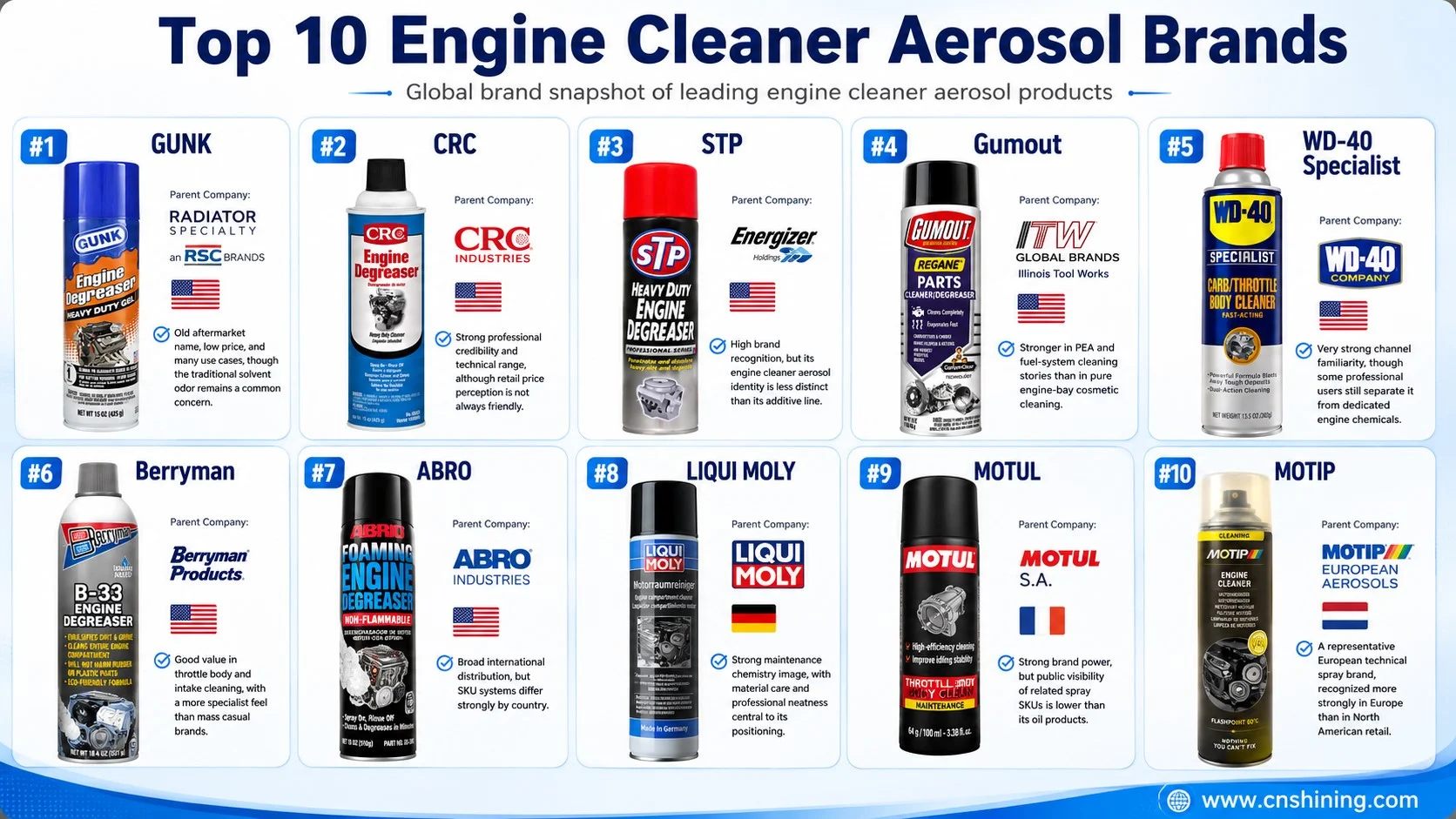
| Brand | Country / Region | Parent / Ownership Context | Typical Can Size / Format | Public Price Sample | Technical Comment |
|---|---|---|---|---|---|
| GUNK | United States | Radiator Specialty / RSC Brands context | 15 oz, 17 oz | Public U.S. retail samples around USD 4.98–5.12 | Old aftermarket name, low price, many use cases. Traditional solvent odor remains a common user concern. |
| CRC | United States | CRC Industries | 11 oz, 15 oz | Professional-channel prices vary widely; one intake cleaner sample was around USD 29.52 | Strong professional credibility and technical range. Retail price perception is not always friendly. |
| STP | United States | Energizer Holdings context | 200–236 ml additives plus spray maintenance lines | Brazil public samples around R$43–52 for 236 ml additive format | High brand recognition. Engine cleaner aerosol identity is less distinct than its additive line. |
| Gumout | United States | Illinois Tool Works | 14 oz carb and choke cleaner formats are common | Public sample incomplete | Stronger in PEA and fuel-system cleaning narratives than pure engine bay cosmetic cleaning. |
| WD-40 Specialist | United States | WD-40 | 15 oz | Public U.S. sample around USD 8.38 | Very strong channel familiarity. Some professional users may still separate it from dedicated engine chemicals. |
| Berryman | United States | Berryman Products | 11 oz | Public U.S. sample around USD 7.97 | Good value in throttle body and intake cleaning. More specialist feel than mass casual brands. |
| ABRO | United States | ABRO Industries context | Carb and choke cleaner, often around 16 oz class | Public sample incomplete | Broad international distribution. SKU systems differ strongly by country. |
| LIQUI MOLY | Germany | LIQUI MOLY context | 400 ml | UK public sample around £6.99 | Strong maintenance chemistry image. Material care and professional neatness are part of its positioning. |
| MOTUL | France | Motul S.A. context | Mainly additives and maintenance chemicals in this area | Engine cleaner aerosol public sample incomplete | Strong brand power, but public visibility of related spray SKUs is lower than its oil products. |
| MOTIP | Netherlands | MOTIP | 500 ml | EU public samples around €12.50–17.95 | Representative European technical spray brand. Stronger recognition in Europe than in North American retail. |
The lesson from these brands is not that one formula wins everywhere. Mature brands usually split use cases: degreasing, carburetor cleaning, throttle body cleaning, intake cleaning, and general maintenance sprays. That segmentation reduces misuse and makes label language more precise.
5. User Pain Points and Packaging Responses
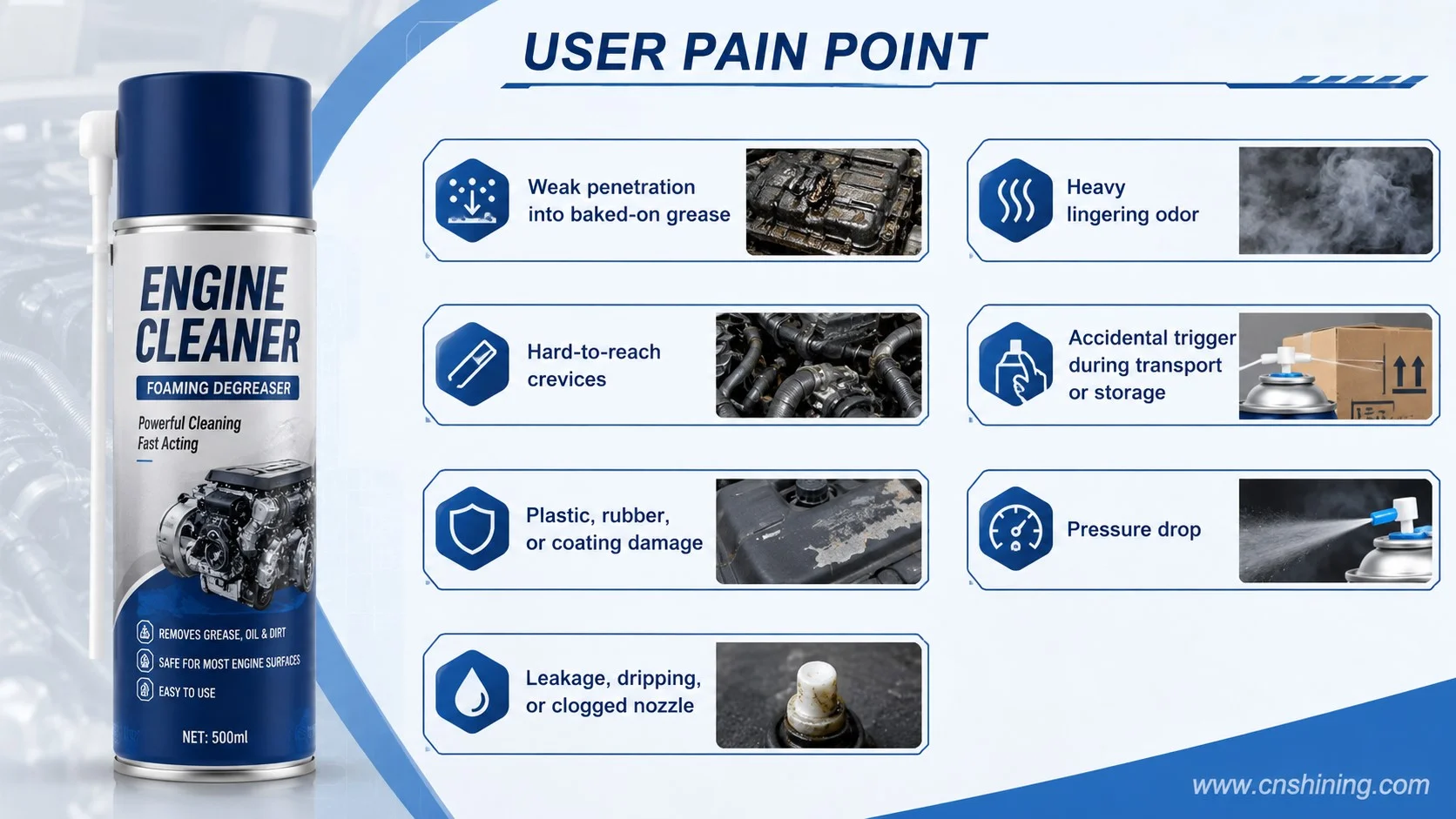
User complaints are concentrated and practical: heavy odor, weak penetration into baked-on grease, residue on fabric or plastics, accidental discharge, poor access to crevices, pressure drop, dripping, leaking, clogging, and unclear instructions. At least half of these are not pure formula problems. They are valve, actuator, nozzle, can, gasket, cap, coating, and label problems.
| User Pain Point | Technical Cause | Packaging / Hardware Response | Why It Helps |
|---|---|---|---|
| Weak penetration into baked-on grease | Spray covers the surface but does not cut into the soil layer. | Dual-pattern actuator: fan spray plus narrow jet; higher-shear insert; clear dwell-time graphics. | Lets the user switch between coverage and point attack. |
| Heavy lingering odor | Strong aromatic solvent, wide overspray, or slow venting from contaminated surfaces. | Smaller spray angle, low-aromatic formula route, lockable actuator, visible ventilation warning. | Reduces excess discharge and improves user control. |
| Hard-to-reach crevices | Engine bay geometry blocks direct spray path. | 360-degree valve, BOV, extension tube, flexible tube, replaceable straw actuator. | Reaches hidden back-side areas without forcing the can upright. |
| Accidental trigger during transport or storage | Exposed actuator or weak cap protection. | Twist-lock actuator, transport lock, stronger overcap, e-commerce cap design. | Prevents unwanted discharge, especially in parcels and service vehicles. |
| Plastic, rubber, or coating damage | Wrong product used on sensitive material; strong ketone or aromatic solvent. | Color-coded actuator and label by product type; small precision spray; clear “not for plastics” wording when needed. | Moves misuse prevention to the front of the package, not only the back label. |
| Pressure drop | Propellant system or user angle does not maintain stable discharge. | BOV, compressed-gas system, flow-control insert, metered valve. | Stabilizes spray rate and reduces waste. |
| Leakage, dripping, or clogged nozzle | Elastomer incompatibility, poor valve cup seal, resin swelling, dried formula at orifice. | Compatible gasket selection, anti-clog actuator, upgraded valve cup coating, storage orientation testing. | Directly reduces one-star hardware complaints. |
Five packaging upgrades deserve priority: lockable actuator, BOV or 360-degree spray capability, metered or flow-controlled valve, anti-clog actuator and valve design, and BPA-NI internal coating or compatible valve cup coating. Metered aerosol valves are already a mature packaging concept in other sectors.
E-commerce safety also matters more than it did ten years ago. A lockable actuator can reduce accidental discharge during parcel handling.
6. Shining Packaging: Actuators, Aerosol Cans and Valves for Engine Cleaner Applications
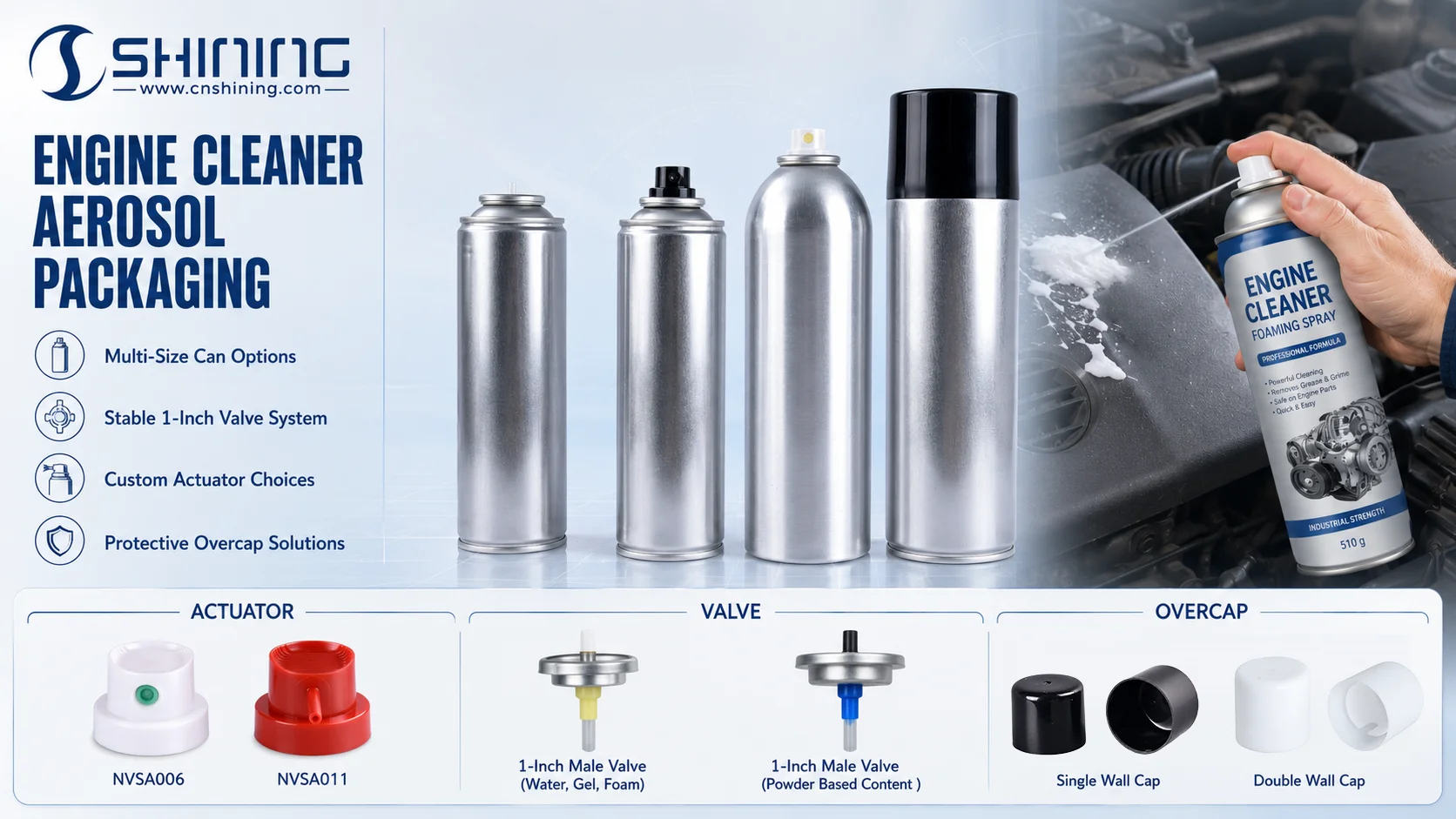
For engine cleaner products, Shining Packaging is most relevant on the packaging side: actuators, aerosol cans, and valves. This is not a formula claim. It is a hardware fit question. The formula may remove grease, but the actuator decides whether the user can place it accurately. The valve decides whether the spray stays stable. The can and coating decide whether the filled product survives storage.
In an engine cleaner aerosol project, the packaging discussion should start with the actual application: broad engine bay degreasing, narrow throttle body cleaning, carburetor jet cleaning, foam dwell-time cleaning, or GDI intake delivery. Each use case asks for a different spray pattern, button force, insertion tube, valve output, gasket material, and internal coating.
For heavy engine bay degreaser, a larger actuator with controlled fan spray can reduce fatigue. For throttle body or carburetor cleaner, a precision actuator with straw fit is safer. For low-VOC or water-based directions, BOV or compatible internal coatings become more relevant. For e-commerce channels, lockable actuators and stronger caps are not decoration. They prevent real loss.
7. Conclusion
Engine Cleaner aerosol remains useful because it delivers chemistry into difficult geometry with speed and control. The pressure on this category is real: VOC limits, flammability, odor, plastic compatibility, and transport risk. But these pressures do not remove aerosol packaging. They force it to become more specific.
A practical product line should not chase one universal spray. It should separate heavy external engine degreasing, low-odor maintenance cleaning, and intake or throttle body cleaning. Shared packaging platforms can still reduce complexity: compatible cans, stable valve cups, lockable actuators, 360-degree options, precision straws, and clear front-label warnings.
The better engineering question is simple: can the product reach the soil, remove it, avoid damaging the wrong material, and survive shipping? If the answer is yes, the cleaner has a real technical basis.
8. FAQ: Engine Cleaner Aerosol Technical Questions
In practical use, engine degreaser usually focuses on external oil, grease, road grime, and sludge around the engine bay. Engine cleaner is a broader term. It can include degreasers, carburetor cleaners, throttle body cleaners, and GDI intake valve cleaners. The chemistry, spray pattern, and material warning should match the actual cleaning target.
Aerosols give stronger reach than a normal trigger bottle. The spray can enter tight spaces around mounts, linkages, wiring edges, throttle plates, and covers. They also allow fast-evaporating solvents to be applied in a controlled way. The trade-off is higher VOC pressure, flammability control, odor management, and greater dependence on valve and actuator quality.
Not safely. Carburetor and throttle body cleaners often use fast ketones, aromatics, or hydrocarbons to remove gum and varnish-like deposits. These solvents can attack plastics, rubber, coatings, or painted parts. External engine degreasers are usually different. Product labels should separate carb cleaner, throttle body cleaner, brake-cleaner-type solvent, and engine bay degreaser.
PEA means polyetheramine. In engine maintenance chemistry, it is used as a detergent active for deposit control. It is especially relevant to GDI intake valve cleaning, where carbon deposits form on the back of intake valves. PEA-based cleaning can help loosen and disperse deposits, but chemical cleaning cannot replace every mechanical decarbonizing job.
Many traditional engine cleaner aerosols depend on volatile organic solvents for penetration, solvency, and fast drying. VOC limits reduce the room available for these solvents. Development then has to shift toward lower-VOC solvent blends, water-based systems, semi-water-based systems, BOV, compressed gas, improved surfactants, and more specific product segmentation.
Common failures include accidental discharge, leaking, dripping after spray, clogged nozzle, weak spray pressure, broken extension straw fit, and poor inverted spraying. Strong solvents can also challenge gaskets, valve cups, actuator resins, and internal can coatings. These failures often look like formula complaints, but many start at the valve, actuator, or can interface.
BOV, or Bag-on-Valve, is useful when the formula should stay separated from the propellant. It can support water-based or lower-odor systems, 360-degree use, and cleaner discharge behavior. It is not automatically the right choice for every strong solvent product. Compatibility, cost, spray rate, bag material, valve output, and filling process all need validation.
The actuator decides how the cleaner leaves the can. A wide fan may cover an engine bay quickly, but it can create overspray and odor. A narrow jet reaches crevices but may be slow on large surfaces. A lockable actuator reduces accidental trigger risk. For engine cleaner aerosols, actuator design is part of the product performance.
Test the cleaner on the real materials found in use: plastics, rubber seals, powder coating, painted metal, labels, sensors nearby, and packaging components. Do not rely only on a generic “safe on plastics” phrase. Strong carb cleaner or brake-cleaner-type solvents may pass on metal but fail on ABS, elastomer, coating, or printed warning panels.
The realistic direction is not one harsher universal cleaner. It is segmented products with clearer use cases: heavy engine bay degreaser, low-odor maintenance cleaner, and intake or throttle body cleaner. Packaging will carry more of the differentiation through lockable actuators, 360-degree valves, BOV options, anti-clog nozzles, and compatible internal coatings.