
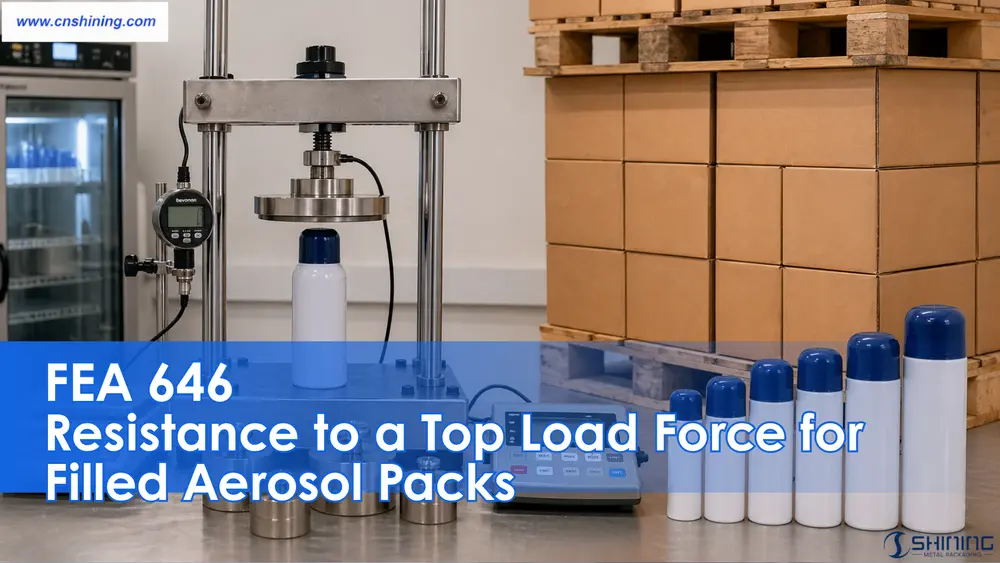
Standard Overview
FEA 646 is an industry standard issued by the European Aerosol Federation (FEA) that defines a test method to evaluate the resistance of filled aerosol packs to vertical top load forces.
The test simulates static loads experienced during palletised storage and transport, where aerosols may be subjected to prolonged compression from stacked pallets above.
Scope and Purpose
The method is intended as a development and pre-validation tool, used before formal dangerous goods testing.
It provides data on:
- Cap creep and permanent deformation
- Progressive displacement of the overcap or actuator
- Accidental actuation detected by product loss
Safety Considerations
If accidental actuation occurs, flammable contents may be released. For safety reasons:
- Test aerosols are preferably filled with water
- Internal pressure is reproduced using compressed gas
- Test rooms must be well ventilated
Test Equipment
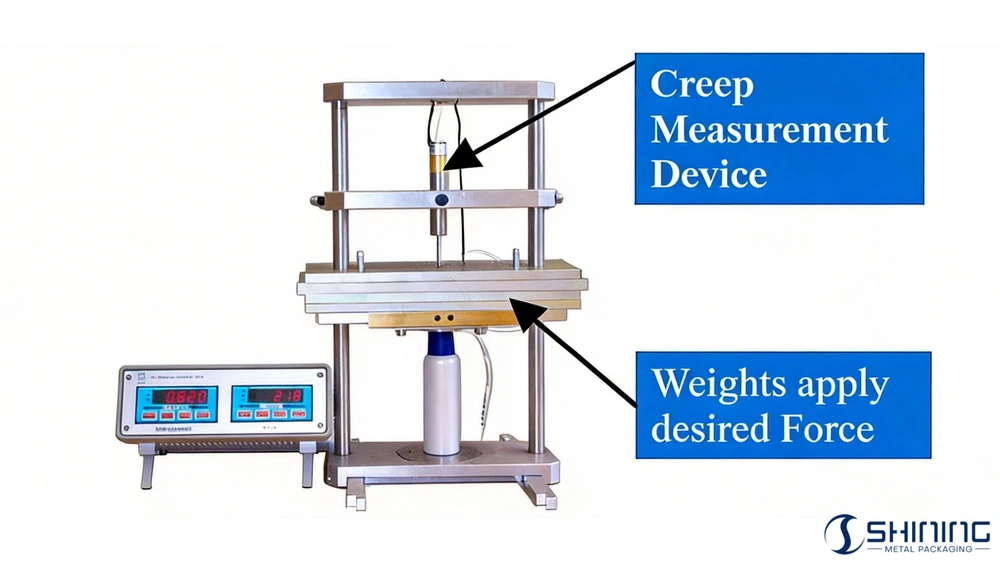
The equipment includes:
- A rigid frame with load application plate
- Calibrated weights to apply the desired force
- A displacement (creep) measurement device
- A balance readable to 0.01 g
- Temperature conditioning equipment (±1 °C)
Sample Conditioning
Before testing:
- Condition aerosols and test rig for 24 hours
- Set the test temperature (e.g. 0 °C, 20 °C, 35 °C, 45 °C)
- Weigh each test aerosol to 0.01 g
Temperature selection is critical, as cap creep is highly temperature-dependent.
Test Procedure
- Place the aerosol upright on the test rig
- Apply the calculated top load evenly to the load plate
- Zero the movement detector
- Record displacement every 24 hours
- Inspect regularly for signs of actuation
The test continues until:
- Accidental actuation occurs, or
- Three identical displacement readings are recorded consecutively
Final Inspection
At the end of the test:
- Reweigh the aerosol to detect product loss
- Inspect overcap and actuator for cracks or distortion
- Document permanent deformation
Calculation of Maximum Theoretical Static Load
FEA 646 provides simplified engineering formulas to estimate the maximum theoretical static vertical load acting on an individual aerosol pack during palletised storage.
These calculations are based on experimental observations of load distribution in pallet stacks and are intended for risk assessment and test definition, not for precise structural design.
Single Pallet Load
For a single pallet load, research shows that the highest static load occurs on the aerosols located in the lowest layer of the pallet.
The maximum theoretical static load acting on one aerosol can be estimated using:
Lmax = (Mg − Mp − Ml) ÷ Nl
Meaning of the Parameters
- Lmax – Maximum theoretical static load acting on a single aerosol (N or kgf, depending on unit system).
- Mg – Gross mass of the fully loaded pallet, including aerosols, pallet, and any packaging materials.
- Mp – Mass of the empty pallet itself.
- Ml – Total mass of the aerosols in the lowest layer of the pallet.
- Nl – Number of aerosols in the lowest layer that are supporting the load.
This formula assumes that the load above the lowest layer is distributed evenly across all aerosols in that layer.
Multiple Stacked Pallet Loads
When pallets are stacked on top of each other, research has shown that the load is not distributed uniformly across all aerosols in the lower pallet.
The highest load is carried by the aerosols located in the top layer of the lowest pallet, directly underneath the pallet boarding of the pallet above.
For this situation, the maximum theoretical static load can be estimated using:
Lmax = 6 x ΣMg ÷ Nb
Meaning of the Parameters
- Lmax – Maximum theoretical static load acting on a single aerosol in the critical load zone.
- ΣMg – Sum of the gross masses of all pallet loads stacked above the lowest pallet. The lowest pallet itself is excluded from this sum.
- Nb – Number of aerosols in the top layer of the lowest pallet that are actually taking the load, i.e. those located directly beneath the pallet boarding of the pallet above.
- 6 – Empirical load concentration factor. This factor accounts for the flexibility of pallet boards, which causes the load to be concentrated on a limited number of aerosols rather than being evenly distributed.
The factor 6 was derived empirically during testing of beverage cans and represents a conservative assumption for load concentration.
Applicability: This calculation method is considered valid for aerosol cans with diameters between 45 mm and 65 mm, when stacked on GKN pallets or Europallets.
Practical warning: For non-standard pallet designs, plastic pallets, or very lightweight cap constructions, additional validation testing is recommended.
Limitation: Dynamic loads during transport are not considered.
Engineering Significance
FEA 646 is particularly valuable for:
- Spray-through caps and domes
- Lightweight cap designs
- Products transported in hot climates
It bridges the gap between:
- Structural pressure testing (FEA 621 / 623)
- Real-world storage and logistics conditions
Relationship with Other FEA Standards
- FEA 606 – Hot water bath safety testing
- FEA 621 – Pressure resistance of empty containers
- FEA 623 – Mechanical resistance of filled packs
- FEA 643 – Discharge rate performance
Download the Standard PDF
FEA 646 standard describing a test method for evaluating the resistance of filled aerosol packs to top load forces. It outlines procedures to measure cap creep, deformation, and accidental actuation under simulated pallet stacking conditions to assess packaging strength during transport and storage.
FAQ – Engineering, QA & Procurement
No. It is a development and risk assessment method used before mandatory dangerous goods testing.
Most cap polymers soften with heat. Creep behaviour at 45 °C can differ dramatically from 20 °C.
No. It evaluates static vertical loads only. Dynamic testing requires additional methods.
Yes. Variations at the container–cap interface can significantly influence creep behaviour.
Accidental actuation, continuous displacement, or permanent cap deformation are all considered failures.