
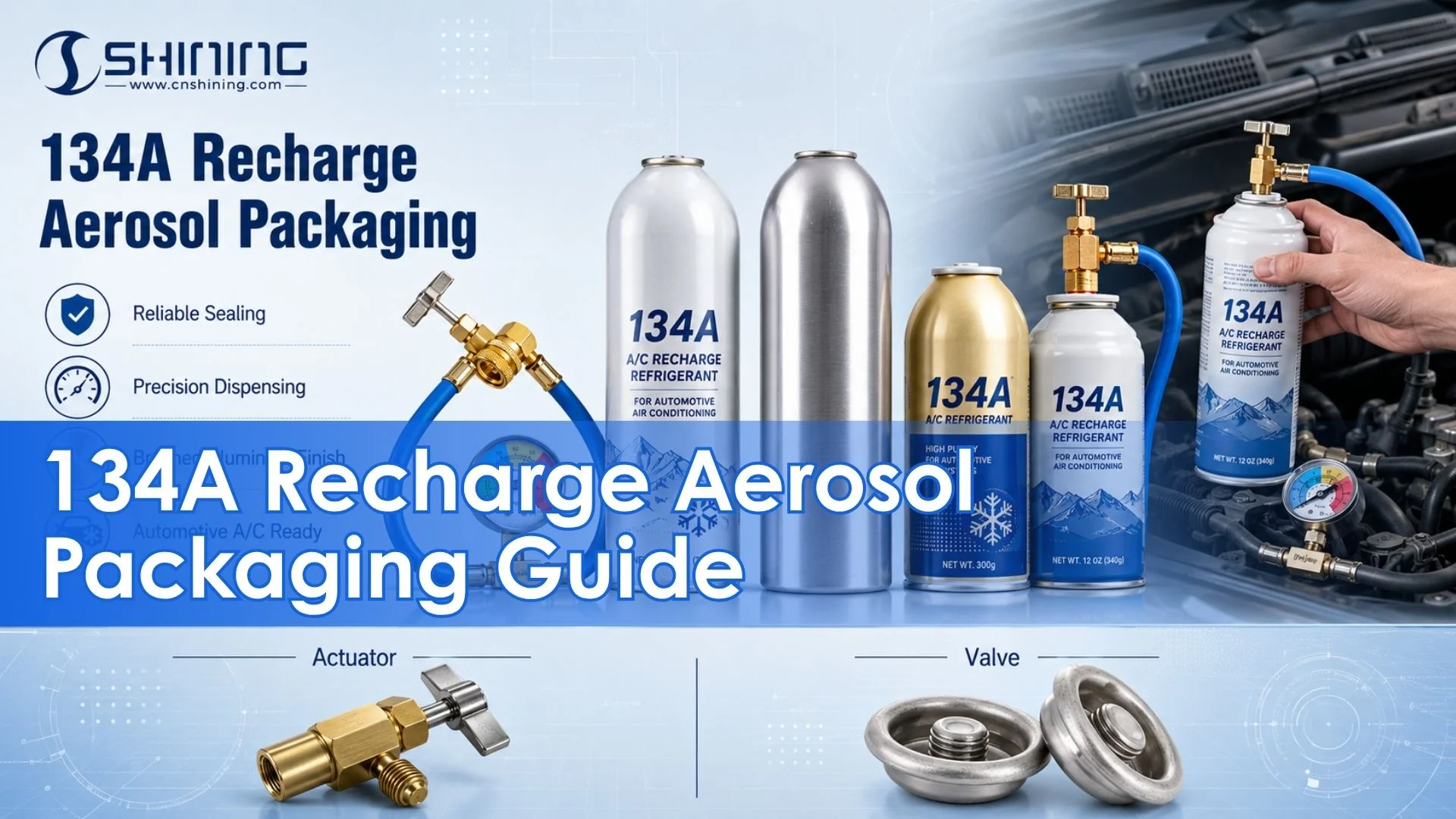
A 134A recharge aerosol is not a precision charging machine. It is a small, retail-ready MVAC refill package that puts HFC-134a refrigerant, a valve, a hose, a low-side coupler, a simple pressure indicator and sometimes oil or stop-leak additive into one consumer-facing product.
The technical value is simple: it compresses a workshop operation into a one-way, low-pressure-side DIY charging process. That is also where the risk starts. The can does not recover refrigerant, evacuate air, weigh the charge or diagnose a leak. It moves refrigerant because the can pressure is higher than the running system’s low-side pressure.
1. Product Definition and Working Mechanism
In the U.S. regulatory context, this product falls close to the category of small containers of automotive refrigerant, generally between about 2 oz and 2 lb for MVAC service use. Products usually split into two groups: pure R-134a refill cans, and recharge kits that combine R-134a with PAG oil, lubricant, rubber seal conditioner, UV dye, anti-acid or moisture-control additives.
At room temperature, R-134a inside the can exists as a liquid-vapor equilibrium. The pressure is not created by a pump. It is set by temperature-dependent saturated vapor pressure. Chemours’ Freon 134a technical data shows why this matters: vapor pressure, density and temperature are linked, and the packaging must be selected for pressurized aerosol use.
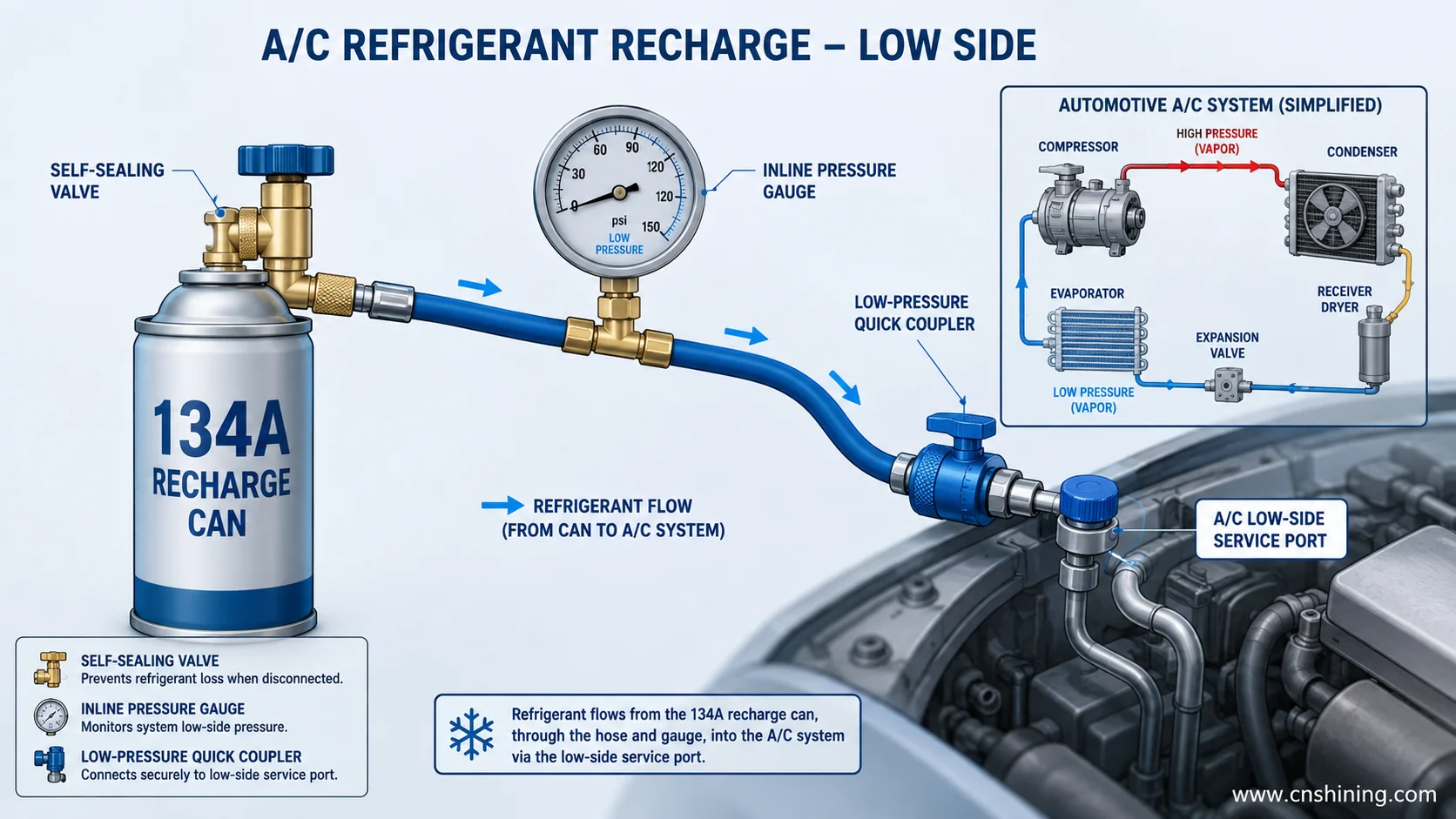
Can internal R-134a liquid/vapor balance
        ↓
Self-sealing valve or older piercing valve
        ↓
Actuator / trigger / turn-and-push mechanism
        ↓
Hose and low-pressure gauge
        ↓
Low-side quick coupler
        ↓
Vehicle A/C low-side service port
        ↓
System low-side pressure rises; user stops by gauge/temperature cue
Most user instructions ask the engine to run, A/C to be set to maximum, blower to high, and the can to be kept upright while being slowly rotated or shaken. This confirms the basic mechanism: pressure-difference charging, not mass-based charging.
Valve and Connection Options
Since 2018, the U.S. mainstream retail market has shifted toward self-sealing valves. The Federal Register rule clarified the sale of small cans and the role of self-sealing valves for containers holding two pounds or less of MVAC refrigerant. Federal Register small-can refrigerant rule
On the vehicle side, EPA requires unique fittings for SNAP-approved MVAC refrigerants to reduce mixing and misconnection. This is why R-134a and R-1234yf cans, service ports and charging hardware should not be treated as interchangeable. EPA MVAC servicing requirements
| Valve / Format | How It Works | Technical Advantage | Weak Point | Market Status |
|---|---|---|---|---|
| Self-sealing valve | Connector depresses an internal valve core; valve closes after hose removal. | Stores unused refrigerant, reduces release, supports compliance. | Needs correct actuator depth and compatible hose hardware. | Mainstream in U.S. retail after 2018. |
| Piercing valve | Needle pierces the can top and creates a permanent opening. | Simple and compatible with older tools. | Unused refrigerant is hard to retain; accidental release risk is higher. | Mostly old stock and older tools. |
| Built-in disposable hose | Short hose and button/trigger are attached to the can. | Lower accessory barrier for first-time users. | Shorter hose, less reusable, weaker service feel. | Common in entry-level SKUs. |
| Reusable hose with gauge or electronic cue | Separate hose assembly connects to multiple cans. | Better handling and room for Smart Clip or digital indicators. | Higher kit price; still not true mass charging. | Common in mid- to higher-tier retail kits. |
2. Market Size, Regional Pattern and Supply Chain
The 2025 global retail GMV for R-134a recharge aerosol cans and recharge kits can be at $250–$450 million. North America dominates. By 2030, the likely range moves toward $220–$420 million, with low growth or mild contraction. The reason is not sudden technical failure. The serviceable vehicle base is narrowing as regulations, HFC quotas, R-1234yf adoption and professional service alternatives apply pressure.
| Region | 2025 Market Size | 2020–2025 CAGR | 2030 Outlook | Explanation |
|---|---|---|---|---|
| Global | $250–$450 million | 0%–4% | $220–$420 million | North America remains large; Europe shrinks; R-1234yf substitution increases. |
| North America | $140–$240 million | 1%–5% | $120–$220 million | Old vehicle stock, DIY culture and price gap support demand; state restrictions add friction. |
| Europe | Below $10 million | -8% to -15% | Continued contraction | Non-refillable F-gas container restrictions and R-134a exit from new cars limit legal retail space. |
| China | $20–$60 million | 3%–8% | $20–$70 million | R-134a base is large; retail small-can data is not transparent and may sit in semi-professional channels. |
| Latin America | $30–$80 million | 2%–6% | $30–$90 million | Hot climate, older vehicles and mixed DIY/street repair patterns support demand. |
| APAC excluding China | $40–$90 million | 1%–5% | $40–$100 million | Japan and Australia are stricter; Southeast Asia and India are more mixed. |
Supply chain risk sits upstream first. The can is visible, but refrigerant supply, HFC allocation and reclaimed R-134a availability shape cost and compliance. Downstream, the visible parts are aerosol filling, valve and spring selection, sealing materials, 1/2″ ACME cap, low-side connector, hose, pressure gauge, carton, hazmat logistics and retailer compliance.
3. Formulation, Compatibility and Alternatives
Retail formulation labels are often less clear than technicians would like. Many products say “R-134a + additives,” “plus oil,” “with stop leak,” or “with UV dye,” without disclosing each chemical component. The ranges below should be read as typical public-label estimates, not as a unified industry standard.
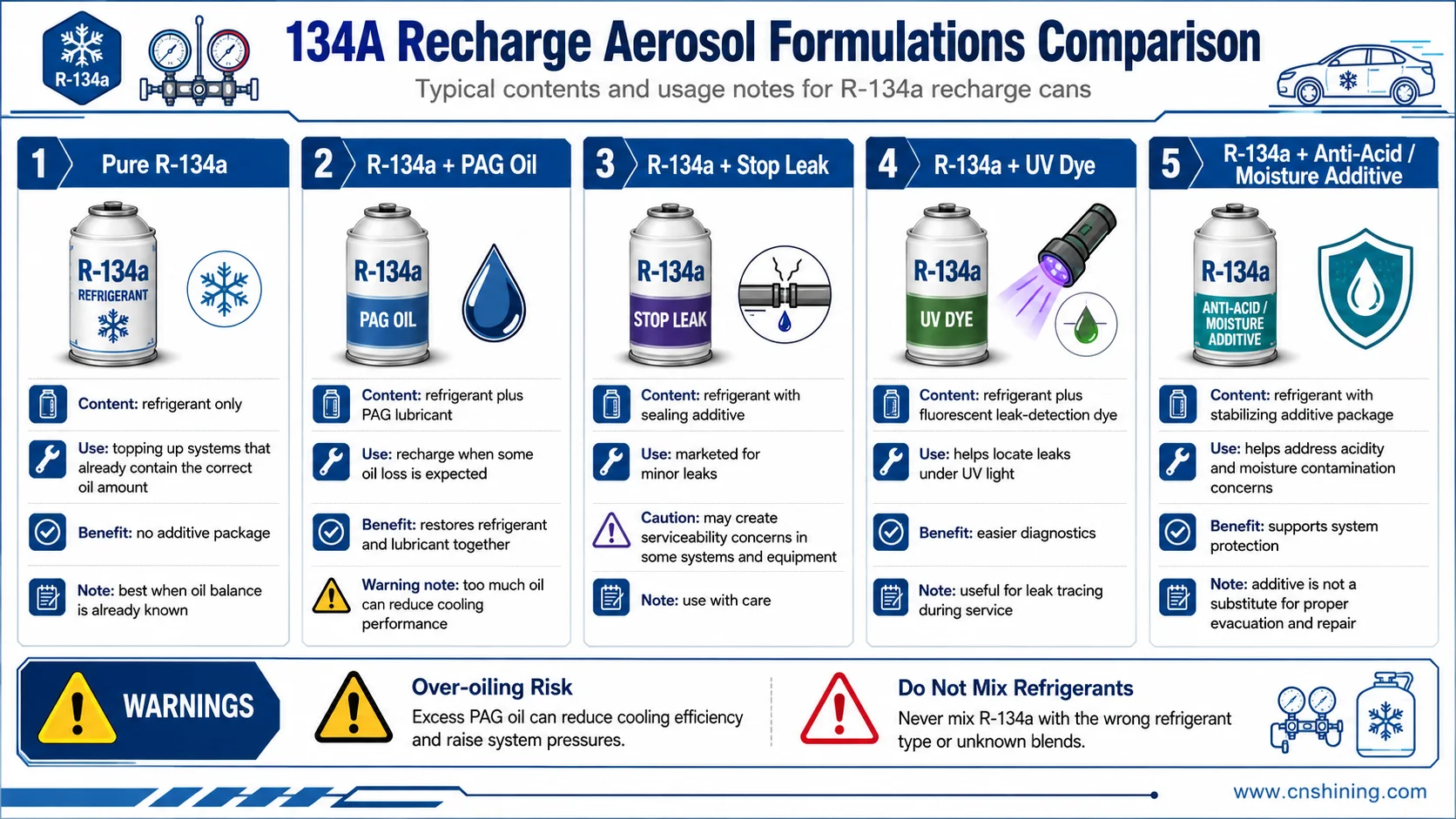
| Formulation Type | Main Function | Publicly Visible Typical Ratio | Compatibility / Risk Judgment |
|---|---|---|---|
| Pure R-134a | Replaces lost refrigerant without adding oil or sealant. | About 99%–100% R-134a; exact purity usually managed through refrigerant standards rather than retail copy. | Best when oil level is known to be correct and only refrigerant is low. |
| R-134a + oil / lubricant | Adds refrigerant and small oil or conditioner charge. | Examples include about 17 oz R-134a + 3 oz additive in a 20 oz kit, or about 11 oz + 1 oz in some 12 oz stop-leak SKUs. | Convenient, but over-oiling is possible if the original system does not lack oil. |
| R-134a + stop leak | Attempts temporary sealing of rubber part, O-ring or hose seepage. | Mostly R-134a with a small seal conditioner / stop-leak package; exact chemistry is often undisclosed. | May help very small elastomer leaks; does not repair metal corrosion, cracked hardware or major leaks. |
| R-134a + UV dye | Recharges while helping locate leak points under UV light. | Some SKUs disclose 10 oz R-134a + 0.25 oz additive. | Better diagnostic value than blind charging; dye is not a repair. |
| R-134a + anti-acid / anti-moisture additive | Attempts to reduce secondary damage from acid, moisture or corrosion. | Often described as a feature; exact ratio is rarely published. | Effect depends on system condition. It cannot replace evacuation, dehydration and repair. |
| Propellant role | In this category, R-134a often acts as both refrigerant and aerosol propellant. | No separate hydrocarbon propellant is normally disclosed in mainstream reviewed SKUs. | This separates recharge aerosol cans from many household aerosol products. |
Compatibility risk starts with refrigerant identity. A vehicle built for R-134a should not be randomly charged with R-1234yf, and a R-1234yf system should not be treated as an R-134a system. EPA lists acceptable MVAC refrigerants and their environmental impacts, including the much lower GWP of HFO-1234yf compared with HFC-134a. EPA acceptable MVAC refrigerants and impacts
Oil is the second problem. “Plus oil” is easy to sell, but oil is not a universal medicine. Wrong PAG grade, universal oil, PAO confusion, excess oil or oil used in the wrong compressor type can reduce lubrication quality and heat transfer. Hybrid and electric compressors add another layer because insulation and oil compatibility matter.
| Option | Advantage | Weak Point | Best-Fit Scenario |
|---|---|---|---|
| 134A recharge aerosol | Low cost, fast, retail-accessible, simple low-side charging. | Charge amount is approximate; no evacuation, recovery or true leak diagnosis. | Confirmed R-134a older vehicle, minor loss, short-term cooling recovery. |
| Bulk R-134a cylinder | Lower refrigerant cost per unit and better fit for weighed charging. | Certification, equipment and proper handling are needed. | Professional shop or fleet maintenance. |
| R-1234yf small can | Fits newer vehicles and low-GWP direction. | Higher cost, different fittings, different oil system, mild flammability considerations. | Confirmed R-1234yf vehicle with correct hardware and process. |
| Professional service | Recovery, evacuation, leak check, weighed recharge and component repair. | Higher cost and time. | Unknown leak, opened system, suspected overcharge, contamination or compressor fault. |
| DIY hose / gauge tool kit | Reusable and lower long-term accessory cost. | Still not a full manifold, vacuum pump or recovery machine. | Experienced user with multiple older R-134a vehicles. |
4. Regulation, Standards and Patent Direction
This category can still be sold in some markets, but the space is getting narrower. The direction is clear: lower emissions, lower GWP refrigerants, self-sealing containers, reclaimed refrigerant and tighter state or regional controls.
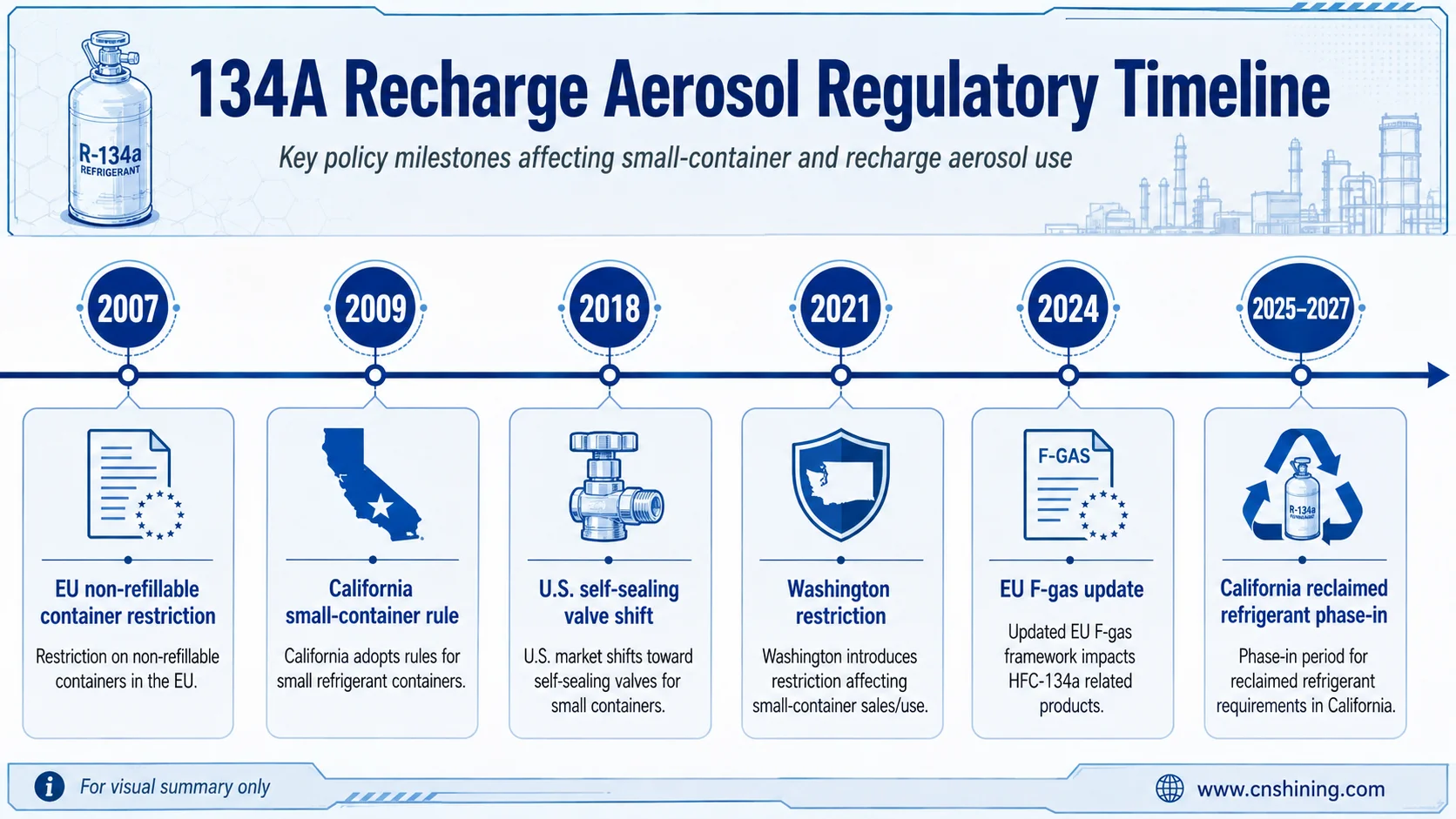
| Year | Regulatory / Market Event | Impact on 134A Recharge Aerosol |
|---|---|---|
| 2007 | EU restriction on non-refillable F-gas containers for service and filling use. | Retail disposable R-134a small-can space is heavily limited in Europe. EUR-Lex Regulation (EC) No 842/2006 |
| 2009–2010 | California adopted and implemented small-container automotive refrigerant rules. | Self-sealing valve, labeling, education and return programs became a strong regulatory model. CARB consumer requirements for small containers |
| 2018 | U.S. small cans moved to self-sealing valve format for current mainstream retail supply. | Valve design and hose compatibility became product-line issues. |
| 2021 | Washington State restricted sale and distribution of small cans containing high-GWP refrigerant. | National SKU planning became more state-specific. Washington State small cans of refrigerant |
| 2025–2027 | California moves toward phased reclaimed refrigerant requirements for small containers. | Competition shifts from “self-sealing valve only” toward traceable reclaimed R-134a. |
EPA refrigerant sales rules also matter because they define who can buy which refrigerants and under what conditions. EPA refrigerant sales restriction
5. Top 10 134A Recharge Aerosol Brands
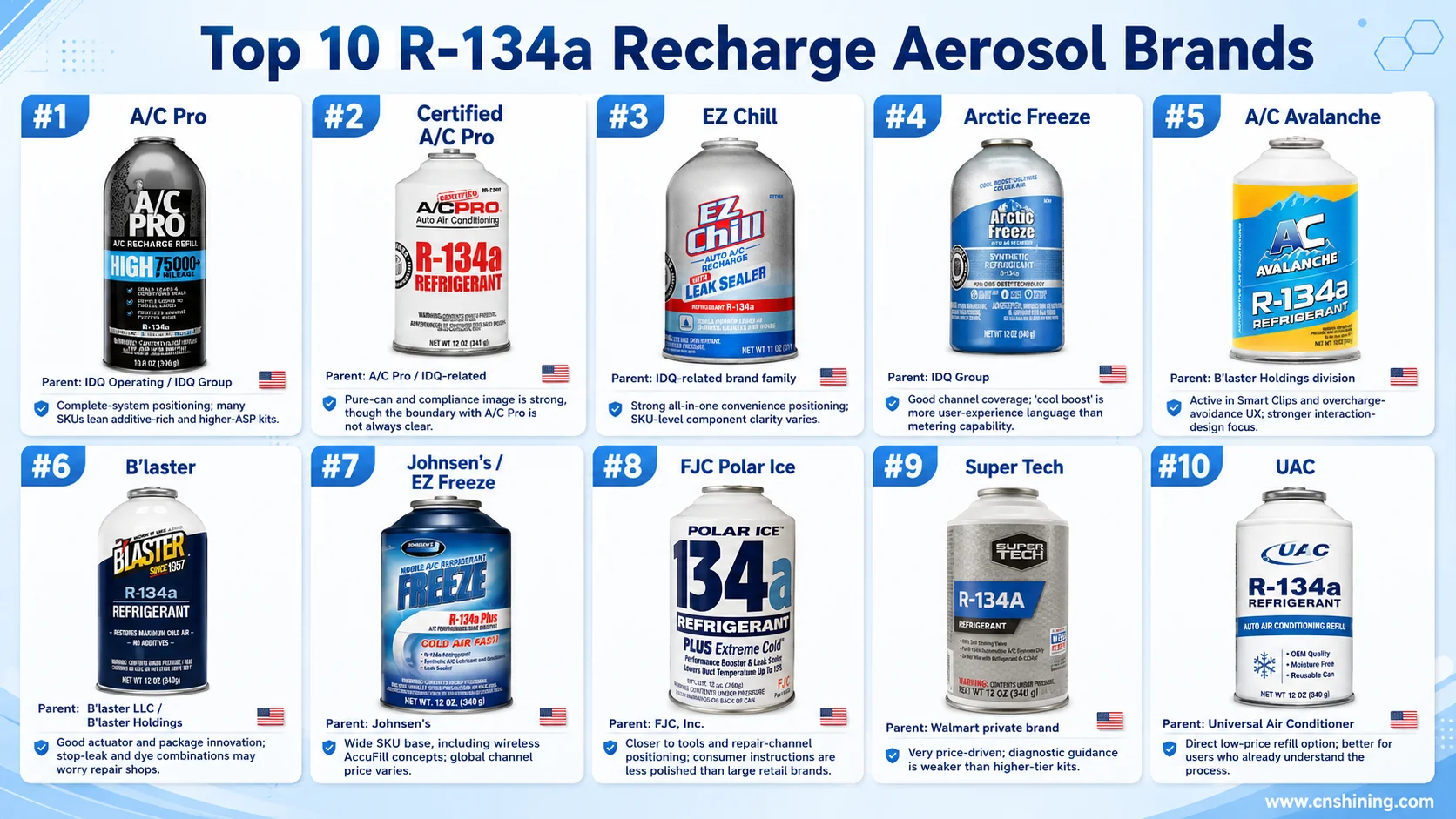
| Brand | Country | Parent / Brand Owner | Typical Capacity | Typical Retail Price | Technical Comment |
|---|---|---|---|---|---|
| A/C Pro | U.S. | IDQ Operating / IDQ group | 12 oz, 18 oz, 20 oz | about $34.95–$59.99 | Complete system positioning; many SKUs lean toward additive-rich, higher-ASP kits. |
| Certified A/C Pro | U.S. | A/C Pro / IDQ-related evidence | 12 oz, 20 oz | about $20.04–$48.99 | Pure-can and compliance image is strong, but brand boundary with A/C Pro is not always clear. |
| EZ Chill | U.S. | IDQ-related brand family evidence | 9.25 oz, 10.25 oz, 12 oz, 16.8 oz | about $19.99–$40.58 | Strong “all-in-one” convenience positioning; SKU-level component clarity varies. |
| Arctic Freeze | U.S. | IDQ group | 12 oz, 14 oz, 19 oz, 22 oz | about $19.97–$50.99 | Good channel coverage; “cool boost” is more user-experience language than metering capability. |
| A/C Avalanche | U.S. | B’laster Holdings division | 12 oz, 18 oz | about $30–$51 | Active in Smart Clips and overcharge-avoidance UX; stronger interaction design focus. |
| B’laster | U.S. | B’laster LLC / B’laster Holdings | 12 oz, 18 oz, 20 oz | about $34.99–$45 | Good actuator and package innovation; stop-leak and dye combinations may worry repair shops. |
| Johnsen’s / EZ Freeze | U.S. | Johnsen’s | 12 oz, 18 oz, 20 oz | about $10–$36 | Wide SKU base, including wireless AccuFill concepts; global channel price varies. |
| FJC Polar Ice | U.S. | FJC, Inc. | 12 oz, 12.5 oz | about $13.76–$26.99 | Closer to tools and repair-channel positioning; consumer instructions are less polished than large retail brands. |
| Super Tech | U.S. | Walmart private brand | 12 oz, 18 oz | about $9.98–$32.88 | Very price-driven; diagnostic guidance is weaker than higher-tier kits. |
| UAC | U.S. | Universal Air Conditioner | 12 oz | about $11.95 | Direct low-price refill option; better for users who already understand the process. |
The competitive line is clear. One group sells brand trust, guided use and leak narratives. Another sells price and pure refrigerant. A third sits closer to repair tools. The real separation is no longer the refrigerant alone. It is the valve, actuator, gauge, hose, label, compatibility logic and compliance package.
6. Packaging Components for 134A Recharge Aerosol: Actuator, Can and Valve
From a metal-packaging view, the refrigerant is only one part of the design. The package must handle internal pressure, temperature fluctuation, valve compatibility, sealing material selection and user handling. For this type of product, the actuator and valve often decide whether the consumer can use the can safely.
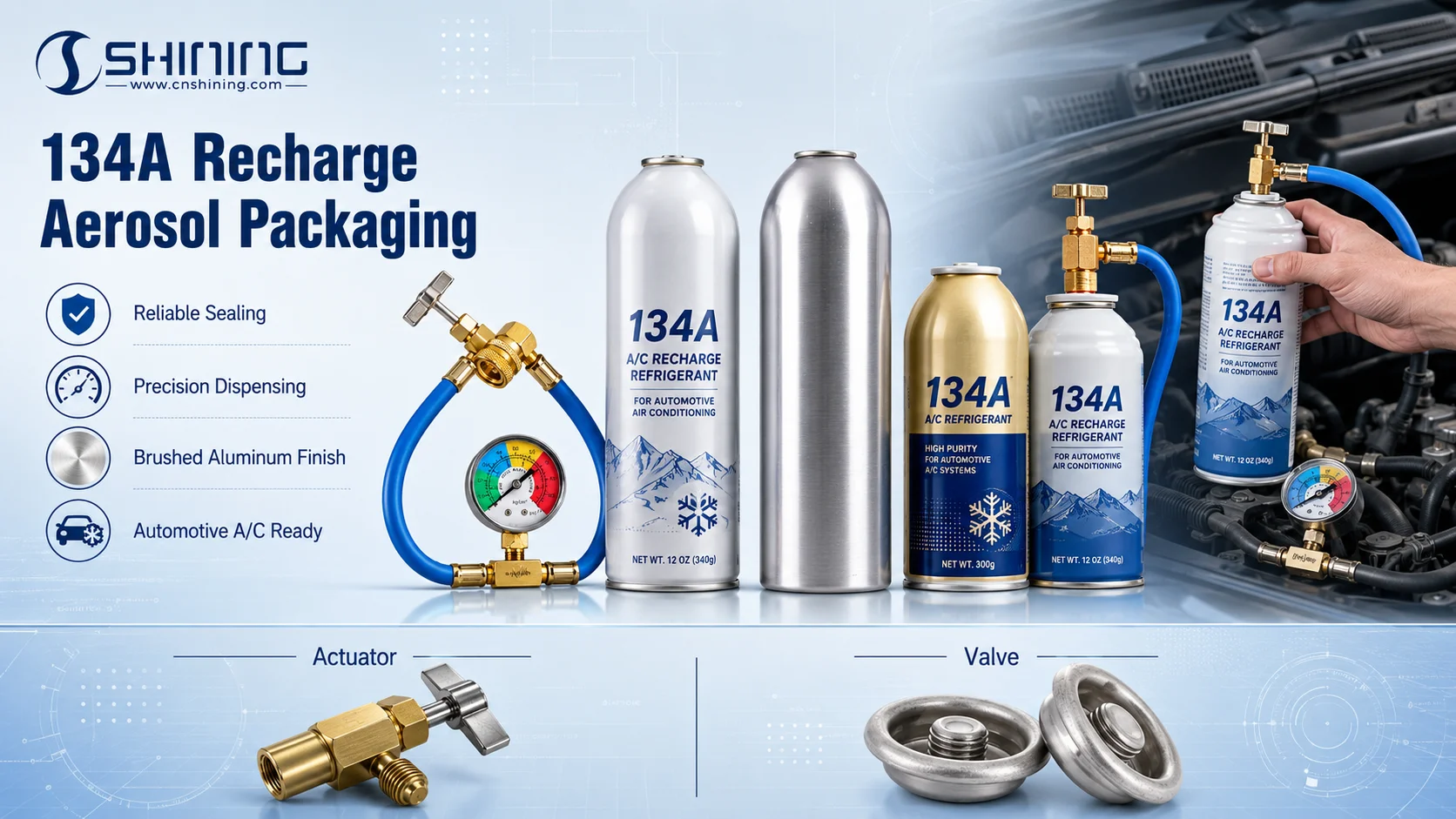
Shining Packaging is relevant here at the component level: aerosol cans, valves and actuators. For a 134A recharge aerosol project, the useful engineering discussion is not “how to make the refrigerant colder.” It is how the can and valve system behaves under pressure, whether the actuator gives clear tactile feedback, whether the stem geometry fits the self-sealing valve, and whether the gasket material remains stable against R-134a and additive blends.
| Component | Technical Role | Risk to Check | Practical Design Point |
|---|---|---|---|
| Aerosol can | Contains pressurized R-134a and additive blend during storage, transport and use. | Pressure resistance, corrosion, inner coating compatibility, temperature exposure. | Use pressure-rated metal packaging and verify with storage and compatibility testing. |
| Self-sealing valve | Controls refrigerant release and closes after the hose is removed. | Stem tolerance, spring force, seal swelling, leakage after partial use. | Match actuator travel and connector geometry early in package validation. |
| Actuator / trigger | Converts user force into controlled valve opening. | Accidental discharge, poor hand feel, unclear open/closed state. | Two-step lock, tactile click and stable grip reduce handling mistakes. |
| Gasket and sealing parts | Prevent leakage at valve, stem and connector interfaces. | Compatibility with R-134a, PAG oil, dye or stop-leak additive. | Test against the real filled formulation, not only pure refrigerant. |
| Cap / collar / external fitting | Protects the valve and supports connection with hose hardware. | Wrong adapter, old piercing tool mismatch, consumer confusion. | Clear geometry and label coding reduce misconnection. |
7. User Feedback and Product Improvement Tasks
Public user feedback repeats the same technical problems: low-side gauge confusion, overcharging, wrong refrigerant choice, old hose and new self-sealing can mismatch, stop-leak concerns, cold can handling, and temporary cooling without root-cause repair.
| User Pain Point | Better Technical Solution | Expected Effect |
|---|---|---|
| User cannot tell R-134a from R-1234yf. | Use stronger shoulder, cap and connector geometry differences; front label should say “Only for R-134a underhood label.” | Reduces wrong purchase and wrong charge events. |
| Single low-side gauge misleads the user. | Add ambient-temperature compensation and outlet-air temperature cross-check; low-cost electronic cue or Smart Clip can help. | Reduces overcharge and undercharge risk. |
| Self-sealing can and old piercing hose mismatch. | Add a compatibility card and QR visual tutorial; include adapter only where allowed and technically safe. | Reduces returns and negative reviews. |
| Accidental discharge during handling. | Use two-stage lock, tactile click and turn-and-push actuator logic. | Improves safety and user confidence. |
| Stop-leak content is not obvious. | Front label should clearly mark PURE / OIL / STOP LEAK / UV DYE / HYBRID SAFE status. | Reduces repair-shop conflict and wrong product selection. |
| Can gets cold and is awkward to hold. | Add insulating grip sleeve, anti-roll base and longer flexible hose. | Improves hand safety and engine-bay handling. |
| Hybrid and electric compressor concern. | Provide clear oil compatibility guidance by vehicle type and compressor system. | Reduces damage risk in higher-value systems. |
8. Conclusion
A 134A recharge aerosol is useful when the vehicle is confirmed as R-134a, the system is only mildly low, and the user accepts that the process is approximate. It is weak when the system has an unknown leak, wrong oil history, compressor fault, contamination or previous stop-leak use.
For packaging and component suppliers, the opportunity is not to make broad claims about “colder air.” The useful work is more concrete: self-sealing valve reliability, actuator feel, compatibility with hose hardware, clear labeling, pressure-safe cans, additive-resistant coatings and fewer ways for users to connect the wrong thing.
9. FAQ: 134A Recharge Aerosol
A 134A recharge aerosol is a small MVAC refill product that stores HFC-134a in a pressurized can and feeds it into the vehicle low-pressure side through a hose and quick coupler. It may be pure refrigerant or a kit with oil, UV dye, stop-leak additive and a simple pressure indicator. It is not a recovery, evacuation or precision charging machine.
The low-side port is used because it is on the suction side of the running A/C system, where pressure is lower than the can’s temperature-driven vapor pressure. This pressure difference lets refrigerant move into the system. The low-side coupler also reduces the chance of connecting to the high-pressure side, but it does not guarantee the correct charge amount.
Yes. A self-sealing valve opens when the compatible connector depresses the internal valve and closes again after the hose is removed. A piercing valve punctures the can and creates a permanent opening. Self-sealing valves reduce leftover refrigerant release and support current U.S. small-can compliance, but they require compatible actuator and hose dimensions.
No. A single low-side gauge gives only a partial pressure signal. It cannot show the high side, recovered weight, air contamination, refrigerant mass or true leak condition. Ambient temperature, compressor cycling and poor coupler engagement can all distort the reading. That is why professional service uses recovery, evacuation, weighing and manifold or machine-based diagnosis.
A plus-oil product is convenient only when the system actually needs that oil type and amount. If the original system oil level is already correct, extra oil can reduce cooling performance and affect compressor lubrication. Wrong PAG grade, universal oil confusion or use in hybrid/electric compressors can create higher repair risk than a pure refrigerant refill.
Stop leak may temporarily slow minor seepage at rubber seals, O-rings or hoses. It does not repair corroded metal, cracked condensers, bad compressors, damaged service valves or large leaks. Some repair shops are cautious with stop-leak-treated systems because additives may contaminate recovery equipment or complicate later diagnosis and flushing work.
They should not be mixed. R-134a and R-1234yf use different refrigerant systems, fittings, labels and often different oil requirements. Mixing refrigerants can affect performance, recovery, service equipment and legal handling. The vehicle underhood label should be checked before buying any recharge product, especially on newer vehicles where R-1234yf is common.
Europe restricted non-refillable F-gas containers used for service, maintenance or filling applications, and new passenger cars moved away from R-134a initial fill after the MAC Directive timeline. The result is a much smaller legal retail space for disposable R-134a recharge cans. Professional refillable cylinders and lower-GWP refrigerant systems are more aligned with the European route.
The key package parts are the pressure-rated metal can, self-sealing valve, actuator, gasket, cap, hose interface and low-side connector. Each must match the refrigerant and additive package. Valve stem tolerance, seal swelling, actuator travel and coating compatibility should be tested with the final filled formulation, not only with empty hardware or pure refrigerant.
HFC phase-down rules increase pressure on virgin refrigerant supply and emissions management. California’s small-container amendments point toward phased use of reclaimed refrigerant in small cans. This shifts competition from simple retail convenience toward traceable refrigerant sourcing, compliant filling, better recovery systems and packaging that reduces leftover refrigerant release after partial use.