
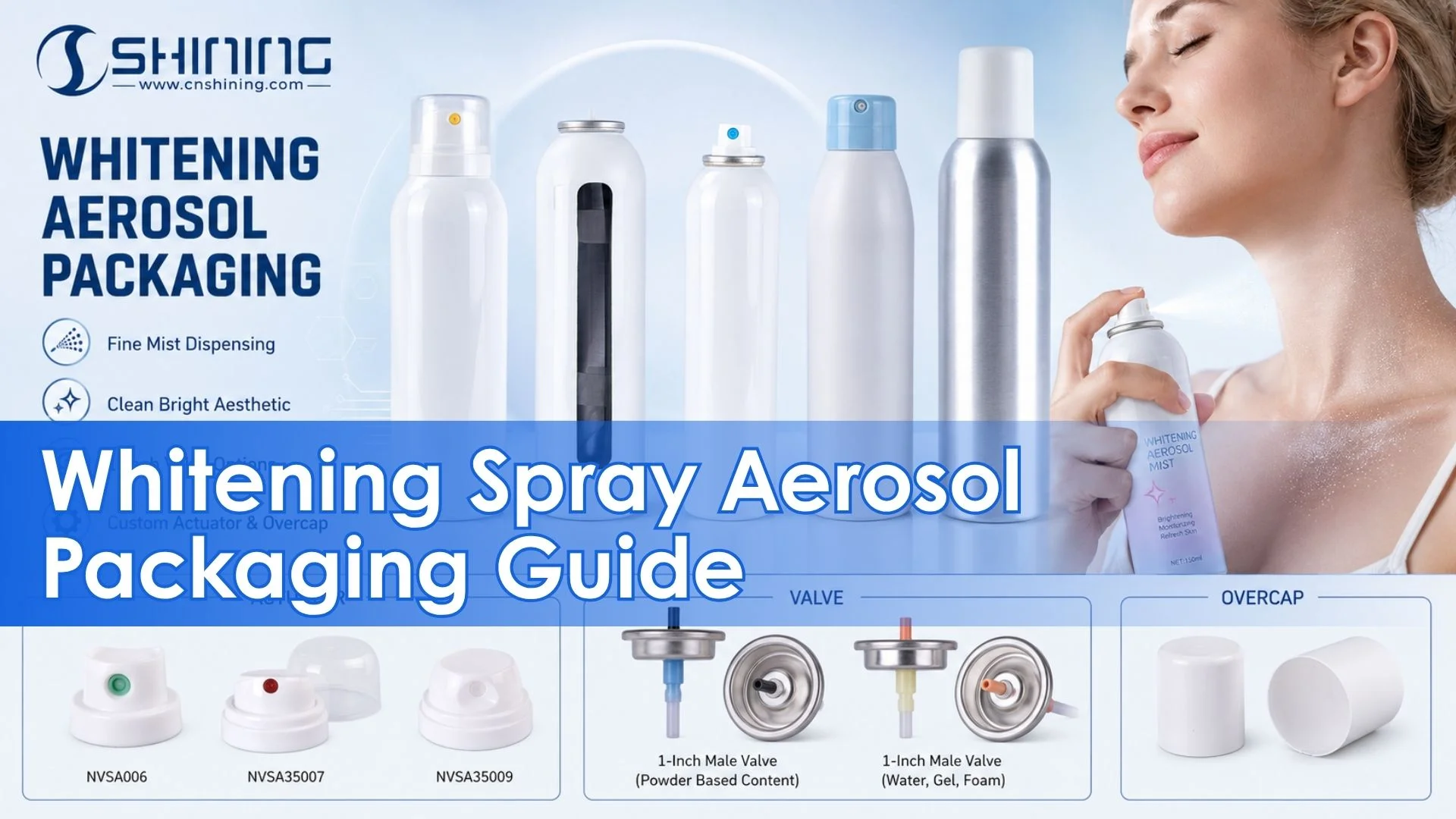
Tone-evening body spray, dark-spot body mist, underarm even-tone spray, brightening aerosol and whitening aerosol spray often describe the same commercial direction: a topical product delivered as a fine mist to improve uneven tone, dullness or visible pigmentation. The aerosol format does not make the active stronger. Its value is more practical: faster coverage, better access to the back or underarm area, lower hand contact, quicker drying and more controlled deposition.
The technical problem is also clear. A whitening aerosol spray must connect four things that do not always cooperate: skin-brightening chemistry, aerosol mechanics, packaging compatibility and cosmetic regulation. If one part is weak, the product usually fails through odor, irritation, leakage, poor spray feel or unrealistic whitening claims.
1. Product Definition and Competitive Formats
1.1 Definition and Working Principle
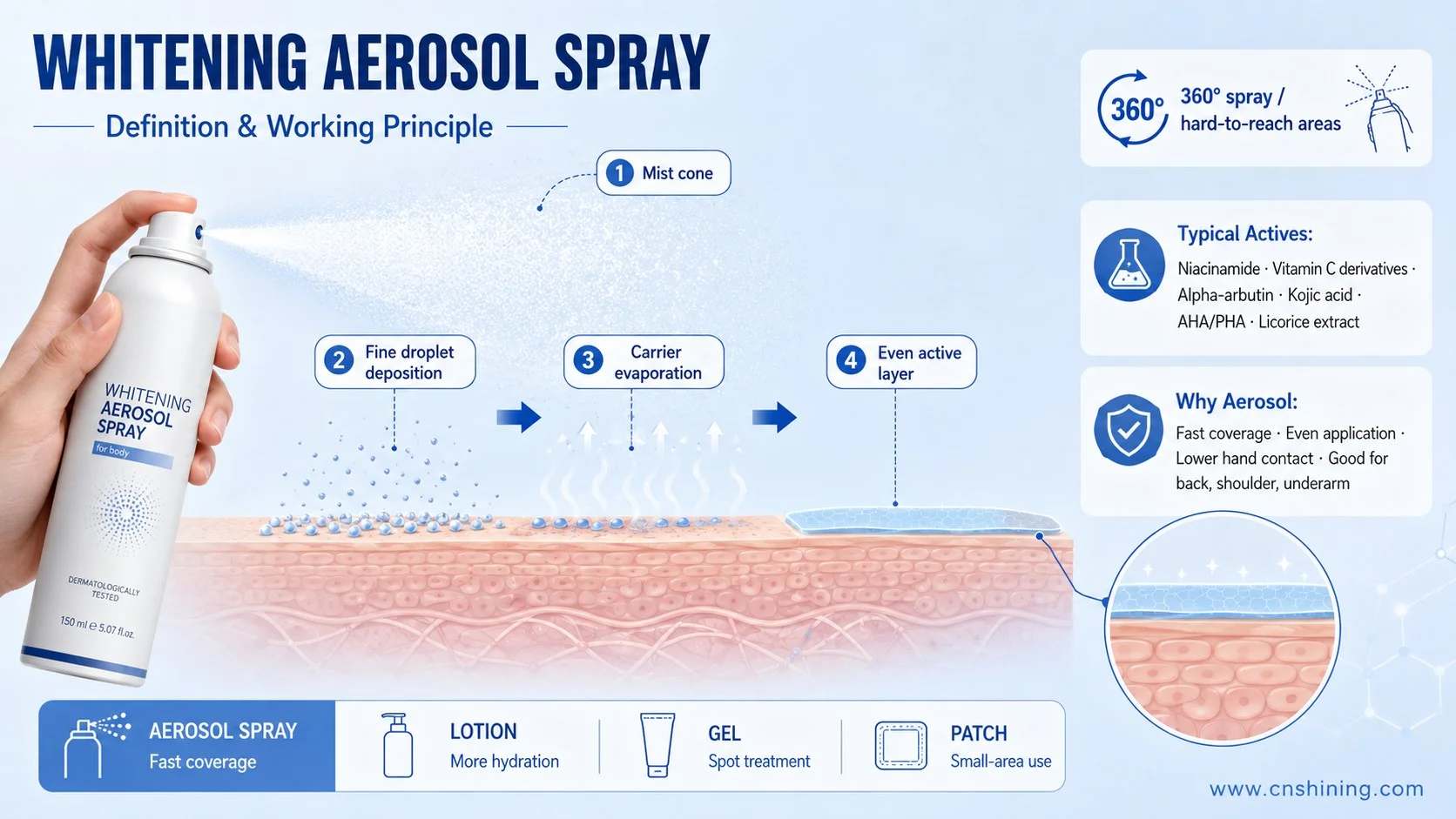
From a formulation point of view, whitening aerosol spray is not “instant white skin in a can.” It is a spray-delivered topical product designed to deposit brightening or tone-evening ingredients more evenly across the skin surface. The active pathways normally include melanosome-transfer control, tyrosinase-pathway inhibition, mild exfoliation, antioxidant support and inflammation management.
Commonly used actives include niacinamide, vitamin C derivatives, alpha-arbutin, arbutin, kojic acid, AHA or PHA acids, licorice extract and selected resorcinol derivatives. Niacinamide is often used for uneven tone and post-inflammatory pigmentation support; DSM-Firmenich’s technical page is one public reference for niacinamide in beauty care.
For an aerosol product, the engineering path is different from lotion. Product passes through the valve and actuator, pressure drop and mechanical shear form droplets, volatile carrier evaporates, and the active layer remains on the skin. In bag-on-valve aerosol systems, product and propellant are separated, which supports 360-degree dispensing, compressed air or nitrogen propellant options, and lower direct VOC pressure compared with conventional hydrocarbon systems.
1.2 Comparison with Lotion, Gel, Patch and Non-Aerosol Spray
| Format | Main Strength | Main Weakness | Best-Fit Use Case | Design Lesson for Whitening Aerosol Spray |
|---|---|---|---|---|
| Aerosol spray | Fast coverage, 360-degree use, hard-to-reach areas, lower hand contact | VOC, odor, flammability, transport complexity, higher valve cost | Body, back, underarm, sports or quick-use routines | Control spray output, odor and irritation before adding more actives. |
| Non-aerosol mist | Simple structure, easier shipping, low-VOC route | Less consistent mist, weaker inverted spraying | Face mist, localized serum spray, early market testing | Useful first step when aerosol compliance is too heavy. |
| Lotion | Good hydration and residence time | Hand application, uneven back or underarm coverage | Daily body care and barrier support | Works well as follow-up care after spray use. |
| Gel | Clear, light, low-oil skin feel | Can pill or leave film; needs hand spreading | Spot treatment and local pigmentation marks | Better as an intensive layer, not a full spray substitute. |
| Patch | Localized dose and longer contact time | Small area only, visible on skin, adhesion limits | Spot marks and small post-acne pigmentation zones | Not suitable for large-area brightening, but useful as a spot-control extension. |
Topical vehicle literature also supports the basic point: the carrier changes deposition, residence time, sensory profile and user compliance.
1.3 Commercial Boundary
Retail products rarely use the narrow label “pressurized whitening aerosol spray.” The real shelf is built from three adjacent groups: underarm even-tone deodorant sprays, body acne plus brightening sprays, and non-aerosol body serum mists. For product planning, the more workable positioning is usually tone-evening body spray, dark-spot body spray, or underarm even-tone spray. This language is more realistic technically and often easier to support with claims evidence.
2. Market Size and Regional Trends
| Region | 2023 Market Size | 2030 Forecast | CAGR | 2023 Share | Use in This Analysis |
|---|---|---|---|---|---|
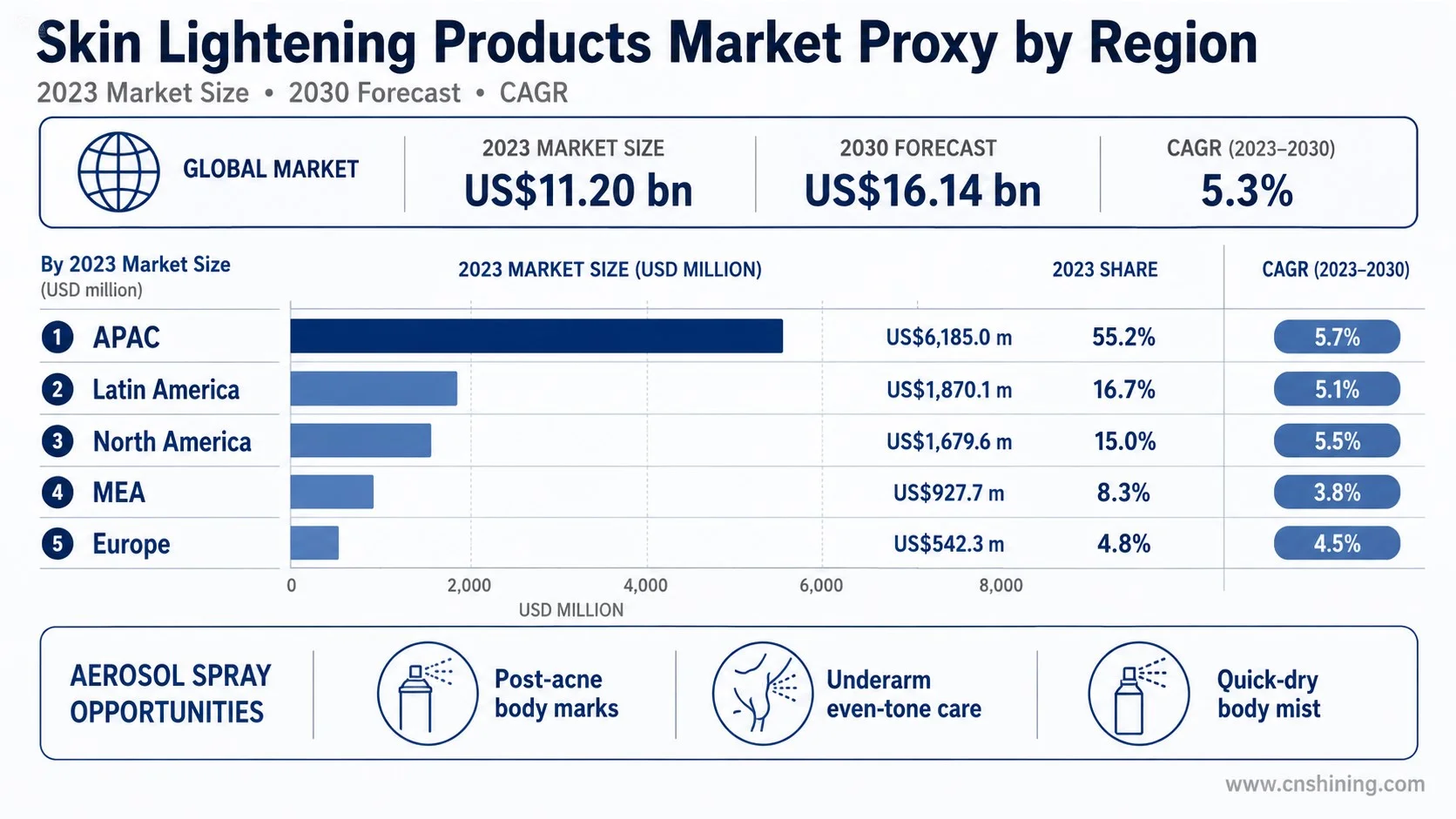
| Global | $11.20 bn | $16.14 bn | 5.3% | 100% | Skin lightening products market proxy |
| North America | $1,679.6 m | $2,441.5 m | 5.5% | 15.0% | North America regional proxy |
| Europe | $542.3 m | $735.9 m | 4.5% | 4.8% | Europe regional proxy |
| APAC | $6,185.0 m | $9,111.0 m | 5.7% | 55.2% | Asia Pacific regional proxy |
| Latin America | $1,870.1 m | $2,648.1 m | 5.1% | 16.7% | Latin America regional proxy |
| MEA proxy | $927.7 m | $1,200.6 m | 3.8% | 8.3% | MEA regional proxy |
The direction is more useful than a single absolute number. APAC is the largest region, and North America shows stronger growth than Europe in the cited proxy set. Regional splits vary by research method. That matters when planning capacity, claims language and aerosol filling location.
Demand drivers include uneven tone management, body care growth, functional skincare, niacinamide and organic active adoption, online education and social-media use cases around underarm care or back-acne marks. A separate market overview is available from Research and Markets.
For the aerosol sub-track, the strongest use cases are practical: post-acne body marks, underarm even-tone care, and summer quick-dry body brightening mist. These situations need fast reach, even application, low stickiness and clear usage instructions.
3. Formula Framework and Terminology
3.1 Formula Logic
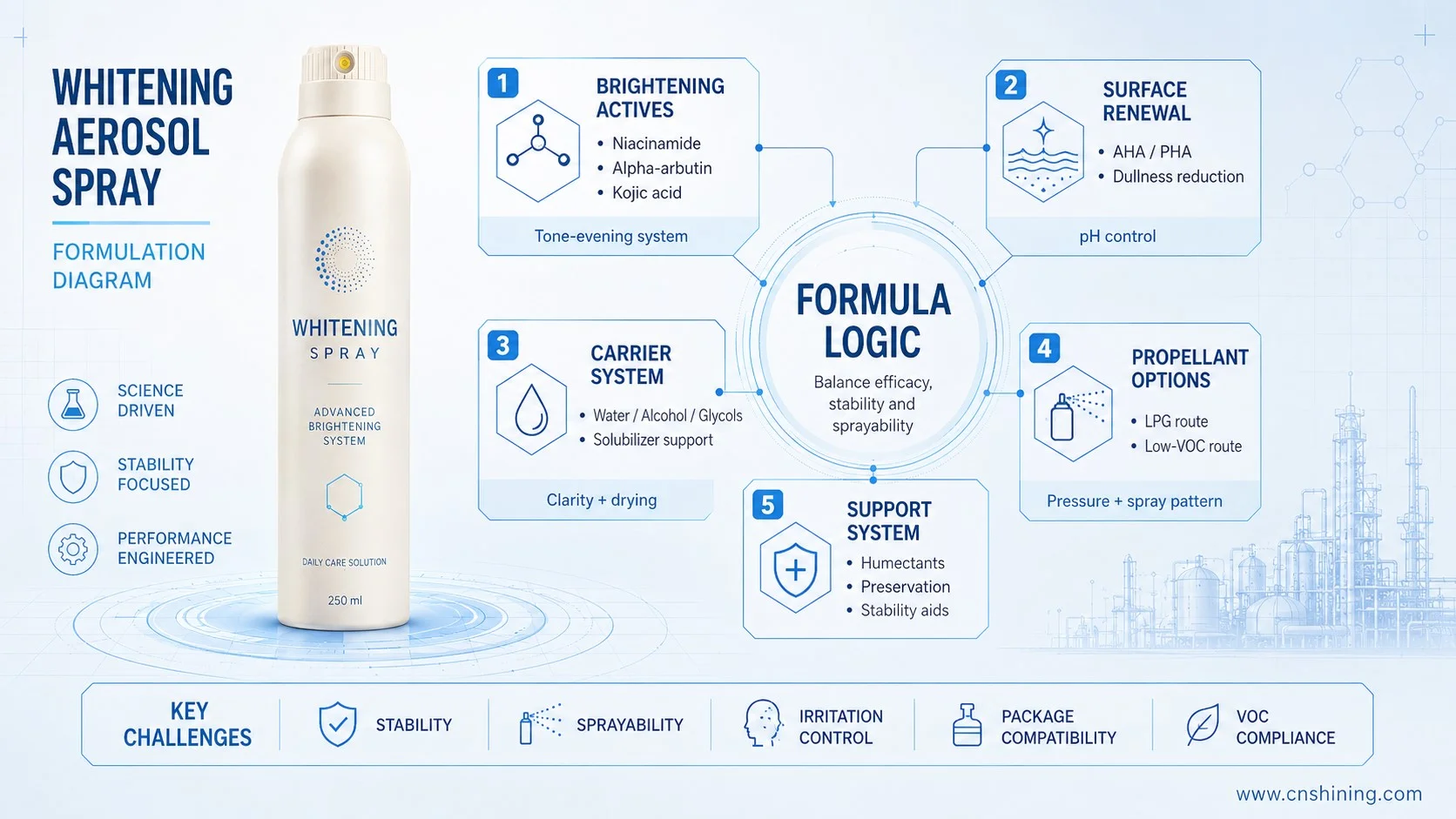
A brightening spray formula is usually not difficult on paper. The hard part is stability, sprayability, irritation control and packaging compatibility. Public retail examples and patents point toward multi-active systems: niacinamide with vitamin C derivatives, AHA or PHA acids, alpha-arbutin, licorice, selected resorcinol derivatives, humectants and a suitable solubilizer system.
| Function | Common Ingredients | Main Role | Typical Range or Limit | Technical Note |
|---|---|---|---|---|
| Brightening active | Niacinamide | Uneven tone, barrier support, post-inflammatory pigmentation support | Often 2–10% in cosmetic work windows | Not irritation-free for every user. Patch testing is still useful. |
| Brightening active | Alpha-arbutin | Pigmentation pathway support | EU safety conclusion: 2% face cream, 0.5% body lotion | Regulation (EU) 2024/996 is highly relevant for EU work. |
| Brightening active | Arbutin | Even-tone support | EU safety conclusion: 7% face cream | Regional limits differ. Do not copy one market into another. |
| Brightening active | Kojic acid | Tyrosinase-pathway inhibition | EU: up to 1% in face and hand depigmenting products | Not a simple “add more for more effect” material. |
| Exfoliating active | AHA / PHA | Surface renewal, dullness reduction | Common body care work window: 3–10% | pH, alcohol and fragrance can raise irritation complaints. |
| Antioxidant support | Vitamin C derivatives | Antioxidant and brightening support | Often 0.5–10% | Metal ion control and color stability need early testing. |
| Carrier | Water, alcohol denat., glycols | Solubility, drying speed, spread | Adjusted by phase behavior and irritation target | Water-alcohol systems are efficient but often drive odor and sting. |
| Propellant | Propane, butane, isobutane, DME | Pressure and atomization | Set by target pressure and spray pattern | Flammability, VOC rules and transport labels enter immediately. |
| Low-VOC route | Compressed air, nitrogen, HFO-1234ze | Lower VOC or alternative propellant system | System-specific | HFO-1234ze propellant data gives one low-GWP reference route. |
| Solubilizer | PEG-40 hydrogenated castor oil, decyl glucoside, polysorbates | Fragrance and oil-soluble active solubilization | Often 0.1–5% | Foaming and valve residue need attention. |
| Humectant / skin feel | Glycerin, betaine, aloe, panthenol | Reduce dryness and support leave-on feel | Often 0.5–5% | Too much humectant can increase tack. |
| Preservation | Phenoxyethanol, benzoic acid, sorbic acid, benzyl alcohol | Microbial control | Set by law and challenge test | A water-rich mist cannot ignore preservation. |
| Stability | EDTA, sodium gluconate, antioxidants | Metal ion control and color stability | Often 0.05–0.5% | Useful for vitamin C derivatives and long shelf life. |
3.2 Working Terms
| Term | Plain Meaning | Why It Matters Commercially |
|---|---|---|
| INCI | International cosmetic ingredient naming system | Controls labeling, registration and cross-border review. |
| BOV | Bag-on-valve, product separated from propellant | Useful for serum-like spray, 360-degree use and lower VOC positioning. |
| VOC | Volatile organic compound | Affects odor, flammability, state rules and sustainability claims. |
| GWP | Global warming potential | Used when comparing propellant sustainability routes. |
| Micro-mist | Fine droplet spray pattern | Improves skin feel and lowers “too wet” complaints. |
| One-shot actuator | Controlled single output per press | Helps reduce over-spraying and active waste. |
| Even-tone | More uniform skin appearance | Usually cleaner than old “fairness” language. |
| Depigmenting | Reducing visible pigmentation | Common in EU and patent language. |
| PIF | Product Information File | Required document backbone for EU cosmetic products. |
| Special cosmetics | China category covering freckle-removing and whitening claims | Raises evidence, registration and time-to-market demands. |
4. Regulations and Technical Frontiers
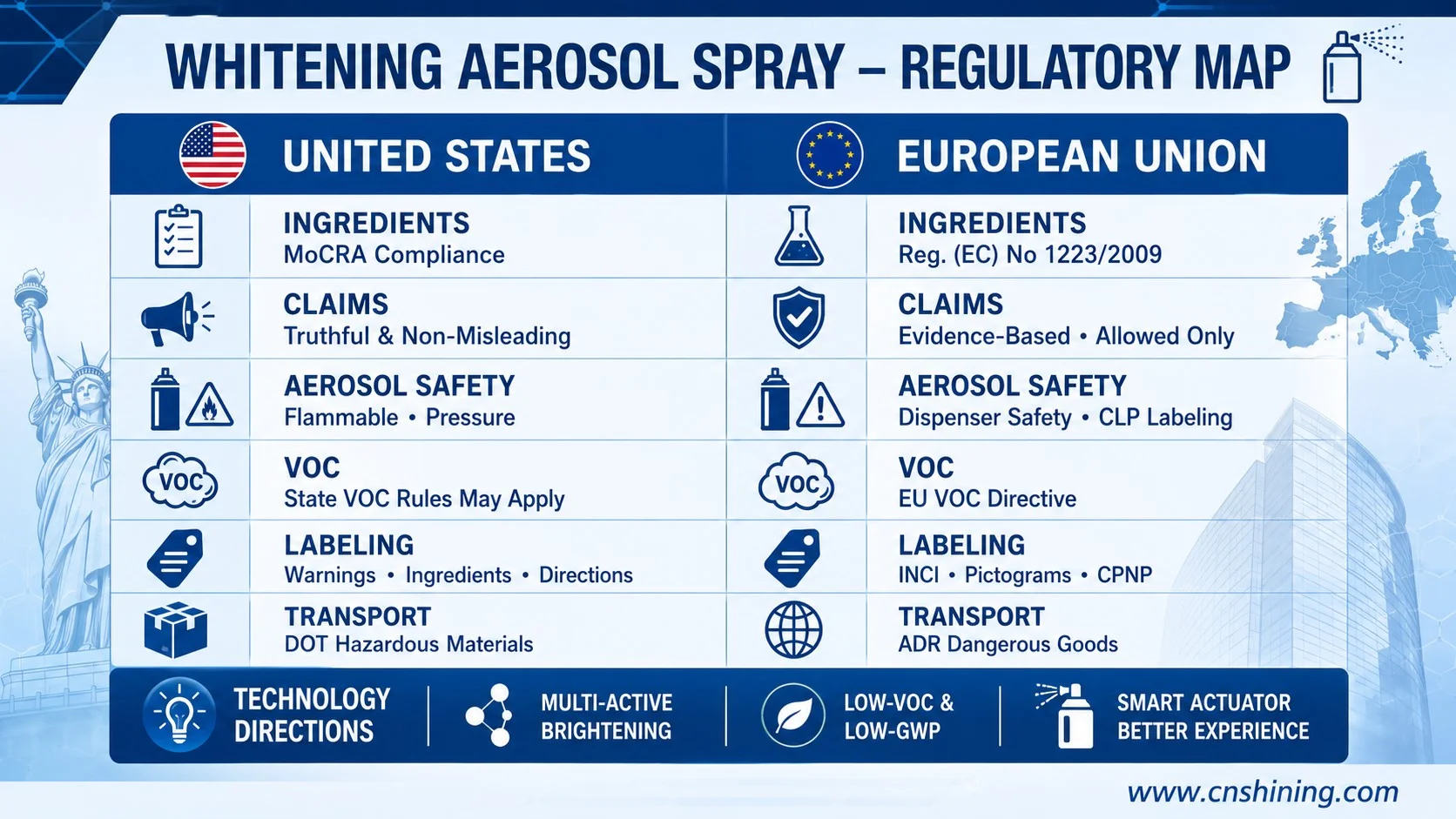
4.1 United States
In the United States, ordinary cosmetics generally do not need pre-market FDA approval. That does not make the route light. Under MoCRA, facilities and products face registration, listing, safety substantiation and adverse-event duties; FDA describes this on its cosmetic facility registration and product listing page.
For whitening claims, hydroquinone and mercury risk cannot be treated as historical details. FDA warns that OTC skin lightening products containing hydroquinone are not lawfully marketed, and mercury is prohibited in such products; see FDA’s skin product safety notice. If the product is pressurized aerosol, flammability, pressure warnings, state VOC rules and dangerous goods transport classification enter the design file.
4.2 European Union
The EU route starts with Regulation (EC) No 1223/2009: Responsible Person, PIF, GMP, CPNP notification, label rules and claims evidence. Aerosol packaging adds dispenser-specific safety and label duties. For whitening actives, hydroquinone is not a normal cosmetic option, kojic acid is more tightly limited, and arbutin materials need careful reading against current SCCS and regulation language.
4.3 Technology Directions
Several trends are already visible. First, brightening formulas are moving away from single “whitening agent” logic and toward multi-active systems. Second, BOV, compressed gases and low-GWP propellants are becoming more attractive for premium or lower-VOC designs. Third, actuator design is now part of formula performance: precise dosage, soft actuation and minimal residue affect both user experience and claim credibility.
5. Top 10 Visible Retail Brands
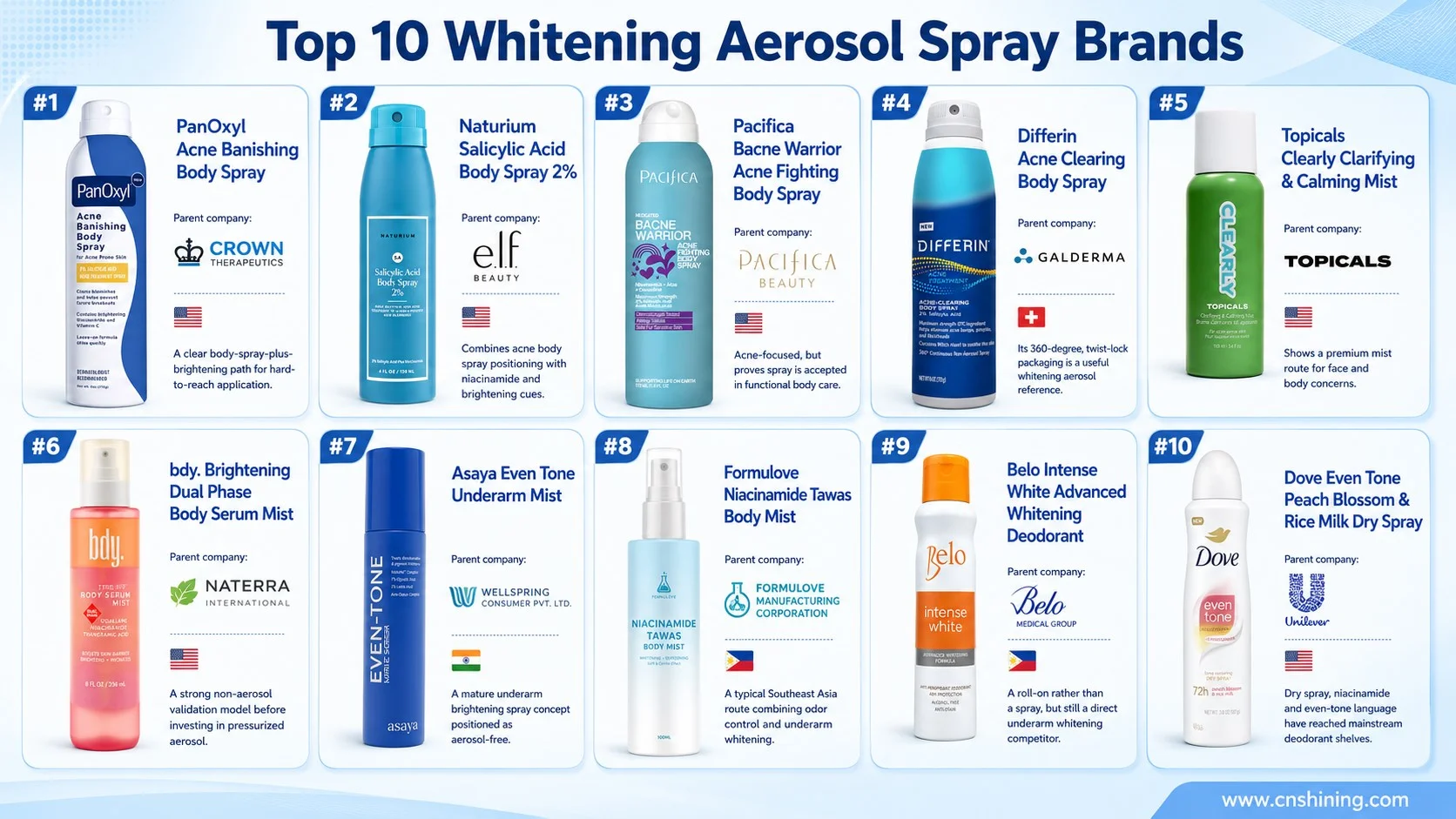
This table is not a global market-share ranking. It is a retail-visible benchmark set from spray, aerosol or closely related mist products that compete for the same consumer use cases: body marks, underarm tone, odor plus tone, back acne marks and fast body application.
| Brand / SKU | Country | Parent Company | Common Size | Price Range | Technical Comment |
|---|---|---|---|---|---|
| PanOxyl Acne Banishing Body Spray | United States | Crown Laboratories / Crown Therapeutics | 6 oz; 4 oz version also visible | about 12.08–14.87$ | A clear “body spray plus brightening” path. Useful for hard-to-reach body application analysis. |
| Naturium Salicylic Acid Body Spray 2% | United States | e.l.f. Beauty | 4 oz | about 17.50$ | Combines acne-oriented body spray with niacinamide, alpha-arbutin and vitamin C-style brightening language. |
| Pacifica Bacne Warrior Acne Fighting Body Spray | United States | Pacifica Beauty | 5.8 fl oz | about 16.00$ | More acne-focused, but shows spray is already accepted in functional body care. |
| Differin Acne Clearing Body Spray | Switzerland | Galderma | 6 oz | about 14.97$ | 360-degree and twist-lock style packaging is useful reference for whitening aerosol projects. |
| Topicals Clearly Clarifying & Calming Mist | United States | Topicals | 3.4 oz / 100 mL | about 26.00$ | Shows a higher-price mist route for face and body concerns. |
| bdy. Brightening Dual Phase Body Serum Mist | United States | Naterra International, Inc. | 3.4 fl oz and 8 fl oz | about 14.00–26.00$ | Good non-aerosol validation model before investing in pressurized aerosol. |
| Asaya Even Tone Underarm Mist | India | Wellspring Consumer Pvt. Ltd. | 100 mL | about 5.22$ | Close to a mature underarm brightening spray concept, but positioned as aerosol-free. |
| Formulove Niacinamide Tawas Body Deo Mist | Philippines | Formulove Manufacturing Corporation | 100 mL | about 2.25–3.07$ | Typical Southeast Asia odor-control plus underarm whitening route. |
| Belo Intense White Advanced Whitening Deodorant | Philippines | Belo | 2 × 40 mL | about 12.81–14.23$ | Roll-on rather than spray, but a direct underarm whitening competitor. |
| Dove Even Tone Peach Blossom & Rice Milk Dry Spray | United States | Unilever | 3.8 oz | about 6–8$ | Shows that dry spray plus niacinamide plus even-tone language has entered mainstream deodorant shelves. |
Consumer Pain Points Seen Across Public Retail and Social Discussion
The complaints are very consistent: too much product per press, strong odor, coughing or inhalation discomfort, redness, itching, slow visible change, leakage, residue, and confusion between deodorizing effect and brightening effect. These are not only formula problems. They point directly to actuator output, droplet size, lock design, sealing, valve compatibility, claim wording and usage graphics.
One practical conclusion follows. A whitening aerosol spray does not win by using a harsher whitening active. It wins by making the product easier to apply, less irritating, better sealed, more predictable in output and more honest about timing.
6. Packaging Improvements for Whitening Aerosol Spray
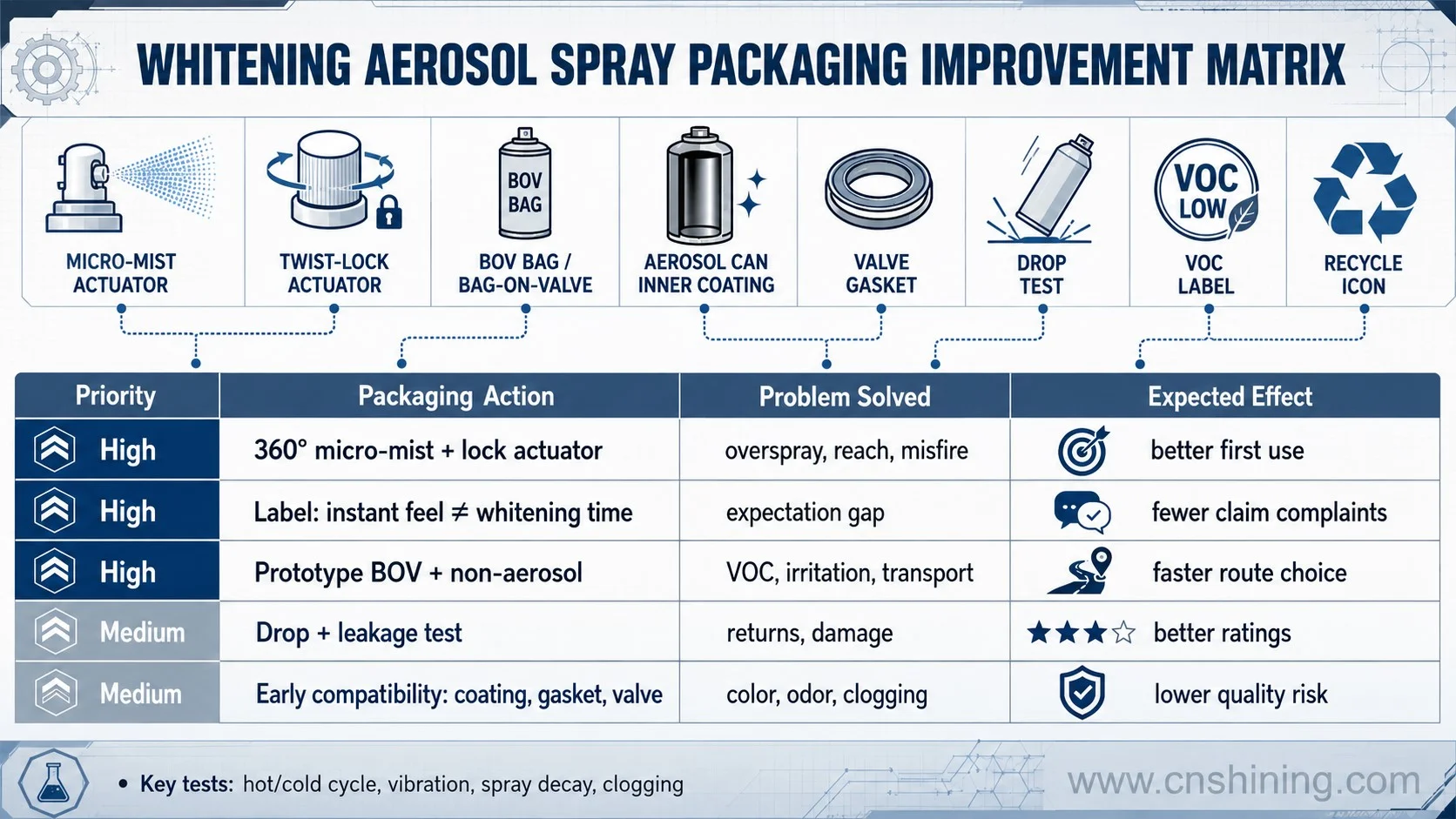
6.1 Actuator and Spray Pattern
The first investment should be a micro-mist or soft-actuation actuator with controlled output. If users complain about “sprayers a lot of product,” changing only viscosity will not solve it. Spray button force, orifice size, vapor tap, valve stem design and formulation volatility work together.
6.2 Locking and E-Commerce Protection
Leakage and accidental discharge are common in e-commerce. A twist-to-lock or overcap-free locking actuator reduces misfire risk and can cut resin use compared with a separate overcap system.
6.3 BOV and Low-VOC Route
For serum-like or lower-irritation body spray, BOV is worth testing early. It separates content from propellant, supports any-angle spraying, reduces dependence on hydrocarbon propellants and can fit water-rich formulations. If the project must use conventional pressurized aerosol, low-GWP alternatives should be assessed together with cost, filling availability, pressure curve and transport classification.
6.4 Can, Coating and Compatibility
AHA, alcohol, vitamin C derivatives, fragrance systems and botanical extracts can be aggressive toward valves, gaskets, internal coatings and metal surfaces. Compatibility testing should include hot storage, cold cycling, transport vibration, spray decay, clogging, crystallization at the orifice, color drift and odor shift. This belongs in CQA, not as a late-stage check box.
| Priority | Packaging Action | Main Problem Solved | Expected Commercial Effect |
|---|---|---|---|
| High | 360-degree micro-mist output plus locking actuator | Hard-to-reach areas, over-spray, accidental actuation | Better trial experience and fewer handling complaints |
| High | Separate immediate feel from brightening timeline on label | Expectation mismatch | Lower claim risk and fewer “does not whiten” reviews |
| High | Prototype non-aerosol and BOV routes in parallel | VOC, irritation and transport uncertainty | Faster route selection before tooling commitment |
| Medium | Run e-commerce drop and leakage testing | Leakage, returns, warehouse damage | Better platform rating stability |
| Medium | Move compatibility testing into early development | Color change, odor change, valve clogging | Lower post-launch quality risk |
7. Product Fit: Shining Packaging Actuators, Cans and Valves
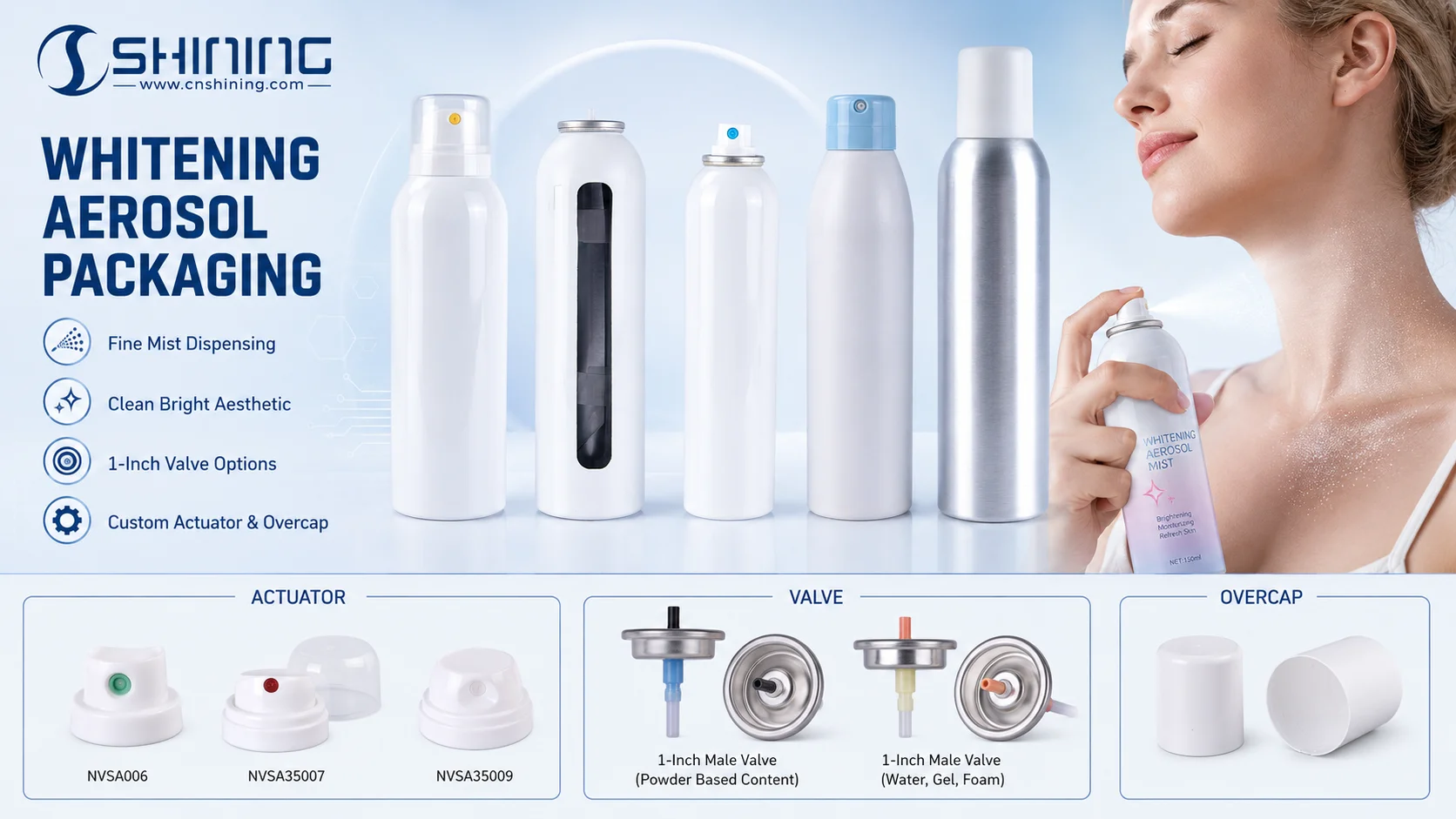
For this type of product, Shining Packaging should be discussed at the component level rather than as a generic packaging supplier. Whitening aerosol spray depends on three linked parts: the actuator, the aerosol can and the valve. The formula decides only part of the result. The package decides how that formula leaves the can.
The actuator should be selected around droplet feel, spray width, button force, over-spray control and whether the product needs inverted or 360-degree use. For underarm use, a softer and narrower spray can reduce inhalation and clothing wetting. For back or shoulder application, a broader micro-mist pattern is usually more useful.
The aerosol can must match product chemistry and filling route. Water-alcohol systems, acids, vitamin derivatives and fragrance packages need internal coating review, crimp integrity testing and storage stability. A slim can can fit underarm or travel use. A larger easy-grip body spray can better serve back and shoulder application.
The valve is the control point for output, pressure behavior and long-term spray reliability. For whitening aerosol spray, the valve should be screened for dose consistency, gasket compatibility, clogging risk, spray decay after storage and performance after temperature cycling. A product that sprays well on day one but blocks after hot storage is not ready.
8. Conclusion
The product path is still clear. The better technical direction is not old-style “fairness” positioning. The more workable route is a tone-evening body or underarm spray built around legal actives, lower-irritation carriers, controlled micro-mist output, BOV or lower-VOC options, strong compatibility testing and clear claim timing.
Packaging is not a secondary detail here. In this category, valve output, actuator feel, can compatibility and transport stability can decide whether the product feels credible. A mild formula with poor spray engineering will lose quickly. A realistic formula with clean deposition, low residue, clear instructions and stable packaging has a better chance.
9. FAQ: Whitening Aerosol Spray Technical Questions
A whitening aerosol spray is a topical brightening or tone-evening product delivered as a pressurized mist. Its function is not instant bleaching. It deposits actives more evenly on the skin, especially on areas that are hard to reach by hand. The technical value comes from deposition control, quick drying, lower contact contamination and consistent coverage.
Body brightening often targets the back, shoulder, underarm or large skin areas. Lotion is harder to apply evenly in these places. Aerosol spray can cover quickly and work at different angles. That said, the format adds pressure-container safety, VOC, flammability, odor, actuator and transport issues, so it needs stronger packaging engineering than lotion.
Common actives include niacinamide, vitamin C derivatives, alpha-arbutin, arbutin, kojic acid, AHA or PHA acids, licorice extract and selected resorcinol derivatives. The practical route is usually a mild multi-active system. High-risk or illegal whitening ingredients should not be used. Regional limits and claim rules must be checked before formula lock.
No. Niacinamide is widely used and often suitable for uneven tone support, but it is not automatically irritation-free. Some users report redness or itching from niacinamide products. In aerosol spray, alcohol, fragrance, acids and high output can intensify discomfort. Patch testing, lower-irritation carrier design and controlled dosage remain necessary.
BOV separates the formula from the propellant inside the can. This can protect sensitive formulas, allow compressed air or nitrogen use, support 360-degree spraying and reduce reliance on hydrocarbon propellants. For water-rich or serum-like brightening sprays, BOV can be a useful route. Cost, filling capacity and target spray feel still need testing.
Common failures include over-spraying, strong initial odor, coughing during application, leakage, blocked spray holes, residue on skin, poor inverted spraying and valve output drift after storage. These problems come from the full package system: actuator, valve, gasket, crimp, internal coating, propellant and formula. Cosmetic performance and packaging performance cannot be separated.
Claims should separate immediate sensory effects from visible tone improvement. “Quick-drying” or “non-sticky” can be immediate if supported. “Brightening,” “even tone” or “dark spot appearance” needs evidence and realistic timing. Old fairness language can create regulatory and social risk. Clear use instructions reduce disappointment and low-rating reviews.
Testing should include formula stability, valve and gasket compatibility, internal coating resistance, spray output, droplet pattern, hot storage, cold cycling, transport vibration, leakage, crimp integrity, clogging, odor shift and color drift. For whitening claims, safety and efficacy evidence are also needed. A passing lab formula is not enough for aerosol launch.
Whitening and depigmenting products touch sensitive regulatory territory because of unsafe historical ingredients, exaggerated claims and skin irritation risks. The United States restricts illegal OTC hydroquinone skin lighteners and bans mercury. The EU has ingredient limits and cosmetic file requirements. China treats freckle-removing and whitening products as special cosmetics requiring registration and efficacy evidence.
The practical route is to start with a compliant tone-evening body or underarm spray concept, screen actives by target market, prototype non-aerosol and BOV versions, then test actuator output and compatibility early. Do not wait until the final stage to choose the valve. In this category, packaging engineering is part of product efficacy.