
1. Executive Summary
A liquid bandage aerosol is a film-forming spray system. It combines a film-forming polymer, volatile solvent, and propellant system. After spraying onto a clean and dry minor cut, scrape, or abrasion, the solvent evaporates and leaves a transparent or semi-transparent flexible film. The film works mainly as a mechanical barrier.
In the United States, liquid bandage is listed under FDA product classification for liquid bandage, and the regulation points to 21 CFR 880.5090. This is not the same device type as a topical tissue adhesive used to approximate skin edges.
The technical complaints are concentrated: stinging, overspray, dirty nozzles, unstable film thickness, edge lifting on sweaty or bending areas, and flammability warnings. These are not only formulation issues. Many of them are directly linked to the valve, actuator, spray pattern, can coating, cap design, and printed instructions.
2. Definition and Film-Forming Mechanism
A liquid bandage aerosol, also searched as liquid spray bandage, spray plaster, waterproof liquid bandage spray, or film-forming wound spray, is designed for clean, dry, superficial minor wounds. The usual use cases are minor cuts, scrapes, abrasions, fingers, knuckles, elbows, knees, and other areas where a strip bandage does not sit well.
It is a clear liquid that covers minor clean and dry cuts and scrapes. It forms a mechanical barrier, and the polymer coating naturally sloughs off as dead skin cells shed and are replaced.
It should be separated from two adjacent categories. First, it is not a basic antiseptic spray. Antiseptic sprays focus on cleaning or antimicrobial action and may not leave a durable film. Second, it is not a skin-closure adhesive,which is intended to close approximated skin edges.
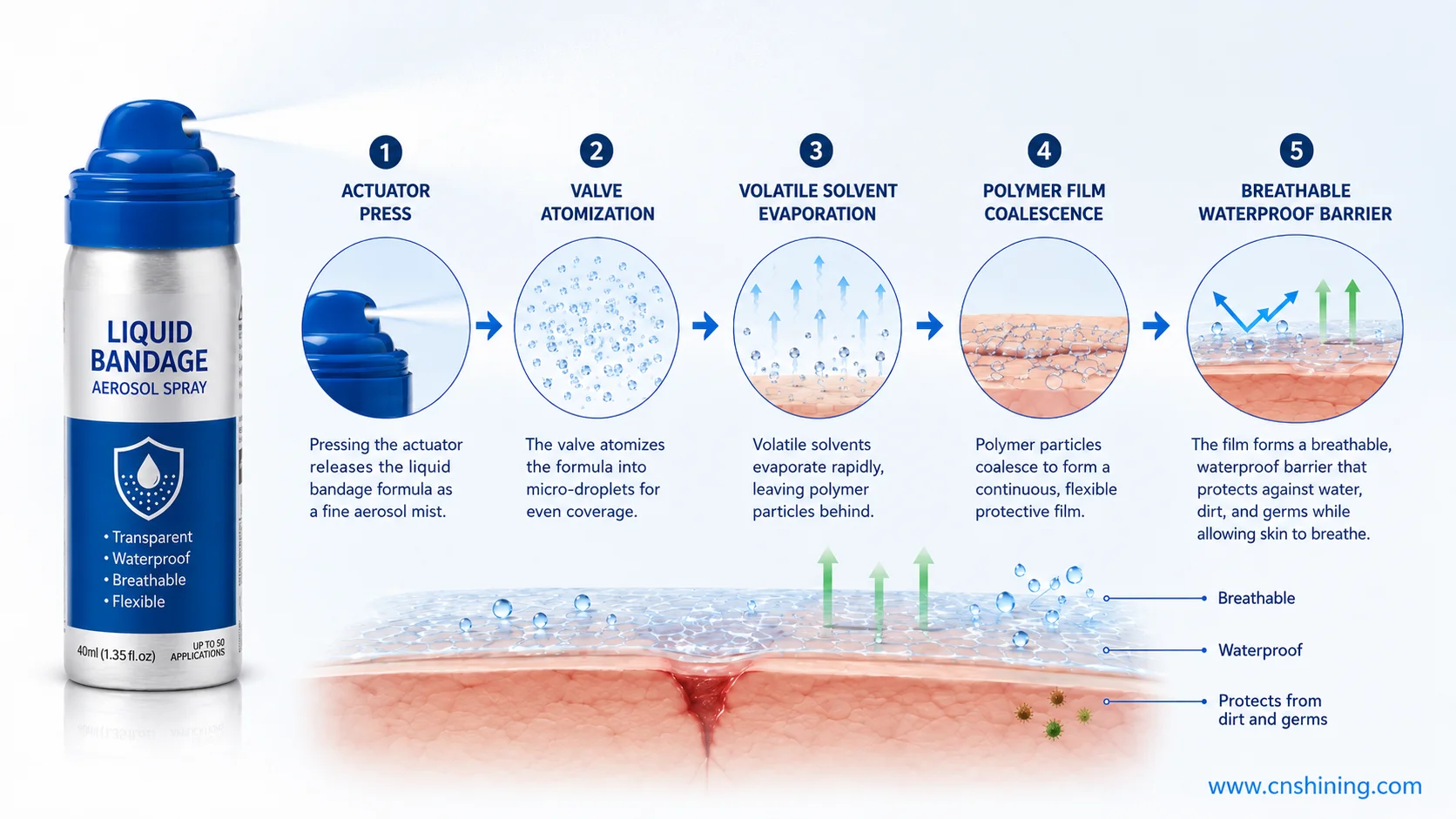
1. Actuator press: The user presses the actuator. The valve releases the liquid phase and propellant through the spray orifice.
2. Atomization: The liquid breaks into droplets. Spray cone angle, droplet size, and output rate decide how cleanly the target area is covered.
3. Solvent evaporation: Volatile solvent and propellant components evaporate within seconds.
4. Polymer film formation: The film former lays down a continuous flexible film over and around the minor wound.
5. Barrier function: The film helps block water, dirt, friction, and part of external contamination while allowing some vapor exchange.
6. Natural wear-off: The film gradually wears off through friction and skin turnover.
3. Where Liquid Bandage Aerosol Works, and Where It Does Not
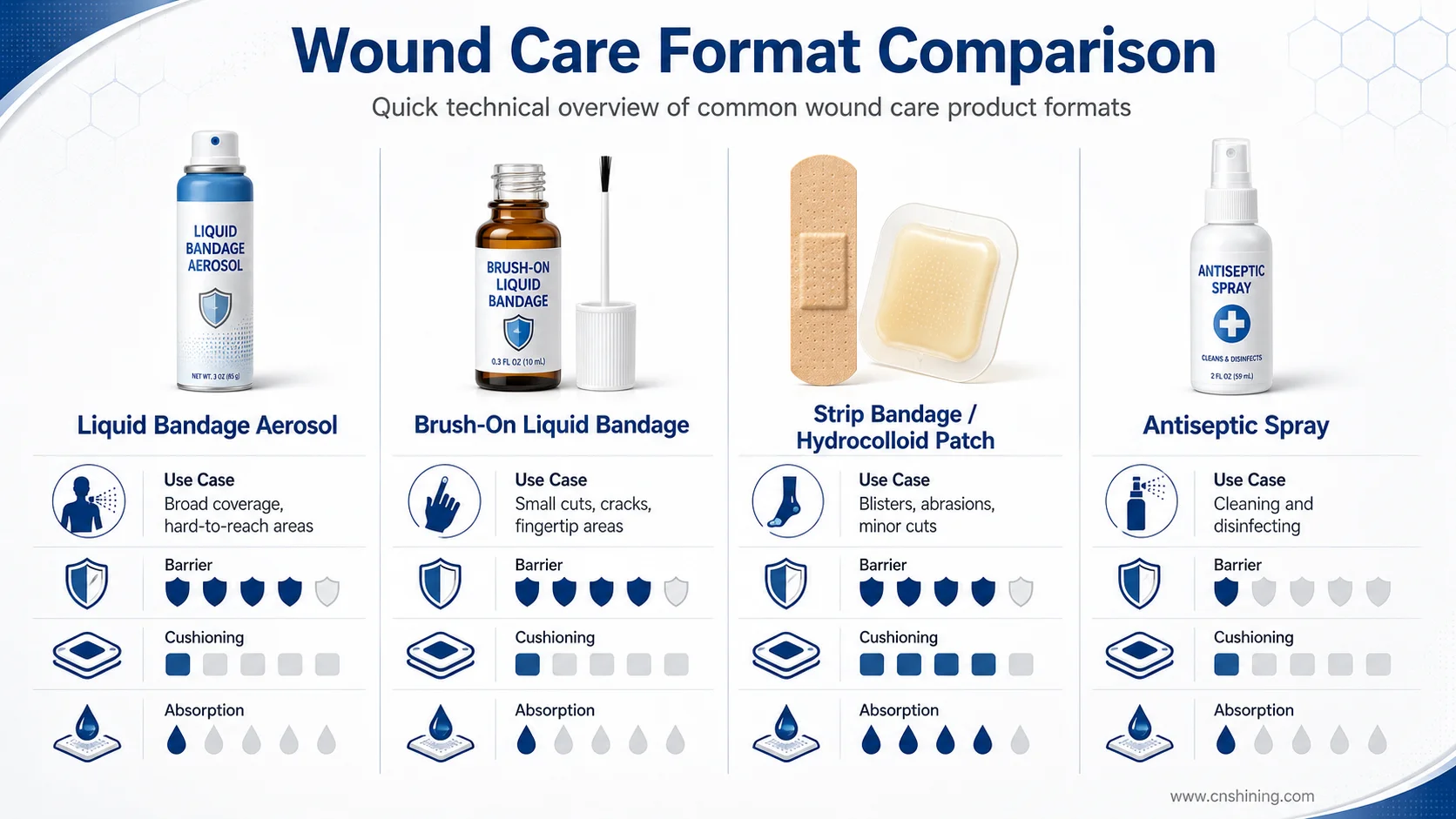
The strength of liquid bandage aerosol is not that it is “more advanced.” It is better for specific surfaces: fingertips, knuckles, joints, knees, elbows, and broad superficial abrasions where contact application is inconvenient.
It is not a universal replacement. It does not provide a pad. It does not absorb exudate. It does not close deep wounds. In sweaty, bending, or high-friction areas, the film may lift or peel. This is why traditional bandages, gauze, and hydrocolloid patches still hold the main volume.
| Category | Main Mechanism | Best Use Case | Strength | Weak Point | Commercial Meaning |
|---|---|---|---|---|---|
| Liquid bandage aerosol | Spray deposition and in-situ film formation | Fingers, joints, hard-to-cover zones, minor abrasions | Non-contact, fast drying, transparent, relatively waterproof | Overspray, stinging, no cushioning, flammable labeling pressure | Useful for convenience first-aid, travel, sport, and outdoor scenes. |
| Non-aerosol liquid bandage | Brush, drop, or swab film application | Small cuts, cracks, precise spot coverage | Better local control and simpler packaging | Contact application and slower large-area coverage | Good for low-cost, precise consumer SKUs. |
| Strip bandage or hydrocolloid patch | Physical covering; hydrocolloid also manages moist environment | Minor wounds needing padding, absorption, or longer wear | Cushioning, familiar use, better physical isolation | Edge lifting on joints, moisture, and curved surfaces | Still the main category; spray is a complement, not a full replacement. |
| Antiseptic or antimicrobial spray | Cleaning or antimicrobial action | Cleaning or pre-treatment | Clear cleaning purpose | Usually no durable physical barrier | Works better as a partner product than as a substitute for coverage. |
4. Formulation Systems, Commercial Examples, and Patent Direction
Current products do not follow one single formulation route. Academic reviews classify these systems as spray film-forming systems. They generally combine a film former, volatile medium, flexibility modifier, and optional active component.
| Formulation Class | Typical Components | Main Function | Packaging Meaning |
|---|---|---|---|
| Traditional solvent-based spray film | Acrylic copolymer, polyurethane polymer, ethyl cellulose; ethyl acetate or ethanol; DME or hydrocarbon propellant | Fast evaporation and transparent film formation | Mature process and cost structure, but strong solvent compatibility testing is needed. |
| No-sting silicone-based barrier spray | Hexamethyldisiloxane, isooctane, acrylate terpolymer, polyphenylmethylsiloxane | Lower sting perception, fast drying, hydrophobic barrier | Good for sensitive-skin or premium positioning, but flammability and gasket compatibility need early testing. |
| Active liquid bandage | Benzalkonium-type antiseptic, pain relief components, preservative systems | Barrier plus antimicrobial or pain-related claim | Regulatory complexity rises. It may move toward OTC drug or combination-product logic. |
| Biopolymer or hydrogel research route | Chitosan, hyaluronic acid, alginate, PVA, cellulose derivatives, lipid nanoparticles, natural antimicrobial actives | Moisture management, biocompatibility, antimicrobial or wound-healing support | Useful for next-generation technical stories, but stability and industrialization are harder. |
| Tissue adhesive adjacent route | Cyanoacrylate and related adhesive chemistry | Approximation of skin edges | Not the same category. Device classification, testing, labeling, and packaging compatibility change. |
| Example | Publicly Visible Ingredients or Claims | Formulation Reading | Technical Comment |
|---|---|---|---|
| Nexcare Liquid Bandage Spray | Hexamethyldisiloxane, isooctane, acrylate terpolymer, polyphenylmethylsiloxane; alcohol-free, fragrance-free, preservative-free | Silicone-acrylate no-sting barrier route | Clear no-sting differentiation, but flammable-until-dry control remains part of labeling. |
| Hansaplast / Elastoplast Spray Plaster | Public pages show ethyl acetate, propane, butane; some markets disclose acrylic copolymer, polyurethane polymer, ethanol, water, and dimethyl ether | Traditional solvent-based spray plaster route | Strong pharmacy fit and mature mass-market format. |
| URGO Pansement Spray Filmogel | Filmogel technology, 40 mL format, difficult-area coverage | Film-forming consumer wound cover | Brand story is built around film technology and pharmacy use. |
The short-term business opportunity is still a usable barrier spray. The mid-term technical barrier is broader: low irritation, stable active loading, can-liquid-valve compatibility, and compliant claims that match the real mechanism.
5. Terminology That Controls Product Decisions
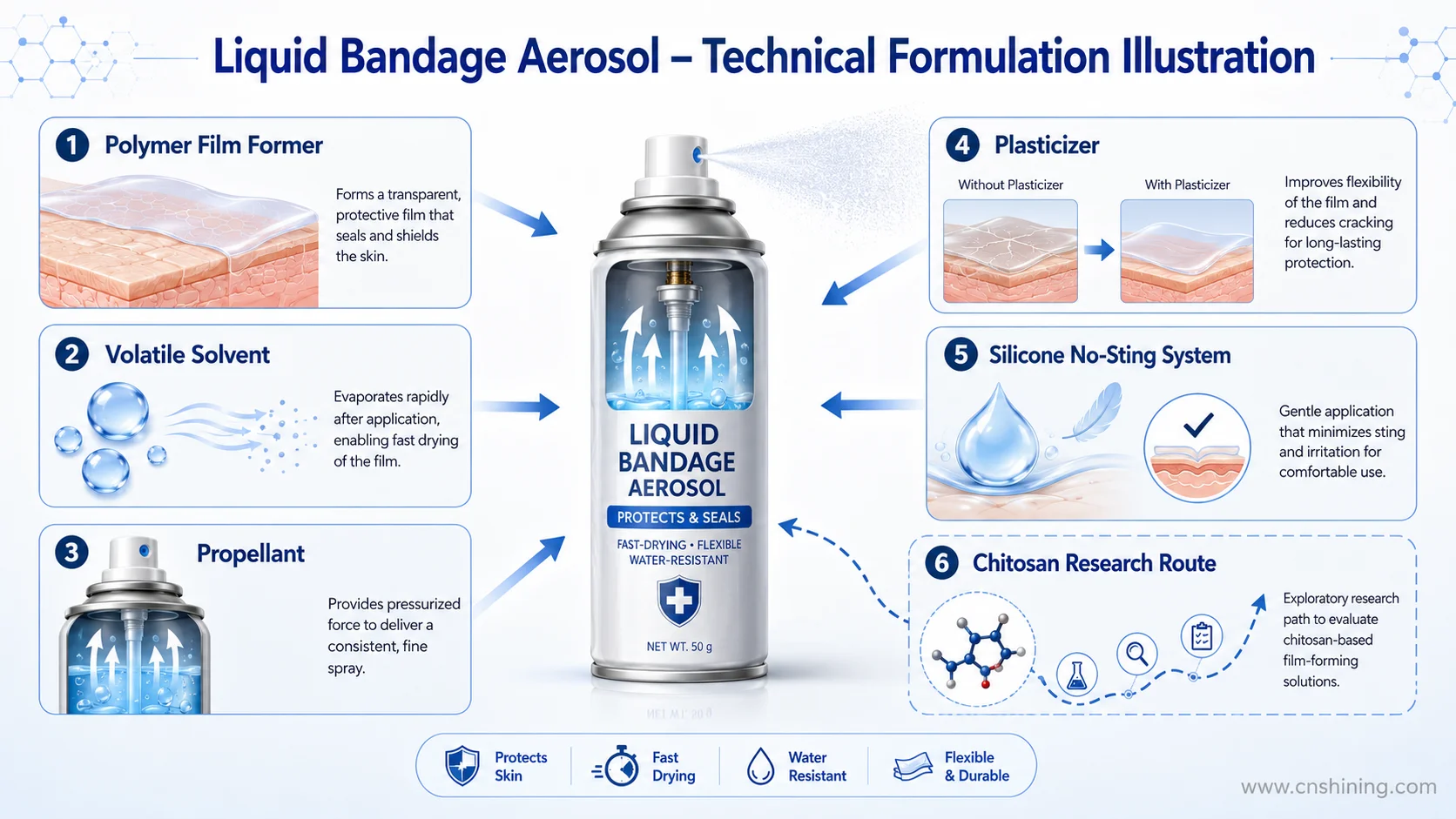
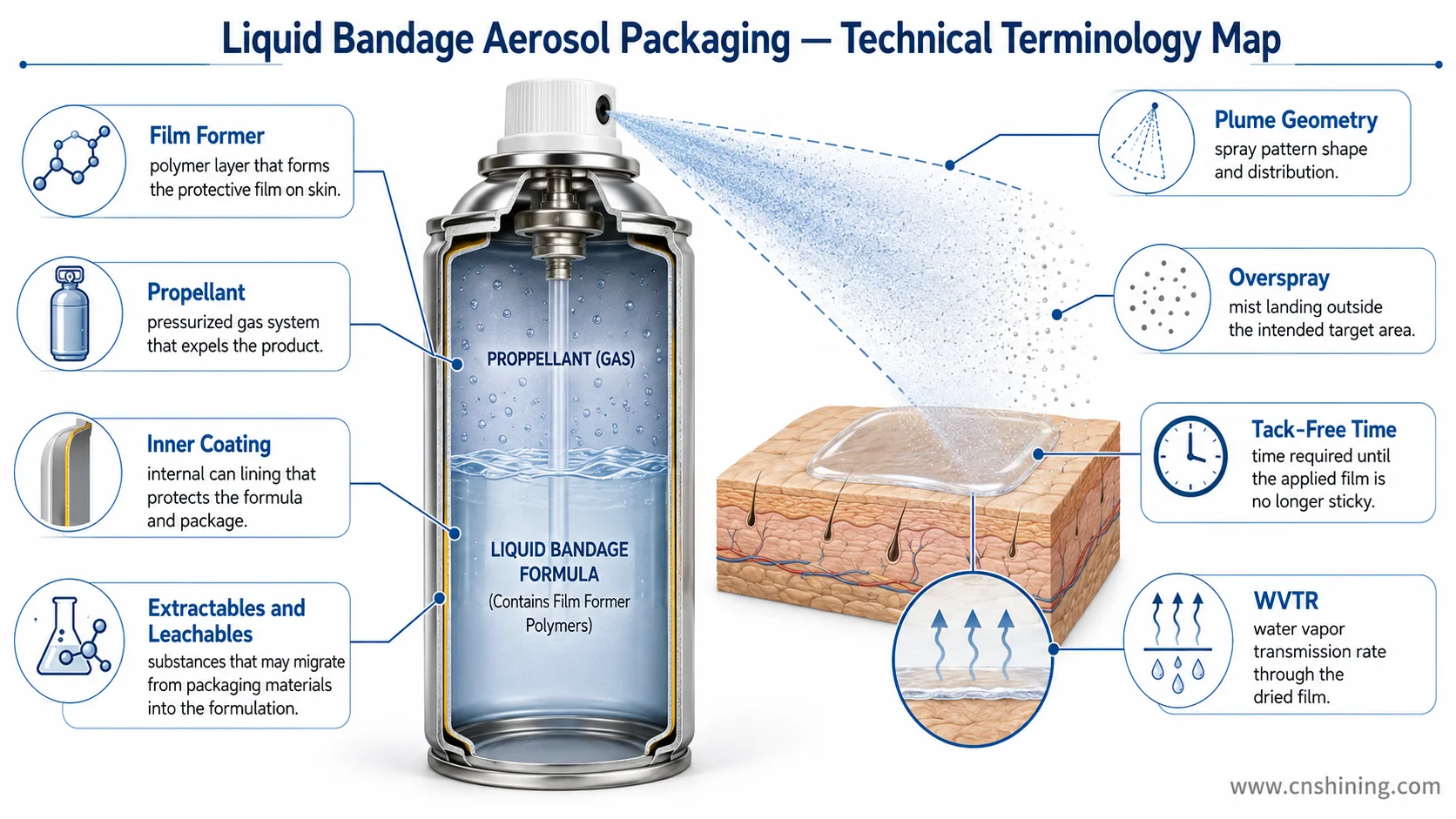
For this category, vocabulary is not academic decoration. These terms decide user experience, compliance risk, and packaging specification.
| Term | Short Explanation | Why It Matters Commercially |
|---|---|---|
| Film former | Polymer that remains on skin and forms a continuous film | Controls transparency, toughness, adhesion, and natural removal. |
| Propellant | Gas or volatile system that drives spray discharge | Controls spray feel, flammability label, pressure, and logistics cost. |
| Tack-free time | Time needed for the surface to stop feeling sticky | Directly affects the “spray and go” experience. |
| Overspray | Droplets deposited outside the target area | Creates waste, dirty surroundings, and complaints about glue-like residue. |
| Plume geometry | Spray cone angle, concentration, and boundary | Decides whether finger and joint use feels precise. |
| Film integrity | Continuity of the dried film without pinholes or cracks | Linked to water resistance, dirt protection, and user confidence. |
| Flex-crack resistance | Ability to resist cracking during bending | Determines whether the product can actually work on joints. |
| MVTR / WVTR | Water vapor transmission through the film | Too low may feel occlusive. Too high may weaken barrier perception. |
| Substantivity | Retention of the film on skin after wear, washing, or friction | Determines whether the film remains after hand washing or movement. |
| No-sting | Formulation and sensory claim focused on reduced stinging | Useful for sensitive-skin, children, and premium differentiation. |
| Bag-on-Valve | Packaging structure separating product from compressed gas | May improve directional discharge, content utilization, and certain compatibility profiles. |
| Inner coating | Protective lacquer on the inside of the metal can | Controls corrosion, discoloration, extractables, and long-term stability. |
| Extractables / leachables | Chemicals that may migrate from packaging materials | Relevant to odor, safety evaluation, shelf life, and regulatory files. |
| Compatibility | Fit between formulation, valve, gasket, spring, can, and coating | Many clogging, odor, pressure loss, and film defects trace back here. |
A spray-on liquid bandage is not just a chemical liquid in a can. It is a formulation-valve-plume-skin interface system. Two outcomes matter most: can the user spray the right place, and can the film form consistently after that?
6. Regulatory and Labeling Boundary
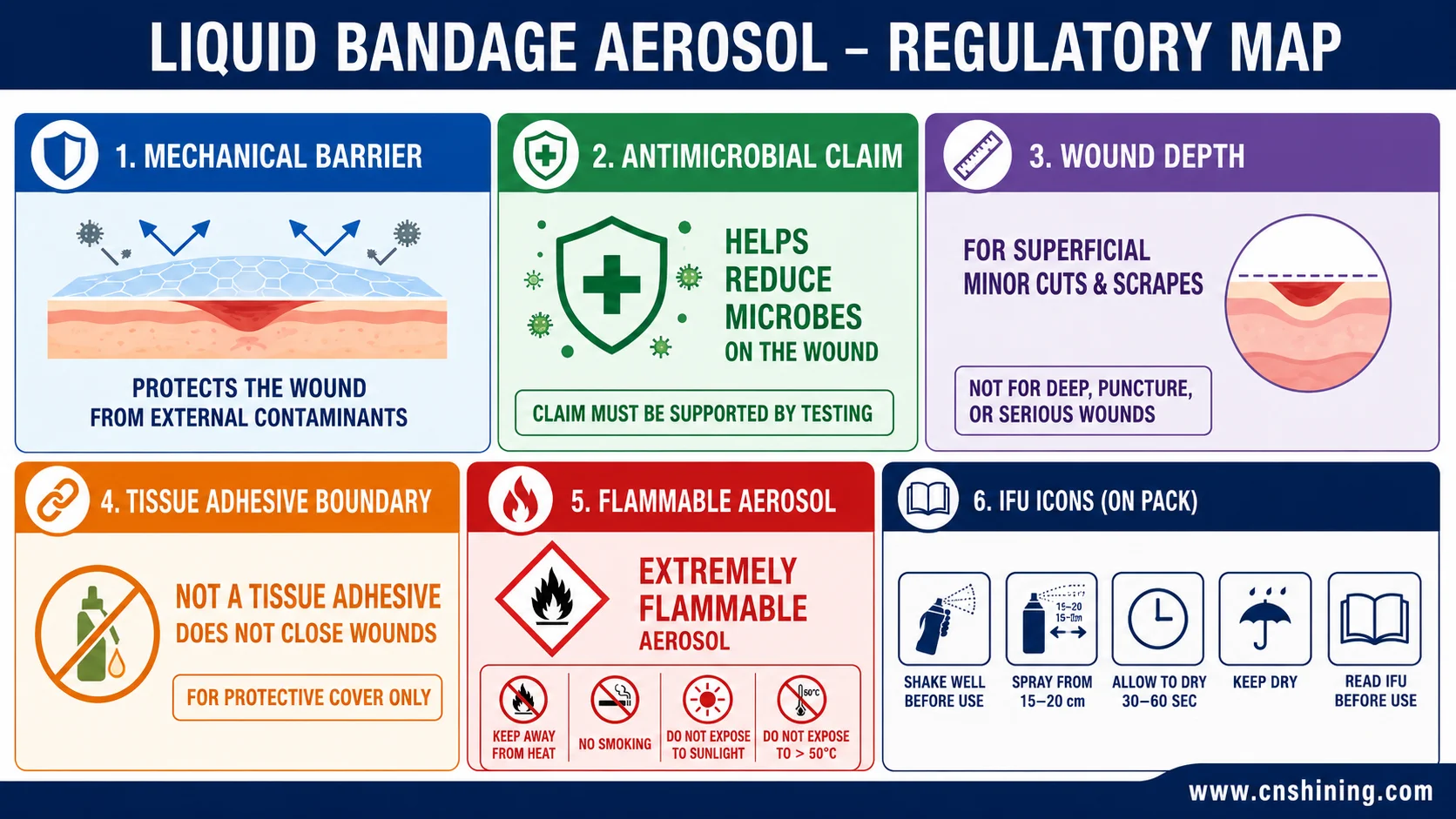
The first regulatory question is not whether the product is a spray. Ask three things first:
- Is the product only a mechanical barrier, or does it make pharmacological, antimicrobial, analgesic, or healing claims?
- Does it contact minor superficial clean wounds, or more complex wounds?
- Does it cover and protect, or does it close approximated skin edges?
| Region | Main Path | Classification Logic | Label / Packaging Focus | Development Note |
|---|---|---|---|---|
| United States | FDA medical device; OTC drug logic may apply if active claims are added | Liquid bandage is Class I under 21 CFR 880.5090; tissue adhesive for skin closure is a different path | 21 CFR Part 801 labeling, UDI, flammability and irritation warnings where applicable | Keep “mechanical barrier” separate from closure, antimicrobial, and pain-relief claims. |
| European Union | MDR 2017/745 and CE route | Risk class depends on use on injured skin, mode of action, absorption, and wound environment management | CE files, IFU, local language labeling, serious incident reporting, flammable warnings | Run a borderline review early. Claim wording can change class. |
| Canada | Health Canada medical device classification | Products contacting injured skin only as a mechanical barrier are lower risk; wound environment management increases class | Device classification, label control, and claim control | The Health Canada risk-based classification guidance is useful as a claim boundary check. |
| Australia | TGA medical device and ARTG | Mechanical barrier is lower risk; wound microenvironment management or deeper wound use raises class | English IFU, ARTG entry, essential principles | Logic is close to Canada and EU. Claim discipline matters. |
| Japan | PMD Act system | Local generic name, intended use, and claims decide route | Local label, IFU, and license holder requirements | Do not hard-translate US or EU packaging claims. |
| Brazil | ANVISA medical device framework | Use, risk, and technical file define route | IFU, local labeling, and aerosol hazard statements | For aerosol products, pressure and flammability language often becomes a practical packaging issue. |
The practical rule is simple: the closer the product stays to minor wound physical barrier, the lighter the path tends to be. The more it moves toward antimicrobial, pain relief, active healing, absorption, surgical use, or skin closure, the heavier the file becomes.
Compliance Development Checklist
- Lock the intended use first: physical barrier only, or active function?
- Choose the formulation route: traditional solvent film, no-sting silicone barrier, or active-loaded spray.
- Start packaging compatibility early: gasket swelling, spring corrosion, lacquer resistance, pressure loss, clogging, and extractables.
- Write claims last. “Waterproof,” “breathable,” “no sting,” “protects against germs,” and “healing” must match the regulatory path.
7. Top 10 Brands and Channel Positions
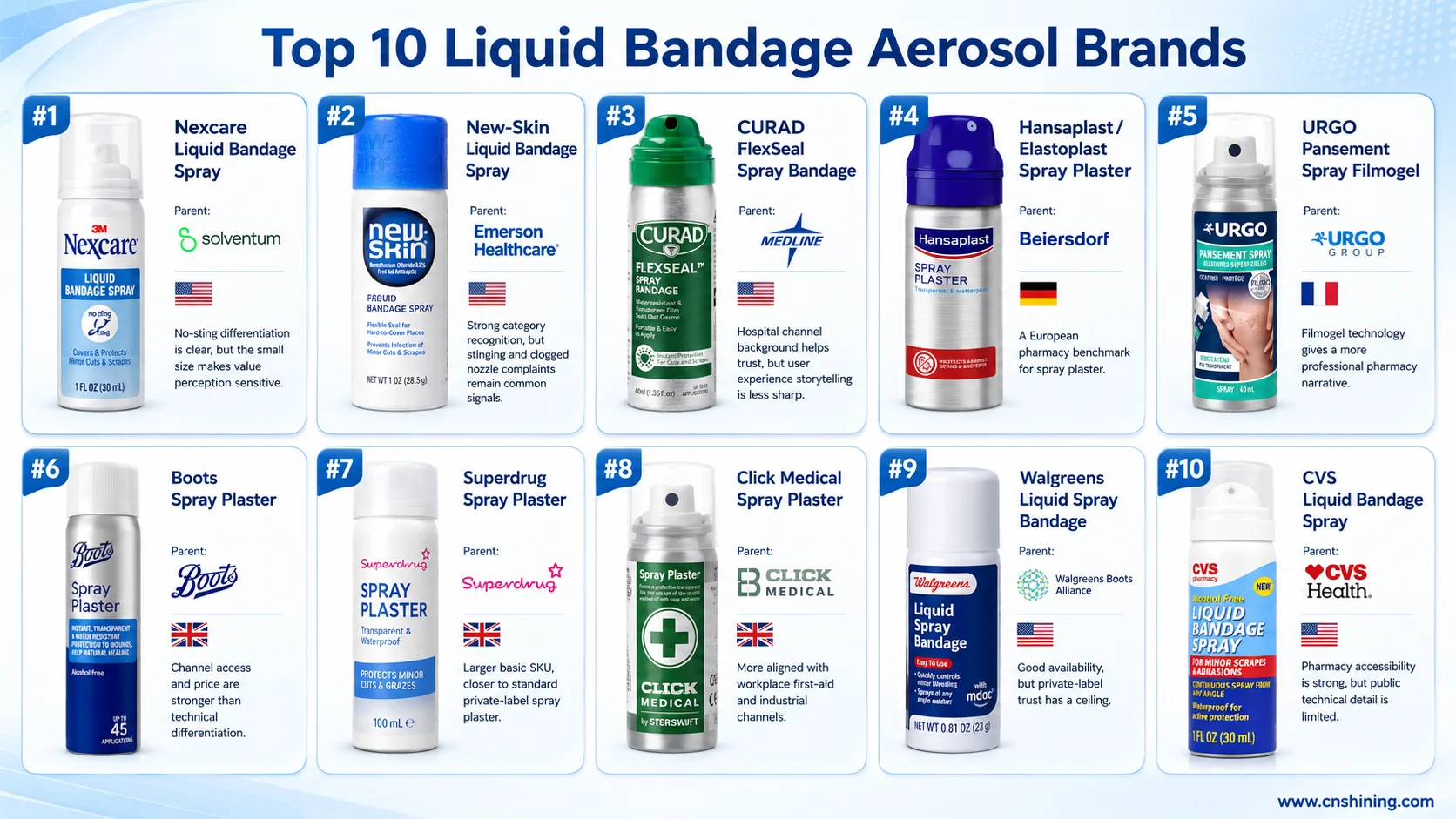
| Brand | Main Market | Owner | Typical Size | Price | Technical Reading |
|---|---|---|---|---|---|
| Nexcare Liquid Bandage Spray | US / Europe / Middle East | 3M healthcare | 18 mL | about 12$ | No-sting differentiation is clear, but the small size makes value perception sensitive. |
| New-Skin Liquid Bandage Spray | United States | Emerson Healthcare | 1 ozL | about 8$ | Strong category recognition, but stinging and clogged nozzle complaints remain common signals. |
| CURAD FlexSeal Spray Bandage | United States | Medline | 40 mL | about 18$ | Hospital channel background helps trust, but user experience storytelling is less sharp. |
| Hansaplast / Elastoplast Spray Plaster | Germany / Europe / UK | Beiersdorf | 40 mL | about 6$–10$ | A European pharmacy benchmark for spray plaster. |
| URGO Pansement Spray Filmogel | France / Europe | URGO Group | 40 mL | about 17$ | Filmogel technology gives a more professional pharmacy narrative. |
| Boots Spray Plaster | United Kingdom | Boots private label | 40 mL | about 10$ | Channel access and price are stronger than technical differentiation. |
| Superdrug Spray Plaster | United Kingdom | Superdrug private label | 50 mL | about 8$ | Larger basic SKU, closer to standard private-label spray plaster. |
| Click Medical Spray Plaster | United Kingdom | Click Medical | 32.5 mL | about 7$ | More aligned with workplace first-aid and industrial channels. |
| Walgreens Liquid Spray Bandage | United States | Walgreens private label | 1 oz | about 9$ | Good availability, but private-label trust has a ceiling. |
| CVS Liquid Bandage Spray | United States | CVS private label | About 1 oz | about 9$ | Pharmacy accessibility is strong, but public technical detail is limited. |
The category split is visible. Nexcare defines a no-sting premium barrier. Hansaplast, Elastoplast, and URGO define the pharmacy spray plaster route. New-Skin and CURAD define the US everyday first-aid liquid bandage. Boots, Superdrug, Walgreens, and CVS push the format toward private-label standardization. A new entrant that only copies “another spray plaster” will face private-label pressure early.
8. User Pain Points and Packaging Failure Modes
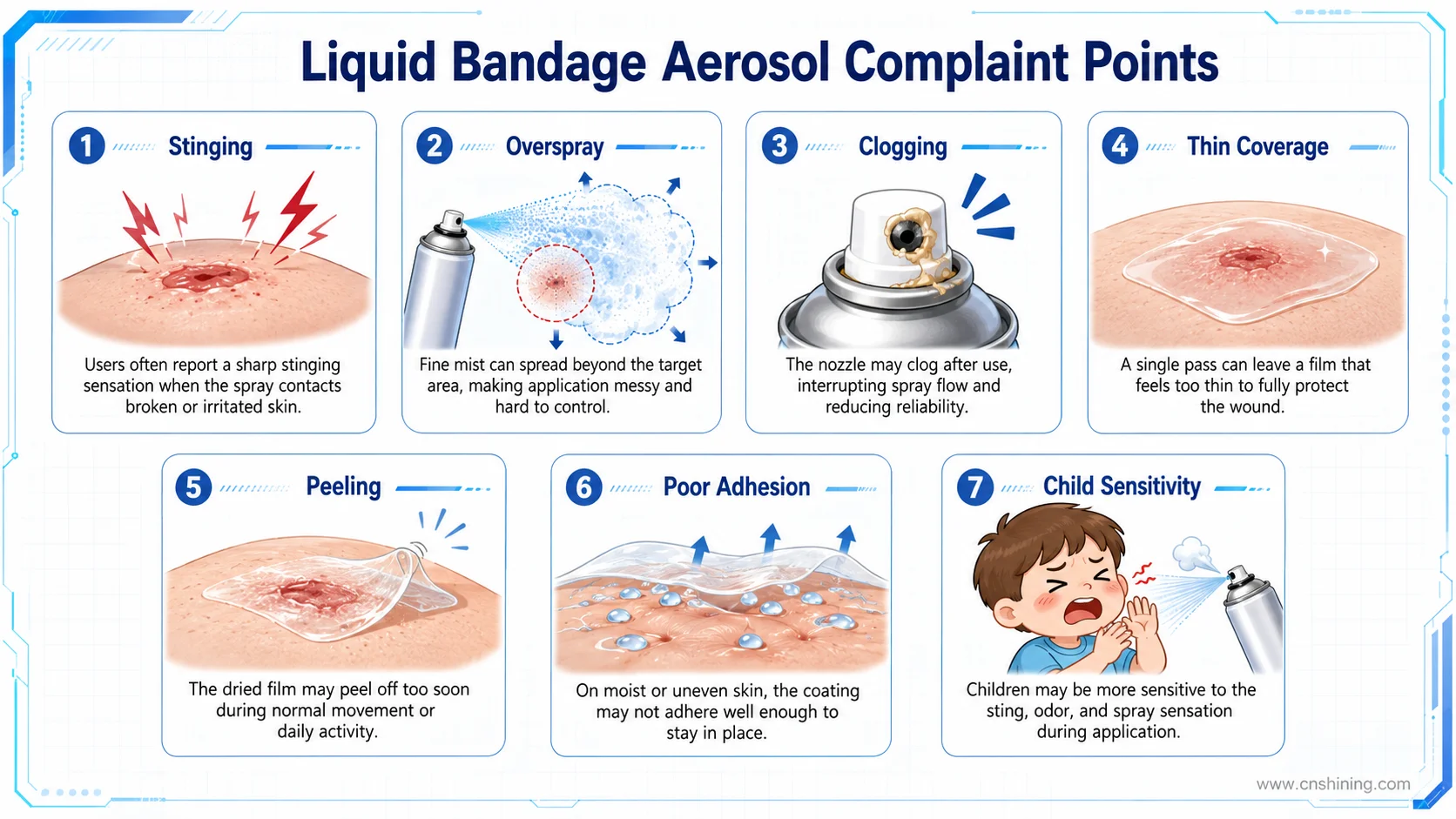
| Pain Point | What It Usually Means | Direct Packaging Response |
|---|---|---|
| Strong stinging | Solvent contact, excessive local dose, or spraying beyond the needed zone | Reduce output rate, narrow the plume, and consider low-sting formulation routes. |
| Overspray and dirty surroundings | Spray cone too wide or actuator lacks target control | Use a directional actuator, smaller orifice design, shielded cap, or finger-target structure. |
| Thin coverage | User expects the security of a padded bandage but receives a light transparent film | Show “one coat, dry, add second coat if needed” on the can, not only in the IFU. |
| Peeling or edge lifting | Sweat, bending, skin oil, lotion, or insufficient drying | Improve instructions for clean/dry skin, drying time, and bending-area application. |
| Unstable adhesion | Skin condition and application technique vary widely | Use icons for “no ointment, no cream, dry first, wait before covering.” |
| Not friendly for children or sensitive users | Sting perception dominates acceptance | Develop sensitive-skin SKUs with lower output and stronger age or use guidance. |
| Clogged or dirty nozzle | Film former dries at orifice after use | Use anti-clog valve and actuator design, protective cap, and nozzle-cleaning instruction if needed. |
The common thread is not abstract. Most complaints can be translated into spray control. Beyond formulation sting, the failure modes point to valve output, actuator targeting, spray boundary, drying instructions, and nozzle protection.
9. Packaging Engineering Recommendations
9.1 Valve
For many continuous spray formats, two valve directions deserve early evaluation. The first is a low-output directional continuous valve to reduce overspray and local solvent load. The second is a metered valve or Bag-on-Valve option for higher-end SKUs where output repeatability is part of the value. The goal is simple: less “one press and everything is covered in glue,” more controlled film deposition.
9.2 Actuator
The actuator is the highest-ROI upgrade point. A standard round spray button is rarely ideal for fingertips, knuckles, and small cracks. A shielded directional actuator can narrow the spray boundary, improve visual aiming, and reduce accidental discharge in a bag. For finger-focused SKUs, a small foldable target shield or finger guard built into the cap is worth testing.
9.3 Can Shape and Printing
A slim can, slight oval body, or grip waist improves pointing control, especially with wet hands. Printing should not only show claims. It should show spray distance, drying time, number of coats, and unsuitable wound types. For this product, icons are not decoration. They reduce misuse.
9.4 Inner Coating and Compatibility
Strong solvent systems may contain ethyl acetate, ethanol, DME, hydrocarbon propellants, hexamethyldisiloxane, or isooctane. If compatibility is weak, the result can be odor, pressure loss, residue, valve sticking, color change, corrosion, or film defect. Inner lacquer, gasket elastomer, spring material, dip tube, and actuator resin should be screened as one system.
| Priority | Recommendation | Main Problem Addressed |
|---|---|---|
| High | Directional actuator with accidental-discharge protection | Overspray, poor aiming, bag leakage |
| High | Valve output optimization or metered valve evaluation | Sting concentration, unstable film thickness, user variability |
| High | Early can-liquid-valve compatibility matrix | Clogging, odor, pressure decay, long-term stability |
| Medium | Front-label icons for spray distance, drying, and unsuitable wounds | Misuse, edge lifting, poor adhesion reviews |
| Medium | Slim easy-grip can and higher-friction surface finish | Wet-hand use and poor directional control |
| Medium to high-end | BOV or lower-flammability delivery route evaluation | Flammable warning pressure, precision, content utilization |
| Medium | Separate child or sensitive-skin SKU logic | Rejection caused by pain or sting perception |
10. Shining Packaging: Actuators, Aerosol Cans, and Valves for This Category
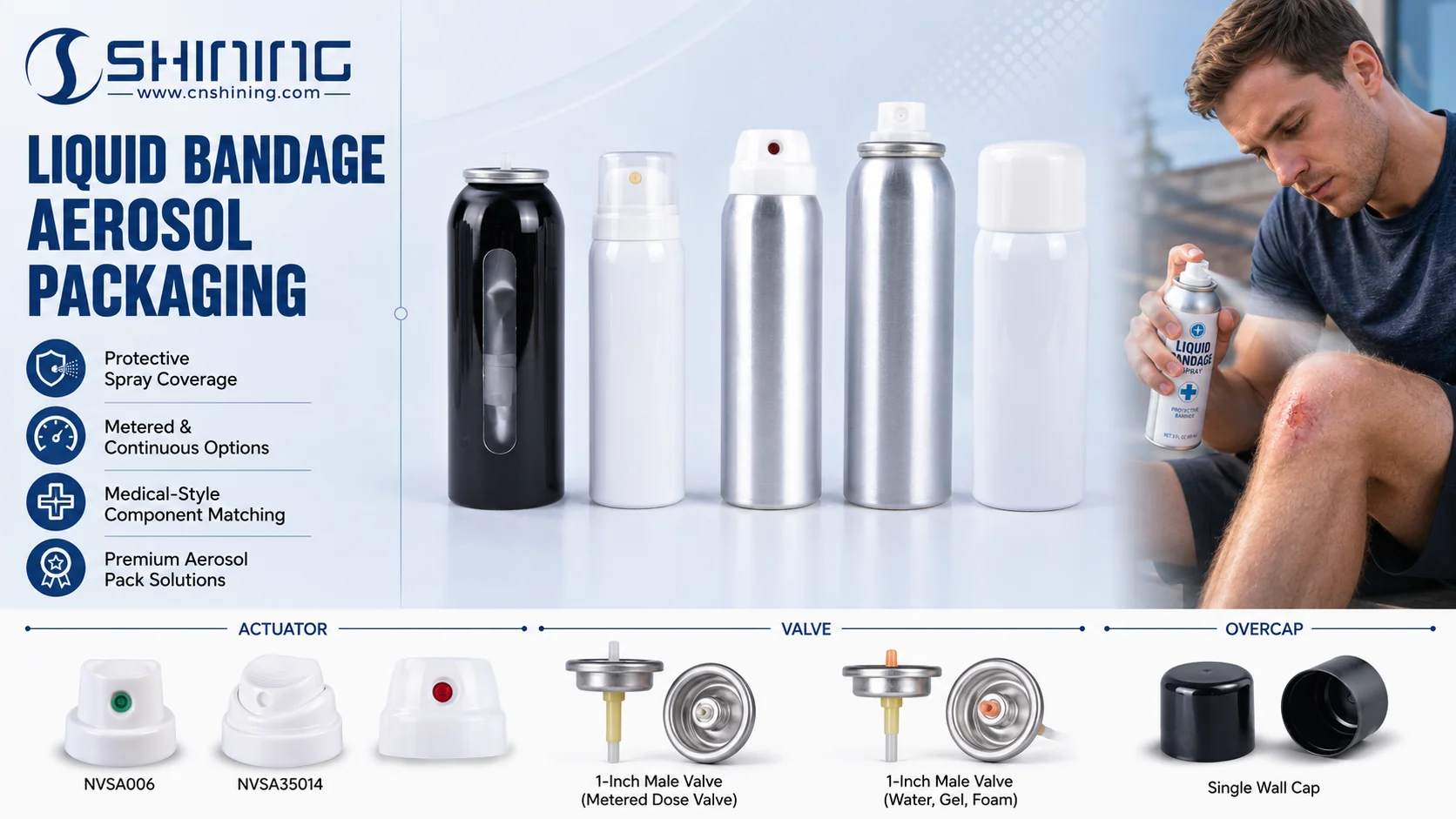
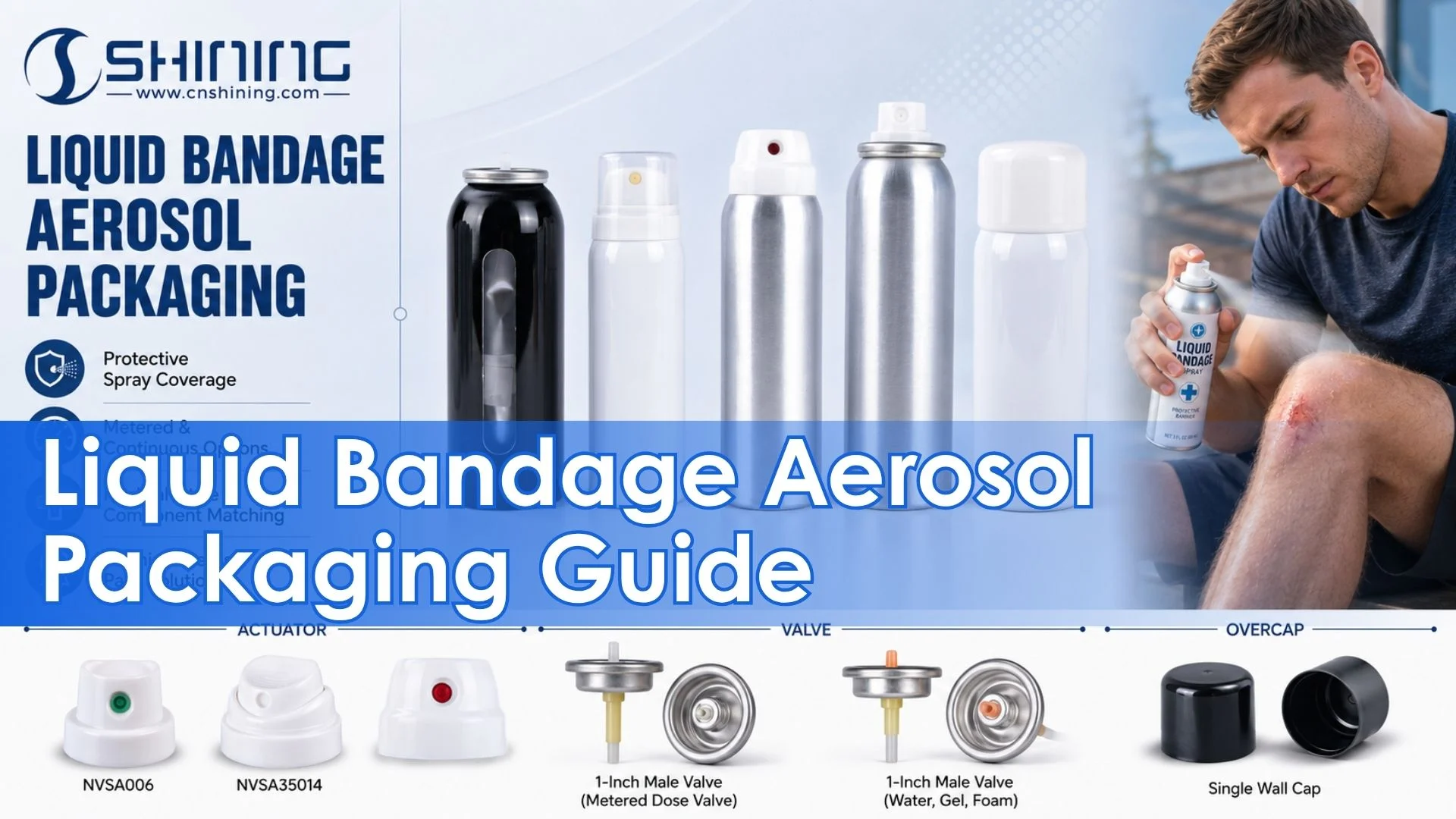
For liquid bandage aerosol projects, the relevant role of Shining Packaging is the delivery hardware, not the wound-care chemistry itself. The three areas that matter most are actuators, aerosol cans, and valves.
Actuator work should focus on directional spray, reduced overspray, cap protection, and user aiming. Valve selection should focus on output control, anti-clog behavior, gasket compatibility, and pressure stability. The aerosol can and inner coating should be screened against solvent systems such as ethyl acetate, ethanol, DME, hydrocarbons, hexamethyldisiloxane, or isooctane-based formulas.
For brands developing no-sting liquid bandage spray, spray plaster, or waterproof liquid bandage aerosol, the packaging question is not only “can it spray?” The better question is: can it spray a controlled film repeatedly after storage, transport, and real consumer handling?
11. Practical Conclusion
The next competition in liquid bandage aerosol will not be decided only by whether the product forms a film. Most products can form a film under controlled conditions. The real test is whether the user can spray that film onto the right area, with tolerable sensation, stable drying, acceptable durability, and clear regulatory boundaries.
The practical packaging priority is clear: directional actuator first, anti-clog valve second, can-liquid compatibility third, visual instructions fourth, and BOV or lower-flammability routes for higher-end lines. This sequence fixes more user pain with less development waste.
12. FAQ: Liquid Bandage Aerosol
A liquid bandage aerosol is a sprayable film-forming wound cover for clean, dry, minor cuts and abrasions. It uses a polymer, volatile solvent, and propellant system. After spraying, the solvent evaporates and leaves a flexible transparent film. The film mainly works as a mechanical barrier against water, dirt, and friction. It is not intended for deep, infected, puncture, bite, or serious burn wounds.
No. Liquid bandage aerosol is normally used to cover and protect minor superficial wounds. Tissue adhesive is designed to approximate or close skin edges. That difference changes the regulatory path, testing burden, and label language. For product development, the claim boundary should be fixed early. “Protects minor cuts” and “closes wounds” are not interchangeable statements.
Stinging usually comes from solvent contact with exposed superficial tissue, excessive local wetting, or broad overspray onto sensitive surrounding skin. Formulation matters, but spray hardware also matters. A high-output valve or wide plume can deposit too much liquid in one spot. Lower output, narrower spray geometry, and no-sting solvent systems can reduce this problem.
Overspray happens when the spray cone is too wide, the actuator has poor directional control, or the user sprays from an unsuitable distance. In liquid bandage aerosol, overspray is more annoying than in many cosmetic sprays because the dried material can feel like glue residue. Directional actuators, target shields, and clear spray-distance icons are practical fixes.
The main routes are traditional solvent-based polymer films, no-sting silicone-acrylate barrier systems, active-loaded liquid bandages, and research-stage biopolymer or hydrogel spray films. Traditional systems are cost-effective and fast drying. Silicone-based systems reduce sting perception. Active or biopolymer systems may add functional claims, but they also raise stability, packaging compatibility, and regulatory complexity.
It should not be positioned as a full replacement. Aerosol liquid bandage is useful for hard-to-cover areas such as fingers, joints, and broad superficial abrasions. It has no absorbent pad and no cushioning layer. For wounds with exudate, high friction, deeper injury, or need for long wear, strip bandages, gauze, or hydrocolloid dressings may be more suitable.
Liquid bandage aerosol formulas may contain strong solvents, silicone fluids, DME, hydrocarbons, alcohols, or active ingredients. These can interact with inner lacquer, gasket elastomers, springs, dip tubes, and actuator plastics. Poor compatibility can cause odor, corrosion, pressure loss, clogging, color change, or unstable film formation. Compatibility testing should start before final artwork and claims are locked.
The label should show the wound boundary, spray distance, drying time, number of coats, and wounds where the product should not be used. For example, deep wounds, puncture wounds, infected skin, animal bites, and serious burns should be handled differently. A short icon panel often works better than burying all instructions in a long IFU.
Bag-on-Valve can be useful when the goal is cleaner separation between product and propellant, better evacuation, or more controlled discharge. It is not automatically better for every formula. Solvent compatibility, bag material, valve selection, pressure profile, and spray pattern still need testing. For premium or lower-flammability concepts, BOV is worth evaluating early.
The first upgrade should usually be the actuator. User complaints about overspray, poor aiming, and messy application often trace back to actuator geometry. A directional actuator with a protective cap or small target shield can improve precision without changing the whole formula. After that, valve output, anti-clog behavior, and can-liquid compatibility should be optimized together.