
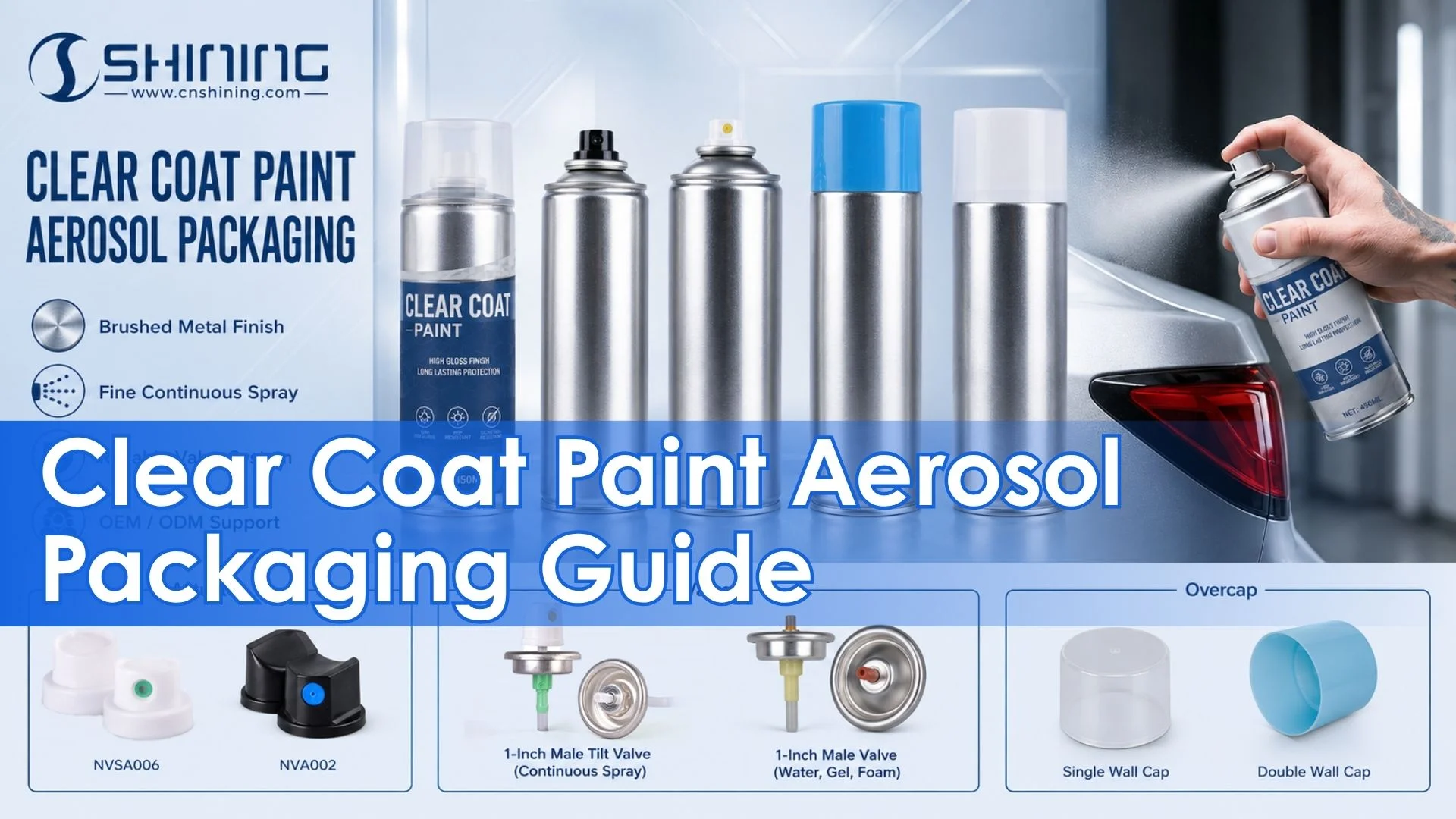
Aerosol clear coat paint, also called clear lacquer spray, aerosol clearcoat, spray can clear coat, or transparent topcoat, is a pressurized finishing system. It combines clear coating resin, solvent or water carrier, propellant, valve, and actuator in a disposable metal container. The value is not that it beats every spray-gun clear coat. It solves a narrower problem: small-batch repair, field touch-up, low equipment threshold, and fast use without a full spray booth.
The strongest use cases are DIY repair, spot refinish, headlight restoration, wheel and trim protection, model work, artwork sealing, and after-sales quick repair. A 2K aerosol clear coat can form a chemically crosslinked film after internal activation. That gives better chemical resistance, gasoline resistance, hardness, and weathering resistance than most 1K products. It also raises the safety bar.
1. Product Definition and Working Mechanism
1.1 Definition and classification
Aerosol clear coat is the spray-can delivery format of a transparent protective film. It is normally applied over basecoat, colored paint, restored headlight plastic, printed graphics, craft surfaces, or decorative substrates. The expected functions are gloss, abrasion resistance, chemical resistance, UV protection, sealing, and surface protection.
The common chemistry routes are solvent-based 1K, solvent-based 2K, waterborne aerosol clear coat, and UV-curable clear coating. 1K systems mainly form film through solvent evaporation and limited self-crosslinking. 2K systems rely on a reaction between resin and hardener. Waterborne systems add one more step: water evaporation followed by polymer particle coalescence. UV systems use light-triggered curing to reduce repair time to minutes.
In true 2K aerosol design, the two components must stay separated before use. The technical note explains that the paint and hardener are stored in different compartments and mixed only after activation through the bottom button mechanism, after which the chemical reaction starts during and after spraying.
1.2 Film formation, atomization, and curing
A standard aerosol valve is mechanically simple. Pressing the actuator moves the valve stem, opens the seal, and lets pressurized product travel through the dip tube, valve body, stem orifice, and actuator nozzle. Releasing the actuator allows the spring to reseal the valve. The technical problem sits in the details. Stem orifice size, vapor tap, actuator geometry, and nozzle outlet shape change flow rate, fan width, droplet size, and spray feel. This is why the same resin can feel different in two cans.
Solvent-based 1K clear coats form film through fast solvent evaporation, resin chain entanglement, and later limited hardening. 2K clear coats use isocyanate or other reactive hardeners to build a higher crosslink density. That is the main reason for better solvent, gasoline, and scratch resistance. Waterborne coatings need enough coalescence after water loss; otherwise early hardness, water whitening resistance, and leveling suffer.
UV-curable clear coat is attractive because it reduces repair dwell time. The automotive refinish literature describes UV-A curable clear coat routes that can cure in about four minutes under the right process conditions. The practical value for aerosol packaging is not replacing spray guns. It is making one-panel or small-part repair less dependent on long drying windows.
2. Substitution Logic
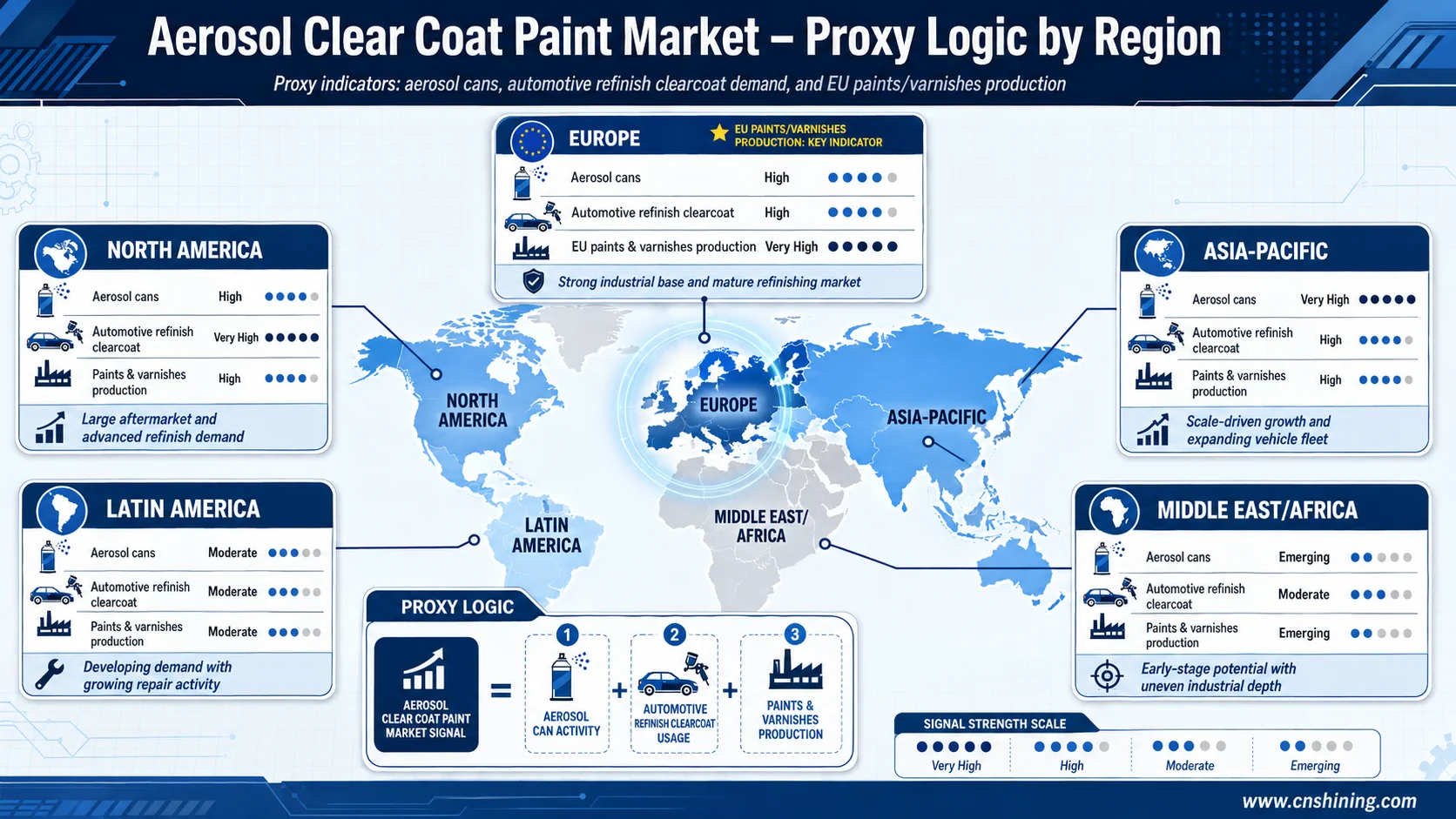
Comparison with liquid clear coat, brush varnish, powder clear, and spray-gun systems
Aerosol clear coat is often judged unfairly. Its direct competitor is not always powder coating or professional spray-gun clear. In many cases, the competitor is “doing nothing” because the user does not want to set up a compressor, spray gun, mixing cup, booth, and cleaning process. Convenience and low failure cost matter more than theoretical peak performance.
| Option | Typical Performance | Application Cost | Equipment Barrier | Typical Use | Practical Conclusion |
|---|---|---|---|---|---|
| Aerosol clear coat 1K | Medium to good appearance; medium hardness and chemical resistance | Medium | Lowest | DIY, small parts, decorative sealing, temporary protection | Fastest entry point, not the most durable route |
| Aerosol clear coat 2K | Medium-high to high appearance; better gasoline, abrasion, and weather resistance than 1K | Medium-high | Low | Headlights, local refinish, wheels, trim, quick repair | Best balance for small-area repair when safety is controlled |
| Liquid clear coat + spray gun | Highest ceiling for film build and leveling | Low to medium per area | High | Full panels, body shops, OEM/refinish shops | Preferred route for professional large-area work |
| Brush-applied varnish | Easy thick film; weak appearance and leveling | Low | Lowest | Wood edges, craft parts, low appearance requirement | Not suitable when surface appearance is the main requirement |
| Powder clear coating | Thick film, good abrasion resistance, solvent-free application | Medium | Very high | Metal parts, factory batch coating | Rarely a direct substitute for field touch-up |
3. Formulation Breakdown and Technical Terms
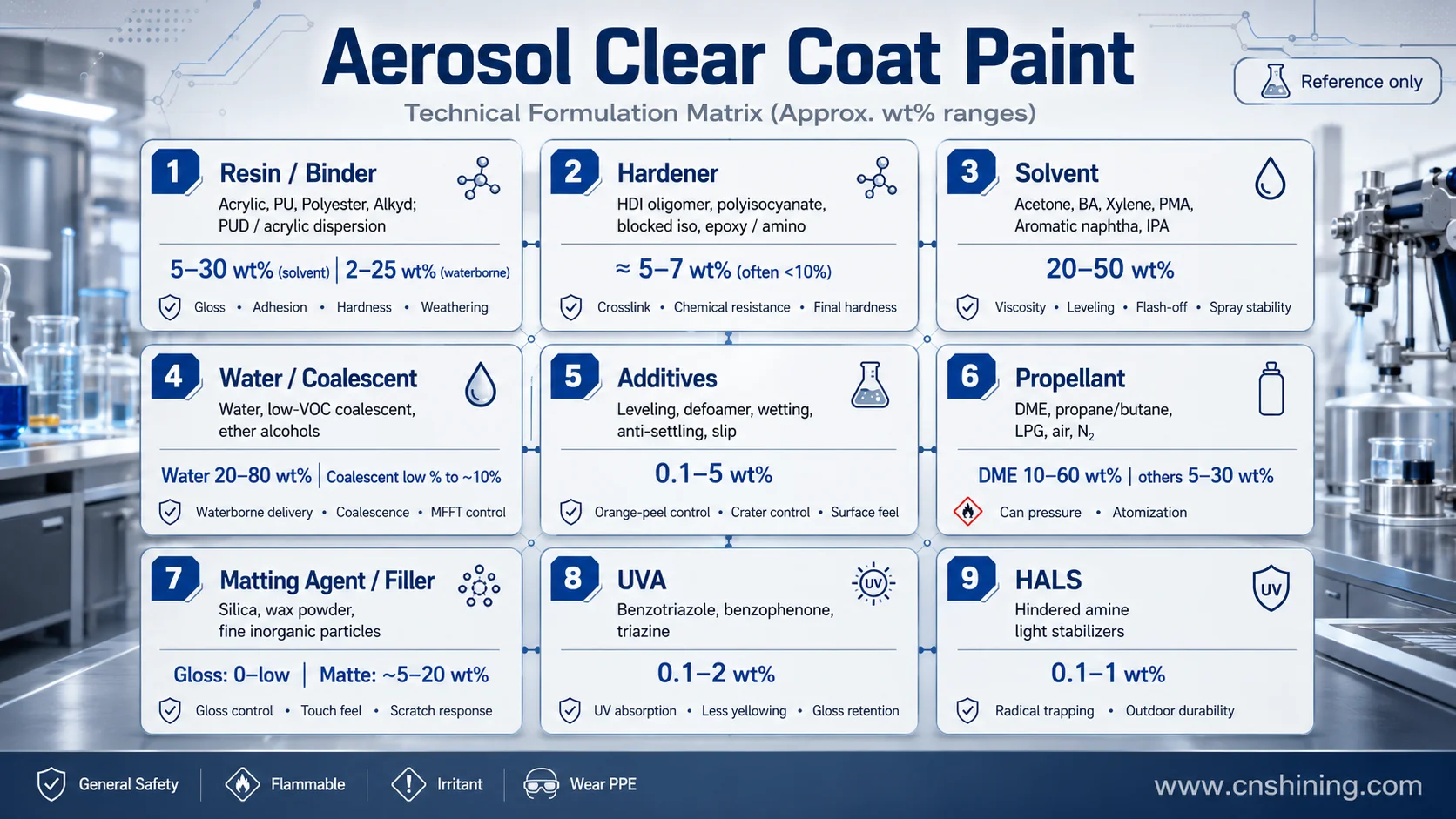
3.1 Representative formulation functions
The following ranges are engineering references, not one brand’s recipe. Clear coat usually contains no hiding pigment. Matte or satin products may use silica or wax matting agents. 2K products normally include a separate hardener component, often based on HDI oligomer or related polyisocyanate chemistry.
| Functional Group | Typical Chemicals | Representative Range | Main Function | Main Safety Note |
|---|---|---|---|---|
| Resin / main binder | Acrylic, modified polyurethane, polyester, alkyd; PUD or acrylic dispersion in waterborne systems | Solvent-based total resin often about 5–30 wt%; waterborne polymer about 2–25 wt% | Gloss, adhesion, hardness, weathering, recoat behavior | Some monomers or oligomers irritate skin and eyes; spray mist inhalation must be controlled |
| Hardener | HDI oligomer, polyisocyanate, blocked isocyanate, epoxy hardener, amino resin | Commercial 2K aerosol SDS often below 10 wt%, commonly around 5–7 wt% | Crosslinking, gasoline resistance, chemical resistance, final hardness | Isocyanates can sensitize skin and respiratory systems |
| Solvent | Acetone, butyl acetate, xylene, PMA, light aromatic naphtha, isopropanol | Commonly about 20–50 wt% | Viscosity reduction, leveling, flash-off, spray stability | Flammable vapor, dizziness, irritation, need for ventilation and ignition control |
| Water / coalescent | Water, low-VOC coalescent, ether alcohols | Water in waterborne aerosol can reach 20–80 wt%; coalescent often low single digits to about 10 wt% | Waterborne delivery, particle coalescence, MFFT control | Water is low hazard, but coalescents can still add VOC or tack |
| Additives | Leveling agent, defoamer, wetting agent, anti-settling agent, slip or scratch additive | About 0.1–5 wt% | Orange-peel reduction, crater control, surface feel, application window | Some silicone or fluorinated additives can affect recoat or fish-eye risk |
| Propellant | DME, propane/butane, LPG, compressed air, nitrogen | DME in aerosol paint patents can be about 10–60 wt%; other propellants often about 5–30 wt% | Maintains can pressure and supports atomization | Usually highly flammable unless using compressed-gas routes |
| Matting agent / filler | Silica, wax powder, fine inorganic particles | Gloss clear: zero to low; matte systems may use silica around 5–20 wt% | Gloss control, touch feel, scratch response | Excess loading can cause haze, cloudy film, and nozzle clogging |
| UV absorber | Benzotriazole, benzophenone, triazine types | Often about 0.1–2 wt% | UV absorption, reduced gloss loss, chalking, and yellowing | Some UV absorbers face regulatory review; compatibility must be checked |
| HALS | Hindered amine light stabilizers | Often about 0.1–1 wt% | Radical trapping and longer outdoor appearance retention | Needs compatibility with resin and pigment system |
Commercial SDS data makes the risk profile clear. 2K aerosol clear coat can contain DME, acetone, butyl acetate, aromatic solvents, and isocyanate hardener. U-POL 2K clearcoat SDS data, for example, lists acetone, butyl acetate, HDI oligomers, and UV stabilizer components in the formulation framework. See the U-POL 2K clearcoat SDS. Light stabilization is also a real formulation topic, not a label word; the chemistry is discussed in the light stabilizer selection article.
3.2 Technical Terms and Commercial Meaning
| Term | Plain Technical Meaning | Commercial Meaning |
|---|---|---|
| 1K | One-component system, ready to spray, mainly physical drying or limited self-crosslinking | Low threshold and lower cost, with moderate final resistance |
| 2K | Two-component system, activated before use and chemically crosslinked | Higher performance, higher price, higher safety requirement |
| Pot life | Usable time after activation | Controls waste rate and realistic work area per can |
| Flash-off | Waiting time between coats | Too short causes solvent trap or attack; too long can affect intercoat bonding |
| Fan pattern | Spray width and shape | Controls coverage efficiency and orange-peel or sag risk |
| Atomization | Droplet formation quality | Directly affects flatness, texture, overspray, and gloss |
| Orange peel | Uneven surface texture like citrus skin | One of the most frequent appearance complaints |
| Sag / run | Clear coat flows downward before it sets | Usually means excess wet film, wrong distance, or poor flash control |
| Dry-to-touch | Surface can be touched lightly | Not the same as polish-ready or solvent-resistant |
| Full cure | Final hardness and chemical resistance have developed | The real performance checkpoint |
| VOC | Volatile organic compound | Affects compliance, odor, transport, and retail access |
| MIR | Maximum incremental reactivity | Important in US aerosol coating compliance |
| BOV | Bag-on-Valve package | Can improve compatibility, spray stability, and residual rate |
| HALS | Hindered amine light stabilizer | Affects outdoor durability and gloss loss speed |
| UVA | UV absorber | Affects yellowing resistance and gloss retention |
4. Regulation, Safety, and Test Methods
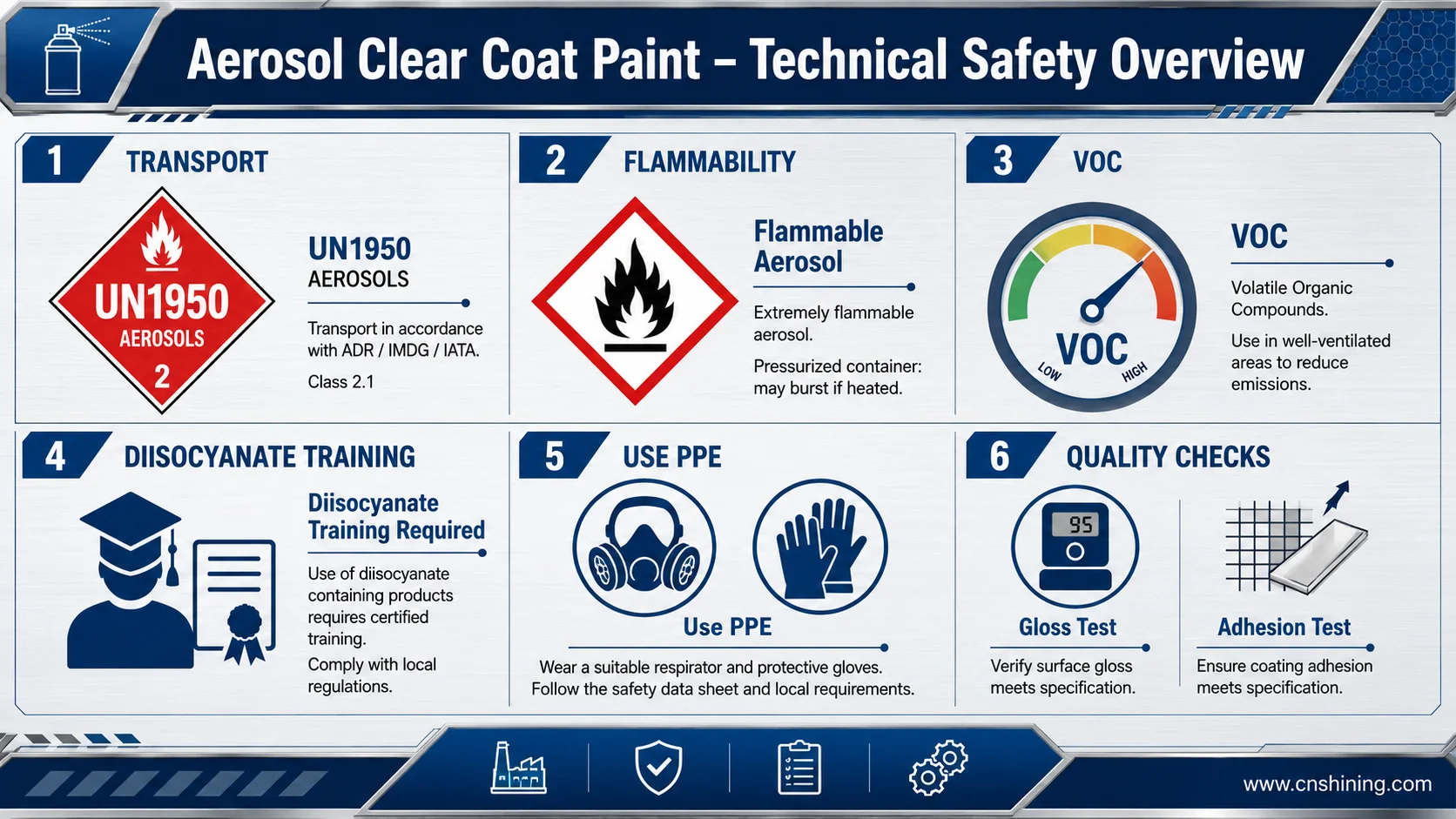
4.1 Main regulation and transport controls
Aerosol clear coat paint has four main compliance layers: chemical compliance, dangerous goods transport, labeling and consumer warning, and VOC or emission control. For transport, aerosols are normally handled under UN1950 AEROSOLS, with hazard class depending on the content. The transport basis is described in the UN dangerous goods model regulations.
In the EU, REACH and CLP form the base layer. For 2K aerosol clear coat, the diisocyanate restriction is the item that matters in daily use. Since 24 August 2023, professional and industrial users of products containing more than 0.1 wt% diisocyanates need adequate training before use. The requirement is explained in the diisocyanate training guidance.
VOC rules are not identical across regions. Europe has long managed decorative paints and varnishes through VOC limits. The US federal aerosol coating rule is reactivity-based, using MIR rather than only total VOC mass. A recent rule discussion is available from the EPA aerosol coatings rule update.
SDS documents show why casual handling is a problem. Extremely flammable aerosol warnings and pressurized-container warnings are common. 2K products often add eye irritation, skin sensitization, drowsiness or dizziness, and isocyanate-related labeling. Eastwood 2K AeroSpray SDS data is one example of the hazard classification pattern in a commercial aerosol clear coat package through the Eastwood 2K clear coat SDS.
4.2 Useful test methods
If aerosol clear coat is treated as an industrial surface protection material, at least four test groups are needed: gloss, adhesion, abrasion or chemical resistance, and weathering. ASTM D523 is a standard method for specular gloss at 20°, 60°, and 85°, and is a useful starting point for high-gloss or matte clear coat claims. See the ASTM D523 gloss test method. Adhesion can be checked through cross-cut or tape methods such as ISO 2409 or ASTM D3359. Weathering and scratch tests should match the target substrate and application.
5. Technology Frontiers, Brand Landscape, and Source Index
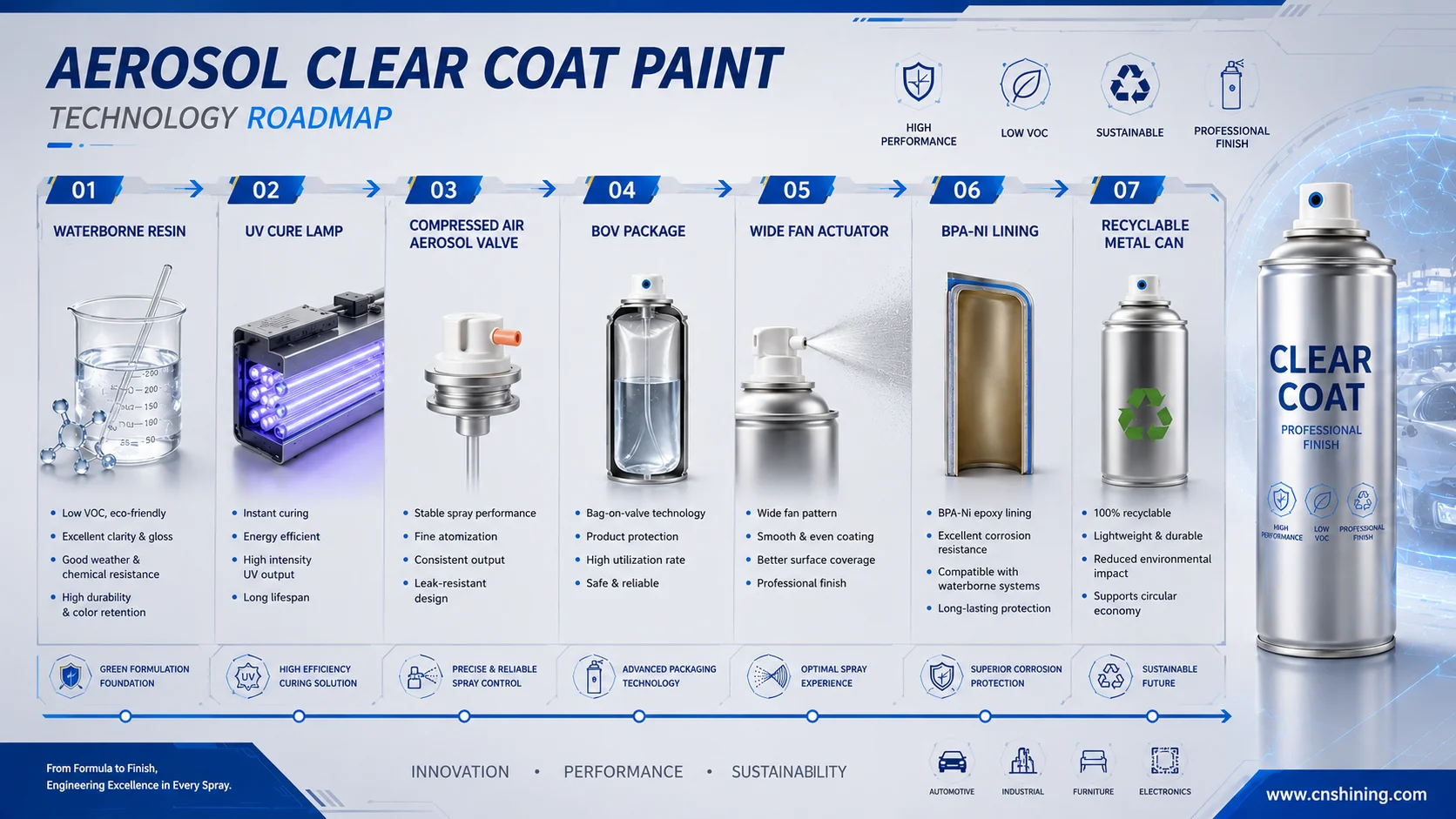
5.1 New technology and development direction
Environmental work is shifting from “lower VOC resin” to a whole-package view: low-GWP propellant, recyclable metal packaging, lower-risk can linings, and better spray delivery. Water-based aerosol paint patents show resin routes using water and DME as a major medium, as seen in EP3592813B1 water-based aerosol paint. Compressed-air or nitrogen aerosol valve concepts also aim to reduce LPG dependence, odor, and oxidation concerns.
Faster curing remains a strong repair-shop driver. UV-curable clear coat can reduce repair dwell time, but it needs controlled exposure, surface geometry awareness, and resin design. Nanotechnology is also active. Nano-silica routes target scratch and abrasion resistance. CeO2 or ZnO nanostructures target UV shielding while trying to preserve transparency. The challenge is not only performance. It is dispersion stability, haze control, cost, and regulatory acceptance. One reference point is the waterborne nanoceria/polymer coating study.
The spray end may be the most practical upgrade area. Adjustable fan actuators, twist-to-lock heads, wide fan nozzles, stable stem-orifice design, and BOV or compressed-gas platforms all target the same user complaints: orange peel, sputter, clogging, sagging, and unstable spray late in the can. Shining’s actuator catalog illustrates how geometry and locking functions are becoming part of the user experience through twist-lock aerosol actuators.
5.2 Top 10 Aerosol Clear Coat Paint Brands
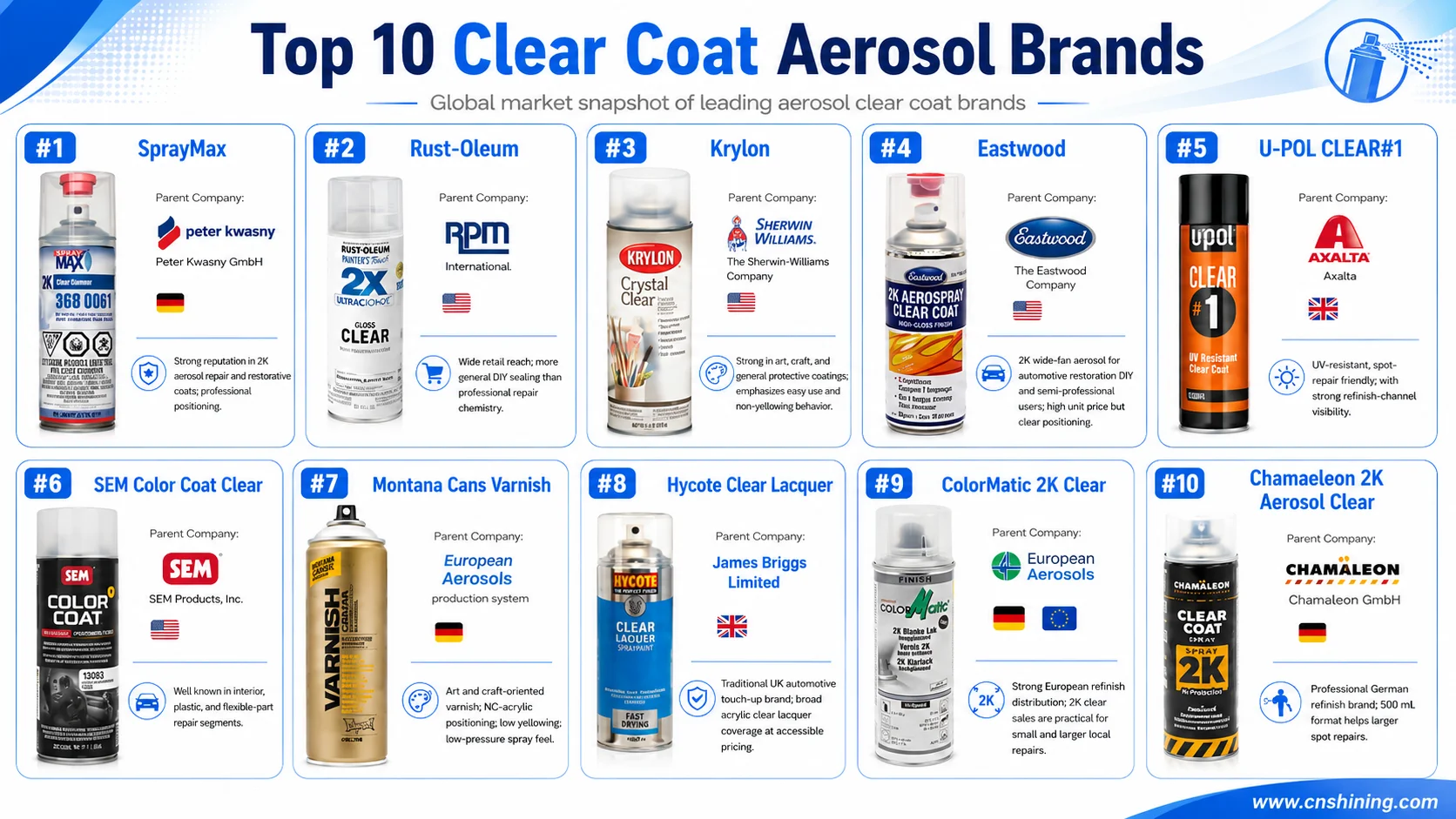
| Brand | Country / Region | Parent Company | Common Capacity | Typical Retail Range | Technical Comment |
|---|---|---|---|---|---|
| SprayMax | Germany | Peter Kwasny GmbH | 400 mL | about 29-35$ | Strong recognition in 2K aerosol repair and restoration; clearly professional positioning. |
| Rust-Oleum | United States | RPM International | 11–12 oz | about 7-12$ | Wide retail reach; more general DIY sealing than professional repair chemistry. |
| Krylon | United States | The Sherwin-Williams Company | 11 oz | about 8-14$ | Strong in art, craft, and general protective coatings; emphasizes easy use and non-yellowing behavior. |
| Eastwood | United States | The Eastwood Company | 11.8–12 oz | about 41$ | 2K wide-fan aerosol for automotive restoration DIY and semi-professional users; high unit price but clear positioning. |
| U-POL CLEAR#1 | United Kingdom | Axalta | 450 mL | about 20-30$ | UV-resistant, spot-repair friendly, with strong refinish-channel visibility. |
| SEM Color Coat Clear | United States | SEM Products, Inc. | 12 oz | about 19-26$ | Well known in interior, plastic, and flexible-part repair segments. |
| Montana Cans Varnish | Germany | European Aerosols production system | 400 mL | about 14-17$ | Art and craft-oriented varnish; NC-acrylic positioning, low yellowing, low-pressure spray feel. |
| Hycote Clear Lacquer | United Kingdom | James Briggs Limited | 400 mL / 13.5 oz | about 11-12$ | Traditional UK automotive touch-up brand; broad acrylic clear lacquer coverage at accessible pricing. |
| ColorMatic 2K Clear | Germany / Europe | European Aerosols | 200 / 500 mL | about 16$ upward | Strong European refinish distribution; 2K clear sizes are practical for small and larger local repairs. |
| Chamaeleon 2K Aerosol Clear | Germany | Chamäleon GmbH | 200 / 500 mL | about 36-52$ | Professional German refinish brand; 500 mL format helps larger spot repairs. |
6. Product Fit: Shining Packaging Actuators, Cans and Valves
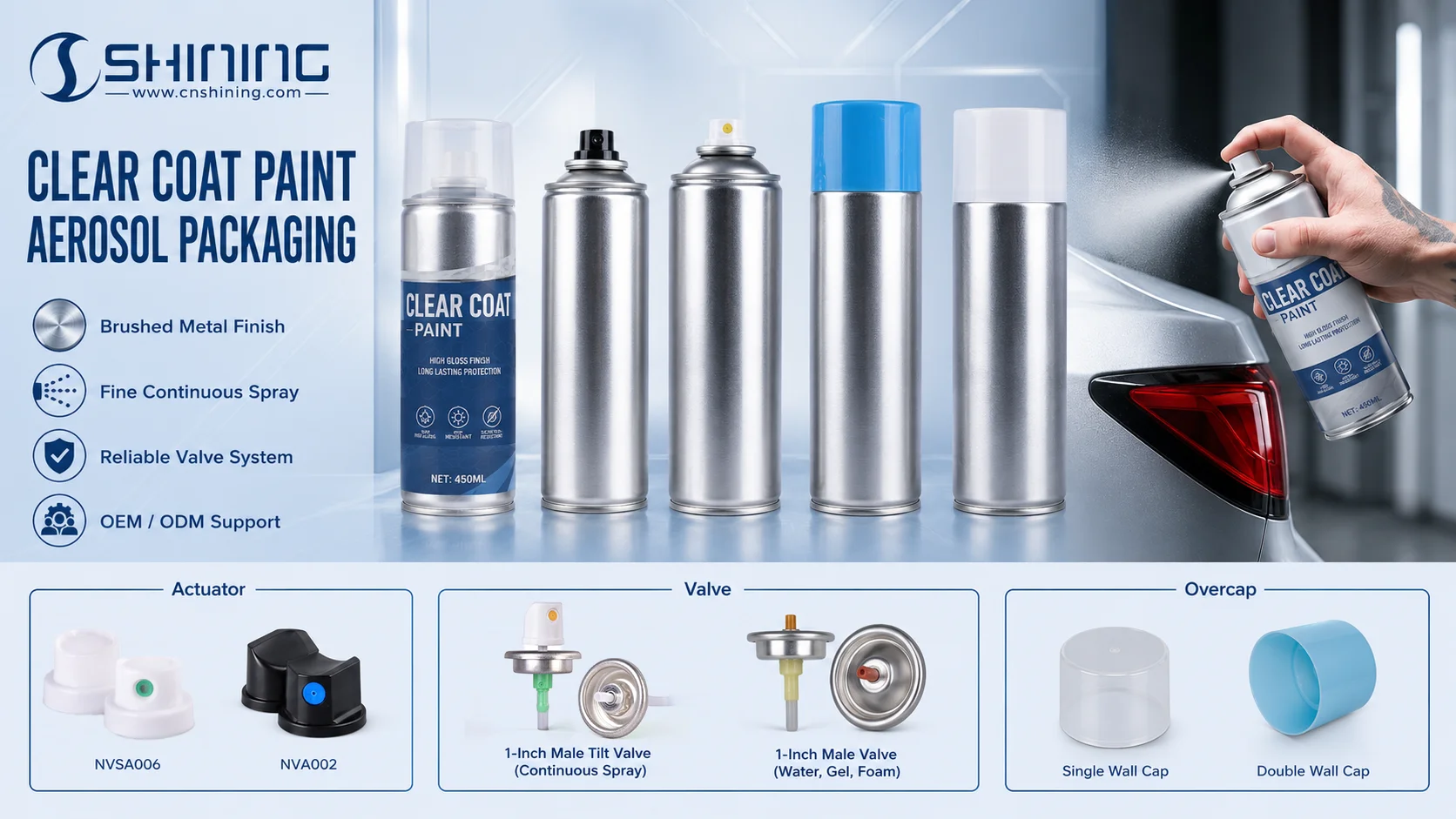
For aerosol clear coat paint, packaging is not just a container. It defines spray behavior, failure rate, and how much the coating chemistry can actually show its performance. Shining Packaging’s relevant work sits around actuators, aerosol cans, and valves. These parts are directly tied to the pain points discussed above: fan width, atomization stability, clog resistance, leakage control, pressure retention, and compatibility with solvent-rich or 2K-style filling systems.
A clear coat can use a good resin and still fail in the user’s hand if the actuator spits, the stem orifice is mismatched, or the can pressure curve drops too fast. For this product category, component selection should start with the target spray job: spot repair, wide-panel pass, headlight restoration, trim coating, or craft varnish. From there, the actuator pattern, valve flow rate, gasket compatibility, can size, and internal coating choice can be selected with less guesswork.
Shining Packaging should be positioned in this blog as a packaging engineering partner rather than a coating formulator. The useful message is simple: a stable clear coat system needs matched chemistry and matched hardware. The actuator, valve, and can are the parts that turn formulation data into a real spray film.
7. User Pain Points and Packaging Improvement Priorities
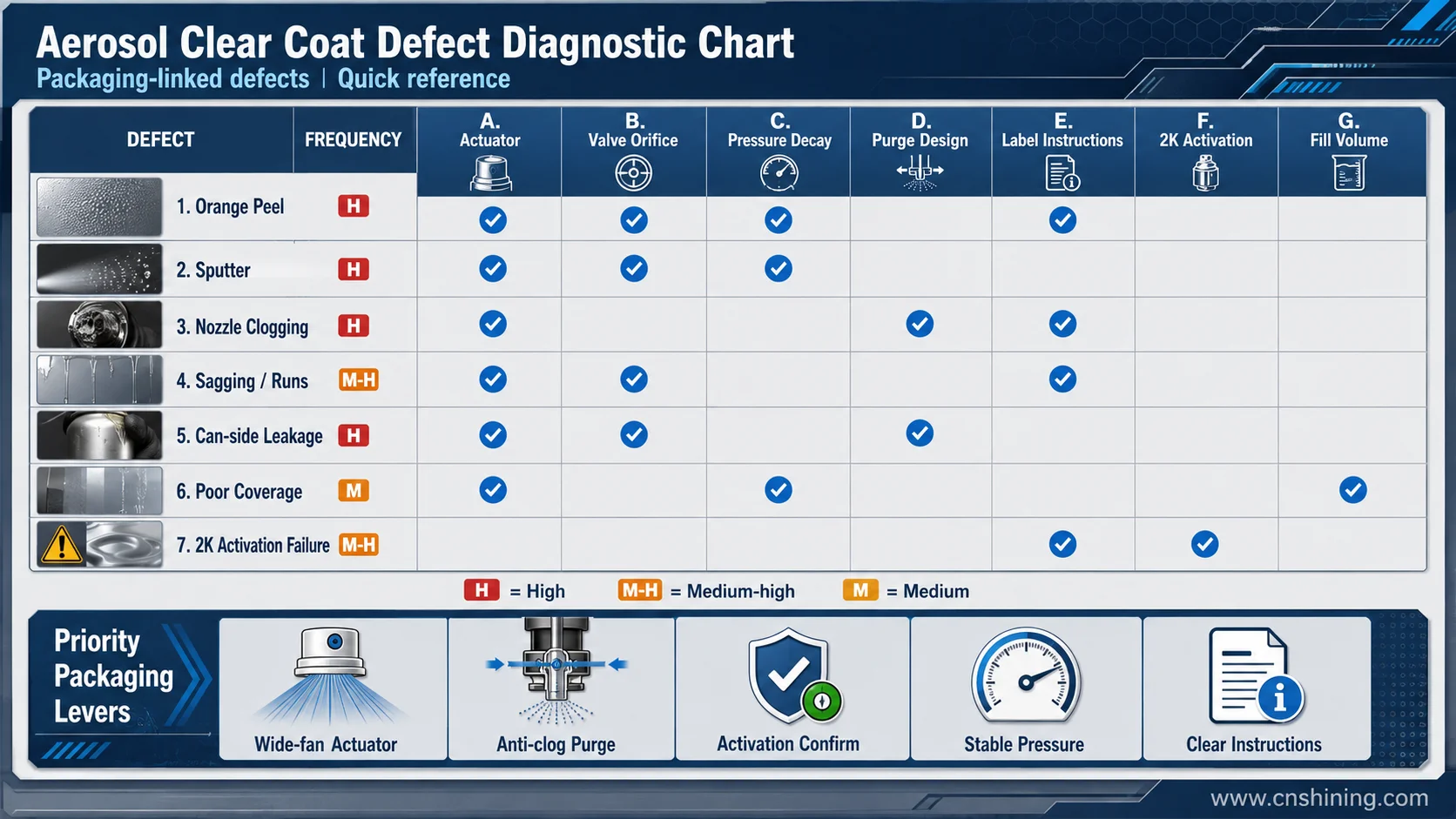
7.1 E-commerce and social feedback patterns
The most frequent complaints are not surprising: orange peel, grainy texture, uneven spray, sputter, clogging, leakage onto the hand, sagging, difficult recoat window, inconsistent 2K activation, soft film after several days, weak coverage, strong odor, and heavy PPE burden. Many of these are not pure resin failures. They come from spray hardware, pressure behavior, user instructions, and the gap between professional chemistry and DIY use.
| Frequency | User Pain Point | Typical Evidence Pattern | Likely Root Cause |
|---|---|---|---|
| High | Orange peel, grain, uneven spray, sputter | Repeated user reports of orange peel, pimples, and sputter; many tutorials focus on reducing texture | Poor atomization, pressure decay, narrow solvent window, wrong spray distance or travel speed |
| High | Nozzle clogging, paint leaking onto hand, side flow | Reviews mention nozzle leakage; product instructions often require upside-down purge | Nozzle geometry, residual coating skinning, seal weakness, purge step dependent on user memory |
| Medium-high | Sags and runs | Tutorials and reviews often discuss runs and wet-film overload | Excess flow, insufficient flash-off, low visual feedback for inexperienced users |
| Medium-high | 2K cure inconsistency or soft film | Users report soft film days after spraying; comments point to activation, shaking, temperature, and humidity | Activation failure, poor mixing, low temperature, high humidity, pot-life misunderstanding |
| Medium | One can does not cover a full panel | Users expect more coverage than a small aerosol can can deliver | Limited fill volume, overspray loss, low transfer efficiency, unrealistic coverage expectation |
| Medium | Strong odor and PPE burden, especially 2K | Users warn about full-face mask and ventilation needs | Solvent and isocyanate content; home-use context collides with industrial hazard profile |
7.2 Packaging improvement priorities
Once user pain points are translated into packaging engineering language, the order is clear. First priority: spray delivery. Second priority: 2K activation interaction. Third priority: can, label, and instruction design. Visual decoration comes later. If the user sees orange peel, clogging, sagging, and cure failure, the problem is not the label artwork.
| Priority | Improvement Direction | Specific Solution | Main Pain Point Solved | Technical Basis |
|---|---|---|---|---|
| High | Valve and nozzle | Use wide-fan actuators; split “spot repair” and “large-area” spray widths; optimize stem orifice and vapor tap combination | Orange peel, sputter, poor coverage | Orifice and actuator geometry strongly affect flow, spray behavior, and droplet size |
| High | 2K activation interaction | Add audible or tactile activation confirmation; high-contrast bottom button; mixing-time strip; post-activation countdown window | Cure failure and uncertain mixing | Activation and shaking are common failure points in 2K aerosol use |
| High | Anti-clog nozzle design | Supply spare nozzle; make purge easier; print purge icon on front label; improve nozzle material against skinning | Clogging, leakage, second-use failure | Upside-down purge is common but user-dependent |
| Medium-high | Pressure stability | Test compressed-gas or BOV routes for premium headlight and small-part repair SKUs | Late-can spray decay, odor, oxidation risk | BOV and compressed-gas systems target more stable spray and formulation compatibility |
| Medium-high | Ergonomic actuator | Use twist-to-lock head, larger finger pad, and lower fatigue trigger geometry | Misfire, finger fatigue, field storage risk | Lockable actuators are mature packaging options |
| Medium | Can size and segmentation | Keep 400/450/500 mL mainstream sizes; add clear 200 mL quick-repair and 500 mL larger-area positioning | Coverage mismatch and waste | 200 mL and 500 mL formats already match different repair scopes |
| Medium | Printed instruction design | Print temperature/humidity window, substrate compatibility, flash-off diagram, failure troubleshooting, and QR video | Application failure and support burden | Many defects come from flash-off, cure, and distance errors |
| Medium | Internal coating and recyclability | Use BPA-NI lining options, mono-material caps where feasible, and clear recycling marks | Retail access, ESG requirements, future regulation | PPWR and BPA-NI discussions are becoming more relevant in aerosol packaging |
A practical product roadmap is: make the 1K line low-error, and make the 2K line easier to teach. The 1K line needs clog control, sag resistance, and clear instructions. The 2K line needs fan pattern, activation feedback, pressure stability, and stronger safety communication. New resin chemistry matters, but the fastest path to fewer complaints is often the spray system.
8. Conclusion
Aerosol clear coat paint is a narrow category, but it sits at a useful intersection of refinish coatings, aerosol packaging, and field repair. The strongest conclusion is not “2K is always better.” The correct conclusion is more specific: 2K aerosol clear coat is the best small-area performance route when activation, ventilation, PPE, pot life, and spray control are handled correctly.
The category will keep improving through lower-VOC systems, waterborne routes, faster curing, better stabilizers, compressed-gas or BOV formats, and improved can lining. Yet most real-world complaints still point to simpler engineering: actuator, valve, spray width, pressure stability, anti-clog design, and clearer instructions. In aerosol clear coat paint, packaging hardware is part of the coating system.
9. FAQ: Aerosol Clear Coat Paint
Aerosol clear coat paint is a transparent protective coating packed in a pressurized spray can. It contains resin, solvent or water carrier, propellant, valve, and actuator. It is used over basecoat, repaired headlights, trim, wheels, graphics, models, and craft surfaces to add gloss, sealing, abrasion resistance, chemical resistance, and UV protection without a spray-gun setup.
A 1K aerosol clear coat is ready to spray and mainly dries by solvent evaporation or limited self-crosslinking. It is easier and cheaper, but final resistance is moderate. A 2K aerosol clear coat is activated before use so resin and hardener react. It gives better hardness, gasoline resistance, chemical resistance, and weathering, but requires stricter PPE and pot-life control.
Orange peel usually comes from poor atomization, wrong spray distance, excessive wet film, fast solvent loss, low temperature, or pressure drop during spraying. The actuator and valve also matter. If droplet size is too large or fan pattern is uneven, the clear coat cannot level before it starts to set, leaving a textured surface.
The valve and actuator control flow rate, fan width, droplet size, and spray consistency. Stem orifice, vapor tap, gasket behavior, nozzle geometry, and actuator shape all affect atomization. A wide, stable fan helps overlap passes and reduce texture. A poorly matched actuator can cause sputter, striping, clogging, overspray, and uneven gloss even when the resin is good.
Headlights, wheels, trim, and local body repairs need stronger chemical and abrasion resistance than typical craft sealing. 2K aerosol clear coat can provide a crosslinked film from a small package, so the user avoids mixing cups and spray-gun cleaning. It works well for small areas when the surface is prepared correctly and the activated can is used within its pot life.
Pot life is the usable time after the can is activated and the hardener mixes with the paint component. Before activation, the two components are separated and the can can remain stable for long storage. After activation, curing also begins inside the can. Temperature affects the usable time, so higher heat can shorten the working window.
Aerosol clear coat often contains volatile solvents and flammable propellants, so VOC and transport rules affect labeling, shipping, and market access. 2K products may contain isocyanate hardeners. In the EU, professional and industrial users of products with more than 0.1 wt% diisocyanates need training before use. This directly affects 2K aerosol clear coat handling.
Basic testing should cover gloss, adhesion, abrasion or scratch resistance, chemical resistance, and weathering. ASTM D523 or ISO 2813 can measure gloss. ASTM D3359 or ISO 2409 can evaluate adhesion. For automotive or outdoor use, UV exposure, humidity, solvent rub, gasoline resistance, and polish readiness should be tested under repeatable conditions rather than judged only by appearance.
Both routes are technically realistic, but they solve different problems. Waterborne systems reduce solvent dependence but need good particle coalescence and early water resistance. UV-curable systems can reduce repair time dramatically, but they need suitable resin, photoinitiator, and light exposure. Packaging compatibility, storage stability, spray quality, haze control, and cost still decide whether they work commercially.
Aerosol cans have limited fill volume and lower transfer efficiency than professional spray equipment. Overspray, test sprays, edge losses, and heavy wet coats reduce usable coverage. A can may be enough for small parts, headlights, trim, or light double coats, but a full body panel needs realistic film-build calculation. Clear size labeling can reduce this complaint.