
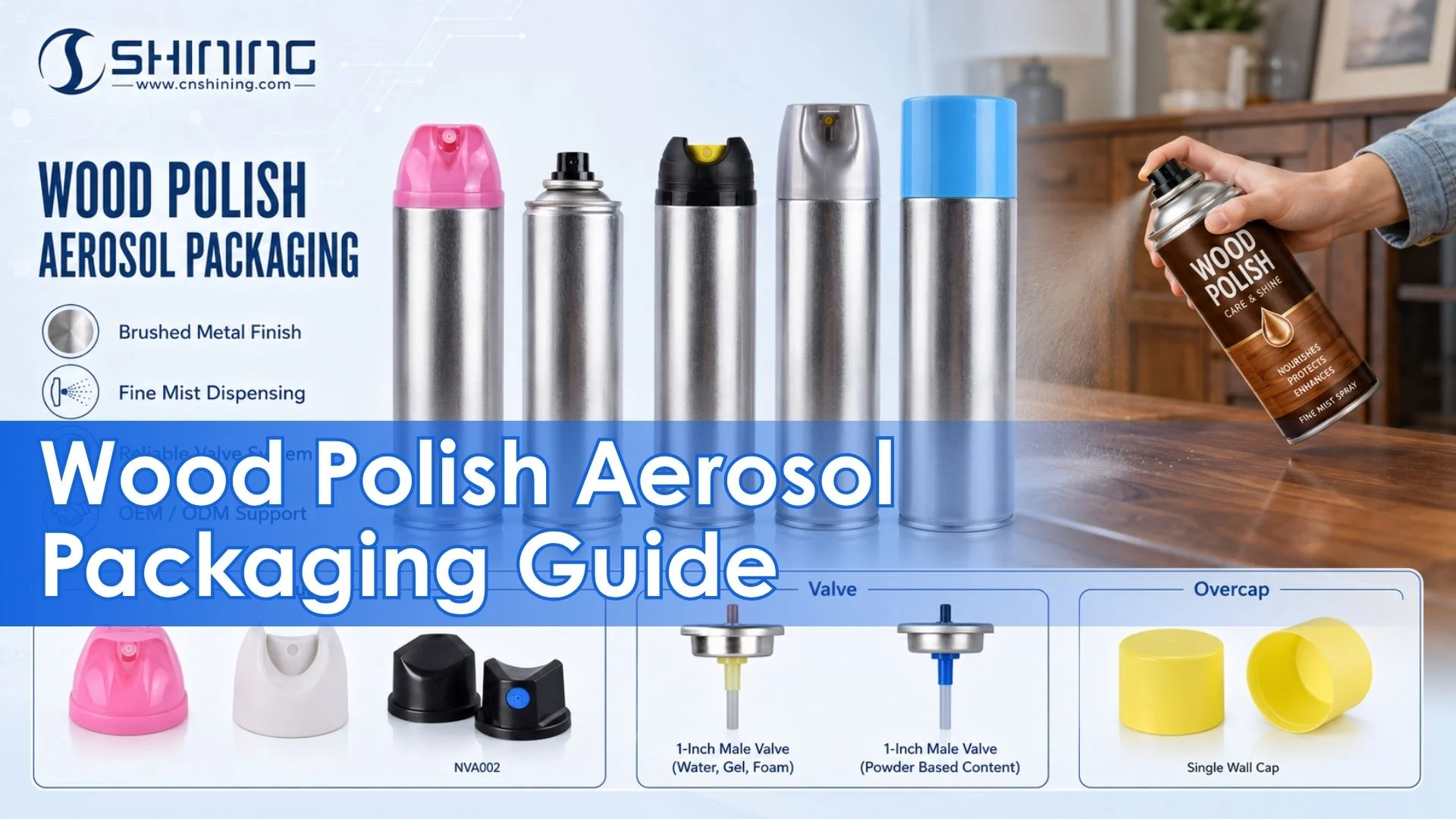
A Wood Polish aerosol Spray is not a small can of furniture paint. It is a pressurized wood-care delivery system: a carrier phase, propellant, polish or film former, surfactant package, fragrance and preservation system packed into an aerosol dispenser. Its job is practical: wet the finished surface, move dust and fingerprints, then leave a very thin wipeable gloss film.
In trade language, the same product may also be called furniture polish aerosol, wood-care spray polish, aerosol furniture shine spray or sealed-surface polish spray. The wording changes by market. The technical boundary does not: it is mainly for sealed, finished wood or wood-effect surfaces, not for repairing bare wood or replacing a coating system.
1. Product Definition and Working Mechanism
1.1 Definition
For commercial and compliance purposes, Wood Polish aerosol Spray is a consumer maintenance product for finished, sealed, painted, varnished or otherwise treated wood and wood-effect surfaces. It is not designed to restore raw timber. It is not a substitute for varnish, lacquer, oil finish or repair coating.
The word “aerosol” describes the package and dispensing method more than a single chemistry. The classic US5397384A furniture polish composition patent states that furniture polish compositions may be used as a liquid or packed into an aerosol can with hydrocarbon propellant. The low-VOC route described in EP2773712A1 furniture polish composition also discusses aerosol-capable polish systems. In practice, the aerosol version changes atomization, droplet size, spreading efficiency, evaporation and user feel.
1.2 Working mechanism
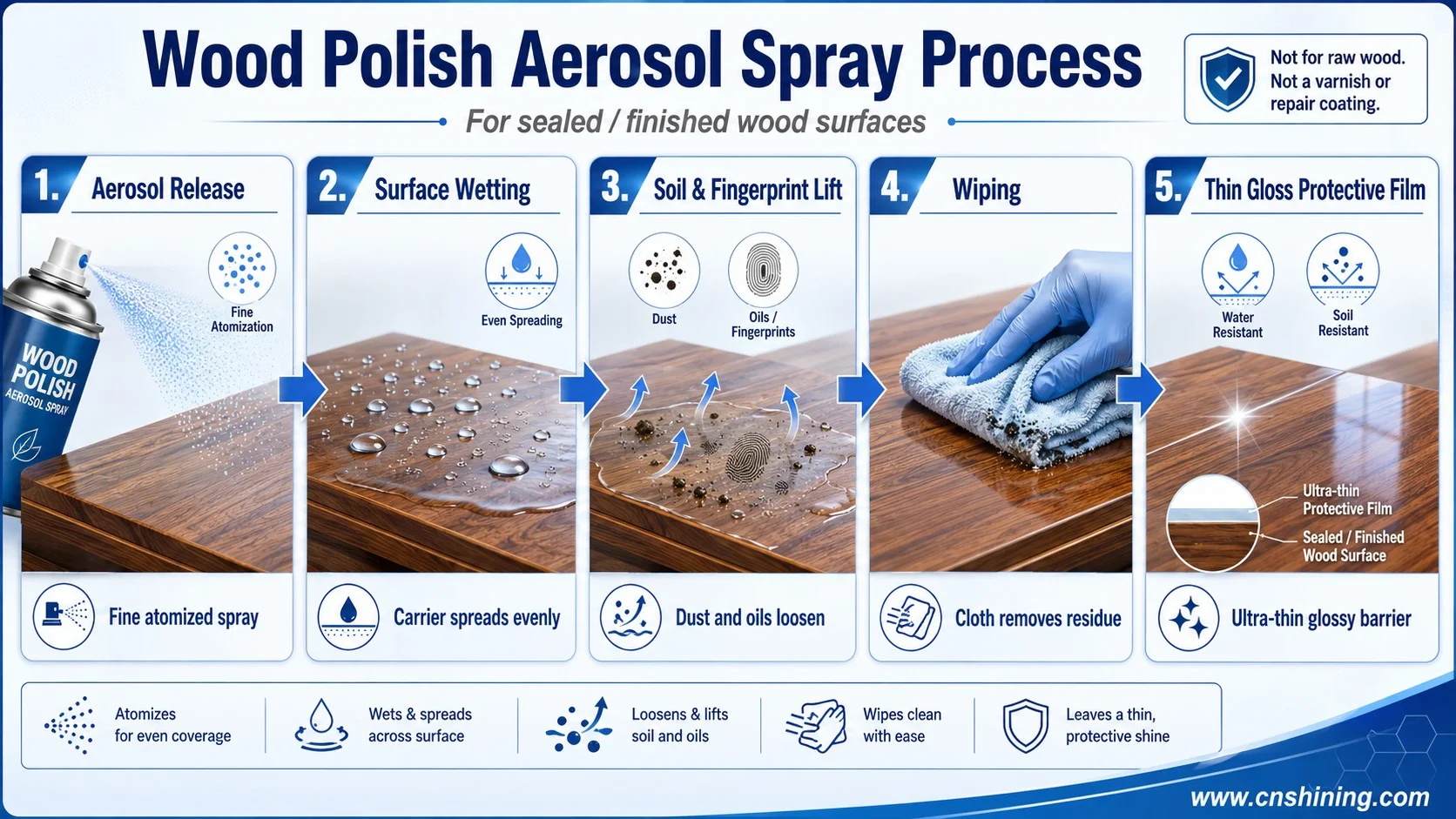
The mechanism can be reduced to five steps. First, the propellant releases the product as a fine spray. Second, the water, oil or hydrocarbon carrier wets the surface and mobilizes dust, skin oils and fingerprints. Third, surfactants and emulsifiers help detach loosened soil. Fourth, mineral oil, silicone oil, plant oil, wax or polymer remains after wiping as an ultra-thin continuous layer. Fifth, that layer lowers apparent surface roughness, increases specular reflection and gives short-term water and soil resistance.
2. Comparison with Adjacent Product Forms
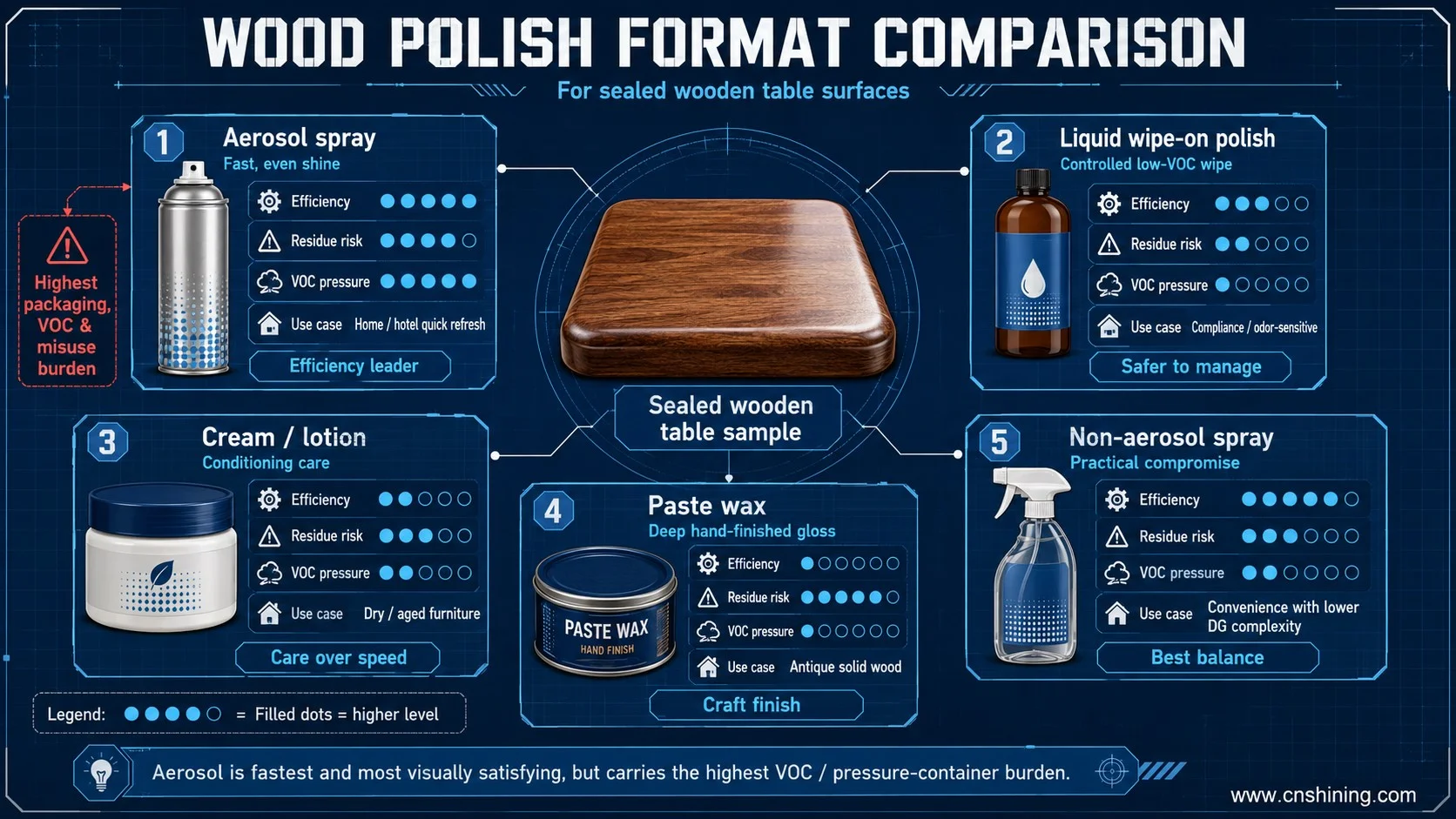
The table below keeps the original application logic: aerosol wood polish is fast and visually satisfying, but it carries the highest packaging, VOC and misuse-management burden.
| Format | Typical advantages | Typical disadvantages | Best-fit use case | Technical judgement |
|---|---|---|---|---|
| Aerosol spray | Fast action, even spreading, quick visual feedback, good for large-area dusting and shine. | Flammability, VOC and dangerous-goods pressure; overspray risk; floor slipping risk; more odor and film complaints. | Home maintenance, hotel rooms, fast display refresh. | Efficiency leader. Compliance and use experience are the hard parts. |
| Liquid wipe-on polish | Easier to formulate for low VOC; better dose control; usually lower transport pressure. | Uniformity depends on cloth and hand technique; weaker “spray-and-shine” feeling. | High-compliance markets and odor-sensitive users. | Safer to manage, but less immediate in user experience. |
| Cream, lotion or emulsion | Stronger conditioning feel; more visible improvement on dry-looking furniture. | Longer polishing time; excess dose can smear, drag or build film. | Mid- to higher-value wood furniture and aged furniture refresh. | Heavier maintenance feel. Better for care than speed. |
| Paste wax | Traditional hand-finished depth and high gloss; suitable for antique care. | Labor intensive, harder to learn, easy to over-apply; poor fit for frequent quick turnover. | Antique furniture and solid wood collections. | Most hand-crafted finish. Lowest efficiency. |
| Non-aerosol spray | Keeps spray convenience while reducing pressure-container and propellant complexity. | Atomization is usually less fine; spray feel may be less refined. | SKU lines that need convenience with lower dangerous-goods complexity. | The most practical compromise route. |
3. Market Size, Regional Signals and Data Boundaries
3.1 Scope problem
The difficult part is not trend prediction. It is scope. Public market reports use different definitions: factory-gate furniture polish, consumer retail furniture polish, liquid versus aerosol product splits, or wider household maintenance categories. “Wood Polish aerosol Spray” is a narrower branch inside that category, so the numbers below should be used as proxy boundaries, not as a customs-level statistical line.
3.2 Global and regional trend
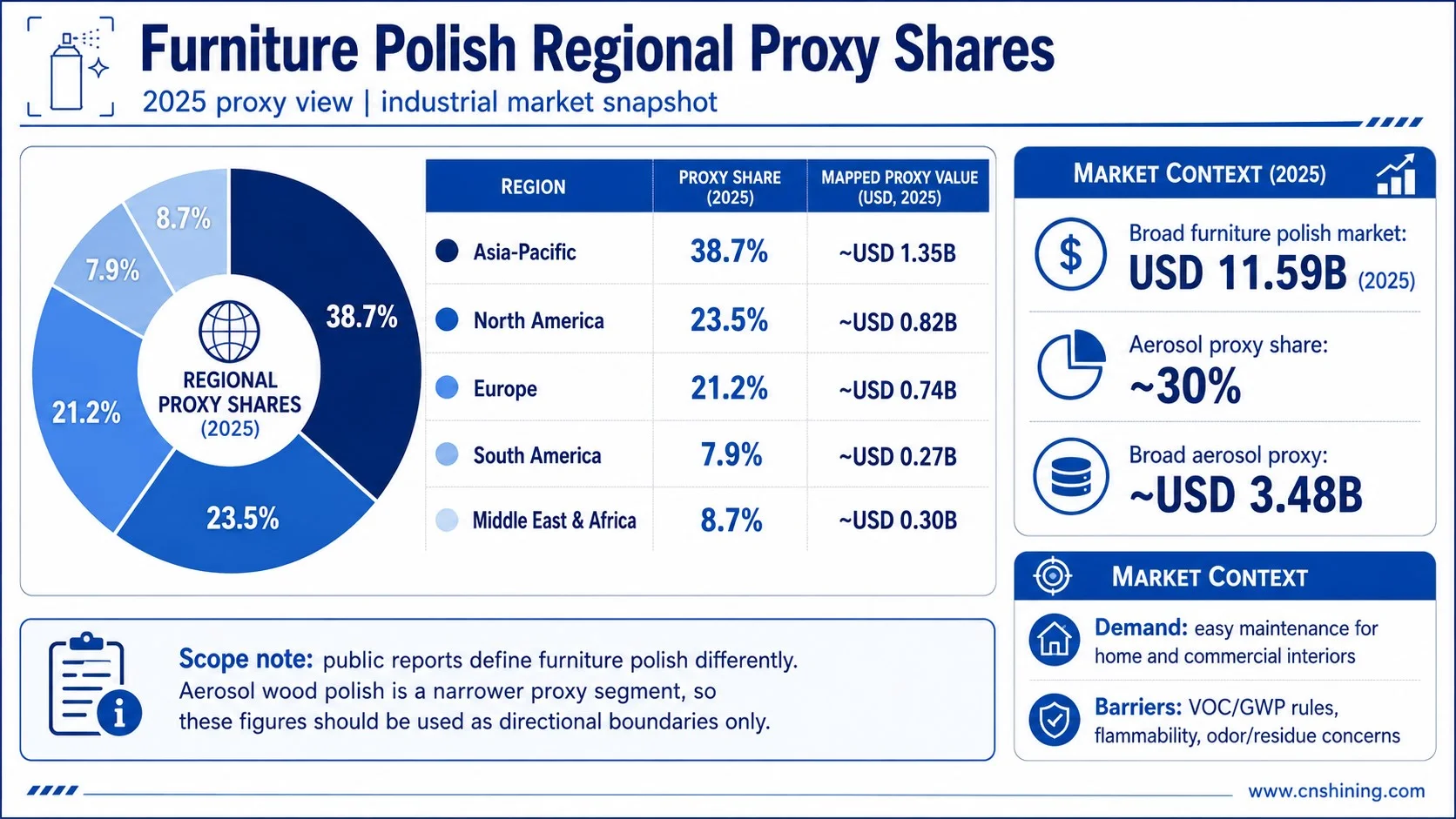
TBRC gives a broad furniture polish market path of USD 11.59 billion in 2025, USD 12.27 billion in 2026 and USD 15.94 billion in 2030. Congruence gives a narrower 2024 value of USD 1.052 billion and a 2032 value of USD 1.741 billion. Future Market Insights adds a format signal: aerosol products account for about 30% of furniture polish by 2025, while liquid products account for about 45%.
If the 30% aerosol share is used only as a proxy coefficient, broad aerosol furniture polish could be around USD 3.48 billion in 2025. That does not mean every dollar is wood polish. It means the broad addressable parent market for wood/furniture polish aerosol is already large enough for packaging, valve and compliance decisions to matter.
Congruence gives the following regional structure for furniture polish: Asia-Pacific 38.7%, North America 23.5%, Europe 21.2%, South America 7.9%, and Middle East & Africa about 8.7%. Mapping those percentages onto the broad aerosol proxy gives roughly USD 1.35 billion for Asia-Pacific, USD 0.82 billion for North America, USD 0.74 billion for Europe, USD 0.27 billion for South America and USD 0.30 billion for Middle East & Africa. This is a proxy, but it is useful for prioritizing regions.
3.3 Growth drivers and hard barriers
Demand comes from four practical factors: wood and wood-effect surfaces remain common in homes; consumers want light maintenance that makes furniture look cared for; hotels, offices and commercial interiors need fast maintenance; and e-commerce favors simple product claims that users understand quickly.
The barriers are more technical: VOC and GWP rules keep tightening; hydrocarbon propellants add flammability, storage and transport constraints; consumers notice residue, sticky feel, heavy odor and slipping risk; and non-aerosol sprays, wipes and low-odor liquids are taking share where risk control matters more than spray feel.
4. Top Brand Landscape: a Standalone View
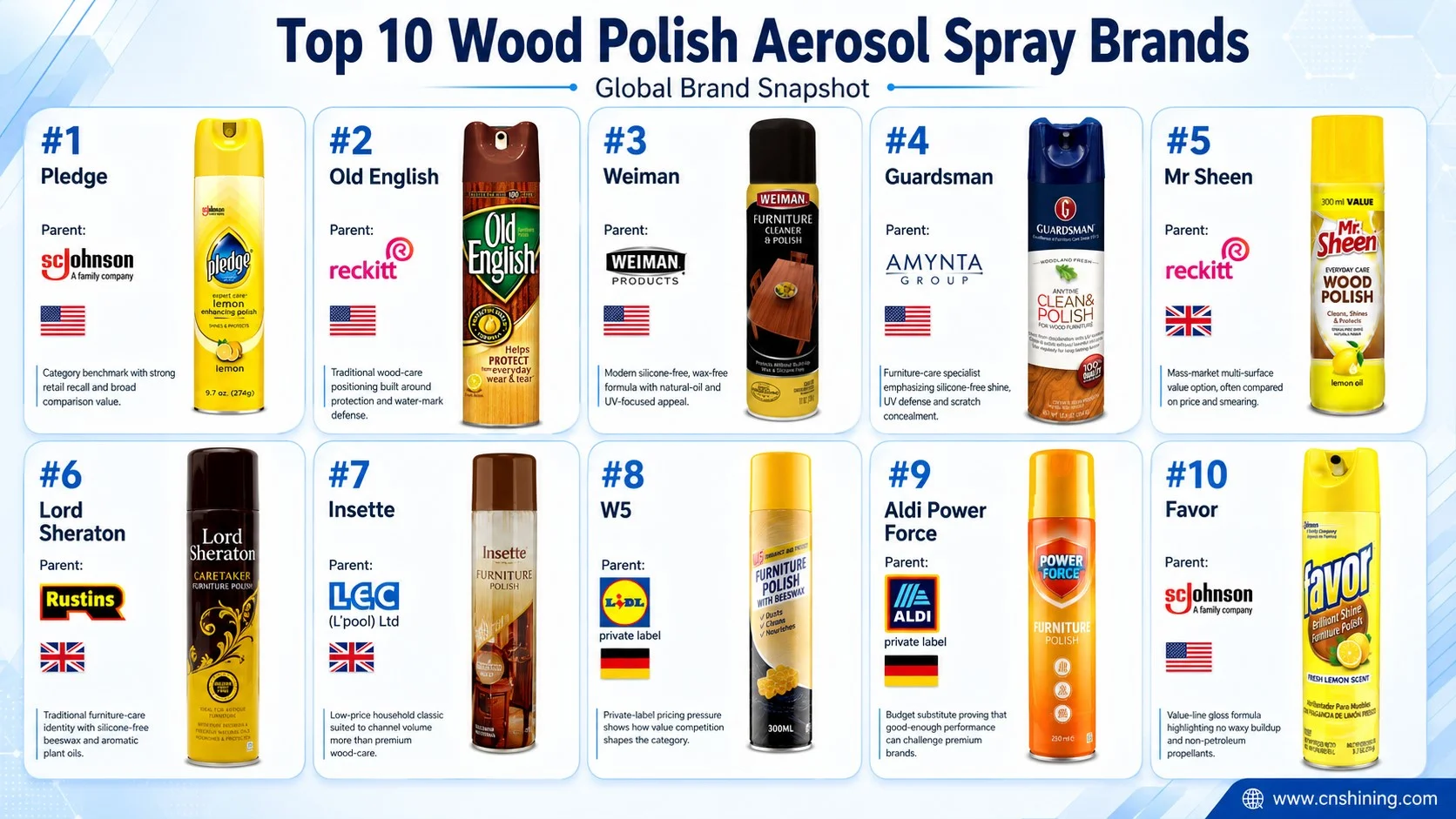
| Brand | Country / brand root | Parent company | Common size | Public price snapshot | Technical read |
|---|---|---|---|---|---|
| Pledge | United States | SC Johnson | 9.7 oz, 14.2 oz | about 13.97$ per 14.2 oz single can; about 14.77$ per 3 x 9.7 oz. | Category anchor with strong retail memory. Also a common comparison point for residue and multi-surface boundary complaints. |
| Old English | United States | Reckitt | 12.5 oz | about 11.90$–19.99$. | Traditional wood-care positioning. Strong protection and water-mark language, with direct floor-slipping warnings. |
| Weiman | United States | Weiman Products | 12 oz aerosol | about 8.49$. | Modern formulation stance: silicone-free, wax-free, natural-oil story and UVX language. |
| Guardsman | United States | Amynta Group | 12.5 oz | about 13.35$–16.00$. | Furniture-care specialist tone. Emphasizes silicone-free, UV protection and scratch concealment. |
| Mr Sheen | United Kingdom | Reckitt | 250 ml / 250 g | about 2.42$ per 250 ml. | Commonwealth mass-market product. Multi-surface strength, but often compared on value and smearing. |
| Lord Sheraton | United Kingdom | Rustins | 300 ml aerosol | about 8.00$–13.34$ per 300 ml. | More traditional furniture-care identity. Silicone-free, beeswax and aromatic plant oil route is clear. |
| Insette | United Kingdom | LEC (L’pool) Ltd | 300 ml aerosol | about 1.80$ or about 1.72$ ex VAT. | Low-price classic household cleaning line. Good for channel volume, weaker as a high-end wood-care story. |
| W5 | Germany | Lidl private label | 300 ml | about 1.14$. | Strong price pressure. Shows that this category is also a private-label battle. |
| Aldi Power Force | Germany | Aldi private label | 300 ml | about 1.14$. | Low-price substitute model. If performance is “good enough,” brand premium becomes exposed. |
| Favor | United States | SC Johnson | 9.7 oz | about 3.29$–3.92$ per 9.7 oz. | Value-line logic. High gloss, no waxy buildup and non-petroleum propellant positioning are the key signals. |
5. Formulation System, Terms and Technical Evolution
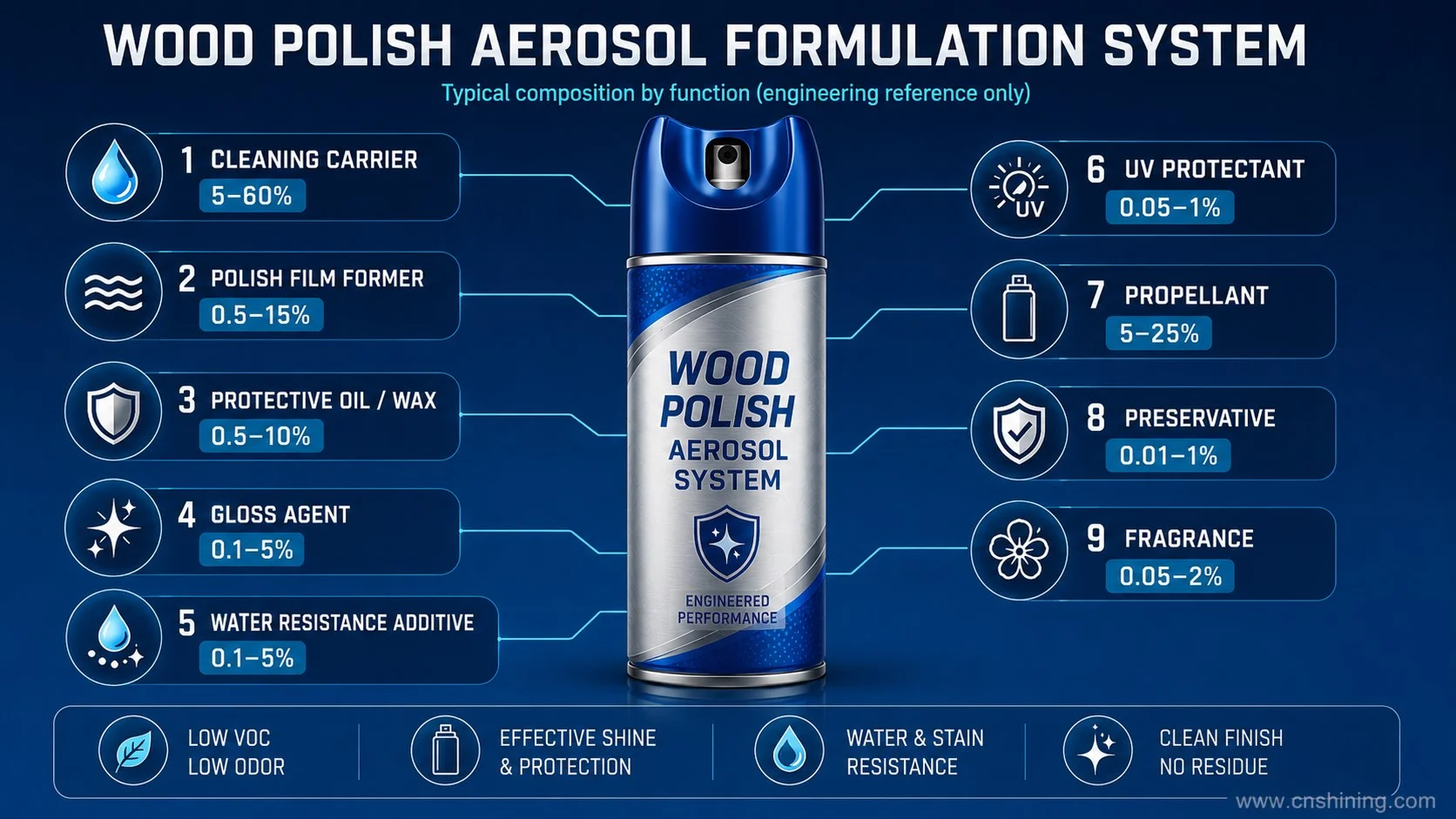
5.1 Typical formula by function
The table is not a commercial formula. It is an engineering synthesis based on public ingredient disclosures, furniture polish patents and wood-protection literature. The percentage ranges are for discussion, not direct production instructions.
| Function | Typical ingredients | Typical range | Mechanism | Safer or lower-impact direction |
|---|---|---|---|---|
| Cleaning | Water, isoparaffins, light petroleum distillates, small surfactant load such as sorbitan oleate or castor oil ethoxylates. | 5–60% | Wets the surface, dissolves skin oil and fingerprints, helps carry dust away. | Higher water phase, lower-odor dearomatized alkanes, less aromatic solvent. |
| Polishing | Dimethicone, cyclopentasiloxane, mineral oil, castor oil, avocado oil, safflower oil, sesame oil. | 0.5–15% | Lowers apparent roughness and improves reflected gloss and hand feel. | Partial replacement with plant oils or bio-based polymers; review cyclic siloxanes for EU-directed SKUs. |
| Protection | Mineral oil, silicone oil, beeswax, natural wax, acrylic polymer emulsion. | 0.5–10% | Forms a thin film that reduces visible water marks, staining and minor abrasion. | Light acrylic or waterborne polymers to reduce thick-film feel. |
| Gloss | Low-viscosity silicone oil, polydiorganosiloxanes, cyclic siloxanes, wax. | 0.1–5% | Gives fast shine and wipe-smooth feel. | Low-VOC aqueous silicone dispersions or lower-migration components to limit drag marks. |
| Water and stain resistance | Wax, oil, hydrophobic nano-fillers, sol-gel organic-inorganic hybrid layers. | 0.1–5% in consumer formats | Raises surface hydrophobicity and reduces short-term stain attachment. | Bio-based bark-derived coatings and nano SiO2 / ZnO routes are research areas; large-scale retail aerosol use is still limited. |
| UV protection | Benzophenone or UVX screen, ZnO nanoparticles, lignin or polyphenols. | 0.05–1% | Absorbs or scatters UV, reducing visible fading, yellowing and drying. | Lignin composites, ZnO/CNF waterborne systems and bio-based polyphenol systems. |
| Propulsion and delivery | Propane, isobutane, butane, nitrogen. | 5–25% | Creates atomization, discharge and internal can pressure. | Nitrogen or compressed-gas routes support lower odor and lower petroleum narrative. |
| Stability and preservation | Sodium benzoate, BIT, MIT, CMIT, morpholine or alternative amines. | 0.01–1% | Controls microbial spoilage, corrosion and pH/storage stability. | Reduce isothiazolinone exposure where possible; use lower-sensitization systems. |
| Sensory profile | Fragrance, d-limonene, linalool, citral and related components. | 0.05–2% | Provides the “cleaning completed” odor cue. | Lower fragrance complexity, lower allergen exposure, low-scent and fragrance-free SKUs. |
5.2 Terms worth keeping precise
| Term | Plain technical meaning | Why it matters commercially |
|---|---|---|
| Aerosol dispenser | Pressure container that releases contents as droplets or spray. | Controls dangerous goods, valve, pressure and label complexity. |
| Propellant | Gas or liquefied gas that pushes the formula out of the can. | Controls spray feel, flammability, VOC and GWP profile. |
| VOC | Volatile organic compound. | Directly affects access to California, US federal and Canadian product categories. |
| Film former | Material that leaves a continuous layer on the surface. | Source of gloss and smooth feel; also the source of sticky residue when overdosed. |
| Emulsion | Oil-water dispersed system. | Makes lower-VOC, lower-odor polish structures easier to design. |
| Dimethicone | Common silicone film former. | Fast gloss and slip, but long-term reputation can be affected by residue perception. |
| Isoparaffin / dearomatized alkanes | Low-odor hydrocarbon carrier or solvent. | Helps reduce harsh solvent odor compared with high-aromatic systems. |
| UV protectant | Additive used to absorb or scatter ultraviolet light. | Supports anti-fading claims. |
| SVHC | Substance of very high concern in EU chemicals management. | Can trigger formulation review, communication duties and legal cost. |
| UN1950 | Common transport identification for aerosols. | Drives logistics, warehousing, air-freight limits and package testing. |
| GHS / CLP / WHMIS / GB 15258 | Chemical classification and labelling systems and regional implementations. | Controls pictograms, signal words, SDS content and local language requirements. |
| No waxy buildup / no residue | Claim that visible wax or polish film should not accumulate. | A core reputation gate in this category. |
5.3 Technical evolution
Low VOC and low odor are the most realistic upgrade direction. The US federal VOC limit for furniture maintenance products in aerosol form is 25 wt% under the EPA consumer product VOC table, while California standards are tighter for many categories under 17 CCR §94509 consumer product standards. That is why older high-solvent, high-propellant, high-odor designs keep losing room.
Non-CFC and lower petroleum-feel propellant systems are also clear. Hydrocarbon propellant still gives strong spray performance, but compressed gas and nitrogen routes help lower odor and improve the sustainability story. The engineering trade-off is discharge consistency, headspace pressure management and valve compatibility.
Bio-based wood protection is moving from academic papers into brand language. A 2024 RSC paper on fully bio-based water-resistant wood coatings from tree bark shows a route using birch bark and spruce bark components. For retail aerosol polish, the near-term expression is more likely to be plant oils, waterborne emulsions and light film formers, not a full replacement of every petrochemical input.
Nano, superhydrophobic and UV-resistant coatings are active research directions. ScienceDirect’s wood nanotechnology review and other coating studies point to ZnO, SiO2, sol-gel networks and multiscale hydrophobic structures. For supermarket aerosol polish, treat these as medium- to long-term material routes, not as proof that every current can already provides such performance.
6. Packaging Fit for Shining Packaging: Actuator, Aerosol Can and Valve
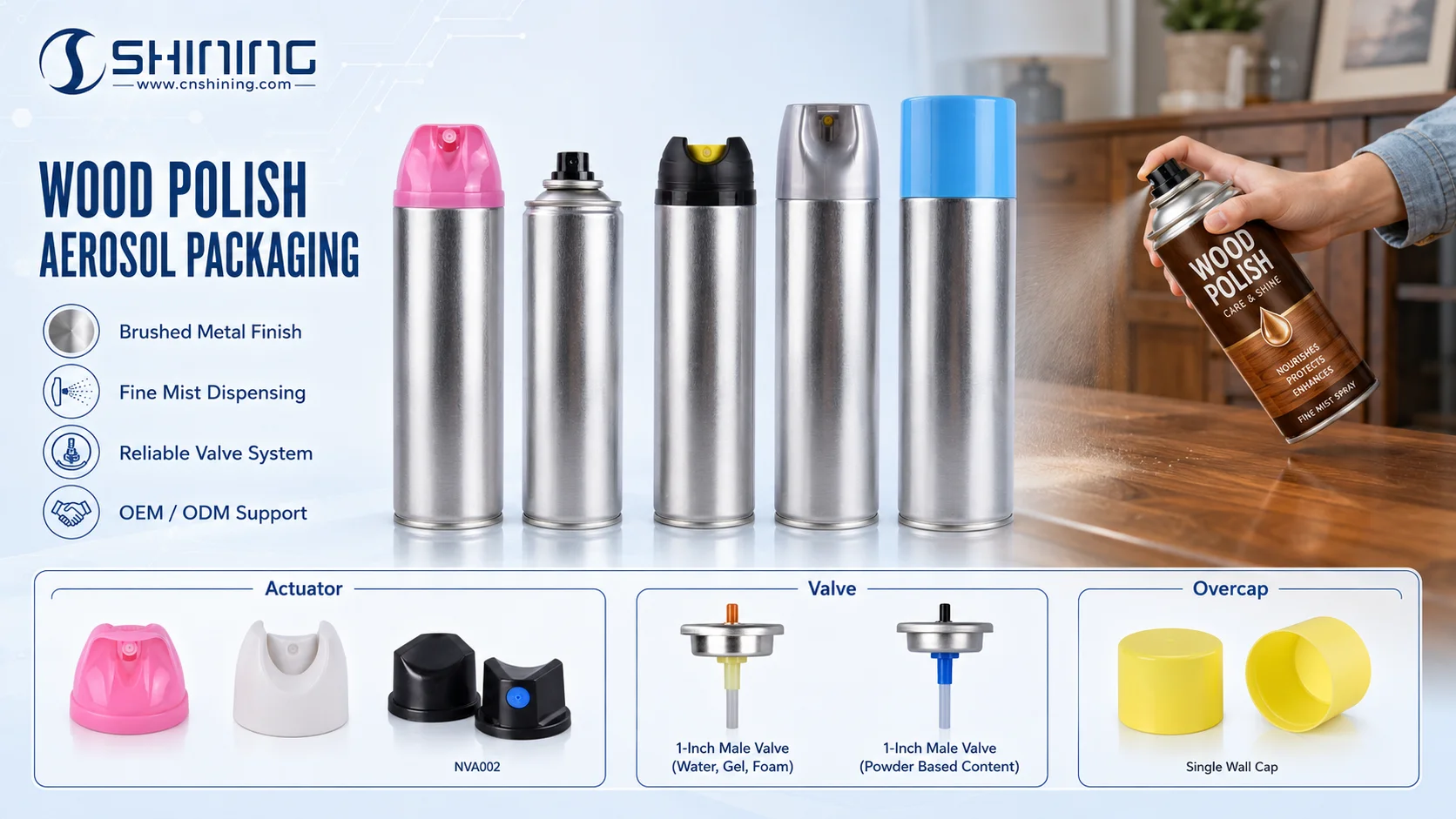
For Wood Polish aerosol Spray, the package is not a neutral container. It decides how much material lands on the surface, how wide the spray fan is, how often users over-apply, and whether the SKU can pass transport and shelf requirements without surprises.
Shining Packaging can position its role around three parts of the same technical problem: the actuator, the aerosol can and the valve. The actuator should support controlled finger force and a spray pattern that does not flood edges or nearby flooring. The valve should keep output stable across the fill life and match the viscosity, propellant and desired spray rate. The aerosol can must handle pressure, internal compatibility, corrosion control, print durability and the visual split between “light daily care” and “deeper furniture care.”
This category rewards restrained output. Too much polish creates residue. Too wide a pattern creates overspray. Too weak a valve gives a poor spray plume and makes users press longer. A practical development route is to test two to three valve-output options, then run wipe-panel tests on sealed wood, glossy laminate and dark furniture. The winning package is usually the one that prevents user error, not the one that sprays the most.
7. Regulatory and Compliance Framework
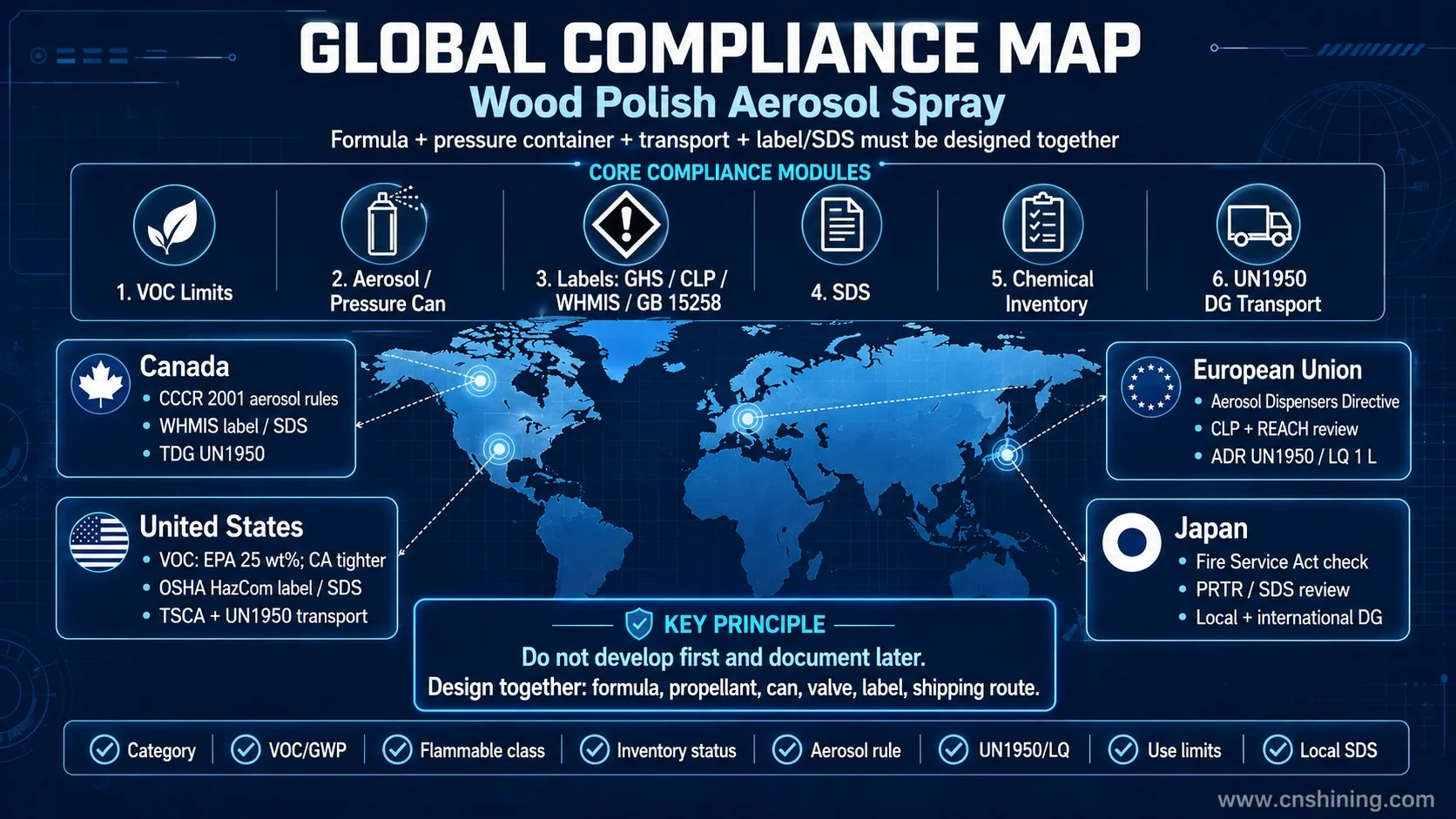
Wood Polish aerosol Spray is a stacked-compliance product: formula compliance + pressure container compliance + dangerous goods transport + label/SDS compliance. It should not be developed first and documented later. The formula, propellant, can, valve, label and shipping route need to be designed together.
| Market | Aerosol / pressure container | VOC / climate constraint | Label / SDS | Chemical inventory / registration | Dangerous goods |
|---|---|---|---|---|---|
| United States | Consumer product and pressure-container duties apply; most aerosol products ship as UN1950. | EPA furniture maintenance products-aerosol limit is 25 wt%; California is tighter in relevant consumer product categories. | OSHA HazCom governs workplace label/SDS framework. | Ingredients should be listed or exempt under the TSCA Chemical Substance Inventory. | 49 CFR hazardous materials table; UN1950 limited quantity is common. |
| Canada | CCCR 2001 covers consumer chemical containers, pressurized containers and hazard information. | VOC Concentration Limits for Certain Products Regulations should be checked by exact category. | WHMIS aligns with GHS for workplace hazard communication. | Ingredient notification and inventory status need local review. | TDG rules identify aerosol containers under UN1950 and container standards. |
| European Union | Aerosol Dispensers Directive 75/324/EEC is the core container rule. | VOC duties depend on member-state and product category; SVHC and GWP direction also reshape formulation. | CLP controls classification, labelling and packaging. | D4/D5 cyclic siloxanes and similar materials need EU SKU review where relevant. | ADR transport often uses UN1950; limited quantity 1 L is an important threshold. |
| United Kingdom | Aerosol Dispensers Regulations 2009 apply in Great Britain. | GB CLP and UK REACH shape product hazard and substance duties. | GB CLP controls classification and label communication. | UK REACH controls registration, authorization and restrictions. | Dangerous goods transport rules still need product-specific classification. |
| Japan | Fire Service Act is important for flammable dangerous goods. | No furniture polish aerosol-specific VOC category rule was identified in the supplied document. | Japan PRTR/SDS system should be checked for listed substances. | Ingredient-specific SDS and labelling duties must be confirmed. | Local and international dangerous goods rules both apply. |
| Australia | Aerosol dangerous goods transport follows the Australian Dangerous Goods Code. | No furniture polish-specific VOC limit was identified in the supplied document. | GHS 7 adoption applies to hazardous chemical classification, labels and SDS. | Introduced industrial chemicals fall under AICIS. | ADG, air and sea transport rules need parallel review. |
| Brazil | Dangerous goods road and rail transport is overseen by ANTT dangerous goods rules. | No furniture polish-specific VOC category limit was identified in the supplied document. | ABNT NBR 14725:2023 is the key local GHS/SDS language baseline. | Lei 15.022/2024 establishes a national chemical substance inventory and risk-control framework. | Transport documents and labels need local language handling. |
| Gulf region | GSO 917:2021 Aerosol Dispensers provides a regional aerosol standard basis. | Public VOC category transparency for household wood polish is lower. | GHS plus local Arabic/English label requirements are typically needed. | Country-by-country import review is needed before shipment. | Air and sea dangerous goods rules are strict. |
| South Africa | Hazardous chemical rules shape workplace exposure and SDS duties. | No furniture polish-specific VOC limit was identified in the supplied document. | Hazardous Chemical Agents Regulations 2021 are the core reference. | Local occupational hygiene and chemical duties need review. | Local and international dangerous goods systems both matter. |
Practical compliance checklist
For a global SKU, start with the strictest target market, then localize the label and SDS. Do not design a main formula first and patch it later. At minimum, lock down eight points before launch: exact product category; VOC and GWP limits; flammable aerosol classification; TSCA, AICIS, REACH, UK REACH and Brazil inventory explanation; aerosol dispenser technical rules; UN1950 limited quantity and transport route; label boundaries such as “sealed surfaces only” and “do not use on floors”; and local SDS language plus emergency contact details.
8. User Pain Points and Packaging Improvements
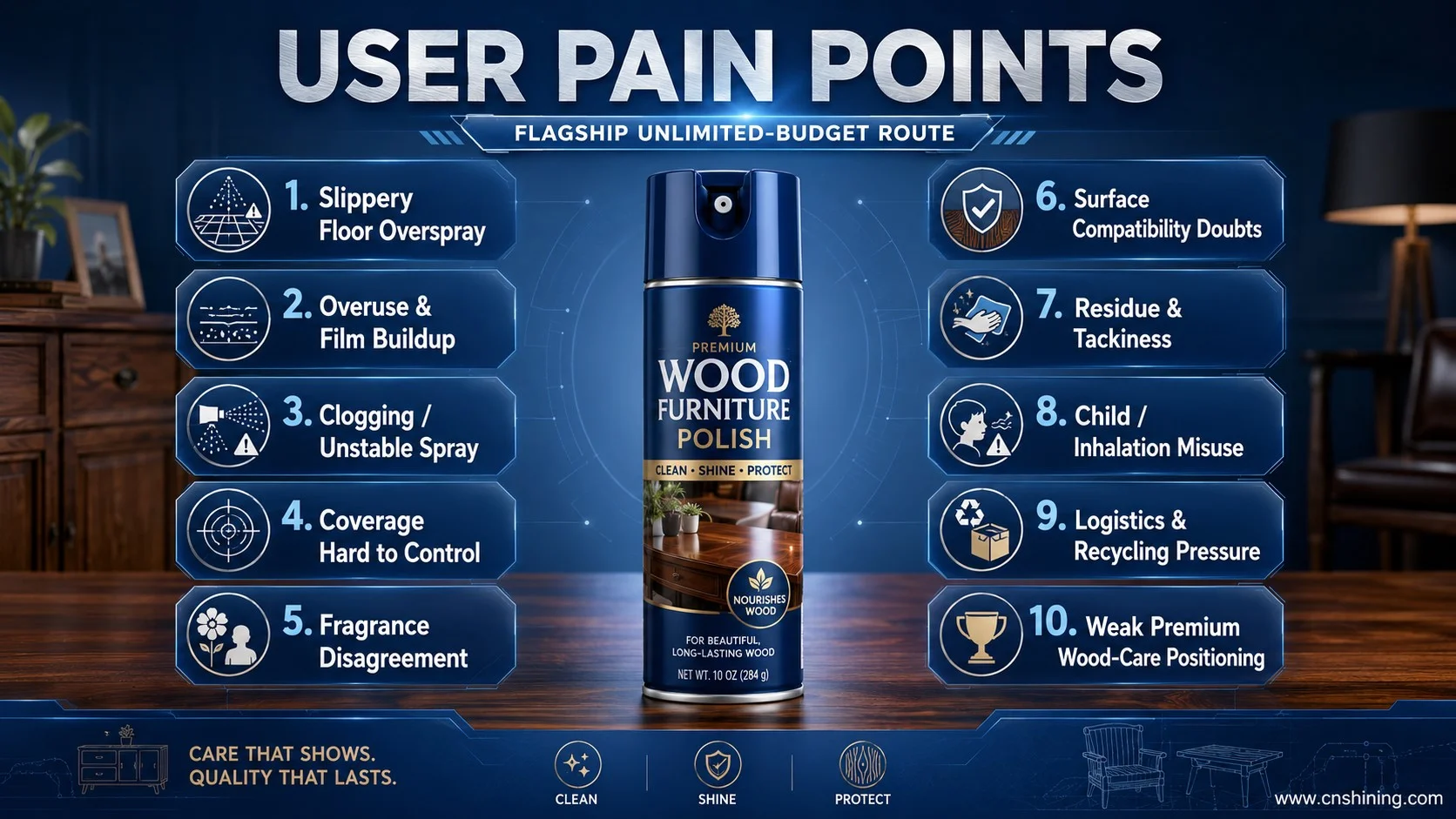
Users rarely complain only about shine. They complain about the price of shine: slippery overspray, sticky film, smear marks, heavy odor, unclear surface compatibility and unreliable nozzles.
The most direct risk is floor misuse. Old English SmartLabel warns users not to spray on floors because they can become slippery. That warning tells us something useful: users naturally extend “wood polish” to floors, baseboards and larger low-absorption surfaces unless the label stops them.
The second issue is residue: wax, silicone or oil can accumulate when applied too heavily or wiped poorly. This is why “no waxy buildup,” “no residue” and “without silicone or wax” appear as category-level claims. A claim often reveals the problem it is trying to control.
The third issue is surface finish. Public product tests reported smearing on glass or very shiny surfaces and more wiping effort on some multi-surface products. That does not prove failure on all sealed wood. It does show that broad multi-surface language can create expectations the product cannot always satisfy.
The fourth issue is scent. Some users buy the scent; others reject the same product because the odor is too strong. For aerosol furniture polish, fragrance is not a small detail. It is a SKU architecture decision.
| Pain point | Packaging or structure improvement | Expected effect | Feasibility | Cost effect |
|---|---|---|---|---|
| Floor overspray causing slipping | Large warning plus no-floor pictogram; front label says “sealed surfaces only / not for floors.” | Reduces misuse, fall risk and complaints. | High | Low |
| Excess dose and local film buildup | Lower instantaneous valve output or finer/narrower spray actuator. | Reduces accidental over-application and smear marks. | High | Low–medium |
| Clogging or unstable output | Anti-clog actuator, reversible cleaning structure or clear purge instruction after use. | Reduces “not spraying” and coarse spray complaints. | High | Low–medium |
| Hard to control coverage area | Dual-pattern actuator: narrow for small parts, wide for tabletops. | Reduces overspray and improves edge control. | Medium | Medium |
| Fragrance disagreement | Low-scent, fragrance-free and classic-scent SKUs with clear can marking. | Manages odor conflict through SKU design. | High | Low |
| Surface compatibility doubt | QR code linking to surface compatibility matrix, use video and SDS. | Reduces customer-service load and incorrect use. | High | Low |
| Residue and tack complaints | Front-label pictograms: light dose, wipe immediately, buff with dry cloth. | Makes correct use visible before complaints start. | High | Low |
| Child contact and inhalation misuse | Locking overcap or child-resistant cap where needed. | Reduces accidental spraying and misuse. | Medium | Medium |
| Logistics and recycling pressure | Prefer mono-material steel/aluminium body, reduce mixed-material accessories, add local recycling path. | Improves disposal clarity and packaging story. | High | Low–medium |
| Weak premium wood-care separation | Upgrade internal coating compatibility and print system; separate “light care” and “deep care” lines. | Makes formulation tiers visible to the user. | High | Medium |
| Flagship unlimited-budget route | Bag-on-Valve or compressed-gas premium platform. | Potential lower petroleum feel, lower odor and 360° spray. | Medium | High |
If only three changes can be made, the best order is: first, fix the label and use instructions; second, tune valve output and spray width; third, split low-scent or fragrance-free SKUs. The first two reduce misuse, returns and complaints. The third improves repeat purchase for odor-sensitive users.
9. Technical Takeaway
The practical direction is not simply “make it shinier.” The better route is controlled gloss with lower VOC, lower odor, clearer surface boundaries, cleaner film behavior and a more forgiving actuator-valve system. The aerosol can, valve and actuator are part of the formula outcome. If they make users apply too much, even a good polish will be judged as sticky or unsafe.
For brand owners and packaging engineers, the category should be treated as a surface-care system. Start with the sealed surface. Define the target dose. Match the valve and actuator to that dose. Then write the label as if the user will otherwise spray the floor. That is not pessimism. It is how this product behaves in real homes.
10. FAQ: Wood Polish Aerosol Spray
It is designed for finished or sealed wood and wood-effect surfaces. The spray wets the surface, helps move dust and fingerprints, then leaves a thin wipeable film that improves gloss and touch. It should not be treated as a repair coating for bare wood, damaged lacquer or deeply worn furniture.
The aerosol package atomizes the formula into small droplets and spreads it quickly across the surface. That gives fast coverage and immediate visual feedback. The trade-off is lower dose control. If the valve output or spray pattern is not controlled, the same speed can create overspray, residue and slippery nearby surfaces.
Shine comes from a very thin film left after wiping. Common film contributors include mineral oil, dimethicone, cyclic siloxanes, plant oils, waxes or acrylic polymers. The film reduces apparent surface roughness and increases reflected light. Too much film, or poor buffing, can shift the result from glossy to sticky.
Furniture polish aerosols often contain oils, waxes or silicone-type film formers that improve slip and gloss on furniture. On a floor, the same film can become a slipping hazard. Overspray is enough to cause trouble. This is why clear “not for floors” label language and no-floor pictograms are useful packaging controls.
Common propellants include propane, isobutane, butane and nitrogen. Hydrocarbon propellants give strong spray performance but raise flammability and transport complexity. Nitrogen or compressed gas can support lower odor and lower petroleum perception, but the can, valve and fill design must manage pressure behavior through the product life.
VOC limits restrict how much volatile organic material can be used in the formula and propellant system. This pushes formulators toward waterborne emulsions, lower-odor carriers, compressed-gas options and lighter film systems. The design challenge is keeping gloss, wipe feel and spray quality while reducing high-solvent or high-propellant load.
Residue usually comes from repeated over-application, weak wiping, incompatible surfaces or a film former that accumulates faster than it is removed. Dark or glossy surfaces make the problem more visible. A lower-output valve, narrower spray pattern and clear “spray lightly, wipe immediately, buff dry” instruction can reduce complaints.
They should test output rate, spray width, droplet quality, clogging tendency, compatibility with the formula, discharge consistency and user wiping behavior. Air-spray appearance alone is not enough. The real test is the wiped panel: sealed wood, dark wood, glossy laminate and edge areas should all be checked for film and smear.
Some bio-based wood coating technologies are promising, especially plant oils, natural compounds, bio-based polymers and bark-derived water-resistant systems. For mass retail aerosol polish, near-term adoption is more likely to be gradual: plant-oil stories, waterborne emulsions and lighter film formers rather than a complete replacement of existing chemistry.
Start by defining the strictest target market, product category and VOC/GWP boundary. Then select the propellant, can, valve and actuator as one package system. After that, confirm inventory status, transport classification, label wording and SDS language. This order reduces late reformulation and avoids treating compliance as paperwork after design.