
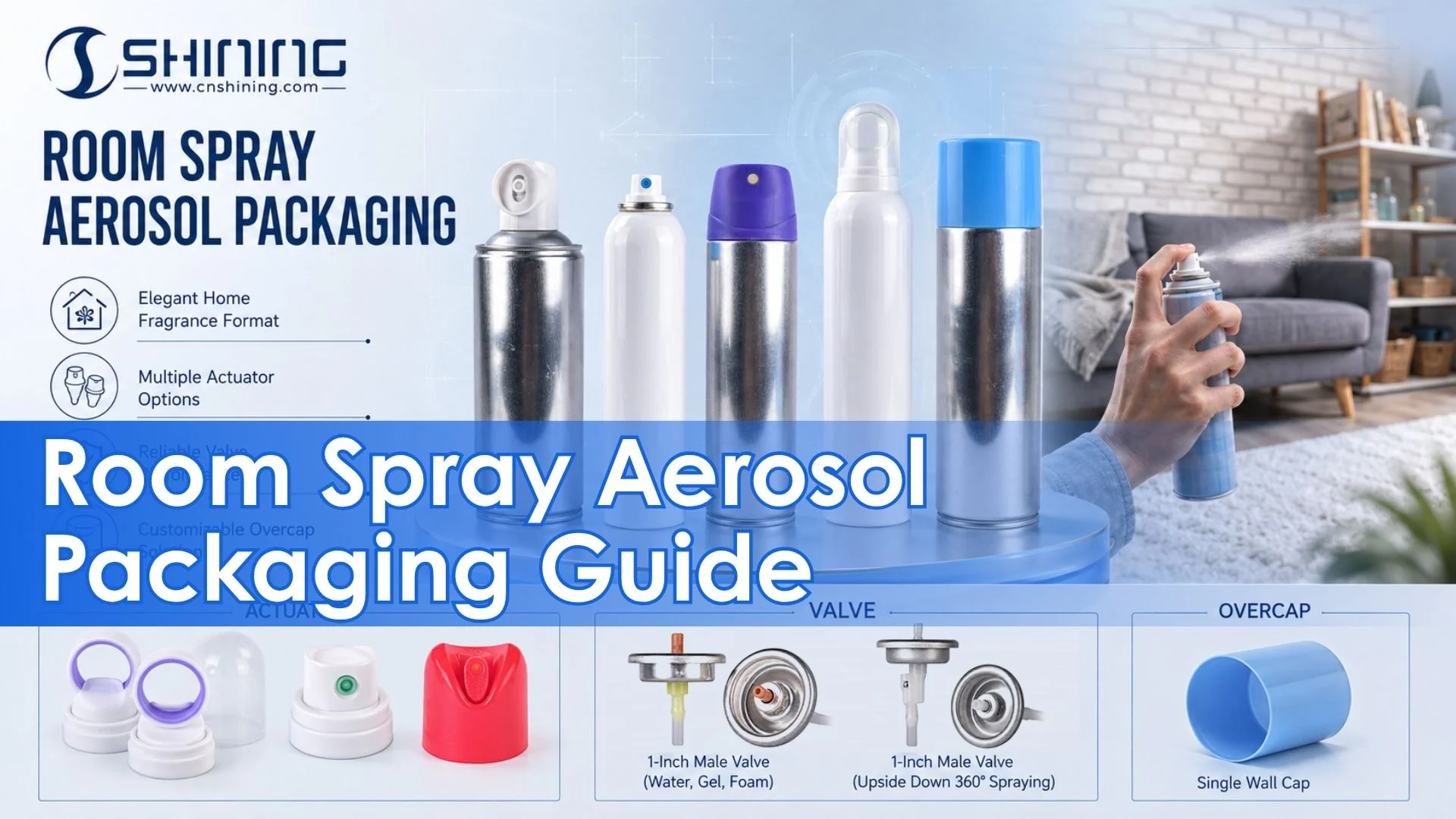
Aerosol room spray, also called manual aerosol air freshener, air care spray, odor eliminator, or room fragrance aerosol, is not just fragrance in a pressurized can. It is a controlled system of perfume, solvent, odor-control chemistry, propellant, valve, actuator, and metal container.
1. Executive Technical Reading
The core value of aerosol room spray is speed. One press gives fast odor correction, immediate fragrance diffusion, and broad short-range coverage. This makes it useful in bathrooms, kitchens, pet areas, rental turnover, hotel maintenance, and reception preparation.
Its weakness is also clear. Compared with pump sprays, reed diffusers, plug-ins, gels, and electric sprays, aerosol has higher pressure-related packaging complexity, stricter VOC exposure, higher flammability risk, and more frequent complaints about nozzle failure, excessive scent, throat irritation, and surface fallout.
The technical direction is stable: lower VOC, compressed gas, finer atomization, more explicit odor-control mechanisms, recyclable metal containers, better actuator locking, and clearer compliance labels. In practical terms, aerosol room spray is now a fragrance engineering + packaging engineering + compliance engineering product.
2. Definition, Structure, and Working Principle
2.1 Product definition
In industry usage, aerosol room spray usually means an indoor air freshening or odor-control product packed in a pressure-resistant aerosol container. It may be a manual spray, an automatic timed refill can, or a small high-fragrance concentrated aerosol.
California CARB separates this field into categories such as Manual Aerosol Air Freshener, Automatic Aerosol Air Freshener, and Concentrated Aerosol Air Freshener. The concentrated category is especially relevant: it includes products with fragrance content of at least 15%, spray output not exceeding 185 microliters per use, and net weight not exceeding 2 oz. The category affects VOC limits, valve selection, and package size.
A normal room spray should not be confused with an air sanitizer or disinfecting air spray. If the label claims killing bacteria, reducing viruses, sanitizing air, or disinfecting surfaces, the US regulatory path may move toward EPA/FIFRA. That is a different product class, not a simple fragrance extension. See EPA’s guidance on whether a cleaning product is a pesticide under FIFRA.
2.2 Typical aerosol structure
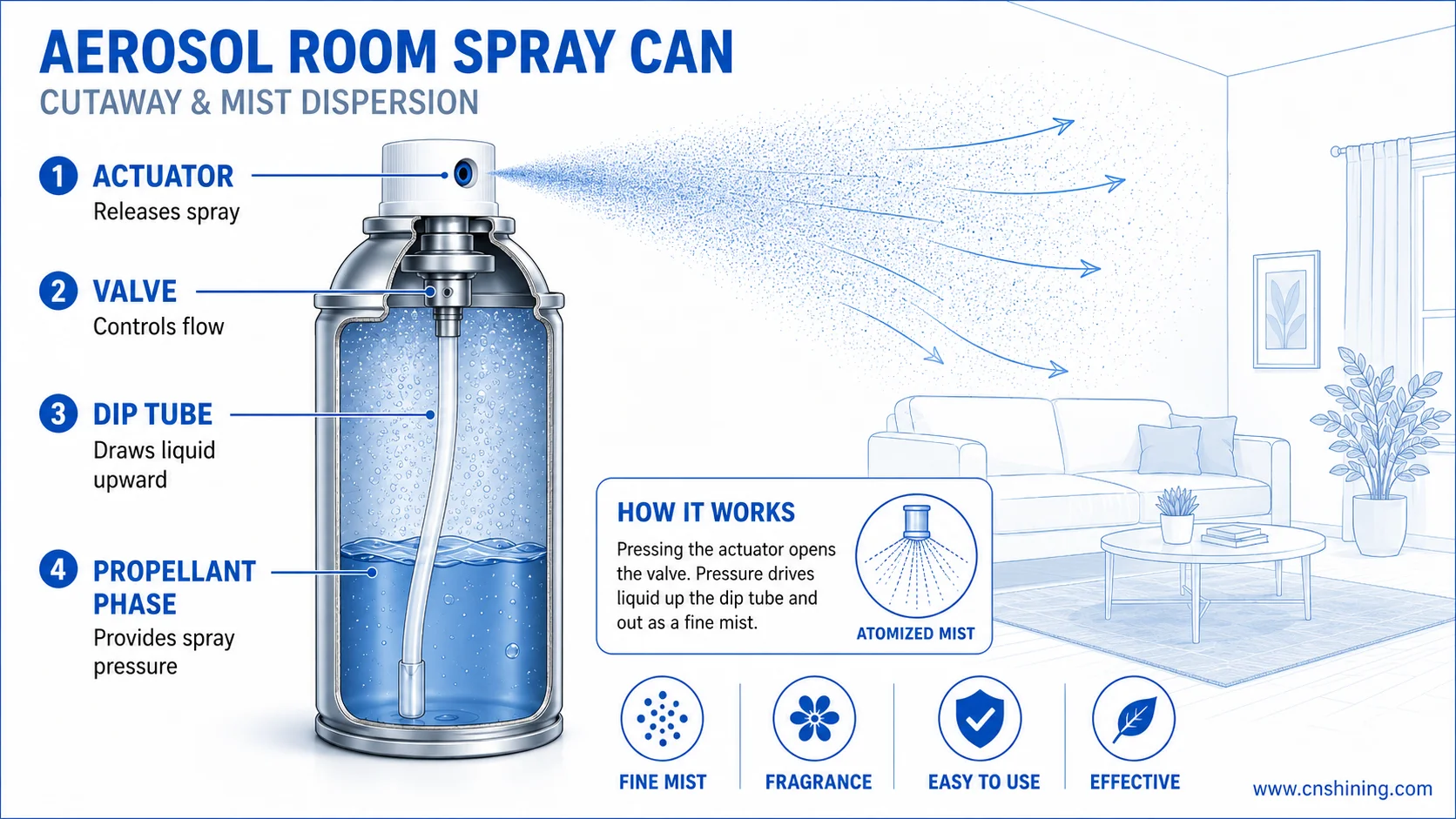
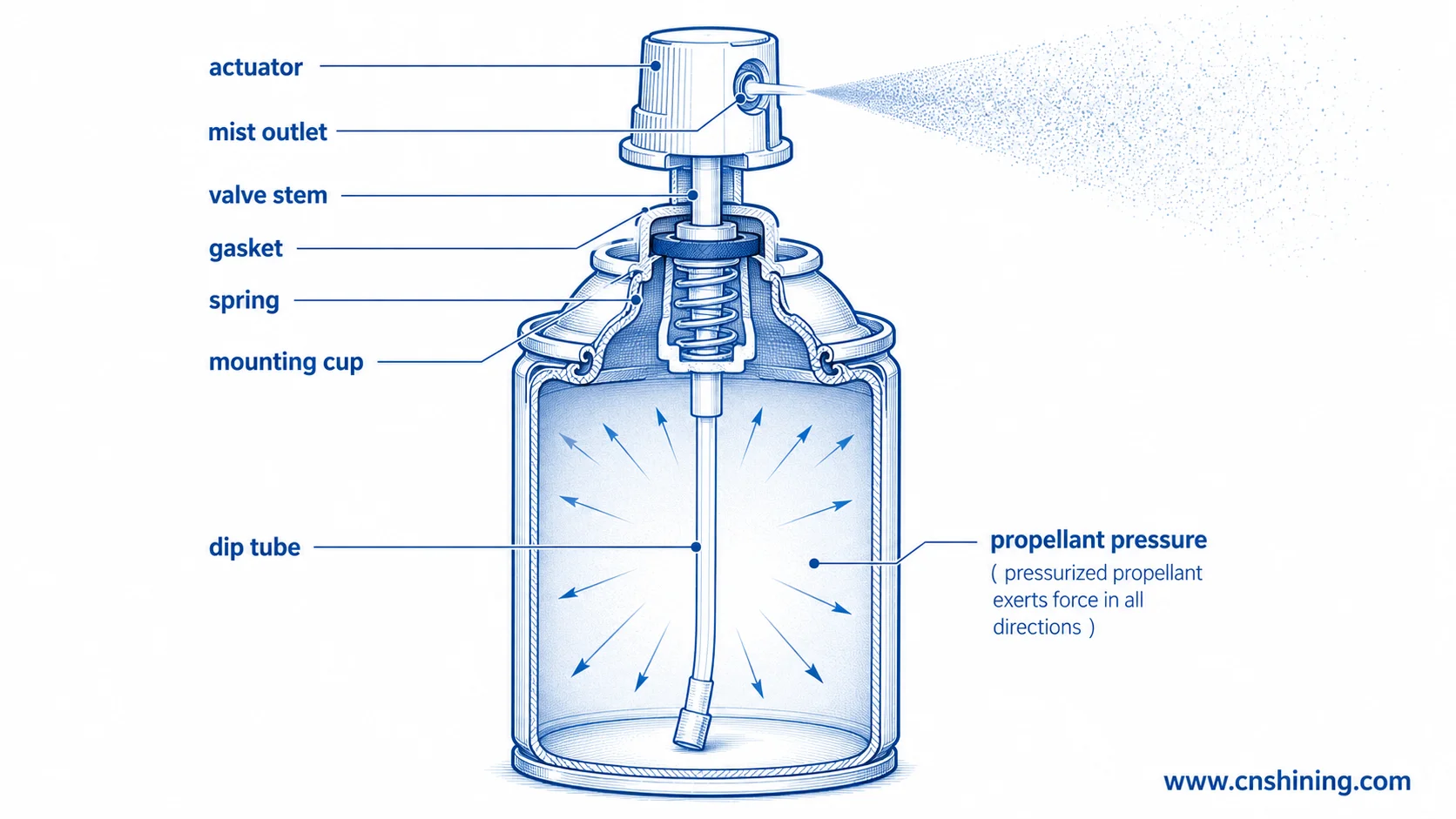
The main parts are the can, valve assembly, stem, gasket, spring, dip tube, actuator, and propellant system. When the actuator is pressed, the stem moves down, the gasket seal opens, internal pressure pushes the liquid through the dip tube and valve body, and the insert/nozzle breaks the liquid into mist. When the actuator is released, the spring reseals the system.
Aerosol cans are commonly made from aluminum or tin-plated steel, and that pressing the actuator opens the valve so product can flow through the dip tube, housing, stem, and insert.
2.3 Common working modes
| Mode | Typical use | Technical character | Main risk |
|---|---|---|---|
| Manual continuous spray | Bathrooms, kitchens, smoke, pets, guest preparation | Low cost, strong coverage, direct user control | Over-spraying, wet fallout, strong fragrance complaints |
| Concentrated low-dose spray | Small cans, premium home fragrance, travel or compact use | High fragrance load, low spray volume, small package | Consumer may read small size as shrinkflation |
| Automatic timed refill | Commercial washrooms, hotels, public areas | Metered dose, repeatable output, device-controlled use | Higher device dependency and refill compatibility issues |
Metered valves can keep each dose within a narrower range. An early automatic aerosol patent describes 2–20 mg per metered spray and droplet sizes of 1–40 μm for room diffusion and reduced fallout. The same logic still applies: dose, particle size, spray rate, and solvent evaporation window decide whether the product smells strong, lands wet, or disperses evenly. See WO2007052016A2 aerosol composition and method.
3. Market Size, Regional Pattern, and Growth Drivers
3.1 Global market reading
| Region | Public quantitative signals | Technical reading |
|---|---|---|
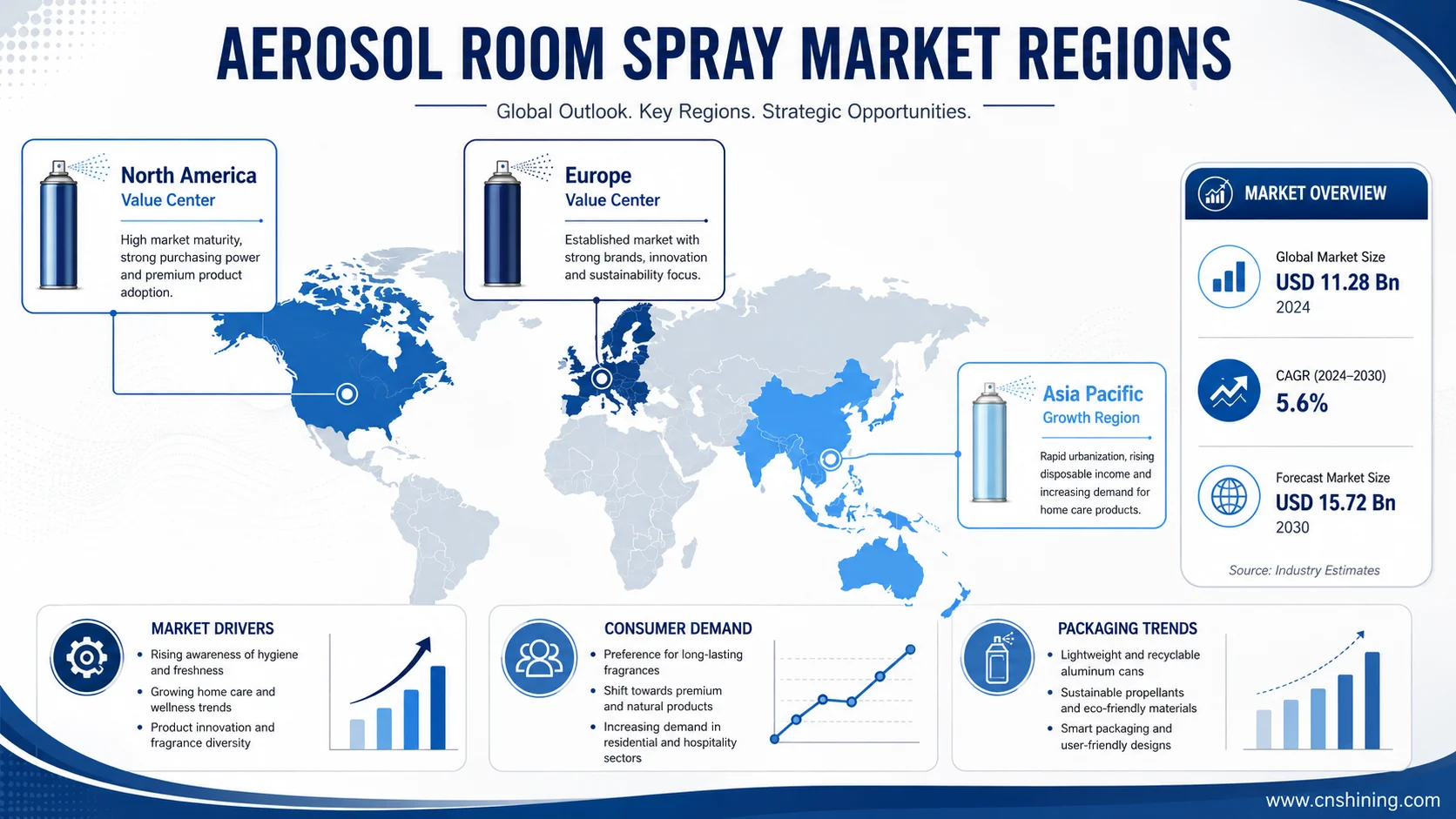
| North America | Public share signals around 38.2%–42.1%, depending on source scope | High brand concentration, high ticket value, high VOC pressure. Low-VOC and lower-irritation positioning fit this market. |
| Europe | Public share signals around 29.7%–35.2%; 2023 European aerosol production was 5.288 billion cans, with household at 19.4% | Strict label, recycling, GWP, and green-claim pressure. Multi-language label space is a real packaging constraint. |
| Asia Pacific | Room-spray revenue split is inconsistent in free sources; China aerosol production was about 2.475 billion cans in 2023 | Large population base, fragmented channels, strong regional brand and price-tier differences. |
| Latin America | One public share signal gives about 8.4%; Brazil aerosol production was about 726 million cans in 2023 | Price sensitivity is high, but aerosol use habits are established. |
| Africa / Middle East | One public share signal gives Middle East and Africa about 5.2%; South Africa aerosol production was about 408 million cans in 2023 | Basic odor control, heat stability, and cost control matter more than complex fragrance architecture. |
The European, Asia Pacific, Brazil, and South Africa figures are all-category aerosol production, not room spray only. They still give a useful proxy for filling capacity and aerosol consumption habits. The FEA annual report is a useful reference for European production, recycling, and regulatory trends: FEA 2024 Annual Report.
UK retail data also shows that aerosol air freshener unit sales fell from 89.10 million in 2015 to 79.069 million in 2024, after reaching 94.614 million in 2018. The category is not disappearing. It is losing some long-duration fragrance occasions to diffusers and electric devices, while keeping the “immediate odor correction” occasion. See BAMA Annual Report 2024–2025.
3.2 Growth drivers
Four drivers are visible. First, urban homes need fast odor control in bathrooms, kitchens, and pet spaces. Second, home fragrance is now part of interior mood design, not just odor masking. Third, regulation pushes lower VOC, lower GWP, clearer claims, and safer labels. Fourth, packaging technology is upgrading: finer atomization, locking actuators, recyclable metal cans, and concentrated formats.
4. Product Format Comparison
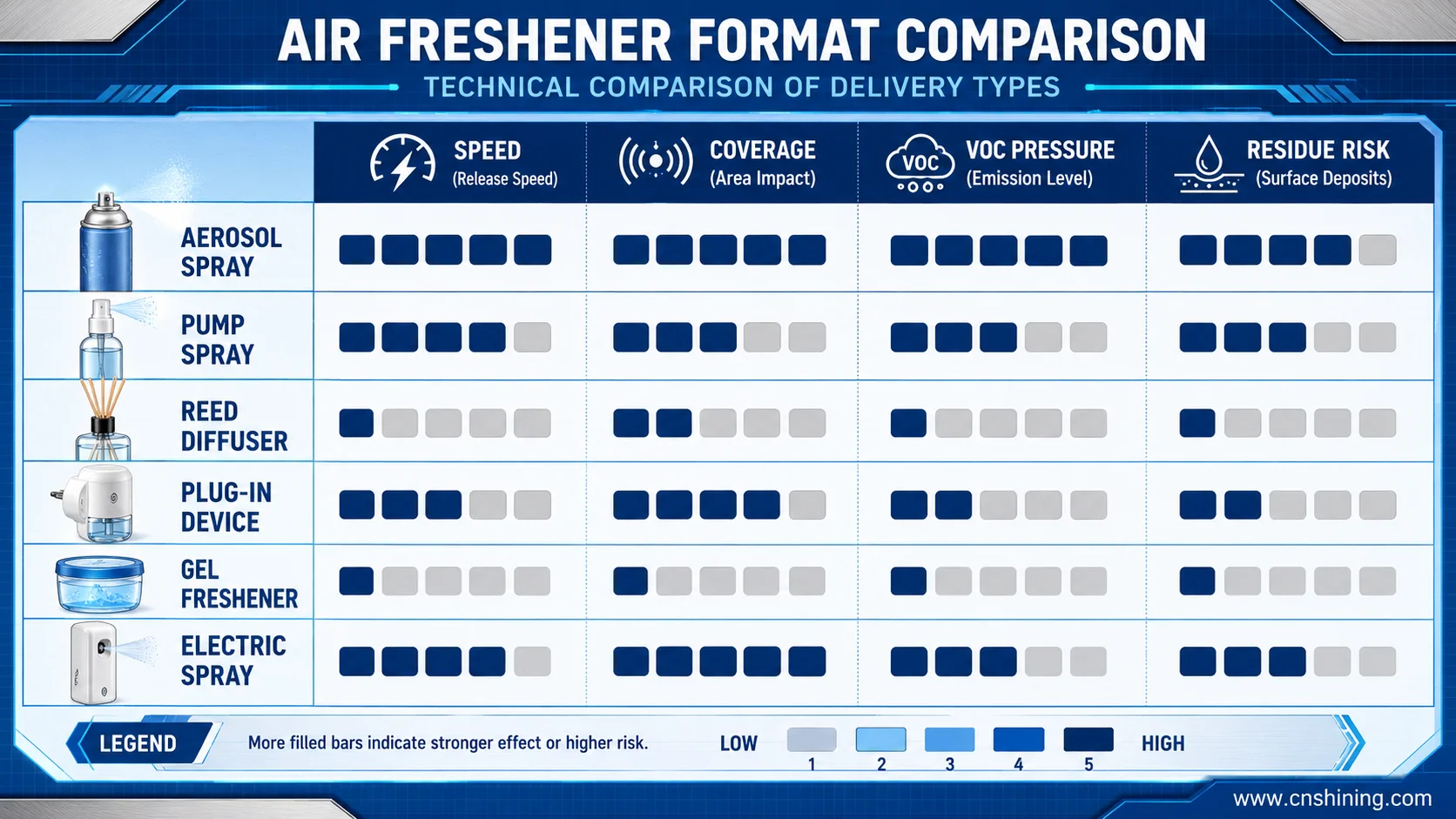
| Dimension | Aerosol Room Spray | Pump Spray | Reed Diffuser | Plug-ins | Gel | Electric Sprays |
|---|---|---|---|---|---|---|
| Speed | Fastest, immediate dispersion | Fast, lower coverage | Slow | Continuous, not instant | Slow | Timed, medium instant effect |
| Coverage radius | Large | Medium | Small to medium | Medium | Small | Medium to large |
| Best scenes | Bathroom, kitchen, smoke, pet odor, before guests arrive | Small spaces, light odor correction | Living room or bedroom ambience | Long-duration home fragrance | Low-cost continuous odor control | Commercial washrooms and public areas |
| Residue / fallout risk | Medium to high, depending on droplet size and solvent | Medium | Low | Low | Low | Medium |
| VOC / flammability pressure | Highest | Medium | Low | Medium | Low | Medium |
| Packaging complexity | High: valve, pressure can, hazardous goods handling | Low | Low | Medium | Low | High |
| Common complaints | Nozzle failure, scent too strong, slippery floor, flammable or irritating feel | Uneven hand feel, weak scent | Too slow, too light | Headache or continuous exposure concern | Slow effect | Device failure and refill cost |
The federal VOC table separates air fresheners into single-phase, double-phase, pump/liquid, and solid/gel forms. This matters because format is not only a marketing choice. It changes the VOC limit, label risk, transport handling, and consumer complaint pattern. See the US federal VOC content limits by product category.
5. Top 10 Aerosol Room Spray Brand
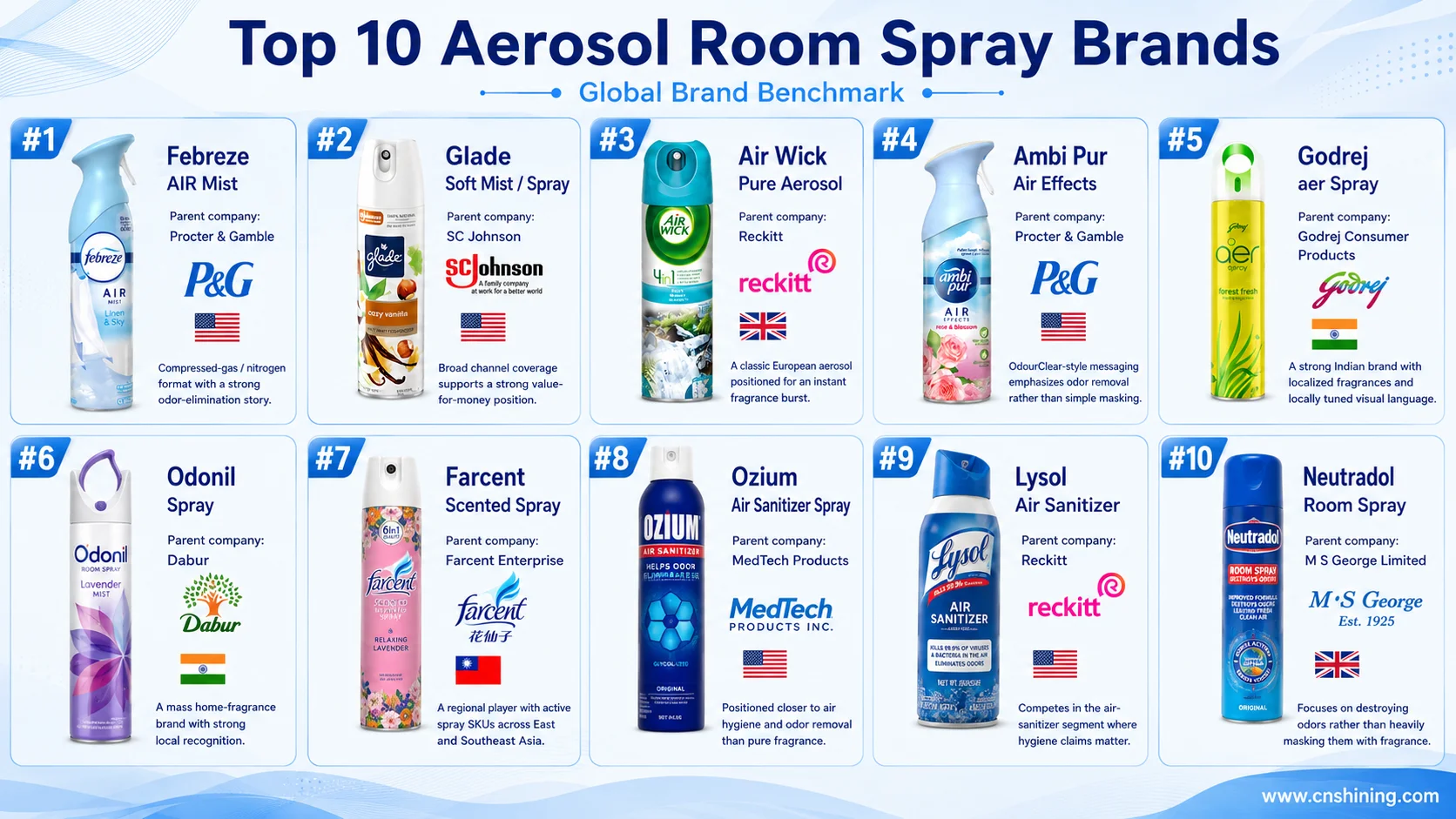
| Brand | Main region | Parent company | Common size | Public price range | Technical reading |
|---|---|---|---|---|---|
| Febreze AIR Mist | US | Procter & Gamble | 185 ml / 8.8 oz | about $4.5 single can | Representative compressed gas / nitrogen route with strong odor-elimination narrative. |
| Glade Soft Mist / Spray | US | SC Johnson | 8 oz / 300 ml | 2-pack about $4.48–5.73 | Very broad channel coverage and value positioning. |
| Air Wick Pure Aerosol | UK | Reckitt | 300 ml | about $3.2–3.8 | Classic European aerosol route, positioned around instant fragrance burst. |
| Ambi Pur Air Effects | US | Procter & Gamble | 275 g / 300 ml | about $4.2–5.8 | Uses OdourClear-style messaging to separate odor removal from masking. |
| Godrej aer Spray | India | Godrej Consumer Products | 200–240 ml | about $1.5–2.1 | Strong Indian brand with localized fragrance and visual language. |
| Odonil Spray | India | Dabur | 150–550 ml | about $0.9–5.1 depending on size | Mass home fragrance brand with strong local recognition. |
| Farcent Scented Spray | Taiwan | Farcent Enterprise | 250–320 ml | about $1.9–2.9 / 250–320 ml | Regional brand with active spray SKUs in East and Southeast Asia. |
| Ozium Air Sanitizer Spray | US | MedTech Products | 3.5 oz | about $4.99 | Closer to air hygiene and odor removal than pure fragrance. |
| Lysol Air Sanitizer | US | Reckitt | 10 oz | about $6.97–7.29 | Adjacent EPA-related category where hygiene claims matter. |
| Neutradol Room Spray | UK | M S George Limited | 300 ml | single can about $4 | Focuses on destroying odors rather than heavy fragrance masking. |
For cross-market benchmarking, price per liter and cost per 100 sprays are more useful than shelf price. A small concentrated can may be technically efficient, but the label must explain spray count and equivalent use clearly. If not, consumers may read it as a smaller pack at the same price.
6. User Pain Points and Packaging Signals
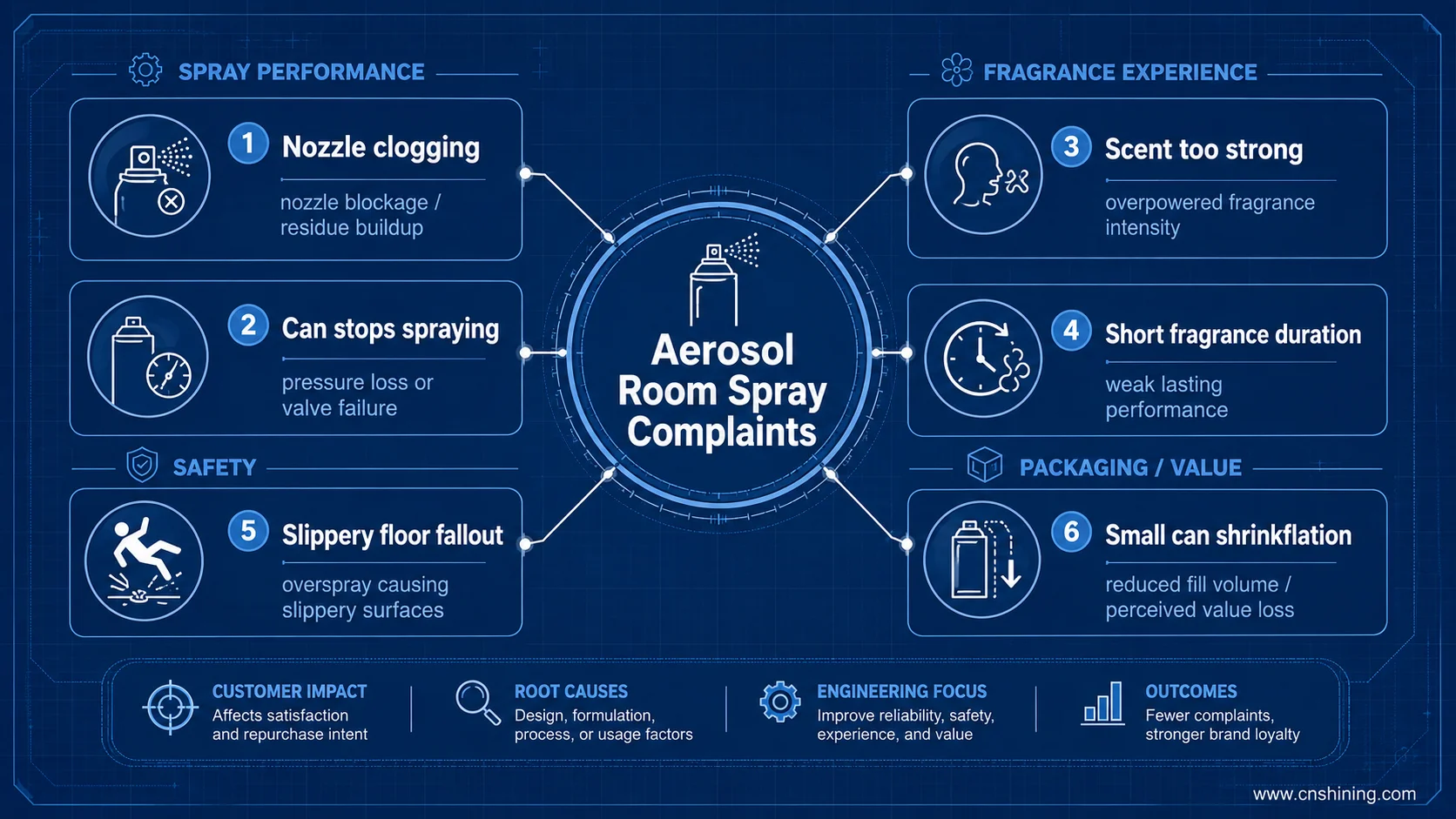
| Pain point | Observed sample type | Technical implication |
|---|---|---|
| Nozzle or can failure | Retail reviews mention cans stopping before empty | Valve, actuator, orifice clog resistance, and pressure retention control repeat purchase. |
| Scent too strong, choking, headache | Retail and social comments report throat irritation and headaches | “Strong fragrance = strong performance” is no longer a safe assumption, especially in small rooms. |
| Short fragrance duration | Users report instant smell but weak lingering effect | Top-note impact and tail-note persistence need separate design. More fragrance is not the only answer. |
| Wet fallout and slippery floors | Users warn about wood or tile surfaces becoming slippery | Large droplets, high spray rate, and slow solvent evaporation turn experience problems into safety problems. |
| Small cans perceived as shrinkflation | Social discussion around downsized packs | Concentrated aerosols need clear spray-count and equivalent-use communication. |
| “Only masks odor” | Repeated comments across platforms | Consumers increasingly separate fragrance products from functional odor-control products. |
These complaints are not random noise. They point directly to packaging and formulation levers: valve chamber geometry, actuator locking, nozzle insert design, droplet spectrum, solvent evaporation curve, corrosion control, and label wording.
7. Formula Systems and Technical Terms
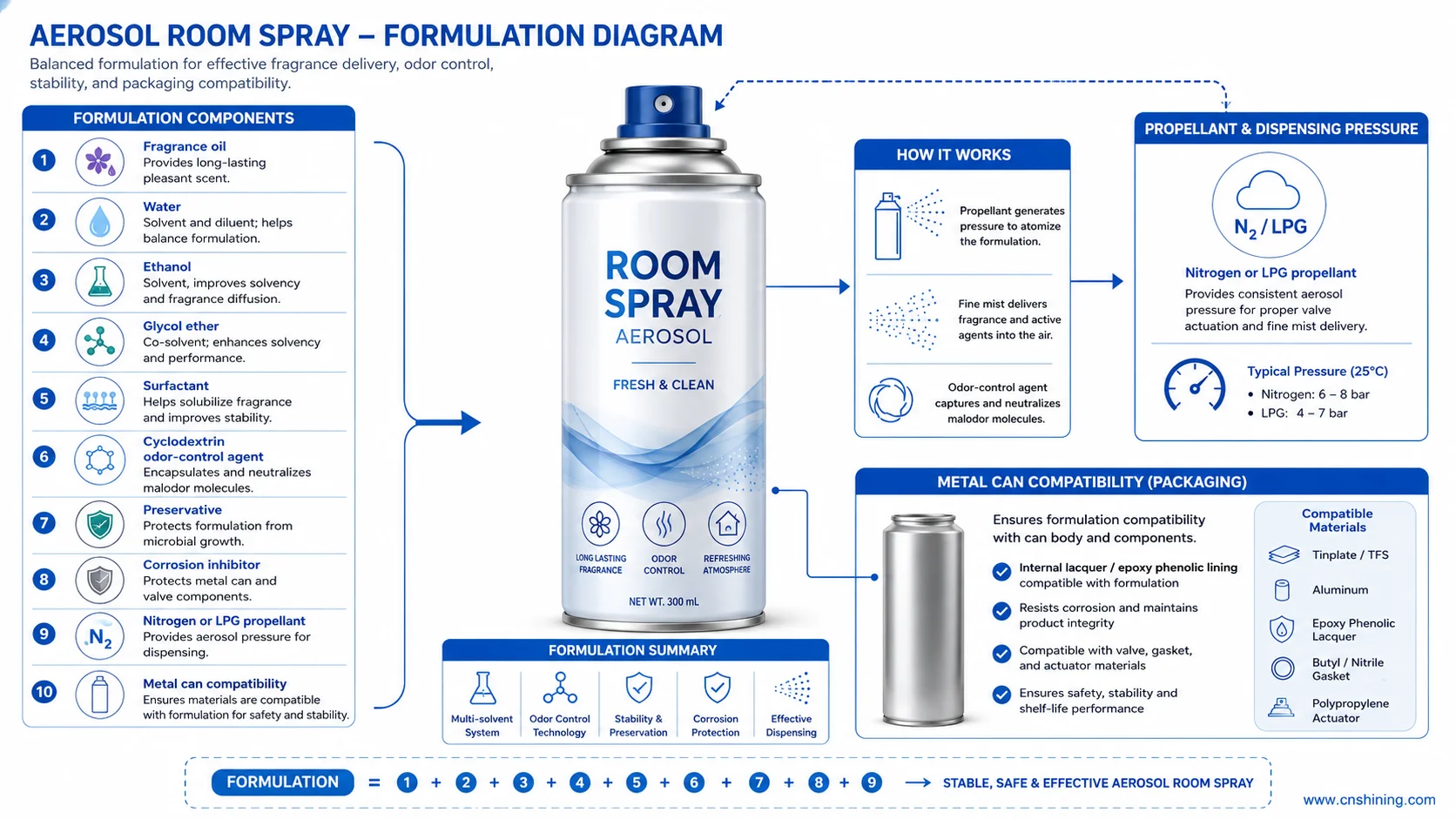
7.1 Common formula routes
| Formula type | Main components | Function | Typical range | Best fit |
|---|---|---|---|---|
| Traditional single-phase aerosol | Liquefied propellant, fragrance, small co-solvent amount | Strong spray, fast diffusion | Propellant 85–99.9%, active 0.1–15%, co-solvent <1% | High-impact traditional sprays and automatic spray systems |
| Water-alcohol-glycol ether compressed gas system | Water, ethanol, DPnP, fragrance, corrosion inhibitor, compressed gas | Lower VOC tendency and lower flammable gas dependence | Water 48–52%, ethanol 26–30%, DPnP 18–22%, fragrance 1–3%, corrosion inhibitor <0.5% | North America and EU-friendly development platforms |
| Low-VOC mixed propellant system | Base liquid + small liquefied gas + compressed gas | Balances lower VOC with spray consistency | Liquefied gas about 5–15% of base liquid; internal pressure 9–11 bar | Technical upgrade route for low-VOC aerosol performance |
| Compressed gas odor-control system | Water, denatured alcohol, surfactant, encapsulating or complexing odor-control agent, fragrance, nitrogen | Lower flammability tendency and functional odor control | Brand-specific, usually lower fragrance load | Light scent plus odor neutralization |
| Air sanitizer-adjacent system | Alcohol or solvent, antimicrobial active, propellant system | Air sanitizing or disinfecting claim | Must follow claim and registration requirements | Different compliance path from normal room spray |
One public patent gives a useful water-alcohol-glycol ether window: water 48–52%, ethanol 26–30%, DPnP 18–22%, fragrance 1–3%, and corrosion inhibitor below 0.5%, with compressed gas such as air, nitrogen, or carbon dioxide. See US20190298878A1 Air Freshening Formulation.
Another low-VOC aerosol route uses a small amount of liquefied gas with an insoluble compressed gas to maintain spray consistency. This is useful because removing liquefied propellant too aggressively can create large droplets, weak atomization, and poor pressure stability. See US20230277421A1 Aerosol Product.
7.2 Technical terms worth aligning before development
| Term | Simple meaning | Why it matters commercially |
|---|---|---|
| VOC | Volatile organic compound | Defines compliance pressure and affects health or green-label claims. |
| Propellant | Gas system that creates pressure and helps atomization | Controls spray force, particle size, flammability, and shipping status. |
| Single-phase aerosol | One uniform aerosol phase | Fast atomization and stable automatic use, often with higher VOC pressure. |
| Compressed gas aerosol | Aerosol pressurized by nitrogen, air, or CO₂ | Better low-VOC and low-flammability story, but atomization can be harder. |
| Metered-dose valve | Valve that limits each spray amount | Reduces over-spray, strong scent complaints, and dose inconsistency. |
| Fallout | Wet mist landing on surfaces | Too much fallout causes slippery floors, furniture residue, and negative reviews. |
| Particle size | Droplet size distribution in the spray plume | Controls diffusion, inhalation feel, and surface wetting. |
| UFI | EU Unique Formula Identifier | Needed for many hazardous mixtures under EU poison center notification rules. |
| BOV | Bag-on-Valve | Can support cleaner separation and lower residue, but cost rises. |
8. Regulatory Framework: US and EU
8.1 United States
For ordinary room spray, the first compliance layer is usually not FDA. It is claim-dependent EPA/FIFRA, CPSC/FHSA hazard labeling, federal VOC rules, and state rules such as CARB.
The FDA explains fragrance issues mainly in the context of cosmetics and intended use. If a spray is marketed for the body, skin, or personal fragrance use, it can move toward a different regulatory path. See FDA information on fragrances in cosmetics.
For household hazardous product labeling, the CPSC explains FHSA cautionary labeling obligations. Flammable propellants, irritating solvents, and other hazard features should be treated as package design inputs, not as late-stage legal edits. See CPSC FHSA cautionary labeling guidance.
CARB is stricter than the federal VOC table for many aerosol air freshener pathways. The source document notes a path where Manual Aerosol Air Freshener moves to 10% VOC in 2023 and 5% VOC in 2027, while Concentrated Aerosol Air Freshener moves to 15% in 2023 and 10% in 2027. See CARB Consumer Products Regulation Article 2.
8.2 European Union
The EU baseline includes REACH, CLP, the Aerosol Dispensers Directive, poison center notification, UFI, and newer pressure around F-gas and green claims. For aerosol room spray, the practical issue is not only ingredient legality. It is also whether hazard pictograms, signal words, precautionary statements, UFI, recycling information, and multilingual text can fit on a small curved label.
The Aerosol Dispensers Directive remains a core legal reference for aerosol containers and labeling obligations. See the EU Aerosol Dispensers Directive 75/324/EEC.
| Market | Main framework | Practical requirement for room spray |
|---|---|---|
| United States | EPA/FIFRA, CPSC/FHSA, 40 CFR Part 59, CARB | Separate fragrance/odor claims from sanitizing claims. Treat VOC category and hazard label as early design constraints. |
| European Union | REACH, CLP, ADD 75/324/EEC, UFI/PCN, F-gas rules | Ingredient status, hazard label space, multilingual packaging, UFI, recycling, and GWP must be checked together. |
9. Technology Trends and Packaging Solutions
9.1 Current technical direction
The strongest direction is low VOC + compressed gas + fine atomization. Brands are already using nitrogen or compressed gas routes, while patents show ways to combine small liquefied propellant amounts with compressed gas to stabilize spray quality.
Sustainability is moving from a brand story to an engineering question. Steel and aluminum aerosol cans have established recycling pathways in many regions, but the propellant system, solvent selection, label claims, and real recovery behavior decide whether the story holds.
Locking and ergonomic actuators are also gaining value. A twist-to-lock actuator is not only a premium touch point. It can reduce accidental discharge in e-commerce shipping, lower misuse risk, and reduce confusion between “the nozzle is broken” and “the actuator is locked.”
9.2 Complaint-to-packaging solution table
| User issue | Packaging lever | Suggested action | Benefit | Trade-off |
|---|---|---|---|---|
| One spray feels too strong | Valve + actuator | Use metered valve or lower-flow actuator | Lower over-spray, headache, and VOC load per use | Some users may think performance is weaker |
| Nozzle clogs or stops spraying | Valve chamber + insert | Improve anti-clog design and front-chamber geometry | Fewer returns and negative reviews | Higher component cost and tighter assembly tolerance |
| Floor becomes slippery | Nozzle + evaporation window | Reduce large droplets, lower dose, tune solvent evaporation | Less surface fallout and safer small-room use | Immediate scent impact may decrease |
| Transport leakage or accidental spray | Locking actuator + overcap | Use twist-lock, overcap, or tamper seal | Better e-commerce compatibility | More parts and higher material use |
| Water-alcohol corrosion | Internal coating + corrosion inhibitor | Test fragrance, solvent, can coating, valve gasket, and inhibitor together | Lower rust, odor drift, and shelf failure | Longer validation cycle |
| Small can read as shrinkflation | Can shape + printing | Print estimated spray count and concentrated-use logic | Turns smaller pack into an efficiency message | Data must be real and reproducible |
| Claims unclear or too green | Label + QR support | Clarify use boundary, ingredients, UFI, recycling, and safety advice | Reduces misuse and improves trust | More complex label management |
9.3 Practical product architectures
A mainstream retail line can use steel or standard aluminum cans, continuous valves, and medium-flow actuators. This keeps cost and filling speed under control. It also exposes the product to the highest complaint risk if atomization and nozzle reliability are weak.
A compliance-upgrade line should consider compressed gas, lighter fragrance loading, functional odor-control chemistry, locking actuator, and clearer label logic. This fits North America, Europe, and large e-commerce channels. The weak point is spray feel. If atomization is poor, users will say it is not strong enough.
A concentrated line can use small cans, higher fragrance concentration, metered valves, tactile decoration, and locking actuators. The engineering question is simple: can the brand prove that fewer grams still deliver enough sprays and room effect?
10. Shining Packaging Components for Aerosol Room Spray
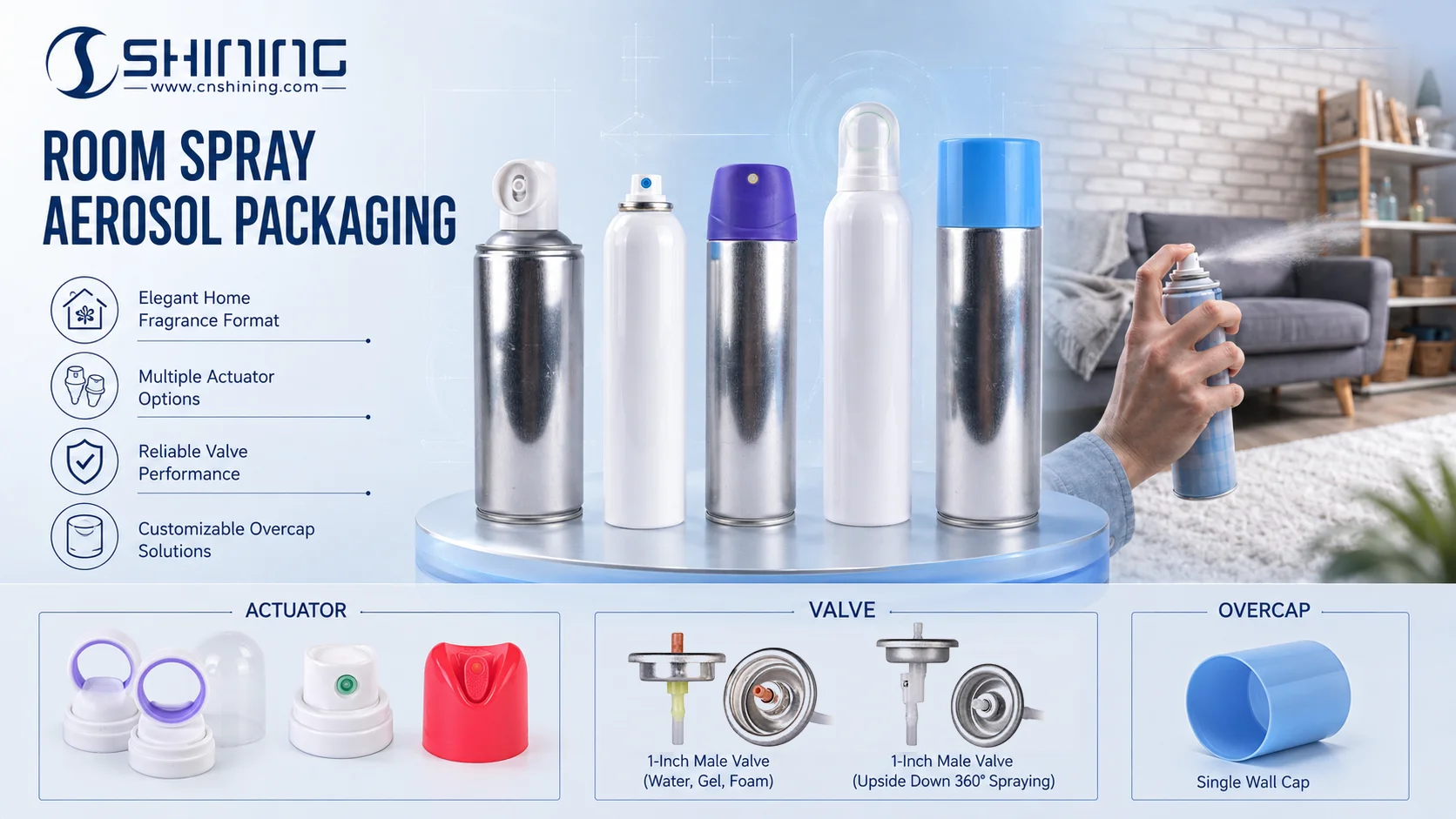
For aerosol room spray projects, packaging selection should start from the failure modes above: over-spray, clogging, leakage, corrosion, and poor dose control. Shining Packaging can fit into this part of the development work through actuators, aerosol cans, and valves matched to the product’s spray target.
The actuator should be selected for hand feel, spray angle, locking function, and nozzle insert behavior. A room spray for small bathrooms does not need the same output as a commercial odor-control aerosol. The valve should match the formula viscosity, propellant pressure, target dose, and expected shelf life. For concentrated products, a metered or lower-flow route may reduce the “one press is too much” problem.
The can is not only a printed metal shell. Material, internal coating, pressure rating, neck finish, decoration process, and corrosion compatibility all affect stability. Water-alcohol systems and aggressive fragrance oils need can-lining and valve-gasket compatibility tests before scale-up. This is where packaging work becomes part of formula validation, not an afterthought.
11. FAQ: Aerosol Room Spray
Aerosol room spray uses internal pressure and a valve-actuator system to release a fine mist quickly. Pump spray relies on hand pressure, so coverage is usually weaker and less consistent. Aerosol gives faster odor correction, but it also brings VOC, flammability, transport, and valve reliability requirements that pump formats do not carry at the same level.
VOC control affects both formula and spray performance. Reducing liquefied propellant can lower VOC load, but it may also weaken atomization, increase droplet size, and reduce pressure consistency over product life. A low-VOC aerosol still needs the valve, actuator, propellant, solvent, and fragrance system to work as one package.
Not always. Nitrogen, air, or CO₂ can support lower flammability and lower VOC positioning, but compressed gas systems often face weaker particle breakup and pressure decline during use. LPG systems can deliver strong spray quality, but they carry higher VOC and flammability pressure. The better route depends on target market, claim, and spray feel.
Early spray failure can come from nozzle clogging, valve chamber residue, pressure loss, dip tube issues, actuator damage, or formula incompatibility. Fragrance oils, resins, surfactants, and corrosion products can also affect the spray path. Reliability testing should use the real formula, not only water or alcohol test liquid.
Wet fallout usually comes from large droplets, excessive spray rate, short spray distance, or a solvent system that does not evaporate fast enough. It is not only a formula issue. Nozzle insert, actuator geometry, valve output, and user spray angle all affect whether the mist remains airborne or lands on tile, wood, or furniture.
A metered-dose valve is useful when the product must control each spray amount, such as concentrated aerosols, automatic refills, or products with strong fragrance impact. It helps reduce over-spraying and user complaints. The trade-off is cost and a different spray feel, so the dose must match the room size and fragrance strength.
A normal fragrance aerosol mainly changes how the room smells, often by masking or reshaping odor perception. An odor eliminator usually adds a mechanism such as encapsulation, complexation, adsorption, or chemical neutralization. The claim should match the tested function. If the label moves into sanitizing or disinfecting language, regulation changes.
The actuator controls user feel, spray angle, plume shape, and sometimes locking safety. A high-output actuator can make a product feel powerful but may cause over-spray and throat irritation. A low-flow or locking actuator can reduce complaints and transport risk. It must be matched with valve output and formula viscosity.
Water-alcohol systems need corrosion and compatibility testing with the can coating, valve gasket, dip tube, fragrance, and corrosion inhibitor. A formula that looks stable in glass may attack metal or elastomers over time. Shelf-life tests should include heat aging, pressure retention, spray pattern, odor drift, and internal can inspection.
Air sanitizer, disinfectant, antimicrobial, or pathogen-reduction claims can move a product into a stricter regulatory category. In the US, this may trigger EPA/FIFRA review. In China, air disinfectant requirements differ from ordinary fragrance sprays. The safest development route is to define the claim first, then design formula, test protocol, and label.