
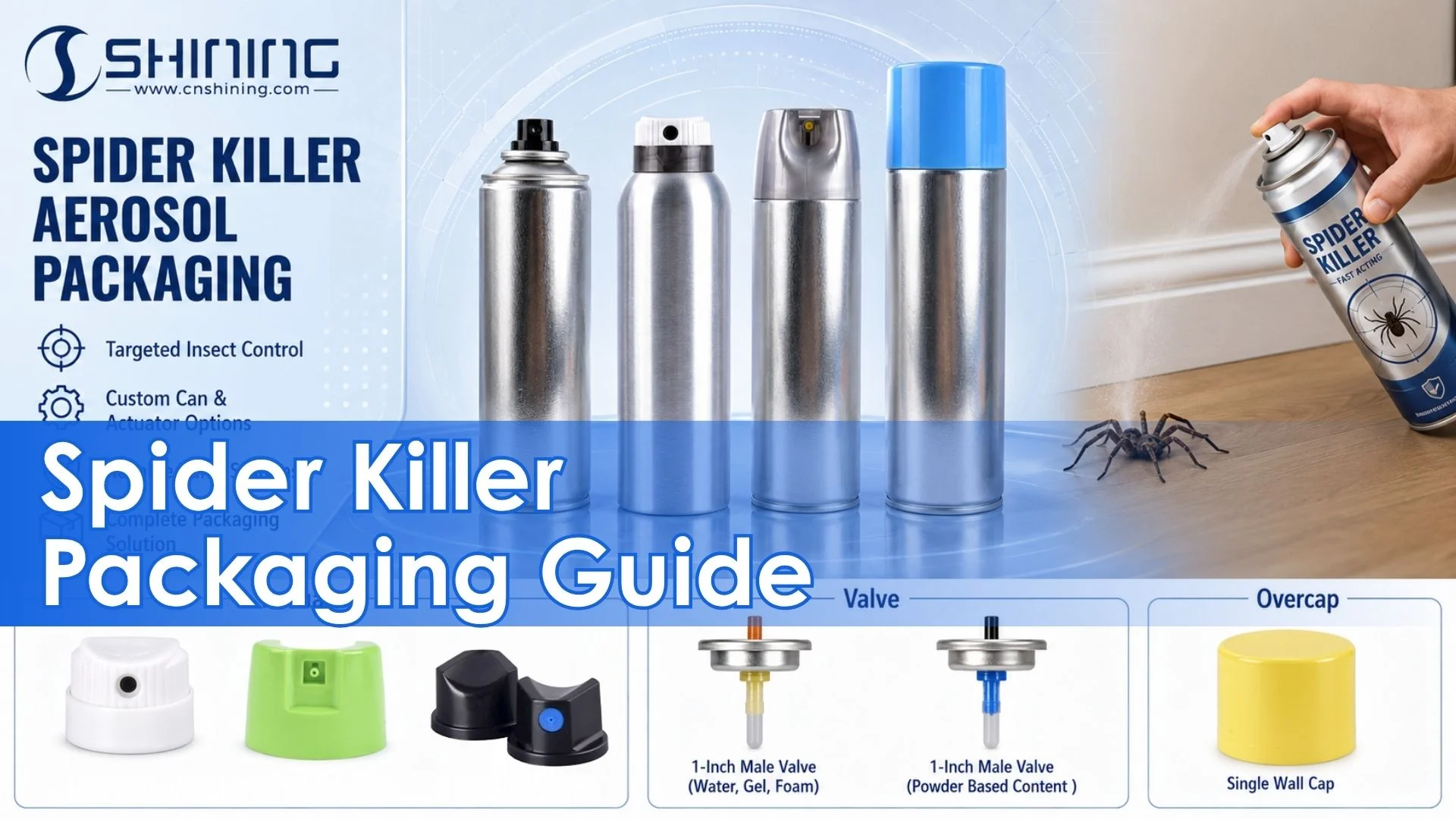
A spider killer aerosol is not a whole-house ecological control system. It is a direct-contact tool: see the spider, keep distance, spray accurately, get fast knockdown, and leave some short-to-medium residual deposit on the treated surface.
That distinction matters. Spider sprays behave differently from baits, glue traps, residual barrier sprays, and foggers. Most retail labels use language such as kill on contact or must be sprayed directly. This puts the product squarely in the engineering space of spray accuracy, droplet delivery, actuator control, valve sealing, formulation stability, and surface deposition.
1. Executive Technical View
The main active systems still sit around pyrethrins and pyrethroids, often supported by synergists such as piperonyl butoxide. Fast knockdown is usually handled by ingredients such as pyrethrins, prallethrin, or imiprothrin. Residual surface performance is more often supported by cypermethrin, deltamethrin, lambda-cyhalothrin, or permethrin.
The commercial point is simple: the user does not mainly complain that the chemical is too weak. They complain that the spray leaks, smells, drifts, stains, leaves slippery residue, misses corners, or feels unsafe indoors. For packaging engineers, that moves attention from “more active ingredient” to “better delivery.”
2. Definition and Aerosol Delivery Mechanism
From a product engineering view, a spider killer aerosol is a ready-to-use household insecticide formulation filled into a pressurized aerosol can. The valve and actuator convert the liquid formulation into a directed spray or droplet plume. The target may be a visible spider, web, egg sac, crack, baseboard, window frame, or surface where spiders rest.
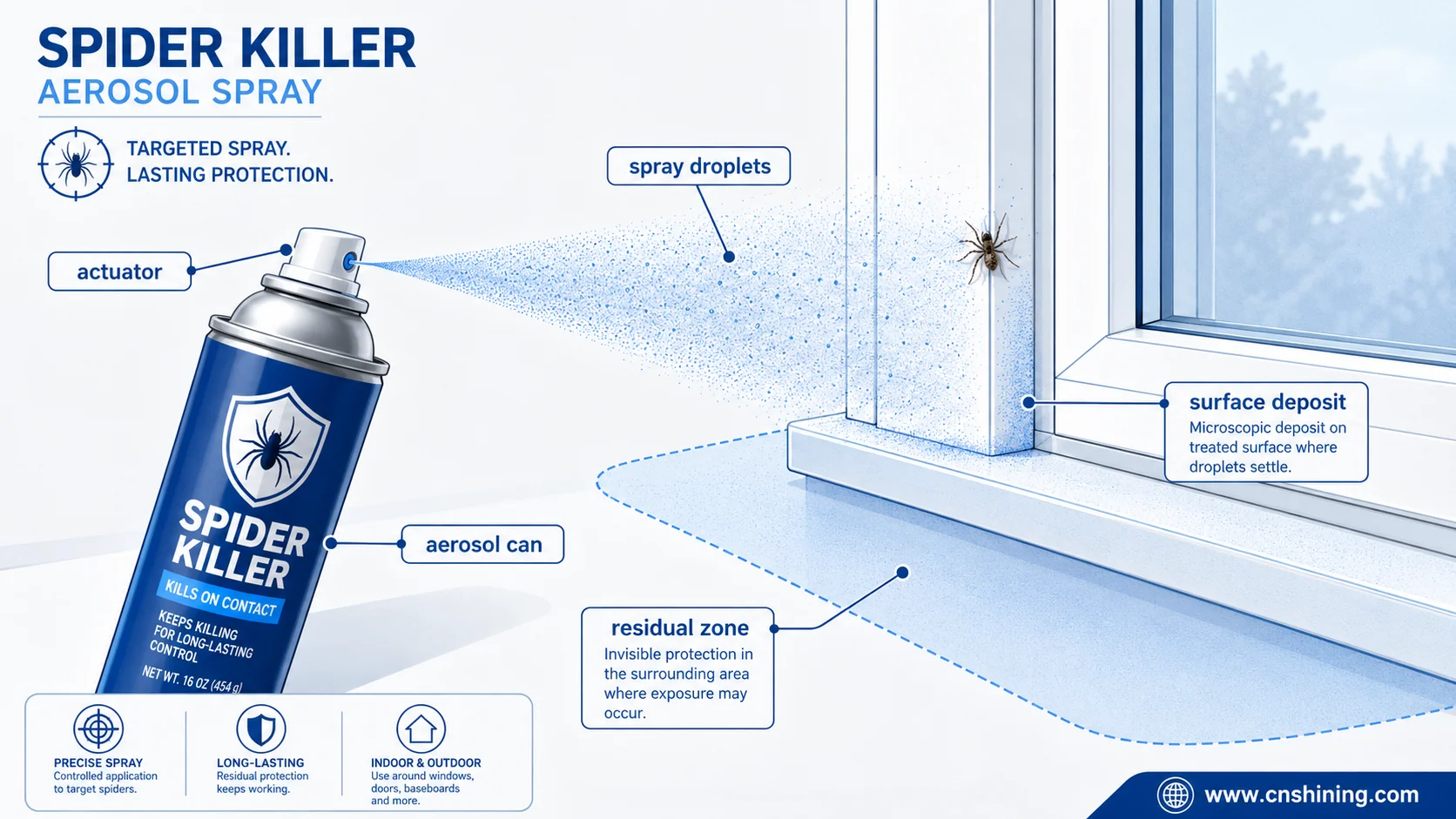
The spray chain follows a familiar aerosol sequence. The user presses the actuator. The valve opens. Propellant pressure or flash-off pushes the product through the valve stem and actuator orifice. The plume deposits droplets on the spider surface, web, or treatment zone. Knockdown chemistry acts quickly, while residual ingredients remain on the treated surface.
1. Press actuator → mechanical force moves the stem.
2. Valve opens → seal breaks and internal pressure is released.
3. Product exits → liquid and propellant move through stem and orifice.
4. Spray forms → droplets are shaped by orifice geometry, pressure, and formulation.
5. Deposit occurs → droplets contact spider body, web, crack, or surface.
6. Biological effect follows → nervous system disruption causes knockdown, paralysis, and death.
Label instructions support this engineering logic. The EPA label for Raid Ant & Roach 26 gives direct-spray and surface-application instructions, including an 18-inch spray distance and direct-spray language for black widow spiders and scorpions.
Spray quality is not a minor detail. Stem orifice, actuator insert, vapor tap, dip tube design, propellant choice, viscosity, and spray rate all influence plume geometry. For a spider spray, a beautiful mist is not always the goal. The product must hit a small, moving arthropod without filling the room with chemical cloud.
3. Formula Architecture and Active Chemistry
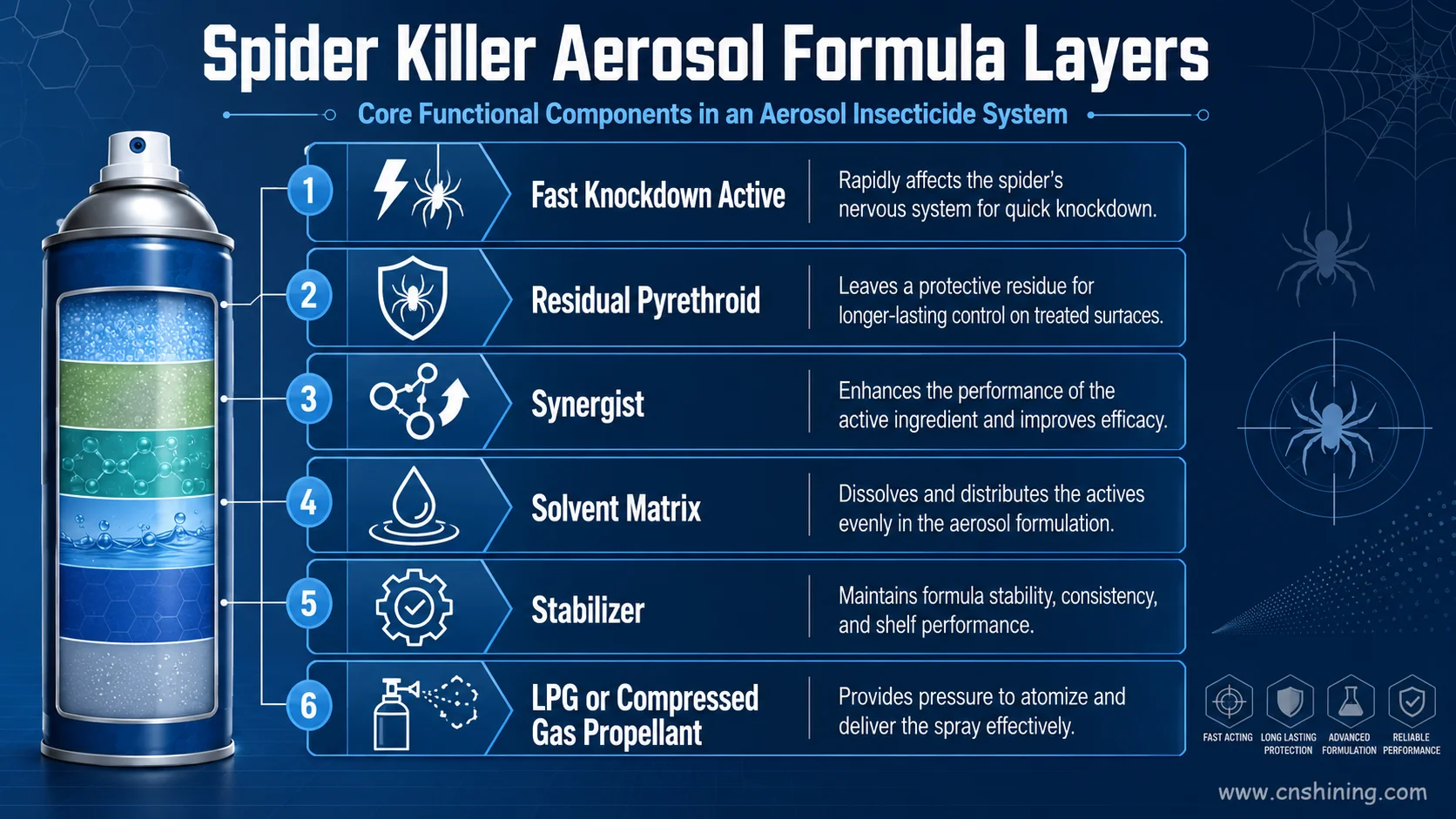
Most spider killer aerosol formulations use a layered structure rather than a single-purpose ingredient. One ingredient gives the fast “drop” effect. Another supports residual activity. Solvents wet the target and carry the active. Propellants create pressure and spray energy. Stabilizers keep the system uniform during storage.
Pyrethrins and pyrethroids work mainly through voltage-gated sodium channels in arthropod nerves. They prolong channel opening, causing repetitive firing, tremor, loss of coordination, paralysis, and death. The EPA pyrethrins and pyrethroids page remains a useful regulatory reference for this chemistry family.
Synergists such as PBO do not function as the main insecticide in the same way. They inhibit detoxification pathways, especially enzyme systems that would otherwise metabolize the active. The EPA PBO reregistration decision is a practical source for understanding how this material is assessed.
| Component Layer | Typical Ingredients | Main Function | Commercial Meaning |
|---|---|---|---|
| Fast knockdown active | Pyrethrins, prallethrin, imiprothrin | Stops spider movement quickly after direct contact. | Creates the “sprayed and it dropped” user experience. |
| Residual active | Cypermethrin, deltamethrin, lambda-cyhalothrin, permethrin | Leaves active material on surfaces for later exposure. | Supports treatment of baseboards, window frames, and corners. |
| Synergist | PBO, MGK-264 | Reduces metabolic breakdown of the main active. | Can maintain performance at lower active loading, but raises review complexity. |
| Solvent or matrix | Petroleum distillates, isopropyl myristate, water | Dissolves actives, wets surfaces, and affects residue. | Controls odor, oiliness, staining risk, and slip complaints. |
| Propellant | Propane, isobutane, compressed air, nitrogen in BOV systems | Pressurizes the can and supports spray formation. | Affects range, flammability, VOC profile, and can design. |
| Stabilizer package | Sorbitan oleate, ATBC, BHT, ammonium benzoate | Supports formulation uniformity and shelf stability. | Reduces separation, odor drift, and compatibility failure. |
| Representative Product | Active or Key Ingredients | Formula Pattern | Engineering Meaning |
|---|---|---|---|
| Raid Ant & Roach 26 | Imiprothrin 0.060%, cypermethrin 0.100%, petroleum distillates | Fast knockdown plus residual active. | A common U.S. mass-market formula template. |
| Hot Shot Spider & Scorpion Killer | Prallethrin 0.025%, lambda-cyhalothrin 0.030% | Spider and scorpion direct-kill positioning. | Designed around fast stopping power for larger crawling arthropods. |
| TERRO Spider Killer | Pyrethrins 0.10%, PBO 0.50%, permethrin 0.20% | Natural pyrethrins plus synergist plus pyrethroid. | Classic fast-contact and residual blend. |
| Raid Max Spider & Scorpion Killer | Deltamethrin, imiprothrin, isobutane, propane, solvent and stabilizer package | Transparent active-propellant-solvent-stabilizer system. | Useful as a formulation breakdown reference. |
| STEM Ants, Roaches and Spiders | Botanical active route | Lower-odor, plant-based positioning. | Fits light indoor use cases where odor perception drives product choice. |
| Onslaught FastCap Spider & Scorpion | Esfenvalerate, prallethrin, PBO | Professional residual concentrate, not aerosol. | Useful comparison point for long-residual spider control. |
4. Product Alternatives and Formulation Classes
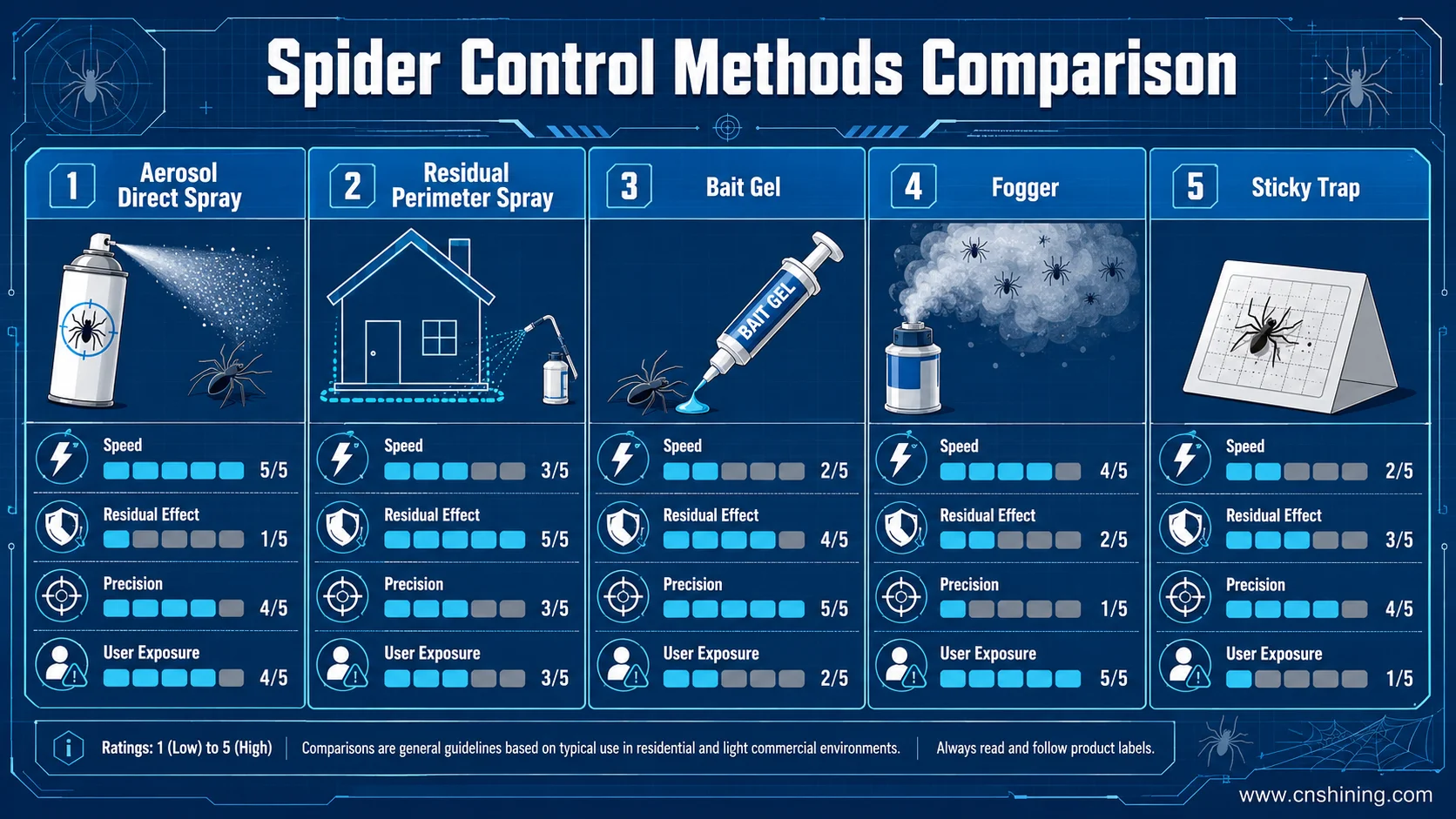
Spider control is not only an aerosol question. The real competition sits between aerosol sprays, baits, residual sprays, foggers, and traps. The decision is usually practical: does the user need immediate visible knockdown, or long-term low-visibility prevention?
| Option | Best Use Case | Speed | Residual Effect | Spider Fit | Main Weakness |
|---|---|---|---|---|---|
| Spider killer aerosol | Visible spider, web, egg sac, window frame, baseboard point treatment. | Fastest | Medium | High | Needs direct hit or close surface contact; odor and drift matter. |
| Bait | Ants and roaches that feed and share bait. | Slow | Medium to high | Low | Spiders do not naturally fit bait-transfer logic. |
| Residual or perimeter spray | Doors, windows, exterior wall lines, baseboards. | Medium | High | Medium | More setup work; weaker instant user feedback indoors. |
| Fogger or bug bomb | Broad enclosed-space treatment. | Fast but coarse | Low to medium | Low to medium | Less precise; misuse risk is higher. |
| Sticky trap | Passive monitoring and low-chemical support. | Slow | Medium | Medium | Does not solve the “visible spider now” moment. |
4.1 Active Ingredient Classes
| Active Class | Examples | Typical Strength | Typical Issue | Commercial Route |
|---|---|---|---|---|
| Natural pyrethrins | Pyrethrins | Fast action and easier natural-origin messaging. | Short residual without support. | Mixed formula systems such as pyrethrins + PBO + pyrethroid. |
| Type I pyrethroids | Prallethrin, imiprothrin | Fast knockdown. | Limited long-term control alone. | Fast-acting component in dual-active aerosols. |
| Type II pyrethroids | Cypermethrin, deltamethrin, lambda-cyhalothrin, permethrin | Better residual surface activity. | Higher regulatory and environmental pressure. | Mainstream spider/scorpion aerosol structure. |
| Botanical or minimum-risk route | Cornmint, rosemary, other essential-oil systems | Lower psychological barrier indoors. | Residual and heavy-infestation limits. | Light indoor use and lower-odor positioning. |
In the U.S., minimum-risk pesticide language has a specific regulatory meaning. The EPA minimum-risk pesticide page is useful because it clarifies that exemption from federal registration does not automatically remove state-level requirements.
4.2 Packaging and System Classes
| System | Description | Typical Contents | Commercial Meaning |
|---|---|---|---|
| Oil-based aerosol | Traditional mainstream system. | Active + hydrocarbon solvent + LPG propellant. | Good range and knockdown, but higher odor, flammability, and residue pressure. |
| Water-based aerosol | Lower-odor, lower-stain direction. | Water phase + emulsifier + active + propellant. | Better indoor comfort narrative, with more formulation stability work. |
| Microcapsule or suspension concentrate | Usually not aerosol; often professional residual spray. | Encapsulated active diluted before use. | Longer barrier logic, often compared against spider aerosols. |
| Bag-on-Valve or compressed gas | Product separated from propellant or powered by compressed gas. | Product bag + air or nitrogen outside the bag. | Can reduce flammability concerns, improve emptying, and improve angle use. |
The Bag-on-Valve technology reference is relevant because BOV addresses several spider aerosol pain points at once: odor perception, propellant separation, emptying rate, non-flammable propellant options, and angle flexibility.
5. Compliance Across Key Markets
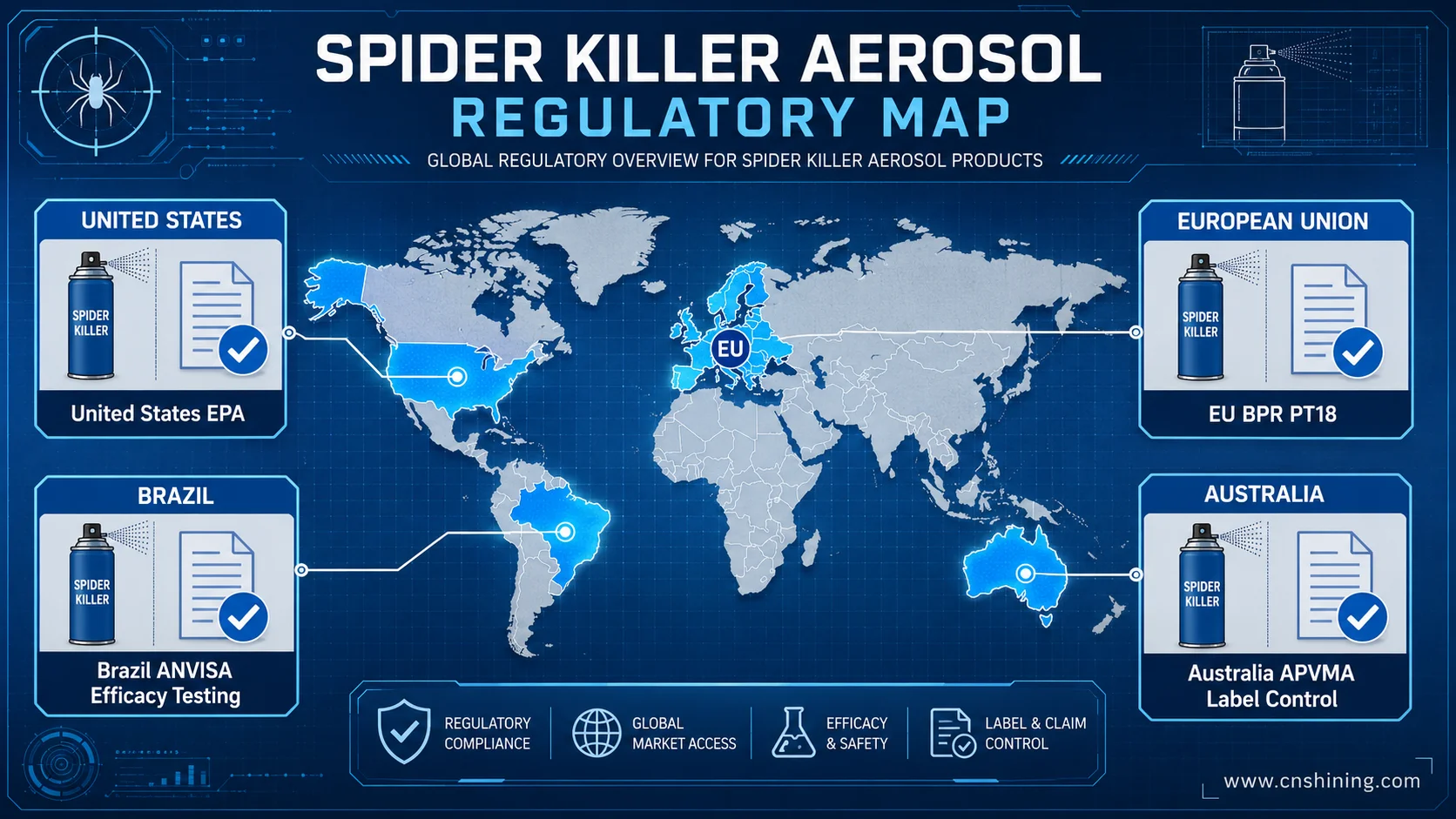
The compliance problem is not only toxicity. For spider killer aerosol, the question is also: can this product be labeled this way, sprayed this way, transported this way, stored this way, and discarded this way?
| Market | Framework | Core Requirement for Spider Aerosol | Commercial Meaning |
|---|---|---|---|
| United States | FIFRA and EPA registration | Use must follow the approved label. Target pests, spray distance, indoor or outdoor use, storage, and disposal are label-controlled. | Claims such as direct spray, residual duration, and target pest list need evidence and label support. |
| European Union | BPR 528/2012, PT18, CLP, Aerosol Dispensers Directive | Active approval and product authorization are separated; insecticides, acaricides, and other arthropod products sit under PT18. | Environmental exposure assessment and claim wording shape product design. |
| Brazil | ANVISA disinfectant and pest product efficacy framework | Aerosol efficacy protocols distinguish crawling insects and flying insects, with defined dose, exposure, and mortality logic. | “Works well” must be converted into testable, reviewable protocol data. |
| Australia | APVMA registration and domestic insecticide label control | Domestic insecticide claims, directions, warnings, and active approvals are tightly controlled. | Spider-heavy demand does not reduce label discipline. |
The EPA pesticide registration manual helps explain the U.S. product-registration process. For China, the pesticide registration management measures are a core reference. For Brazil, the ANVISA efficacy testing manual gives practical test-protocol structure.
EU PT18 exposure logic is moving. The PT18 emission scenario update note describes how revised exposure assumptions affect environmental risk assessment and product claims.
6. Top 10 Brands and Field Language
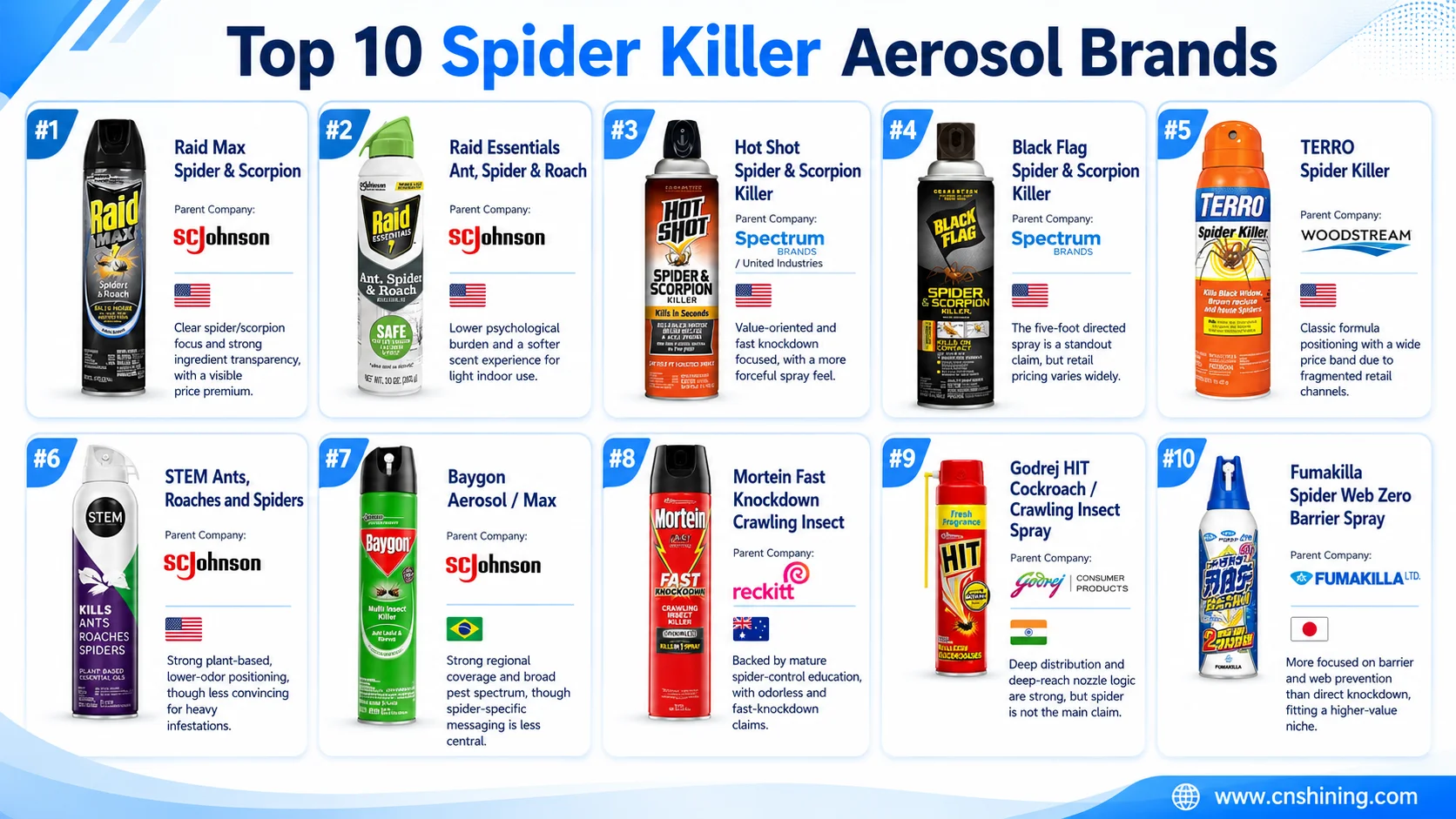
| Brand | Main Market / Origin | Parent Company | Typical Size | Typical Retail Price | Technical Comment |
|---|---|---|---|---|---|
| Raid Max Spider & Scorpion | United States | SC Johnson | 12 oz | about $15.88-$16.59 | Clear spider/scorpion positioning and strong ingredient transparency, with a visible price premium. |
| Raid Essentials Ant, Spider & Roach | United States | SC Johnson | 10 oz | about $8.50/can | Leans toward lower psychological burden and scent experience for light indoor use. |
| Hot Shot Spider & Scorpion Killer | United States | Spectrum Brands | 16 oz | about $6.50-$7.00 | Value-oriented and fast knockdown focused; spray feel is more forceful. |
| Black Flag Spider & Scorpion Killer | United States | Spectrum Brands | 16 oz | about $6.98-$14.40 | Five-foot directed spray is a strong use-case claim, but retail price varies widely. |
| TERRO Spider Killer | United States | Woodstream | 16 oz | about $4.99-$16.75 | Classic formula logic; fragmented channels create a wide price band. |
| STEM Ants, Roaches and Spiders | United States | SC Johnson | 10 oz | about $7.28-$9.99 | Plant-based and lower-odor position is strong, but heavy-infestation credibility is weaker than traditional pyrethroid systems. |
| Baygon Aerossol / Max | Brazil and other markets | SC Johnson | 360–400 ml | about $3.71-$4.01; some European listings about $6.90/400 ml | Strong regional coverage and broad pest spectrum; spider-specific label language is less central than in North America. |
| Mortein Fast Knockdown Crawling Insect | Australia | Reckitt | 350 g | about $10.04-$11.65 | Australia and New Zealand have mature spider-control education; odorless and fast-knockdown claims are common. |
| Godrej HIT Cockroach / Crawling Insect Spray | India | Godrej | 200–625 ml | about $0.94-$3.55 | Deep distribution and deep-reach nozzle logic are strong; spider is not the single main claim. |
| Fumakilla Spider Web Zero Barrier Spray | Japan | Fumakilla Ltd. | 450 ml | about $13/can by multi-pack average | More barrier and web-prevention oriented than pure direct knockdown; fits a higher-value niche. |
Common Field Terms
| Term | Plain Explanation | Why It Matters Commercially |
|---|---|---|
| Knockdown | The target is immobilized, though not always confirmed dead immediately. | Controls whether the user feels the spray worked. |
| KT50 | Time required for 50% of test insects to show knockdown. | Common for aerosol performance comparison, especially flying insects. |
| Residual efficacy | How long treated surfaces remain active. | Supports baseboard, window frame, and crack treatment claims. |
| Direct-contact kill | The product works best when sprayed directly onto the target. | Central to spider aerosols because spiders may avoid treated residues. |
| Crack-and-crevice | Targeted application into narrow gaps and hiding points. | Relevant for skirting boards, cabinet backs, and frames. |
| Plume geometry | The shape and spread of the spray cloud. | Affects accuracy, drift, user exposure, and perceived control. |
| Spray rate | Mass of product discharged per second. | Too high wastes product and increases drift; too low may not stop the spider. |
| Valve stem orifice | Opening in the valve stem that meters flow. | Controls flow, droplet size tendency, and range. |
| BOV | Bag-on-Valve packaging system. | Can improve emptying, angle use, and propellant separation. |
| PBO | Piperonyl butoxide synergist. | Amplifies pyrethrin or pyrethroid performance by limiting detoxification. |
| PT18 | EU BPR product type for insecticides, acaricides, and other arthropod controls. | Defines the EU regulatory entry point. |
| Total release actuator | One-shot actuator used in foggers. | Not suitable for precise spider spot treatment. |
7. User Complaints as Packaging Inputs
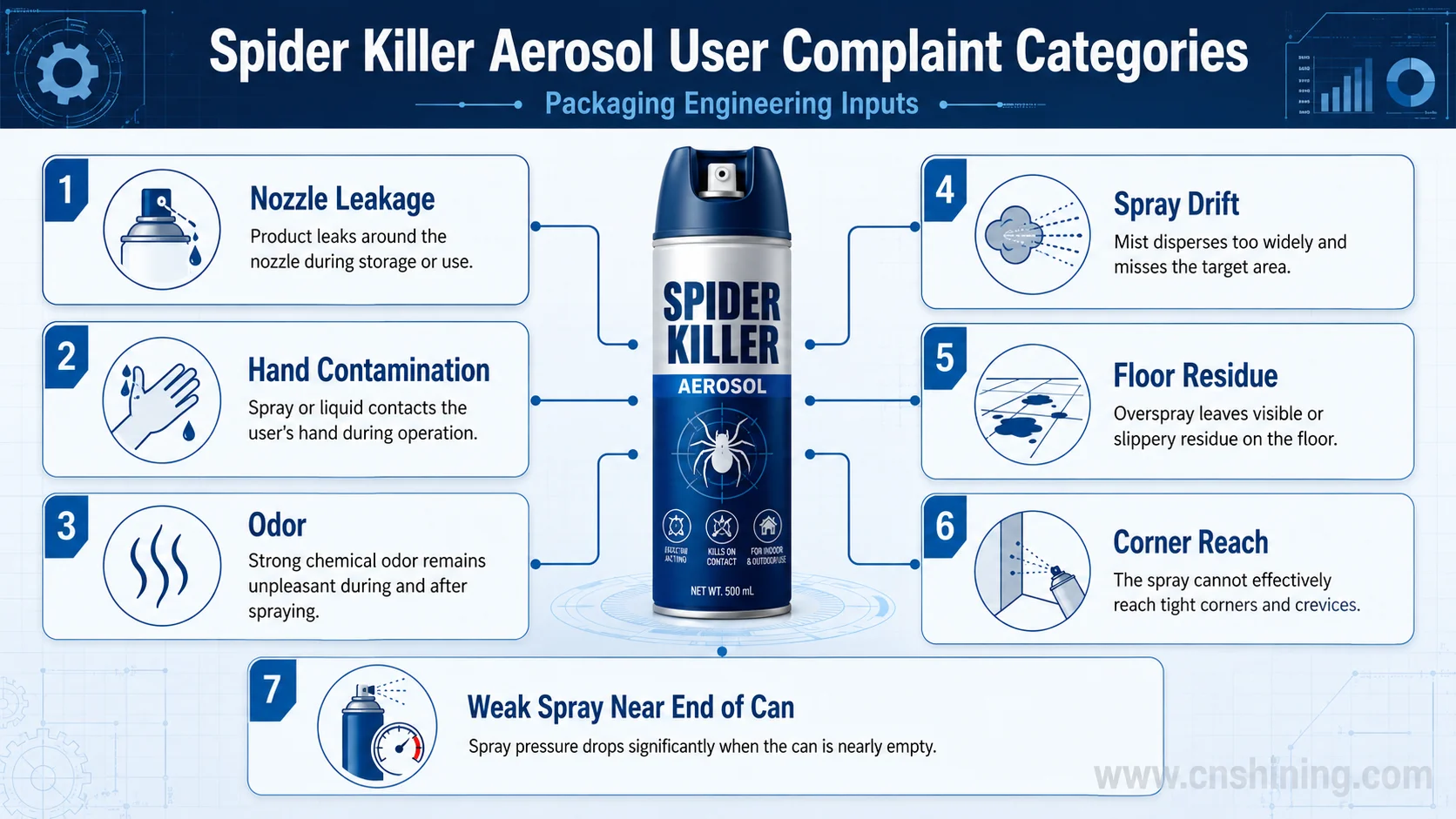
Consumer comments are not laboratory data. They are still useful packaging inputs. The repeated complaints are not subtle: leakage, bad odor, drifting aerosol cloud, oily residue, slippery floor, stained surfaces, weak spray near the end of the can, and difficulty hitting corners.
| User Pain Point | Typical Field Language | Packaging or Design Input |
|---|---|---|
| Nozzle or valve leakage | “Both cans are leaking when you spray out nozzle.” | Stem-gasket compatibility, actuator fit, valve quality control, and leak testing matter before marketing copy. |
| Product leaks onto floor or hand | “This leaks like crazy whenever I spray.” | Anti-drip actuator geometry and gasket matching should be validated in use position. |
| Odor is too strong | “The stink is really bad.” | Solvent choice, propellant system, fragrance masking, and ventilation instructions all affect acceptance. |
| Aerosol cloud concern | “The aerosol will float in the air.” | Use larger droplets, directed spray, lower indoor spray rate, or dual-mode actuator. |
| Residual effect is uncertain | “Spider control is difficult because they do not drag their bodies on the ground.” | Separate direct-kill claims from perimeter-prevention claims; do not force one SKU to do everything. |
| Good nozzle gets noticed | “The nozzle is very nice because it sprays easily and gives a nice wide spray.” | Actuator feel and spray pattern are user-visible performance features. |
This is where spider aerosol development becomes packaging engineering. A formula that performs in a lab but leaks through the actuator in a kitchen is not a finished product. The user does not separate chemistry from packaging. The can, valve, actuator, plume, smell, and residue are judged as one system.
8. Packaging Innovation and Shining Packaging Component Fit
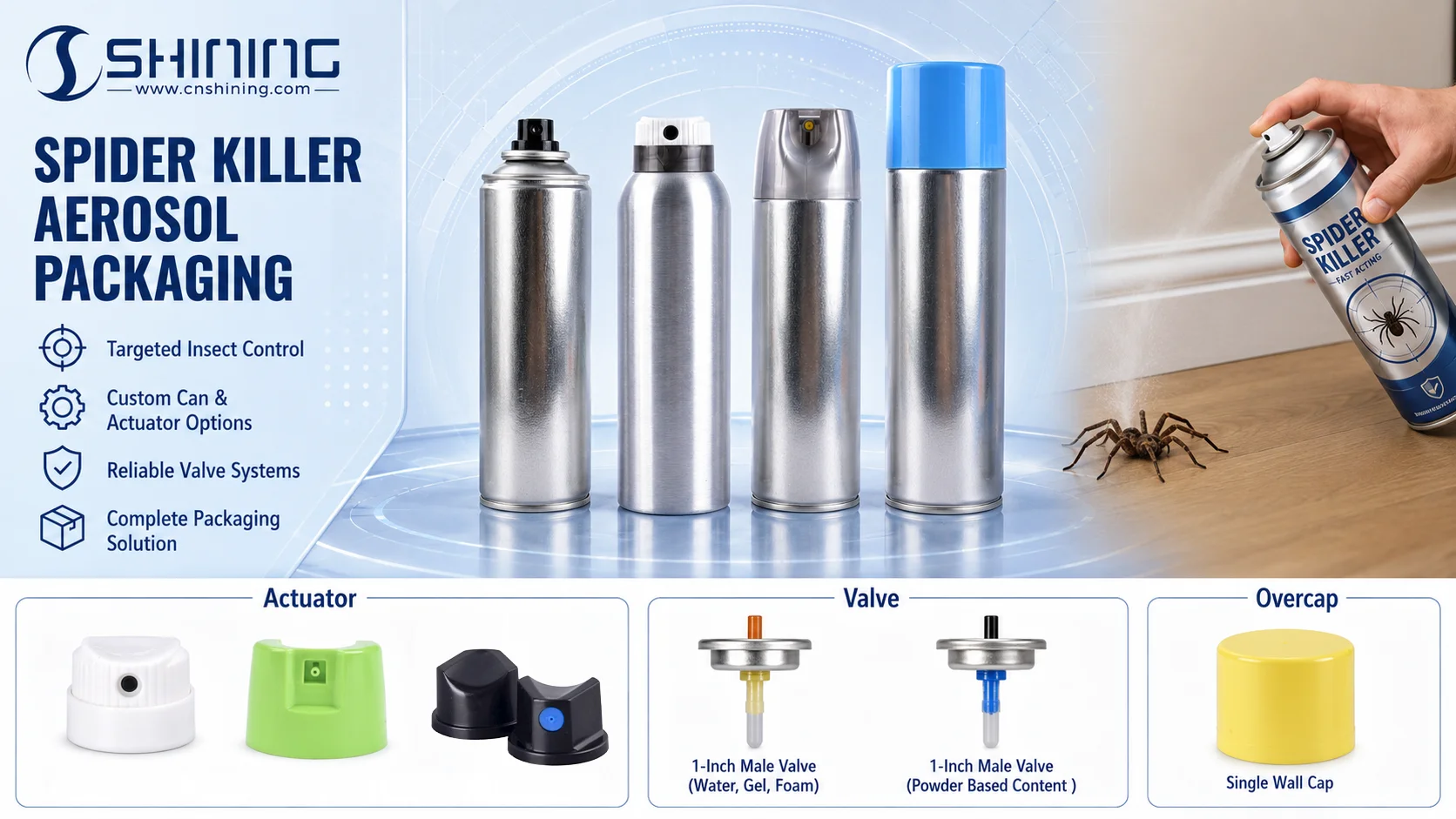
For a spider killer aerosol, Shining Packaging is not part of the insecticide chemistry decision. Its role sits in the delivery hardware: the aerosol can, valve, actuator, cap, and related metal-packaging compatibility work. That is exactly where many field failures show up.
A spider aerosol needs a can that tolerates its formulation, a valve that seals after repeated short bursts, and an actuator that gives the right balance between reach and drift. If the product contains hydrocarbon propellant, petroleum distillates, water phase, emulsifier, or mixed solvent systems, compatibility should be tested early.
Shining Packaging can be positioned naturally in this context as a supplier of aerosol cans, valves, and actuators used in household insecticide packaging. The engineering focus should be: anti-drip performance, lockable actuator options, spray angle consistency, inner coating compatibility, corrosion resistance, filling-line suitability, and stable discharge near the end of can life.
9. Conclusion: What Actually Improves a Spider Killer Aerosol
The useful direction for spider killer aerosol is not “make it sound stronger.” It is make it hit better, leak less, smell less, drift less, and leave fewer unwanted residues. Chemistry still matters, especially fast knockdown and residual balance. But the user judges the product through the spray event. In that event, the valve, actuator, can compatibility, propellant system, and label instruction are all part of performance.
10. FAQ Section
A spider killer aerosol is usually designed around direct-contact performance. It must reach a visible spider, deliver enough active material to the body surface, and stop movement quickly. General crawling insect sprays may focus more on ants or roaches, where surface trails and hiding points are more predictable.
Spiders do not behave like ants or roaches. They often keep body contact with treated flat surfaces low, and they may stay on webs, corners, or vertical structures. Direct spray increases the chance that droplets reach the legs, body surface, and web area at a dose high enough for knockdown.
Common actives include pyrethrins, prallethrin, imiprothrin, cypermethrin, deltamethrin, lambda-cyhalothrin, and permethrin. Fast-acting ingredients support knockdown, while more persistent pyrethroids support residual surface deposits. Some formulas also use PBO or MGK-264 as synergists.
Not always. A spider aerosol must first deliver the spray accurately. If the actuator creates too much drift, leaks, or fails to reach the target, higher active loading may not improve field performance. Spray pattern, droplet size, valve consistency, and user distance often decide whether the chemistry reaches the spider.
Odor can come from solvents, hydrocarbon propellants, active ingredients, fragrance systems, or residues left on surfaces. Petroleum distillates and LPG systems can produce a stronger chemical perception. Water-based, low-odor, compressed gas, or BOV systems may reduce odor, but formulation stability still has to be validated.
Leakage often relates to actuator fit, valve stem sealing, gasket compatibility, formulation swelling effects, or poor tolerance control during assembly. A can may pass basic filling checks but still leak during repeated short bursts. Anti-drip actuator geometry and stem-gasket compatibility testing are practical prevention steps.
Residual action can help on window frames, baseboards, cracks, and other traffic points, but it is less predictable than direct contact. Spiders may avoid treated residues or contact them unevenly. A label should separate direct-kill claims from residual or perimeter-treatment claims so the user understands the real use case.
The actuator defines user control. It affects spray width, distance, droplet size tendency, finger feel, leakage, accidental actuation, and corner access. Since spiders are small and often located on walls, ceilings, or frames, an actuator that improves aim may produce more value than a small formula adjustment.
Key checks include can coating compatibility, corrosion resistance, valve sealing, actuator leakage, discharge rate, spray pattern, upside-down behavior if claimed, heat stability, drop handling, and end-of-can spray consistency. Water-based and high-solvent formulas should be tested separately because they stress materials in different ways.
Most public market reports do not isolate spider aerosols as a separate audited category. They usually report household insecticides, home insecticides, sprays, aerosols, or pest control products. A proxy estimate is more honest: start with the household insecticide market, then adjust for aerosol share, crawling pests, and spider-targeted SKUs.