
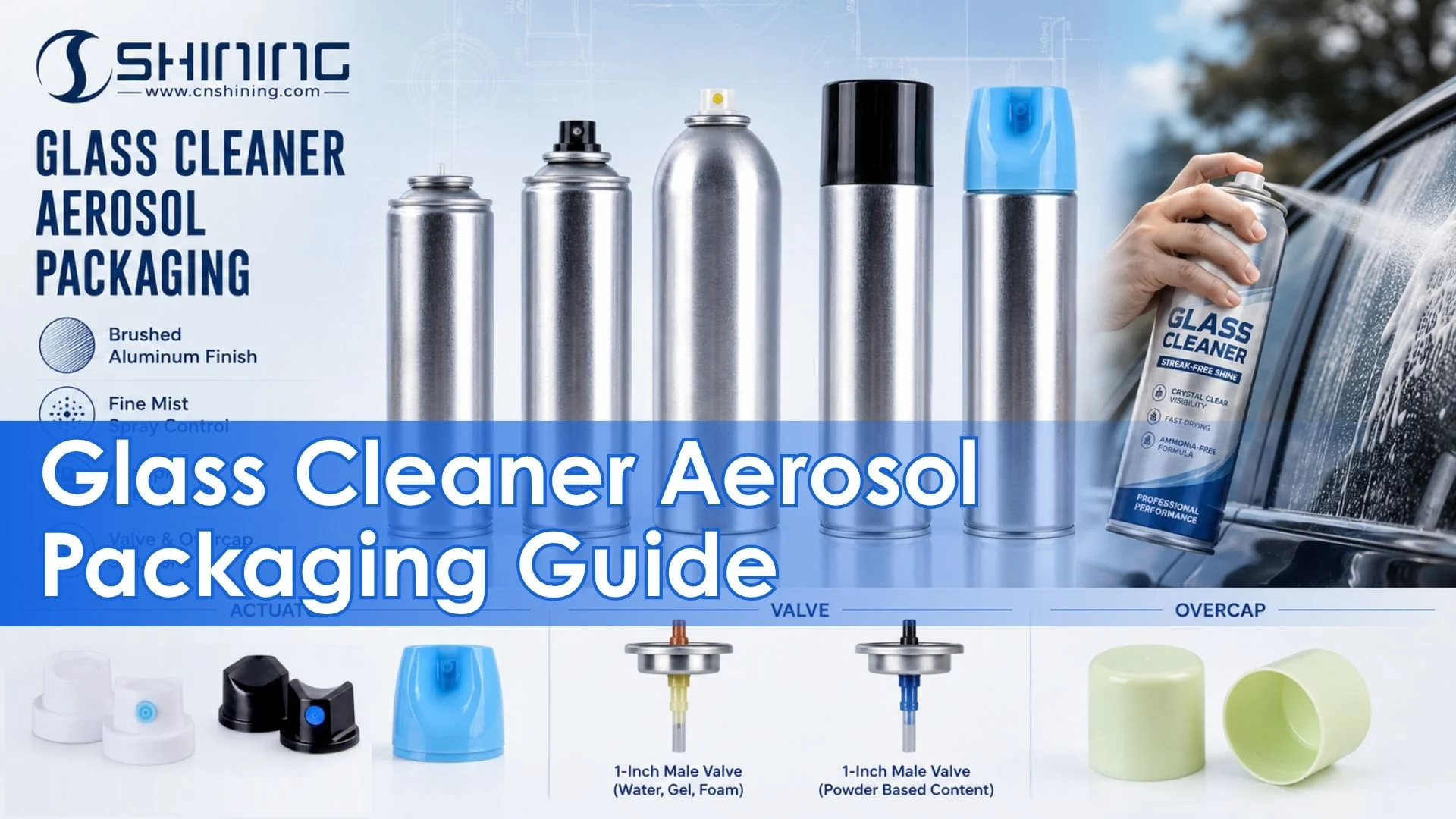
A glass cleaner aerosol spray is a pressure-delivered cleaning system, not just a liquid formula in a metal can. It combines a glass-cleaning formulation with propellant, valve, actuator, and aerosol can geometry. The output may be a fine mist, a wet foam, or a no-drip foam that stays longer on vertical glass.
In commercial use, its strength is not that the chemistry is automatically more advanced. The real advantage is the delivery mode. Aerosol glass cleaner is easier to use on windows, interior windshields, mirrors, shower doors, and fast-cleaning maintenance jobs where run-off is a problem.
The technical balance is simple to state and harder to execute: cut oily film, avoid visible streaks, control VOC, keep the spray system reliable, and keep the product transportable.
1. Definition and Working Principle
Chinese industry standard QB/T 4086–2010 for glass cleaning agent defines this product family as cleaners made from surfactants, auxiliaries, solvents, and related ingredients for non-tableware glass such as window glass, automotive glass, mirrors, and decorative glass. When this formulation is packed into a pressurized one-way metal aerosol container, the product becomes a ready-to-use aerosol glass cleaner.
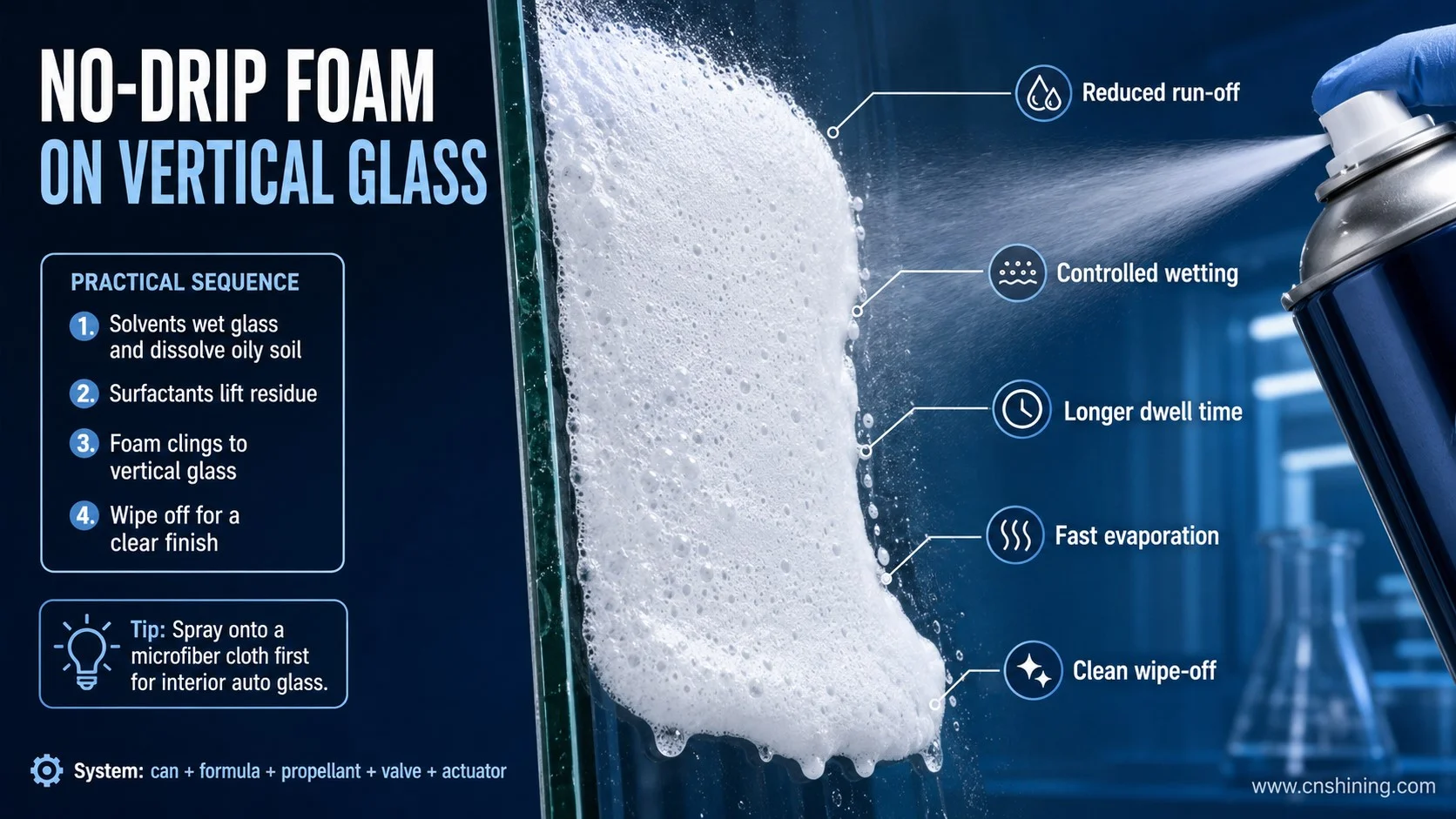
The operating sequence is practical:
- Alcohols, glycol ethers, or other solvents wet the glass and dissolve fingerprints, road film, smoke film, insect residue, and oily deposits.
- Low-dose surfactants reduce surface tension and lift soil from the surface.
- Foam output increases dwell time and reduces run-off on vertical glass.
- Wiping removes the dissolved soil and spent liquid.
- Fast evaporation reduces water marks, film, and haze.
The hard part is not only soil removal. The hard part is cleaning without visible film, streak, or haze after drying. Several patent documents treat post-wipe appearance as a central formulation problem, not a minor complaint.
A typical product contains five physical parts: the metal can, the liquid formulation, the propellant, the valve assembly, and the actuator. The propellant may be LPG, DME, or a blended system. The actuator decides spray pattern, foam texture, back-spray, clog sensitivity, and hand feel.
Older aerosol window-cleaner patents described propellant windows around 8–15%, with 10% as a preferred point. Modern products vary more because VOC limits, flammability classification, water content, and foam requirements all push the design in different directions.
2. Market Size and Regional Trend Reading
| Region | Publicly checkable signal | Trend judgment | Meaning for aerosol glass cleaner |
|---|---|---|---|
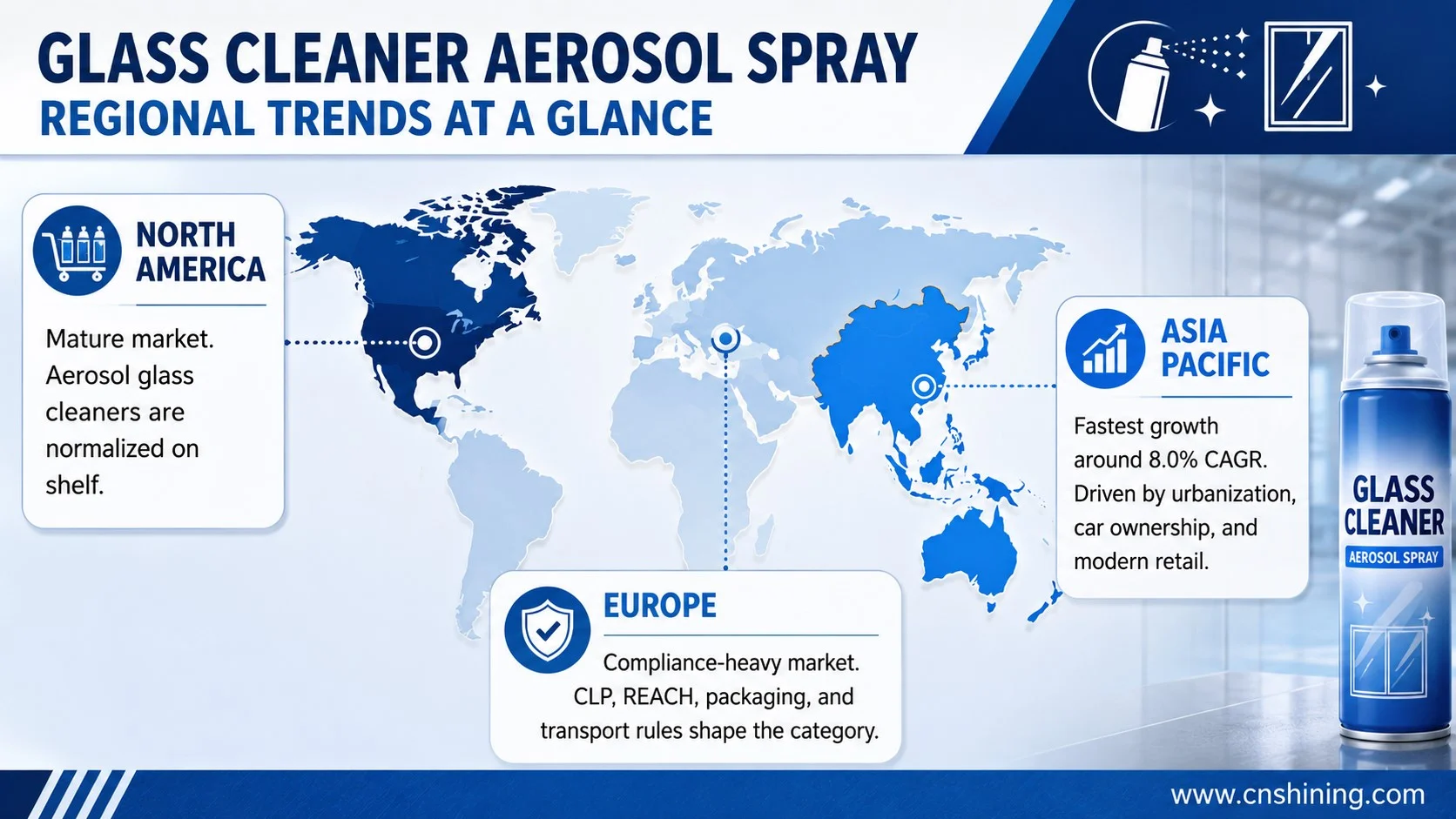
| North America | Largest mature region in the source report; about USD 1.08 billion in 2024 for glass cleaners. | Brand and channel concentration is high. | Aerosol and foam glass cleaners are already normalized on shelf. |
| Asia Pacific | Fastest growth signal, around 8.0% CAGR in the source report. | Growth follows urbanization, car ownership, and modern retail. | Opportunity exists in automotive care and convenience cleaning, but trigger sprays and concentrates remain strong on cost. |
| Europe | Regulatory framework is more visible than free market-size detail. | Compliance, chemical disclosure, and packaging rules shape the category. | Aerosols remain viable, but CLP, REACH, aerosol dispenser rules, and transport rules must be designed in early. |
The core reading is direct: aerosol glass cleaner is not a separate runaway category. It is a delivery-form advantage in mature markets and in automotive, mirror, shower-door, and vertical-surface use cases.
3. Competitive Comparison and Commercial Positioning
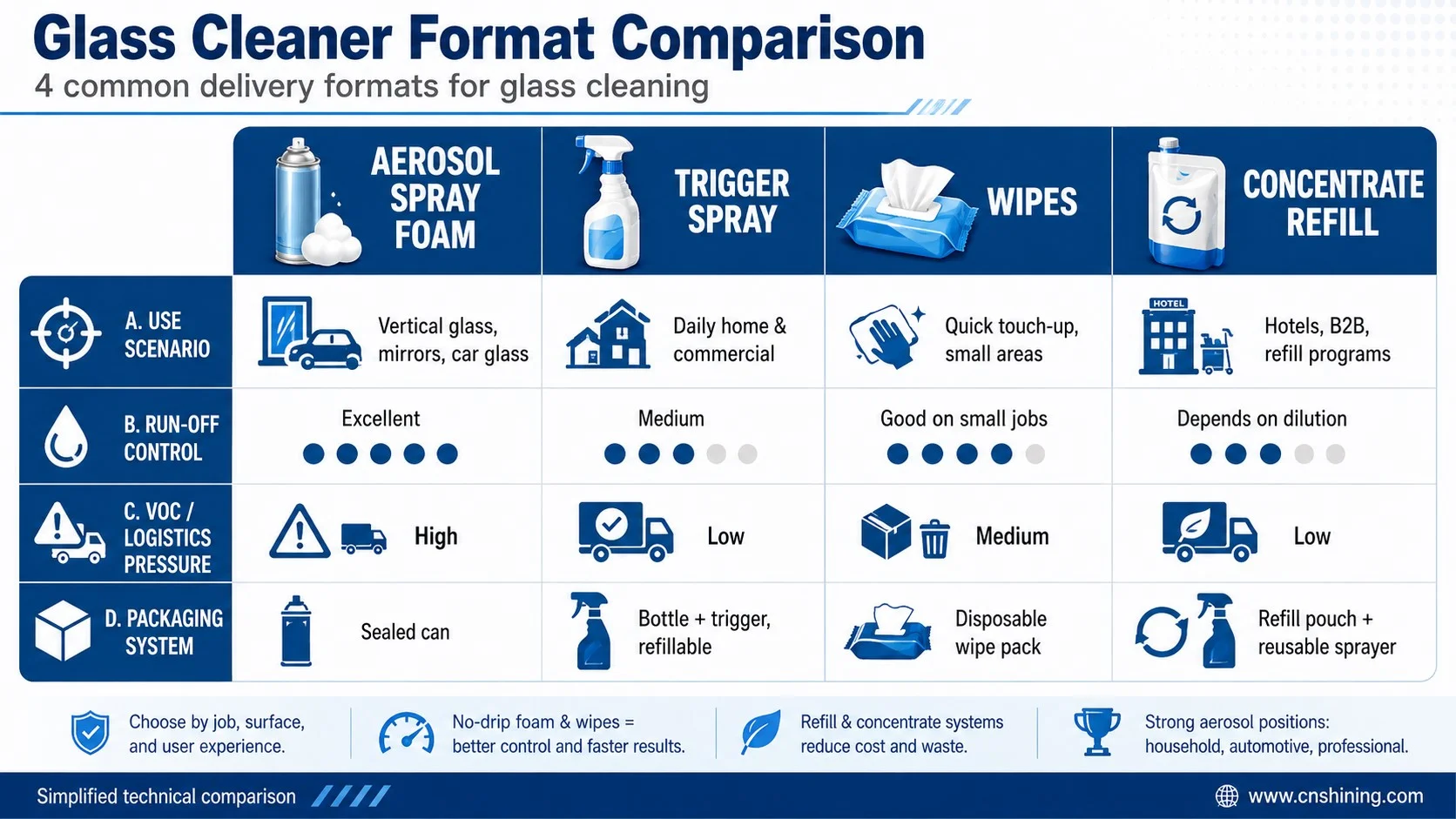
Aerosol spray only makes sense when compared with neighboring formats. The cleaning chemistry may overlap. The user experience does not.
| Format | Main advantages | Main weak points | Typical use | Business meaning |
|---|---|---|---|---|
| Aerosol spray | Foam clings to vertical surfaces; sealed can feels hygienic; fast spray-and-wipe use. | VOC, flammability, transport, actuator and valve failure, weaker refill story. | Mirrors, car glass, shower doors, property maintenance. | Works for higher-experience positioning, but compliance cost is higher. |
| Trigger spray | Lower cost, wide formula window, easy refill, usually lower regulatory pressure. | More run-off; spray pattern can be uneven; dripping leads to second wiping. | Daily household and commercial cleaning. | Strong for mass distribution, refill systems, and cost-sensitive channels. |
| Wipes | Portable and cloth-free for small quick jobs. | Higher cost per clean; drying-out risk; poor efficiency on large glass. | Car interiors, office touch-up, small mirrors. | Better as a supporting SKU than as the main format. |
| Concentrate or powder | Less shipped water, lower packaging mass, good for reusable sprayers. | User must dilute correctly; wrong ratio can create streaks or weak cleaning. | Hotels, property cleaning, B2B supply chains, refill-led retail. | Strong sustainability route, especially when paired with durable tools. |
If the job is only “remove light dust,” aerosol may not win by chemistry. It wins when the job involves a vertical surface, a tight interior windshield, or a user who wants controlled foam and fast wiping. That is why no-drip foam, single-wipe claims, and longer can output have become visible selling points in the category.
The strongest aerosol positions are threefold: household foam glass cleaner, automotive residue-control cleaner, and professional or semi-professional glass maintenance cleaner. The strongest substitute is not another aerosol can. It is a good trigger sprayer, reusable microfiber system, and concentrate refill that solves cost and waste pressure.
4. Formula System and Technical Terms
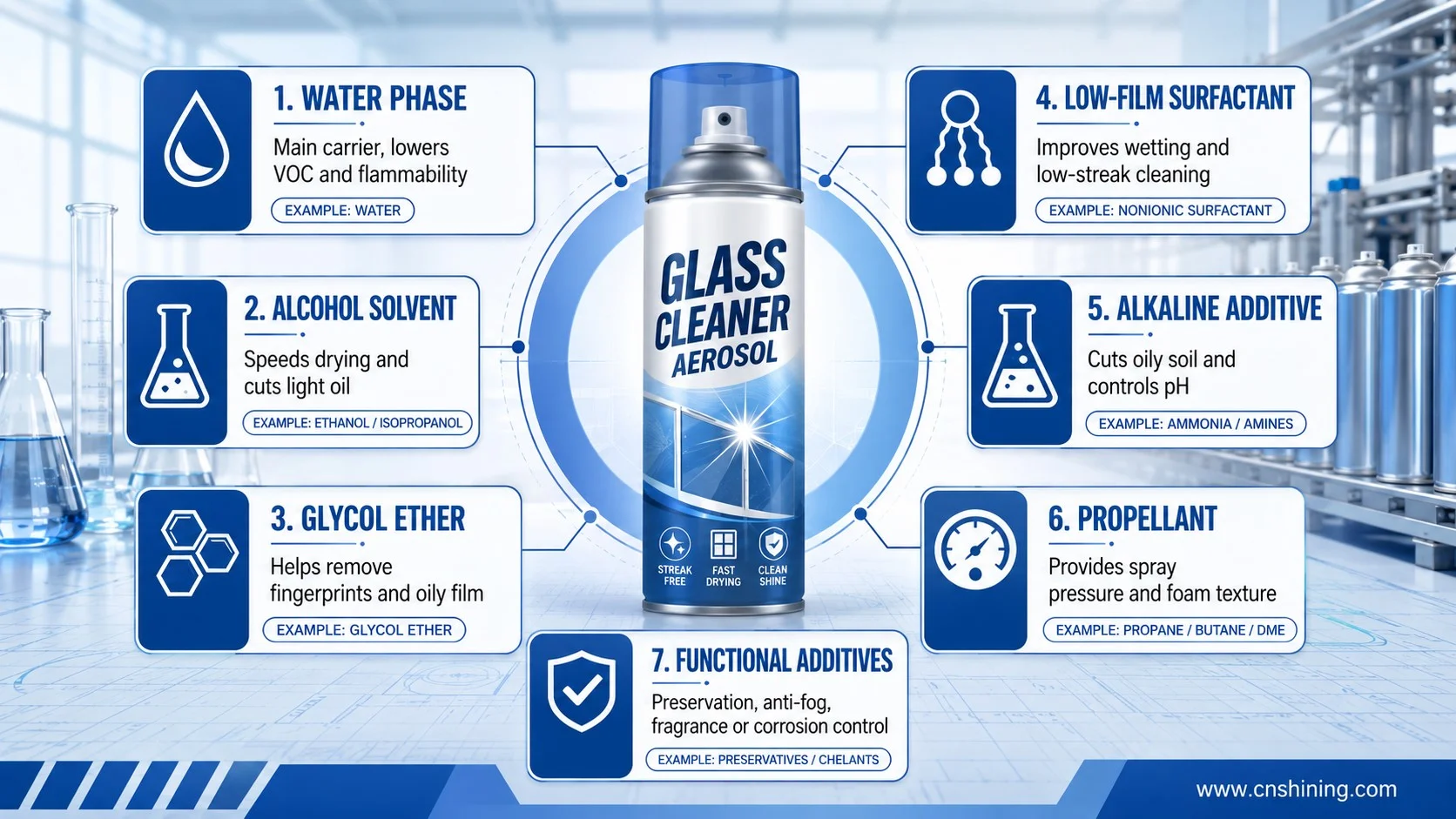
| Formula class | Role | Typical examples | Typical concentration or appearance | Technical note |
|---|---|---|---|---|
| Water phase | Cost control, surfactant carrier, lower flammability and VOC burden. | Water | Often 70–95%; some SDS examples show water as the major component. | Modern household aerosols often use a high water phase. |
| Fast volatile alcohols | Cut light oil, speed drying, reduce residual water marks. | Ethanol, isopropanol | Commonly 1–10%; Sprayway SDS discloses ethanol in a broad range. | Improves dry-down but raises odor and flammability questions. |
| Glycol ethers and co-solvents | Improve removal of fingerprints, smoke film, and heavier oily film. | 2-butoxyethanol and related glycol ethers. | Commonly 0.5–10% in public technical references. | Too much can increase film or haze risk. |
| Nonionic surfactants | Improve wetting and low-streak cleaning. | C9–11 Pareth-8 and low-film nonionics. | Usually kept low. | Glass cleaners cannot carry high surfactant residue without appearance risk. |
| Anionic or specialty surfactants | Lift soil and support final surface appearance. | Sodium dodecylbenzene sulfonate, PAS, DOS. | Usually low dosage. | Useful in synergy; excessive use increases streak potential. |
| Alkaline components | Cut oily soil and control pH. | Ammonia, amines. | Often 0–1% level in glass cleaner formulations. | Odor and material compatibility explain the popularity of ammonia-free claims. |
| Propellant | Create pressure, drive output, affect foam texture. | Propane, butane, isobutane, DME. | Zep Foaming Glass Cleaner SDS lists ethanol, butane, isopropanol, and propane in low percentage bands. | Propellant selection changes spray quality, safety classification, and logistics. |
| Functional additives | Stability, preservation, corrosion control, fragrance, tint safety, anti-fog or easy-clean effect. | Preservatives, chelants, corrosion inhibitors, hydrophilic or hydrophobic modifiers. | Trace to low percentage. | This is where higher-end differentiation usually sits. |
A common formulation mistake is to chase stronger visible foam by raising surfactant too far. That may help perceived wetting, but it can damage the optical result. Glass cleaning is judged under light, often at night through a windshield. The KPI is not foam. It is low film, low streak, low haze, and low rewipe count.
| Term | Plain technical meaning | Commercial effect |
|---|---|---|
| VOC | Volatile organic compounds that affect regulation, odor, and air-emission profile. | Higher VOC may help cutting and drying, but makes broad distribution harder in strict states. |
| Aerosol Category 1/2/3 | Hazard classification for aerosols, tied to flammability and pressure behavior. | It drives label, SDS, storage, transport, and e-commerce handling. |
| H229 | Hazard statement for pressurized containers that may burst if heated. | It affects front-label wording and storage-temperature warnings. |
| No-drip foam | Foam designed to stay on vertical glass instead of running down immediately. | One of the clearest visible advantages of aerosol glass cleaner. |
| Filming | A thin visible layer left after wiping and drying. | Users describe it as “clean but still foggy.” |
| Streaking | Lines or drag marks visible under angled light or vehicle headlights. | A major cause of repeat cleaning and negative reviews. |
| Tint-safe | Compatibility claim for automotive tint films and treated glass. | Helps move a product from household cleaning into car care. |
| UN1950 | International transport number for aerosols. | It affects sea freight, air freight, warehousing, and cross-border shipping. |
| Limited Quantity | Transport relief for certain small dangerous-goods packages. | Can reduce logistics friction for small retail packs. |
| Actuator | The user-pressed spray head that shapes output. | Many complaints blamed on “bad product” are actually actuator failures. |
| Valve compatibility | Compatibility between valve materials and solvent, propellant, fragrance, and alkaline system. | Poor compatibility causes leakage, clogging, sticking, broken spray, or wasted residual liquid. |
5. Regulatory and Standard Framework
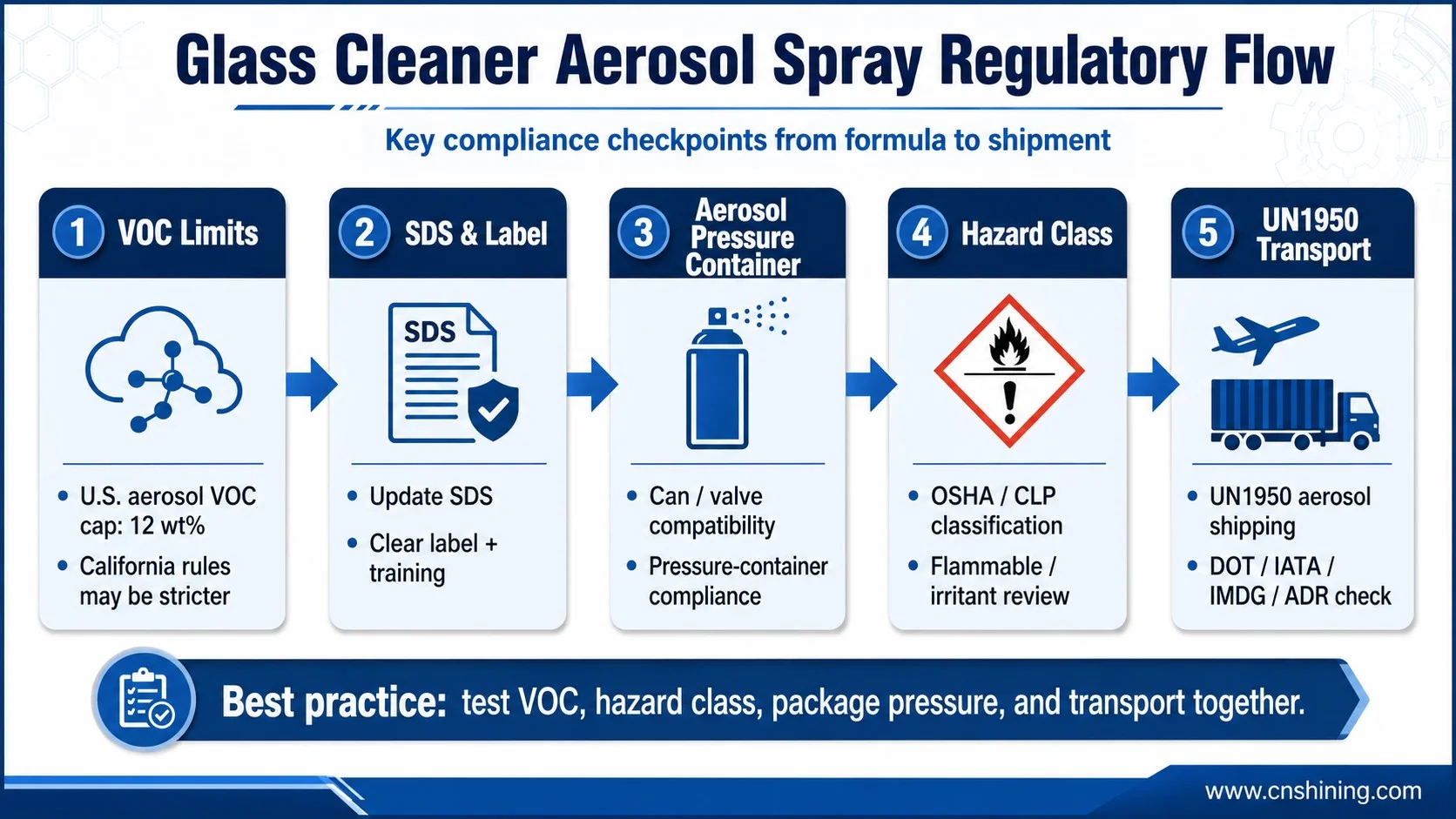
Glass cleaner aerosol spray is more complex than ordinary liquid glass cleaner because it crosses four systems at once: chemical compliance, consumer product rules, pressure container rules, and dangerous-goods transport.
| Region | Core rules or standards | Key requirement | Direct product effect |
|---|---|---|---|
| U.S. federal | EPA 40 CFR Part 59 consumer product VOC table, OSHA HazCom physical criteria, and EPA Safer Choice Standard. | Federal VOC limit for aerosol glass cleaners is 12 wt%; OSHA classification, labeling, SDS, and training are part of the control system. | Lower VOC, accurate SDS updates, label clarity, and factory training become hard costs. |
| California | CARB Title 17 §94509 consumer product standards. | Glass cleaner VOC limits are tighter: aerosol 10 wt%, non-aerosol 3 wt% from the source report. | A national formula may still need reformulation or separate control for California. |
| European Union | REACH Regulation 1907/2006, CLP, and the Aerosol Dispensers Directive. | REACH controls registration, restriction, and authorization. CLP controls classification, labeling, and packaging. Aerosols also face dedicated dispenser rules. | Ingredient choice, label language, pressure-container conformance, and transport classification must be planned together. |
| Global transport | IATA Dangerous Goods Regulations, ADR, IMDG, DOT, and UN1950 aerosol logic. | Classification depends on formula, propellant, and flammability. Some products may qualify for limited quantity routes. | Freight design must start before launch, not after finished-product testing. |
Regulation will not remove aerosol glass cleaner from the market. It will remove weak designs. Products built only by trial blending, strong fragrance masking, and unclear labels will face rising cost and distribution resistance.
6. Top 10 Representative Brands and Series
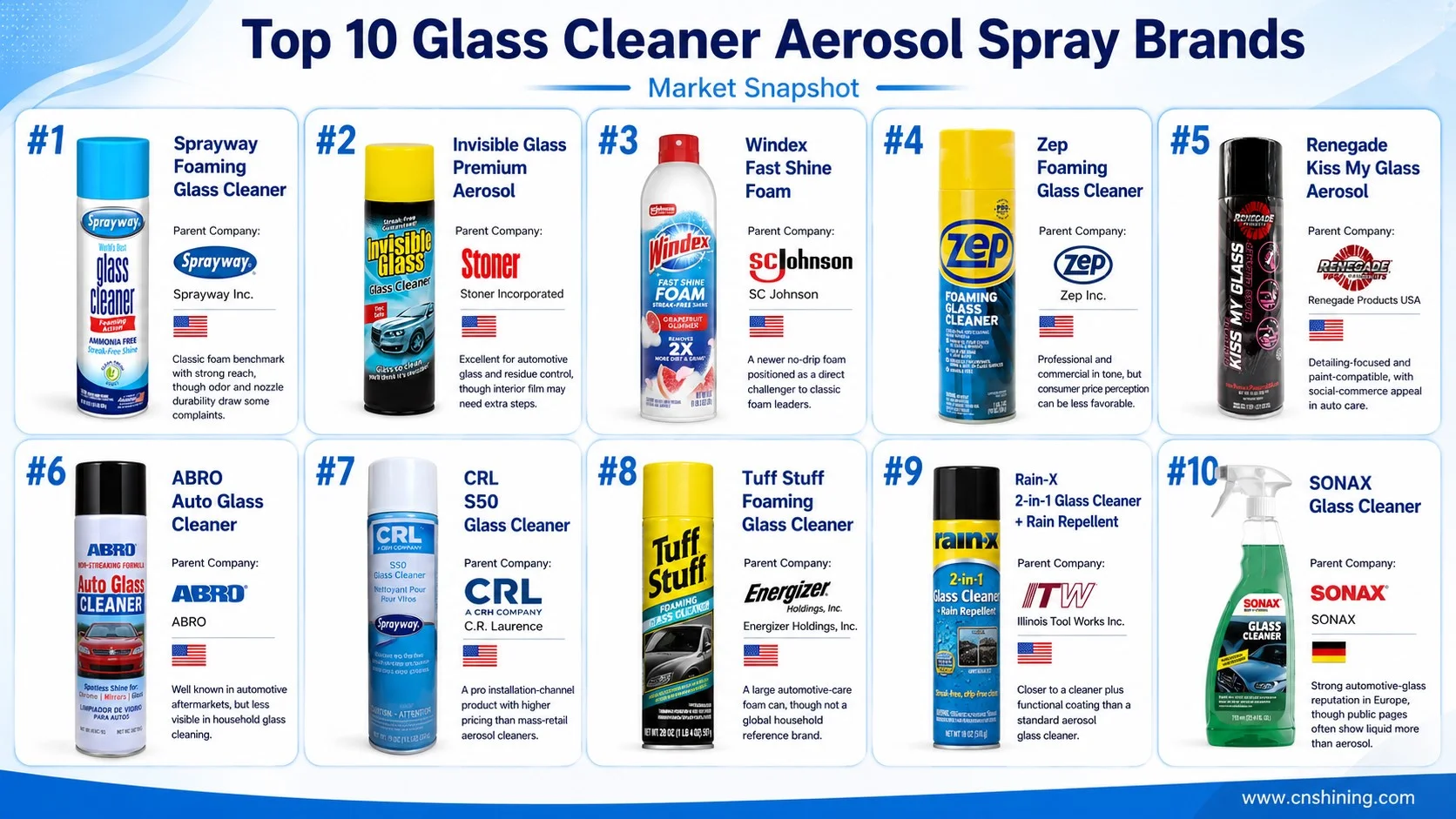
| Brand / series | Country | Parent or public operating entity | Typical size | Public retail range | Technical comment |
|---|---|---|---|---|---|
| Sprayway Foaming Glass Cleaner | U.S. | Sprayway Inc. | 15 oz / 19 oz | about 7.25$ per 15 oz can | Classic foam benchmark with strong channel depth; odor and nozzle durability complaints are visible. |
| Invisible Glass Premium Aerosol | U.S. | Stoner Incorporated | 15 oz / 19 oz | about 4.11–6.14$ per can | Strong in automotive glass and residue control, but new-car interior film may still need multi-step cleaning. |
| Windex Fast Shine Foam | U.S. | SC Johnson | 19 oz | about 3.48–3.49$ per can | Newer foam push with no-drip and longer output messaging; direct challenge to classic foam products. |
| Zep Foaming Glass Cleaner | U.S. | Zep Inc. | 18 oz / 19 oz | about 12–12.5$ per can | More professional and commercial in tone; consumer price perception may be less favorable. |
| Renegade Kiss My Glass Aerosol | U.S. | Renegade Products USA | 13 oz | about 8–25$ per can | Automotive-detailing positioning; non-flammable and paint-compatible claims fit social commerce. |
| ABRO Auto Glass Cleaner | U.S. brand | AIPL ABRO | 19 oz / 562 mL | about 9.99$ per can. | Known in global automotive aftermarkets; weaker in household glass cleaner visibility. |
| CRL S50 Glass Cleaner | U.S. | C.R. Laurence | 19 oz | about 15.48–16.29$ per can | Professional glass and installation-channel product; higher price than mass retail aerosol cleaners. |
| Tuff Stuff Foaming Glass Cleaner | U.S. | Energizer Holdings, Inc. | 20 oz | about 13.41$ per can. | Automotive-care oriented large foam can; not a global household glass cleaner reference brand. |
| Rain-X 2-in-1 Glass Cleaner & Rain Repellent | U.S. | Illinois Tool Works Inc. (ITW) | 16 oz | about 9.96$. | Closer to cleaner plus functional coating. Useful as a glass-care reference, not a standard aerosol glass cleaner. |
| SONAX Glass Cleaner | Germany | SONAX | 750 mL | about 13.99–19.80$. | Strong automotive glass reputation in Europe; public pages reviewed were mostly liquid rather than pure aerosol. |
The brand pool shows a practical reality: globally recognized aerosol glass-cleaner SKUs are concentrated in U.S. household and automotive channels. Many international reference brands are closer to car-care liquids or functional glass treatments than to pure household aerosol foam.
7. User Pain Points and Packaging Engineering Fixes
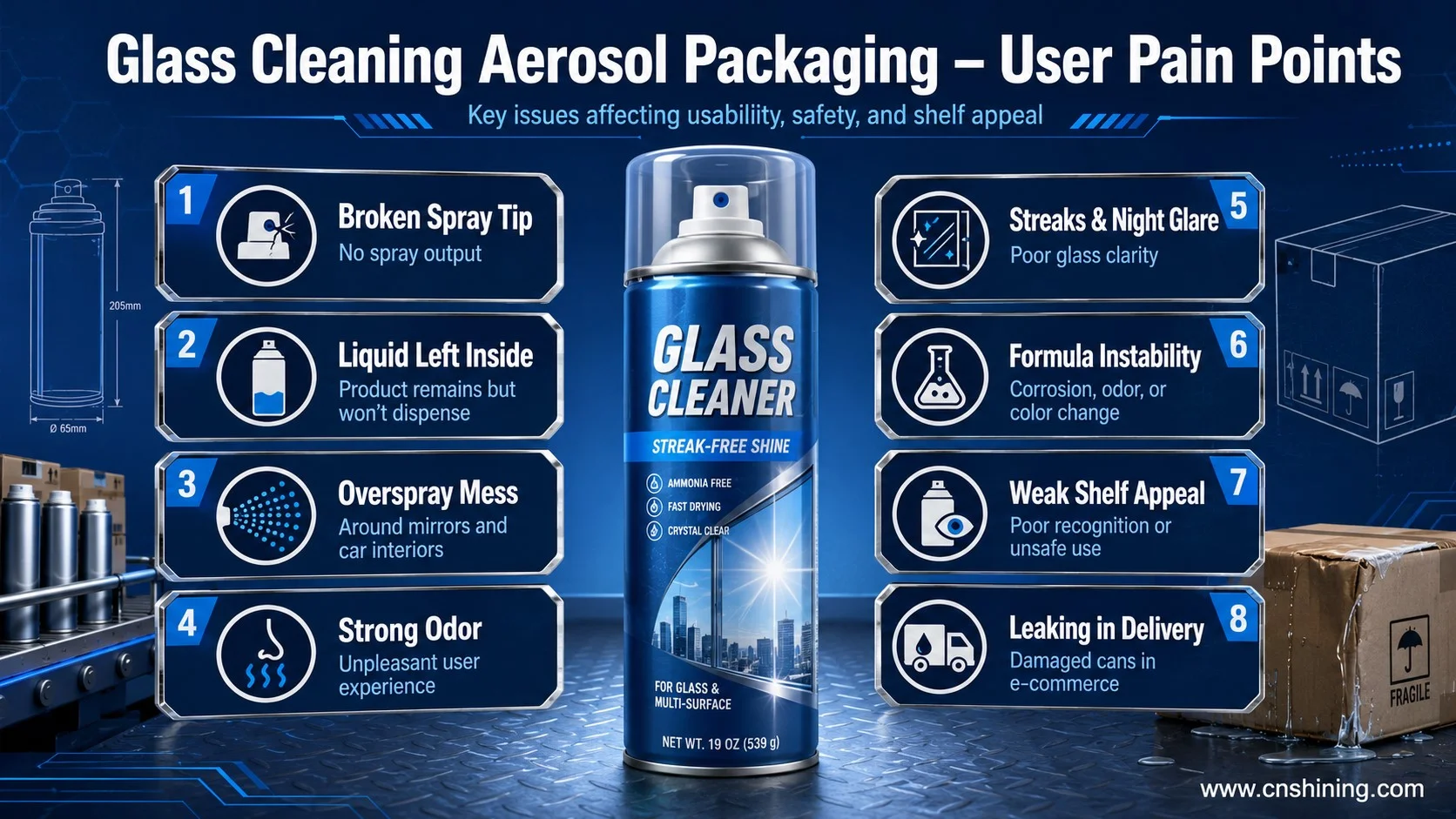
User complaints are not random. They cluster around five repeat issues: strong odor, streaking, broken or clogged spray heads, poor spray control in tight areas, and inability to clean complex interior windshield film in one pass. These are not just after-sales noise. They point directly to formulation, valve, actuator, inner coating, and secondary packaging design.
| Pain point | Part to improve | Design change | Expected benefit |
|---|---|---|---|
| Spray tip breaks or stops output | Actuator | Use a thicker bridge, wider press surface, twist-lock cap, and removable/cleanable nozzle geometry. | Fewer broken-tip complaints and better drop resistance during shipping. |
| Liquid remains but cannot spray | Valve and dip tube | Improve compatibility with solvents, fragrance, and propellant; add anti-clog filtration; tune liquid-gas ratio. | Less residual waste and better perceived value. |
| Overspray in car interiors and around mirrors | Spray pattern | Use narrow fan or directional foam output instead of a wide cone; use lower rebound foam. | Better control near dashboards, trim, and small mirrors. |
| Strong odor | Formula and label | Use lower-odor solvent balance, reduce fragrance masking, and label low-odor or fragrance-free variants clearly. | Less mismatch between buyer expectation and actual indoor use. |
| Streaks and night glare | Spray volume and user instruction | Limit output per press and print interior-glass use guidance such as “spray on cloth” and “finish with dry microfiber.” | Lower over-application and fewer visible drying marks. |
| Corrosion, odor change, or color instability | Inner coating | Match coating to water-alcohol-alkaline system and run accelerated compatibility tests. | Lower metal migration, pitting, odor, and long-storage risk. |
| Poor shelf recognition and unsafe use | Can shape and print | Use grip-friendly shape, high-contrast icons, and clear front-panel claims for tint-safe, no ammonia, VOC and flammability. | Fewer wrong-surface applications and faster product selection. |
| Leaking or damaged cans in e-commerce | Secondary packaging | Add nozzle guard, transport lock, better carton dividers, and clearer batch coding. | Fewer leaking-can disputes and easier traceability. |
The first upgrade package should be modest: stronger actuator, directional low-drip output, and better valve/inner-coating compatibility. These three moves attack broken nozzles, overspray, odor amplification, and wasted residual liquid without immediately forcing a complete propellant redesign.
8. Shining Packaging Components for Glass Cleaner Aerosol Spray
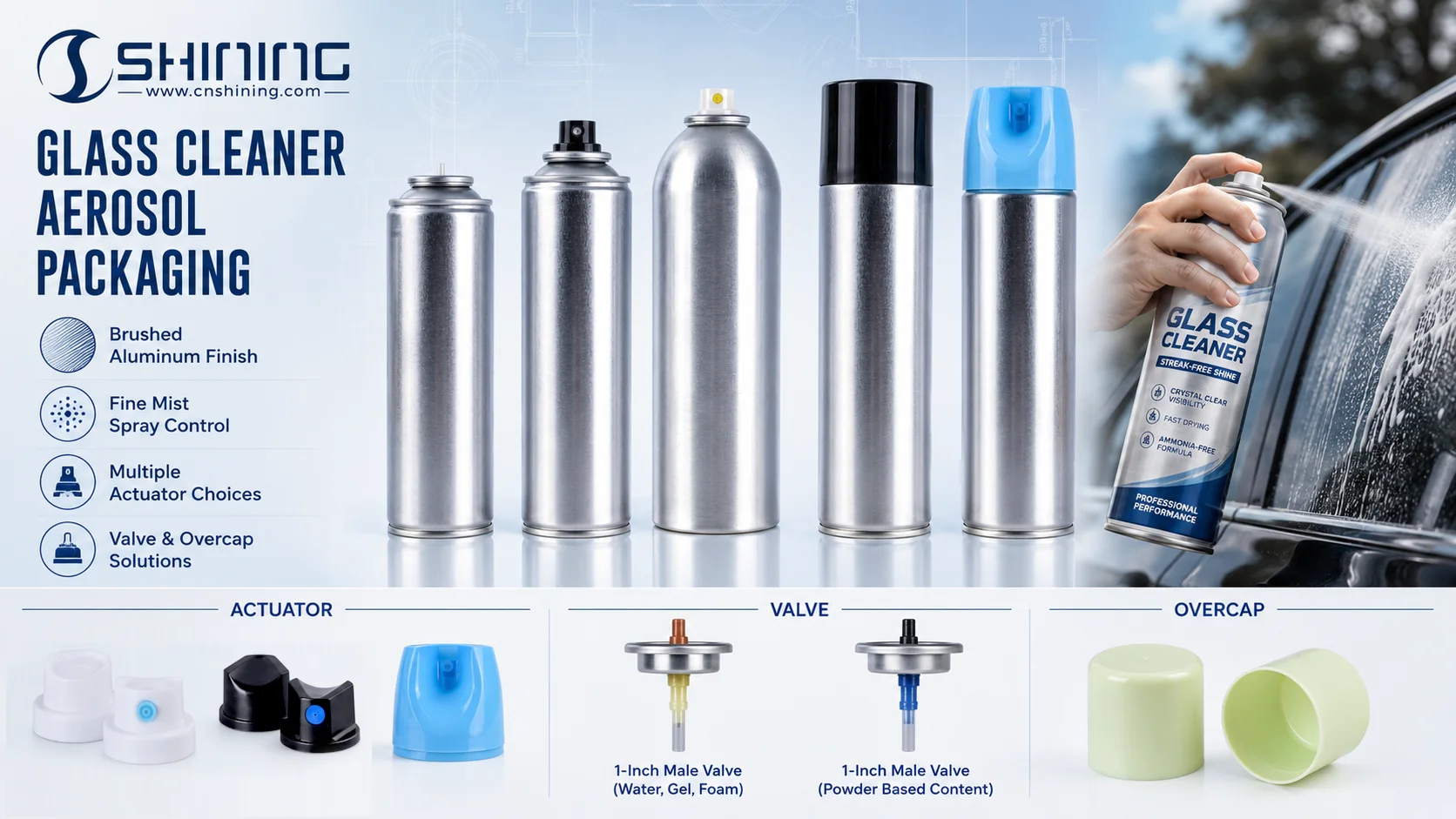
For a glass cleaner aerosol spray, packaging components are not passive hardware. The actuator, valve, dip tube, can body, inner coating, and cap decide whether the formula can be delivered in the way the chemist intended.
Shining Packaging’s relevant work for this product type sits mainly in three areas: actuators, aerosol cans, and valves. The practical focus is output control, foam consistency, compatibility with water-alcohol systems, and transport robustness. A cleaner that looks good in lab glassware can still fail on shelf if the actuator cracks, the valve sticks, or the can coating does not match the formula.
For no-drip foam glass cleaner, actuator geometry should be selected around target spray width, foam density, rebound, and clog tolerance. For the aerosol can, coating choice and seam performance need testing against alcohols, glycol ethers, alkaline components, fragrance, and propellant. For the valve, gasket material and spring/valve-cup compatibility must be tested under heat aging and storage orientation.
9. Conclusion
Glass cleaner aerosol spray remains a mature but technically active format. Its future is not decided by a louder fragrance or a larger foam pile. It is decided by four measurable results: lower streaks, lower odor, fewer spray failures, and cleaner compliance.
The next practical improvement will come from packaging and formulation working together. A low-VOC formula still needs the right propellant. A good foam still needs the right actuator. A strong solvent system still needs the right valve material and inner coating. The brands that reduce these failure points will have a real technical edge, even if the product still looks like a simple can of glass cleaner on the shelf.
10. FAQ: Glass Cleaner Aerosol Spray
It is a ready-to-use glass cleaner packed in a pressurized metal aerosol can. The formulation is released through a valve and actuator as mist, foam, or no-drip foam. The system is used on windows, mirrors, automotive glass, and shower doors where controlled coverage and reduced dripping matter.
Foam increases residence time on a vertical surface. Instead of running down immediately, it holds solvent and surfactant against fingerprints, road film, smoke film, or soap residue long enough for wiping. The benefit comes from delivery control, not from foam volume alone.
No. The cleaning chemistry may be similar. Aerosol has an advantage when controlled foam, sealed packaging, quick use, and vertical cling are needed. Trigger spray can be cheaper, easier to refill, and less complex to ship. The right format depends on surface, soil level, and channel requirements.
Streaks usually come from residue, over-application, slow evaporation, dirty cloths, or complex films on the glass. High surfactant dosage, heavy co-solvents, and too much spray per press can make the problem worse. Interior windshields often need a second dry microfiber wipe.
Alcohols, glycol ethers, hydrocarbon propellants, and some co-solvents help wetting, oil removal, drying, and spray formation. Many of them count toward VOC or flammability concerns. The formula must clean and dry well while staying inside federal, state, or regional VOC limits.
The actuator controls spray width, foam texture, output mass, back-spray, clogging tendency, and hand feel. A weak actuator can break during use or transport. A poorly matched actuator can overspray in car interiors or apply too much product, increasing streak and odor complaints.
This usually points to valve, dip tube, actuator, or phase-balance issues. Clogging, poor compatibility with fragrance or solvent, propellant loss, or liquid-gas ratio drift can leave usable liquid trapped inside the can. Compatibility testing under heat aging helps catch this before launch.
DME is useful because it has good water compatibility and can support pressure and solvent behavior in high-water systems. It is not a universal fix. Flammability, VOC treatment, odor, material compatibility, and local rules must be checked against the full formulation and target market.
Key tests include valve compatibility, actuator durability, output mass, spray pattern, foam collapse time, can corrosion, inner coating resistance, leakage, heat aging, and shipping vibration. Testing should include upright and inverted storage because consumer cans are not always stored under ideal conditions.
Consumer refilling of pressurized aerosols is harder than refilling a trigger sprayer. Pressure control, valve sealing, propellant dosing, and dangerous-goods rules make it complex. Before 2030, refill and plastic-reduction efforts are more likely to grow through concentrates, powders, reusable sprayers, and cleaning tools.