
An oven cleaner aerosol spray is not just a cleaning liquid packed in a pressurized can. It is a coupled system of caustic or low-caustic chemistry, surfactants, solvents, thickeners, propellant, valve, actuator, aerosol can, inner coating and user-warning design.
The technical value is simple: the product must dissolve baked grease and carbonized residue, hold on vertical oven walls, spray with control, avoid excessive fumes, and stay compatible with the container during shelf life. When one part fails, the complaint usually appears as “bad smell,” “thin foam,” “hard nozzle,” “leaking cap,” “blocked spray,” or “damaged aluminum.”
1. Product Definition and Working Principle
1.1 Definition
Under OSHA wording, an aerosol is a material dispensed from its container as a mist, spray or foam by a propellant under pressure. For oven cleaner aerosol spray, that means the product must also manage pressurized container safety, flammability, spray form, residue and user handling. See the OSHA definition in 29 CFR 1910.106 aerosol definition.
Commercially, the category splits into two main routes:
- Heavy-duty caustic type: usually built for severe carbonized grease and fast breakdown.
- Low-fume, non-caustic or mildly caustic type: often based on amines, carbonates, glycol ether solvents and surfactants to reduce harshness and widen household use.
1.2 Working Mechanism
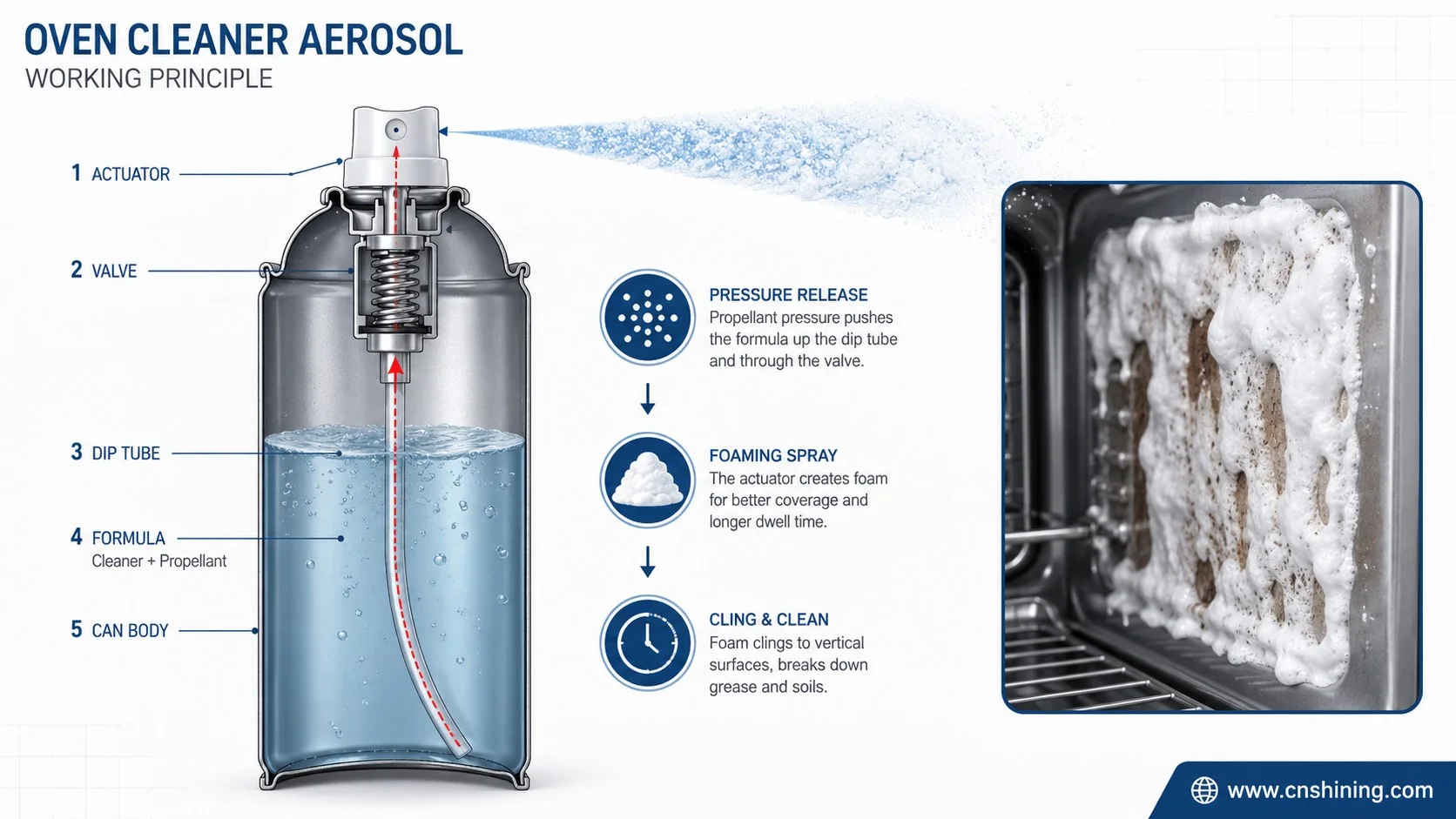
The first layer is chemical cleaning. Sodium hydroxide or potassium hydroxide attacks grease by saponification and hydrolysis. This converts part of the greasy soil into more removable materials. Non-caustic or low-caustic systems depend more on monoethanolamine, carbonate, solvent swelling and surfactant wetting.
The second layer is physical coverage. Oven cavities have side walls, back walls, racks, corners and door glass. A thin liquid runs down quickly. A stable foam or gel-like foam gives longer dwell time and better cling. That is why many oven cleaner products stress “foaming,” “self-scouring foam,” “clings to vertical surfaces,” or “thick gel.”
The third layer is packaging release. The propellant controls pressure and spray energy. The valve controls flow stability. The actuator controls spray pattern, foam texture, over-spray and finger force. A cheap actuator can turn a good formula into a bad user experience.
2. Formula Routes and Cleaning Chemistry
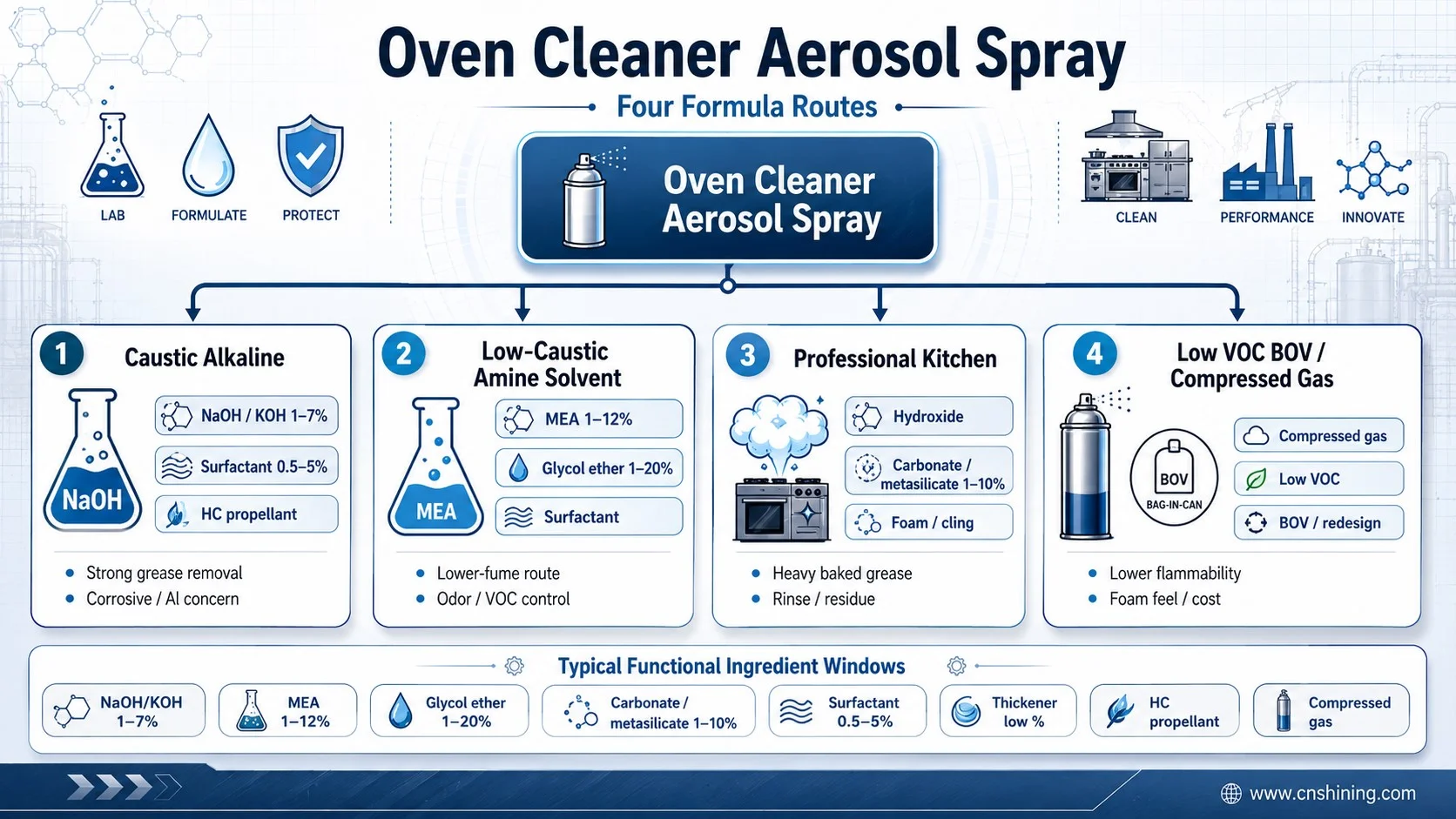
The original research separates oven cleaner aerosol spray into four practical groups. They are not mutually exclusive. A real SKU may combine low-fume positioning with aerosol foam, or heavy-duty caustic chemistry with a large professional can.
- Strong alkaline type NaOH or KOH dominant. Used for heavy baked grease and carbonized soil. High warning burden. High compatibility demand.
- Low-caustic or non-caustic type MEA, carbonate and glycol ether solvent systems. Better suited to cold-oven cleaning and lower fume positioning. Heavy soil needs longer dwell.
- Professional kitchen type Higher alkalinity or longer dwell time. Often larger can size or case-pack supply. Efficiency and process discipline matter more than fragrance.
- Green or low-VOC type Compressed gas or Bag-on-Valve routes. Lower propellant interaction and lower GWP direction. Foam feel and cost need rebalancing.
| Ingredient group | Typical public range | Main function | Technical concern |
|---|---|---|---|
| Sodium / potassium hydroxide | About 1–7 wt% in public patent examples | Saponifies grease and breaks baked residue | Corrosive; poor fit with aluminum and weak internal coatings |
| Monoethanolamine | About 1–12 wt% in non-caustic patent windows | Alkalinity, soil swelling, lower-fume route | Odor, respiratory irritation and residue management |
| Glycol ether solvents | About 1–20 wt% in public formulation windows | Swells tar-like grease and improves wetting | VOC pressure, odor and skin exposure |
| Carbonates / metasilicates | About 1–10 wt% | Buffer alkalinity and support detergency | High pH, white residue and rinse burden |
| Surfactants / foam stabilizers | Often about 0.5–5 wt% | Wetting, emulsification and foam control | Residue feel, skin irritation and rinse performance |
| Thickeners / clays / polymers | Low single-digit percentage to several percent | Cling, anti-sag and foam body | Too much can block the actuator or reduce spray reach |
| Hydrocarbon propellant | Low single-digit to double-digit levels in SDS examples | Can pressure, spray force and foam expansion | Flammability, VOC and storage classification |
| Compressed gas propellant | System dependent | Lower flammability and lower VOC route | Foam feel, pressure curve and cost need redesign |
Patent examples remain useful because they show why thixotropy matters. The older oven-cleaning patent US4157921A describes alkaline, surfactant, solvent and thickener combinations that liquefy under spraying and then rebuild body on the oven wall.
Non-caustic work follows a different route. WO1995002033A1 shows how ethanolamine, carbonate and glycol ether can be used to build a low-temperature non-caustic oven cleaning composition.
From a toxicology view, sodium hydroxide and ethanolamine need direct handling respect. NIOSH data for sodium hydroxide and ethanolamine are practical references when safety teams review SDS language and exposure controls.
3. Market Size and Regional Trend
| Region | Aerosol market 2023 | 2030 forecast | CAGR | Meaning for oven cleaner aerosol spray |
|---|---|---|---|---|
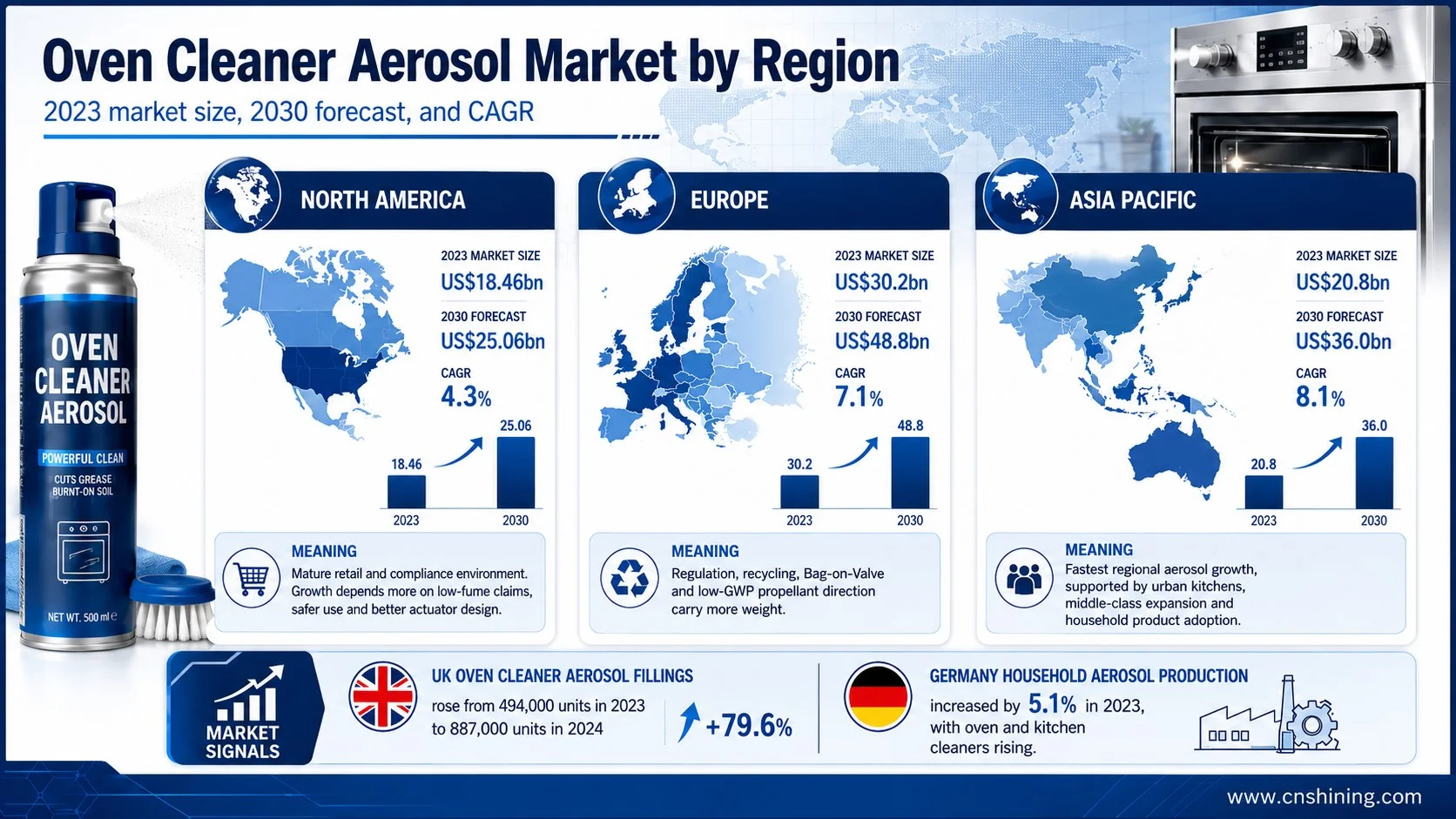
| North America | US$18.46bn | US$25.06bn | 4.3% | Mature retail and compliance environment. Growth depends more on low-fume claims, safer use and better actuator design. Source: North America aerosol market |
| Europe | US$30.2bn | US$48.8bn | 7.1% | Regulation, recycling, Bag-on-Valve and low-GWP propellant direction carry more weight. Source: Europe aerosol market |
| Asia Pacific | US$20.8bn | US$36.0bn | 8.1% | Fastest regional aerosol growth, supported by urban kitchens, middle-class expansion and household product adoption. Source: Asia Pacific aerosol market |
UK filling data gives a useful physical-volume signal. The BAMA Annual Report shows UK oven cleaner aerosol fillings rising from 494,000 units in 2023 to 887,000 units in 2024, a 79.6% increase, while household aerosol products as a group declined. That means oven cleaning behaves like a high-pain-point subcategory, not just a follower of the household aerosol cycle. Source: BAMA Annual Report 2024–2025.
European data points in the same direction. FEA reported that German household aerosol production increased by 5.1% in 2023, with oven and kitchen cleaners rising. Source: FEA aerosol filling 2023 major countries.
4. Product Formats, Formulation Windows and Terms
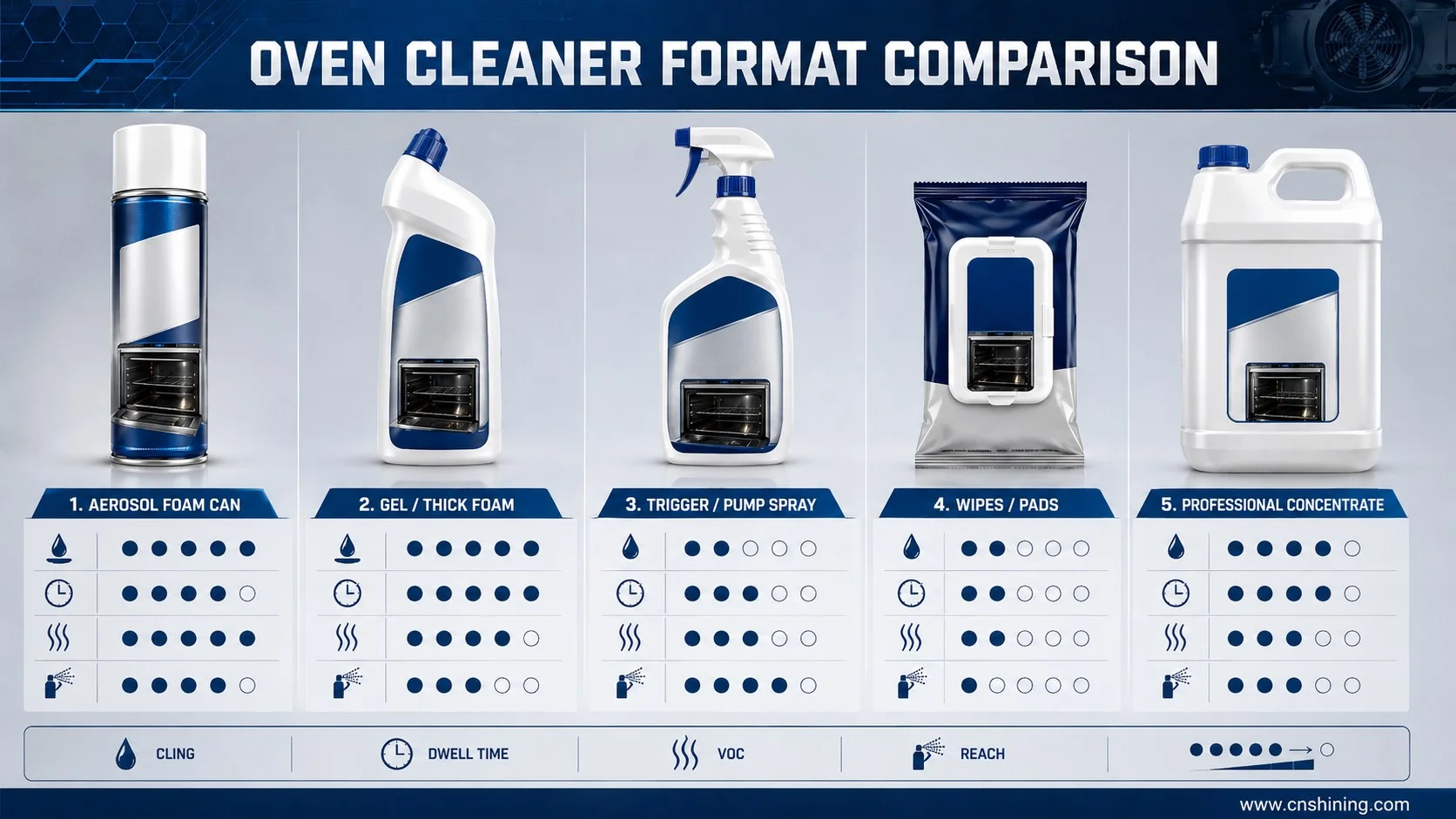
| Format | Main advantage | Main weakness | Typical use | Commercial judgement |
|---|---|---|---|---|
| Aerosol foam spray | Fast coverage, good reach, strong vertical cling and professional feel | VOC, flammability, hazardous logistics, actuator clogging and over-spray risk | Home deep cleaning, BBQ, grill and professional kitchens | Main high-pain-point format |
| Gel / thick foam | Very strong cling and lower dripping | Slower action and heavier wiping or rinsing | Old ovens and severe door-wall grime | Good for long dwell positioning |
| Trigger or pump spray | Lower pressure-container risk and easier refill story | Weaker foam structure and poorer reach into corners | Lower-risk household lines | Works for low-VOC positioning |
| Wipes / pads | Convenient for spot cleaning | Weak against thick carbonized soil and hard to reach oven roof areas | Glass door, knobs and routine maintenance | Better as accessory format |
| Professional concentrate | Low cost per use and process control | Requires dilution, PPE and training | Central kitchens and foodservice cleaning | Stable B2B logic, poor household UX |
| Term | Simple meaning | Business impact |
|---|---|---|
| Aerosol | Pressurized product dispensed as mist, spray, stream or foam | Requires formula, container, transport and label control |
| Propellant | Gas or liquefied gas providing pressure | Affects VOC, flammability, spray feel and cost |
| Dwell time | Time the cleaner remains on soil before wiping | Decides whether “less scrubbing” is believable |
| Cling | Ability to stay on vertical or inverted surfaces | Directly affects repeated spraying and user satisfaction |
| Self-scouring foam | Foam layer that stays active on soil | Creates the user-visible sense of professional cleaning |
| Bag-on-Valve | Product in a bag, propellant outside the bag | Can reduce propellant contact and support compressed gas design |
| Through-valve corrosion | Corrosion or degradation along the valve path | Creates blockage, leakage and shelf-life failures |
| Inner coating / lacquer | Protective coating inside the can | For caustic cleaners, it is a stability requirement, not decoration |
5. Regulatory Framework
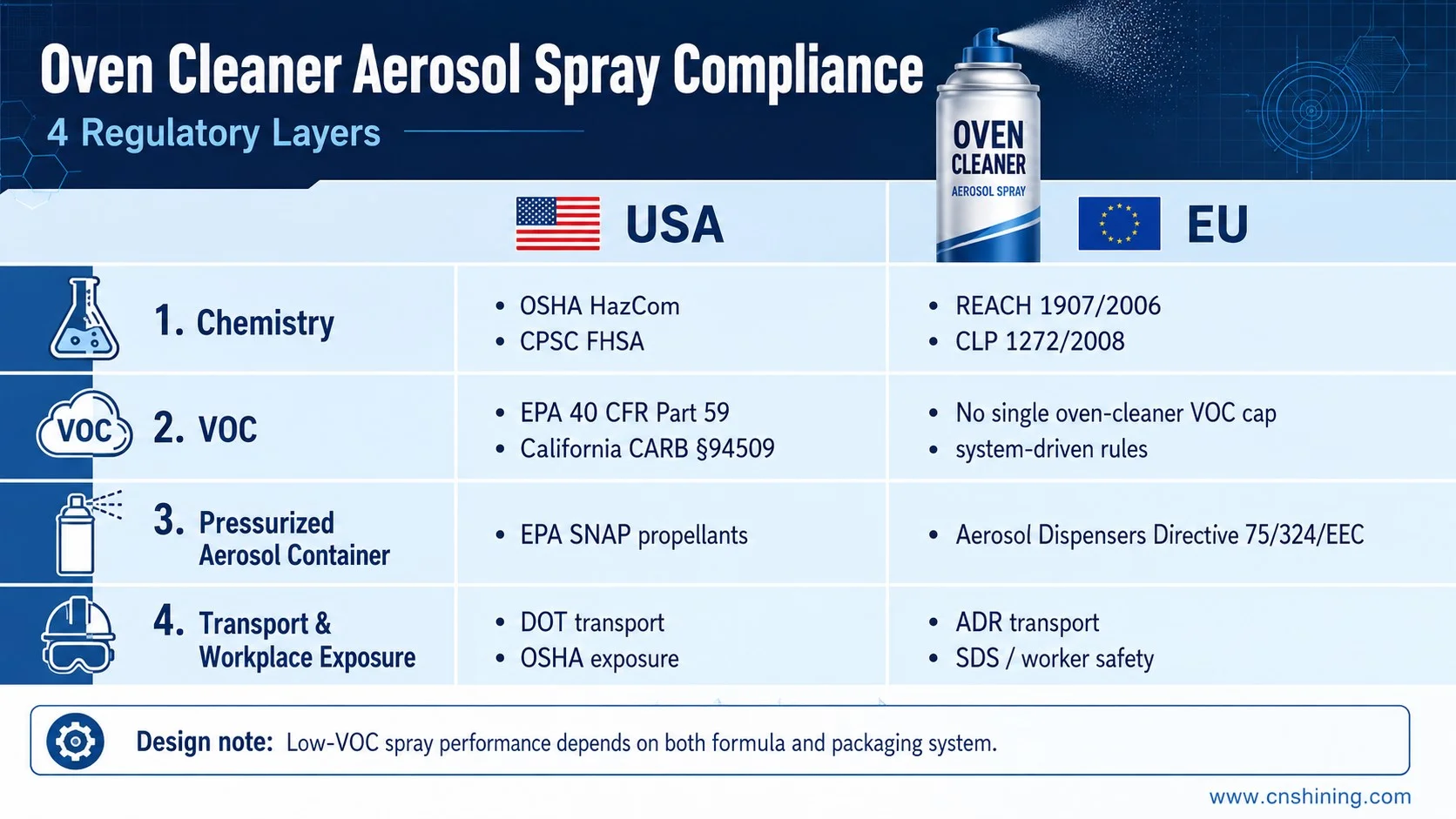
The regulatory structure has four layers: chemical hazard, VOC limits, pressurized aerosol container rules, and transport or workplace exposure. The US gives direct VOC numbers for oven cleaners. Europe is more system-driven through chemical, CLP, aerosol dispenser and climate rules.
| Region | Rule or standard | Direct design meaning |
|---|---|---|
| US federal | EPA 40 CFR Part 59 VOC table | Oven cleaners: aerosol / pump 8 wt% VOC; liquids 5 wt%. This affects propellant and solvent selection. |
| California | CARB 17 CCR §94509 | Oven or grill cleaner: aerosol / pump spray 8%, liquid 5%, nonaerosol 4% after later effective date. |
| US workplace | OSHA Hazard Communication | Controls SDS, label and training expectations for hazardous chemical products. |
| US consumer product safety | CPSC FHSA requirements | Warning labels and first-aid language matter for hazardous household chemicals. |
| US propellants | EPA SNAP substitutes in propellants | Light hydrocarbons and compressed gases can be acceptable substitutes, but flammability and use conditions still govern design. |
| EU chemicals | REACH Regulation 1907/2006 | Registration, restrictions and SDS obligations form the chemical compliance base. |
| EU classification | CLP Regulation 1272/2008 | Classifies aerosol flammability and hazard communication. |
| EU aerosol container | Aerosol Dispensers Directive 75/324/EEC | Safety, filling and labeling base for pressurized aerosol dispensers. |
| EU SDS | Regulation EU 2020/878 | Updates REACH Annex II SDS format and content requirements. |
| EU climate | EU F-gas legislation | Pushes aerosol sprays away from high-GWP gases where alternatives exist. |
6. Top 10 Oven Cleaner Aerosol Brands
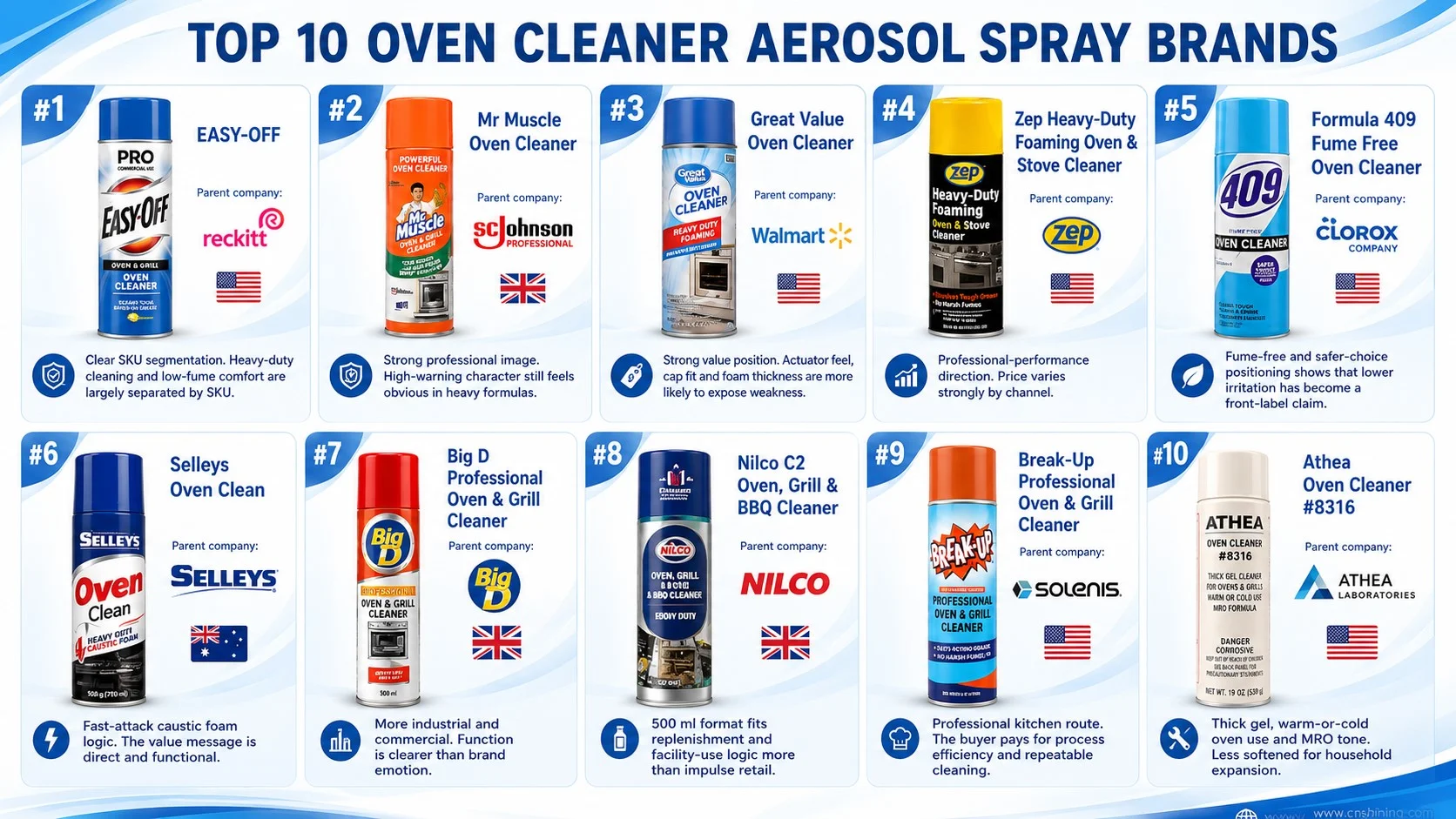
| Brand / series | Country / origin | Parent company | Typical can size | Technical comment |
|---|---|---|---|---|
| EASY-OFF Heavy Duty / Fume Free / Professional | United States | Reckitt / Easy-Off line | 14.5 oz, 24 oz | Clear SKU segmentation. Heavy-duty cleaning and low-fume comfort are largely separated by SKU. |
| Mr Muscle Oven Cleaner | United Kingdom | SC Johnson Professional / Mr Muscle | 300 ml aerosol | Strong professional image. High-warning character still feels obvious in heavy formulas. |
| Great Value Heavy Duty / Fume Free | United States | Walmart private label | 16 oz | Strong value position. Actuator feel, cap fit and foam thickness are more likely to expose weakness. |
| Zep Heavy-Duty Foaming Oven & Stove Cleaner | United States | Zep | 19 oz | Professional-performance direction. Price varies strongly by channel. |
| Formula 409 Fume Free Oven Cleaner | United States | Clorox Company | 14.5 oz / 19 oz | Fume-free and safer-choice positioning shows that lower irritation has become a front-label claim. |
| Selleys Oven Clean | Australia | Selleys | 350 g aerosol | Fast-attack caustic foam logic. The value message is direct and functional. |
| Big D Professional Oven & Grill Cleaner | United Kingdom | Big D | 300 ml | More industrial and commercial. Function is clearer than brand emotion. |
| Nilco C2 Oven, Grill & BBQ Cleaner | United Kingdom | Nilco | 500 ml | 500 ml format fits replenishment and facility-use logic more than impulse retail. |
| Break-Up Professional Oven & Grill Cleaner | United States | Solenis | 19 oz, 6 per case | Professional kitchen route. The buyer pays for process efficiency and repeatable cleaning. |
| Athea Oven Cleaner #8316 | United States | Athea Laboratories | 20 oz can / 18 oz net weight / 12 cans per pack | Thick gel, warm-or-cold oven use and MRO tone. Less softened for household expansion. |
| Pain point | Likely technical cause | Packaging implication |
|---|---|---|
| Hard nozzle and tired fingers | High valve spring force, small button area or poor actuator travel | Use larger press surface, optimized spring force and ergonomic actuator geometry |
| Thin foam and repeated spraying | Weak expansion chamber, low viscosity, poor surfactant / propellant match | Redesign foaming actuator and validate vertical dwell time |
| Heavy soil not softened | Low-fume route underpowered for carbonized grease | Match label claims to dwell time and soil severity |
| Cap pulls off actuator or causes leakage | Poor overcap retention and actuator fit | Define cap-off force window and anti-misassembly structure |
| Strong odor or “fume-free” disappointment | Amine odor, solvent residue, fragrance interaction or insufficient rinse guidance | Control droplet size, residue and front-label ventilation instructions |
| Product sprayed into fan or heating element | Over-spray and weak no-spray-zone communication | Use directional actuator, pictograms and visible warning zones |
| Damage to aluminum or incompatible surfaces | High alkali attack or unclear compatibility instruction | Put compatibility matrix on the front panel, not only in small back text |
The pattern is consistent: future competition is not only about stronger grease removal. The more valuable improvement is making the product less unpleasant, harder to misuse and more controlled at the spray point.
7. Packaging Engineering Recommendations
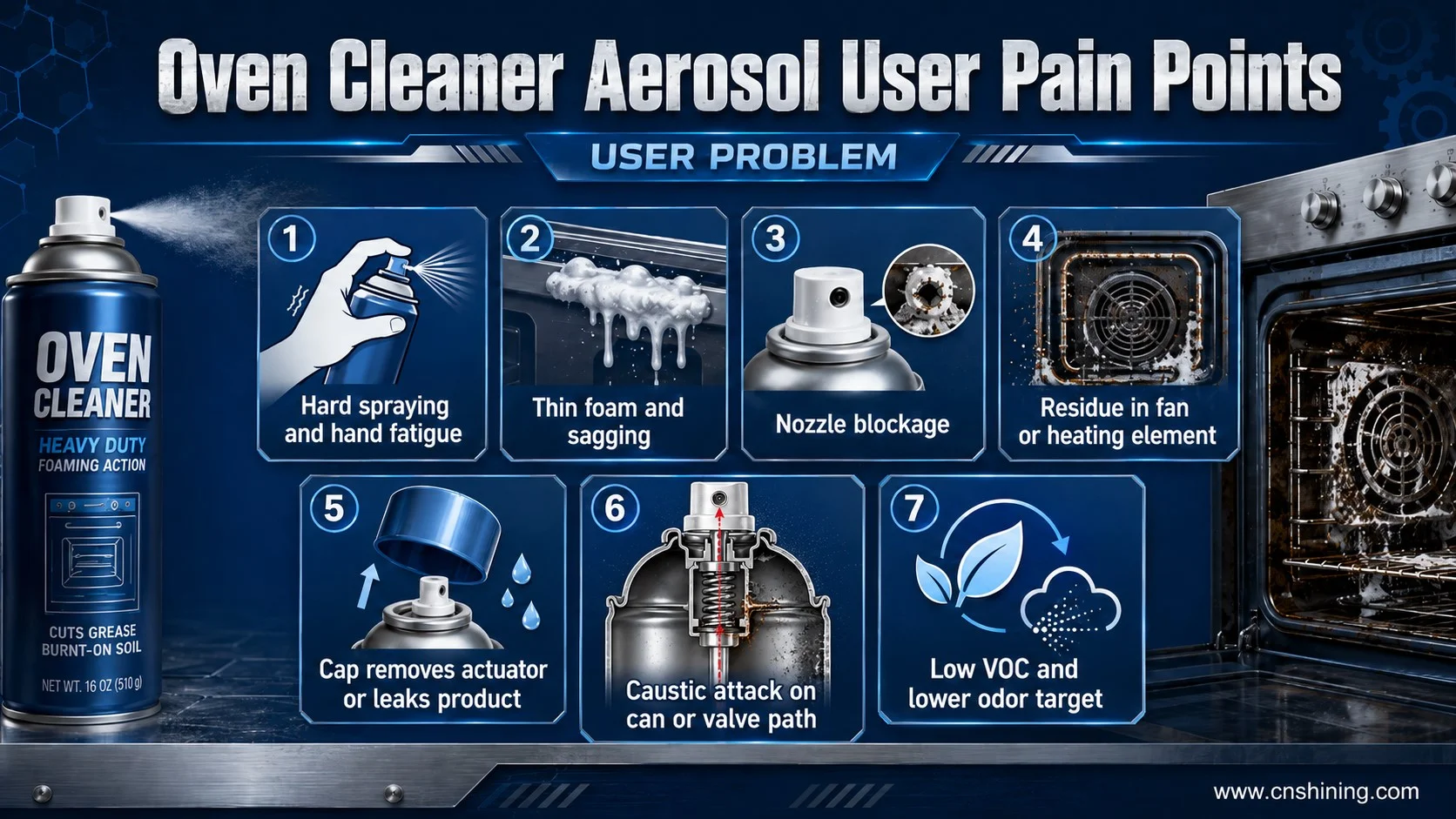
| User problem | Recommended design | Expected gain | Trade-off |
|---|---|---|---|
| Hard spraying and hand fatigue | Low-force button or trigger-style actuator with larger finger pad | Better use comfort, fewer complaints from long spraying | Higher mold and component cost |
| Thin foam and sagging | Foaming actuator with expansion chamber and formula viscosity adjustment | Better cling, less repeated spraying, longer dwell | Too much foam reduces spray reach |
| Nozzle blockage | Self-cleaning or anti-crystallization actuator path | Lower second-use failure rate | More parts and tighter assembly control. Related concept: cleaning actuator for aerosol cans |
| Residue in fan or heating element | Directional spray, optional dual pattern and front warning icons | Less over-spray and fewer misuse cases | Dual pattern raises cost and user learning burden |
| Cap removes actuator or leaks product | High-retention overcap with anti-misfit guidance | Reduces panic leakage during first use | Too tight a cap creates a different complaint |
| Caustic attack on can or valve path | High-alkali-resistant inner coating and valve compatibility test | Lower risk of corrosion, discoloration, leakage and blocked valve | Higher can cost and fewer supplier options |
| Low VOC and lower odor target | Bag-on-Valve or compressed gas system | Less propellant interaction and stronger low-GWP story | Foam texture, pressure curve and economics need full rework |
For a mass-market household SKU, the practical route is a medium-high viscosity low-fume formula, large press-surface foaming actuator, front compatibility icons, high-alkali-resistant coating and tested cap retention. The target is not maximum aggression. The target is fewer odor, fear, misuse and clogging failures.
For a professional kitchen SKU, a stronger caustic system still makes sense. It should be paired with stronger lacquer, a controlled fan-foam actuator, clear PPE warnings and 500 ml / 19 oz class can sizing. Professional users do not reject hazard. They reject uncertainty.
For a green premium route, BOV or compressed gas plus low-odor chemistry is technically more convincing than a thin “eco” claim. The propellant direction is also supported by EPA SNAP’s listing of compressed gases as acceptable propellant substitutes and Europe’s F-gas pressure on high-GWP aerosol gases.
8. Shining Packaging Components for This Application
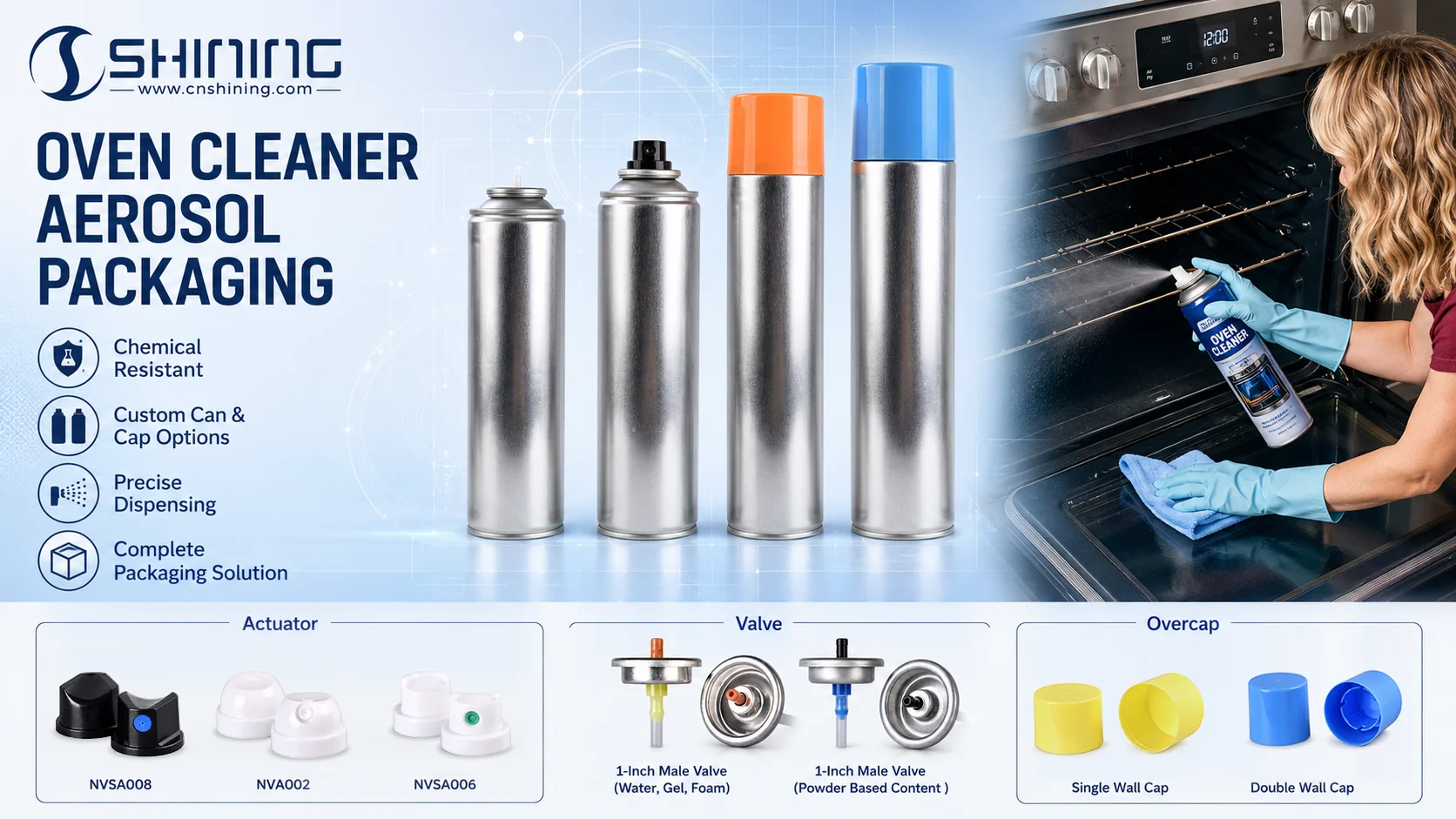
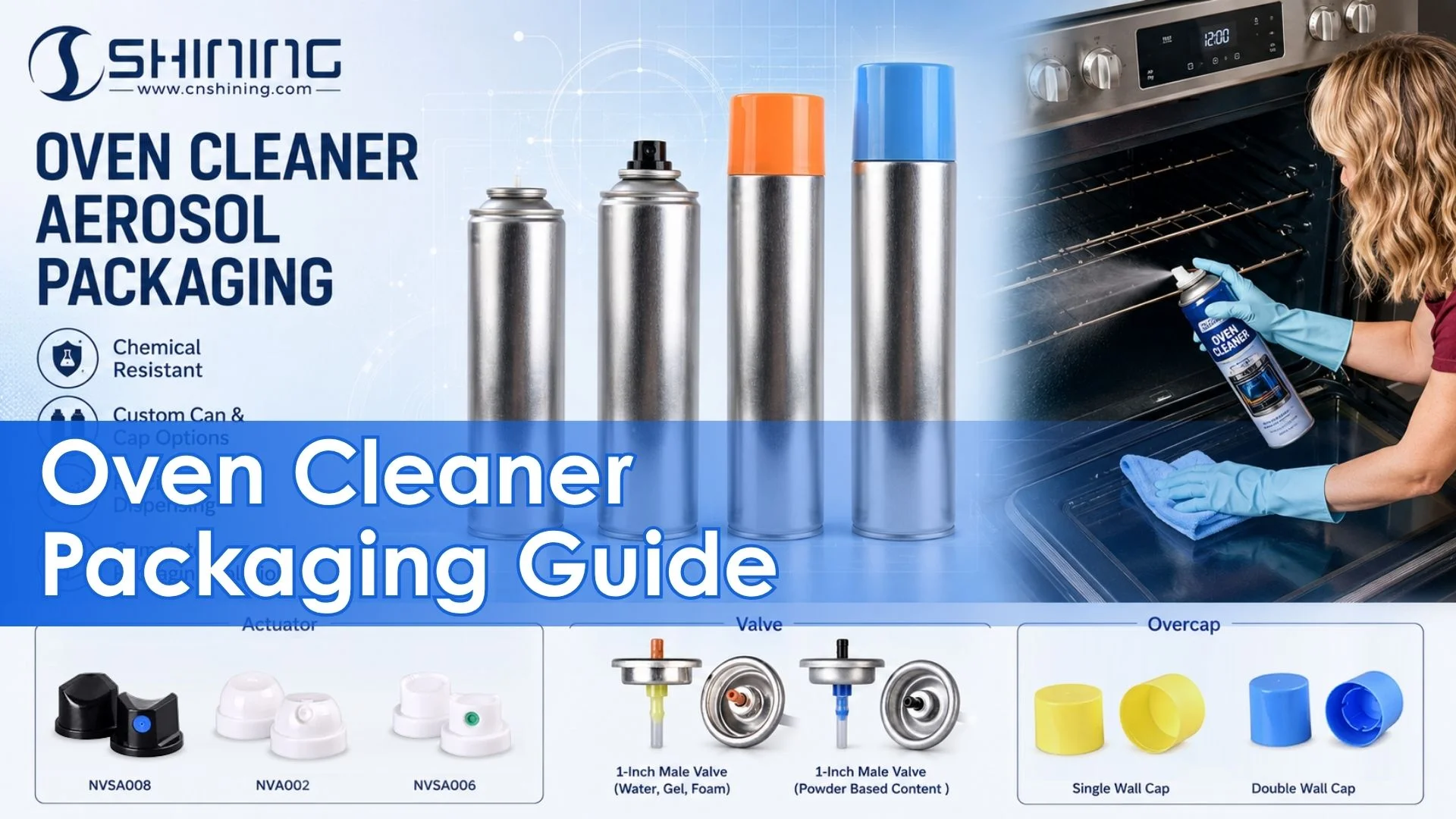
For this category, Shining Packaging should be discussed through the same engineering lens as the rest of the article: actuator, aerosol can and valve. These parts decide whether the oven cleaner sprays as a controlled foam, whether the can tolerates alkaline formulation, and whether the valve path survives storage without leakage or blockage.
A suitable actuator for oven cleaner aerosol spray usually needs a wider finger pad, stable foam expansion and clear spray direction. A suitable aerosol can needs the right tinplate or aluminum route, matched inner coating and pressure performance. A suitable valve needs gasket and stem compatibility with high-pH, amine, solvent and surfactant systems.
This is where packaging development should begin early. Waiting until the formula is “finished” and then selecting a generic valve or actuator often creates late-stage failures: poor foam, excessive force, clogged nozzle, cap looseness or corrosion. The better sequence is formula screening, can coating test, valve compatibility test and actuator spray test in parallel.
9. Latest Development Direction
The development direction is more specific than “natural cleaning.” Five lines matter.
9.1 Low irritation moves to the front label
Low-toxicity, low-fume and eco-friendly formulation claims are no longer minor back-label language. They increasingly define SKU architecture. The risk is under-cleaning heavy soil. Low irritation still needs enough dwell, wetting and soil swelling.
9.2 Propellant and package systems are changing
Compressed gas and BOV systems can reduce propellant-formula interaction and support lower VOC or lower flammability design. The price is real: foam feel, pressure curve and actuator geometry often need redesign.
9.3 Reduced misting remains technically relevant
Fine aerosol mist is part of the “choking” complaint. Reduced-misting oven cleaner concepts, such as the Ecolab patent reduced misting oven cleaner, remain relevant because strong cleaning and low inhalation discomfort are still hard to combine.
9.4 Cold-oven and low-caustic cleaning keeps improving
Cold-oven use reduces user anxiety. Non-caustic or low-caustic chemistry can help, but it is not a shortcut. The formula must compensate with amine, carbonate, solvent, surfactant and dwell-time design.
9.5 Packaging innovation is moving from “can spray” to “spray correctly”
Better valves, actuators, caps, BOV structures, printed warnings and compatibility icons directly reduce complaints. For oven cleaner aerosol spray, these details are not decorative. They control repeat purchase and liability exposure.
10. Final Technical View
Oven cleaner aerosol spray is a regulated functional chemical product where packaging engineering shapes the user result. Stronger chemistry alone will not solve the category. The practical design advantage comes from stable foam, controlled mist, lower actuator force, correct valve compatibility, durable inner coating, clear front-label warning icons and a VOC-aware propellant strategy. In this product class, the can, valve and actuator are part of the cleaning performance.
11. FAQ: Oven Cleaner Aerosol Spray
Oven cleaner aerosol spray uses a pressurized container, propellant, valve and actuator to release the formula as foam, mist or spray. This gives faster coverage and better reach inside the oven cavity. It also creates extra design duties: VOC control, flammability review, actuator force, spray pattern, can coating compatibility and clear misuse warnings.
Foam improves dwell time and vertical cling. Oven grease often sits on side walls, door glass, racks and corners, not just flat surfaces. A thin liquid runs down too quickly. A stable foam layer keeps alkaline, amine, solvent and surfactant chemistry in contact with baked soil longer, reducing repeated spraying and heavy scrubbing.
Heavy-duty products often rely on sodium hydroxide or potassium hydroxide. These alkaline ingredients saponify grease and help break carbonized organic residue into more removable material. The formula may also contain solvents, surfactants and thickeners. The trade-off is higher corrosivity, stronger warnings and tighter compatibility requirements for aluminum, coatings, valve parts and skin exposure.
Low-fume systems usually reduce reliance on strong caustic chemistry and lean more on monoethanolamine, carbonates, glycol ether solvents and surfactants. They can be more comfortable for household use, especially in cold-oven cleaning. The weakness is slower action on severe carbonized grease, so dwell time and foam cling become more important.
VOC limits restrict how much volatile solvent and propellant can be used. In the US federal consumer product rule, oven cleaners have an 8 wt% VOC limit for aerosol and pump forms and 5 wt% for liquids. This means spray power, foam texture and low odor must be solved through formulation and packaging design together.
Clogging can come from thickener overload, crystallization, dried alkaline residue, poor actuator flow path, incompatible surfactant structure or valve-path corrosion. Oven cleaner formulas are often high pH and foam-forming, so the actuator needs enough flow area and sometimes self-cleaning geometry. Storage testing should include repeated-use cycles, not only first-spray checks.
Strong alkaline chemistry can attack aluminum and some decorative or protective surfaces. The risk is higher when the formula contains sodium hydroxide or potassium hydroxide and remains in contact for too long. This is not only a label issue. Spray direction, warning icons and clear compatibility matrices reduce accidental use on aluminum parts, toaster ovens and exposed metal trim.
The can should be tested with the exact formula, valve and storage conditions. Key checks include internal coating resistance, pH stability, corrosion, pressure, leakage, discoloration, odor change and through-valve compatibility. Caustic and solvent-containing oven cleaners need stricter coating selection than many household aerosols because small corrosion paths can become leakage or blockage failures.
Bag-on-Valve can be suitable when the project needs compressed gas, lower propellant interaction, lower contamination risk or improved emptying behavior. It is not a drop-in solution. Foam quality, spray rate, pressure curve, actuator design and cost must be revalidated. For oven cleaners, BOV works best when the formula and foam system are designed around it early.
The common complaint drivers are actuator force, foam thickness, spray direction, cap retention, leakage, residue and warning visibility. A formula may clean well in lab testing but fail in use if the nozzle is too hard, the foam runs down, the cap pulls off the actuator, or the user cannot see where not to spray.