
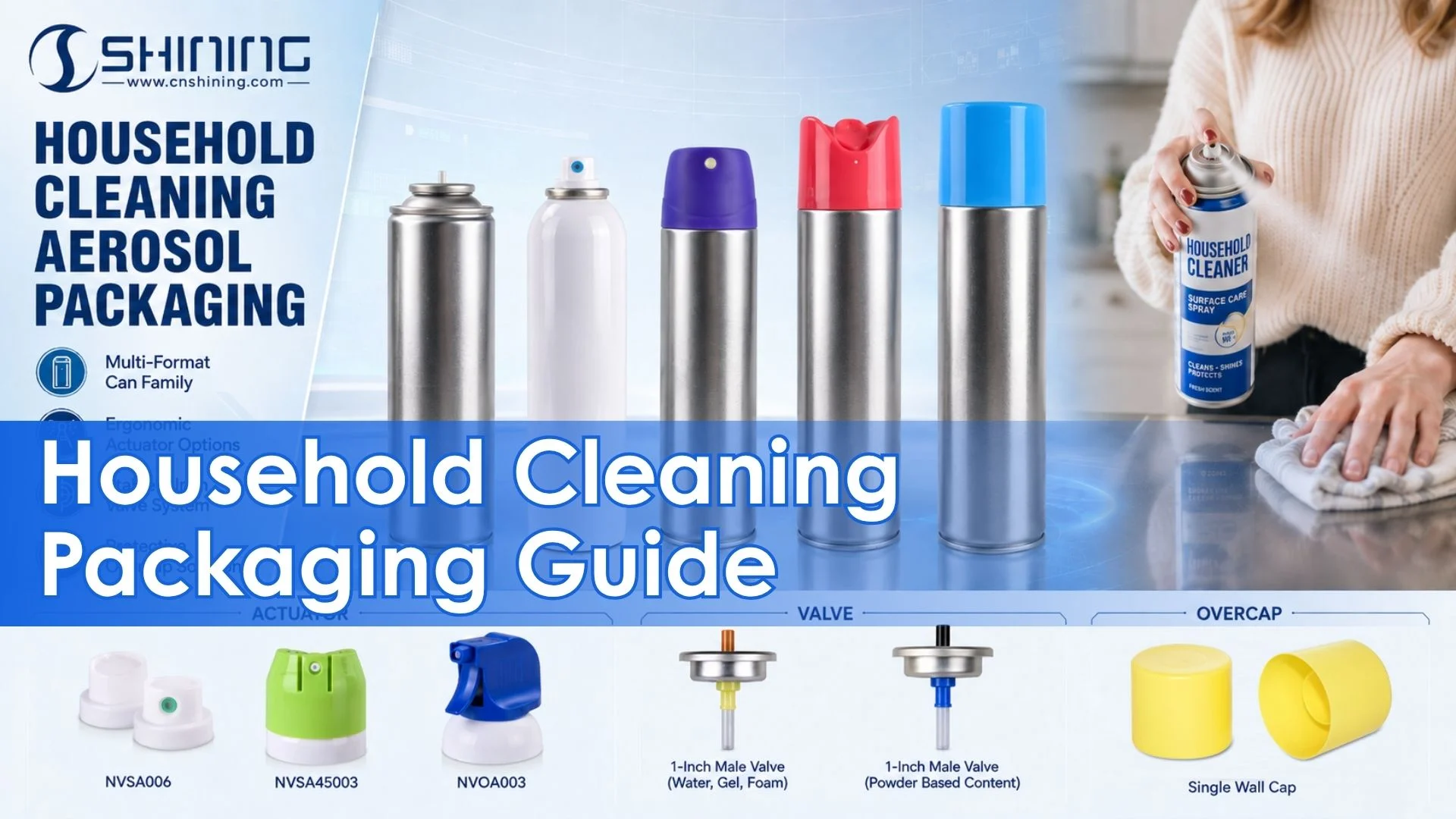
A household cleaning aerosol spray is a self-pressurized packaging system. The concentrate and propellant are filled into a metal can or barrier package. When the user presses the actuator, the valve opens and internal pressure drives the product through the nozzle as a mist, foam, cone spray, fan spray, or wet plume. That is the basic mechanism behind aerosol disinfectant spray, oven cleaner aerosol, glass cleaner spray, bathroom foam cleaner, air freshener aerosol, and many multi-surface cleaning sprays.
The performance is not decided by chemistry alone. Valve geometry, actuator insert, gasket material, dip tube, propellant phase behavior, can lining, and spray-hole design jointly control spray rate, droplet size distribution, plume shape, wetting, residue, and user complaints. This is why two household cleaning sprays may look similar on shelf but behave very differently in real use.
1. Definition, Dispensing Mechanism, and Substitute Formats
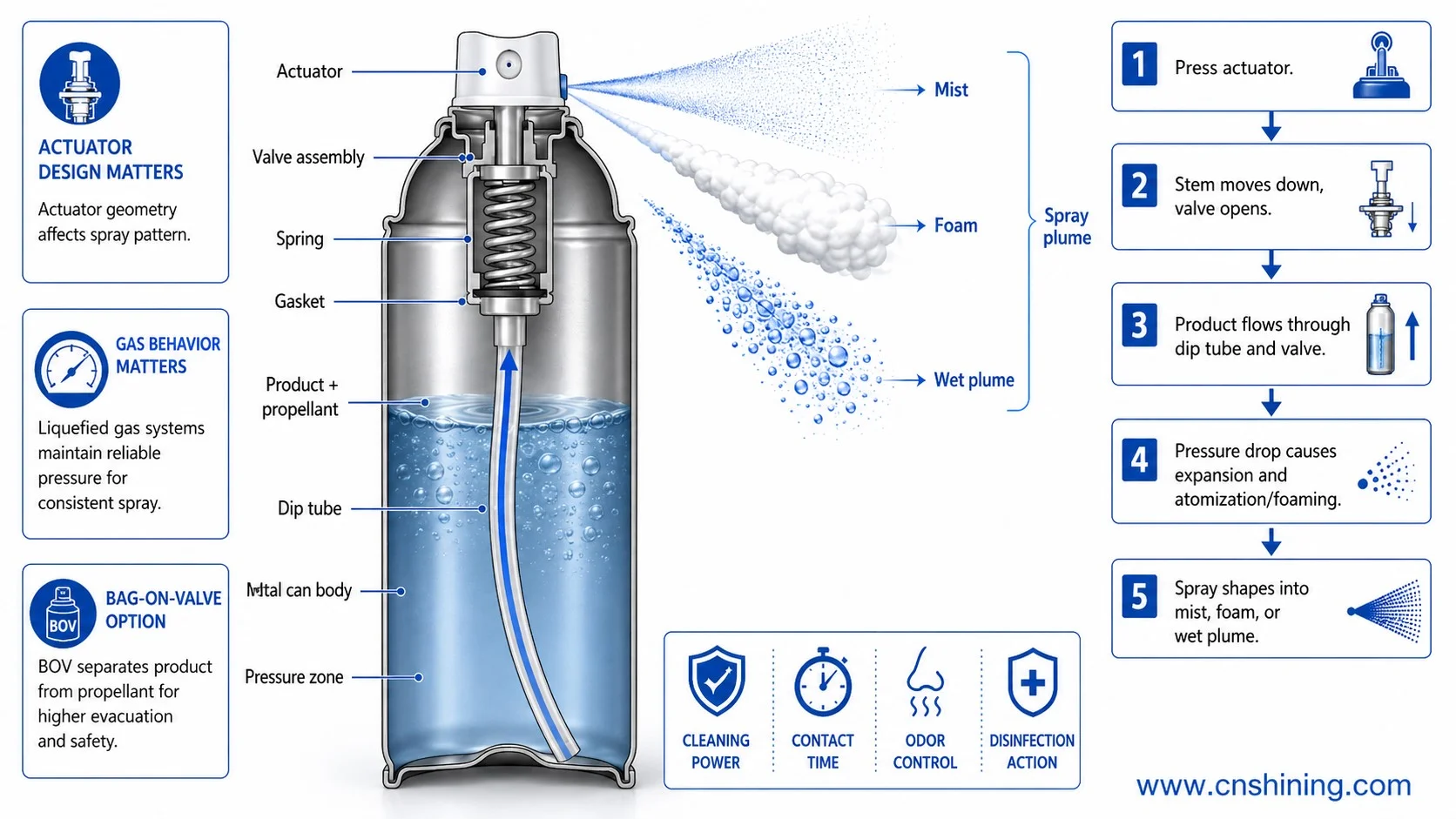
In packaging terms, an aerosol package is a self-dispensing pressurized container made of a container, valve system, and release device. Pressing the actuator moves the stem downward, breaks the gasket seal, and lets pressurized product flow through the dip tube, valve chamber, stem, actuator channel, and orifice. When pressure is released, the spring returns the stem and reseals the system. The actuator is not just a button. It is a spray-shaping part. Technical valve references such as Aerosol Valves 101 explain why the insert, swirl chamber, and orifice geometry are tied directly to particle size, spray angle, and spray pattern.
Can interior: concentrate + propellant / compressed gas
↓
Press actuator
↓
Stem moves down and valve opens
↓
Product flows through dip tube and valve chamber
↓
Pressure drop at actuator orifice
↓
Liquefied propellant flashes / compressed gas expands
↓
Atomization or foaming
↓
Spray shaping: cone, fan, foam, or wet plume
↓
Surface wetting, contact time, soil removal, disinfection, or odor control
Gas phase behavior matters. Traditional liquefied gas aerosol systems, often based on propane, butane, or isobutane, maintain relatively stable vapor pressure through much of the can life because liquid and vapor propellant coexist. Compressed gas systems using nitrogen, air, or carbon dioxide reduce flammability and VOC pressure, but spray pressure falls during use. Bag-on-valve (BOV) separates the product inside a bag from the propellant outside it, reducing formula-propellant interaction and supporting 360-degree spray and higher evacuation rates.
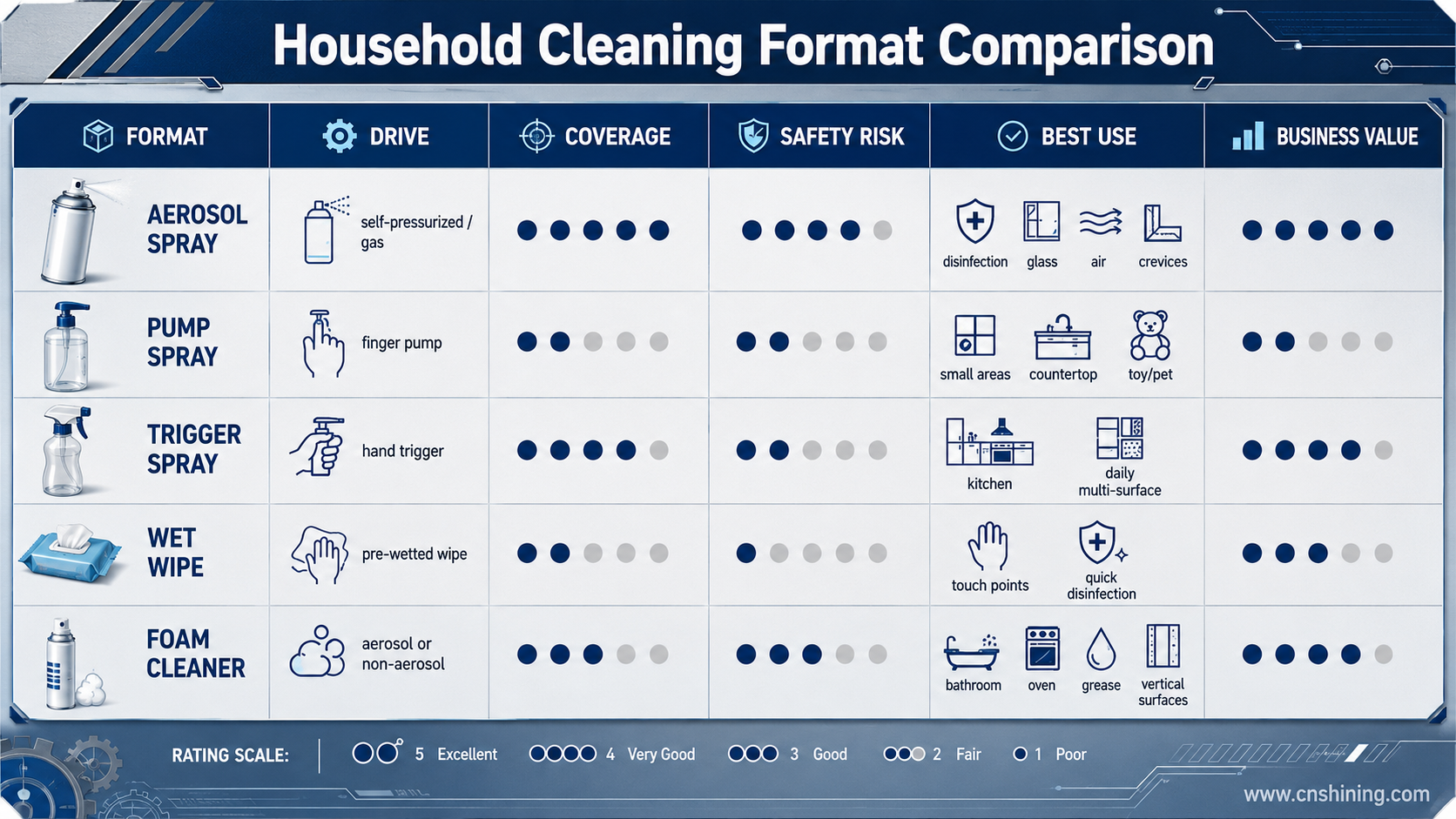
| Format | Driving Method | Main Strength | Main Weakness | Best-fit Use Case | Commercial Meaning |
|---|---|---|---|---|---|
| Aerosol spray | Self-pressurized; LPG, compressed gas, or BOV | Fast coverage, stable spray feel, foam/fan/360-degree options | Pressurized transport, flammability, inhalation concerns, valve risk | Disinfection, glass, vertical foam, air freshening, crevices | High experience value, higher compliance burden |
| Pump spray | Finger pump | Simple structure, no propellant, small pack possible | Lower flow rate, hand fatigue, weaker atomization consistency | Small glass areas, countertop care, toy or pet-area cleaning | Low-cost entry format |
| Trigger spray | Hand trigger | Large surface coverage, stream/mist switching, refill-friendly | Spring and seal wear, formula compatibility requirements | Kitchen surfaces and multi-surface daily cleaning | One of the strongest substitutes for aerosol cleaning spray |
| Wet wipe | Pre-wetted carrier | Convenient, portable, stable dose | High cost per use, more solid waste, weak economics on large areas | High-touch points and quick disinfection | Convenience wins, waste pressure remains |
| Foam cleaner | Aerosol or non-aerosol system | Cling, dwell time, visible cleaning coverage | More residue and rinse demand; not fit for all surfaces | Bathroom, oven, grease, vertical surfaces | Dwell time is easy for consumers to understand |
2. Market Size, Regional Structure, and Forecast

There is no single clean public number for the global household cleaning aerosol spray market. Most public datasets measure broader aerosol markets, packaging value, finished goods value, household aerosol, air care, disinfectant, or surface cleaner categories. The right way to read the market is to state the scope first.
| Scope | Year | Public Size | Forecast | Reading Note |
|---|---|---|---|---|
| Global aerosol market, broad scope | 2025 | US$94.41 billion | US$160.56 billion by 2033; 2026-2033 CAGR 6.9% | Grand View Research broad aerosol scope; includes personal care, air care, cleaning, and other categories. Source: global aerosol market data. |
| Global aerosol market, another broad scope | 2025 | US$44.1 billion | US$76.1 billion by 2035; 2025-2035 CAGR 5.6% | Future Market Insights uses a different scope and cannot be mixed directly with the higher estimate. Source: FMI aerosol market estimate. |
| U.S. aerosol market, broad scope | 2024 | US$15.54 billion | US$21.56 billion by 2033; 2025-2033 CAGR 3.6% | Household is one application, but household aerosol cleaner is not split out as a free public number. Source: U.S. aerosol market report. |
| Europe aerosol production | 2023 | 5.288 billion units | Not directly comparable with retail value forecasts | FEA production data show household at 19.4%, and household cleaning products at 47.83 million units. Source: FEA 2023 aerosol production data. |
| UK aerosol fillings | 2024 | Total fillings increased nearly 2% versus 2023 | Household slowed versus the prior year | BAMA noted recovery in total filling, but household showed weaker movement. Source: BAMA 2024 filling figures. |
The cleanest structural window is Europe. In 2023, European household aerosol production was split into air fresheners at 470.352 million units, insecticides and plant protection at 199.784 million units, care products at 102.597 million units, cleaning products at 47.830 million units, and others at 202.320 million units. The conclusion is direct: household aerosol is large, but hard-surface cleaning aerosol is a more functional and narrower sub-track than air care.
Market growth from 2024 to 2026 is less about pandemic-driven disinfection demand and more about substitution, packaging honesty, lower-carbon propellants, refill systems, and spray reliability. The winners are unlikely to be decided only by active ingredients.
3. Formulation Systems, Terms, and Representative Recipes
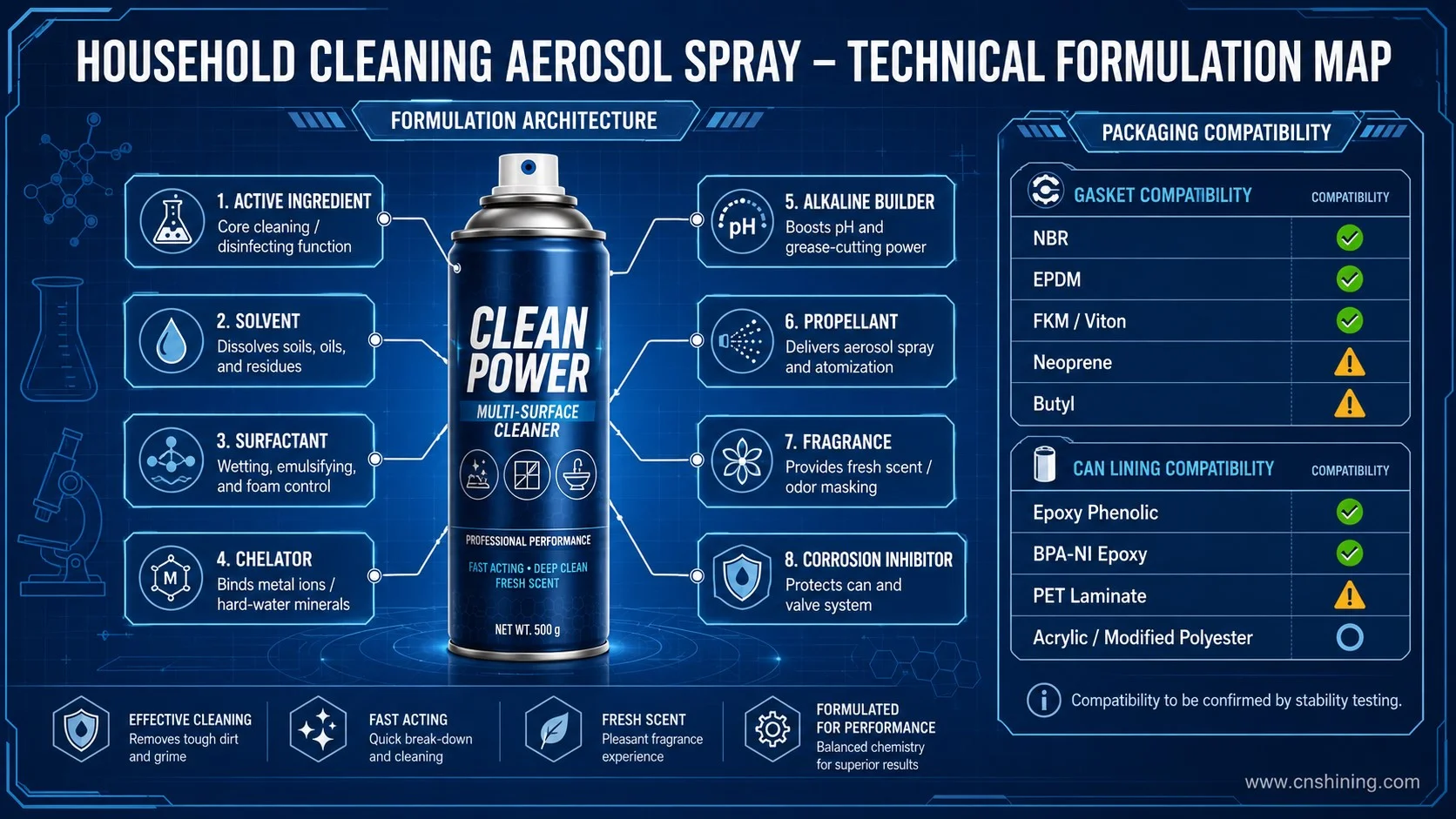
A household aerosol cleaner formula usually contains active ingredient + solvent system + surfactant or chelator + alkaline builder + propellant + fragrance + preservative or corrosion-control package. Selling performance is rarely controlled by one raw material. Four balances decide the product: soil removal versus material compatibility, disinfection versus residue, spray pattern versus surface dwell, and regulatory burden versus logistics.
| Function | Typical Active / Role | Typical Public Concentration | Common Propellant / Additives | Representative Public Formula Signal |
|---|---|---|---|---|
| Disinfectant spray | Ethanol for rapid kill; QAC for broader surface antimicrobial performance | About 58.0% ethanol and 0.09-0.10% QAC in Lysol/Dettol-type references | Water, ethanolamine, ammonia, sarcosinate, LPG or undisclosed propellant | Lysol EPA 777-99 type systems use ethanol and quaternary ammonium actives. Public SDS reference: disinfectant spray SDS. |
| Oven / degreaser aerosol | Sodium hydroxide for saponifying grease; monoethanolamine and glycol ether for alkaline cutting | NaOH 3-7%; MEA 1-5%; diethylene glycol monobutyl ether 3-7% | LPG 3-7%; water base; strong lining and gasket compatibility required | Easy-Off heavy-duty oven cleaner SDS discloses strong alkaline ranges. Source: oven cleaner SDS. |
| Glass cleaner aerosol | Ethanol for fast drying; 2-butoxyethanol for oily film; low-foam system for streak control | Ethanol 2.5-10%; 2-BE 2.5-10% | Propane 1.0-2.5 vol%; butane 1.0-2.5 vol%; water and wetting agents | Sprayway glass cleaner SDS gives solvent and propellant ranges. Source: glass cleaner aerosol SDS. |
| Multi-surface / foam cleaner | QAC for disinfection; phosphate or EDTA builders; glycol ether for soil removal | QAC active 0.384%; water 85-90%; TSP 1-5%; 2-BE 1-5% | n-Butane 1-5%; propane 1-5%; detergents, builders, chelators | SprayPak label and SDS show a traditional industrial aerosol cleaner structure. Sources: EPA label sample and foam cleaner SDS. |
| Air freshener aerosol | Fragrance for odor profile; ethanol or DPnP as solvent; corrosion control as needed | Glade SDS discloses ethanol 5-10%; patents show fragrance often around 0.1-5% | Propane, butane, isobutane, or undisclosed propellant; preservative and stabilizer systems | Air-care systems hide fragrance packages, so SDS and patent reading are both needed. Source: air freshener SDS. |
3.1 Propellant Route Comparison
| Route | Typical Materials | Strength | Risk / Limit | Practical Judgment |
|---|---|---|---|---|
| LPG | Propane, butane, isobutane | Mature, low cost, stable pressure, good spray quality | Flammable, heavier logistics label, VOC and carbon pressure | Still mainstream for mass production, but under sustainability pressure. |
| Compressed gas | Nitrogen, air, CO2 | Lower GWP, lower flammability potential, cleaner sustainability story | Pressure drops during use; spray can weaken if the valve system is not tuned | Works for low-odor and non-flammable positioning, but demands tighter valve engineering. |
| BOV | Air or nitrogen outside product bag | Propellant separation, 360-degree use, high evacuation, viscous formula options | Higher cost, complex filling, more validation work | Better fit for premium or professional cleaning aerosol than lowest-cost SKUs. |
| Low-GWP fluorinated olefin | HFO-1234ze(E) | Useful where non-flammability and spray performance must be kept | Higher raw material complexity and stronger regulatory attention | More realistic in selected performance niches than in all household cleaner SKUs. |
3.2 Working Terms That Matter in Daily Engineering
| Term | Plain Meaning | Why It Matters |
|---|---|---|
| Propellant | Pressurized medium that expels the product | Controls spray feel, compliance, cost, and carbon profile |
| Concentrate | The actual cleaning formula | Controls cleaning effect and package compatibility |
| Valve | Opening and sealing system between can and outside air | Primary responsibility for leakage and dispensing failure |
| Actuator | User-pressed spray head | Controls hand feel, droplet size, spray angle, and clogging risk |
| Dip tube | Tube that pulls liquid from the can bottom to the valve | High-viscosity, salty, alkaline, or particle-rich formulas stress it |
| Spray rate | Product dispensed per unit time | Decides whether coverage feels fast or weak |
| PSD | Particle size distribution | Controls drift, inhalation risk, wetting, and film quality |
| Contact time | Wet time required for disinfectant claims | Label claim fails if the surface dries too quickly |
| Lining / lacquer | Protective coating inside metal can | Poor matching with alkali, alcohol, amines, or fragrance can cause corrosion |
| Hot water bath test | Leak and pressure check after filling | Connects safety, logistics acceptance, and production yield |
4. Regulations, Standards, and Safe Transport
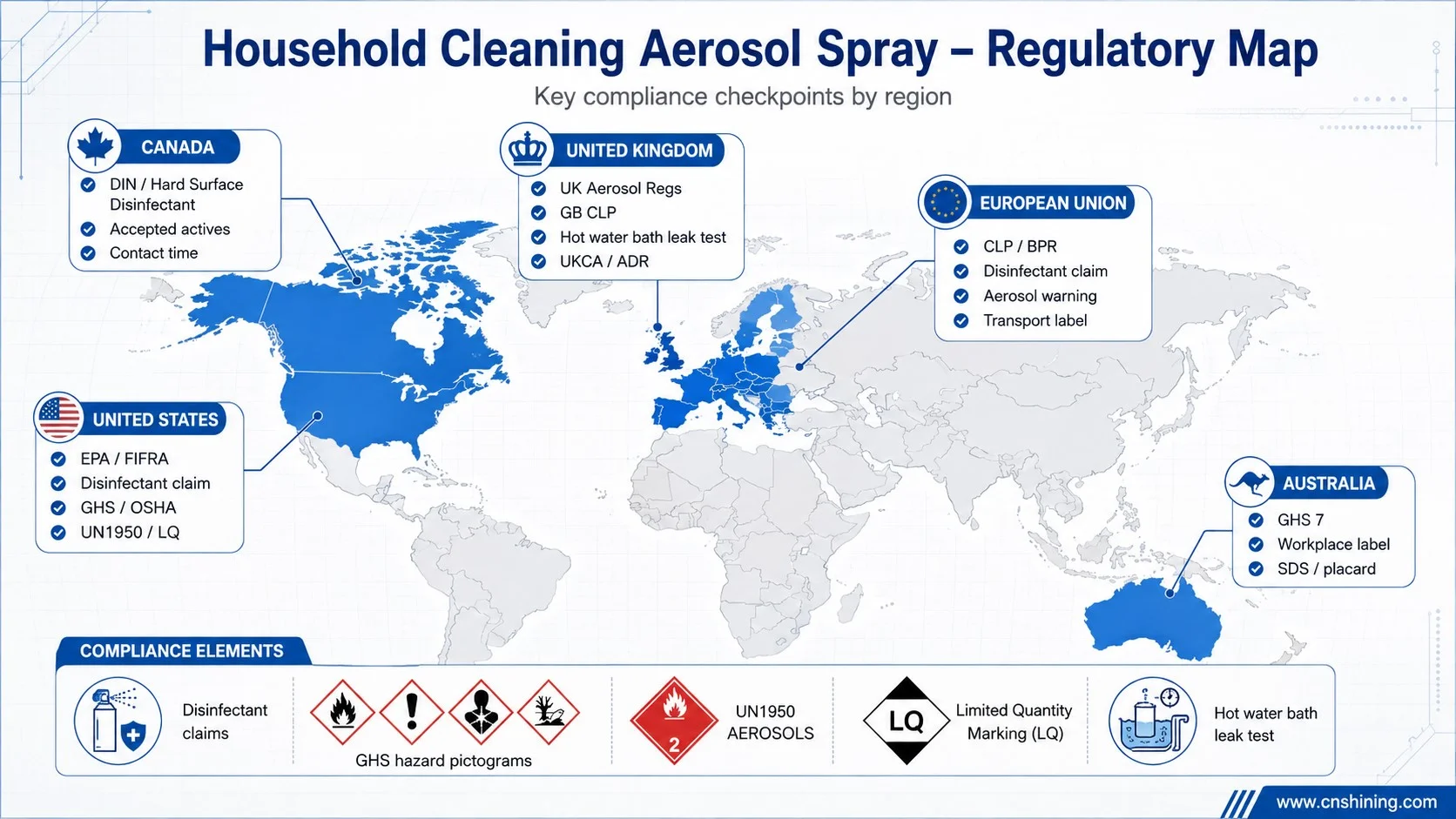
For household cleaning aerosol spray, regulation is not an add-on. It is part of product design. The product may sit under chemical classification, disinfectant claims, aerosol dispenser rules, pressure-container testing, transport of dangerous goods, and retail labeling at the same time.
| Region | Main Framework | Label Focus | Transport / Safety Focus | Engineering Meaning |
|---|---|---|---|---|
| United States | FIFRA/EPA label rules, OSHA HazCom, 16 CFR 1500.45, 49 CFR 173 | Directions for use, contact time, misuse statements, EPA Reg. No. | Division 2.1 / 2.2 aerosol classification; limited quantity conditions | Claims, formula, and label must be developed together. References: EPA pesticide labeling rules, 16 CFR flammability test, and 49 CFR hazardous materials rules. |
| European Union | Aerosol Dispensers Directive, CLP, Detergents Regulation, BPR, F-gas Regulation | Pressure container warnings, hazard classification, detergent disclosure, biocidal authorization | Extra attention to fluorinated gases and climate-related labeling | The trend is lower carbon, clearer authorization basis, and more transparent labeling. References: Aerosol Dispensers Directive, CLP Regulation, Biocidal Products Regulation, and F-gas Regulation 2024/573. |
| United Kingdom | Aerosol Dispensers Regulations 2009, UKCA / reversed epsilon, ADR / CDG | Conformity mark, pressure warnings, GB CLP alignment | Hot water bath, hot final test, or approved cold final test | Market access and leak-test approval are tightly linked. Reference: UK aerosol dispenser guidance. |
| Canada | Hard Surface Disinfectants Monograph and disinfectant drug guidance | Accepted actives, minimum concentrations, target organisms, contact time | Disinfectants follow a heavier efficacy and safety file route | Useful reference for active ingredient plus contact time logic. Reference: Health Canada hard surface disinfectants monograph. |
| Australia | Safe Work Australia GHS 7 chemical labeling | Aerosol category and hazard label elements | Workplace label, SDS, and placard expectations | A useful view of GHS 7 aerosol classification practice. Reference: Safe Work Australia chemical label guidance. |
5. Top 10 Household Cleaning Aerosol Spray Brands
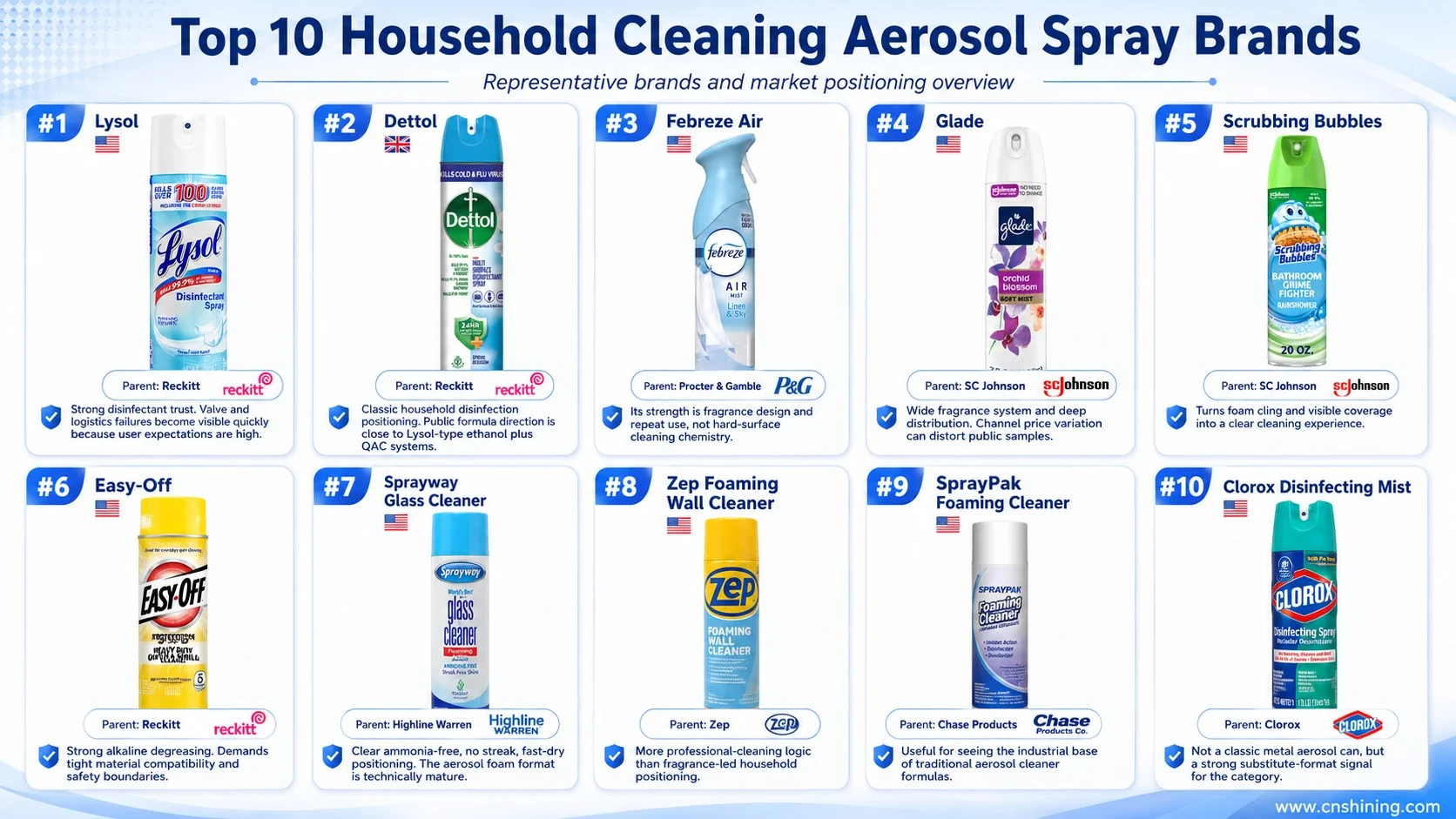
| Brand | Brand Origin | Parent Company | Spray Size | Price | Technical Comment |
|---|---|---|---|---|---|
| Lysol | United States | Reckitt | 1.5 oz, 19 oz | about $6.29-13.79 for 19 oz samples | Strong disinfectant trust. Valve and logistics failures become visible quickly because user expectations are high. |
| Dettol | United Kingdom | Reckitt | 300 ml, 400 ml | about $2.70-8.10 for 300 ml samples | Classic household disinfection positioning. Public formula direction is close to Lysol-type ethanol plus QAC systems. |
| Febreze Air | United States | Procter & Gamble | 8.1 oz, 8.8 oz | about $3.49-6.99 | Its strength is fragrance design and repeat use, not hard-surface cleaning chemistry. |
| Glade | United States | SC Johnson | 8 oz | about $1.48-17.99 | Wide fragrance system and deep distribution. Channel price variation can distort public samples. |
| Scrubbing Bubbles | United States | SC Johnson | 20 oz | about $4.99-8.69 | Turns foam cling and visible coverage into a clear cleaning experience. |
| Easy-Off | United States | Reckitt | 14.5 oz | about $5.48 | Strong alkaline degreasing. Demands tight material compatibility and safety boundaries. |
| Sprayway Glass Cleaner | United States | Highline Warren | 19 oz | about $3.59 | Clear “ammonia-free, no streak, fast dry” positioning. The aerosol foam format is technically mature. |
| Zep Foaming Wall Cleaner | United States | Zep | 18 oz | about $5.47 | More professional-cleaning logic than fragrance-led household positioning. |
| SprayPak Foaming Cleaner | United States | Chase Products | 16.5 oz, 17 oz | about $3.99-5.54 | Useful for seeing the industrial base of traditional aerosol cleaner formulas. |
| Clorox Disinfecting Mist | United States | Clorox | 14 fl oz | about $4.39-7.19 | Not a classic metal aerosol can, but a strong substitute-format signal for the category. |
6. Consumer Pain Points and Packaging Improvements
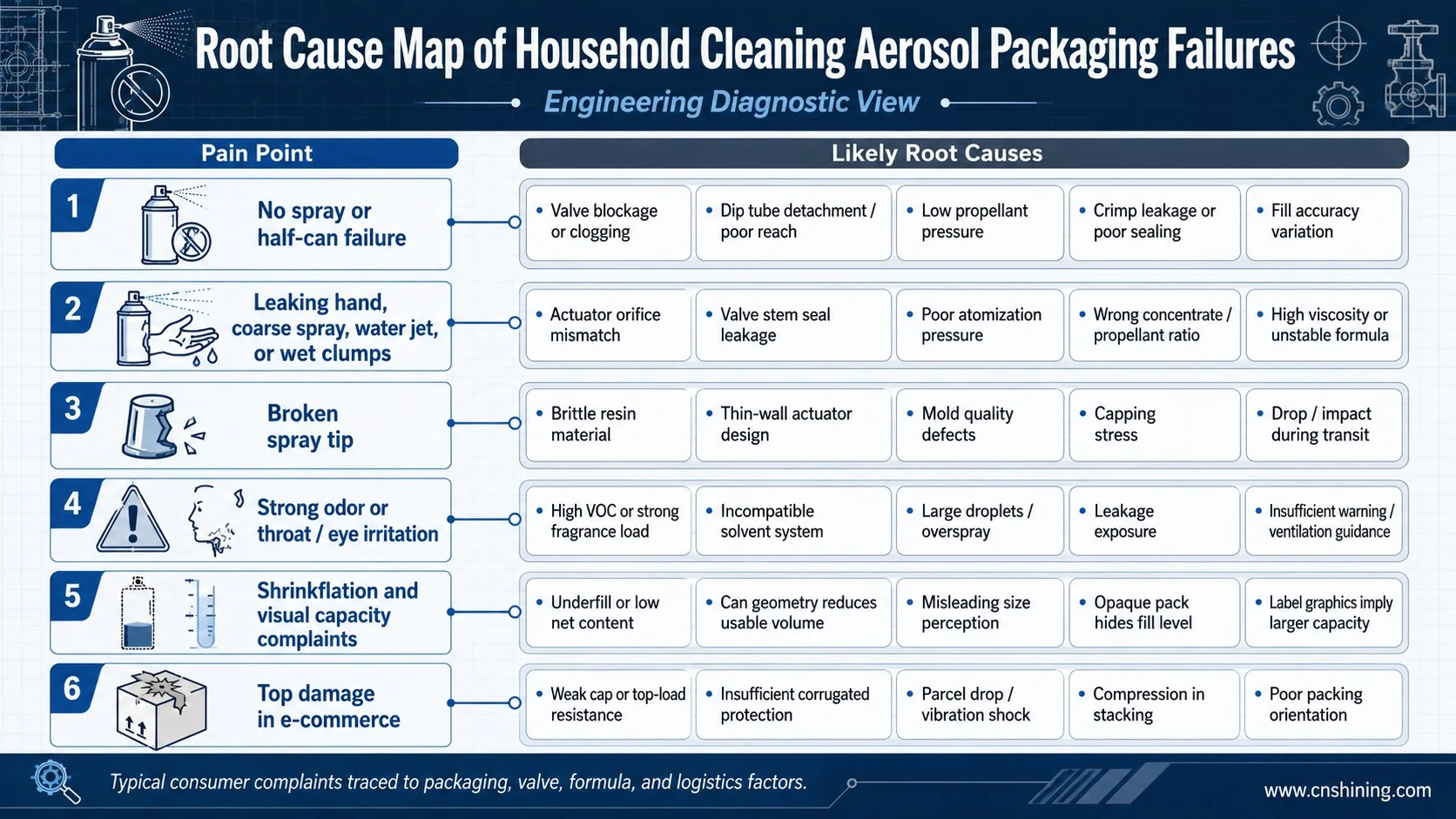
Public consumer feedback points to a hard conclusion: the most common complaint is not always weak cleaning power. It is spray failure. Users complain that the can does not spray, sprays unevenly, leaks onto the hand, produces wet clumps instead of mist, leaves half a can unusable, smells too strong, or looks visually misleading. Forum evidence such as a consumer thread on spray failure is not lab data, but it shows how valve and actuator issues become reputation issues.
| Pain Point | Likely Root Cause | Better Packaging / Valve Response |
|---|---|---|
| No spray or half-can failure | Poor valve cup crimp control, sticky stem, blocked dip tube, formula-propellant mismatch | Larger filtration area, anti-clog stem design, stricter crimp process control, stronger leak testing, BOV for high-salt or high-viscosity systems |
| Leaking hand, coarse spray, water jet, or wet clumps | Actuator insert or orifice not matched to formula and propellant pressure | Use fan or soft mist actuators for fabric and soft surfaces; separate soft-surface and hard-surface spray heads |
| Broken spray tip | Actuator resin toughness, snap-fit fatigue, top compression during transport | Reinforced overcap, twist-to-lock, deeper e-commerce protective cap |
| Strong odor or throat / eye irritation | High fragrance load, fast solvent evaporation, fine mist drift | Lower initial fragrance burst, coarser soft mist, stronger ventilation wording on front label |
| Shrinkflation and visual capacity complaints | Large shoulder or tall slim pack creating a capacity illusion | Front label net content plus estimated spray count; more honest can height and shoulder ratio |
| Top damage in e-commerce | Weak overcap and insufficient single-can protection | Channel-specific compression ring, taller cap, shrink sleeve pair pack, molded pulp support |
The practical message is simple: if the valve fails, the formula cannot explain itself. Consumers press once and judge the whole system. Packaging engineering is therefore not secondary decoration. It is the user interface.
7. Product Interface: Actuators, Aerosol Cans, and Valves from Shining Packaging
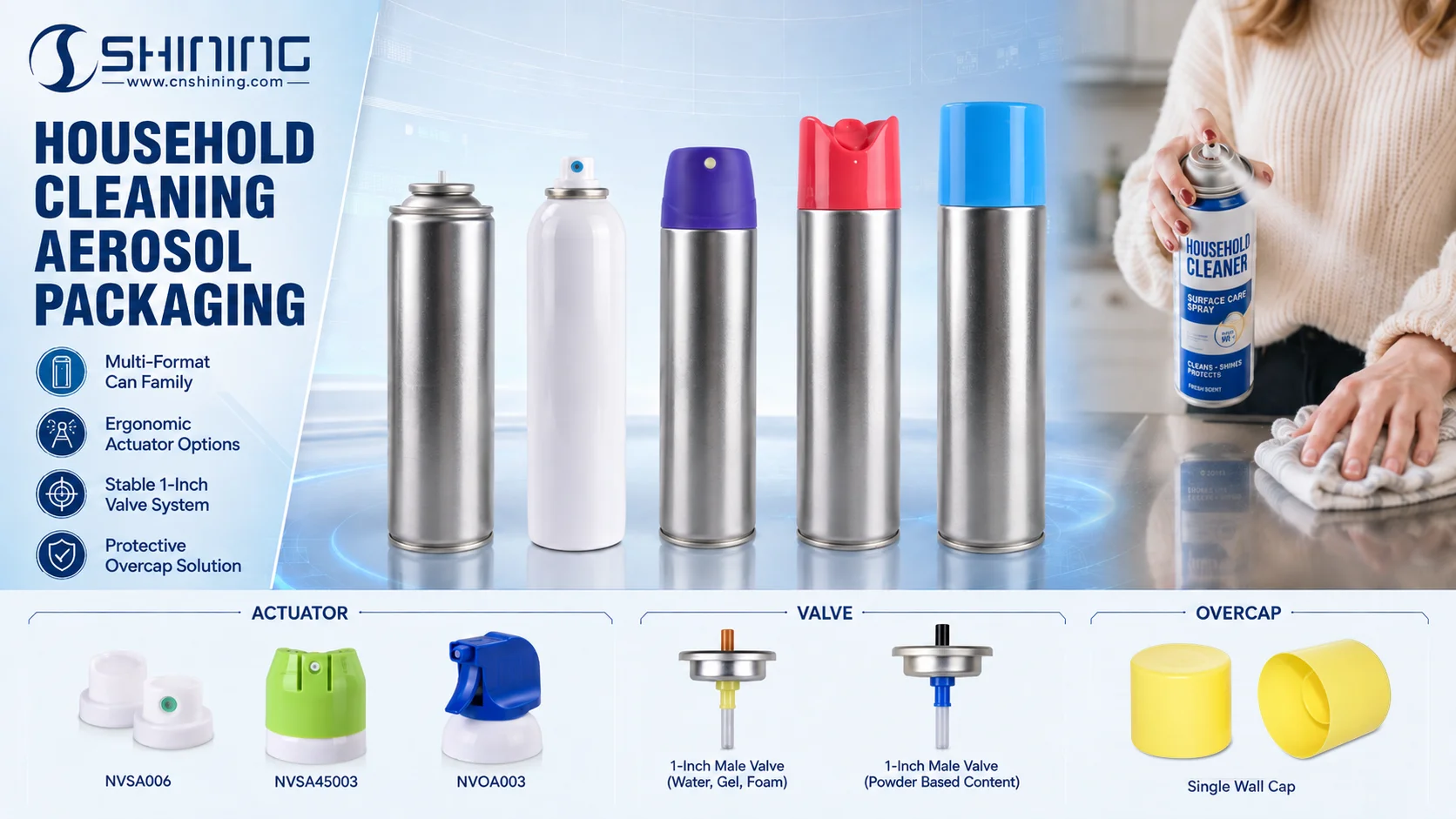
For Shining Packaging, the relevant work area in household cleaning aerosol spray is the hardware interface: actuator, aerosol can, valve, dip tube, overcap, and compatibility planning. The formula owner may define cleaning power, but the package decides whether the product sprays as a fine mist, foam, fan pattern, or wet stream through the whole can life.
In practical development, actuator choice should follow the surface. Glass cleaner needs controlled wetting and low streaking. Bathroom foam needs cling and output. Disinfectant spray needs enough wet coverage to meet contact time. Air freshener aerosol needs drift control and odor release without excessive throat hit. One actuator cannot solve all of these without compromise.
The aerosol can and valve should be selected with the formula profile in mind. Strong alkaline oven cleaner pushes lining, gasket, and corrosion-control requirements. Alcohol-rich disinfectant spray stresses seal compatibility and flammability labeling. High-fragrance air care systems can challenge gasket swelling and odor retention. For BOV or compressed gas systems, the valve must also handle pressure decay, evacuation, and spray stability.
8. Technical Frontiers, Patents, and Research Map
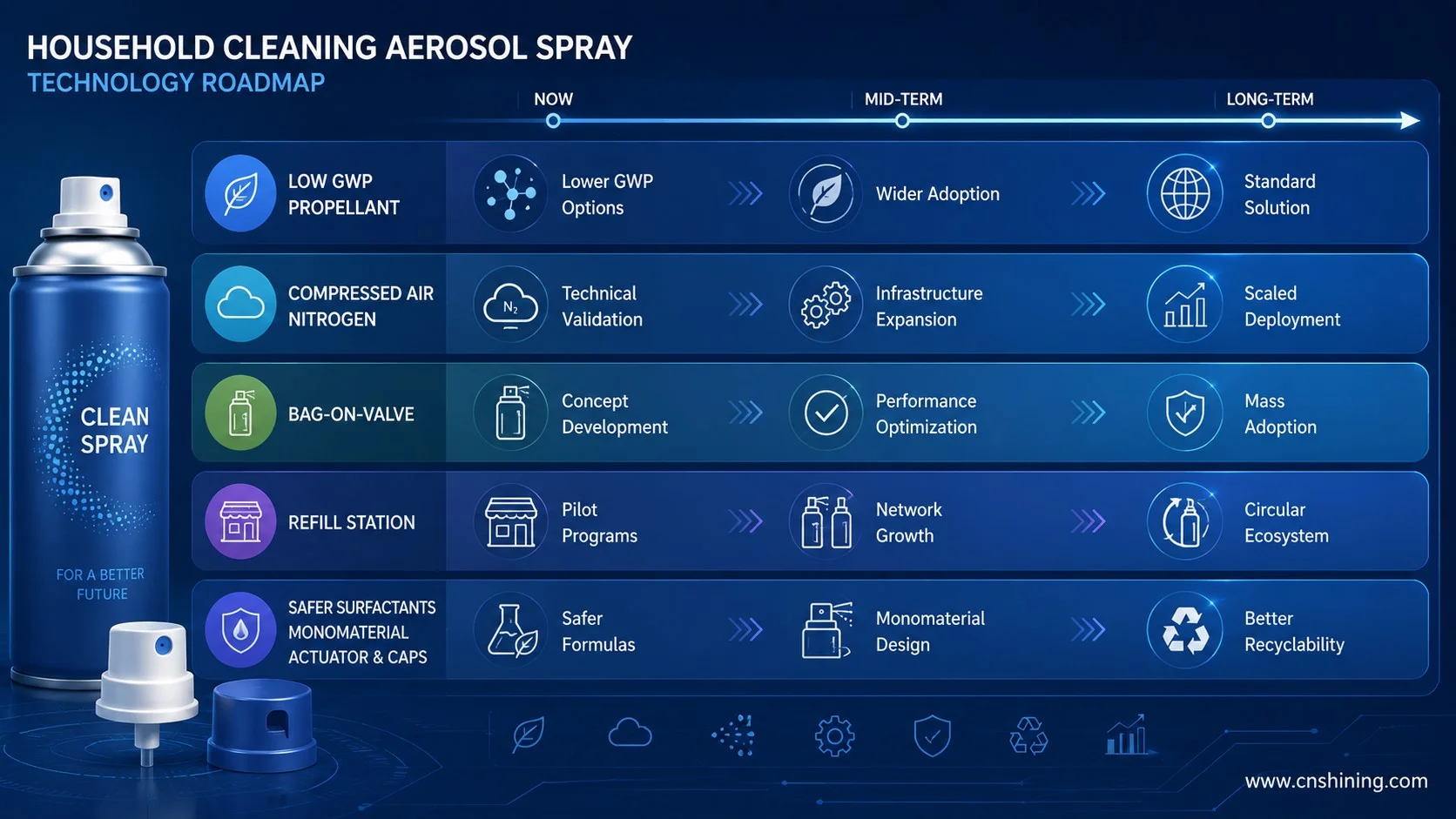
The technical direction is already visible: lower GWP propellants, compressed air or nitrogen, BOV, refill infrastructure, concentrated formulas, safer surfactants, monomaterial actuators, and better spray control. This does not mean traditional LPG aerosol disappears. It means the engineering threshold goes up.
EPA SNAP material lists substitutes in propellant applications through Substitutes in Propellants, while EPA also published technical notes on transitioning to low-GWP aerosol alternatives. For household cleaners, the question is not only whether a substitute gas exists. The real question is whether the spray pattern still feels stable after switching away from LPG.
Refill systems are also worth watching. Respray has shown a store-based refill model for compressed-air aerosol packaging through its refill solution. If this type of infrastructure scales, the aerosol can may stop being treated purely as a disposable pack and start behaving more like a controlled channel asset.
Green chemistry is not just a claim layer. EPA Safer Choice documents, including the Safer Choice and DfE Standard and Safer Choice surfactant criteria, push formulators to compare hazard profiles inside the same functional class. That affects surfactants, fragrance carriers, VOC contribution, aquatic toxicity, and biodegradation.
| Source Type | Representative Source | Technical Value |
|---|---|---|
| Patent | HFO-1234ze household aerosol routes | Shows that low-GWP fluorinated olefin use in household aerosol is a patented technical path, not just a concept. |
| Patent | Multi-refillable piston-type spray can | Shows refillable aerosol concepts existed before the recent refill trend. |
| Patent | BOV plus activated-carbon or filtering structure | Points to deodorizing and filtering structures as possible household aerosol combinations. |
| Patent | Air freshener water / ethanol / DPnP / fragrance systems | Useful for reading air-care aerosol stability, odor control, and sprayability. |
| Industry report | FEA and BAMA data | Closest public material for production structure and filling trends. |
| Forum source | Cleaning and shrinkflation forums | Fast way to detect how engineering failure becomes consumer language. |
Actuators and caps are also moving toward fewer materials and better recyclability. The industry direction is not “use less plastic and accept worse spray.” It is to reduce material complexity while keeping spray rate, lock function, and plume control stable. The monomaterial actuator and cap discussion is a useful reference for this shift.
9. Closing Technical View
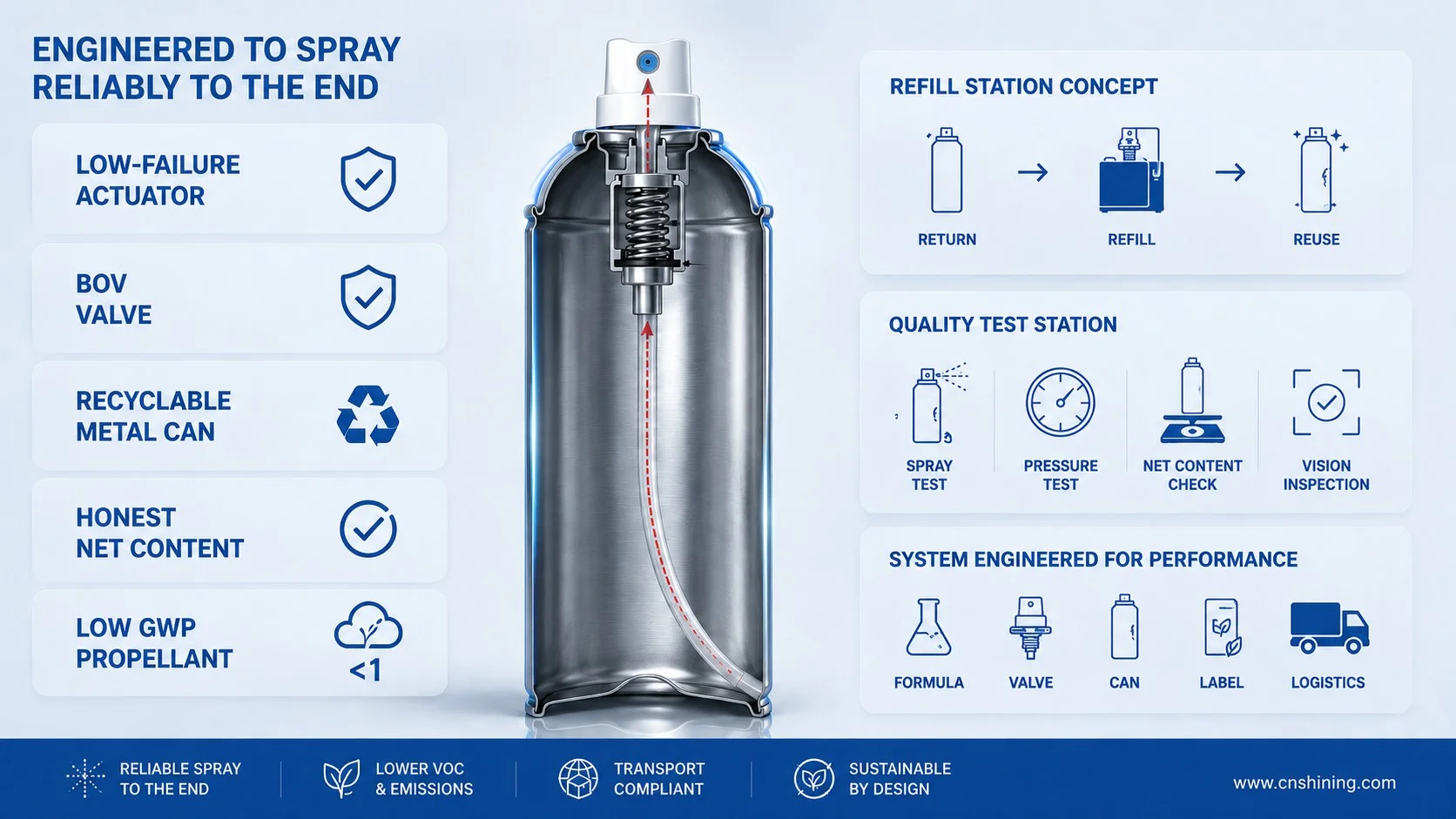
Household cleaning aerosol spray will not disappear. It will become more engineering-driven. The next cycle will reward packages that spray reliably to the end, match the formula with the valve and lining, reduce propellant and VOC pressure, pass transport rules without drama, and communicate net content honestly. The product is no longer only a cleaner in a can. It is a formula, valve, actuator, can, label, and logistics system working together.
10. FAQ: Household Cleaning Aerosol Spray
A household cleaning aerosol spray uses internal pressure to dispense product continuously after the actuator is pressed. A trigger spray depends on user hand force for every stroke. Aerosol packaging gives faster coverage, more stable spray feel, and foam or 360-degree options, but it adds propellant selection, pressure safety, valve reliability, and dangerous-goods transport requirements.
Early spray failure usually comes from the dispensing system, not the cleaning formula alone. Common causes include actuator blockage, valve stem sticking, dip tube restriction, poor valve cup crimping, loss of propellant pressure, or formula-propellant incompatibility. High-viscosity, high-salt, alkaline, or particle-containing formulas need stronger filtration and more careful valve selection.
Bag-on-valve separates the product from the propellant by placing the formula inside a flexible bag and compressed gas outside it. This reduces product-propellant interaction, can support 360-degree use, and often improves evacuation. It is useful for sensitive, viscous, or low-VOC products, but it costs more and requires different filling and validation work.
Yes. Propane, butane, and isobutane remain common because they are mature, cost-effective, and provide stable pressure with good spray quality. Their weak points are flammability, VOC pressure, labeling burden, and transport complexity. Many new projects are testing compressed gas, BOV, or lower-GWP routes, but LPG is still widely used in mass-market aerosol systems.
The actuator controls more than user touch. Its insert, swirl chamber, orifice, and spray outlet shape affect droplet size, spray angle, flow rate, foam quality, and clogging risk. A glass cleaner, bathroom foam, fabric disinfectant, and air freshener should not automatically use the same actuator because their target surfaces and wetting behavior differ.
The lining protects the metal can from the formula. Strong alkali, alcohol, amines, fragrance oils, and corrosion-active systems can attack poorly matched coatings. If lining selection is wrong, the result may be corrosion, gas loss, discoloration, odor change, or leakage. Lining, gasket, valve, and formula compatibility should be tested as one package system.
Disinfectant claims depend on the surface staying wet for the required contact time. A spray that atomizes too finely may dry too fast, while a heavy wet spray may cause residue or material damage. The formula, actuator, spray rate, and label directions must support the claimed kill performance under realistic household use conditions.
Public data are strongest at the broad aerosol or regional production level. Narrow household cleaning aerosol spray values are rarely available for free. A practical market view uses broad aerosol value reports, FEA production splits, household aerosol subcategories, and brand-level SKU evidence. Directly mixing retail value and production unit data creates misleading precision.
Packaging cannot remove all formula odor, but it can change exposure. A coarser soft mist, lower spray drift, controlled output, and better actuator targeting can reduce direct inhalation. Label placement also matters. Strong-fragrance or alcohol-rich sprays should clearly state ventilation and surface-use limits instead of hiding the warning in small back-label text.
Test formula compatibility with can lining, valve gasket, stem, dip tube, and actuator resin. Check spray rate, droplet behavior, foam quality, clogging, leakage, corrosion, hot water bath performance, storage stability, and end-of-can evacuation. If the product claims disinfection, test contact time and label directions together with the real spray pattern.