
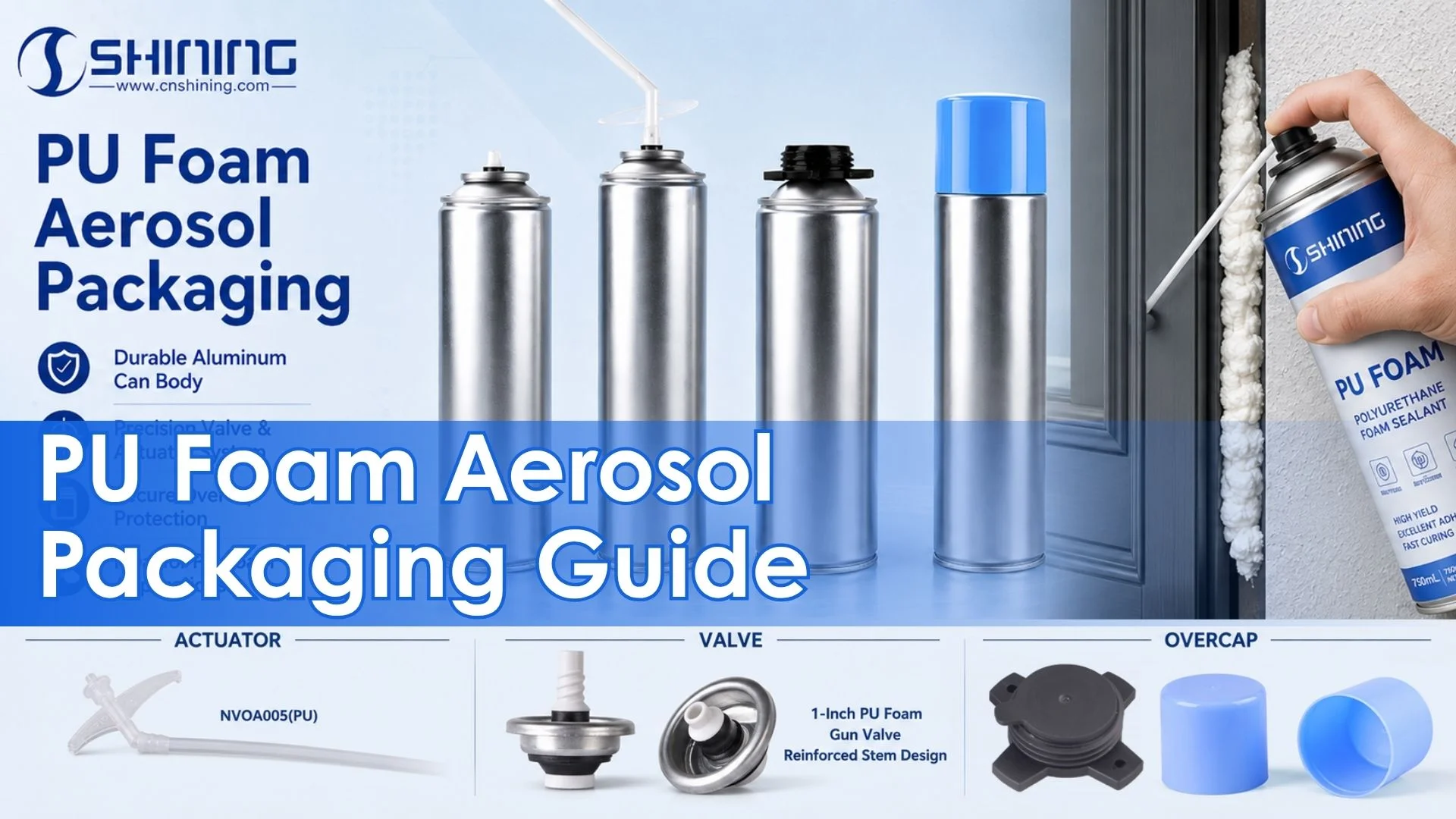
PU foam aerosol spray fails most often at the dispensing path, not in the cured foam. The chemistry matters, but the user usually judges the product through a simpler question: does the can dispense cleanly, stop cleanly, and work again after the first use?
This article focuses on one-component polyurethane foam aerosol, also called 1K PU foam aerosol, one-component PU foam, expanding foam aerosol, foam gap filler, gun-grade PU foam and straw-grade PU foam. The subject sits between adhesive, sealant and insulating material. Treating it as only “foam in a can” misses the main engineering point.
1. Technical Definition and Operating Mechanism
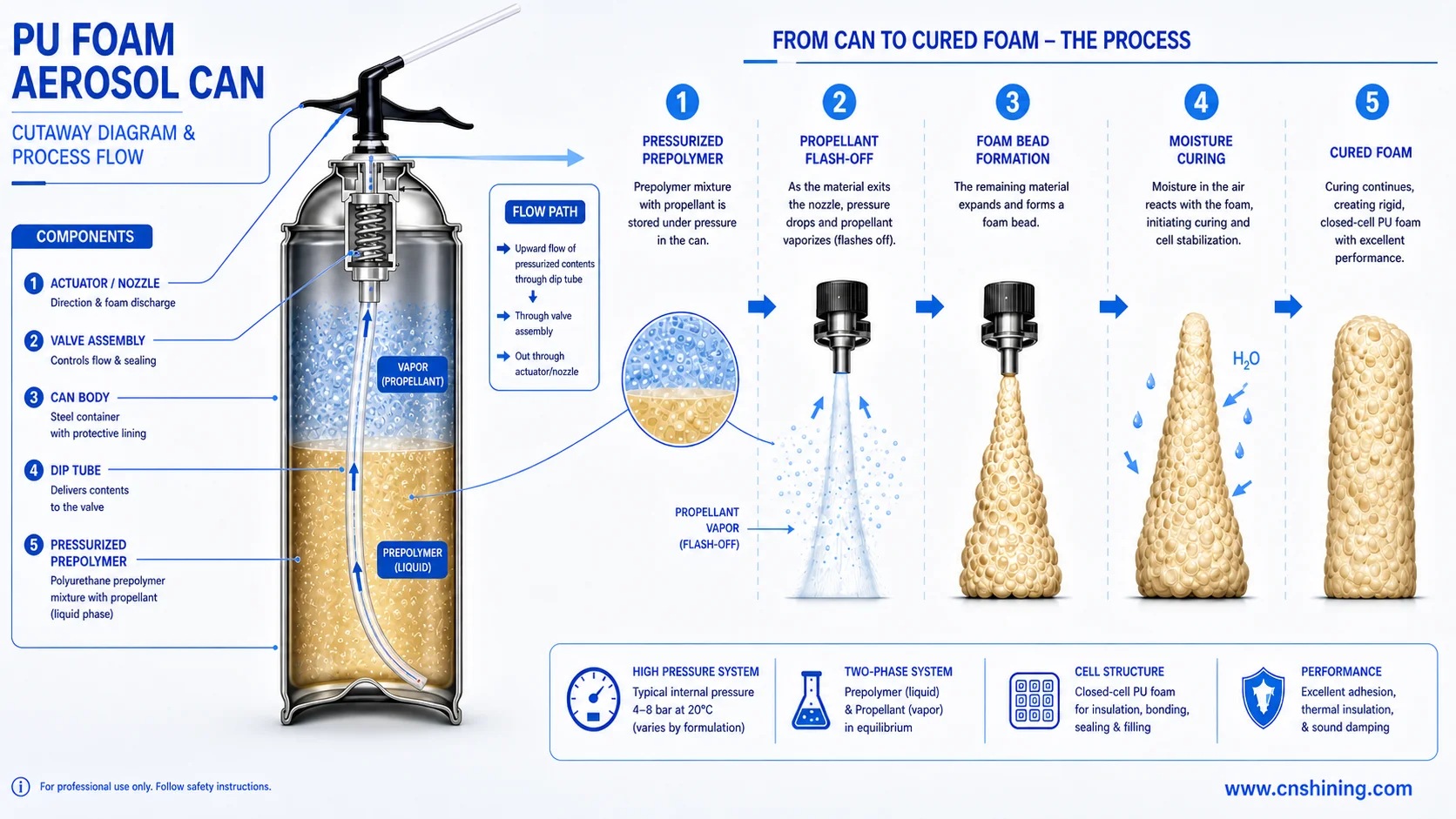
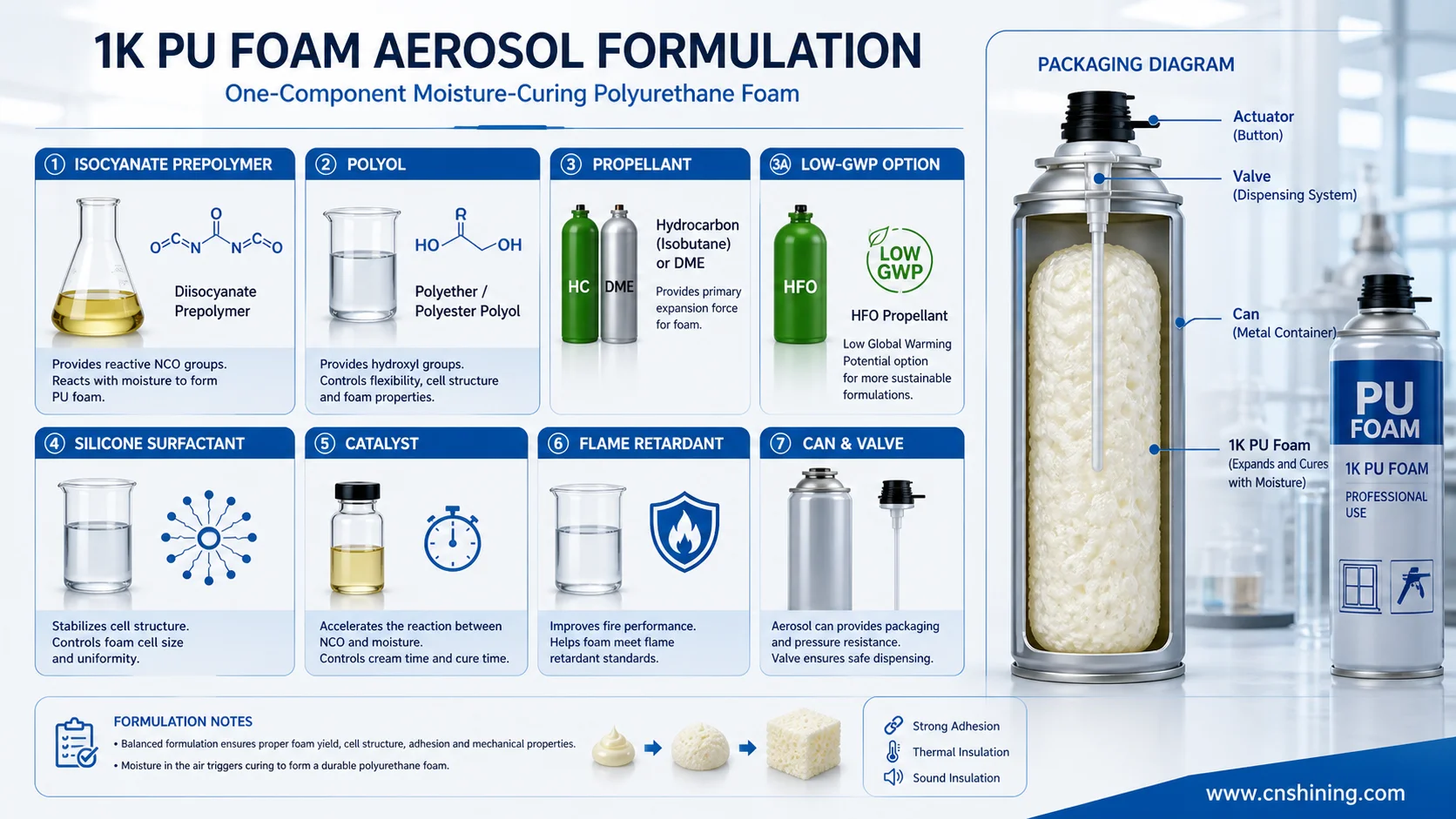
PU foam aerosol spray is a one-component, moisture-curing polyurethane foam system. Inside the pressure-resistant aerosol can are an isocyanate-terminated polyurethane prepolymer, propellant or blowing medium, surfactants, catalysts, flame retardants and other additives. The user does not meter or mix components on site. Pressing the actuator is enough to release and foam the material.
The working process can be read in four steps:
- The can stores the formulation under pressure. The propellant supplies discharge force and supports initial physical foaming.
- When the actuator is pressed, the valve stem moves, the gasket seal opens, and internal pressure pushes the liquid through the valve body and actuator channel.
- As the material exits the can, pressure drops quickly. The propellant flashes off and creates the first foam bead.
- The foam contacts air moisture. Residual -NCO groups react with water, forming urea and urethane networks while generating some CO2. The surface skins first; internal curing then becomes moisture-diffusion controlled.
This explains why typical data sheets focus on tack-free time, cut time, post-expansion, dimensional stability and free-rise density. These properties are not only chemical values. They are shaped by formulation viscosity, propellant vapor pressure, actuator geometry, valve compatibility and ambient humidity. A research paper on enhanced one-component spray polyurethane foams also describes OCF as a moisture-cured foam dispensed from pressurized containers used for installing doors and windows, sealing roof gaps and insulating buildings through gap filling and air sealing applications: one-component spray polyurethane foam mechanism.
2. Valve, Actuator and Propellant Interaction
PU foam aerosol is not a standard spray valve filled with thicker content. The basic aerosol valve principle is the same: actuator pressure depresses the stem, opens the sealing interface, and allows pressure to move product outward. The difference is that PU foam can continue expanding and curing inside the flow channel.
For this reason, the commercial value of the package is decided by the system: formulation × valve × actuator × internal can protection × user instructions. The valve gasket must resist the prepolymer, propellant and storage environment. The actuator must control bead size, reduce after-drip and reduce cured residue. The can and internal coating must keep moisture and metal contamination under control.
| Component | Main Function | Key Design Point | Common Failure |
|---|---|---|---|
| Valve | Sealing, opening and first metering path | Compatibility of gasket or elastomer with prepolymer and propellant; no sticking during shelf life | Stuck valve, slow leakage, no second opening |
| Actuator / Nozzle | Controls hand feel, flow, bead size and drip behavior | Outlet geometry, channel length, anti-drip and reuse structure | After-drip, cured nozzle, over-application, messy bead |
| Propellant / Blowing System | Pushes material out and creates initial cell structure | Vapor pressure, solubility, flammability, GWP and regulatory fit | Unstable expansion, shrinkage, flow variation, compliance cost |
| Can Body and Internal Coating | Pressure containment, corrosion resistance and moisture barrier | Resistance to moisture, solvent attack and metal contamination | Skinning inside can, corrosion, shorter shelf life |
3. Market Size and Regional Pattern
Open summaries place the global one-component polyurethane foam market around US$3.2–3.3 billion in 2024–2025, with longer forecasts moving toward a larger 2030–2033 market. ResearchAndMarkets gives a global market page for this category here: one-component polyurethane foam market data.
| Reference Year | Public Value | Reading Method |
|---|---|---|
| 2020 | About US$2.4bn | Older public estimate; not directly comparable with newer forecasts |
| 2024 | About US$3.2bn | Commercial research summary, different base definition |
| 2025 | About US$3.25bn | Commercial research summary, forecast period differs by provider |
| 2030 | About US$4.7bn | Forecast band, not a continuous historical series |
| 2033 | About US$5.33bn | Longer forecast horizon; compare carefully |
At regional level, one public data set uses a consistent 2023 base year and 2031 forecast. Asia-Pacific is the largest region, followed by North America and Europe.
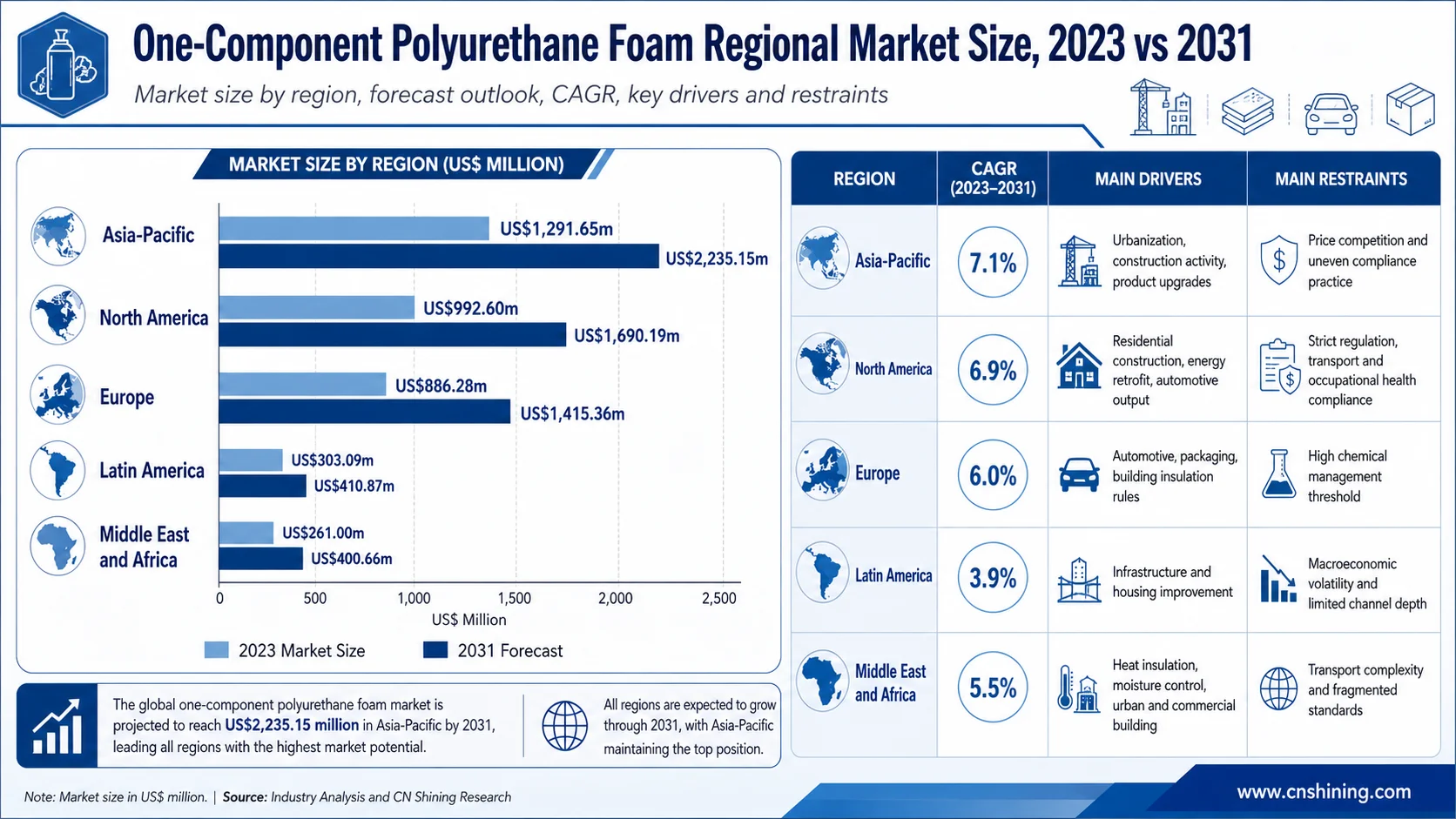
| Region | 2023 Market Size | 2031 Forecast | CAGR | Main Drivers | Main Restraints |
|---|---|---|---|---|---|
| North America | US$992.60m | US$1,690.19m | 6.9% | Residential construction, energy retrofit, automotive output | Strict regulation, transport and occupational health compliance |
| Europe | US$886.28m | US$1,415.36m | 6.0% | Automotive, packaging, building insulation rules | High chemical management threshold |
| Asia-Pacific | US$1,291.65m | US$2,235.15m | 7.1% | Urbanization, construction activity, product upgrades | Price competition and uneven compliance practice |
| Latin America | US$303.09m | US$410.87m | 3.9% | Infrastructure and housing improvement | Macroeconomic volatility and limited channel depth |
| Middle East and Africa | US$261.00m | US$400.66m | 5.5% | Heat insulation, moisture control, urban and commercial building | Transport complexity and fragmented standards |
The common growth drivers are clear: building energy efficiency, old-house renovation, air sealing around windows and wall penetrations, lightweight filling, shorter labor time, and low-GWP propellant development. The common restraints are also clear: isocyanate health risk, training rules, aerosol transport limits, raw material price movement, narrow construction windows in low temperature or high humidity, and the familiar half-used-can problem.
4. Performance Profile and Substitution Logic
The main strength of 1K PU foam aerosol is not absolute peak performance. It is field efficiency. One can handles filling, initial expansion, bonding, and some thermal and acoustic insulation. That is why it fits window installation, crack sealing, renovation repair and DIY work.
The main weakness is also fixed by its mechanism. It depends on moisture curing. It can continue expanding after application. It is hard to reuse if foam cures in the straw or actuator path. The uncured material also carries isocyanate and aerosol transport obligations.
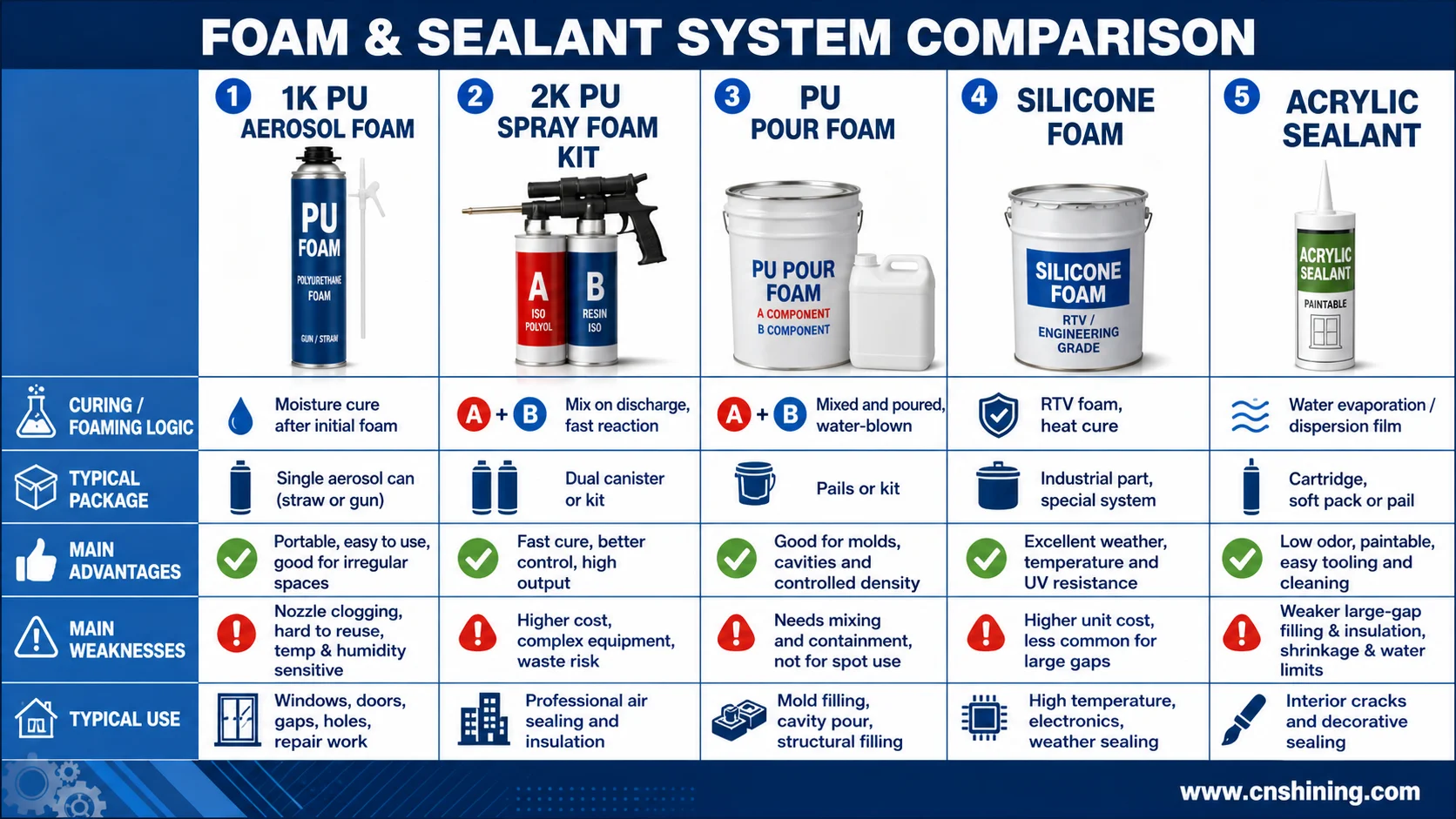
| System | Curing / Foaming Logic | Typical Package | Main Advantages | Main Weaknesses | Typical Use |
|---|---|---|---|---|---|
| 1K PU Aerosol Foam | Pressure drop creates initial foam; moisture completes cure | Single aerosol can, straw-grade or gun-grade | Portable, no on-site ratio control, good for irregular cavities | Nozzle clogging, reuse difficulty, temperature and humidity sensitivity, post-expansion control | Window and door installation, gaps, holes, repair work |
| 2K PU Spray Foam / Sealant Kit | A/B components mix during discharge and react quickly | Dual canister or kit | Fast cure, better reaction control, higher work output | Higher cost, more complex equipment, waste risk after activation | Professional air sealing and insulation |
| PU Pour Foam | A/B mixed and poured, usually water-blown | Pails or kit | Useful for molds, cavities and controlled density filling | Not convenient for spot aerosol dispensing; needs mixing and containment | Mold filling, cavity pour, structural filling |
| Silicone Foam | Often RTV or engineering-grade foamed silicone | Industrial part, gasket, special potting system | Better weathering, temperature and UV resistance in many cases | Higher unit cost; less common for rapid large-gap filling | High temperature, electronics, weather-resistant sealing |
| Acrylic Sealant | Water evaporation or dispersion film formation | Cartridge, soft pack or pail | Low odor, paintable, easy tooling and cleaning | Weaker large-gap filling and insulation than PU foam; shrinkage and water resistance limitations | Interior cracks and decorative sealing |
For small workstations, 1K PU aerosol foam is usually the most efficient choice. For faster cure and larger output, 2K kits are stronger. For high-temperature or weathering priority, silicone systems make more sense. For paintability and low odor, acrylic sealants are easier to handle. The right question is not “which material is better?” The right question is “which failure mode matters most at the job site?”
5. Formulation Routes and Terms
Public patents and technical data show that typical 1K PU foam aerosol contains isocyanate or isocyanate-terminated prepolymer, polyether or polyester polyols, blowing agent, silicone surfactant, amine catalyst, flame retardant, plasticizing or rheology modifiers, and sometimes cell-opening agents or emulsifiers.
The difficulty is not the list of ingredients. The difficulty is balance. High viscosity hurts flow and trigger feel. A strong propellant can increase post-expansion. Very low free monomer design can affect shelf stability, rheology and mechanical properties. Packaging compatibility then becomes part of the formulation.
| Formulation Route | Key Composition | Typical Range / Example | Main Function | Technical Note |
|---|---|---|---|---|
| Conventional 1K OCF | Isocyanate prepolymer + polyol + hydrocarbon/DME/HFO propellant + silicone surfactant + catalyst | Patent examples often show isocyanate 35–60 wt%, polyol 30–55 wt%, propellant system 5–35 wt% | Storage stability, dispensing foam and moisture cure | Easy to apply, but demanding on packaging compatibility |
| Low Free MDI 1K OCF | PMDI/MDI prepolymer + TDI-capped prepolymer + mono-functional alcohol + diol + castor oil + flame retardant + catalyst | Public example: 15–25 wt% MDI/PMDI prepolymer; 50–75 wt% TDI-capped prepolymer; 5–15 wt% mono-functional alcohol; 1–15 wt% diol; 8–20 wt% castor oil | Lower free MDI without a separate monomer removal step | Developed mainly under occupational health and low monomer pressure |
| Hydrocarbon / DME Propellant | Propane, butane, i-butane, DME, CO2 blends | EP 2383304 example uses a 60 vol.% propellant system containing 7 wt% propane, 63 wt% i-butane and 30 wt% DME | Cost and flow advantages | Flammable; more sensitive to valve sticking and material compatibility |
| Low-GWP HFO or Inert Gas Route | HFO, CO2, N2O or inert gas with special emulsifier, cell opener and surfactant design | WO 2011123248 requires propellant system 5–35 wt%, with at least 50 wt% non-liquefied inert gas | Lower GWP and better regulatory fit | Requires reformulation of flow, cell structure and pressure behavior |
| 2K PU Kit | A-side isocyanate; B-side polyol, catalyst, surfactant and blowing agent | EPA/CPSC materials describe A/B two-component systems | Fast and stable reaction for larger work areas | More complex and more expensive than a single aerosol can |
| PU Pour Foam | Water-blown A/B system | Common commercial systems use 1A:1B, with some grade exceptions | Mold and cavity filling with selected density | Not suitable for direct point-spray aerosol use |
Two patent examples show the direction. EP 2383304 describes a low free monomer one-component foam composition built around specific MDI/PMDI and alcohol chemistry: low free monomer one-component PU foam composition. WO 2011123248 shows that low-GWP inert gas use is not a simple propellant swap; emulsification, cell opening and surfactant design must change together: one-component PU foam with non-liquefied inert propellant.
| Term | Short Meaning | Commercial Meaning |
|---|---|---|
| 1K / One-component | Factory-filled system curing by ambient moisture | DIY-friendly and channel-friendly |
| 2K / Two-component | Two components mix during application | Professional, higher-output work |
| NCO Content | Amount of isocyanate groups in the system | Affects cure rate, reactivity and compliance |
| Free Monomeric MDI | Unreacted monomeric MDI | Directly tied to risk labelling and EU training |
| Tack-free Time | Time until surface is no longer sticky | Controls site rhythm and rework window |
| Cut Time | Time until foam can be trimmed | Controls finishing speed |
| Post-expansion | Expansion after initial placement | Too much can deform frames or overflow joints |
| Free-rise Density | Density of free-expanded foam | Affects fill feel, insulation and material use |
| Closed-cell / Open-cell | Cell structure balance | Affects water uptake, strength, insulation and stability |
| Yield / Theoretical Yield | Expected foam volume or board feet | Directly affects cost calculation and label claims |
| Gun-grade | Threaded can for foam gun | Better metering and reuse, professional channel |
| Straw-grade | Handheld straw dispenser | Lower entry barrier, weaker reuse stability |
| Low Expansion | Reduced post-expansion formula | Useful for windows and deformation-sensitive areas |
| Fire-rated | Flame-retardant or fire-resistance positioning | Needed in engineering or fire-stop applications |
| GWP | Global warming potential | Key propellant and blowing-agent policy factor |
| VOC | Volatile organic compound | Affects regional compliance, odor and green building claims |
| UN1950 | Dangerous goods number for aerosols | Controls transport documentation and labelling |
| Shelf Life | Usable storage period | Linked to valve sticking, skinning and return rate |
6. Regulatory, Safety and Transport Constraints
Compliance is layered. It is not only about the cured foam. Many restrictions apply to the uncured chemical system, the pressurized aerosol package, shipping mode and user behavior.
| Region / Area | Key Item | Direct Business Effect |
|---|---|---|
| European Union | REACH restriction on diisocyanates: industrial and professional use above 0.1 wt% total diisocyanates requires training from 24 August 2023; label requirement started earlier | B2B and professional channels need training, SDS, label control and sales documentation. Low-monomer development becomes more attractive. |
| European Union | Aerosol Dispensers Directive 75/324/EEC | Sets basic aerosol dispenser definitions, container capacity and safety requirements. It affects can and valve design. |
| United States | EPA SNAP foam blowing agent substitutes and AIM-related transition pressure | High-GWP HFC routes face long-term pressure. HFO and low-GWP systems are more future-oriented. |
| United States | TSCA risk management for MDI and related compounds | Risk communication around isocyanate exposure remains relevant, especially for consumer and self-employed user scenarios. |
| GCC / Middle East | GSO 917:2021 aerosol dispenser standard | Non-refillable metal, plastic and glass aerosol dispensers must meet local product-entry requirements. |
| International Transport | FEA guide on transport of aerosols: UN1950, limited quantity, ADR/IMDG/IATA boundaries | Net content, propellant choice, outer carton marks and transport documents shape the real sales radius. |
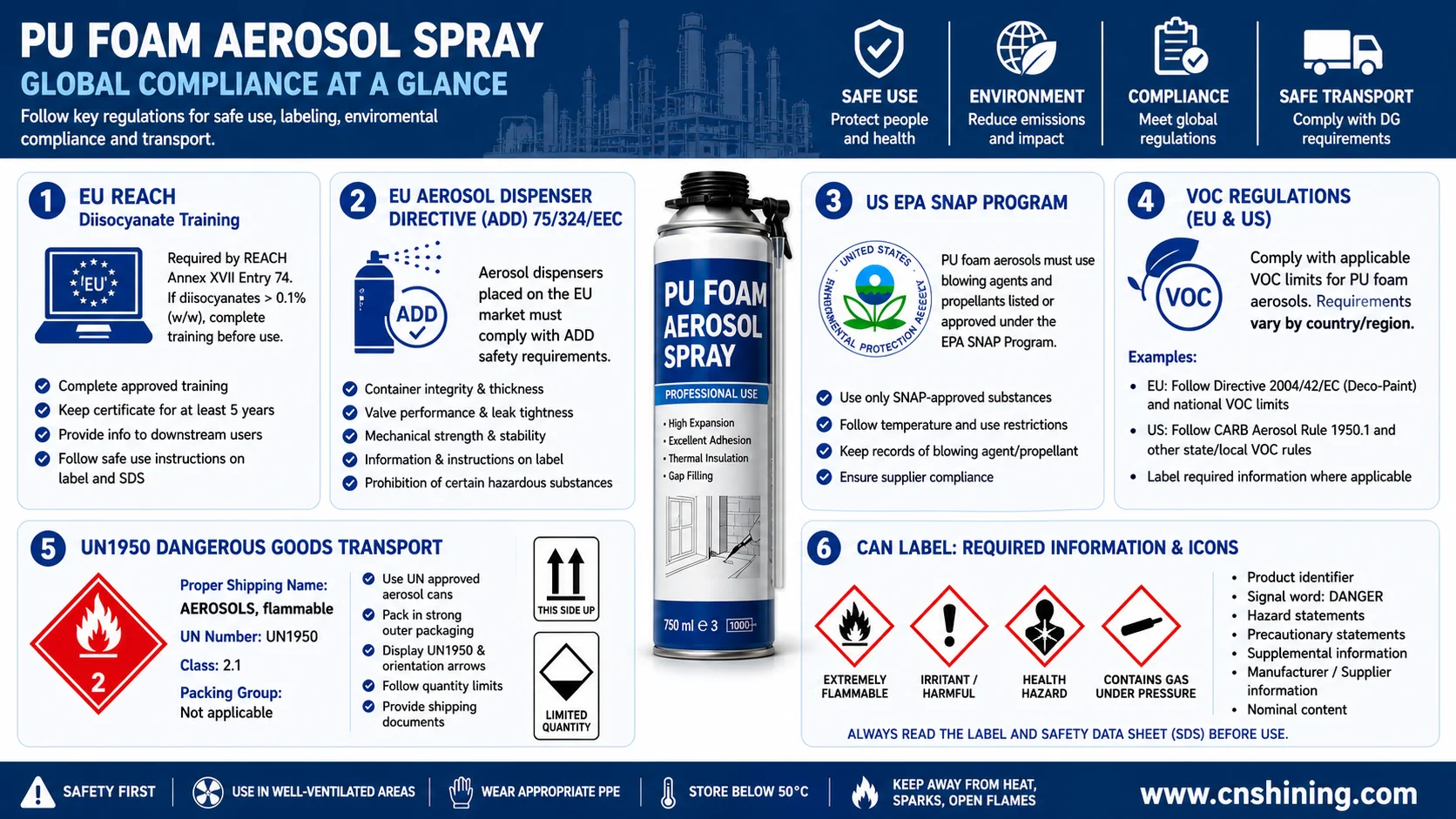
The safety message is simple: “safe after cure” does not replace “safe during application.” Uncured MDI-containing foams can present inhalation and skin sensitization concerns. For cross-border e-commerce and sample shipment, the problem is often upstream. The SKU must be designed for the intended transport path before launch.
7. Technology Trends: Low-GWP, Reuse and Recycling
The clearest technology trend is the move toward low-GWP propellant and blowing systems. Honeywell Solstice materials state that its HFO blowing agent technology can be used in one- and two-component PUR foams and can deliver very low GWP relative to older HFC options: HFO foam blowing agents for PUR foams. The technical issue is not only climate claim. The formulation must still hold foam cell uniformity, flow rate, shrinkage resistance and shelf stability.
A second trend is controlled expansion. Low-expansion products reduce the risk of window-frame deformation and overfilling. Soudal’s public low-expansion foam data sheet emphasizes minimal expansion and no shrinkage or post-expansion positioning: low-expansion PU foam data sheet.
A third trend is smarter dispensing. DuPont’s GREAT STUFF Smart Dispenser publicly emphasizes reuse up to 30 days, no dripping and better control: Smart Dispenser reuse and anti-drip concept. That shows where user value has moved. Better expansion yield matters, but a can that works again after interruption often matters more.
A fourth trend is packaging circularity. Aerosol cans are commonly steel or aluminum, both with mature recycling markets. The hard part is not metal recyclability. It is emptying, sorting and clear user instructions. FEA’s recycling page gives the sector-level view: aerosol can recycling context.
8. Top 10 PU Foam Aerosol Spray Brands
| Brand / Line | Country | Parent Company | Common Capacity | Public Price Snapshot | Technical Comment |
|---|---|---|---|---|---|
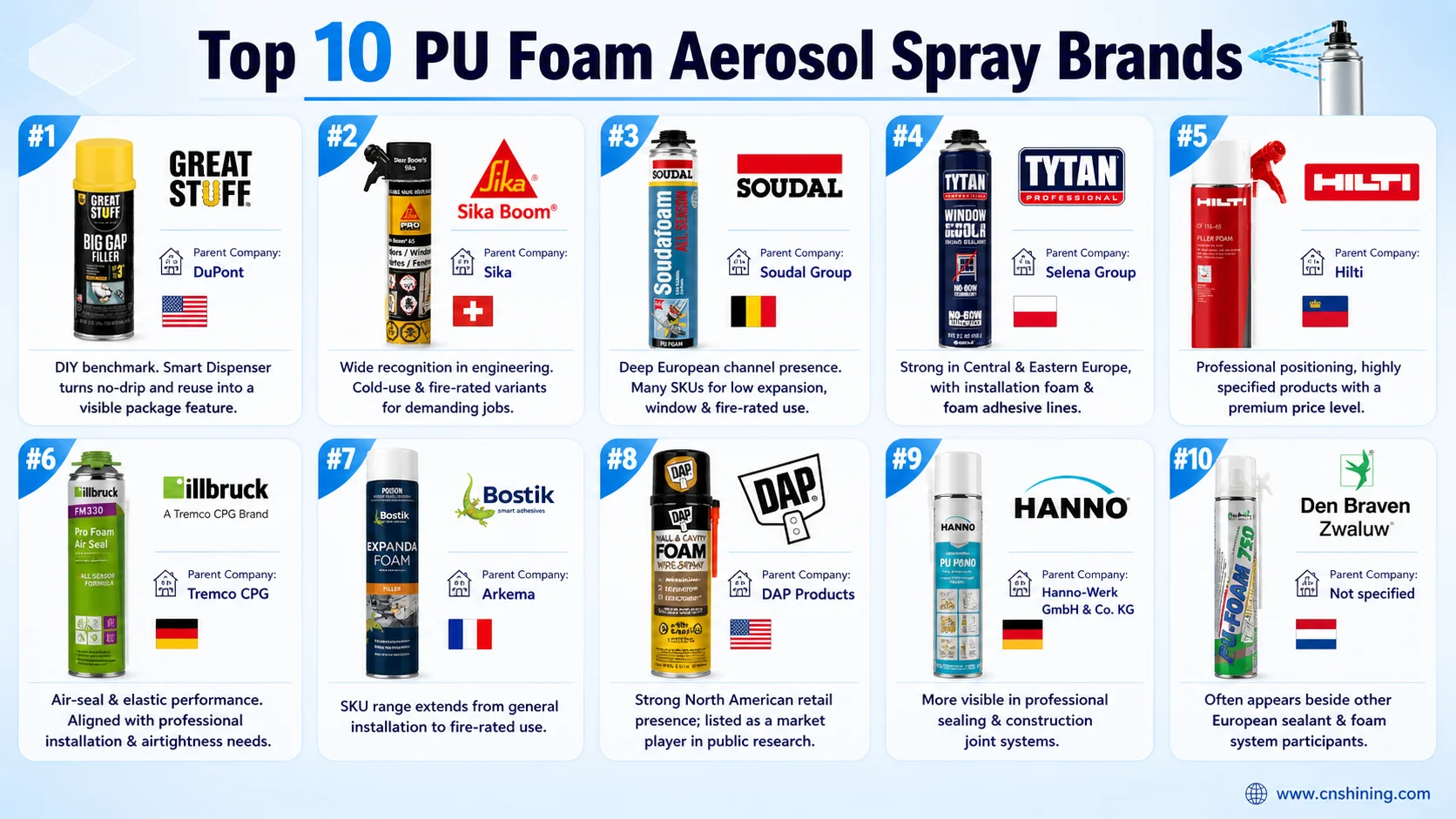
| GREAT STUFF | United States | DuPont | 12 oz / 340 g | about $4.48–$5.98 / 12 oz in US retail snapshots | DIY benchmark. Smart Dispenser turns no-drip and reuse into a visible package feature. |
| Sika Boom | Switzerland | Sika | 400 ml, 750 ml | about $19–$38 / 750 ml in public snapshots | Good recognition in engineering channels, with cold-use and fire-rated variants. |
| Soudal Soudafoam | Belgium | Soudal Group | 300 ml, 500 ml, 750 ml | about $9–$10+ / 750 ml in UK retail snapshots | Deep European channel presence. Many SKUs for low expansion, window and fire-rated use. |
| TYTAN Professional | Poland | Selena Group | 750 ml | about $13 / 750 ml in Netherlands retail snapshot | Strong in Central and Eastern Europe, with installation foam and foam adhesive lines. |
| Hilti CF Series | Liechtenstein | Hilti | 22.5 oz and other formats | about $40+ / can on US professional channel snapshots | Professional positioning, highly specified products, clearly higher price level. |
| illbruck FM330 | Germany | Tremco CPG | 750 ml | about $15–$21 / 750 ml in public snapshots | Air-seal and elastic positioning. More aligned with professional installation. |
| Bostik Expanda / Foam’n’Fill | France | Arkema | 750 ml | about $14–$16 / 750 ml in regional snapshots | SKU range extends from general installation to fire-rated use. |
| DAP Products | United States | DAP Products / RPM International | 12 oz, 16 oz, 24 oz formats | about $6–$12 / 12 oz in US retail snapshots | Strong North American retail presence; listed as a market player in public research summaries. |
| Hanno-Werk | Germany | Hanno-Werk GmbH & Co. KG | 750 ml | about $9–$18 / 750 ml in European distributor snapshots | More visible in professional sealing and construction joint systems. |
| Den Braven / Zwaluw | Netherlands | Bostik / Arkema | 750 ml | about $7–$14 / 750 ml in European retail snapshots | Often appears beside other European sealant and foam system participants. |
9. User Pain Points and Packaging Engineering Actions
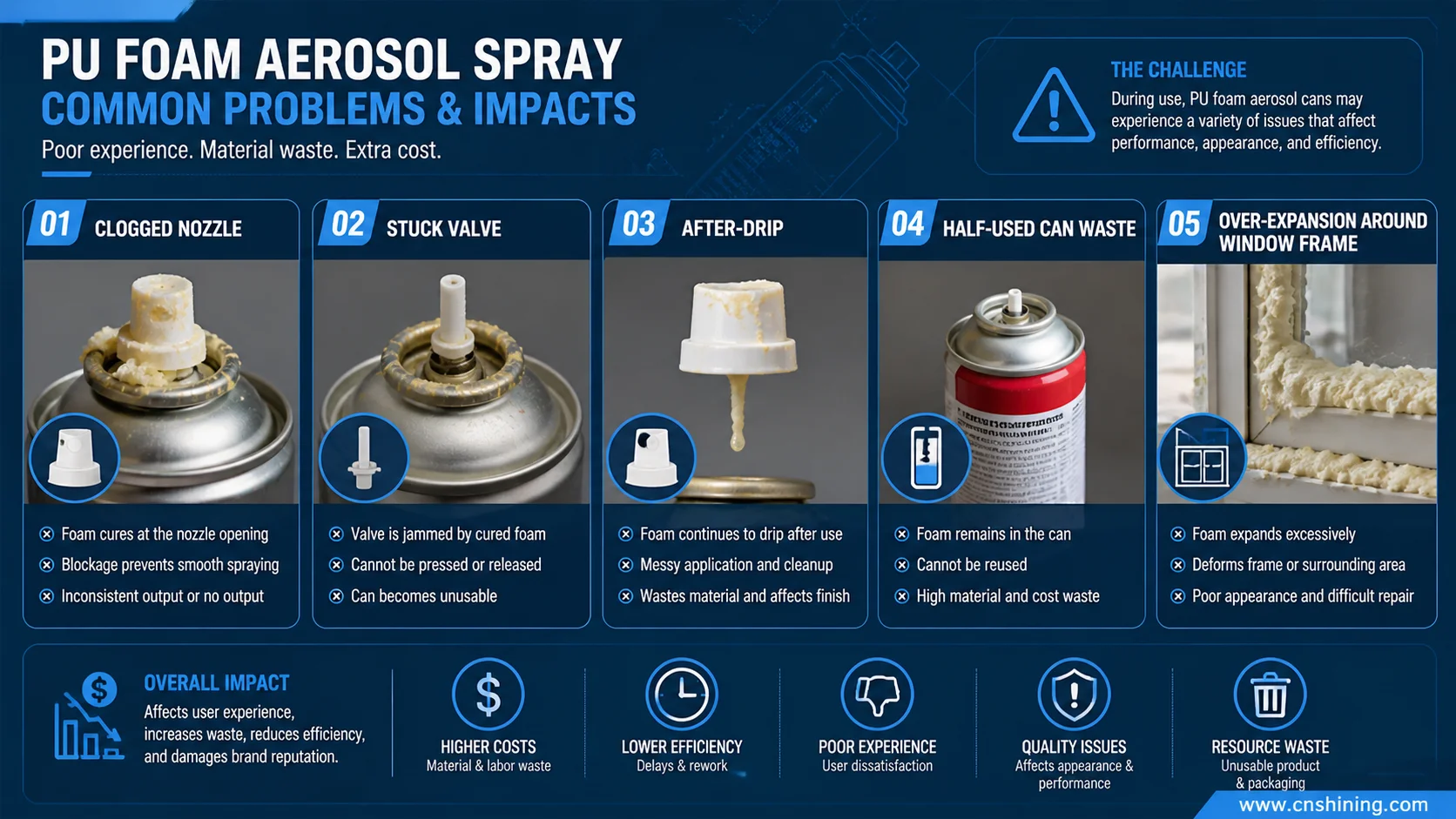
User complaints concentrate on a small number of practical failures: half-used cans becoming waste, clogged nozzles, stuck valves, messy application, uncontrolled post-expansion and poor cleanup. These are not minor user-experience issues. They are packaging engineering issues.
| Pain Point | Likely Technical Cause | Packaging Action |
|---|---|---|
| Half-used can discarded | Foam cures in straw or actuator channel after first use | Reusable integrated actuator, self-sealing tip, cleaner interface, stronger anti-drip or pull-back function |
| Stuck valve | Moisture migration, incompatible propellant, poor storage position, cured polymer near valve seal | More robust elastomer and gasket design, clear upright storage instruction, valve shelf-life testing with filled formula |
| Messy application | Unstable bead size, large residual channel volume, uncontrolled discharge burst | Shorter dead volume, trigger-style actuator, bead-stable outlet geometry, simple front-label guidance |
| Over-expansion | User fills too much before post-expansion completes | Large icons for gap width, final expansion, low-expansion window SKU and trimming time |
| Job interruption causes failure | Nozzle left with reactive residue and no sealing path | Interrupt-friendly cap, plug feature, pause-time warning and short QR video instruction |
| Can skinning or shelf-life drop | Moisture inside can, metal contamination, internal coating weakness | Moisture-controlled filling, compatible internal lacquer, corrosion control at seams and curl areas |
The practical priority is clear. Reduce reuse failure before chasing a small increase in theoretical yield. A customer does not notice another 1–2% foam volume if the nozzle blocks after one small gap. A cleaner second use is a stronger technical claim.
10. Shining Packaging Components for PU Foam Aerosol Spray
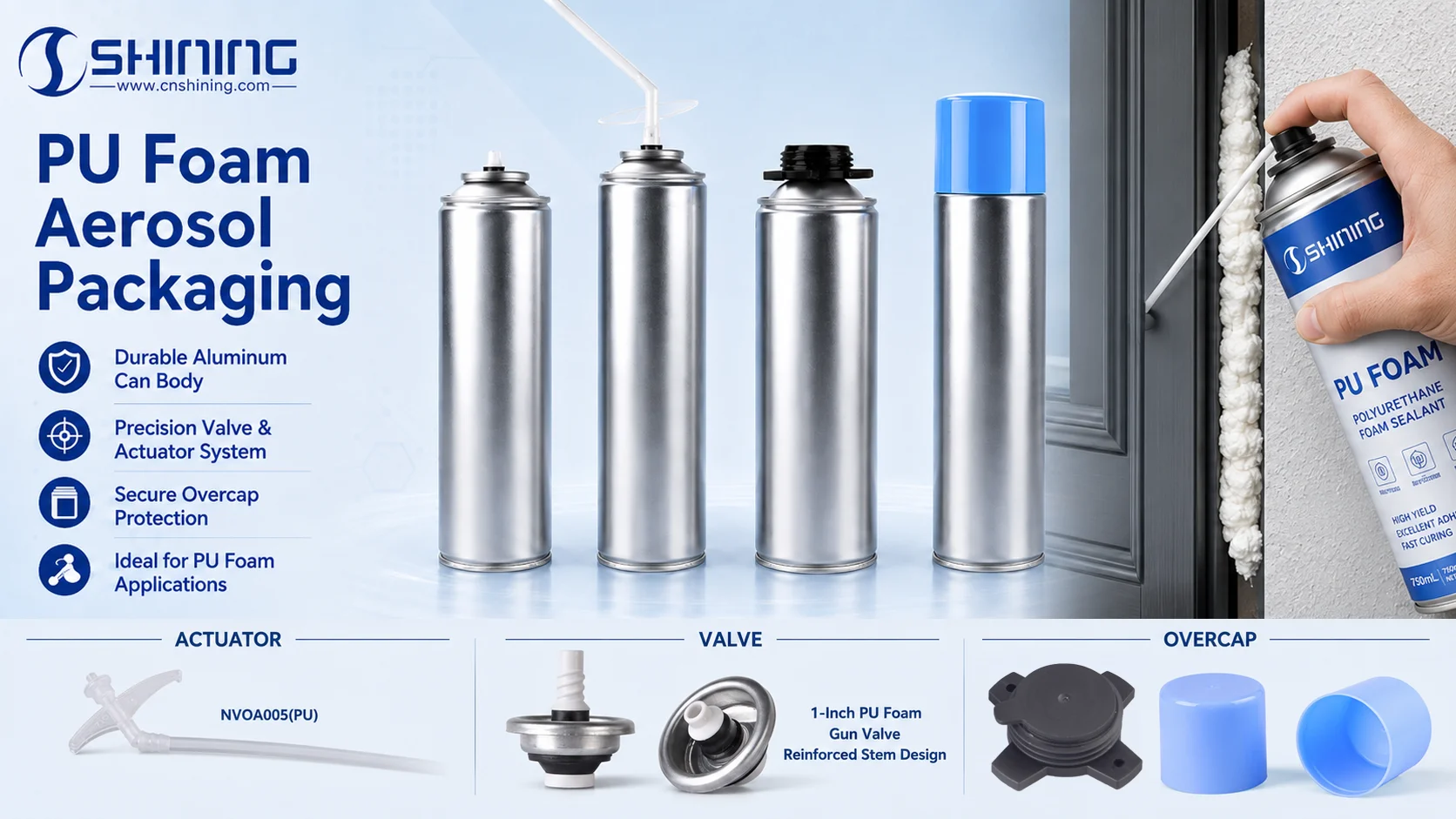
For PU foam aerosol spray, the package should be specified as a dispensing system, not as separate parts purchased by price only. The actuator controls bead shape, hand feel, drip behavior and residue volume. The valve controls sealing, opening force, compatibility and shelf-life stability. The can body and inner coating control pressure safety, corrosion resistance and moisture protection.
Shining Packaging’s relevant component scope fits this system view: aerosol actuators, aerosol valves including PU valve options, and aerosol cans for technical products. For a PU foam project, the useful discussion is usually about valve elastomer compatibility, upside-down or gun-grade use, actuator flow path, internal coating, pressure rating, printing space for safety instructions and shelf-life validation with the filled formulation.
This is not a place for shortcuts. A lower-cost valve or actuator can become expensive if it increases returned cans, clogged outlets or half-used-can waste. The correct package decision should be made after filled-can testing, storage-position testing, discharge repeatability testing and post-dispense residue observation.
11. Conclusion
PU foam aerosol spray is a practical product because one can can fill, expand, seal, bond and insulate small to medium gaps. Its main technical risk is also practical: the dispensing system can fail before the chemistry has a chance to show its value.
The strongest development direction is therefore clear: lower reuse failure, improve actuator control, prevent stuck valves, manage post-expansion, and move toward low-GWP propellant systems without sacrificing shelf stability. For packaging developers, the value is no longer only in the resin formula. It is in the complete delivery experience.
12. FAQ: PU Foam Aerosol Spray
PU foam aerosol spray is usually a one-component polyurethane foam packed in a pressurized aerosol can. The can contains an isocyanate-terminated prepolymer, propellant or blowing system, surfactants, catalysts and additives. When dispensed, pressure drop creates the first foam structure, then ambient moisture cures the foam into a solid cellular material used for gaps, windows, doors and repair work.
One-component PU foam contains reactive isocyanate groups that need water from air or the substrate to complete curing. After the foam exits the can, moisture reacts with residual -NCO groups and forms urea and urethane networks. The surface skins first, then moisture diffuses inward. This is why temperature, humidity and joint depth can change tack-free time and cut time.
Nozzle clogging happens because uncured foam remains in the straw, actuator outlet or valve-adjacent flow path. That residue is still moisture-reactive. Once air and humidity reach it, it can cure inside the narrow channel. Long actuator channels, high dead volume, poor sealing caps and interrupted use all increase the chance that a half-used can becomes difficult to reuse.
A stuck valve can result from cured prepolymer near the valve seal, moisture migration through elastomer parts, incompatible propellant systems or poor storage position. Hydrocarbon propellants and side or upside-down storage can increase the risk in some systems. Valve gasket material, stem design and shelf-life testing with the actual filled formula are more useful than checking the valve alone.
Straw-grade PU foam uses a simple handheld straw actuator and is easier for DIY users. It has a lower entry barrier but often weaker reuse control. Gun-grade foam uses a threaded interface for a foam dispensing gun. It gives better metering, cleaner bead control and improved reuse when properly cleaned, so it is more common in professional installation work.
Post-expansion occurs because foam continues to expand after the first discharge and during moisture curing. If the user fills a gap completely at the beginning, the later expansion can push window frames, overflow joints or create trimming waste. Low-expansion formulas, clearer label icons and better actuator flow control help reduce the mismatch between user expectation and final foam volume.
Low-GWP propellants are not simple drop-in replacements. Changing from older propellant systems to HFO, CO2, inert gases or blends can change vapor pressure, solubility, discharge rate, cell structure and shrinkage behavior. The formulation often needs adjusted surfactants, emulsifiers or cell-opening agents. The valve, can pressure rating and actuator flow path must also be checked under storage and discharge tests.
The main compliance areas are diisocyanate exposure rules, aerosol dispenser safety rules, VOC or blowing-agent regulations, and dangerous goods transport. In the EU, professional or industrial use above the diisocyanate threshold requires training. For transport, aerosols usually fall under UN1950 rules. The uncured formulation and pressurized package drive many obligations, not the cured foam alone.
Internal coating helps isolate the reactive formulation from metal surfaces, corrosion sites and contamination. PU foam systems are sensitive to moisture and certain contaminants because they can trigger skinning or premature reaction. A suitable internal lacquer, controlled filling moisture and stable curl or seam protection can reduce can corrosion, internal skin formation and shelf-life complaints that users never connect to the can body.
Testing should cover filled-can storage, valve sticking, leakage, actuator residue, discharge rate, bead control, post-dispense drip, upright and inverted use where relevant, corrosion, pressure safety and repeat use after interruption. The package should be tested with the real formulation and propellant system. Component-only approval is weak because PU foam performance depends on the combined system.