
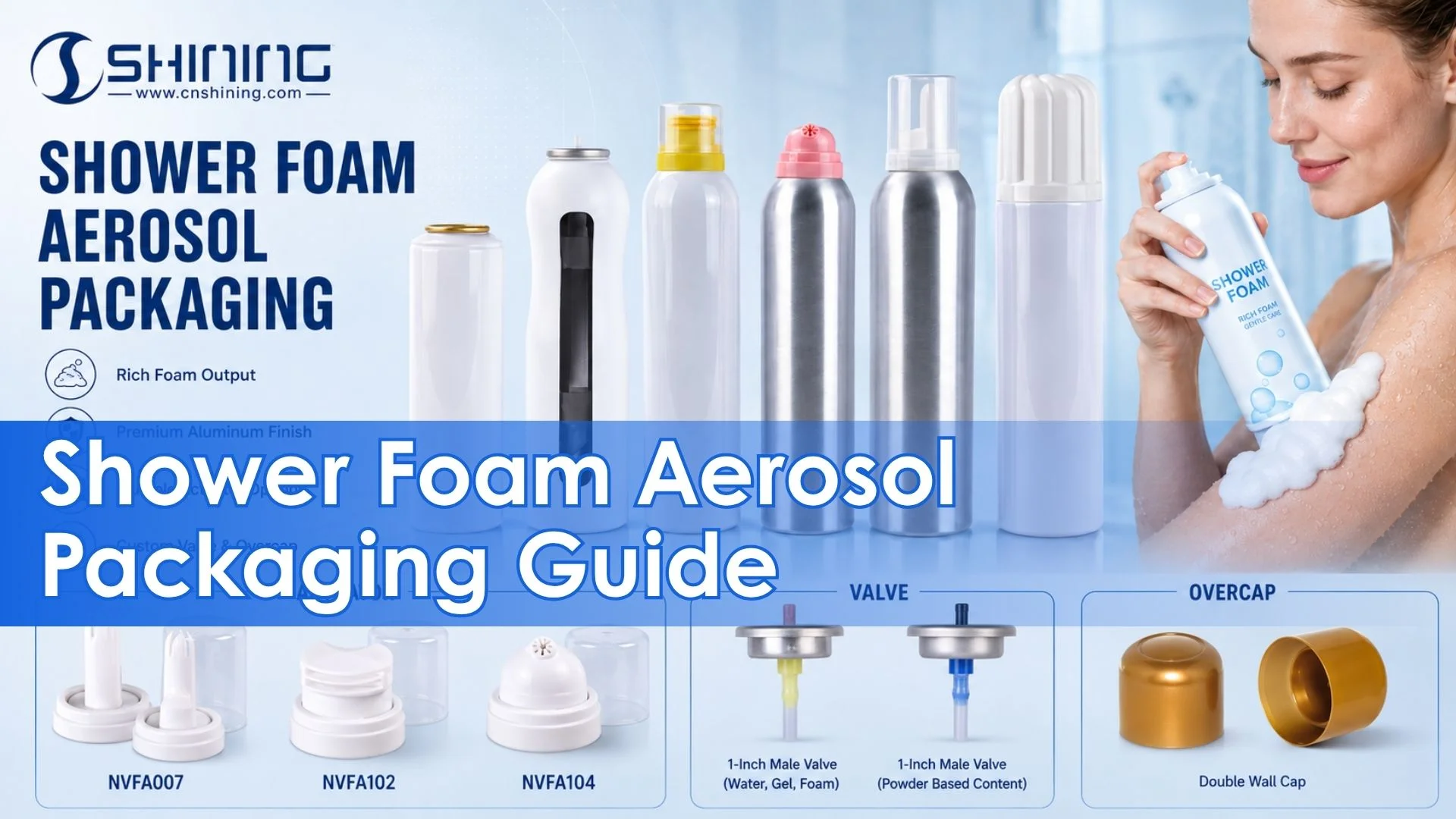
Whipped shower foam is a pressure-and-rheology problem before it is a fragrance story. The category usually covers whipped shower foam, shower foam, shower mousse, foaming shower gel, and gel-to-foam body wash. These names are not one strict legal class. They describe products that turn a concentrated cleansing base into a dense, high-air foam during pressure release, actuator shear, or post-foaming expansion.
The core value is not simply “more foam”. A workable product needs the formula, propellant or gas system, valve, actuator, can, and overcap to behave as one system. Foam expansion rate, bubble size distribution, foam stability, spreadability, collapse during rubbing, and after-feel are all connected.
1. Product Definition and Technical Boundary
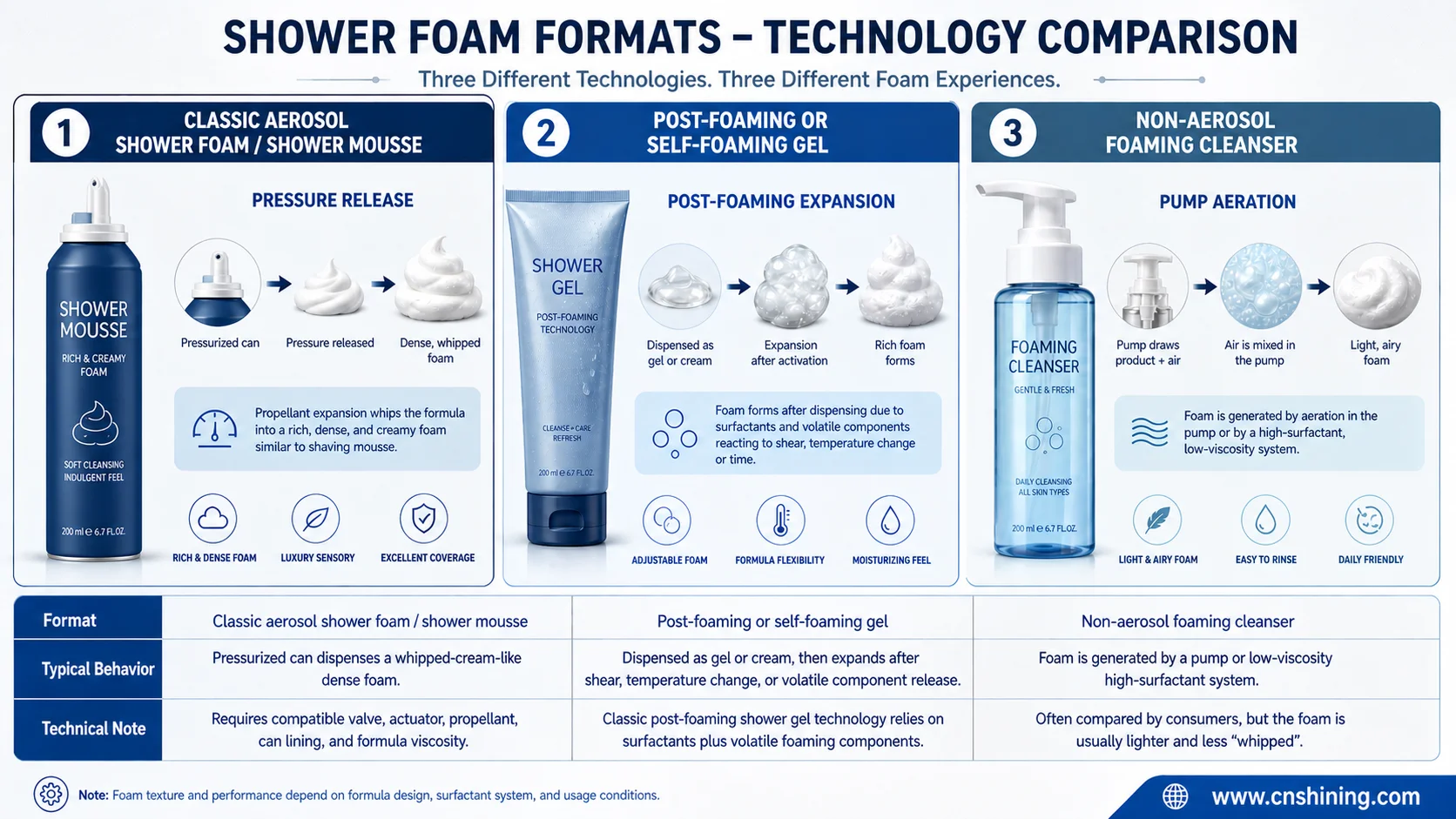
For product and packaging decisions, it is safer to define whipped shower foam as a commercial and formulation family, not a single regulated product name. The market uses several overlapping formats.
| Format | Typical Behavior | Technical Note |
|---|---|---|
| Classic aerosol shower foam / shower mousse | Pressurized can dispenses a whipped-cream-like dense foam. | Requires compatible valve, actuator, propellant, can lining, and formula viscosity. |
| Post-foaming or self-foaming gel | Dispensed as gel or cream, then expands after shear, temperature change, or volatile component release. | Classic post-foaming shower gel technology relies on surfactants plus volatile foaming components. |
| Non-aerosol foaming cleanser | Foam is generated by a pump or low-viscosity high-surfactant system. | Often compared by consumers, but the foam is usually lighter and less “whipped”. |
The commercial attraction is clear: high sensory density, visible one-shot dosing, fragrance release, and a format that looks good in short video. But the same visibility raises user expectations. A foam that looks rich but feels hollow, dry, or wasteful will not survive repeat use.
2. Foam Formation: Formula, Gas, Valve and Actuator
The formation of whipped shower foam normally follows five steps: pressure storage, valve opening, pressure drop, gas expansion, surfactant stabilization, and controlled foam collapse during rubbing.
2.1 Step 1: Energy is stored in the package
The base formula and the propellant or pressure system are sealed in a pressure-resistant container. In classic aerosol systems, product and propellant can share one chamber. In bag-on-valve, the product sits inside a bag while compressed air or nitrogen provides pressure outside the bag. BOV is a one-way dispensing system that separates product and propellant, with foam or gel as possible formula types.
See our technical reference: BOV aerosol valve information.
2.2 Step 2: The valve opens and the actuator shapes the flow
When the user presses the actuator, the valve opens. Flow passes through the stem and actuator channel. The valve controls the release boundary. The actuator controls spray direction, shear, initial velocity, button feel, and foam geometry. Our actuator catalog separates foam, gel, liquid, and viscous product actuator families, including foam actuators for upright and upside-down use.
See our technical reference: Actuator Catalog.
2.3 Step 3: Pressure drops and gas expands
Once the fluid leaves the can, pressure drops sharply. Propellant or post-foaming components vaporize or expand, creating gas nuclei. The older post-foaming shower gel route used aqueous surfactant systems with volatile hydrocarbon foaming components. Later aerosol skin cleanser patents explored HFO and HCFO foaming agents to reduce interaction with the cleanser phase and address environmental pressure.
2.4 Step 4: Surfactants stabilize the lamella
Surfactants migrate to the gas-liquid interface, reduce surface tension, and stabilize the thin liquid films between bubbles. Anionic surfactants normally provide cleaning and primary foam. Betaine, hydroxysultaine, and other amphoteric surfactants help refine foam texture and improve mildness. Polymers, thickeners, and polyols slow drainage and extend foam life.
2.5 Step 5: Foam must collapse at the right time
A good foam is not just a stable foam. It should look full after dispensing, spread under wet-hand friction, then collapse in a controlled way while cleaning. If the lamella is too weak, the foam becomes wet and loose. If it is too stable, rinse-off may feel slow.
| Module | Main Task | Key Variables | Commercial Effect |
|---|---|---|---|
| Formula | Create and stabilize foam while cleaning and moisturizing. | Surfactant type, active matter, fragrance/oil load, polymer, pH. | Controls dense vs hollow foam, mildness vs cleansing, and premium skin feel vs cost. |
| Gas / Propellant | Provide expansion energy and dispensing force. | Hydrocarbons, compressed air, nitrogen, HFO/HCFO, can pressure, vapor pressure. | Controls whipped appearance, flammability, transport burden, and evacuation rate. |
| Hardware | Convert stored energy into a stable terminal foam shape. | Valve, actuator, orifice, dip tube, overcap, ergonomics. | Controls dose, misfire risk, upside-down use, wet-hand handling, and transit damage. |
3. Comparison with Adjacent Body Wash Formats
The following table is for product managers, formulation chemists, and packaging engineers. It is not a consumer shopping table. The point is to locate where whipped shower foam creates value and where it creates extra engineering load.
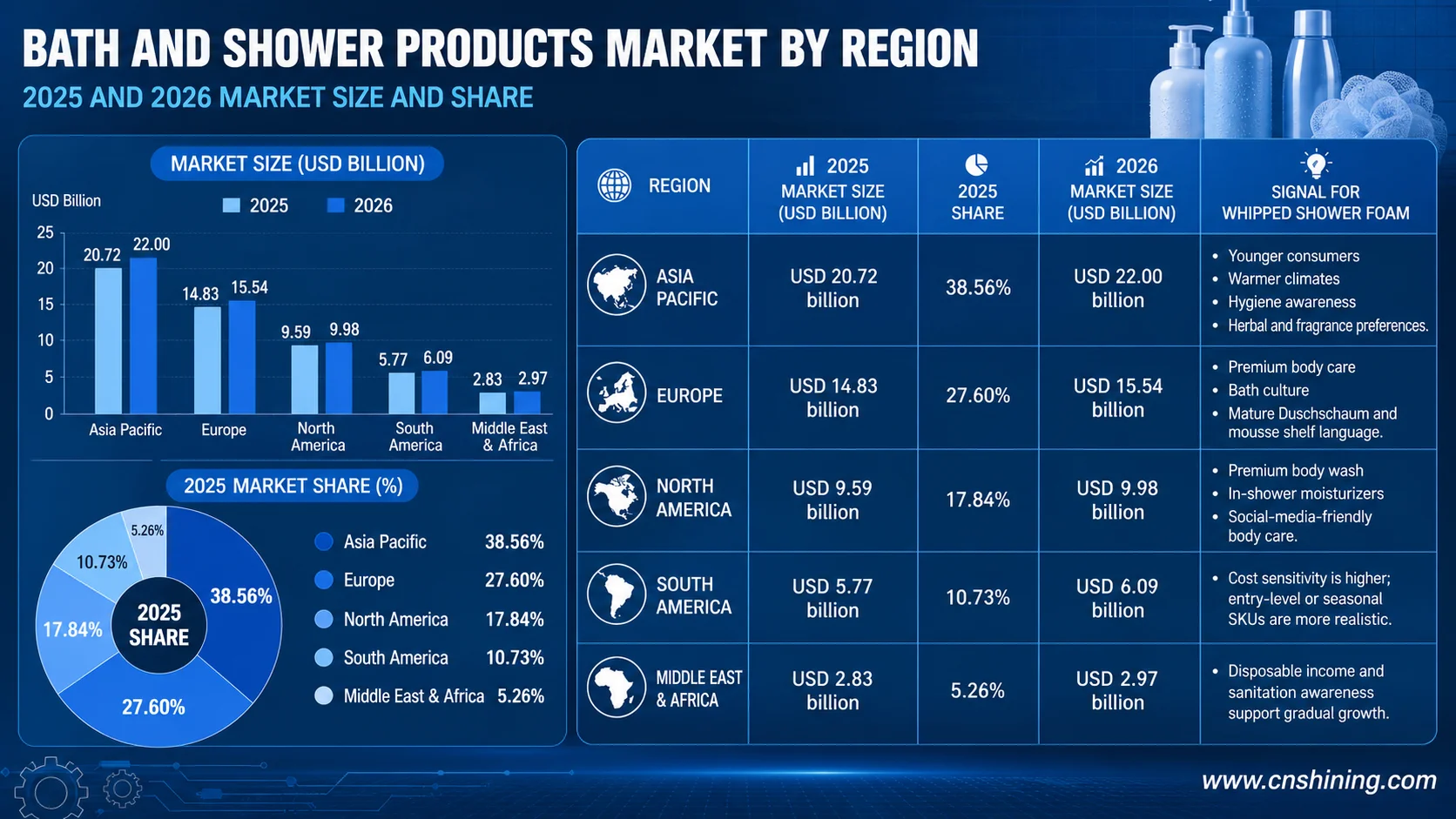
| Dimension | Whipped Shower Foam | Shower Gel | Foaming Face Cleanser | Foaming Hand Wash | Traditional Bath Foam |
|---|---|---|---|---|---|
| Main Use | Shower cleansing, high sensory experience, optional shaving aid. | Daily body cleansing. | Facial cleansing. | Hand cleansing. | Bath tub experience. |
| Terminal Form | Dense, expanded, moldable foam. | Liquid or gel. | Fine light foam. | Light foam. | Loose large bubbles. |
| Foaming Method | Pressure release, post-foaming, actuator shear. | Manual rubbing. | Pump foaming or self-foaming formula. | Pump foaming. | Water agitation in tub. |
| Packaging Complexity | High: can, valve, actuator, overcap. | Low: bottle, pump, or tube. | Medium: foam pump. | Medium: foam pump. | Low: bottle or pouch. |
| Unit Packaging Cost | High or medium-high. | Low to medium. | Medium. | Medium. | Low. |
| Transport Complexity | High, often aerosol or dangerous goods related. | Low. | Low. | Low. | Low. |
| User Value Perception | Whipped cream effect, fragrance ritual, social media visibility. | Familiar, economical. | Mild fine foam. | Fast and convenient. | Bath ritual. |
| Common Complaints | Wasteful dose, nozzle failure, upside-down requirement, high price, dryness. | Normal sensory experience, less dramatic foam. | Insufficient cleansing or slow rinse. | Foam too light, limited oil removal. | Not ideal for shower use, excess residue. |
| Suitable Positioning | Gift sets, fragrance-led body care, IP collaboration, higher-margin sensory product. | Mass-market daily wash. | Functional facial care. | High-frequency home use. | Bath and family leisure. |
4. Market Scale, Trends and Regional Signals
Public, verifiable data for a separate global “whipped shower foam” market is limited. A practical method is to use the wider bath and shower products market to estimate regional capacity, then use shower foam shelf presence, brand penetration, user comments, and social media visibility to judge the whipped sub-format.
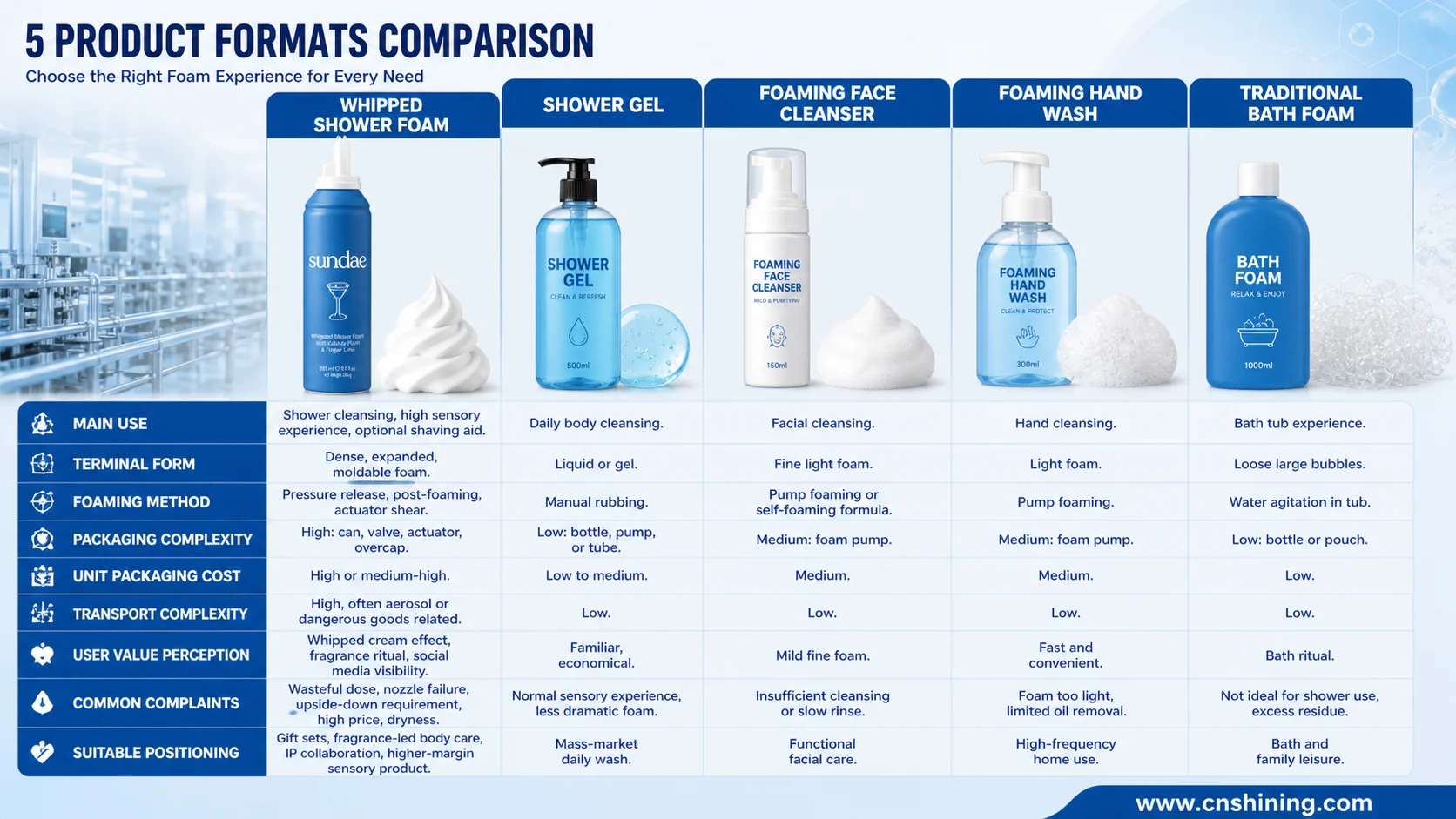
According to the verified Fortune Business Insights public page, the global bath and shower products market was valued at USD 53.74 billion in 2025, is projected at USD 56.59 billion in 2026, and is expected to reach USD 90.47 billion by 2034, with a 2026-2034 CAGR of 6.04%. Asia Pacific held 38.56% of the market in 2025.
Market reference used once here: Fortune Business Insights bath and shower products market data.
| Region | 2025 Market Size | 2025 Share | 2026 Market Size | Signal for Whipped Shower Foam |
|---|---|---|---|---|
| Asia Pacific | USD 20.72 billion | 38.56% | USD 22.00 billion | Younger consumers, warmer climates, hygiene awareness, herbal and fragrance preferences. |
| Europe | USD 14.83 billion | 27.60% | USD 15.54 billion | Premium body care, bath culture, mature Duschschaum and mousse shelf language. |
| North America | USD 9.59 billion | 17.84% | USD 9.98 billion | Premium body wash, in-shower moisturizers, social-media-friendly body care. |
| South America | USD 5.77 billion | 10.73% | USD 6.09 billion | Cost sensitivity is higher; entry-level or seasonal SKUs are more realistic. |
| Middle East & Africa | USD 2.83 billion | 5.26% | USD 2.97 billion | Disposable income and sanitation awareness support gradual growth. |
Asia Pacific also showed historical growth from USD 18.51 billion in 2023 to USD 19.56 billion in 2024. That matters because it is not only a future forecast. There is already volume movement in the wider bath and shower category.
5. Top 10 Representative Whipped Shower Foam Brands
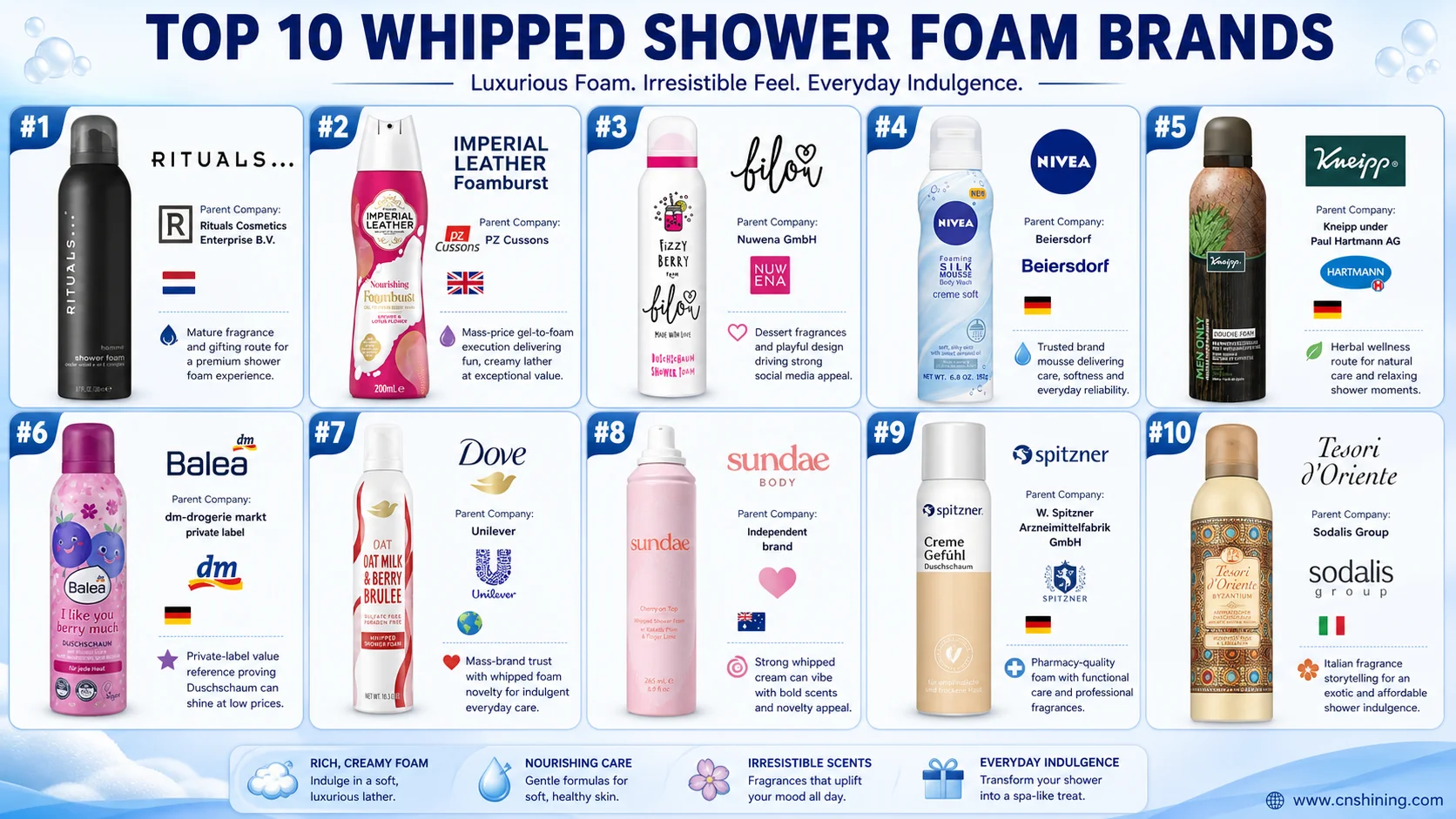
| Brand | Country / Region | Parent Company | Common Size | Price Range | Technical / Commercial Reading |
|---|---|---|---|---|---|
| Rituals | Netherlands | Rituals Cosmetics Enterprise B.V. | 200 ml | about €10.90 | Mature fragrance and gifting route. Useful for studying higher-margin shower foam. |
| Imperial Leather Foamburst | United Kingdom | PZ Cussons | 200 ml | about £2.25 | Mass-price gel-to-foam execution. Useful for studying scalable sensory products. |
| bilou | Germany | Nuwena GmbH | 200 ml | Official store commonly about €3.95 | Dessert fragrance and youth packaging. Strong example of social-media-led shower foam. |
| NIVEA Silk Mousse | Germany | Beiersdorf | 200 ml | About €2.25-€3.75 | Large-brand aerosol mousse reference. Useful for studying trusted-brand adoption. |
| Kneipp Shower Foam | Germany | Paul Hartmann AG | 200 ml | About €4.99-€6.30 | Herbal and wellness route. Useful for pharmacy-style positioning. |
| Balea Duschschaum | Germany | dm-drogerie markt private label | 200 ml | About €1.95 | Private-label value reference. Shows that Duschschaum can be pushed into low-price shelves. |
| Dove Shower Mousse / Whipped Shower Foam | Global | Unilever | 200 ml; 10.3 oz; 13.5 fl oz foaming formats | About £2.25 | Mass-brand trust plus mousse novelty. Relevant for North America and Europe. |
| Sundae Body | Australia | Independent brand | 265 ml / 8.9 oz | Around USD 19 | Strong “whipped cream can” association. Good case for social conversion and novelty packaging. |
| Spitzner Duschschaum | Germany | W. Spitzner Arzneimittelfabrik GmbH | 150 ml | About €4.64-€6.30 | Pharmacy and therapy-channel feel. Useful for professional fragrance and functional body care. |
| Tesori d’Oriente Duschschaum | Italy | Sodalis Group | 200 ml | From about €4.95 | Italian fragrance body care route. Useful for affordable fragrance storytelling. |
6. Shining Packaging Components for Whipped Shower Foam
For whipped shower foam, packaging should be specified from the foam problem backward. The first questions are simple: Does the product need upright use, upside-down use, or 360-degree use? Is the foam wet, dense, or cream-like? Is the formula high in fragrance, oil, acid, or surfactant? Will the SKU be shipped by e-commerce?
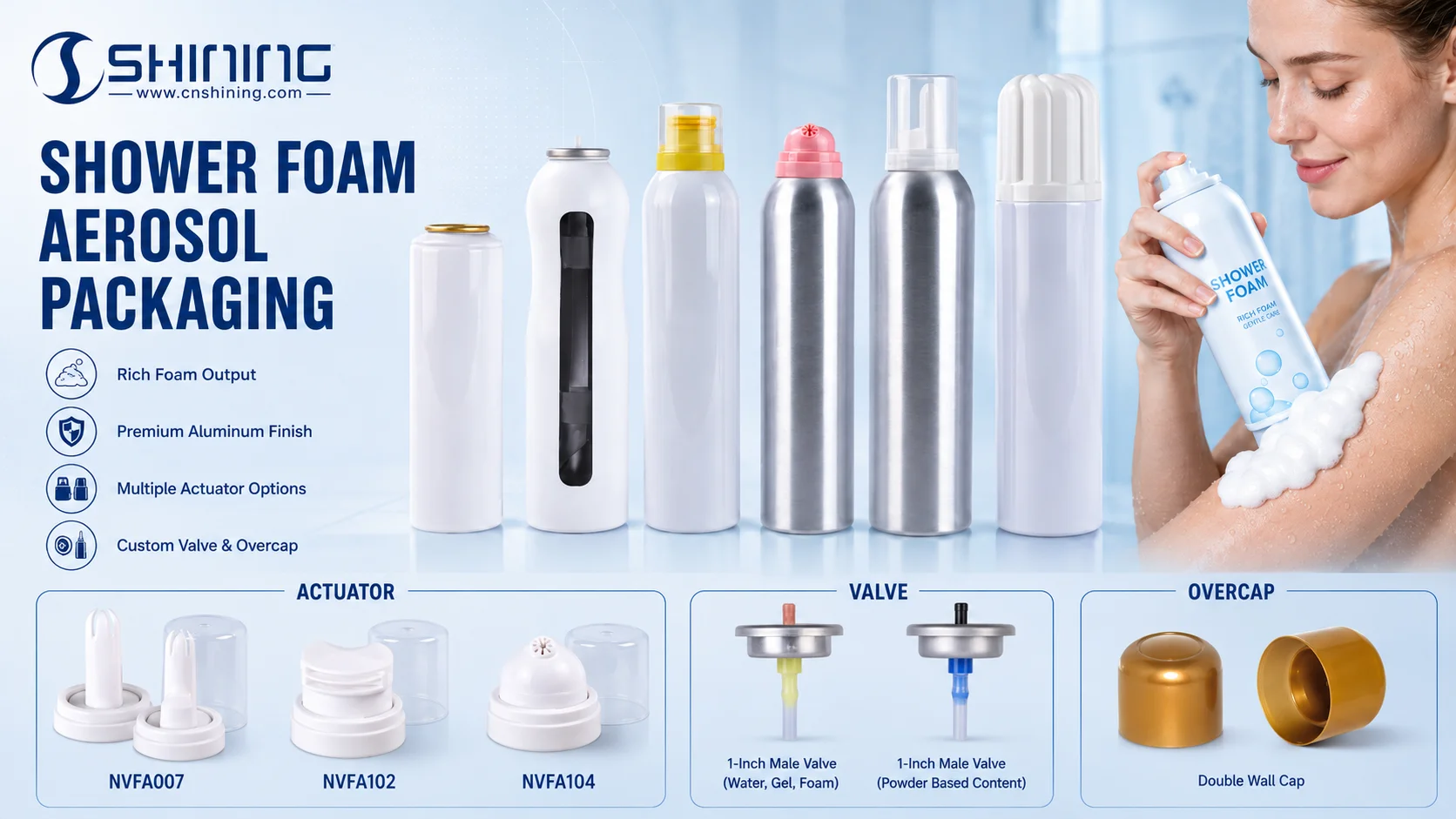
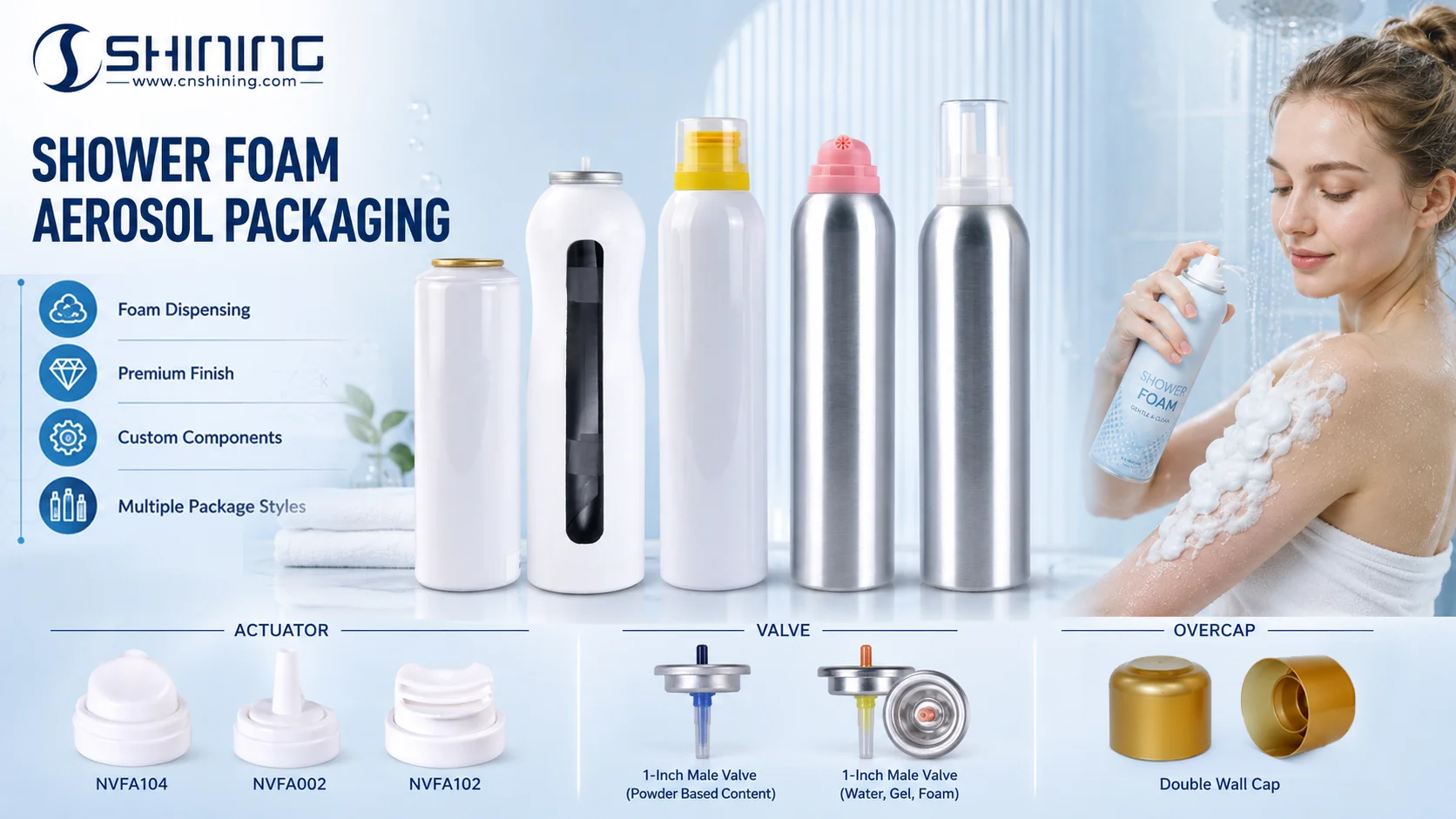
In this context, Shining Packaging can be positioned around three hardware areas: aerosol cans, valves, and actuators. The can protects pressure stability and formula compatibility. The valve sets the release boundary and evacuation behavior. The actuator decides button feel, flow direction, orifice behavior, and how the foam looks in the user’s hand.
A practical development path is to test several actuator-orifice combinations against the same formula before final artwork. Many foam complaints come from flow rate and user operation, not from label design. A stable overcap and protected actuator shoulder should also be considered early, especially for online retail shipments.
7. Formulation Routes and Decision Points
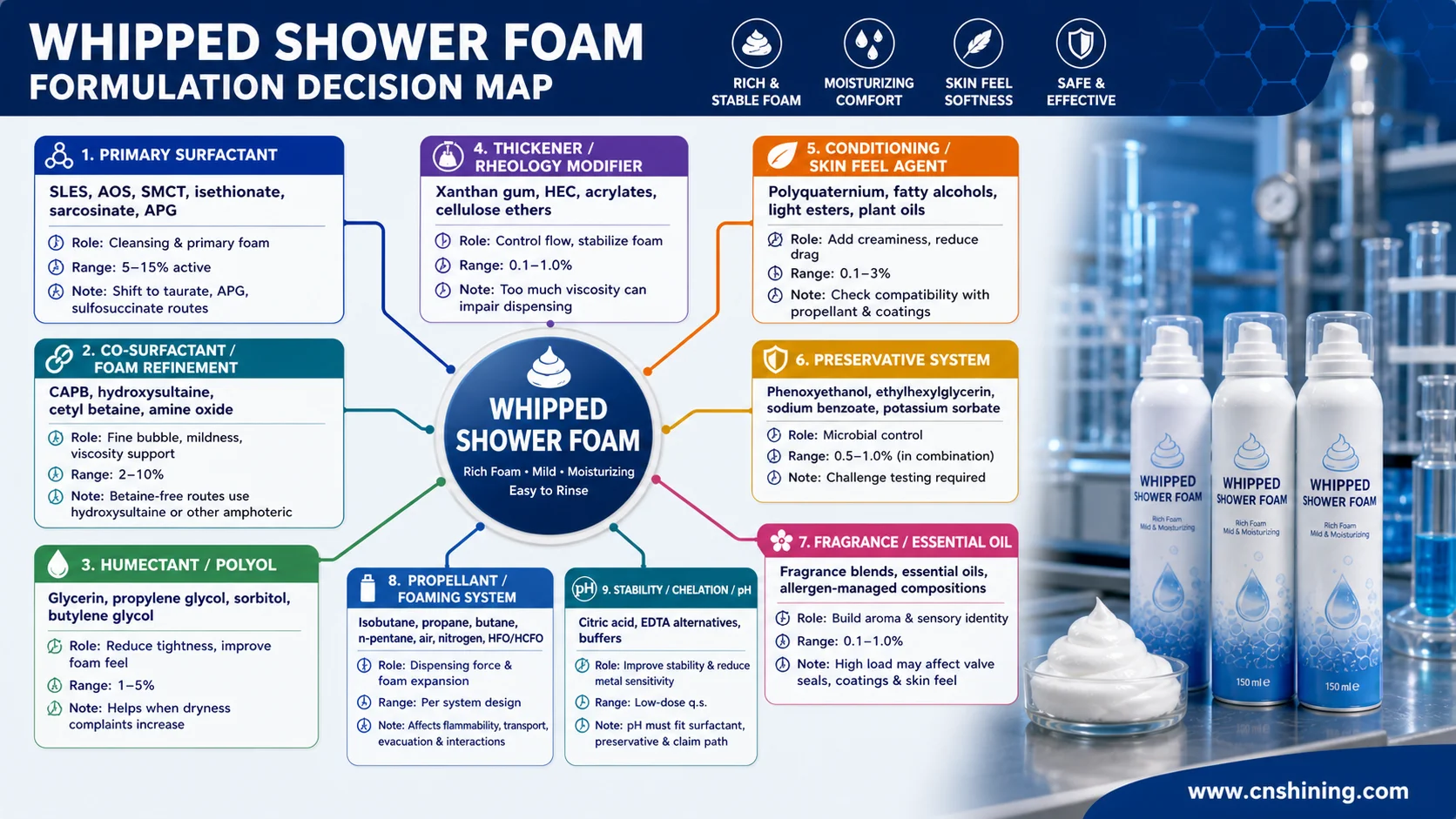
The formula is not only about cleansing. It must survive the can environment, tolerate propellant or pressure, pass microbial and stability testing, and still deliver foam that feels dense instead of empty.
| Function | Common Ingredient Examples | Main Role | Typical Development Range | Notes |
|---|---|---|---|---|
| Primary surfactant | SLES, AOS, SMCT, isethionate, sarcosinate, APG | Cleansing and primary foam. | Active matter often about 5-15%; supplier bases may be higher. | Shift often moves from sulfate systems toward taurate, APG, and sulfosuccinate routes. |
| Co-surfactant / foam refinement | CAPB, hydroxysultaine, cetyl betaine, amine oxide | Fine bubble texture, mildness, viscosity support. | Often about 2-10%. | Betaine-free routes can use hydroxysultaine or other amphoteric systems. |
| Humectant / polyol | Glycerin, propylene glycol, sorbitol, butylene glycol | Reduce tightness after cleansing and improve foam hand feel. | Often about 1-5%; higher in some systems. | Useful when strong surfactant or acid routes increase dryness complaints. |
| Thickener / rheology modifier | Xanthan gum, HEC, acrylates, cellulose ethers | Control flow, slow drainage, stabilize foam. | Often about 0.1-1.0%. | Too much viscosity may impair dispensing through foam valves. |
| Conditioning / skin feel agent | Polyquaternium, fatty alcohols, light esters, plant oils | Add creamy feel and reduce squeaky drag. | Often about 0.1-3%. | Oil and polymer compatibility with propellant and inner coating must be checked. |
| Preservative system | Phenoxyethanol, ethylhexylglycerin, sodium benzoate, potassium sorbate | Microbial control. | Often about 0.5-1.0% in combination. | Challenge testing is still needed, especially for water-rich formulas. |
| Fragrance / essential oil | Fragrance blends, essential oils, allergen-managed compositions | Build sensory identity and shower aroma. | Often about 0.1-1.0%. | High fragrance load can stress valve seals, coatings, and skin feel. |
| Propellant / foaming system | Isobutane, propane, butane, n-pentane, compressed air, nitrogen, HFO/HCFO | Dispensing force and foam expansion. | Classic post-foaming patents use hydrocarbon foaming components; BOV uses pressure gas outside the bag. | Changes flammability, transport, evacuation, and formula interaction. |
| Stability / chelation / pH | Citric acid, EDTA alternatives, buffers | Improve stability and reduce metal sensitivity. | Low-dose q.s. | pH must fit surfactant, preservative, skin feel, and regulatory claim path. |
7.1 Route A: Classic post-foaming or aerosol shower product
Classic post-foaming shower gel patents. describe aqueous surfactant systems with anionic surfactant, nonionic fatty alcohol or ester components, and hydrocarbon foaming agents. The advantage is a strong before-and-after foam effect. The drawback is flammability, valve compatibility pressure, and more difficult transport handling.
7.2 Route B: Mild sulfate-free foam base
If the target is mildness, moisturizing, and fine foam, development often moves toward taurate, betaine, sulfosuccinate, APG, xanthan or cellulose rheology control, and polyol support. A supplier formulation can contain high percentages of commercial surfactant solutions; this does not equal the same percentage of active matter in the finished product. Colonial Chemical’s sulfate-free. shower gel example lists AOS-40 at 30%, cetyl betaine at 10%, sodium chloride at 2.8%, fragrance at 0.2%, and pH 6.0-6.5.
7.3 Technical Terms
| Term | Short Explanation | Commercial Meaning |
|---|---|---|
| Surfactant | Material that reduces surface tension and helps cleaning and foaming. | Controls cleansing, mildness, and cream-like foam feel. |
| Propellant | Gas or volatile component that provides dispensing and expansion energy. | Controls dangerous goods status, evacuation, cost, and compliance difficulty. |
| Post-foaming | Product expands after dispensing. | Creates strong visual effect but can increase upside-down or dispensing complaints. |
| Aerosol valve | Core component controlling product release from the can. | Directly affects dose and stability; it is a common complaint point. |
| Actuator | Button and nozzle assembly pressed by the user. | Controls foam shape, hand feel, first-dose behavior, and breakage risk. |
| BOV | Bag-on-valve system separating product from pressure gas. | Cleaner, higher evacuation, supports compressed air or nitrogen, but costs more. |
| Lamella | Thin liquid film between bubbles. | If drainage is too fast, foam becomes coarse and collapses early. |
| Rheology | Flow and deformation behavior under force. | Decides whether the output looks like cream, gel, or wet foam. |
| INCI | International naming system for cosmetic ingredients. | Affects labeling, global formulation communication, and registration work. |
| UN1950 / LQ | Aerosol transport classification and limited quantity rules. | Impacts warehousing, air shipment, cross-border fulfillment, and returns. |
8. Regulations, Transport and Technology Direction
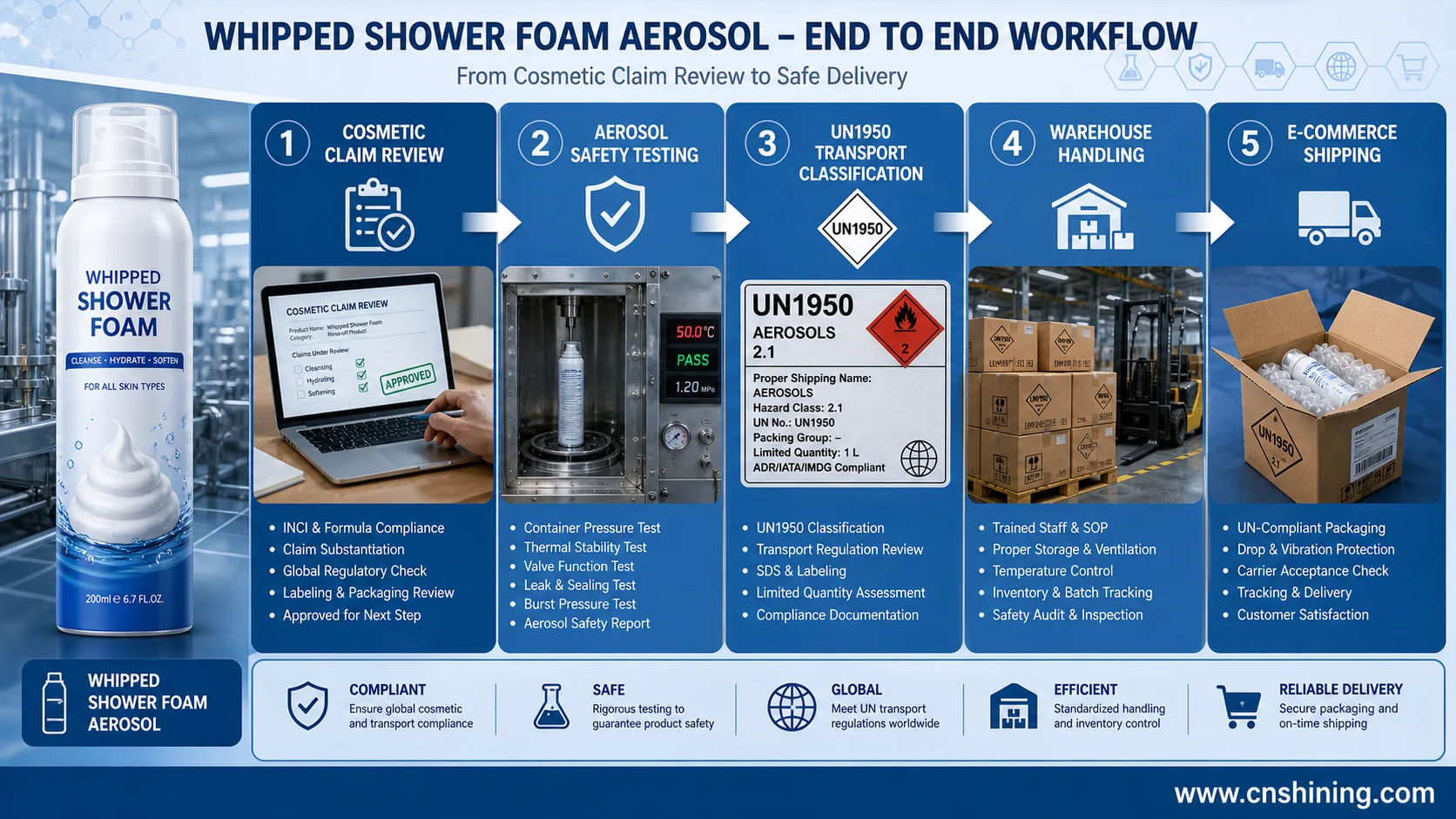
In most markets, whipped shower foam starts as a cosmetic product. That changes if the claims move into treatment, antibacterial function, acne treatment, or drug-like action. The intended use can change the regulatory identity faster than the formula itself.
| Market / Area | Applicable Framework | Key Requirement for Whipped Shower Foam | Business Impact |
|---|---|---|---|
| United States | FDA cosmetic framework; drug framework if treatment claims are made. | Intended use decides whether the product is cosmetic, drug, or soap. Acne body wash claims may trigger OTC drug rules, including salicylic acid active concentration limits. | Claims review must involve regulatory staff before packaging copy is locked. |
| European Union | Cosmetic regulation plus Aerosol Dispensers Directive 75/324/EEC. | Product safety, labeling, responsible person, and aerosol dispenser safety need to be handled together. | Formula safety and aerosol hardware compliance must move in parallel. |
| Transport and Warehousing | PHMSA, IATA, UN, ADR and related dangerous goods systems. | Aerosol products often involve UN1950, limited quantity marking, and packaging rules. | Samples, e-commerce export, cross-border warehousing, and returns need early planning. |
The practical sustainability route is shifting from slogans to hardware choices. BOV with compressed air or nitrogen can reduce product-propellant interaction and improve evacuation. BOV lists up to 99% evacuation, 360-degree continuous dispensing, and compressed air or nitrogen pressure support.
Recyclability is also a structure question, not only a material claim. Aluminum cans can support a premium and recyclable story, but real recovery depends on separable overcaps, reduced mixed-material decoration, and clear material identification.
Patent activity points in three directions: low-GWP foaming systems, shaped or textured foam dispensing, and compact higher-concentration compositions. A P&G patent covers aerosol foam skin cleanser using HFO or HCFO foaming agents, and another application focuses on textured foam dispensing through shaping orifices.
| Patent / Application | Subject | Development Meaning |
|---|---|---|
| US10987290B2 | Aerosol foam skin cleanser with HFO / HCFO foaming agent. | Represents low-GWP or newer foaming agent direction. |
| US20200148459A1 | Textured foam dispenser and shaping orifices. | Shows how actuator and orifice geometry can shape foam appearance. |
| WO2000072805A1 | Foamable shower oil composition. | Relevant to cleanser plus oil-care mousse routes. |
| EP3877091B1 | Foam dispenser and method. | Connects compact composition and textured foam dispensing. |
9. User Complaints and Packaging Countermeasures
User comments tend to repeat the same issues: too expensive, not enough clean-feel, too drying, nozzle breaks, product must be dispensed upside down, last portion cannot be used, or fragrance disappears after rinsing. These complaints should be translated into hardware and formula variables.
| User Pain Point | Likely Root Cause | Executable Countermeasure | Expected Effect |
|---|---|---|---|
| Must invert, cannot dispense, high residue | Classic aerosol phase balance, dip tube orientation, weak instructions. | Evaluate BOV, or use a more stable foam valve. Add simple “shake-invert-press” icons when inversion is required. | Lower false “faulty product” complaints and improve evacuation. |
| First press gives too much foam | Orifice and flow rate too high; foam expansion ratio too aggressive. | Use foam-specific actuator, flow restriction, or near-metered output for premium SKUs. | Less waste and better value perception. |
| Nozzle breaks in shipping | Exposed actuator, weak overcap, poor e-commerce protection. | Use recessed shoulder, stronger overcap, and protective insert for parcel shipping. | Reduced leakage, breakage, and returns. |
| Does not feel clean | Foam is too airy; surfactant and rinse balance are wrong. | Increase foam density, optimize anionic/amphoteric ratio, add conditioning polymer carefully. | Moves the product from “fun” to actually useful. |
| Dry or tight after use | Strong surfactant, acid route, fragrance irritation, or weak humectant system. | Separate moisturizing base SKU from exfoliating SKU. Use mild surfactant blends and polyols. | Wider skin compatibility and fewer negative reviews. |
| Fragrance disappears after shower | Rinse-off products naturally have short fragrance retention. | Use layered fragrance design or pair with lotion or mist. Avoid hard “long-lasting” claims for a rinse-off single product. | Manages expectation without overclaiming. |
| Sustainability concern | Aerosol image, propellant concern, mixed-material packaging. | Use BOV with compressed air or nitrogen, aluminum or PCR aluminum where suitable, separable overcap, and low-complexity decoration. | More credible sustainability story and better fit for premium channels. |
10. Conclusion
Whipped shower foam succeeds when formula, gas system, valve, actuator, and can are specified together. The market signal is real, but the independent public data for this exact subcategory is thin. Use the larger bath and shower market for direction, then test the sub-format through shelf presence, user complaints, and sample performance.
The packaging conclusion is direct: most complaints can be translated into engineering variables. Residue points to evacuation and valve selection. Waste points to actuator flow. Breakage points to overcap and shipping protection. Dryness points back to surfactant and humectant balance. A good-looking foam is not enough. It has to dispense cleanly, feel dense, rinse correctly, and leave the user with a normal sense of clean skin.
11. FAQ: Whipped Shower Foam Technical Questions
No. In most markets, whipped shower foam is a commercial format rather than a strict legal category. It may be sold as shower foam, shower mousse, foaming shower gel, or gel-to-foam body wash. Regulatory status usually depends on intended use and claims. A normal cleansing claim stays cosmetic; acne, treatment, or antibacterial claims may change the pathway.
Shower gel only needs a bottle, tube, or pump to deliver liquid. Whipped shower foam needs a pressure or aeration system that creates a dense foam at the outlet. The can, valve, actuator, propellant, and overcap all affect foam texture, dose, residue, user direction, and shipping reliability. A normal liquid package cannot control those variables.
Dense foam depends on bubble size, liquid film strength, drainage speed, and formula viscosity. Anionic surfactants provide cleaning and foam volume, while amphoteric surfactants can improve mildness and bubble fineness. Polymers, cellulose, gums, and polyols slow liquid drainage. The actuator orifice and flow rate then decide whether the foam exits as cream-like mousse or wet loose bubbles.
BOV is not automatically better, but it solves several common problems. It separates product from compressed air or nitrogen, can improve evacuation, and can support use at different angles. It also raises component cost and requires compatible filling. For formulas sensitive to propellant contact, residue complaints, or contamination risk, BOV is worth evaluating early.
Upside-down use often comes from the internal product-propellant arrangement, dip tube design, and phase behavior inside the can. If the system is designed for inversion, upright dispensing may produce weak foam or no output. The problem becomes serious when labels do not explain the operation clearly. Hardware design and front-label pictograms can reduce false fault complaints.
Over-dispensing usually comes from excessive actuator flow, large orifice size, high internal pressure, or a foam expansion ratio that is too aggressive. Users read this as waste, even if the foam looks impressive. Testing first-second discharge weight and perceived dose is useful. For premium SKUs, flow restriction or near-metered actuator behavior can improve control.
Dryness can come from strong surfactants, insufficient humectant, high fragrance load, acid-based exfoliating claims, or poor rinse balance. A foam may look soft but still remove too much skin lipid or leave a tight after-feel. Mild surfactant blends, polyols, and carefully selected conditioning polymers are practical tools, but they must remain compatible with the aerosol system.
Do not select the actuator only by appearance. Test discharge weight, foam expansion, bubble texture, button force, wet-hand grip, clogging tendency, upside-down behavior, and breakage after drop or e-commerce vibration tests. Foam actuators differ in orifice, flow path, and ergonomics. A visually attractive button that cracks in transit will become a packaging complaint.
Aerosol shower foam may fall under UN1950 aerosol transport classification and limited quantity rules, depending on formulation, pressure, and propellant system. This affects sample shipment, air freight, warehouse labeling, carton design, and returns. Transport planning should start before launch artwork. Treating the product as ordinary liquid body wash can create avoidable logistics delays.
Start with the target foam: dense mousse, wet foam, post-foaming gel, or BOV output. Then choose formula architecture, propellant or pressure system, valve, actuator, and can coating together. Run compatibility and evacuation tests before final decoration. After that, validate user operation, transport damage, and refill residue. The sequence prevents late-stage packaging rework.