
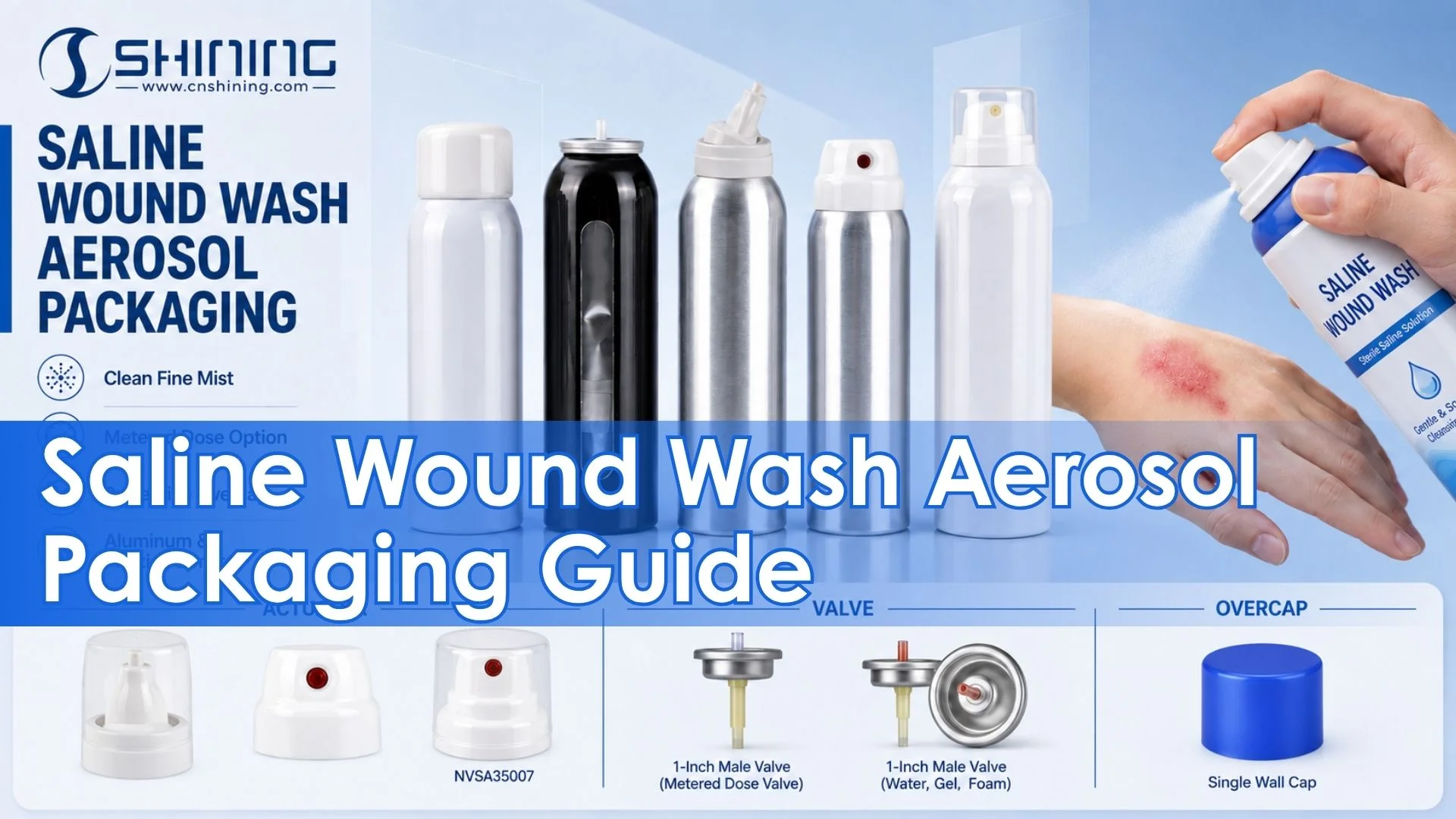
Sterile saline irrigation spray, wound cleanser spray, first-aid wound wash, and piercing aftercare saline all point to the same basic technology: 0.9% isotonic saline delivered in a controlled spray or wash format. The value is not the salt alone. The value sits in sterility, spray pressure, valve reliability, actuator design, closed packaging, and what the product is legally allowed to claim.
A saline wound spray/wash is usually positioned for rinsing minor cuts, abrasions, minor burns, dressing wetting, and surface debris removal. It should not be framed as a drug, disinfectant, or healing accelerator unless the evidence and regulatory pathway support that claim. For packaging engineers, the practical question is simple: can the system deliver sterile saline cleanly, at the right pressure, without making the wound feel worse?
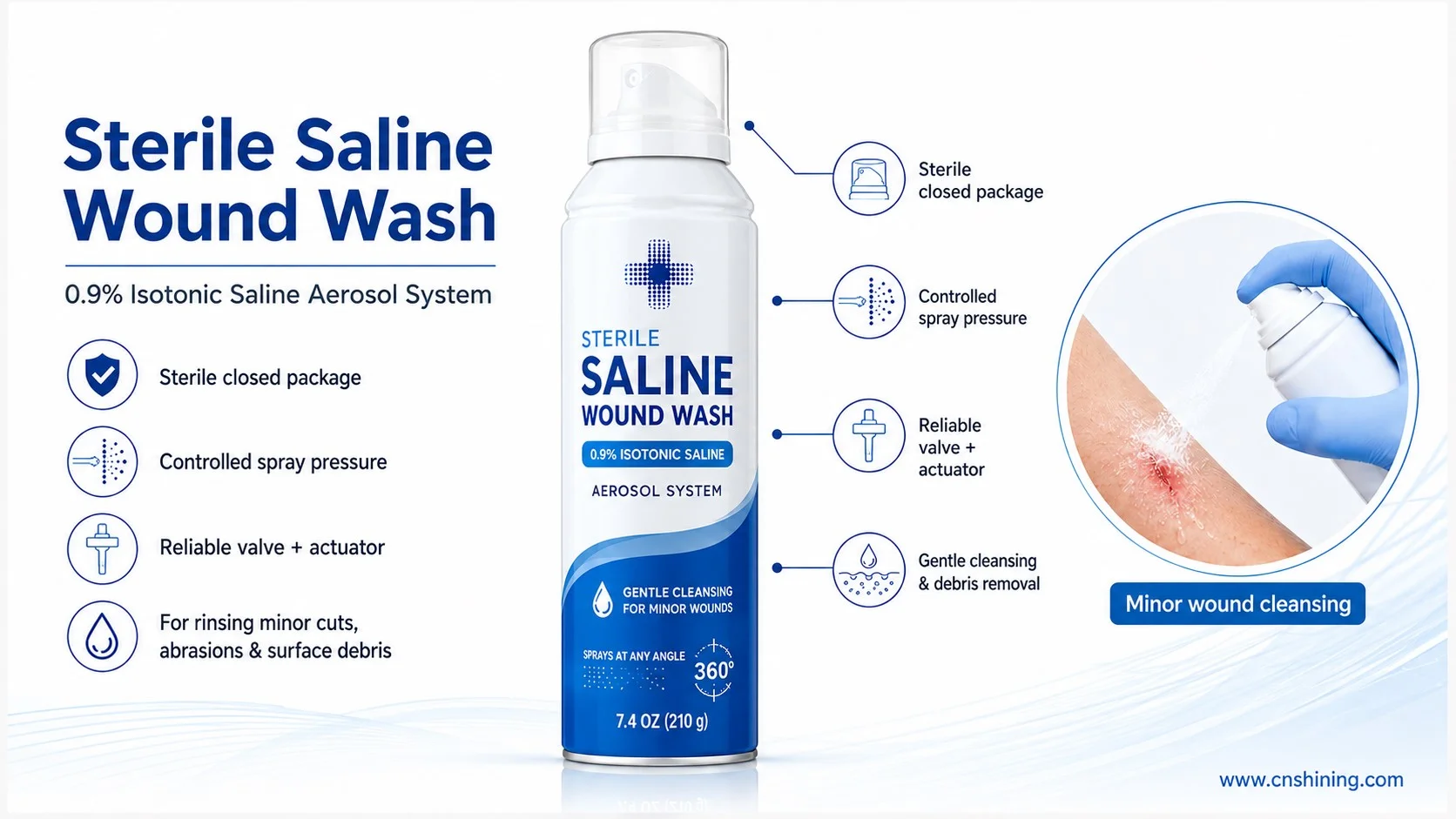
1. Definition, Working Mechanism, and Clinical Use
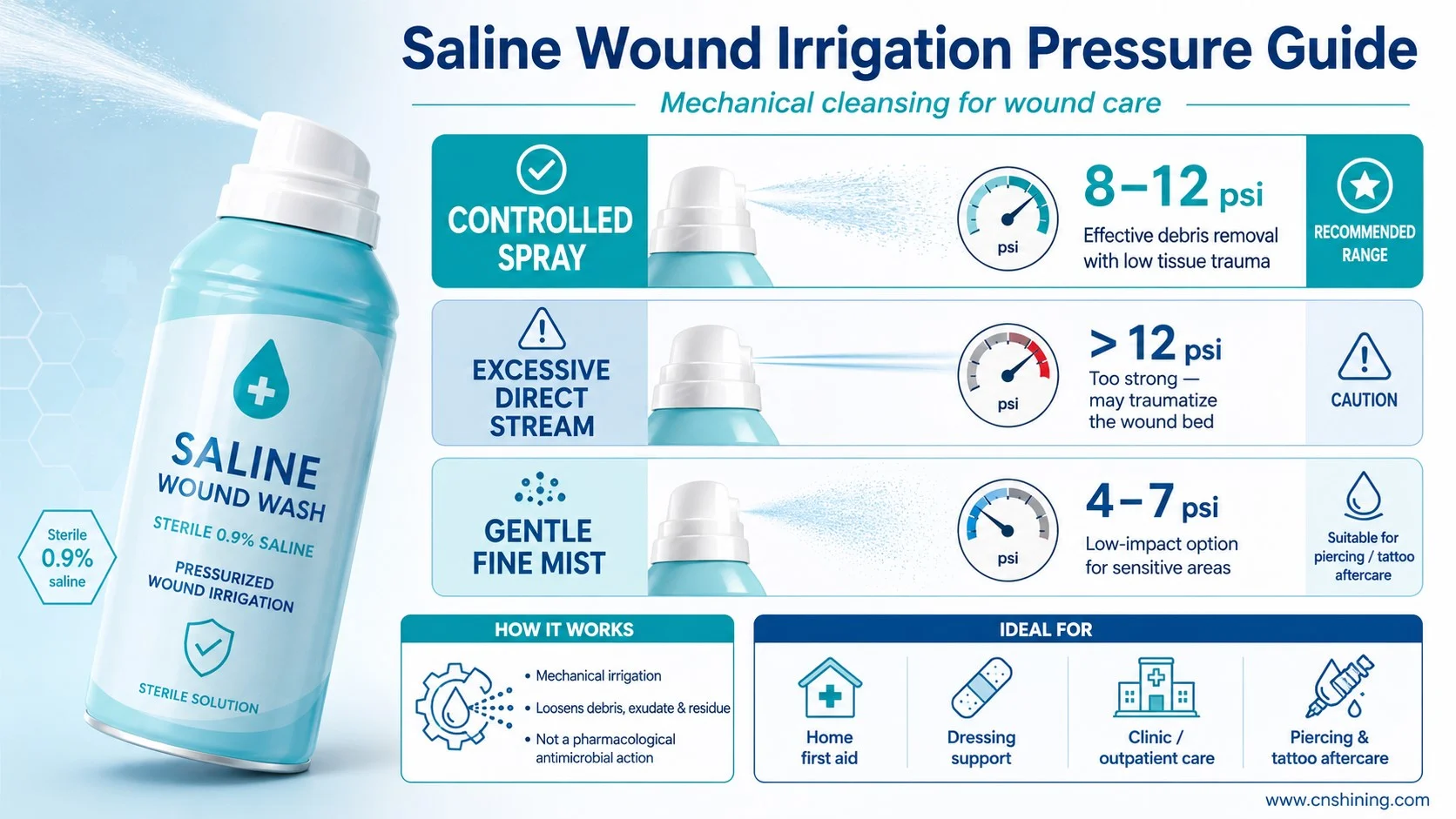
Saline wound spray/wash works by mechanical irrigation. It does not kill microbes by pharmacological action. The liquid stream loosens and removes surface contaminants, dressing residue, crusts, exudate, and visible debris. That is why pressure matters. Too weak, and the wash may not remove debris. Too strong, and it may traumatize the wound bed.
Clinical wound irrigation references often target an irrigation pressure around 8–12 psi. A wound irrigation enabler from Winnipeg Regional Health Authority states that irrigation pressure should not cause trauma and recommends 8–12 psi for wound irrigation. This range fits the practical logic of wound wash packaging: deliver enough force to clean, but not enough to punish tissue.
Common use cases fall into four groups:
| Use Case | Typical Situation | Technical Requirement |
|---|---|---|
| Home first aid | Minor cuts, scrapes, shallow burns, sport abrasions | Easy one-hand spray, moderate stream, clear distance guidance |
| Dressing support | Wetting adhered dressings, softening crusts, removing residue | Stable flow, no contamination after repeat use |
| Clinic and outpatient care | Basic cleansing before dressing change or inspection | Controlled pressure, lot traceability, sterile assurance |
| Piercing or tattoo aftercare | Sensitive small-area cleansing during healing | Fine mist, low impact, small travel format |
The Association of Professional Piercers gives a useful market signal: it recommends that saline ingredients list 0.9% sodium chloride and advises users to spray with sterile saline wound wash while healing. This helps explain why the same formula can split into different SKUs: wound wash uses a stronger stream; piercing aftercare often needs a gentler mist.
2. Market Size and Regional Trend
Public market research rarely isolates “saline wound spray/wash” as a narrow subcategory. The best public proxy is the wider wound cleanser products market, which includes saline, antimicrobial cleansers, wetting agents, wipes, and irrigation systems. So the market numbers below should be read as category context, not exact saline spray TAM.
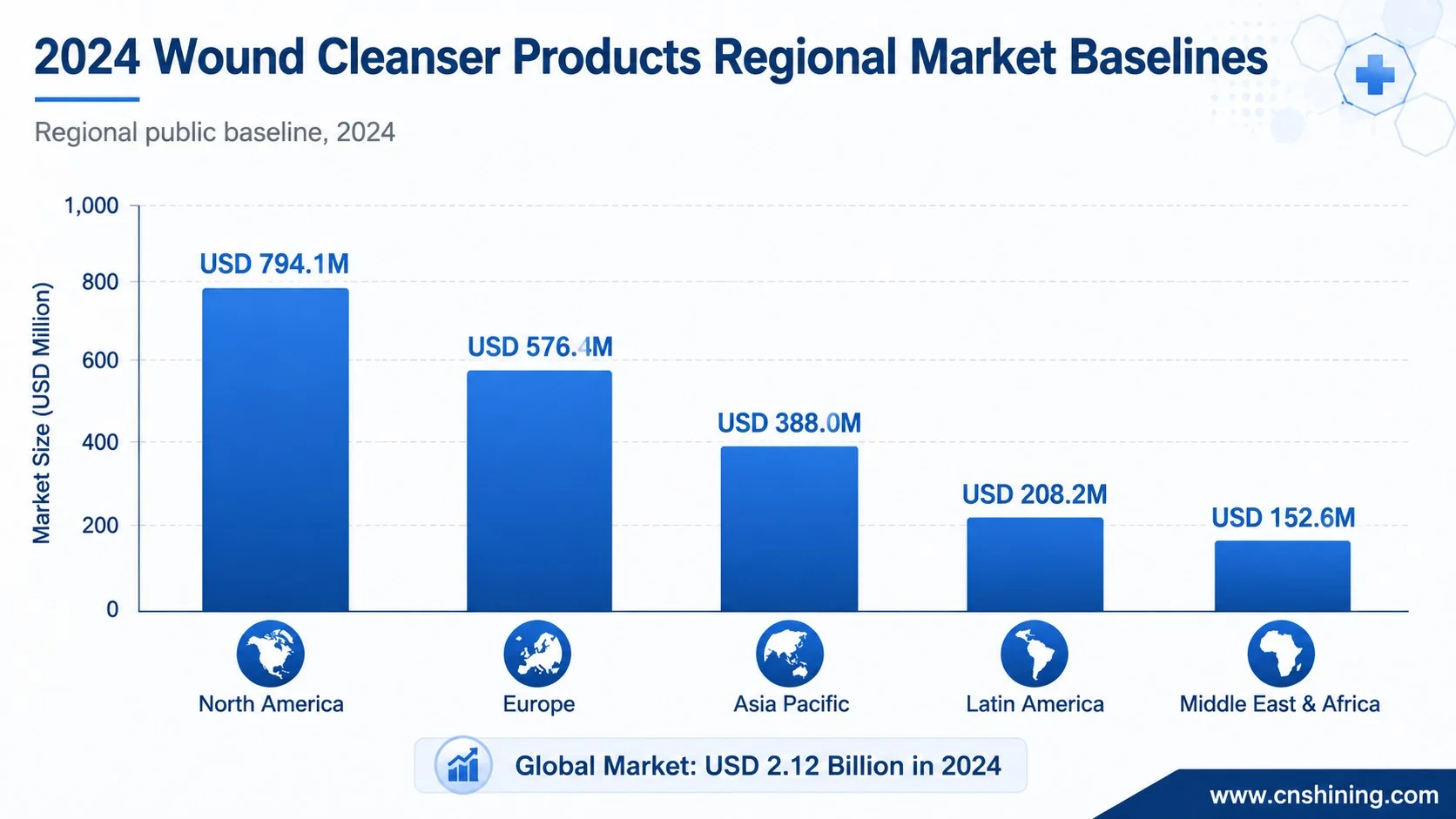
According to Grand View Research wound cleanser products market data, the global market was about USD 2.12 billion in 2024, expected to reach USD 2.20 billion in 2025, and projected to reach USD 2.79 billion by 2030, with a 2025–2030 CAGR of 4.8%.
The same source identifies North America as the largest region and Asia Pacific as the fastest-growing region. Regional public baseline data puts North America at about USD 794.1 million in 2024 with an expected 4.2% CAGR to 2030, according to Grand View’s North America outlook.
| Region | 2024 Public Baseline | 2025–2030 CAGR | Interpretation |
|---|---|---|---|
| North America | About USD 794.1 million | About 4.2% | Largest mature market; strong OTC and outpatient channels |
| Europe | About USD 576.4 million | About 4.8% | Stable demand, strong regulatory discipline |
| Asia Pacific | About USD 388.0 million | About 5.7% | Fastest growth; rising healthcare access and chronic wound load |
| Latin America | About USD 208.2 million | About 5.2% | Growing demand for accessible wound care products |
| Middle East and Africa | About USD 152.6 million | About 4.8% | Healthcare infrastructure and chronic disease burden drive demand |
3. Product Comparison, Formulation, and Terms
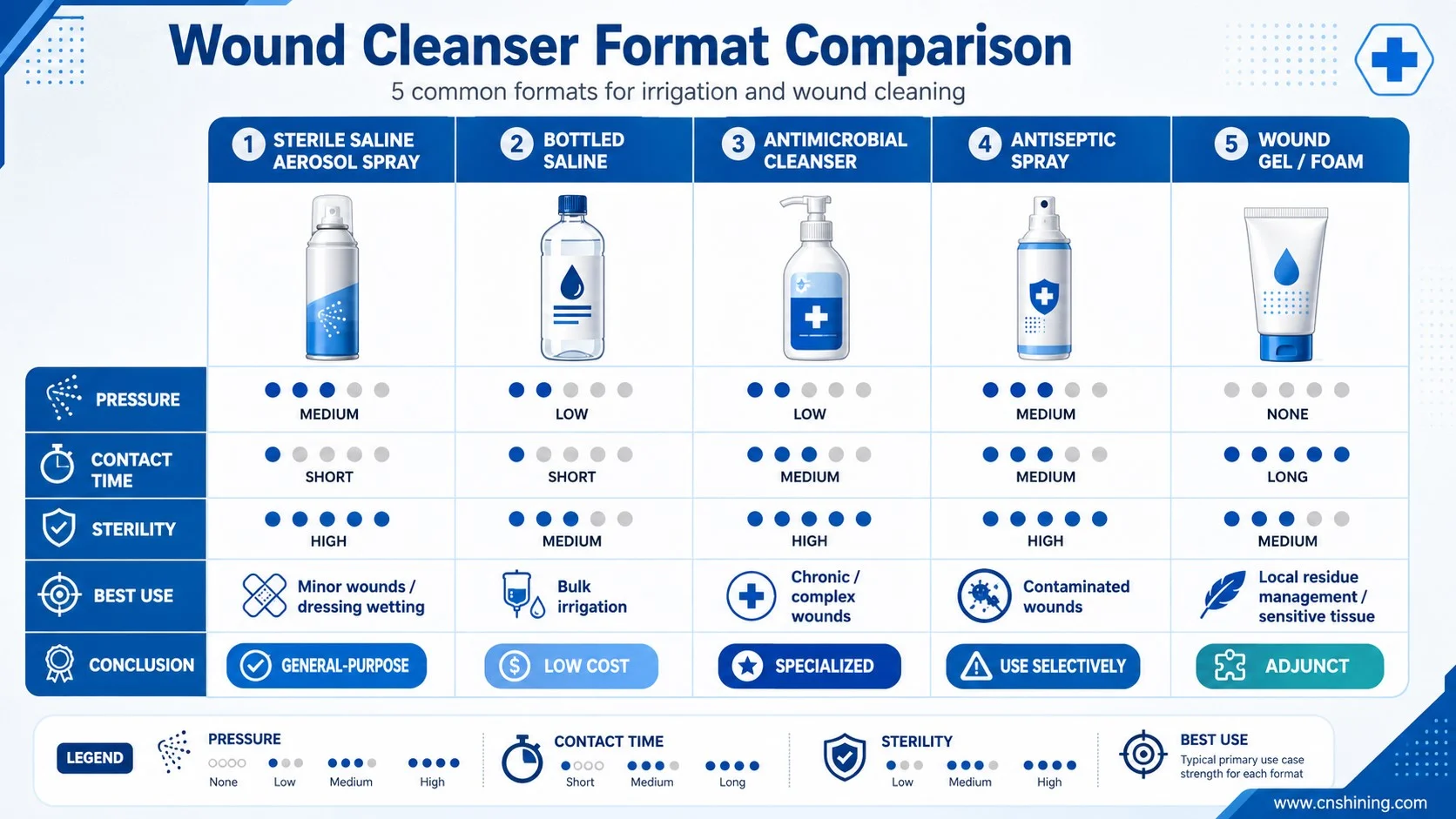
The main competitive line is no longer “saline versus saline.” The real comparison is saline spray versus bottled saline, antimicrobial cleanser, antiseptic spray, foam, gel, or professional irrigation system. Each solves a different problem.
| Category | Typical Example | Performance Character | Best-Fit Scenario | Practical Conclusion |
|---|---|---|---|---|
| Saline wound spray/wash | 0.9% sterile saline spray | Mechanical rinsing, low irritation, portable, pressure-dependent | Minor wounds, dressing wetting, home and clinic use, piercing aftercare | Default general-purpose format when the wound is low risk |
| Plain bottled saline | Irrigating saline bottle | Similar formula, but pressure and post-opening contamination control depend on secondary tools | Clinical bulk irrigation and dressing wetting | Lower cost, weaker convenience and portability |
| Antimicrobial or antibiofilm cleanser | PHMB/betaine, HOCl, super-oxidized solutions | Designed for higher microbial burden or biofilm-related care | Chronic wounds, complex wounds, dirty wounds, professional care | More specialized; not necessary for every minor cut |
| Conventional antiseptic spray | Iodine, chlorhexidine, hydrogen peroxide systems | Stronger antimicrobial action, higher tissue compatibility concern when overused | Contaminated wounds or specific clinical decisions | Should not be treated as a routine saline replacement |
| Foam or gel cleanser | Wound gel, foam cleanser | Longer contact time, more local stay, possible moisturizing role | Local residue management and sensitive tissue handling | Functional complement, not a true rinse substitute |
CADTH reviewed antimicrobial or antiseptic cleansers against saline and found mixed evidence across different surgical and complex wound settings. The safest technical reading is that antimicrobial cleansers may help in some contexts, but evidence is not uniform. For low-risk minor wounds, starting with saline or clean water and escalating only when needed is often the steadier route.
| Term | Plain Technical Meaning | Packaging or Business Relevance |
|---|---|---|
| Isotonic | Close to body fluid osmotic pressure; 0.9% NaCl is the common expression | Supports low-sting, low-irritation positioning |
| Sterile | Maintains sterility through release and shelf life | Raises validation, closure integrity, and recall exposure |
| Irrigation pressure | Impact pressure of liquid on the wound bed | Controls cleaning force and tissue comfort |
| BOV / bag-on-valve | Liquid separated from propellant inside a flexible pouch | Supports any-angle spray and cleaner dispensing architecture |
| Fine mist | Soft spray pattern with smaller droplets and lower impact | Useful for piercing, face, children, and sensitive areas |
| Biofilm | Structured microbial community on wound surfaces | Drives demand for professional antibiofilm cleansers |
4. Regulatory and Compliance Logic
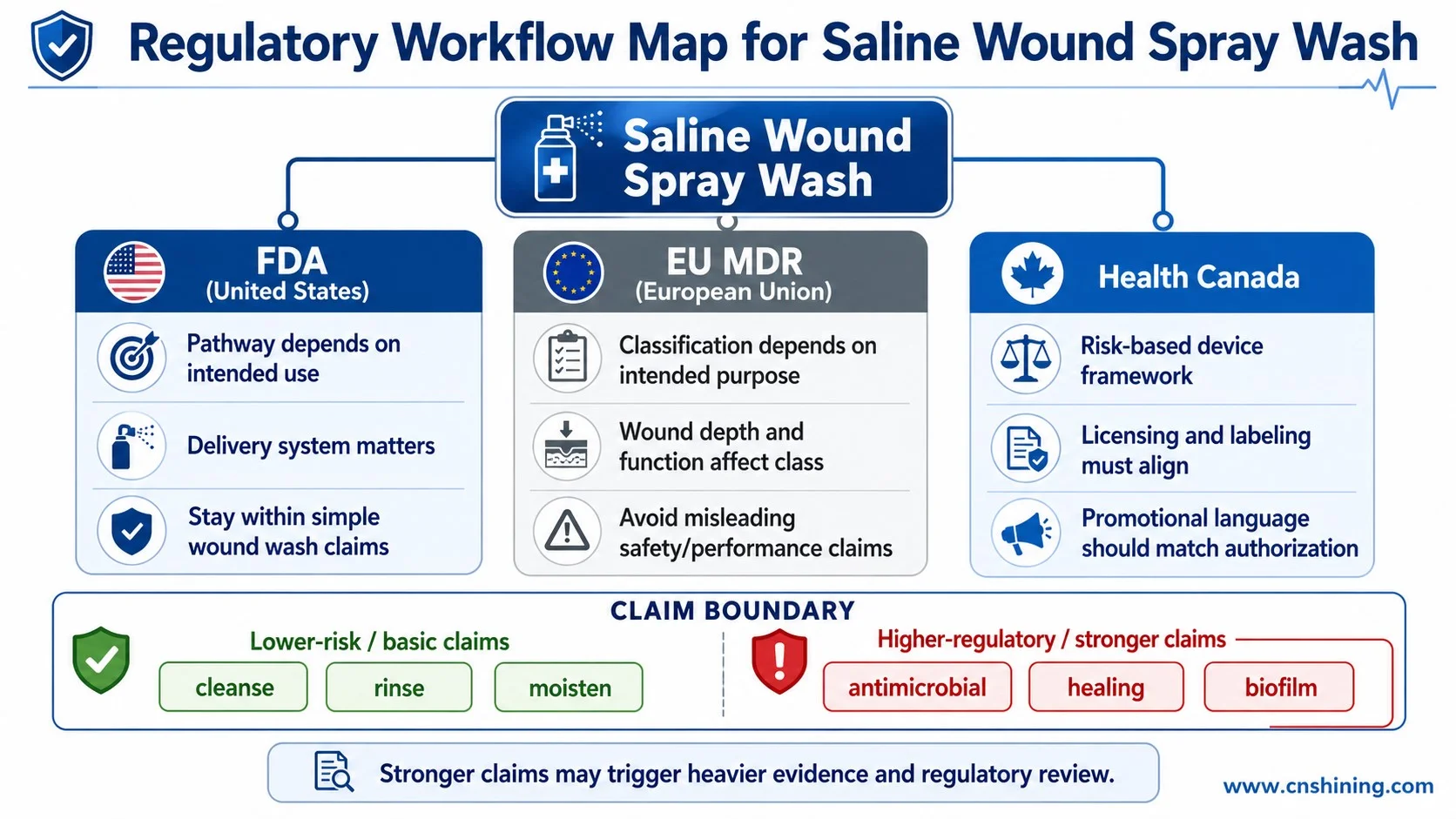
In the United States, public FDA files show that saline wound wash products may be positioned under wound wash or jet lavage-related pathways depending on intended use and delivery characteristics. One FDA record for Saline Wound Wash, SteriCleanse states use for cleansing minor wounds, abrasions, and minor burns. Products with stronger jet lavage or irrigation system traits may follow a different device logic.
The labeling boundary is narrow. “Cleanse,” “rinse,” “remove foreign material,” and “moisten dressings” are the stable core. “Antimicrobial,” “heals faster,” “treats infection,” or “removes biofilm” move the product into heavier evidence and regulatory territory. FDA’s public rulemaking discussion on liquid wound washes containing antimicrobials or other chemicals shows why this boundary matters.
The European Union uses risk classification and intended purpose under MDR. MDCG guidance explains how devices contacting injured skin can fall into different classes depending on wound depth, purpose, and whether the product manages the microenvironment or involves substances dispersed into the body. The MDCG 2021-24 classification guidance is useful for understanding the logic. MDR Article 7 also restricts misleading claims, and the consolidated EU MDR text should be checked before final label work.
Canada and Australia follow risk-based medical device systems. Health Canada’s medical device guidance document index and its guidance on labelling and promotional material are useful references for export teams.
| Market | Regulatory Reading | Label Discipline |
|---|---|---|
| United States | FDA device pathway depends on intended use and delivery system | Stay with cleansing, rinsing, debris removal, dressing moistening unless evidence supports more |
| European Union | MDR classification depends on Rule 4, Rule 21, wound depth, and intended purpose | Avoid misleading safety, performance, or purpose claims |
| Canada / Australia | Risk-based classification and licensing logic | Promotional language should stay aligned with authorization |
The quality risk is not theoretical. FDA’s recall database lists a Class II recall where the manufacturer may not have met the minimum sterility assurance level required for sterile products. That sterile saline wound wash recall is a direct reminder: if sterility is on the label, packaging and manufacturing validation are not background work.
5. Top 10 Retail-Visible Brands and SKUs
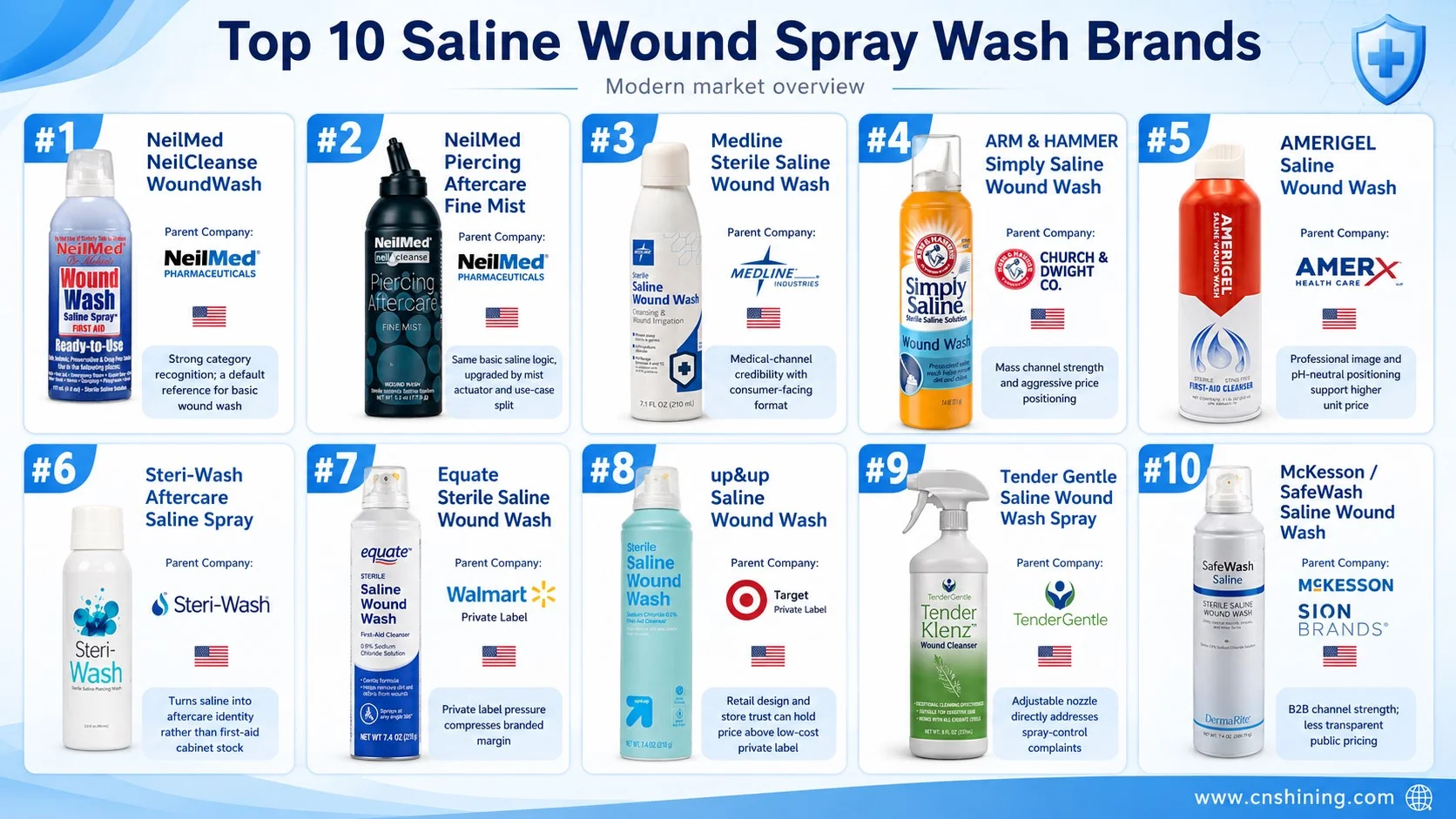
This table is not a verified global sales ranking. It is a practical list of brands and SKUs that are visible to consumers and buyers, especially in North American retail and medical supply channels. The technical lesson is clear: the formula often stays close to 0.9% saline, while differentiation comes from spray head, use case, size, channel, and price band.
| Brand / SKU | Country | Parent Company | Common Size | Public Price Range | Technical Comment |
|---|---|---|---|---|---|
| NeilMed NeilCleanse WoundWash | USA | NeilMed Pharmaceuticals | 6.3 oz / 177 mL | about 6.72-7.99$ | Strong category recognition; a default reference for basic wound wash |
| NeilMed Piercing Aftercare Fine Mist | USA | NeilMed Pharmaceuticals | 6.3 oz; 75 mL travel size | about 9.99-16.59$ | Same basic saline logic, upgraded by mist actuator and use-case split |
| Medline Sterile Saline Wound Wash | USA | Medline Industries | 7.1 oz / 210 mL | about 8.50$ | Medical-channel credibility with consumer-facing format |
| ARM & HAMMER Simply Saline Wound Wash | USA | Church & Dwight | 3 oz; 7.1-7.4 oz | about 6.57$ | Mass channel strength and aggressive price positioning |
| AMERIGEL Saline Wound Wash | USA | AMERX Health Care | 4 oz; 7.1 oz | about 13.74-18.72$ | Professional image and pH-neutral positioning support higher unit price |
| Steri-Wash Aftercare Saline Spray | USA | Steri-Wash | 3 oz | about 7.49$ | Turns saline into aftercare identity rather than first-aid cabinet stock |
| Equate Sterile Saline Wound Wash | USA | Walmart private label | 7.4 oz / 210 g | about 4.56$ | Private label pressure compresses branded margin |
| up&up Saline Wound Wash | USA | Target private label | 7.4 oz | about 9.99$ | Retail design and store trust can hold price above low-cost private label |
| Tender Gentle Saline Wound Wash Spray | USA | Tender Gentle | 8 oz | about 8.99$ | Adjustable nozzle directly addresses spray-control complaints |
| McKesson / SafeWash medical supply products | USA | McKesson / Sion Brands | About 7.1 oz | about 5.99-13.23$ | B2B channel strength; less transparent public pricing |
One pattern is worth keeping: spray head plus scenario is doing more commercial work than extra ingredients. Wound wash, fine mist piercing aftercare, travel size, and adjustable nozzle all prove that mechanical delivery can define user value.
6. Technology Direction: BOV, Fine Mist, and Use-Case Split
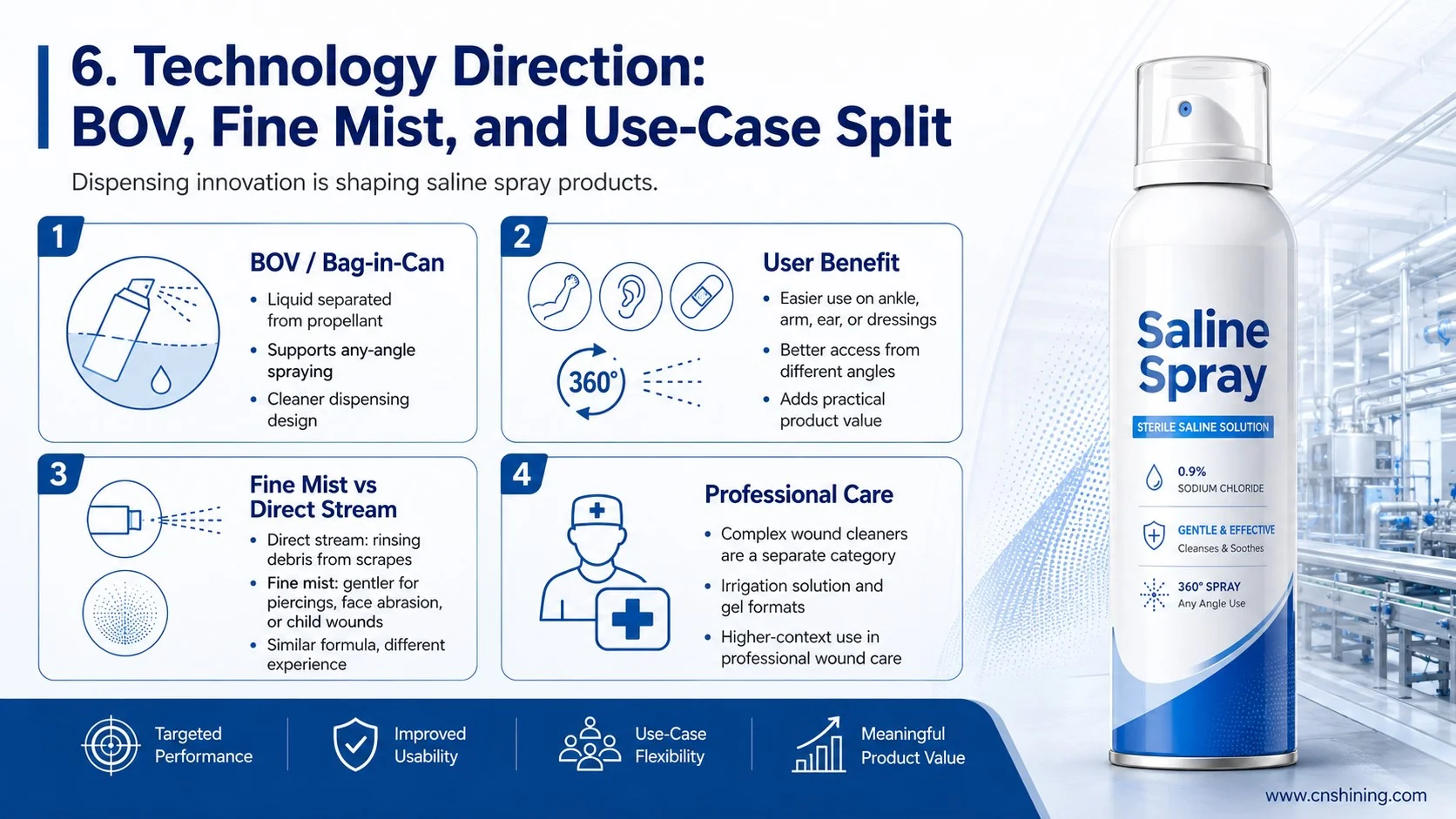
The category is not moving toward exotic chemistry first. It is moving toward better dispensing. Public technical and retail signals point to four directions: fine mist actuators, BOV or bag-in-can systems, any-angle spraying, and smaller scenario-based sizes.
BOV and bag-in-can designs separate liquid from propellant. That helps with any-angle use and supports cleaner dispensing architecture. It also allows brands to explain why a sterile saline product is not simply a plastic bottle with salt water. For users, the difference is practical: can they spray an ankle, back of arm, ear, or dressing without awkward can orientation?
Fine mist is the other meaningful split. A strong direct stream can be appropriate for rinsing debris from a scrape. The same stream may feel too aggressive on an ear piercing, face abrasion, or child’s wound. That is why a wound wash SKU and a piercing aftercare fine mist SKU can both exist without major formula change.
Professional wound care is also expanding into more complex cleaners. B. Braun’s Prontosan wound irrigation solution and gel brochure shows a different category logic: complex wounds, biofilm management, irrigation solution, and gel formats. This is not a direct substitute for household saline spray. It is a higher-evidence, higher-context professional product family.
7. User Pain Points and Packaging Improvement Priorities
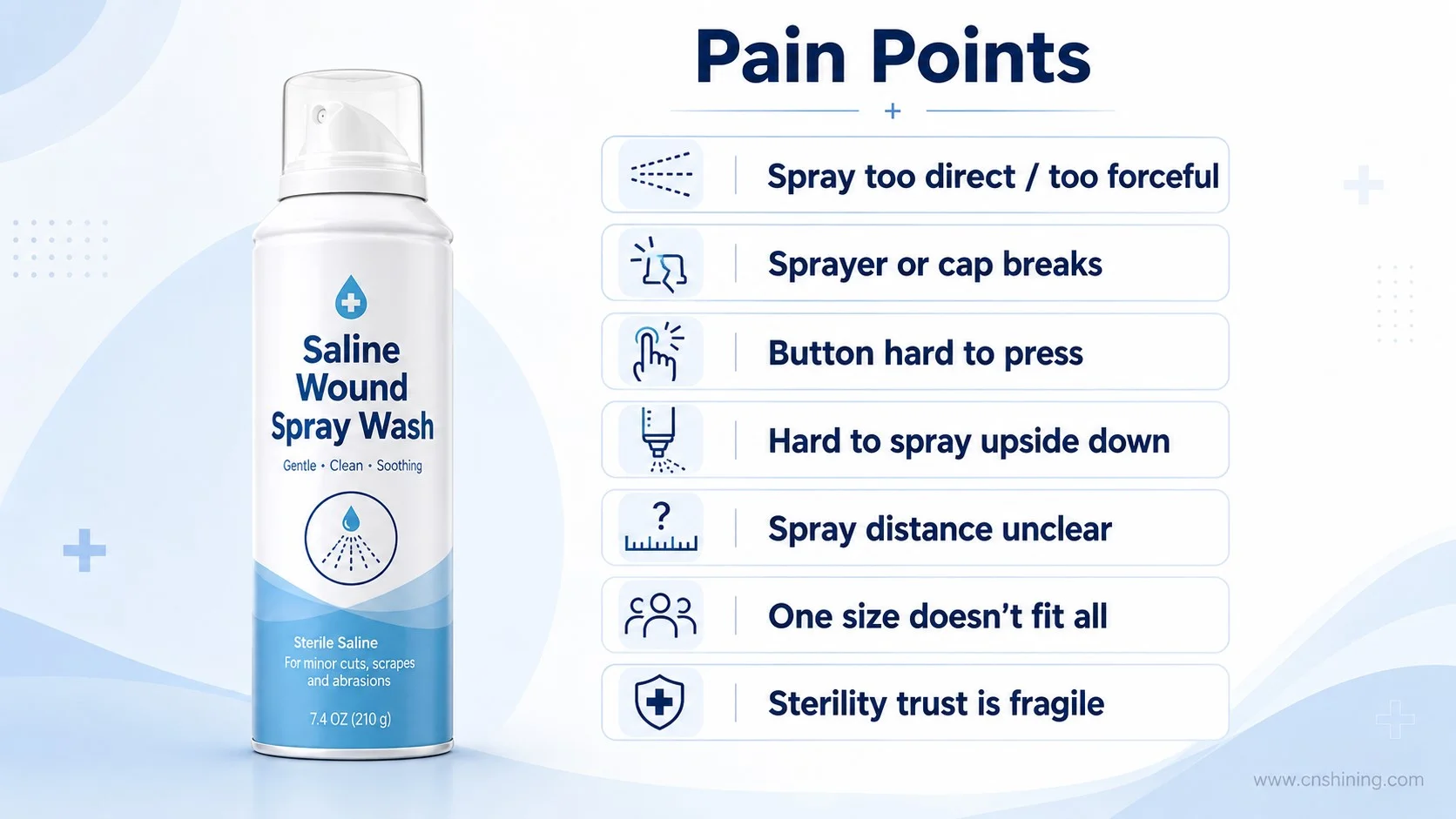
User complaints concentrate in a few engineering areas: direct stream too harsh, cap or sprayer breakage, hard press force, poor aim, poor scenario guidance, and confusing difference between wound wash and piercing fine mist. These complaints are not cosmetic. They point directly to actuator, overcap, valve, spray pattern, and label design.
| Priority | Pain Point | Packaging or Structure Response | Reason to Act |
|---|---|---|---|
| High | Spray is too direct or too forceful | Dual-mode actuator: stream for rinsing, fine mist for sensitive areas | This is the fastest way to improve perceived comfort without changing formula |
| High | Sprayer or cap breaks | Stronger actuator, better overcap, transport drop testing, valve stem protection | A failed sprayer turns a sterile product into a useless can |
| High | Button is hard to press | Optimize press force, travel distance, finger pad size, and anti-slip surface | Wound care users may have limited hand strength or need one-hand use |
| High | Cannot spray upside down or at a difficult angle | Use BOV or bag-in-can architecture with any-angle claim support | Self-care often requires awkward orientation |
| Medium | Users do not understand spray distance | Add front-label distance icons and use-case pictograms | Some “too harsh” complaints are distance and misuse problems |
| Medium | One size does not match all use cases | Offer 75 mL travel size plus 177-210 mL home size | Piercing, sports, travel, home first aid, and clinic use need different volumes |
| Medium | Sterility trust is fragile | Validate closure integrity, valve compatibility, transport stability, and lot traceability | Sterility claims create quality risk that cannot be solved by label copy |
If only one upgrade path is selected, the practical specification would be: 0.9% sterile isotonic saline + BOV any-angle dispensing + dual-mode actuator + 75 mL / 210 mL size split + clear wound / piercing / dressing-moistening front-label distinction + reinforced overcap. It keeps formula risk low and addresses the complaints users actually make.
8. Packaging Components from Shining Packaging
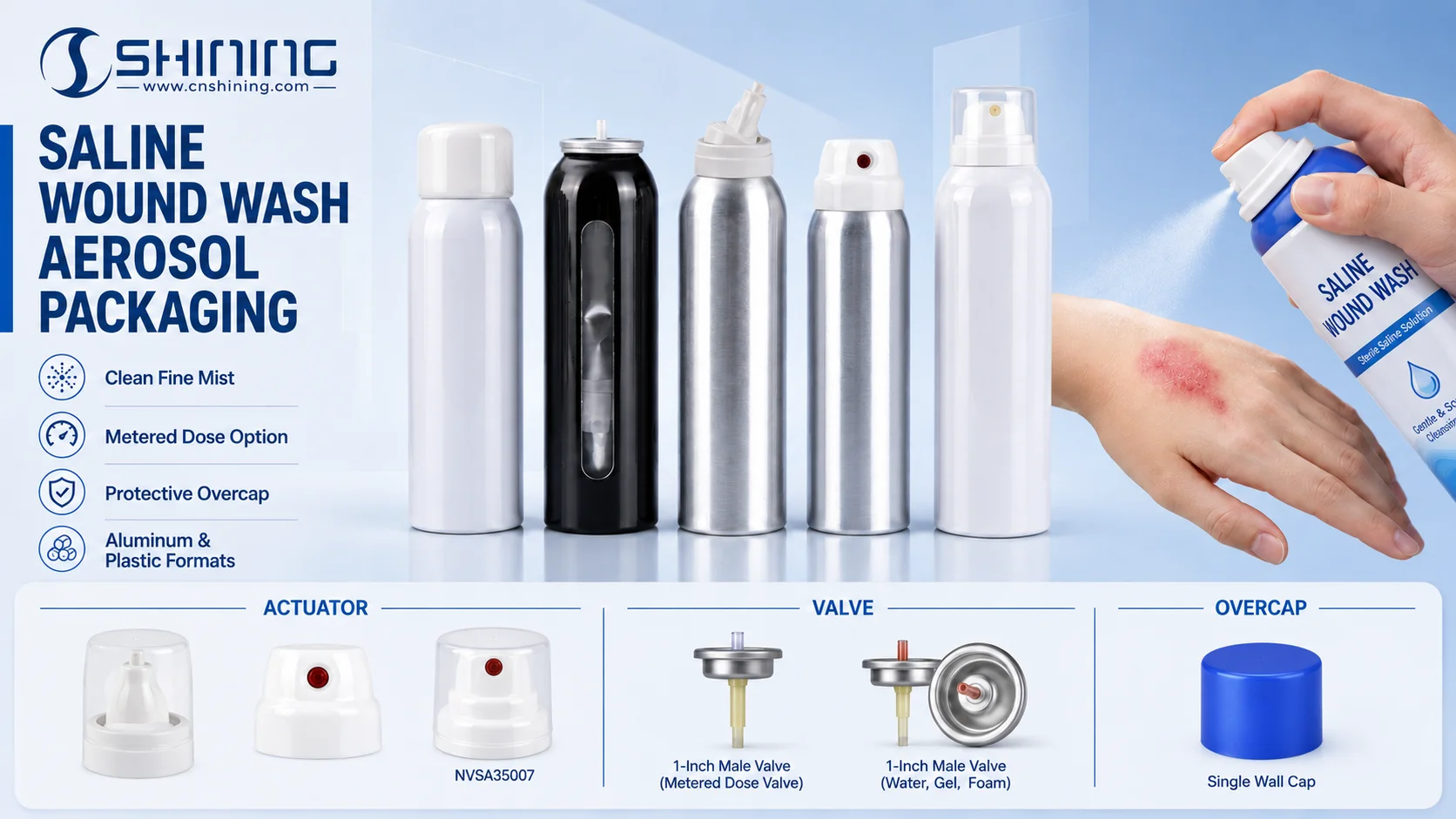
For saline wound spray/wash, Shining Packaging’s relevance is not the saline formula. It is the metal packaging and dispensing hardware around the formula: aerosol cans, actuators, valves, overcaps, and component matching for pressurized sterile liquid systems. In this category, the last centimeter between valve and wound often decides whether the product feels controlled or irritating.
A technically sound component discussion should start with the use case. A household wound wash may need a narrow stream with controlled force. A piercing aftercare product may need a fine mist actuator. A clinic-oriented SKU may focus on larger capacity, any-angle dispensing, and traceable packaging quality. These choices affect actuator geometry, valve output, can compatibility, overcap protection, and line filling requirements.
Shining Packaging can be positioned in the article context as a component partner for aerosol-based saline spray formats, especially where brands need to compare actuator spray pattern, valve output, BOV compatibility, can coating compatibility, and overcap durability. The engineering work is practical: make the spray repeatable, protect the sterile system, and reduce avoidable complaints.
9. Conclusion
Saline wound spray/wash is easy to underestimate because the formula is simple. That is the wrong reading. The technical value sits in sterile liquid handling, controlled pressure, actuator design, valve reliability, can compatibility, and disciplined claims. The market is not a high-drama chemistry race. It is a steady category where better packaging can solve real user problems.
The engineering conclusion is direct: build the spray system around the wound scenario. Use stream where cleaning force is needed. Use fine mist where tissue is sensitive. Use BOV or bag-in-can where any-angle use and closed dispensing matter. Then write the label so users know the distance, use case, and limits. That is how a basic saline product stops looking like a commodity and starts working like a controlled wound care tool.
10. FAQ: Saline Wound Spray Wash
Saline wound spray wash is used to mechanically rinse minor cuts, scrapes, minor burns, and dressing areas. Its main job is to remove visible dirt, debris, exudate, and residue while keeping the wound surface moist. It is usually based on sterile 0.9% sodium chloride and should not be treated as an antimicrobial drug unless specifically cleared and labelled that way.
A 0.9% sodium chloride solution is isotonic, meaning its osmotic pressure is close to body fluids. This helps reduce stinging and tissue irritation compared with stronger salt solutions. For wound wash products, the commercial value is not only the formula. Sterility, controlled spray pressure, actuator design, and packaging closure integrity strongly affect performance and user comfort.
Standard saline wound wash should be understood as a mechanical cleanser, not a disinfectant. It helps flush away debris and surface contamination, but it does not rely on pharmacological antimicrobial action. If a wound is heavily contaminated, infected, deep, or not healing, stronger clinical assessment and possibly antimicrobial or antiseptic products may be needed under professional guidance.
Spray pressure determines whether saline removes debris without damaging tissue. Too little force may not clean effectively. Too much force can cause pain or disturb the wound bed. Many wound irrigation references discuss controlled pressures around 8–12 psi, while some aerosol saline systems cite a broader safe impact range. Packaging design must convert this into repeatable real-world spray behavior.
The formula may be similar, often sterile 0.9% saline, but the actuator and spray pattern are different. Wound wash often uses a stronger stream for rinsing debris. Piercing aftercare products usually use a fine mist because new piercings and sensitive tissue do not tolerate a hard direct stream well. This is a packaging-driven difference, not necessarily a formula breakthrough.
Bag-on-valve packaging separates the saline from the propellant inside a flexible bag. This supports cleaner dispensing architecture and can allow any-angle spraying. For self-care users, any-angle spray is not a small feature. It helps reach ankles, arms, ears, and awkward dressing positions without tilting the wound or contaminating the nozzle through poor handling.
Evidence reviews have found that potable tap water and saline do not always show statistically different infection outcomes in some wound types. That does not make sterile saline useless. Sterile saline spray offers standard concentration, sealed packaging, low irritation, portability, and controlled delivery. In home, travel, school, and outpatient settings, those practical factors often drive product choice.
The most damaging failures are broken actuators, hard-to-press caps, unstable spray streams, leakage, poor upside-down performance, and weak closure integrity. These issues directly affect usability and perceived safety. Since the product is often bought for simple first aid, a failed sprayer can destroy repeat purchase even if the saline formula itself is technically correct.
Safer claims usually stay close to cleansing, rinsing, removing foreign material, moistening dressings, and maintaining a moist wound environment where supported. Claims such as antimicrobial action, infection treatment, faster healing, or biofilm removal need stronger evidence and may change regulatory expectations. A technically conservative label often protects the product better than broad medical language.
The practical upgrade is not usually adding more active ingredients. A stronger product concept is sterile 0.9% saline in BOV or bag-in-can packaging, with any-angle spray, dual stream/fine mist actuator, improved overcap strength, clear spray-distance icons, and separate travel and home sizes. This targets real user complaints while keeping formulation risk relatively controlled.