
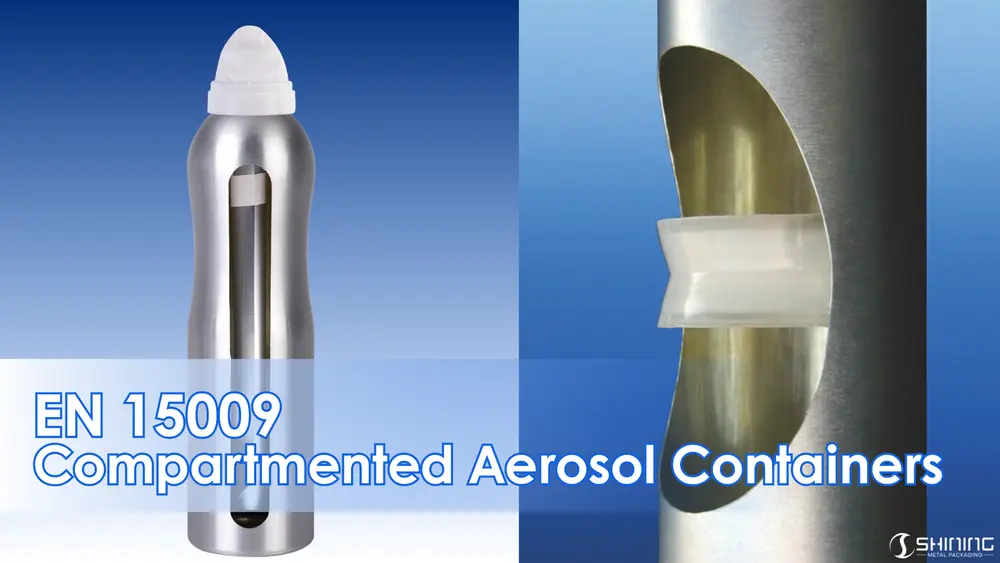
Standard Overview
EN 15009 is the European Standard defining the relationship between declared product volume and container capacity for compartmented aerosol containers.
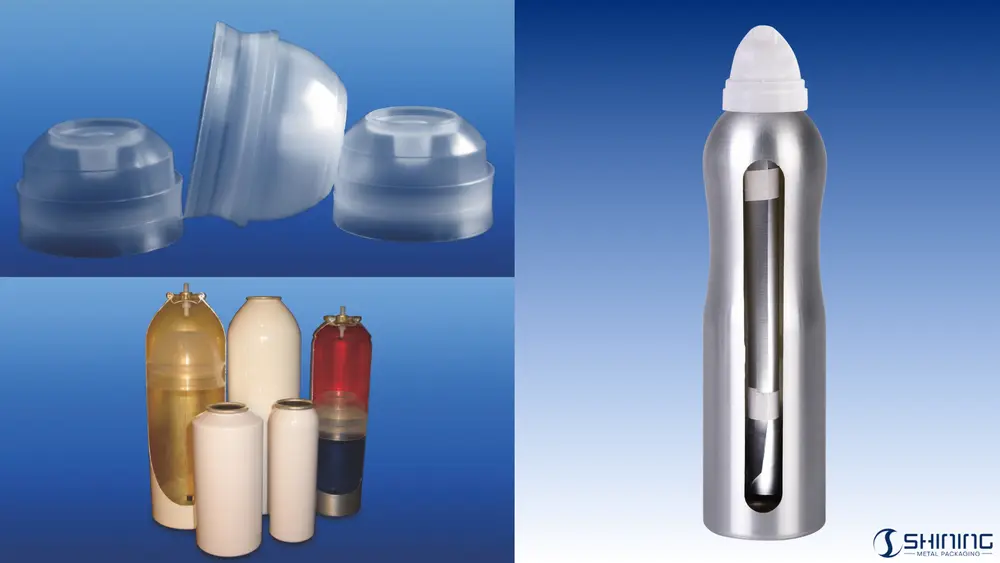
Unlike conventional aerosols, compartmented systems separate the product from the propellant using a piston, inner bag, or flexible chamber. This standard ensures that filling volumes remain safe, honest, and comparable across different system designs.
1. What Is a Compartmented Aerosol Container?
A compartmented aerosol container uses an internal separation between product and propellant. Product discharge is driven either by:
- Compressed or liquefied gas acting on a piston
- Expansion of an inner flexible bag
This design is commonly used for:
- Bag-on-valve (BOV) systems
- Piston aerosols
- Products requiring no propellant mixing
2. Relationship Between Filling Volume and Container Capacity
The core requirement of EN 15009 is to define how the nominal product volume relates to the maximum brimful capacity of the outer container.
The chart in the standard illustrates typical industry practice rather than fixed mandatory values, helping manufacturers select appropriate container sizes for compartmented systems.
3. Liquid Phase Volume Limitation
EN 15009 specifies a critical safety rule:
The total liquid phase volume at 50 °C shall not exceed 90% of the net capacity of the filled and closed dispenser.
This includes:
- The product
- The propellant, if contained as a liquid phase in a separate compartment
4. Nominal Quantity Declaration
For compartmented aerosols, the declared nominal quantity:
- Includes only the product volume
- Excludes the propellant, as it is not expelled with the product
This rule ensures transparent and comparable labeling for consumers, independent of whether compressed or liquefied gas is used.
5. Dimensional References and Compatibility
EN 15009 does not define new container dimensions. Instead, it relies on existing container standards:
To accommodate internal chambers, limited variation is permitted in:
- Overall height (including contact height)
- 25.4 mm aperture configuration
6. Practical Application Scenarios
6.1 Product and System Design
EN 15009 helps engineers select an appropriate outer container size based on the required product volume and compartment technology.
6.2 Regulatory and Labeling Compliance
Clear separation of product volume and propellant quantity avoids misleading declarations and supports compliance with aerosol safety directives.
6.3 Procurement and Specification
Referencing EN 15009 in specifications aligns container size, filling volume, and labeling expectations across suppliers.
Download the Standard PDF
This document provides EN 15009, specifying requirements for compartmented aerosol containers. It defines the relationship between nominal filling volume and maximum brimful capacity, ensuring correct quantity declaration, safe filling limits, and consistent performance for aerosols using compressed or liquefied propellants.
FAQ – Engineering, Regulatory & Purchasing
EN 15009 is not legally mandatory, but it is the recognized European reference for compartmented aerosols. Ignoring it often leads to regulatory, labeling, or safety challenges.
No. It applies only to compartmented aerosol systems. Conventional aerosols are covered by ISO 90-3 and the EN 15006 / EN 15007 / EN 15008 series.
Liquids expand significantly at elevated temperatures. Exceeding 90% fill can cause dangerous pressure increases at 50 °C.
No. Only the product volume is declared. The propellant remains separate and is not dispensed with the product.
Yes, provided they comply with EN 15007 or EN 15008. However, height and opening geometry may need adjustment to integrate the internal chamber safely.