
Standard Overview
FEA 422 is an industry standard issued by the European Aerosol Federation (FEA) that provides typical standard fill levels for filled aerosol dispensers.
Unlike dimensional standards, FEA 422 focuses on the relationship between container capacity, liquid fill volume, and safety at elevated temperature. Its purpose is to help manufacturers avoid misleading prepackages while maintaining functional and regulatory safety.
Regulatory Background
Historically, standard aerosol fill volumes were linked to Directive 80/232/EEC (Prescribed Quantities – Ranges). From April 2009, this directive was replaced by Directive 2007/45/EC, which deregulated fixed nominal volume ranges for aerosols.
Despite deregulation, OIML Recommendation R87 still refers to the earlier ranges when assessing misleading prepackages. FEA 422 therefore preserves a harmonised reference for typical filling practice.
Key Definitions
- Total capacity: volume of the open container up to the rim of the opening.
- Net capacity: volume of a filled and closed aerosol dispenser.
- Volume of liquid phase: volume of all non-gaseous phases in the filled dispenser.
- Fill level: liquid phase volume at 20 °C divided by total container capacity.
Fundamental Safety Requirement
For all aerosol systems, FEA 422 reiterates a critical safety rule derived from the Aerosol Dispensers Directive 75/324/EEC:
At 50 °C, the volume of the liquid phase must not exceed 90% of the net capacity.
Aerosols Propelled by Liquefied Gas(es)
For aerosols using liquefied propellants, fill levels must account for thermal expansion of the liquid phase. The standard provides a typical relationship between product volume and total container capacity, based on historically standard can sizes.
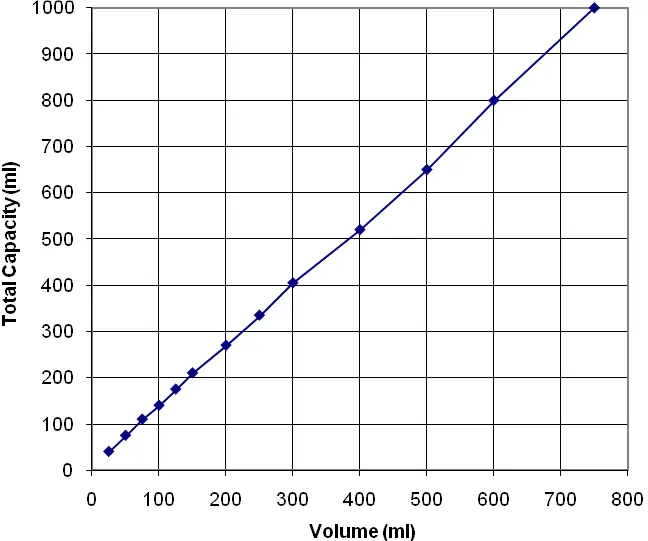
These values are not mandatory limits but serve as a reference for safe and non-misleading packaging design.
Aerosols Propelled by Compressed Gas or CO₂ / N₂O
For aerosols propelled by:
- compressed gas alone, or
- nitrous oxide or carbon dioxide (alone or in mixtures) with a Bunsen coefficient ≤ 1.2
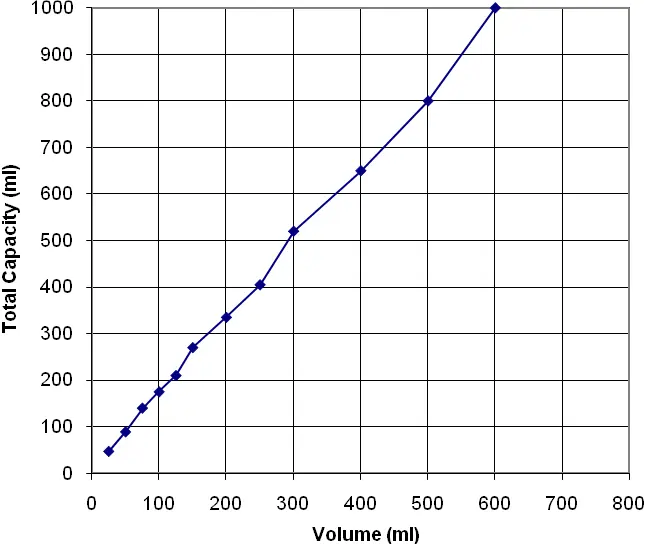
the dominant concern is not thermal expansion but pressure drop during product use. Fill levels must therefore ensure acceptable spray performance until end of life.
Compartmented Aerosol Containers
FEA 422 explicitly states that aerosol products in compartmented containers are excluded from its fill-level guidance.
Such products must instead comply with:
- EN 15009 – Aerosol containers — Compartmented aerosol containers
How FEA 422 Is Used in Practice
Packaging Design
FEA 422 provides a reference starting point for selecting container size relative to declared fill volume.
Regulatory & Consumer Protection
Following typical fill levels helps reduce the risk of products being considered misleading under OIML R87 principles.
Technical Justification
When deviating from typical fill levels, FEA 422 provides a recognised benchmark against which technical justification can be documented.
Relationship with Other Standards
- ISO 90-3 – determination of container capacity
- EN 15007 / EN 15008 – tolerances related to filling
- EN 15009 – compartmented aerosol containers
Download the Standard PDF
This document provides FEA 422, defining standard fill levels for filled aerosol packs. It outlines safety limits, expansion considerations at 50°C, and guidance for liquefied or compressed propellants to ensure regulatory compliance and prevent misleading prepackages.
FAQ – Engineering, Regulatory & Procurement
No. They are typical industry references. Manufacturers may deviate, provided safety and consumer information requirements are met and justified.
50 °C represents a conservative worst-case storage condition. It ensures safety margins for transport and storage in warm environments.
No. Legal labeling is governed by EU directives and national law. FEA 422 supports technical and consumer-protection reasoning, not labeling compliance by itself.
Because their physical behavior differs fundamentally. Liquefied gases expand with temperature, while compressed gases lose pressure during use.
Whenever the product uses a compartmented container design. In such cases, standard fill-level assumptions no longer apply.